
America First
Episode 1 | 55m 55sVideo has Closed Captions
A pioneering class of astronauts is recruited by NASA to fly aboard its new Space Shuttle.
With the dawn of the Space Shuttle, the US gains ground on their Cold War rivals. A pioneering class of astronauts takes flight, but when tragedy strikes NASA are left reeling.
Problems playing video? | Closed Captioning Feedback
Problems playing video? | Closed Captioning Feedback
America First
Episode 1 | 55m 55sVideo has Closed Captions
With the dawn of the Space Shuttle, the US gains ground on their Cold War rivals. A pioneering class of astronauts takes flight, but when tragedy strikes NASA are left reeling.
Problems playing video? | Closed Captioning Feedback
Where to Watch Once Upon a Time in Space
Once Upon a Time in Space is available to stream on pbs.org and the PBS app.

Share Inspiring Moments From The Film
Explore the PBS Giphy collection for Once Upon a Time in SpaceProviding Support for PBS.org
Learn Moreabout PBS online sponsorship[laughter] [indistinct chatter] [indistinct PA announcer] BILL FISHER: Kristin, where are the rockets?
The rockets.
KRISTIN FISHER: I grew up five minutes away from the Johnson Space Center in Clear Lake, Texas.
BILL FISHER: Hi!
KRISTIN FISHER: It's a really sort of middle-class neighborhood.
Nothing too fancy about it, clearly.
But literally everybody's parents, they worked for NASA in some way.
[jet engine roars] You know, my first word was "jet".
Other than mama and daddy, it was jet.
What are these?
A whole bunch of jets, huh?
[baby babbles] Big jets!
KRISTIN FISHER: My mom used to wake my sister and I up every time there was a launch.
MISSION CONTROL: ...two, one, ignition.
[cheering] KRISTIN FISHER: And she does this ridiculous like: Woohoo!
Godspeed!
Go, go, go!
And she's like screaming.
[indistinct screaming] It was just something that was very normal, natural.
It was all very routine.
Some might say boring even.
[chuckles] ANNA LEE FISHER: Give Daddy a kiss.
KRISTIN FISHER: It wasn't until I went away to college that I realized how special and unique my childhood had been.
And I remember the moment.
It was first few weeks of my freshman year of college and I'm in my dorm room and I decided to take some psychedelics for the very first time.
Magic mushrooms to be specific.
And I had this moment, like a full psychedelic moment, where I was like, holy [bleep], my parents are astronauts.
I call my dad.
It's like midnight.
And I'm like, "Dad!
Oh my god!
You went to space.
You did a space walk.
What was that like?"
[ethereal music] And he kind of laughed and he was like, Kristin, go to bed.
[laughs] Call me in the morning and we'll talk about it.
But that night completely changed how I view space and spaceflight and my parents.
[cheering] [rocket rumbles] There's this whole universe out there and I don't know what my place and it is but I want to find out what all of humanity is doing here and how far we can go.
[inspirational music] MALE MISSION CONTROL: T-minus ten, nine... FEMALE MISSION CONTROL: Eight, seven... MALE: Six... [countdown in various languages] MISSION CONTROL: And lift off!
[inspirational music continues] [indistinct radio dialogue] CHARLIE BOLDEN: People use the term, space becoming a warfighting domain.
And my answer to that is, the first time a human being went into space, it became a warfighting domain.
Human beings don't know how to behave.
[intense music] JERRY LINENGER: I think history will judge us pretty nicely.
They'll say those people had courage and they got us to the point where we can now take off and become space-faring nations.
[music crescendos, then stops] [laughter] [overlapping radio chatter] CHILD: Hello from the children of planet Earth.
[gentle music] MIKE MULLANE: In Albuquerque, New Mexico, back in the early 1960s, just a short drive from my house, you were out in the middle of the desert.
This is a homemade rocket that I built back when I was a teenager.
I would have walked out, oh, maybe a couple hundred feet.
I would find a spot that was level and clear to set up my rocket.
Bang!
And you'd see this thin trace of smoke as this thing headed up.
MAN: What would happen if you lit that now?
Besides getting arrested by Homeland Security.
[laughing] It's literally a pipe bomb.
This is the type of stuff people plant to blow up things.
And this one just happened to have fins on it.
We had a rocket club in high school where the chemistry teacher, and this is remarkable when you think of it, told us how to make some solid propellant rocket fuel, which was wicked.
It was dangerous.
It was explosive.
But yet, as a teenage boy, you don't have a brain in your head, and it never crossed my mind that I could get killed or maimed or injured doing it.
I just ran faster after I lit the fuse.
[explosion] INTERVIEWER: Where did this fascination with rockets come from?
Where did it begin for you?
From my dimmest memories I was always interested in the sky, everything associated with the sky.
[dramatic music] And then, October 4th, 1957, was when Sputnik launched, and that changed my life.
I could now see these science fiction movies where we could fly to the moon were real.
ANNOUNCER: Soviet scientists have made a major breakthrough.
A man-made celestial body for the first time in history flew into space.
After jettisoning the nose fairing, the Sputnik started circling the Earth in a pre-calculated orbit.
[satellites trill] MIKE MULLANE: My dad was reading the paper mad as hell.
He had no idea what a satellite was.
He had no idea what that newspaper was talking about.
But all he knew is the Russians did it, and we didn't.
[explosion] This is the deepest, darkest days of the Cold War.
And Russia was our dreaded enemy.
And now here they had launched this satellite.
And it could have a bomb in it, and everybody was fearful about that.
REPORTER: Sir, what do you think about this achievement of the Russian?
It's frightening.
We should find out what they're doing that we're not doing.
At seven minutes past one this morning, a man went around the world.
The spaceship was built in Russia.
The name of the man, Yuri Alekseyevich Gagarin.
[cheering] Khrushchev greeted the hero saying, "Now let the capitalist countries try to catch up."
We keep saying we're not in a race.
But so long as we're competing with Russia for the beliefs, the loyalties of people around the world, we are in a race.
And in the area of spectacular scientific achievement, we're losing.
MIKE MULLANE: We were embarrassed by them on world stage.
Because our failures were so public, they were running away with it.
They were running away with it.
ANNOUNCER: The world's first woman astronaut, Valentina Tereshkova.
[indistinct dialogue] The American public were clamoring.
You've got to beat the Russians.
[applause] We wanted nothing but evil to befall communism, and we wanted America to be first.
JOHN F. KENNEDY: The exploration of space will go ahead, whether we join in it or not.
And no nation, which expects to be the leader of other nations, can expect to stay behind in this race for space.
[explosion] We need to be a part of it.
We need to lead it.
MISSION CONTROL: Lift off.
We have a lift off.
32 minutes past the hour.
Lift off on Apollo 11.
MIKE MULLANE: Still amazing when you think about it.
12 years after Sputnik, we had men on the moon.
[foreign language from TV] MALE SPEAKER: It is said that 500 million people gathered at TV sets around the world to wait for the first earthling to set foot on the moon.
Never before had so many people been attuned to one event at one time.
[speaking foreign language] RADIO: Move forward.
Drifting to the right a little.
I believe they're setting up the flag now.
Going to see the stars and stripes... [indistinct radio dialogue] Beautiful, just beautiful.
Neil and Buzz, the president of the United States would like to say a few words to you.
Over.
NEIL ARMSTRONG: That would be an honor.
RICHARD NIXON: For every American, this has to be the proudest day of our lives.
For one priceless moment in the whole history of man, all the people on this earth are truly one.
[cheering] [uneasy music] CARL McNAIR: There was no Black people doing that.
So that wasn't our world.
In '69, we're still segregated out here.
Lake City was a typical small town in South Carolina.
We knew our place as Black people.
Growing up in the 60s, it felt normal because that's the way it was.
We had our own Black schools by law.
You had white water fountains and you had colored water fountains.
And we thought there was always something special about the white water fountain because why do we have two?
Is that water better than our water?
Some of us got the courage.
I was one of them.
I would look around [chuckles] and I would go and take a sip.
It was just water.
The house that we lived in for most of our young lives, it was quite dilapidated.
And Ron and I lived in the same bedroom, slept in the same bed.
My brother Eric slept in the same bedroom on a fold down couch.
We fought like dogs all the time, like brothers would.
That's Ron, and that's my dad, and that's me.
And I still got that body in here somewhere.
The only connection we had with space was Star Trek.
That was it.
[chuckles] We saw ourselves there.
There was one person in particular.
Lieutenant Uhura, take over navigation.
CARL McNAIR: From the first time that we saw her on screen, we were absolutely smitten.
Oh, she just took our hearts.
We've never seen a Black woman on television that not only was a Black woman, but she was an officer.
From what I understand, fourth in command of a starship.
So that told us that there is a possibility for us to have a future in space.
And I think Ron and I both saw that.
Though Ron took it a little more serious, a lot more serious than many of us.
Flying in space was a fantasy that everybody had.
Most kids wanted to see themselves floating around the moon and doing the type of things you saw on TV.
And so did I. But it was only a fantasy.
CARL McNAIR: He went to MIT to earn a PhD in physics.
And he did that by the time he was 26.
However, there were some challenges between him and space.
How's he going to get there?
[chuckles] First of all, most astronauts were military.
They're all pilots.
They all were white men.
Just a minor detail.
[chuckles] [clanking] MAN 1: Is the orbiter ready to be rolled out?
MAN 2: Yes, sir.
The orbiter is ready.
[fanfare] MALE SPEAKER: As we witness today the rollout of the space shuttle, we are on the verge of a new era, not only in spaceflight, but in the lives of men and women and children all across this Earth.
[applause] MALE SPEAKER 2: The Space Shuttle is designed to carry satellites and scientists into and out of orbit for the next several decades.
It's as large as a medium-sized airliner and designed to be used over and over again like an airliner.
The key word is reusability to lower the cost of spaceflight.
The space agency has begun accepting applications for would-be astronauts who want to take part in the Space Shuttle program.
And the agency says it is committed to give women and members of minority groups a chance to participate.
MALE SPEAKER 3: Each candidate will undergo a week of interviews, psychological tests and medical exams.
Twenty will be selected as pilots.
Twenty will be chosen as mission specialists.
Crew members will perform scientific and medical experiments in space.
BILL FISHER: This was the first selection where you didn't have to be a pilot.
Now they were going to take scientists because Space Shuttle was going to be a vehicle to do science with.
I was also told the plan at that time was to go to Mars and they needed physicians on board.
What better physician than an emergency physician?
Come on, we're the guys.
Um... We were so stoked.
I mean... [chuckles] That's all we could think about from that moment.
INTERVIEWER: Tell me about meeting Bill.
Um... So, I was a third-year medical student.
He was a year ahead of me.
We became interested in each other and then we lived together, got engaged and got married.
What was it that you liked about Bill?
Well, one of the first things we talked about was space.
He'd wanted to be an astronaut since he was six years old.
This is from... I think it's October 1952.
And the teacher says, "When we can keep Billy down to Earth and not let his mind wander to the clouds and rockets, he is so much more willing to do his best."
So my mother writes back, "We have the same problem at home.
He is still extremely rocket conscious."
Yeah, I was very rocket conscious, you bet, and still am.
[chuckles] Rocket conscious, that's the way to be.
ANNA LEE FISHER: You know, it was neat.
I just felt incredibly lucky that I met someone who felt the same way I did about everything.
[archival] I really believe that space exploration is man's ultimate destiny.
And I think the next new frontier is space and I want to be part of that pioneering effort.
Basically at the time I was growing up, your options were to be a nurse, a teacher, or a secretary.
and none of those interested me.
[indistinct] ...lift-off and the clock is starting.
[indistinct] is a go.
ANNA LEE FISHER: It was really Alan Shepard's flight that motivated me.
He was the first American to go into space.
[indistinct] are go!
All systems are go!
What a beautiful view!
So at that moment I decided I wanted to be an astronaut, but I never told anybody because I was afraid people would laugh at me.
[chuckles] Medicine seemed to me like the best potential option, because in the back of my mind I thought, hey, maybe if I don't get to be an astronaut, I could be a doctor on a space station.
That concrete's hard.
Harder than my head is.
This is going to hurt a bit, okay?
Ron gave me a call one day and he said, "Hey man, I don't know if I should tell you this, but I'm going to be an astronaut."
So I'm looking at the phone and I said, "You're going to be a what?
What makes you think you're going to be an astronaut?"
And he said, "Because I applied."
I said, "Well, how many people applied?"
He said, "I don't know, 9, 10,000."
I said, "Well, how many astronauts are they looking for?"
"They're looking for 35."
At this time I knew my brother had lost it.
I'm thinking, Well, I'm going to be the Pope.
So, I mean... [laughing] So we can play this all day, you know?
The National Aeronautics and Space Administration today chose the 35 persons who will ride the Space Shuttle into orbit and back in the 1980s.
MALE SPEAKER: Among the women selected, four are single, two are married, one with three children.
I'm just hoping that I can do a good job and repay the confidence that NASA and all of these other people have in me.
MALE SPEAKER: Another of the new astronauts is Dr.
Ronald McNair.
It wasn't until recently that I saw a break to make a dream come true.
I rushed to the phone.
I said, "Congratulations, man, you did it!"
He actually did it.
I mean, could this be happening?
He's about to take his own Starship Enterprise into space.
MALE SPEAKER: One of the six women chosen as astronauts is a medical doctor.
Anna Fisher learned of her appointment, but a NASA official called to ask if she was still interested in the job.
Well, you know I am.
I can't believe it.
[laughs] Oh, thank you.
OK, I... I don't know what to say except thanks so much.
MALE SPEAKER: Dr.
Fisher's husband also was considered for the job of astronaut.
But William Fisher was not chosen.
Instead, he'll move to Houston with his wife.
BILL FISHER: You know, I wasn't feeling bad at all.
I was happy for her.
I thought she was perfect for the job.
There wasn't one iota of resentment or of disappointment.
You know, it was just yes for her and no for me.
MALE SPEAKER: The 35 candidates begin two years of unisex interracial training at the Johnson Space Center.
Those who pass will become astronauts.
My friends said, what?
You know, like, shy, studious Anna is going to be an astronaut.
Nobody still quite believed it.
And I have to say that I almost didn't believe it myself still.
It just seemed so surreal.
And I realized it was, you know, historically significant.
MALE SPEAKER 2: Shannon Lucid.
She's a postdoctoral fellow, Oklahoma Medical Research Foundation in Oklahoma City.
ANNA LEE FISHER: But I didn't spend a lot of time thinking about it.
MALE SPEAKER 2: Judith Resnick, product development with the Xerox Corporation.
ANNA LEE FISHER: Other than being very happy that women were now being given the chance.
MALE SPEAKER 2: Next is Sally Ride.
ANNA LEE FISHER: And thinking to myself, now don't screw up.
You've got to make sure that all of us succeed so that the women that come after us will have the same opportunities.
MALE SPEAKER 2: Katherine Sullivan.
Ronald McNair, a mission specialist.
Captain Richard Malaine.
MIKE MULLANE: Oh, God.
Look how young.
Oh, my God.
I look like a child.
I'll tell you, one thing I learned rapidly there, white males were invisible to the press.
I could have walked naked across that stage at that point.
Nobody would have seen it, because they were all focused on those women and African-American astronauts, and mostly the women.
I certainly harbored my suspicions about the civilians and the women, because I'd never worked with civilians or women.
So I was suspicious of them, whether they were going to be able to really fill the role of an astronaut.
For 20 years in this country, the word astronaut automatically meant a man.
But that's changed.
What happens when you meet a man and you say, I'm an astronaut.
Does he say, you're too cute to be an astronaut.
Come on, little lady, you can't be an astronaut.
I just tell him I'm an engineer.
You don't tell him you're an astronaut?
No, unless he asks.
MIKE MULLANE: I had been in combat, and these people had done nothing but studied and been in laboratories and stuff like that.
I was in Vietnam in '69.
This was a war against communism, which we had all been taught was the greatest evil that existed.
So I wanted to be there.
I wanted to go do it.
I saw those heroic airmen do it in World War II, fight the enemy.
[explosion] There's no way that a civilian, I don't care who they are, male, female, that a civilian is going to be able to equal that flying experience.
MALE SPEAKER: On the edge of a mangrove swamp south of Miami, the six women who want to be America's first female astronauts began their training, survival training.
MAN: Excellent.
MALE SPEAKER: A few had difficulty muscling themselves into life rafts, but so did some of the men.
The only special consideration for the women was protection from photographers, which they needed.
ANNA LEE FISHER: It was such a sense of belonging and such a sense of finally being where I wanted to be.
I guess because I studied so hard, it was like the first time ever in my life I was ever able to just like really have fun.
As a little girl did you mostly want to grow up and be an astronaut, a doctor, or a wife and mother?
All of the above.
[chuckles] You know, it was hard because, you know, I wanted to be real excited but I didn't want to, you know, make Bill feel bad.
[jet engine roars] [dreamy music] INTERVIEWER: What was the motivation that kept you going?
Because that must be tough.
Well, you know the answer to that.
They hadn't told me no.
They hadn't told me no.
They said, go ahead and get another degree, get more experience, and come back when we have our next selection.
The space agency today selected 19 new candidates to be astronauts.
This is the second group of pilots and scientists to be selected specifically for the Space Shuttle program.
TOM BROKAW: NASA's Space Shuttle program does not lift off until next year, but it is getting a little pre-flight publicity with the announcement of a husband and wife astronaut team.
They are Bill and Anna Fisher.
INTERVIEWER: Did it change things between you both?
No, it was much easier after that because I didn't feel guilty about being selected and him not being selected.
Besides, I had seniority.
[laughing] [jet engines roar] My fellow citizens of this great nation, I accept your nomination for the presidency of the United States.
[cheers and applause] For those of abandoned hopes, we'll restore hope and we'll welcome them into a great national crusade to make America great again.
[crowd cheers] MISSION CONTROL: T-minus ten, nine, eight, seven, six, five, four, we've gone for main engine start.
We have main engine start.
MIKE MULLANE: The very first shuttle launch was a very very big deal.
Not just to NASA but to all us new astronauts because we didn't know if we had a career yet.
To that point, it was theoretical.
ANNOUNCER: The launch of America's first space shuttle.
You see everybody get a bigger bigger smile as we got further and further into the launch and then finally when we heard, "main engine cutoff," meaning now you're safely in orbit, we all just jumped up and cheered.
[cheering and applause] It was like, oh my god, this thing is working.
You know, it was like, it is gonna work.
It's nearly six years since the Americans had a man in space and in that time the Russians have had dozens.
So on Florida's Space Coast where the flight began, there is a feeling expressed here with more gusto than grammar of an overdue triumph and of having got one back.
This put America firmly in the lead in space.
REPORTER: Today many people found themselves glued to TV sets so they could share a piece of history in the making.
RADIO: Two, one... [indistinct] [applause and cheers] REPORTER: Re-entry and landing were seen on television throughout virtually all of Western Europe [applause] TOM BROKAW: The popular notion is that America needed a success.
Columbia was seen to be it.
You said you beat the Russians, you beat everyone.
You spent a lot money and you got troubles in your country.
You deserve success.
Once again the Soviets made only brief reference, and as they have since the mission began concentrated on the shuttle's military potential.
And many people are concerned that the arms race will be extended to space.
MIKE MULLANE: The military was a big partner.
In fact the military drove some of the specifications for the size of the cargo bay.
You know, they said, hey we need a vehicle that can carry this type of weight into orbit.
So the military had a lot to say about the design of the shuttle INTERVIEWER: When you say military, what does that mean?
We carry secret satellites, you know.
INTERVIEWER: And can you say what those payloads was.
No, I can't talk about those.
- That's still classified?
- Oh, yeah.
Still classified.
- Yeah.
- Right.
You know, these are national Secrets, you know.
You're sworn to secrecy on these things.
You don't talk about them.
RONALD REAGAN: The space program in general and the Shuttle program in particular have gone a long way to help our country recapture its spirit of vitality and confidence.
We must never forget that as long as there are frontiers to be explored and conquered, Americans will lead the way.
[applause and cheers] Jet magazine, yeah.
That was a... Yeah, I have this.
This is the epitome of rock star right here.
I got this thing blown up like this at my house to this day.
There's my brother.
There's my brother.
CHARLIE BOLDEN: Three Black men in a space suit, that was special.
That got me.
I was impressed.
RADIO: 581, this is TM I would say we're ready to go into the spin.
[ominous music] I was at the Navy's test pilot school.
You're flying an airplane in a place that's never been flown.
Either you're flying a speed that's never been flown or altitude it's never been flown.
So you're just trying to make sure that it didn't tumble or do something bad.
[loud beeping] Every once in a while they come apart, you lose the airplane.
And the guy that's flying it ends up bailing out.
INTERVIEWER: And this was something you enjoyed doing.
Mm-hmm.
Loved it.
We had gotten word that there were three or four NASA T-38s coming in.
And so I went out to the flight line like a lot of us to greet them.
And then I saw this Black guy get out.
And I went, wow!
So I rushed out to meet him and introduce myself and when we had an opportunity I took him home to meet Jackie, meet my wife and kids.
I was mesmerized talking to him.
And as he left to go back to Houston, he asked me if I was gonna apply for the space program.
I said, not on your life.
And he looked at me real strange.
He said, why not?
I said, they'd never pick me.
And he, he paused for a moment and then, look, he said that is the dumbest thing I ever heard.
How do you know if you don't ask?
And I felt like that big.
I said, holy... jeez.
That's why I say Ron McNair is my idol and my role model because he painfully reminded me that I had forgotten what my mom and dad taught me growing up, that I could do anything I wanted to do [plaintive music] But anyway, I ended up being selected in the second group of Space Shuttle astronauts.
[laughing] Just... that's the dumbest thing I ever heard.
And he was right.
INTERVIEWER: When Ron was selected for his first flight, how did your mom and dad react?
Well, my mother got real nervous about that.
I mean... Her baby's going to go into space.
But my dad, he's ready to pass out cigars.
I mean, my boy the astronaut, I mean... It's different for guys.
We got down to about four seconds prior to liftoff when the main engines began to throttle up to 100%.
All of a sudden the vibrations set in like I've never seen before.
The countdown continued three, two, one.
At t-minus zero, I got a boot like I never felt.
And that 404 million pound vehicle literally leaped off of the launch pad.
And we were on our way.
[jet engine roars] MISSION CONTROL: Challenger Houston, you're good on the throttle up.
Go and throttle up.
[excited chatter] REPORTER: Ron McNair may be in space, but his father's in heaven thrilled to death that his son is aboard the shuttle.
Oh, wow.
Carl McNair has been monitoring the flight in the office of his auto body shop in Harlem.
Ronald was just a model kid.
Ha!
CARL McNAIR: He was just perfect.
REPORTER: And when Ron McNair comes back to Earth, it's a safe bet his father will still be on Cloud 9.
I just wish every father could have a son like I have.
I need that.
I've never seen that.
Uh... Wow.
That's a... That's an incredible piece, because I haven't heard him say that much about it.
[sighs] Yeah, give me a moment.
[ethereal music] [exhales] Okay.
- INTERVIEWER: You okay?
- Yeah.
I was thinking of my dad.
I can't imagine what went through his head as an eighth grade dropout, being the father of one of the first African American astronauts.
I can't imagine what he must have felt like.
An astronaut at that time, the only thing that could be greater than that is perhaps to be the President of the United States.
ANNOUNCER: How about us giving a standing ovation to this wonderful crew?
[applause] Thank you very much.
Would all my family members please stand?
Let me see who's here.
All of them.
I want to see who's here.
Alright.
Great, great, great, great, great, great, great, great.
[applause] It's incredible.
From slavery to space, in four generations.
Thanks a lot.
[applause] TOM BROKAW: NASA officials hope that today's successful launch will get them back on schedule for what should be a very busy year, critical to the space agency's future.
MIKE MULLANE: The shuttle was not going to make any economic sense if it wasn't flying and flying often.
In fact, the plan was 24 missions a year, a mission every two weeks.
And so that translated into pressure on the agency to rapidly expand the shuttle flight rate.
I remember sitting in meetings where some issue was being discussed.
And one of the first things out of my mouth or other astronauts that might be in a meeting would be, what's this going to do to the schedule?
In other words, how many weeks are we going to slip to fix this problem?
So, in a way, we were projecting the same sense of urgency.
Hey, we got to get going.
You know... [chuckles] We wanted to fly, and wanted to fly often.
And that trumped everything else.
ANNA LEE FISHER: Every so often I would just have to pinch myself and say, I'm just so lucky to be here.
But of course, you're not a real astronaut until you've flown in space, so... [laughs] BILL FISHER: Anna was pregnant and there was some concern to how that would affect her flight status.
No one else had gotten pregnant as an astronaut before.
I am told, Anna, that you gave birth on Friday, then you were back to work on Monday.
Is that so?
And if so, how did you do that?
I just was very fortunate.
I had an easy delivery and a very good baby.
And I was feeling fine and very excited.
I love my baby and I love work and I wanted to go back.
BILL FISHER: At pilots meeting early before the first shuttle flight, they told us we expect to lose one in 25 shuttle flights.
Four percent.
John Young stood up.
The astronaut who was chief of the office, he said, now I want to say something to you.
If that four percent bothers you, if you're concerned, he said leave, because there's a thousand people waiting behind you to take your place.
The point was, you don't belong here if that's a concern.
Look, what is it?
Where's your name tag?
- There we go.
- BILL: Hey, Sue.
ANNA LEE FISHER: You know, occasionally I would think, is it really going to be worth the risk?
You know, something could go wrong and this might be all the time that I ever am going to get with Kristin.
ANNA: What a smile.
BILL: There is an astronaut.
ANNA LEE FISHER: Okay.
So, since I knew that she would not actually remember me, we just took lots of videos.
Who's that?
Tell us who that is.
Who's that?
Who's that?
I know there were some people who thought that what I was doing was wrong.
"Anna Fisher is a good astronaut.
She's a good doctor.
She's a good citizen.
But is she a good mother?
That will be the question on millions of minds when the first astronaut mother goes up leaving a year-old daughter behind."
[lip trill] [lip trill] ANNA LEE FISHER: I would say it was probably... two thirds like this and one third supportive, you know.
It probably wasn't 50/50.
[chuckles] - What's that?
- What's that?
- No.
- No.
That's a space shuttle.
Space shuttle Discovery.
Mommy's gonna fly in Discovery in six weeks.
KRISTIN FISHER: Man, I mean, I watched that and I think, thank God I wasn't older.
Thank God I couldn't understand what was going on.
I would have been so scared and so upset.
I mean, it was a blessing that I was as little as I was.
Kristin's too little to know it, but this is gonna be my last night home.
And I want to have a few minutes before she gets tired.
Oh, let's wait for Daddy.
I love you, baby.
- Let's wave.
Can we wave?
- [Kristin babbles] Oh!
Bye bye!
KRISTIN FISHER: I'm, I'm so torn on it actually.
Like even as I sit here now, part of me is like, yeah, go, like go to space, achieve your dream.
It's incredible.
And then there is another part that's like, oh man, like... don't go, don't go.
But I look at those videos and it was such a sweet year.
And I think in some ways it made her really treasure and savor those moments all the more because you know there's a chance that you're gonna die.
[cameras clicking furiously] MALE SPEAKER: At t-minus 2 hours 28 minutes, 6 seconds and counting, 51-A crew is on their way.
KRISTIN FISHER: Even when you're going to war, you know there's a good chance that you might die.
But how many other professions have an actual countdown clock to the moment when you might perish?
Like literally to the second.
MISSION CONTROL: 11, 10, we're go for main engine start, seven, six, we have main engine start, three, two, one and liftoff!
Liftoff of Discovery.
The shuttle has cleared the tower.
[applause] KRISTIN FISHER: She was the first mother in space.
She was the first person who ever had to deal with this kind of scrutiny and decision.
I mean, that took such discipline and strength to be able to do because I know she... I know how much she loved me.
[indistinct radio chatter] [pensive music] People have asked me, do you think your mom was selfish for going to space?
It's a fair question, but it's also a question that people aren't asking the men.
[applause and cheers] [indistinct radio voice] You could ask any astronaut that question.
I'd venture to say a lot of them were being a bit selfish.
Maybe my mom was too.
Kristin!
Look at my caterpillar!
[laughter] [Anna's voice fades out] [air whooshing] [click] MIKE MULLANE: Any time you're on a crew, you're together for so long, probably the better part of two years, it's like a combat team almost.
You know, the enemy is space out there ready to exploit any mistake you might make.
A good astronaut is a very difficult thing to... MIKE MULLANE: And I didn't realize until years later the history I was surrounded with.
Here was Sally Ride, the first American woman in space.
I flew with Judy, second American woman in space.
I was going to parties and palling around with Ron McNair and the other African American astronauts who were making history.
Looking back on it, I can see the ridiculousness of me thinking, you know, that I'm better than them, just because I had this flying experience.
They were incredibly smart people, very talented.
And I feel privileged that I was around people like that.
I was arrogant.
That's the word.
I was arrogant.
I look back on it and I've got this sense of shame.
How could I have ever, ever had that attitude?
Yeah, and uh, anyway, yeah, I'm glad I changed.
[pensive music] We were young, we were brash, and we were eager to get into space.
We... We had the right stuff, I guess.
[chuckles] FEMALE SPEAKER: The countdown clock is ticking for the space shuttle Challenger.
The flight's seven-member crew arrived at the Kennedy Space Center late this afternoon.
And if all goes well, Christa McAuliffe will become the first school teacher in space.
Also making this journey into space aboard the Challenger will be Lake City, South Carolina native Ron McNair.
CARL McNAIR: Ron came to my apartment and he had this VHS cassette tape, part of the footage that he'd taken in space, but he only was interested in one specific part of the tape.
He was always fascinated with the launch itself.
And he played that up until it entered orbit, then he'd rewind it and he'd start over again.
I had to buy new speakers on and he kept turning the volume up, blew out one of my speakers and all.
Because the roar, he felt, he wanted to feel it, the same kind of power and the sensation that he felt when it was lifting off the launch pad.
Because that's all he played, just that part, over and over again.
[rumbling] [loud roar] He shared with me that he was planning to leave the space program.
He'd gotten an offer to become a professor at the University of South Carolina.
One of the schools that would not have allowed us in there back when we graduated.
INTERVIEWER: So he was planning on leaving NASA?
That's right.
He wanted one more flight.
One more flight.
And that was going to be it.
RADIO 1: [indistinct] 65.
RADIO 2: 65.
5-0.
RADIO 1: [indistinct] RADIO 3: Challenger, go and throttle up.
RADIO 4: Throttle up.
[ominous music] [indistinct chatter] MAN: Anybody see the shuttle?
MISSION CONTROL: Flight controllers here looking very carefully at the situation.
Obviously a major malfunction.
Reports from the flight dynamics officer indicate that the vehicle, um, apparently exploded.
TED KOPPEL: Tonight on Nightline there is only one story today: the deaths of the space shuttle Challenger and of seven American pioneers.
MALE SPEAKER: There are no firm answers this morning to the question of why the space shuttle Challenger blew up a little more than a minute after it was launched from Cape Canaveral.
NASA has created an interim review board to investigate this morning's catastrophic explosion.
In the meantime, all future shuttle flights have been... CARL McNAIR: I woke up that morning to turn on the television... One teacher, seven heroes... And I can't tell you everything that the newscaster was saying.
All I know is that it just kept playing it over and over again.
FEMALE SPEAKER: NASA says nothing seemed to be wrong right up to the time the explosion started... CARL McNAIR: It was all over every news station... FEMALE SPEAKER: Slow motion videos shows what appear to be fuel or vapor... over and over and over again.
FEMALE SPEAKER: And then the fireball began.
CARL McNAIR: My brother dying.
CHARLIE BOLDEN: My first thought was, jeez, please, you know, find a way to make this come out right.
You know, you were hoping against hope that some miracle would take place and... It was personal to almost everybody in the office.
For some reason, I just really wanted to see Kristin.
ANNA LEE FISHER: You know, probably realizing how... how that could have been, you know, me and I wouldn't be coming back to her.
Suddenly the things that we had all worried about but not really talked about were real.
CARL McNAIR: For probably more than a year I thought maybe they'll find a maroon on an island some place, you know.
But I knew really I was just trying to... keep hope.
Just keep hope.
Even if it didn't make sense.
INTERVIEWER: How did Challenger leave NASA in the immediate aftermath?
CHARLIE BOLDEN: Woo!
Devastated.
Demoralized.
Where do we go from here?
What are we gonna do next?
We didn't have any clue as to where we were gonna pick up, how we were gonna pick up.
The first thing they did was cancel the rest of the schedule.
Shuttle was grounded for nearly three years BILL FISHER: We predicted 1 out of 25 would get lost.
Then 1 in 25 gets lost.
That's it.
It's done.
No, you honor their death by fixing the problem and proceeding.
I was so disappointed with the way that was handled.
I just loathe quitting and giving up.
And I still don't understand to this day.
It's like Rocky got knocked down and didn't get up for three years.
Instead of showing you got fight in you and you're gonna fix it.
[fight bell rings] COMMENTATOR: Rocky Balboa trying to stay in the middle of the ring against the big Russian.
He's cut, he's bleeding!
But he's on his feet!
NEWS ANCHOR: While our space program remains on hold, the Russians are moving theirs into high gear.
Today the Soviets launched a sophisticated space station.
They said that it will serve as a permanently manned base in the years to come.
BRITISH NEWS ANCHOR: The Americans too are planning a space station, but theirs won't be ready until the mid 90s.
CHARLIE BOLDEN: While we were looking at shuttle for low-earth orbit operations, the Soviets really weren't interested in that.
They kind of said, okay, you guys have fun doing whatever you're doing.
And so they turned their attention to long duration spaceflight.
How do we prepare to send somebody to Mars?
How do we prepare to send somebody to the moon for a long period of time?
I thought it was a masterful switch in strategy.
So again, the Russians were years ahead of us.
[slow dramatic music] [dramatic music] JERRY LINENGER: I had never seen smoke spread like it spread on that space station.
Within the first 30 seconds or so, I can't see the five fingers in front of my face.
Video has Closed Captions
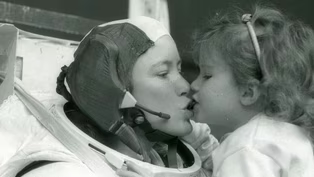
Clip: Ep1 | 1m 26s | Anna Fisher, the first mother in space, and daughter Kristin, reflect on leaving loved ones behind. (1m 26s)
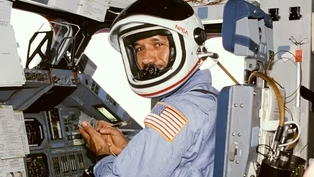
"That’s the dumbest thing I’ve ever heard.”
Video has Closed Captions
Clip: Ep1 | 1m 32s | Meeting astronaut Ron McNair inspires Charlie Bolden to apply to NASA. (1m 32s)
Providing Support for PBS.org
Learn Moreabout PBS online sponsorship
- Science and Nature

Miles O'Brien travels the world searching for solutions to today’s most urgent challenges.
 New Episode
 New Episode







 Recently Added

Support for PBS provided by: