
American Spirit
3/27/2026 | 1h 24m 39sVideo has Closed Captions
Follow the Graham dancers from rehearsal to premiere as they carry Martha's legacy forward.
Follow the Graham dancers from rehearsal to premiere as they carry Martha's legacy forward with a new work, a protest dance from choreographer Jamar Roberts in collaboration with Pulitzer-winning composer Rhiannon Giddens.
Problems playing video? | Closed Captioning Feedback
Problems playing video? | Closed Captioning Feedback
American Spirit
3/27/2026 | 1h 24m 39sVideo has Closed Captions
Follow the Graham dancers from rehearsal to premiere as they carry Martha's legacy forward with a new work, a protest dance from choreographer Jamar Roberts in collaboration with Pulitzer-winning composer Rhiannon Giddens.
Problems playing video? | Closed Captioning Feedback
How to Watch Martha Graham Dance Company: We Are Our Time
Martha Graham Dance Company: We Are Our Time is available to stream on pbs.org and the free PBS App, available on iPhone, Apple TV, Android TV, Android smartphones, Amazon Fire TV, Amazon Fire Tablet, Roku, Samsung Smart TV, and Vizio.
[music playing] I am a dancer.
Many times I hear the phrase "the dance of life."
It is close to me for a very simple and understandable reason.
[music playing] The instrument through which the dance speaks is also the instrument through which life is lived, the human body.
It is the instrument by which all the primaries of experience are made manifest.
It holds in its memory all matters of life and death, and love.
[music playing] [music playing] [music playing] [music playing] [music playing] [music playing] [music playing] [music playing] [music playing] [applause] Yay!
That was much better.
[applause] Not bad for our first attempt at what we have.
Oh, yay.
[chatter] Na, na, na, na, na, na, na, na, na, na, na.
You OK?
Mm-hmm.
Your body all right?
I'm good.
All right.
I need some coffee.
[chatter] Hi.
You ready to go?
Good morning, afternoon.
Yeah, good morning.
Am I ready to go?
I have no choice.
I think so.
More so than not.
Yeah.
Hi, everybody.
Hello.
Welcome.
Or you should to be welcoming me.
Yeah.
[applause] Thank you for having me.
I normally start by building a lot of phrases, like a lot of movement, and it's going to be really tedious and annoying.
Sometimes you're not going to want to see me, but it's just how things get built.
I invite the spirit of collaboration.
If things don't feel good, if you feel like, oh, this should be on the left or the other side, just say it.
I'm not easily offended, so everything is cool.
I think the more that you can just be yourself and bring yourself to the dance floor, then the better product we'll get.
That's all.
Let's just start, I guess.
[applause] [music playing] If you watch my feet, they do this, and then this kind of steps back.
That's all I know.
Maybe this right arm is coming up this way.
Both arms are coming down, and then this is stepping forward, and this is doing that.
I've always admired the way that Graham speaks about dance and how she holds it at such a high standard.
And I've always loved that, and I think it's good to be reminded of that.
She really elevates the art form.
And I think that in the work that I do, there's always a little hint of that that I try to hold on to.
[music playing] We are really proud to be the oldest dance company in the United States, and we're about to launch the celebration for our 100th anniversary.
When this opens, have your focus at the floor.
We want to have the best Graham dances on stage.
That's the spirit.
But we're not making sort of a sacred altar to Martha Graham.
We're honoring her appetite for the new.
[music playing] Our first commission is amazing.
Can I get some iTunes?
Some tunes?
Rhiannon Giddens creating the score and Jamar Roberts doing the choreography.
2, 3, 4, let's go.
Rhiannon is a leading expert in the roots of American music, resting in the immigrant and enslaved communities.
[music playing] 2, 3, 4, 5, 6.
Jamar came to mind because he studied the Martha Graham technique, moved on to become a star with the Alvin Ailey Company, and Ailey was heavily influenced by Martha.
The torso must be flat, as flat as you can get.
Yeah.
I think the difference in choreographing for Graham versus elsewhere is that I know that they can get down.
You know what I mean?
Come down, feet on the floor, barefoot, pelvis dropped.
[music playing] There's the spirit of the untamed that I think lives here.
And you just don't find it everywhere.
[music playing] [applause] Thank you.
Thank you.
[cheering] [laughter] [chatter] Send it to Janet.
She got to post.
I was drawn to this intense technique-driven company that also is moving forward in contemporary, and making people talk about what was happening in the dance scene in New York City.
There's Graham, Ailey, Paul Taylor that are really like the modern dance forces here.
And I think we are at the forefront of what's happening in New York City dance.
[music playing] When did I know I wanted to be a dancer?
I feel like it was always in my body, in my being.
[music playing] Well, before being taken into any dance program, I would watch Shirley Temple films with my mom, or really was inspired by legendary artists like Tina Turner.
And then at one point, I was Tina.
[laughs] So the world of entertainment and fantasy was always something that really inspired me.
Let's do a 1, 2, 3 turn.
OK?
I don't know about that.
1, 2, 3.
Yep.
[laughing] [music playing] I got this fire inside, and I knew I wanted to be a dancer my entire life.
I loved Graham, but I was like, the Graham company is too hard to get into.
[music playing] I started dancing when I was 10, and all my girlfriends of the class were doing dance.
I went to my mom and I was like, I want to join the ballet school.
And so my mom, she was like, why would you want to do ballet school?
[music playing] Before I came to America, I didn't really know who Martha Graham is.
And after I came here and suddenly realized, whoa, I have all these desires, I have this dream to fulfill.
It's been 14 years I'm here, and I'm still chasing the dream.
I started as a ballerina since I was five years old.
So by the time I discovered Graham, I was 15.
And what the technique gave me, it was a feeling of empowerment, strength, confidence, and reality, things that ballet didn't give me as much.
[music playing] I actually started dancing at the age of 18, which is extremely late for anyone.
My ballet teacher, she used to tell me all the time, she was like, you have a big butt.
You will never make it in the classical world.
You should just be a modern dancer.
[music playing] I met Lloyd Knight when I was about 19.
I just saw this beautiful black man.
I'm like, he just knew how to move his body.
I saw him and I was like, I can actually become a professional dancer.
This can actually be my life.
[music playing] I think the reason dance has held such an ageless magic for the world is that it has been the symbol of the performance of living.
[music playing] The most brilliant scientific discoveries will in time change and perhaps grow obsolete.
[music playing] But art is eternal, for it reveals the inner landscape, which is the soul of man.
Are we ready?
Start your engines.
Wow.
Welcome.
Welcome, everybody.
Thanks for your interest in Graham, and thanks so much for being here.
We're just thrilled to have this much interest in the company.
We want you to know that at Graham auditions, we like to have a friendly, relaxed, collaborative atmosphere.
We know a lot of you haven't had a lot of Graham technique.
Just do what you can and enjoy it.
Great.
Thanks for being here.
[applause] Hi, guys.
How's it going?
You take a contraction to the split, and you're here.
As much as you can, you want to be inverted.
The weekend where I was auditioning, I was called for the callback the second day.
--towards the front.
You go over into an attitude, fourth position.
And I go home and I see an email of my mother that says, your grandmother passed away.
I missed my grandmother's funeral because I wanted to get the job.
3, 4.
[music playing] The competition is so high, especially in New York.
There are so many dancers that you slip once, there's another 50 people behind you that are eager to take your job.
[music playing] Ready?
Two.
[music playing] All right.
[applause] Thank you.
[applause] Thank you.
[applause] Should we just go through it?
Yeah.
I like number one.
Me too.
I think he is-- Keep him.
I think we need to lose three and four.
Anybody says they want to keep somebody for a little while, let me know.
14?
I don't think 10 or 14 would make it.
I'm not really-- I think.
10 definitely was out for me at the beginning.
OK.
And I don't think 14 would do well with the Graham work.
I see them both the same.
Yeah.
Looking for individuality, so how the dancer can pick up the movement very quick, and then make it his own.
Because the company's dancers are so strong that it needs somebody that match the level.
So 1, 4, 6.
8, 9, 22, 23, 24, 26, 29, 31, and 32.
And everybody else, thank you so much for being here.
[applause] [music playing] I look for men that can handle the partnering.
You really need to over-exaggerate that back and this forward.
This, the first step is easy.
Yeah, you can really open that up.
It's this next one that's going to kill you.
If it feels this much comfortable, you're doing it wrong.
The whole thing should feel like not the most pleasant experience of your life.
[music playing] Because the partnering is very different in Graham.
And if you don't know how to do it, you will injure yourself pretty substantially.
[music playing] I always say the women here will give you everything they got to help you do what you need to do.
[music playing] But if you disrespect them, they will eat you alive, as they should.
Thank you guys.
Beautiful job.
Beautiful.
Beautiful job.
[applause] I would like-- if James is in the right frame of mind, I would like to have him on stage.
I think he's as theatrical as our other men.
What do you think?
I don't think his Graham work is strong enough.
I think in the Graham work, he's going to look like an amateur.
I don't either.
But that's just my opinion.
I think Joey would be your choice, personally, but-- Yeah.
That's like, I don't know.
You make good decisions.
Yeah.
[laughing] [music playing] Hi.
I'm here to meet with Janet.
Yeah.
You can meet in Studio 2.
OK, thank you.
Hi, honey.
And a 1, 2, 3, 2.
[music playing] Thank you so much for coming here today.
Of course.
Thank you.
Yeah.
We just needed a little more time to make some decisions, and, well, we want to offer you this job.
Let me just put that on the table right now.
We want to offer you this job.
I'm trying not to cry.
Oh.
It's OK.
Yeah.
I'm not crying on camera.
It's OK.
You can do that.
It's the real thing.
And I'm so happy that you're excited about it and that this means so much to you.
It does, thank you.
Yeah.
No, no.
Thank you so much.
You're welcome.
OK.
This is mine?
Yes, this is yours.
I give you.
Thank you.
Thank you so much.
Thank you.
Thank you.
So glad you came to us.
I know.
We'll be in touch.
Thank you.
Thank you.
Have a good one.
Bye bye.
A lot of things are going through my head.
Excitement.
Crazy.
I feel crazy right now.
I've second guessed myself so many times as a dancer, so this is just good confirmation that I'm on the right track, that I'm doing something that I love, and I can make things happen.
[laughs] Thank you guys so much.
Thank you.
Congrats.
Thank you.
[music playing] When making the solo with Jamar in "We the People."
Yeah, yeah, think of that gesture as a scream.
You know what I mean?
He gave me the opportunity to express those feelings that I've never gotten to express before on stage.
[music playing] I am a Black man expressing all the frustrations that I've ever had to deal with, or what I've witnessed other people go through.
[music playing] And without me shouting out what this is about, certain gestures like being handcuffed on a floor, you get the gist of it.
[music playing] And I think it's really important for the world that we live in today to see that and be face to face with that, and to feel it.
Let's speed this up a little bit.
[music playing] Thank you.
[chatter] I just collected all kinds of denim-y things, so that was the world I felt like you were before.
We spoke about the America vibe.
Mm-hmm.
I took four social things that America's got a problem with.
So the first one is the Black woman.
Mm-hmm.
Then the second one is same-sex couples, and then the third is a group of women, and then the fourth is the Black man.
[singing] Maybe this is a young group of people that is pushing for change.
How do you feel, Leslie?
Great.
OK.
How do you feel?
I think it looks good.
Yeah.
And the split is good.
OK, cool.
[chatter] [music playing] I met Martha exactly 50 years ago in New York City after the performance at the New York State Theater.
She came backstage and introduced herself.
I sort of recognized, or somebody else, and said it's Martha Graham.
[music playing] And she took my chin like this, grabbed it, and pierced to my face, just with her small but extraordinary powerful stare.
And that moment, for me, I will never forget.
By the time I met her, of course, she was a goddess.
And she was not even a legend.
She was beyond that.
She was the goddess of modern dance.
Oh, yes.
There was always a certain energy in the room whenever Martha entered.
Yeah, an alertness, an awareness.
As I sit here, I'm remembering it now and I can almost feel my body responding.
It's as if the skin sort of became alive.
[laughs] She could be a tyrant.
She could be a mother.
She could be a flirt.
She read people in an instant and was able to transform herself into whoever she needed to be to get whatever she wanted.
When you came into the studio to Martha, you never saw an old lady.
I never saw age.
I just saw this light and this energy demanding more light and more energy.
[music playing] No artist is ahead of his time.
He is his time.
[music playing] It is just that others are behind the time.
[music playing] A dance reveals the spirit of the country in which it takes root.
To the audience of America, the American dance owes a duty.
It must not lull them into complacency by presenting a decorative or imitative dance form.
[music playing] Appalachian Spring emerged out of the atmosphere in this country during World War II.
[music playing] There was isolationism.
There was nationalism.
There was racial division.
Martha set out to create a work about American optimism, determination, hope for the future.
[music playing] These divisions in America, those themes are still part of the American conversation.
[music playing] And I think Jamar has taken on the same themes.
[music playing] There's a real conversation between these works about America.
[music playing] Jamar immediately said, this piece is a protest.
So we are immediately thinking, we're going to fight.
[music playing] We're going to speak up.
We're going to yell.
We're going to be angry.
We're going to be vulnerable.
[music playing] It is a good place for us to now speak on what social activism looks like today.
[music playing] Good.
All right, everybody, I'm going to keep Alessio, and everybody else can go, go.
[applause] Thank you.
[laughs] Thank you.
Now come to me.
Every time I go to you, you go away.
Working with Jamar in "We the People" was a dream.
Jamar was kind of like a dance star of New York City.
So this is down, down, down, down, down, down, down.
So Jamar and I met through Lloyd.
My dear Lloyd, love you so much.
Can you unfurl like a flower.
[laughs] And we started hanging out, and then we got together, and now we're married.
This is hiding the mouth.
This is pink.
This is swan.
When he realized that he needed to do a solo, he used me like, let's go back into your upbringing.
I grew up in this small village in Italy of 2,000 people.
[music playing] So growing up in that town, it was hard for me being a dancer because you run into people that bully you.
I got followed and got a few punches in the stomach, and just then, didn't get out the house for a year.
So I think he created that solo just to put into steps and dance what I actually went through growing up, fighting and trying to liberate and find myself.
[music playing] I feel like coming to New York to be an artist made me believe in myself even more, because you are surrounded by many other artists that inspire you every day to do better and to be better.
[music playing] Modern dance dates so quickly.
That is why I always use the term "contemporary dance."
It is of its time.
[music playing] I never, never say modern dance.
There is no such thing.
The public may have called me modern, but I did not.
[music playing] I want my dancers not to be like me.
I want them to have studied with me, of course.
I want them to be themselves, and I encourage them to do that.
[music playing] I want the dancers to learn the dance physically, strongly, and then put their own meaning into it, if they can dare to do that.
[music playing] [music playing] [music playing] [music playing] There's a lot that you give up to be a part of this world.
Especially being so far away from home.
There has been a lot of missed personal moments.
Family occasions and nieces and nephews growing up.
We have an annual family reunion.
Just missing that is always hard.
Probably over 10, 11 weddings in my career of people who I would consider close.
And dating and sometimes lack thereof because of the schedule.
[music playing] It's part of the commitment.
It's part of the job.
[music playing] It is Anne Souder's birthday, day of birth, her, the queen.
She's 24.
Yes.
21.
She's 18.
32?
I'm 32.
I'm old.
You're 32?
I thought it was 30 today.
Oops!
She thought I was 30 today.
She's lying.
No, I could be your mother.
Stop.
Happy birthday, my queen.
(SINGING) Happy birthday to you.
I'm old.
[applause] [cheering] [music playing] Yeah.
I was like, do you have cakes?
No.
Thank you guys.
It's such a nice birthday to spend it with y'all.
Aw!
We love you.
We love you.
I come from a big family.
And I think a part of the reason why I enjoy company life so much is that it feels like a family.
[music playing] And part of what I envision my life is, I would love to have a kid.
But it's really hard for me not to see a child as a possible end to a career.
Hello.
Hi.
This is what I call the cuteness report for the day from my niece.
I love being an aunt.
What do you want to say?
See you on my birthday.
That's not what you want to say.
It's her birthday?
No, it isn't.
She really wanted to call you, and I said she's at work right now.
And she said, let's just try her anyway just in case.
I said, OK.
OK, goodbye.
We love you Aunt Annie.
She's cute.
I simultaneously want it right now, and then also I've been like, it's really nice to sit on the couch and have a glass of wine and not little girls running around.
But I feel, obviously, so excited to be a parent with you because I think you obviously believe in equally, as much as you can, sharing parenthood.
But you need a village, and it's quite daunting.
What's it going to be like?
How is having a kid going to change my life, all of that stuff?
But then, on the other hand, it does feel like I'm just feeling stable taking care of myself.
Us as adults.
Yeah, we're great now.
Yeah, throw a kid in there?
Ooh, what?
You have 18 years, 24 years, however many years of them.
That's the hard question.
I think we just don't know.
You can't be prepared.
But I do feel very confident in us.
That's the one thing I'm not stressed about.
And I'm really excited.
I'm always like, do I want a baby right now because I know you'll be a great dad, and I hope I'd be a great mom.
I hope I will be.
Oh, Martha Graham.
A woman of great mystery and great talent.
[music playing] Sometimes it was very formal, and sometimes it's quite chaotic.
She's giving some suggestions or scolding somebody, say, you do [mumbles], and keeping everybody on their toes.
Martha, what do you think?
What the solo should be about.
What do you want to-- because now I know the steps.
I wish I was around.
I wish I was there.
You just have so many legends in the room, which is really exciting.
It's for sure really interesting to see Baryshnikov in the Graham world.
The emotions that come through for me is just-- [music playing] --kind of really wishing that I could have Martha in the room with me rehearsing, just because what she-- her messaging that she's giving off is so beautiful, and sometimes she says these things that are very poetic.
[music playing] I wanted to dive into Martha's world.
I just couldn't believe that this one woman could change, in my opinion, the face of dance and flip it on its head.
I can just connect to Martha so deeply.
To be a Graham dancer is something that I will always hold in my heart.
It's a beautiful thing.
[music playing] I feel the burden of unborn dreams within.
[music playing] They struggle to be born, and nature wills it.
The woman must die that the artist may be born.
[music playing] To many people, I was a heretic.
I was outside the realm of women.
I did not dance the way that people danced.
I had what I called a contraction and a release.
I used the floor.
I used the flexed foot.
I showed effort.
My foot was bare.
In many ways, I showed on stage what most people came to the theater to avoid.
But I'd rather they disliked me than be apathetic, because that is the kiss of death.
[music playing] "Heretic" is like a great work of modernist art come to life.
The geometry, these walls of women that keep shifting and blocking the individual who's clearly, through her gestures, asking for something, wanting something.
Martha's simple, stark, stripped down movement gives you a powerful emotional message.
[music playing] She was also designing costumes at this point that revealed the torso.
She wanted the audience to be able to see the undulation of the torso for its emotional description, for its eroticism.
Naturally, in a skintight dress, that's going to become possibly this idea of sexualization of the body, but it's honored.
It's not put out in this way of, I am woman because it's for a male gaze.
I am woman because I've discovered myself in the mirror and how beautiful I can be in my relationship to my own body.
And that's powerful.
[music playing] Hi.
Hi.
I wanted to let you know, Thursday-- I will be running late Thursday because my friend's memorial is that day, so I will be running late.
5, 6, 7, go.
[music playing] Those claps are so off the beat, so irregular and off the rhythm.
This piece is so weird.
I have no clue how this is going to fly in New York.
[laughs] 1, 2, 3.
It's not weird, it's good.
It's just I've never made anything like this before.
[music playing] I just wonder if people will be open minded enough to sit with it and really try to feel what it's trying to say.
[clapping] That's the spirit.
That's the American spirit.
[laughs] Good job.
Good job.
[applause] See that?
Lots of steps, but you did that.
That's all your hard work.
You should be proud.
We've still got work to do, obviously.
It's got to be as tight as we can get it in the time that we have to do that.
But I think that we are-- we've stepped onto the first stair.
You know what I mean?
That's it.
We'll do this one more time, and we'll take the five.
Yeah?
So working with Martha, it had to be absolute.
She wanted me to do this movement around my back, and I'm going into trying to be perfect.
You have to turn until you almost hear the bone go "crack."
And she says, Peter, turn your back and keep going.
Yes, ma'am.
And I noticed she started to drop her leg very hard on the floor and cross it back.
Peter, turn your back.
And I was like, yes, ma'am.
And she'd drop it again.
And then finally she said, come over here.
And so in my head, I'm feeling fabulous, because Martha-- I just got into the company, and Martha and everybody's here, and Martha is working with me.
[laughs] And she's like, come over here.
And I was like, yes, ma'am.
And I came, and she said, get a little closer.
And she said, now kneel down.
And I knelt, and she was like, bam, bam, bam.
Now get up and go, and do it like a man and stop "yes ma'am-ing" me.
So I did all the way, and I fell out of it, and she said, that's it.
Hi.
Bonjour.
[laughs] Ca va?
Ca va?
How are you?
Great.
You look great.
Fabulous.
You look great.
Not a day older than since I met you the first time.
What is the Voodoo juice you are drinking?
[laughing] Martha's blood, I'm sure.
You got a vial, one of the secret vials, huh?
[laughing] Rub it.
I'm just like-- Peter London, every year, he puts on a show.
He really likes to give opportunities to alumni.
So he was like, can you come down and choreograph a piece if you want?
And I was like, OK, sure.
[music playing] Graham is a Union company, which is great, but we're not working year round, which is problematic.
You find other performing opportunities.
[music playing] I met Peter when I was 18 or 19, and he taught Graham technique, and he really was hands on and pushed all of us in the greatest possible way.
He was awesome.
[music playing] In making this piece, I was discovering what inspired me growing up.
[music playing] And Martha Graham, of course, and my mom really inspired me.
Some of those girls are quite-- what's the word?
Big-boned?
Mommy.
[laughing] You can't say that.
Big-boned?
What's wrong with big-boned?
You can't call the girls big.
It's a dance company.
But off camera, I used to say to him, I'm like, how do you lift up those big girls?
This will be taken out.
[laughing] Because they will never talk to you.
[laughing] My parents are Jamaican.
So even growing up in Jamaica, you didn't hear about anyone dancing or anything like that.
Yeah, I'm the first artistic person.
No?
Yeah.
But we were trying to discourage him somewhat because in the Black community, it's like it wasn't a manly thing to do.
So we were trying to discourage him, but-- Then I took the karate.
Yeah.
[laughing] Did the football thing.
I have to give him credit, because he knew what he wanted and he went after it.
It didn't matter what anybody else say.
And I just wish other people had the guts, to just stand up for themselves and do what they think is best for them.
Yeah, I was disappointed because, like I said, when I was renovating homes, I said, well, this will be a good thing, the typical man duties, like building homes, painting.
Anything that's hard work is a man's job.
And anything that-- basically, anything that a woman can usually do, we don't do it.
In the Jamaican culture.
And then I was like, I'm dancing.
[laughs] Soft jobs.
Soft jobs are for women and hard jobs are for men.
It's only going to last so long anyway.
[laughs] At a certain point.
you got to-- I disagree with her.
I believe that he's got many more years.
If I see him and he tells me he's about 40, I'm like, how many 40-year-olds look like that?
It's impressive to have someone look like that at his age.
I can't believe it's been so long since he started.
One minute he was here, next minute-- [laughing] Right?
[music playing] For the piece I choreographed, I wanted to play with the different stages of growth.
In the beginning, I start like seeds in the Earth, being nourished, and growing and developing.
[music playing] And then the middle stage is like finding my footing and living.
[music playing] And then the third stage is just full on freedom.
[music playing] Rejoicing being in that last portion.
[music playing] [cheering] Hey, everyone.
This doesn't feel real to me.
Yeah.
Do you know what I mean?
Everyone's getting this pose with the same right arm up here.
You have to get in the face of the other, get in the face of the other.
1, 2, 3, 4, 5, 6, 7, 8.
Cool.
[laughing] One more time.
One more time.
The 1, 2, 3, 4, 5, 6, 7, 8, and then you can't move.
It's stillness here.
In the position, I thought we drop.
5, 6, 7.
No, you hold it.
[laughing] No, don't drop it.
This little traveling here, can you show me what you do?
So this is your 5, 6, 7, 8, 1, 2 3, 4.
Lloyd, you don't look like you're involved at all.
[laughing] You're trying to exit the stage.
[laughs] Do what you do, but even if let's say you do the two turns, keep your-- try to keep your eye on the group and stay closer at the same time.
But right now, it just looks like you're counting, and all this kind of thing, but you need to bring the theatricality to the idea that you are in a fight.
Do you know what I mean?
[music playing] Good.
[applause] Thank you.
Good work.
[applause] Graham is such a beautiful technique.
I fell in love with Graham from the first time I've done a contraction, but I didn't know how short Graham's contract was.
Graham gives us so many long periods of time off, but it's not pay.
I've actually turned down a lot of projects because of the Martha Graham company, because I wanted to give them my full availability.
But there's no way I can pay my rent.
I thought this was my full time job.
Shouldn't this be my full time job?
Would you like a cookie?
Please, please.
Thank you.
Wait.
I've not had lunch.
I really needed this.
Cookie?
Good.
This is lunch.
We needed a cookie.
I wanted to see the square dance.
Oh, yeah.
You know James is not going to be here on Friday or on Monday.
Yeah.
I don't know.
Yeah, I'm coming up with a plan.
OK.
The only crusty part is it's one less body.
Yeah.
You know?
I don't know what that looks like now, but I am aware.
I see it.
OK.
Whatever you wind up thinking is fine.
Yeah.
If you take him out of it completely, he'll be a cover.
You know what I mean?
He's just going to still learn it.
Yeah.
I would also like to talk to him.
Yeah.
You have to figure out what's best for the piece.
Yeah.
[music playing] Being with Martha in rehearsal was always an incredible adventure.
In 1984, she finally agreed to do "Rite of Spring."
She didn't want to tell anybody she was choreographing to "The Rite of Spring," to Stravinsky's music.
She was terrified to use that music, because she knew that everyone was going to be coming to the theater on opening night to see if her choreography could stand up to it.
And this was a time in the studio that was absolutely explosive.
She was 90.
One night when we couldn't seem to do anything right, and so she just stopped the rehearsal and she said, I hope you all die.
[laughs] She was putting her fear into us.
[chatter] I have based everything that I have done on the pulsation of life, which is to me the pulsation of breath.
Every time you breathe life in or expel it, it is a release or a contraction.
It is that basic to the body.
You are born with these two movements and you keep them both until you die.
She based everything on breath.
It's something that you can think, oh, easy.
So natural.
But it's very, very complicated to achieve, to understand how deep a contraction could be, how deep a release could be, where your center is.
That's where Graham is all about, to me, contraction, release and back.
It's beautiful.
[music playing] "Rite of Spring," It's a presentation a very primitive ritual.
[music playing] It's a community coming together to perform this ritual of sacrificing a virgin every year to bring forth a fertile spring.
[music playing] The chosen one was possessed to dance herself to death.
[music playing] [music playing] [music playing] When dancing the "Rite of Spring," you don't just become that chosen one.
You want to become the chosen one.
You're not just like another person.
It's you inside that role.
[music playing] You're just entering this zone when you dance and you sometimes forget who you are.
Sometimes I don't know what I am on stage.
I cannot tell you what I'm thinking.
I don't know.
[music playing] I cannot tell you if I'm even thinking.
[music playing] I don't know.
I'm just in another hemisphere.
I'm not there.
[music playing] [applause] [cheering] Wait, let me get a picture.
Group photo.
Group photo.
[chatter] Oh my God.
I love you.
[laughs] How do you feel?
Yes, it was wild.
I feel wild.
On the rope, I was like-- I was-- [laughs] I was like, ooh, I like it, it's tight, OK.
It was awesome.
I loved it.
Love you.
Thank you.
Thank you.
[music playing] This is my cooking apron.
[music playing] Jamar has one too, but it's never been used.
[laughs] It's fresh.
It's fresh and new.
I am the chef, yeah, usually.
Yeah, but I like to cook, because that's what we usually do in Italy.
We cook on Sunday, and we do great meals and we invite people over.
It's family time.
It helps me feeling close to home.
[chopping] I do miss Italy.
I've been missing it more, and more, and more every year.
But yeah, we just went for Christmas.
We're trying to go as much as we can when we're free to go visit my mom.
And my mom loves Jamar.
She makes him eat lots of cheese and drink a lot of wine.
We decided to get married.
It was my idea.
I didn't say yeah right away.
And then I thought about it, and I was like, this actually seems perfect, and I'm going to trust my gut.
And look at you now.
Look at me now.
Look at we now.
We took a Target run one day and-- With no intention of getting Barbies.
With no intention to getting Barbies.
And I was walking through the aisles, and I turn around and I'm like-- and I see Jamar into the Barbies aisles.
And I'm like, excuse me.
Where are you doing?
And he goes, I found the Barbie of my dreams.
This is me.
And then I saw her, and I was like, I need to get one to look like me.
No, I wasn't allowed to have, I mean boys were not allowed to have Barbies.
So when I was growing up, I would always like sneak and play with my cousin's Barbies, and I would get found out several times.
I would be doing hair.
I'd be making dresses for Barbies, and I would get teased by my cousins, and uncles, and aunts, and be called gay, and all these things.
For me, it's a reclamation.
I think it's just fun to have them there.
Sometimes you change in position depending on what you feel.
When you came back from Graham, and I'm really tired, I'm like this.
Put her leg down.
She's a lady.
My hopes for her is just more outfits.
[laughs] I think they look great like this.
Sweetheart, if you can't change Barbie's clothes, then what's it all about?
[music playing] [music playing] Cool.
And we're out of time.
[applause] Thanks, everybody.
See you when there's more time.
Thank you.
[applause] He has three hours a day, and we just have to go through it.
And say, I'm getting a little frustrated because I couldn't get some of the combos and I'm going to cry.
You get frustrated because you feel so stupid because it's like, why can I not get it?
No, it's all so much information you have to process.
You have to take your time.
That's a lot of information.
There just needs to be more clarity, but in order for there to be more clarity, we need more time, and I need to be more specific.
I don't know where to place-- But it's also the music.
We are dragged by the music many times.
Yeah.
We're just dragging it.
Cheers.
Dragging all the things instead of just a rough going.
But it needs time, which we don't have.
Creating a new work needs time, and that's very expensive for a non-profit dance company.
So it's a very tight schedule.
[music playing] Financially, everything has shifted, not just for Graham, but for the arts world in general.
Traditional funders have shifted to more social services and the political happenings that are going on.
For a small company like Graham, it means really tightening the belt.
And we look at other companies who haven't made it or who are disappearing as we speak.
It's just a very difficult time.
[music playing] It's tough to be a dance maker now.
I feel like dance is kind struggling to stay afloat in some ways.
And a part of me feels like, OK, if that's the case, then what you have to contribute will help it stay afloat.
But then there's another part of me that is kind of like, the world is moving in such a strange direction.
And it just feels like dance just may get left behind.
I'm frustrated.
I'm not worried as much as I'm frustrated that we are the oldest dance company in the United States, with such a important cultural history woven into the history of this country.
I'm not worried about disappearing.
Our legacy is a touchstone of American culture, so in some form, it's going to be there.
I'm just frustrated that we can't fulfill all of our potential right now.
[music playing] In 1980, a well-meaning fundraiser came to see me and said, Ms.
Graham, the most powerful thing you have going for you to raise money is your respectability.
I wanted to spit.
Respectable!
Show me any artist who wants to be respectable.
[music playing] Frankie, can you come to eat some cereal, please?
Hey, hey.
Go eat some cereal.
Then we'll have to go.
Oh!
OK, here we go.
You said pigtail, right, baby?
I gave birth February, 2020.
I remember once I have to go to Turkey for three weeks.
I was just crying to my manager.
I was kind of yelling and crying at the same time.
That was so hard, so painful.
Then my manager just told me, but you still have to go.
You know that, right?
And I know that.
That's something you have to do.
You still have to do.
OK, Frankie, Get up.
Da-da-da-da-da.
Here, here, here.
Get up.
Ah!
What shoes are we wearing, baby?
Crocs.
Are you sure you're not going to be cold?
That will be the hardest for me, is leaving Frankie.
Yeah, you ready?
OK, let's go.
But I want my daughter knows me as a dancer, an artist, not just mom.
And this is one of the reasons you have to keep doing it.
Yeah, yeah.
Doo-doo-doo.
[music playing] I always loved dancing.
I was really into contemporary and modern dance.
I was trained in Chinese folk, Chinese classical dance.
I still love it, but people keep telling me I have to be really pretty, or I'm not pretty enough.
That kind of comments always get into my mind.
I didn't know who I was.
[music playing] When I decided I really wanted to come to America, I already had a career in China.
I was teaching in college.
I have very good stable life and job.
And I tell my mom, and I think she thought I was crazy.
She thought I was washing dishes in the restaurant, where she had no idea what modern dance, who Martha Graham was.
I would like to do the big lift more, more thinking, passing you.
One thing really attracting me to Graham-- You ready?
Yeah.
Yes?
--is she was very true to that emotional reaction on the body.
And now I feel, oh, I can be a badass sometimes, and I have real emotions.
I think that's what Graham taught me.
The erotic element is life, but it doesn't have to absorb you.
It doesn't have to be a naughty word.
It's the love of life in many ways.
When people have said, your dances are erotic, I've replied that I've always regarded eroticism as a beautiful word.
I'm not ashamed to be linked to it.
As far as sex is concerned, I think that it is quite beautiful.
I do not know what life would be without it.
There is a certain beauty about sex that can only be expressed through eroticism.
The beauty of the body and I enjoy what it expresses about life.
For that reason, I don't deny sex.
I have no reason to.
I've only glorified in the beauty of it.
Only hidden things are obscene.
[music playing] [music playing] [applause] We got more work to do, obviously, but I think where you are is great.
Aside from all of these notes, and steps and things, I think, try to identify somehow within each section, who am I, what am I, what am I doing?
Am I the mad one?
I am the happy one?
You know what I mean?
I think in order to do that, you have to show us a little bit more of who you are in the context of the piece.
Not who you are, Leslie, but who are you in the-- you know what I mean?
And I think that just comes with, OK, if I decide I'm going to be the bitch.
So whenever I walk, everything I do, I'm just walking like a bitch the whole time.
[laughing] That is my character, and that's how I want the audience to identify with me.
That kind of thing.
That's it.
My three minutes are gone.
Bye.
Thank you.
Thank you guys.
[applause] Good work.
I'm proud of all of you.
We've come a long way.
Remember those days?
[laughs] That was yesterday.
That literally was yesterday.
[music playing] [chatter] Keep going.
[chatter] [gasps] Oh, my God!
Hi.
Husband is here.
Wow!
[claps] Wow, how cool!
Wow, it's such a great pic.
Look at that pointed foot.
[laughs] Same right?
Love it.
Love it.
Oh, beautiful man.
Right?
You don't dance for an audience of 1,000 people.
You dance for 1,000 ones.
There is always one to whom you speak.
All right.
House out.
Go.
Warmers out.
Go.
Please let me know when it's complete.
Main curtain.
[music playing] [music playing] [music playing] [feet stomping] [music playing] [applause] [applause] [music playing] [music playing] [applause] There's a quote that Martha said that really resonated with me, and that was, "You'll never know who you've touched," meaning that the audience will always-- someone will be touched by what you're doing.
[music playing] And that always stays with me.
Performing her works, and being open on stage and being authentic to yourself and to the character, and to the environment she's set up, you're touching someone out there, and then somebody is walking away with an experience.
[music playing] [music playing]
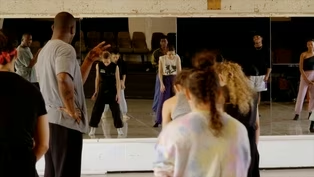
Jamar Roberts Begins Rehearsal
Video has Closed Captions
Former Alvin Ailey dancer and choreographer Jamar Roberts begins rehearsal at the Graham studio. (2m 41s)
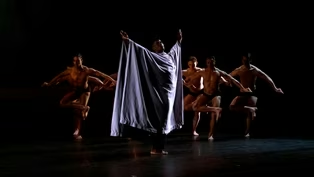
Martha Graham Created the Rite of Spring
Video has Closed Captions
In 1984, at the age of 90, Martha Graham choreographed to Leopold Stravinsky’s “Rite of Spring.” (2m 51s)
Providing Support for PBS.org
Learn Moreabout PBS online sponsorship

- Arts and Music
The Best of the Joy of Painting with Bob Ross
A pop icon, Bob Ross offers soothing words of wisdom as he paints captivating landscapes.











Support for PBS provided by: