Finding Your Roots
Artistic Roots
Season 12 Episode 8 | 52m 9sVideo has Closed Captions
Henry Louis Gates, Jr. maps the roots of director Spike Lee and actor Kristin Chenoweth.
Henry Louis Gates, Jr. traces the roots of filmmaker Spike Lee and Broadway superstar Kristin Chenoweth, uncovering ancestors who made bold decisions to lay the groundwork for their success. Moving from the Texas frontier to World War One battlefields to plantations in the old South, Gates introduces his guests to the women and men who used their creativity to build a future for their families.
From
Problems playing video? | Closed Captioning Feedback
Problems playing video? | Closed Captioning Feedback
Corporate support for Season 11 of FINDING YOUR ROOTS WITH HENRY LOUIS GATES, JR. is provided by Gilead Sciences, Inc., Ancestry® and Johnson & Johnson. Major support is provided by...
Support provided by:


Finding Your Roots
Artistic Roots
Season 12 Episode 8 | 52m 9sVideo has Closed Captions
Henry Louis Gates, Jr. traces the roots of filmmaker Spike Lee and Broadway superstar Kristin Chenoweth, uncovering ancestors who made bold decisions to lay the groundwork for their success. Moving from the Texas frontier to World War One battlefields to plantations in the old South, Gates introduces his guests to the women and men who used their creativity to build a future for their families.
From
Problems playing video? | Closed Captioning Feedback
How to Watch Finding Your Roots
Finding Your Roots is available to stream on pbs.org and the free PBS App, available on iPhone, Apple TV, Android TV, Android smartphones, Amazon Fire TV, Amazon Fire Tablet, Roku, Samsung Smart TV, and Vizio.
Buy Now
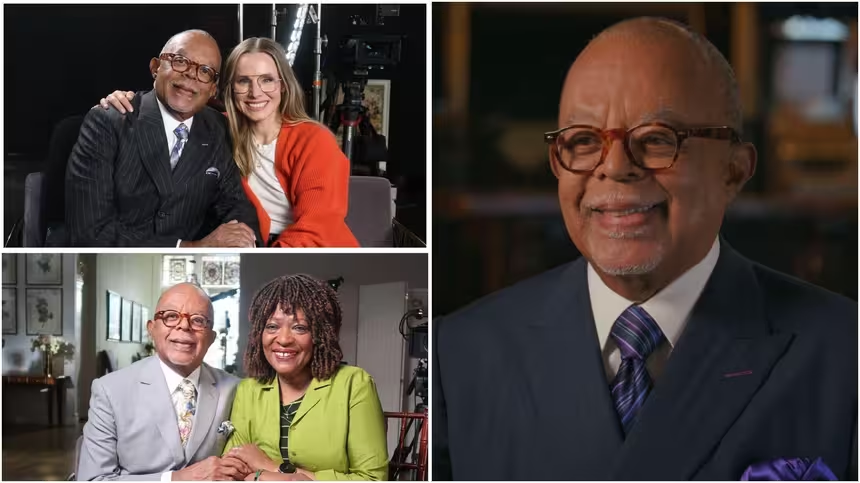
Explore More Finding Your Roots
A new season of Finding Your Roots is premiering January 7th! Stream now past episodes and tune in to PBS on Tuesdays at 8/7 for all-new episodes as renowned scholar Dr. Henry Louis Gates, Jr. guides influential guests into their roots, uncovering deep secrets, hidden identities and lost ancestors.Providing Support for PBS.org
Learn Moreabout PBS online sponsorshipGATES: I am Henry Louis Gates, Jr.
Welcome to "Finding Your Roots."
In this episode, we'll meet Broadway superstar Kristin Chenoweth and iconic filmmaker Spike Lee.
Two people who are known all over the world yet know nothing about their own family trees.
CHENOWETH: I wanna know, was I from like a long line of like fighters, warriors?
Who am I?
LEE: I've been thinking all last night.
What will I find out today?
What's coming out the box?
GATES: To uncover their roots, we've used every tool available.
Genealogists comb through paper trails, stretching back hundreds of years.
CHENOWETH: Oh my gosh.
Oh my Gosh.
GATES: While DNA experts utilize the latest advances in genetic analysis to reveal secrets that have lain hidden for generations.
LEE: I know none of this.
GATES: And we've compiled it all into a book of life, a record of everything we found.
(excited gasp).
LEE: Oh, you got this.
Oh, thank you.
GATES: And the window to the hidden past.
CHENOWETH: Is that not freaky?
GATES: That's freaky.
CHENOWETH: That's nuts.
LEE: I mean, that's, that's, see, that's why I'm here.
I wanna learn about my family, my heritage, my ancestors.
CHENOWETH: I'm so happy right now.
You don't even know I, I, this like actually makes me so emotional.
GATES: My guests are both independent spirits.
Artists who blaze their own trails, and they are both in for some big surprises.
In this episode, they're going to meet a cast of characters every bit as dramatic as the ones they brought to life on stage and screen, all hidden in the branches of their family trees.
(theme music plays).
♪ ♪ (book closes).
♪ ♪ ♪ ♪ GATES: Spike Lee is a living legend.
Over the past four decades, the prolific director has forever changed American cinema, working in a dizzying array of genres and styles, creating some of the most original films ever made.
But as anyone who knows Spike is aware, the key to it all is simple.
Spike is a proud product of his city and his family.
Born in Georgia in 1957, Spike grew up in Brooklyn, the oldest of five children.
His father was a celebrated jazz musician who sometimes struggled to earn a living.
His mother, a beloved teacher, worked hard to fill in the gaps.
And Spike was a keen observer of the creative cauldron of chaos that often defined his household.
LEE: We were crazy.
(laughter).
I mean, my father was like, daddy, can we jump off the top of the stoop?
Yeah, go ahead.
So, that was my father.
He was like, whatever you want do.
And so my mother, she was put in a position of being... GATES: The policeman.
LEE: Yes.
GATES: Yeah.
LEE: Because my, whatever you wanna do, my father didn't care.
I mean, he cared, but was "Express yourself."
Well, you know, "You break an arm, you know you'll be all right."
GATES: Was she effective as a cop?
LEE: Oh, yeah.
We were like, "When is daddy coming home?"
And, and I know that must have hurt her that, that for the most part, you know, her, her, her children, you know, daddy was like... I don't remember ever saying, "When is mommy coming home?"
GATES: Though Spike adored his father, he didn't try to follow in his footsteps.
In fact, he told me he wasn't sure what he wanted to do with his life until the summer of 1977, when he returned from college to find his home city in turmoil, roiled by a financial crisis, with a citywide blackout looming.
It was an infamous time in New York's history and a defining time for Spike.
LEE: There were no jobs.
So, I had nothing to do, and this one day changed my life.
Vietta Johnson, who lived at the cross street of the park, Fort Greene Park, went to Stuyvesant High School.
Now she, she's a doctor in Chicago.
She was a friend.
And that day I wasn't doing nothing.
I said, I went over to across the park, rang the bell, and said, "Come on up."
So I'm sitting there and she's studying for some type of test, and I said, what's in that box?
She said, "This is a Super 8 camera."
I said, "What's in this box?"
She said, "That's the cartridge for the film.
You can have it."
GATES: Hmm.
LEE: I said, "Who gave it to you?"
"My father gave me but, I, I, I'm, yeah, you just take it.
GATES: Hmm.
LEE: And that day changed my life.
GATES: Hmm.
LEE: And so when the blackout happened of '77... Blacks, my brothers and sisters, my Puerto Rican brothers and sisters, started looting.
I started filming it.
GATES: Huh.
LEE: It was also the first summer of disco, and so I was filming the block parties.
So all this footage I shot the summer, went back to school that fall, and declared my major.
GATES: Huh.
LEE: Mass Communication, Film.
GATES: And you had never thought about being a filmmaker before?
LEE: I liked films, but I, that never occurred to me.
GATES: But you picked this thing up, then how'd you figure out how to use it?
LEE: Super 8 camera.
Just put the cartridge in, and you pull the trigger.
(laughter).
GATES: Once he pulled that trigger, Spike never looked back.
His graduate school thesis film won a Student Academy Award.
His first feature was a breakout hit.
And he's gone on to direct more than 25 movies, five documentaries, and a series of iconic commercials, winning virtually every major award along the way.
But when I laid out all of his accomplishments in front of him, Spike turned the conversation back to where it began, with the joy that he takes from his life.
Looking back at that incredible career... LEE: I'm not done!
GATES: I know, but just looking back from where you are.
LEE: Mm-hmm.
GATES: What are you proudest of?
LEE: What am I proud of?
GATES: Yeah.
LEE: Mmm, that, I tell this to my students, that people who are blessed making a living and doing what they love, you can't beat that.
GATES: Mm-hmm.
LEE: Because the majority these people on this earth, this God's earth, go to the grave having worked a job they hated.
GATES: Mm-hmm.
LEE: So if you, if you could make a living doing what you love, you won.
GATES: You won.
LEE: You won!
GATES: My second guest is actor, singer, and Broadway Superstar, Kristin Chenoweth, famed for her groundbreaking performance as Glinda, the Good Witch of Oz in the Smash hit "Wicked."
Kristen is blessed with perfect pitch, a radiant smile, and a story that sounds like its own Broadway show.
As an infant, she was adopted by an Oklahoma couple named Junie and Jerry Chenoweth.
They were engineers with no musical interest at all, but they embraced Kristen's talents from the moment they emerged.
CHENOWETH: It started for me in church.
GATES: Mm-hmm.
CHENOWETH: I auditioned for a solo in the adult choir.
My mom said, "It's for the adults."
I said, "I don't care."
I still wanted to try out.
And I went to a pretty big church, First Baptist Church, Broken Arrow, was pretty big at the time.
GATES: Mm-hmm.
CHENOWETH: And I got the solo, and I remember going up to, in front of the crowd, and singing a song called, ♪ I'm Only 4'11, ♪ ♪ But I'm Going to Heaven and it makes me feel 10 feet tall.
♪ If I'd only known that's how tall I was gonna grow, Skip, I probably wouldn't have sang that song.
But after it was over, people leapt to their feet and cheered.
And I thought, and we were pretty calm congregation.
And I remember thinking, I like that.
GATES: Kristen didn't know it yet, but she'd found her calling, though there would be a few twists in the road ahead.
After spending her high school years immersed in musical theater, she went to Oklahoma City University and ended up with a scholarship to train as an opera singer at the Prestigious Academy of Vocal Arts in Philadelphia.
And that's when things took a major turn... Just before my program started and we graduated, my best friend Denny Downs was moving to New York to try his hat at Broadway.
The whole, the whole life, right.
Well, that's really always what I wanted to do.
But I was succeeding in opera, so I thought, well, I should do it.
GATES: Mm-hmm.
CHENOWETH: Because the teachers and, uh, so many guest teachers would come and say, you actually fit the roles.
You, you're little.
GATES: Mm-hmm.
CHENOWETH: You know, you look like a doll, you will play the doll.
You will, you know, you, you fit the parts.
GATES: Right.
CHENOWETH: Anyway, I went to New York with Denny.
I decided, just for fun, to sign up at the Actors' Equity Building for an audition.
I was not... GAETES: "Just for fun."
CHENOWETH: Just for fun.
GATES: Uh-huh.
CHENOWETH: I had never, I did not have my equity card, so I waited 12 hours until the end of the day.
And the, the guy came out and goes, "Oh, you're still here?"
I said, "Yeah."
And he goes, "I'll see what I can do."
'cause I wasn't a union member.
They were auditioning for a show called "The Animal Crackers."
It was to be done at Paper Mill Playhouse.
It was a Marx Brothers musical.
And they'd been auditioning for this one part for many, many months.
So I walk in, and I sang "On the Other Side of the Tracks" to show that I could belt.
Then they asked me to read a little scene, and they said, "What are you doing, who are you?"
And I said, "Well, actually, I'm gonna go to AVA, I'm just here to experience a New York audition."
And Charlie Ripley, the director, who I will never, never forget him, sat me down and he said, "I know you're gonna do this other thing, but you're very unique in a world where there's not a lot of uniqueness... GATES: Mm-hmm.
CHENOWETH: I would really like for you to take this part."
GATES: Kristen heeded that advice and accepted the role, a decision that paid off spectacularly, launching one of the most acclaimed careers in the history of musical theater.
Along the way, Kristen has also been able to add a happy chapter to her personal story.
In 2012, she met her birth mother for the first time.
And the two forged a close bond, a loving relationship that lasted right up until her mother's death in 2023.
How did getting to know her change you?
CHENOWETH: Oh Man.
Everything made sense.
Um, it's, it's a powerful thing to know in this world that you are like someone.
GATES: Mm-hmm.
CHENOWETH: You know, even when you look at entertainers that you relate to, why do you relate to cert-certain people?
Because there's something about them, usually I find that's sort of like you, or that you can relate to.
GATES: Mm-hmm.
CHENOWETH: When I met and I, I met her and it was like, oh my gosh, looking into my future, like, that's me.
GATES: Huh.
CHENOWETH: That's me.
GATES: And your bond was immediate?
CHENOWETH: Immediate.
GATES: Hmm.
CHENOWETH: There was no, that could have gone either way, right?
GATES: Yeah, oh yeah.
CHENOWETH: But not with us.
GATES: What do you miss most about her?
CHENOWETH: You know, sometimes I've made decisions in my life that seem a little, are you sure you wanna do that, Kristie?
Or what are you thinking over here, Kristie?
She completely, um, accepted me.
GATES: Mm-hmm.
CHENOWETH: For all the rights and wrongs.
GATES: Mm-hmm, unconditional love.
CHENOWETH: Yeah, that's it.
GATES: Kristen and Spike are both self-creations.
They rose to the top on their talents alone, never knowing what their ancestors might have done to blaze the trail before them.
But that is about to change.
I started with Spike Lee and with his father, Bill Lee.
Bill was a brilliant artist who struggled to support his family for the most artistic of reasons.
In the 1960s, at the height of his fame, he refused to change as the music world changed around him.
LEE: My father was the most requested jazz folk bassist.
Bob Dylan, I mean, Theodore Bikel, Josh White, I mean, every folk artist... he on the first album, the first Simon and Garfunkel album, that's him.
The first Gordon Lightfoot album.
That's my father playing.
GATES: I didn't know that.
LEE: Yeah, and when Bob Dylan decided he's going electric, my father said, no.
And so, when Bob Dylan went electric, everybody went electric, so... GATES: Mm-hmm.
LEE: My father was not gonna play electric bass.
GATES: Wow.
LEE: He said, can't do it.
So my mother had to work 'cause we would've starved.
GATES: Spike's father would go on to score some of Spike's early films and compose several well-received jazz operas.
But he never regained the popularity of his youth.
And perhaps as a result, he rarely chose to discuss his past.
So Spike knew that his father came from a musical family, but beyond that, his father's family tree was a blank slate.
We set out to fill it in and immediately uncovered a surprise.
The story begins with Spike's grandfather, a man named Arnold Lee.
Arnold was born in Selma, Alabama, in 1892.
He worked much of his life as a college instructor and band leader.
But he also ran a family singing group that performed across the South.
A group that included Spike's father.
LEE: "One family musical performance by Negroes will be presented at the Selma University Chapel at 8:00 Monday evening.
Seats reserved for white friends, wishing to attend.
The troop have appeared before numerous groups in the past."
GATES: Isn't that wild?
Have you ever seen that before?
LEE: "Sound of Music," the Trap family.
(laughter).
♪ So long, farewell... ♪ They weren't doing that.
They weren't doing Oscar Hammerstein.
GATES: No.
There is your grandfather leading the family band in a performance at the Selma University Chapel.
Your father would've been 11 years old at the time.
Did your dad ever talk about those shows?
LEE: Skip, I didn't know that.
GATES: Mmm.
LEE: I mean, that's, that's, see this is why I'm here.
I wanna learn about my family, my heritage, my ancestors.
Thank you for sharing this with me and the world, too.
GATES: You've come to the right place.
LEE: Yeah, I know that.
GATES: Spike wondered how Arnold ended up as a band leader.
The answer seems to be that just like Spike, he followed his dreams.
His father was a carpenter.
And for a time, it appeared that Arnold, too was destined for a life of labor.
LEE: "Arnold Wordsworth Lee, age 24."
GATES: Mm-hmm.
LEE: "Date of birth, October 28th, 1892."
GATES: Mm-hmm.
LEE "What is your present occupation?
Steam engineer.
By whom employed?
Buckeye Cotton Oil Company."
GATES: There's your grandfather, 24 years old, working as a steam engineer at a factory.
LEE: I thought he was a musician?
GATES: Yeah, and that was a rough job.
As a steam engineer, he operated machinery that processed cotton seeds into cottonseed oil.
A popular ingredient used in supermarket fats and soap.
He was essentially working on a factory floor, hot, humid, and loud.
You think he could have handled that for a living?
LEE: Nuh-uh.
GATES: You know, in... LEE: And also you work from sunup to sundown, too.
GATES: Oh, yeah.
But he quit this job to follow his passion, which was music.
LEE: Damn!
GATES: Isn't that amazing?
We wanted to trace the Lee family back in time, and we were able to identify Arnold's grandfather, who was likely born into slavery around 1825, but we couldn't go any further.
Enslaved people were almost never listed by name in federal records.
So to learn their stories, we need to find them in the records of the people who owned them.
And we weren't able to do that for the Lees.
But when we shifted to another line on Spike's father's family tree, our fortune seemed to change.
Spike's third great-grandparents, a couple named Albert and Mariah Craig, were living in Dallas County, Alabama after the Civil War, as was their son, Harrison Craig.
And in the 1850s census for that county, we found a white slave owner named John J. Craig.
The shared surnames were impossible to ignore.
So we kept looking through the records of this white Craig family, because the only way to trace black genealogy is to find the names of your ancestors listed in their documents.
LEE: By the people enslaved, right?
GATES: Yes.
Like estate records in wills, whatever.
Sometimes we get lucky, sometimes we're not.
LEE: We get lucky?
GATES: Please turn the page.
You're looking at a file for the estate of a man named James Craig.
He was John J. Craig's father.
It was recorded on January 3, 1844.
Would you please read the transcribed section?
LEE: "We, the undersigned, met this day and proceeded to appraise, said Negroes.
We then proceeded to put them into lots, which are drawn for as follows.
Lot number one, Albert at $650."
GATES: Mm-hmm.
LEE: "Mariah and Child $575."
GATES: Mm-hmm.
LEE: Total $1,225.
Lot number five.
Harrison at $200 drawn by J.D.
Craig.
GATES: There you go.
Those are your third great-grandparents listed by name with a valuation placed on 'em.
LEE: $650.
GATES: Yep.
LEE: $575.
GATES: Yep.
LEE: $1,225.
And Harrison at the cheap price of $200.
GATES: $200.
LEE: A human life, $200.
GATES: That is your bloodline.
What's it like to see that?
LEE: It's amazing.
And when you think about, and I, I, when you think about your ancestors... You think you're going through problems.
And I, I've done this before.
I said, what?
And I got like, I hit myself in the head like, yeah, this ain't nothing.
GATES: Nothing.
LEE: This is light stuff compared to what our ancestors went through.
GATES: Yeah.
LEE: Holy living hell!
GATES: Looking closer at the records that the white Craig family left behind, we soon realized just how much hell Spike's ancestors had endured.
When James Craig died, Spike's third great-grandparents became the property of his son.
But their son, Spike's great-great-grandfather, Harrison, was inherited by another Craig relative.
That is the moment that your Craig family line was split apart by slavery.
LEE: Mm-hmm.
GATES: What's it like to see that?
LEE: Well, you know, you think in your mind, you know what the ancestors went through, but this just makes it more, I mean, this is real right here, this is not like conjecture.
This, this happened.
GATES: Mm-hmm.
LEE: And this is how our ancestors, not just my, but our ancestors were, were treated as a piece of property inhuman.
GATES: Mm-hmm.
LEE: And could be killed, discarded, raped, whatever.
Uh, you know, and that's gonna happen.
GATES: Spike, of course, is correct.
Enslaved people had absolutely no control over their lives.
And there was an added dimension to their torment.
They had no idea that their enslavement would ever come to an end.
Albert and Mariah and Harrison could not imagine if they'd ever be free or be together again.
LEE: But you know what, though?
I think they knew.
They believed in God and be like, may not be me or my children, but somewhere down the line.
GATES: Mm-hmm.
A better day's coming.
LEE: Better day's coming.
GATES: Yeah?
Please turn the page.
This is a year after the Civil War, 1866, Dallas County, Alabama.
Would you please read that transcribed section?
LEE: "Albert Craig.
One male, 50 to 60 years old, one female, 10 to 20 years old, one female, 40 to 50 years old."
GATES: That is your third great-grandfather, Albert as a free man.
He's head of a household, most likely, including his wife, that your third great-grandmother, Mariah, and their son, your great-great-grandfather, Harrison, was living with his wife on another property in the same county.
So they survived, and they kept their family together.
LEE: Religion, spirituality, you know, you had, uh, I believe that someday, maybe not themselves, but their children or grandchildren, that, that, uh, we be treated as human beings.
GATES: Spike's words would prove prophetic.
Freedom transformed his family.
Within just two generations, the Craigs would see their horizons expand dramatically.
As Harrison's daughter Alma gave birth to Spike's band leader, grandfather Arnold, the man who laid the groundwork for Spike's father's success, as well as his own.
A fact that was not lost on Spike.
LEE: I got a whole lot of people behind me.
GATES: Yeah.
LEE: Looking down on me and say like, come on now, come on now.
What we went through and come on, lets, let's keep it going.
Let's keep it going.
Let's keep this, this family, this generational thing, and let's strive to make a positive mark in the world.
GATES: Mm-hmm.
LEE: You know?
And so it's empowering to know that it's not just you.
You know, there's some people, you got relatives... GATES: Yeah.
LEE: Generations that paved the way.
GATES: Right.
By name, now.
LEE: Yeah, so it's not no flim-flam, this is like... GATES: Yeah.
LEE: Documented.
GATES: Much like Spike, Kristen Chenoweth was about to find empowerment in a newfound branch of her family tree.
The journey began with her biological mother, Wanda Lynn Cooper.
When Kristen and Wanda reconnected, it was largely thanks to the efforts of Wanda's youngest daughter, Kristen's sister Jennifer.
But there was another person who played a significant role in that effort.
A man, Kristen never got the chance to meet.
Wanda's father, Kristen's grandfather, Charles Cooper.
Now I understand when your grandfather was on his deathbed, he told your sister Jennifer... CHENOWETH: Mm-hmm.
GATES: About you being given up for adoption, which led her to register her DNA in an adoption database.
So in a sense, he's the reason that you ended up here with me today.
CHENOWETH: Yeah.
GATES: So what's it like to think about that?
CHENOWETH: You know what's funny?
I've never thought about the connection with him.
I've only just thought about her and my sister, my brother.
You know what?
I've never thought about grandpa.
GATES: But he made that decision on his deathbed.
I find that fascinating.
CHENOWETH: I do too.
I wonder, I mean, I've always wondered if he felt guilty about it.
GATES: Mm-hmm.
CHENOWETH: Or just sad.
GATES: Mm-hmm.
CHENOWETH: You know, wondering about that baby.
GATES: As it turns out, Charles had many reasons to be sympathetic to his granddaughter.
He'd experienced great suffering of his own.
He lost his mother when he was a young man.
And when he was 21 years old, he almost lost his own life.
CHENOWETH: "The accident occurred last Saturday near Natchez, and the youth suffered six broken ribs."
Ow.
"Internal injuries and a punctured lung.
Two blood transfusions have been given in an effort to bring him back to health."
Wait, I didn't know that he'd had a bad accident.
GATES: Your grandfather was in a terrible car accident.
He had six broken ribs, internal injuries, and a punctured lung... CHENOWETH: Lucky to be here.
GATES: And two blood transfusions.
Can you imagine?
CHENOWETH: Unfortunately, I can imagine.
I've had a bad accident myself.
Broken ribs alone will take you down.
I mean, it doesn't sound like that big of a deal, but they hurt.
GATES: Oh, it's a big deal.
CHENOWETH: They hurt.
GATES: According to another newspaper article, Charles was lucky to be alive, and he had to struggle to recover, but he ended up back home walking around in a month.
Sounds like a tough guy.
CHENOWETH: Yeah, tough.
GATES: Is that how your mom remembered him?
CHENOWETH: Yes.
GATES: Mm-hmm.
CHENOWETH: Big teddy bear.
But outwardly, maybe tough.
GATES: Charles's toughness would soon be put to another test.
Roughly four months after his accident, Japan attacked Pearl Harbor, drawing the United States into World War II.
Charles could have tried to avoid military service on medical grounds, but he chose a different route.
CHENOWETH: "Cooper, Charlie E. Private, automotive maintenance company."
Your grandfather was drafted.
CHENOWETH: Sure was.
GATES: He survives a car accident and still answers the call to serve his country.
What do you make of that?
CHENOWETH: I think he's pretty badass.
Pardon me.
I think that's pretty cool that he, you know, I, I, I would imagine that a lot of people could have chosen not to do it.
GATES: Sure.
CHENOWETH: But he did it anyway.
GATES: Charles was assigned to an Army Ordnance Corps and ended up in France, maintaining equipment for frontline troops.
Kristen told me that she believes the experience took an emotional toll on him, a toll that her mother, Wanda, observed firsthand.
And as it turns out, Charles was not the first member of Kristen's family to face such challenges.
Shifting to another branch of her mother's roots, we came to a man named Oscar McKinley Brown.
He's Kristen's great-grandfather.
And in 1917, when he was 24 years old, he joined the United States Army at the height of World War I. Now, we found this record in the National Archives.
CHENOWETH: Oh!
GATES: Would you please read the transcribed section over there?
CHENOWETH: This is, look how handsome he was.
"Passenger list."
Ah, "Fourth sanitary train, date of sailing May 27, 1918.
Port, New York.
New York.
Name: Oscar McKinley Brown.
Rank: Medical Department, Wagoner.
Notify in case of emergency, Mrs.
Liz Lee Webb, sister.
Address, Quentin, Oklahoma.
GATES: In 1917, when he was 24, Oscar enlisted.
And you could see Oscar there in his uniform.
Any family resemblance?
CHENOWETH: Yeah.
The eyes.
GATES: Mm-hmm.
CHENOWETH: For sure.
Very similar.
GATES: Your great-grandfather was assigned to the fourth sanitary train of the fourth infantry division.
Do you have any idea what a sanitary train is?
CHENOWETH: No, what is that?
GATES: Please turn the page.
CHENOWETH: Um, I think it might be not something I would wanna do.
GATES: I was thinking that.
CHENOWETH: Oh, wow.
GATES: Sanitary trains were medical units that operated field hospitals in combat zones.
Oscar's job was to transport supplies and wounded soldiers along the trenches of the Western Front.
It was dangerous, often deadly work, as evidenced by an account written by a fellow soldier in Oscar's unit.
CHENOWETH: "One of our boys was at the dressing station helping a lieutenant dress up a wound when a shell hit the dugout, killing them both."
GATES: Mmm.
CHENOWETH: "Once the Germans let a bomb fall just outside our hospital, it shook up the chateau next door and smashed all the windows in our hospital.
The air raid was the worst.
You can hear the plane right over you, and you know, it has death load for someone, and you just lay there and wonder where it will fall."
GATES: That is what your ancestor experienced.
CHENOWETH: The stress, the not knowing whether you're gonna make it.
You're in the line, truly the line of fire.
GATES: Mm-hmm.
CHENOWETH: Truly.
GATES: Yeah.
24/7.
No respite.
CHENOWETH: No, thank you.
GATES: So what do you think that was like for him to witness that carnage?
CHENOWETH: I mean, now we always talk about our trauma, right, in today's times?
GATES: Yeah, oh yeah.
CHENOWETH: This is serious trauma.
GATES: That's is serious trauma.
CHENOWETH: Um, and that... GATES: Without even having a word for it.
CHENOWETH: Right.
GATES: You know, which makes it worse.
CHENOWETH: Yeah, and I mean, he probably put it, put it down here.
GATES: Yeah, as best he could.
CHENOWETH: As best he could.
GATES: We don't know how he did it, but Oscar was able to leave the war behind him.
In 1919, he returned to America and set out to build a life for himself.
The following year, he married Kristen's great-grandmother, a woman named Ola Blaylock, and started a family.
He would help raise three children and support them by running a taxi service and later a farm.
Surveying his life, Kristen's thoughts turned first to her mother, Oscar's granddaughter.
CHENOWETH: When I think of Mama Lynn, I think about her resilience.
That's really what stands out the most to me.
GATES: Mm-hmm.
CHENOWETH: Because of the trauma, if I may, that she went through of having me and giving me away.
GATES: Yeah, oh yeah.
CHENOWETH: Um, but continuing on.
GATES: Mm-hmm.
CHENOWETH: And staying tough.
GATES: Mm-hmm.
CHENOWETH: And life did hand, hand her a lot of lemons.
GATES: Mm-hmm.
CHENOWETH: But she made lemonade out of it.
GATES: Yeah.
CHENOWETH: And so did this guy.
GATES: Mm-hmm.
CHENOWETH: It's funny, I have this too.
People don't always see me coming.
They just don't know that I'm as tough... GATES: Uh-huh.
CHENOWETH: But when push comes to it... GATES: Mm-hmm.
CHENOWETH: I'm pretty tough.
GATES: We'd already traced Spike Lee's father's roots in Alabama, exploring a family that ended up as a musical group.
Now, turning to Spike's mother's ancestry, we found ourselves back in the deep south with a very different kind of family.
The story begins with Spike's great-great-grandparents, Richard and Mary Paschal.
They're listed in the 1880 census for Georgia, along with their seven children.
And almost all of them had the same job.
LEE: "Henry, age 16, son.
Occupation: farm hand.
Felix, age 14, son.
Occupation: farm hand.
Ida, age 11, daughter.
Occupation: farmhand.
Birch, age nine, daughter.
Will, age seven, son.
Jack, age five, son.
Jerry, age three son."
So you worked as soon as you could walk, you're working.
GATES: You got it, farmhand.
LEE: Yeah.
GATES: That's why they had big families.
LEE: Mm-hmm.
GATES: So they're your great-great grandparents.
LEE: That ain't the only reason.
GATES: Yeah, well, there were no movies.
Nothing was streaming.
They're your great-great grandparents, Richard and Mary Paschal, living with their children.
And as you could see, they were working on a farm, an 11-year-old working.
Uh, think back when you were 11, how much cotton can you plant and pick, and clean?
LEE: Not much.
GATES: We estimate that Richard and Mary were both born in Georgia sometime in the 1830s.
So, they were both almost certainly born into slavery.
And when we set out to see if we could learn about their lives before emancipation, we kept hitting the same brick wall we'd hit with Spike's father's ancestors, like all enslaved people, their names were almost never recorded in federal records.
But then one of our researchers noticed something unusual.
In the years following the Civil War, Richard Paschal also went by the name Richard Wellborn.
He used two surnames, more or less interchangeably.
He said, I'm free, I'm gonna name myself.
And some days he woke up, he was Richard Paschal.
LEE: He sounds like a Lee.
GATES: Isn't that amazing?
LEE: Mm-hmm.
GATES: So we don't see this often, and at first it was hard for us to understand the track, but there are multiple records listing your great-great-grandfather by both names.
LEE: Both names, huh?
GATES: At various times in the 1870s and the 1880s.
And we know it's him, because as you could see, the names and ages of his children all remain the same.
So you've never heard any stories about these people?
LEE: I never heard that.
I mean, a lot of stuff... Skip, this is, like, all new.
GATES: Mm-hmm.
LEE: All new.
GATES: Spike was about to learn much more that was new, but some of it would prove painful.
Discovering that Richard used the surname Wellborn led us to a white Georgia planter named Abner Wellborn.
When he passed away in 1842, Abner owned 72 human beings, and his estate records assigned a name and a dollar value to each of them.
LEE: "We have this day proceed to make said division to Miss Martha Wilburn, we've allotted and assigned Negroes, Harriet and five children.
Mertus, Richard, Polina, Martha, George value, let's see, five children valued at $1,600."
GATES: There's your great-great-grandfather Richard, part of Abner Wellborn's estate, alongside his four siblings and their mother.
You just met your great-great-great-grandmother, Harriet.
And that's your family listed together as property in the estate of that white man.
LEE: Human beings, property.
GATES: Human being as property.
After Abner's death, they were inherited by his daughter, Martha Wellborn from... Like an heirloom man.
"Oh, you get the piano."
LEE: Or an old coat.
GATES: Yeah.
In 1847, three years after that record, Martha Wellborn married a man named Lodowick Merriweather Hill, who was a prominent plantation owner... LEE: I don't like him already, that name.
(laughter).
GATES: Please turn the page.
LEE: Mm.
GATES: That is the main house at Lodowick Merriweather Hills Plantation in Wilkes County, Georgia.
LEE: Woo.
Lord.
GATES: Your ancestors saw that house every day of their lives.
That was the big house.
Spike, he owned 7,000 acres of land.
LEE: 7,000?
GATES: 7,000.
LEE: Is all cotton?
GATES: Produced a variety of crops, including cotton.
LEE: Mm.
GATES: Cotton was money.
LEE: High cotton.
GATES: Did you ever imagine you'd see a picture of the big house on a plantation where your family was enslaved?
LEE: Nooka, never.
GATES: Lodowick Hill was a significant figure in his day.
A wealthy farmer and businessman who left a substantial legacy behind.
Combing through it, we were not only able to give Spike a glimpse of his plantation, we were also able to show Spike his face.
LEE: Oh, now.
GATES: That is the man who owned your ancestors.
So not only do you... LEE: He looks evil!
GATES: Yeah.
What's it like to see that?
What are you feeling when you look at that?
LEE: That's a evil man.
GATES: Mm.
LEE: Slavery was evil.
I mean, he just, he just, I don't think this guy was capable of a smile.
GATES: Mm.
We believe that Lodowick Hill held Spike's family in bondage for roughly 18 years... And that wasn't the end of their ordeal.
When freedom finally came, white southerners were determined to suppress the rights of the formerly enslaved and willing to use violence to achieve those goals.
Paramilitary groups like the Ku Klux Klan emerged almost immediately after the Civil War ended to terrorize African Americans.
But Spikes' great-great- grandfather was not a man to be intimidated.
LEE: "State of Georgia, county of Wilkes, personally appeared on the fifth day of August, 1867.
Richard Paschal, who makes oath as follows, I Richard Paschal, do solemnly swear in the presence of Almighty God that I am a citizen of the state of Georgia and I resided in said state for 12 months.
I now reside in the county of Wilkes in said state.
I will faithfully support the Constitution and obey the laws of the United States, and do the best of my ability, encourage others to do so.
So help me God.
Richard Paschal."
GATES: Your ancestor registered to vote as soon as he could.
LEE: Heroic.
GATES: Mm-hmm.
LEE: I mean, he's doing something new.
There could be some, uh, be killed, family killed, burned off the land.
You know, just, he knew there was consequences of his action, but he had to do, I don't wanna say do the right thing, I'm just saying that he had to do what he had to do.
He knew who was just.
GATES: Yeah.
LEE: And he knew that had to do that for his children.
GATES: Mm-hmm.
LEE: Had to do that for generations... For me!
GATES: That's right.
LEE: My, my, my sisters, my, my sister, my siblings.
For us to, he can't even... Somewhere, he's like this... "Somewhere down the line, I don't know how long it's gonna be.
This is gonna make an impact."
GATES: That's right.
LEE: So he's looking forward.
GATES: We'd already traced Kristin Chenoweth's biological mother's roots, uncovering a tradition of toughness and bravery.
Now turning to Kristen's biological father, we encountered a very different kind of tradition.
One of creativity.
Kristen's father, a man named Billy Etheridge, was a talented musician who played with the Chessmen, a seminal rock band.
But Kristen had no idea that she and Billy had an even deeper connection until we showed her a newspaper clipping from his childhood.
CHENOWETH: The Junior Player's Guild stage production of the... of the "Wizard of Oz," opening at 8:00 PM Friday in the Great Hall of St.
Matthew's Cathedral.
The cast for the Wizard is as follows: Oz, Billy Eugene Etheridge."
Are you kidding me, are you kidding me?
Oh my gosh.
That is, is that not freaky?
GATES: That's freaky.
CHENOWETH: That's nuts.
"The Wizard of Oz?"
Wow.
GATES: Hmm.
CHENOWETH: Well, we were a lot alike.
GATES: And that's not your only connection.
Growing up, Billy was in musical productions of "The King and I."
"A Connecticut Yankee in King Arthur's Court."
And he also participated in a dance review, a music club, and the school choir.
CHENOWETH: You know, I think of Billy as a rockabilly.
GATES: Mm-hmm.
CHENOWETH: I mean, he was an incredible guitarist and, and also pianist and, but I don't think of him as this music theater kid.
GATES: Yeah.
CHENOWETH: But he was... GATES: But he was, that makes you believe in fate.
CHENOWETH: It, right.
GATES: Yeah.
CHENOWETH: Right there.
Oh, I wish he was alive so I could just be like, "Look at this."
GATES: As it turns out, Billy was not the only creative spirit in Kristen's newfound family tree.
Moving back along his mother's line, we came to another, Kristen's third great-grandfather, a man named Peter Delbrel.
Peter passed away in Texas in 1859, just a few hundred miles from where Kristen was born.
But as we looked into Peter's life, we found ourselves in an unexpected place... The archives of Bordeaux, France.
CHENOWETH: "January 23, 1811 appeared Mr.
François Delbrel, who presented an infant of the masculine sex born the morning before at six o'clock to the Declarant and to Ann Coast... GATES: Coast, uh-huh.
CHENOWETH: His wife and to whom he gives the forename of Pierre.
GATES: You just read your third great-grandfather's birth record from France.
Did you know you had French roots?
CHENOWETH: No, I didn't.
GATES: I assume you've been to France.
CHENOWETH: I sang at the Paris Opera.
I love France.
That's probably my best language.
GATES: Well... CHENOWETH: Uh, foreign language.
GATES: It comes natural.
CHENOWETH: Yeah... GATES: Because... CHENOWETH: It's in my DNA.
GATES: It's in your DNA.
CHENOWETH: That's crazy.
GATES: According to this record, Peter's father was a barrel maker.
It was an ancient occupation and crucial to the economy of Bordeaux, but it was also backbreaking work, and it seems that Peter wanted more for himself.
So rather than take up his father's trade, he boarded a ship.
So Peter got to America, let's see how he got there.
CHENOWETH: Okay.
GATES: Um, please turn the page.
CHENOWETH: Wow, wow, wow.
This is so cool.
Oh gosh.
GATES: Now, there are no records because Ellis Island wouldn't open until 1891.
CHENOWETH: Mm-hmm.
GATES: But he arrived sometime in the 1830s, and this is the kind of ship that he'd likely sailed on.
CHENOWETH: Oh my gosh.
GATES: It would held around 200 people.
CHENOWETH: Oh, wow.
GATES: Almost all of them immigrants.
The trip would've taken about six weeks, and there would've been no running water and no, uh, sanitation facilities.
CHENOWETH: Are you sure we're related?
I wouldn't be able to handle it.
GATES: Man, I often, think that.
Whoa, I bet you could smell that ship.
CHENOWETH: Yeah, they knew it was coming.
GATES: Peter arrived in America sometime in the 1830s when he was in his 20s.
By 1838, he'd settled in Texas, which at the time was an independent nation not yet part of the United States.
Texas offered opportunities that Peter never could have found back in France.
But it was also an unstable and sometimes a violent place.
So what do you think it was like for your ancestor?
CHENOWETH: Listen, I think they were probably in a state of shock.
GATES: Oh, you say "Damn" in French?
CHENOWETH: Right.
(grunts).
GATES: But think about this... It's likely that he never saw Bordeaux or his parents ever again.
CHENOWETH: Because he came by himself.
GATES: That was a big decision to make... CHENOWETH: That's hard.
GATES: ...to immigrate.
What do you think that was like for him?
CHENOWETH: Lonely, and I wonder if he had any Frenchmen that came with him and that he knew.
GATES: Well, we know he was single, so he didn't come with a wife.
Do you think the sacrifice was worth it?
CHENOWETH: Heck yeah.
Said like a true American girl.
GATES: Peter would prove Kristen right.
He soon settled down in Galveston, an Island City, on the Texas coast, where he started a family and launched an unusual business.
CHENOWETH: "Occupation, restaurant keeper, value of real estate owned $300.
Theresa, age 20," I guess that's his wife.
GATES: Mm-hmm.
CHENOWETH: "Francis, age six.
Charles, age five.
Selena or Selena, age three."
So those were his kids.
GATES: That's right.
That's Peter living with his wife.
You just met your great -great-great-grandmother.
CHENOWETH: That's nuts.
GATES: And he was a restaurant keeper.
He started an oyster house.
You like oysters?
CHENOWETH: Oh, no.
GATES: San... San Jacinto Oyster House.
CHENOWETH: Stop.
GATES: Well, you don't get all everything from and through DNA from your ancestor.
CHENOWETH: That's right.
GATES: When Peter started his business, restaurants were a rarity in Texas.
But the waters off Galveston were filled with oyster beds, and Peter put those oysters to good use.
Did you ever... CHENOWETH: No.
GATES: ...Imagine that you descended from a restaurateur?
CHENOWETH: No, no, that's cool though.
GATES: Your ancestors did very well.
Turn the page.
CHENOWETH: Oh my goodness.
This is so neat.
GATES: Kristen, this is from a newspaper published in 1850, it's an advertisement, and from a Galveston, Texas paper called "The Semi Weekly Journal" March 26th, 1850.
Would you please read what we've transcribed here?
CHENOWETH: I mean, I've been offered to play this role.
Jenny Lind.
GATES: Isn't that amazing?
CHENOWETH: It says, "Jenny Lind, the "Swedish Nightingale" is coming to enliven this land of liberty with her sweet music.
She said to be the sweetest singer in the world.
But the best, freshest, and fattest oysters are to be had at the San Jacinto House where all orders will be promptly attended to for raw or roasted, stewed or steamed, broiled or fried."
That's crazy.
GATES: Jenny Lind was a world-famous opera singer who toured America in the 1850s, often drawing huge crowds.
And it seems that Peter felt she could help him promote his restaurant.
CHENOWETH: He was a marketer.
GATES: He was, and guess what?
We looked high and low.
We don't think Jenny, Jenny Lind ever came.
CHENOWETH: Oh, well, he probably false advertised right here.
Anything to get 'em in town.
GATES: Peter was a busy man.
Not only did he have a restaurant to run, a family to raise, he was also a lighthouse keeper.
He sounds like an extremely enterprising guy.
CHENOWETH: Yeah.
GATES: You see any of those traits in yourself, Kristin?
CHENOWETH: Same.
The adventurous, the a little bit entrepreneurial, a little bit.
GATES: Mm-hmm.
CHENOWETH: Um, and, and pardon the word, but hustler.
GATES: Yeah.
The paper trail had now run out for each of my guests.
It was time to show them their full family trees.
CHENOWETH: Oh my God.
GATES: This is your family tree.
CHENOWETH: My gosh.
This is so cool.
GATES: They're now filled with names they'd never heard before.
I'm getting this framed, this is getting framed today, the framer!
GATES: For each, it was a revelation, but Kristen's newfound roots also contained an unsettling discovery.
Her mother descends from at least eight slave owners.
CHENOWETH: They had slaves?
GATES: Yeah.
CHENOWETH: You know, look, it's a part of our history.
GATES: Mm-hmm.
CHENOWETH: Um, I'm glad to know that about my history.
GATES: Sure.
CHENOWETH: Um, I'd like to think that through education and evolution, they would not make the same choice today.
GATES: Oh yeah.
CHENOWETH: But this is a real part of the truth, and it's the ugly truth.
I wish it weren't, but it is a fact.
GATES: For Spike, seeing his family's journey laid out from slavery to freedom, provided nothing but joy.
LEE: Just one of greatest days of my life.
GATES: Mmm, thank you.
LEE: 'Cause I'm not here alone.
Not here alone.
Didn't get here alone either.
GATES: No.
LEE: A whole bunch of my ancestors are right here.
GATES: Yeah.
My time with my guest was running out, but I still had one surprise to share.
When we compared Kristen's genetic profile to that of others who've been in the series, we found a match.
Evidence of a distant cousin she could never possibly have imagined she had.
(excited gasp).
You are cousins.
CHENOWETH: Wanda Sykes?
GATES: Wanda Sykes.
CHENOWETH: I'm so happy right now.
You don't even know.
I love her so much.
I, I, this like actually makes me so emotional.
I love her.
GATES: Kristen shares a long segment of DNA with comedian Wanda Sykes, which means that the two share a common ancestor somewhere in the branches of their family trees.
CHENOWETH: She's my favorite.
GATES: Well, she is your cousin.
She's your absolute cousin.
End of our journey.
CHENOWETH: That's the best surprise ever!
GATES: That's the end of our journey with Kristen Chenoweth and Spike Lee.
Join me next time when we unlock the secrets of the past for new guests on another episode of "Finding Your Roots."

- History
Great Migrations: A People on The Move
Great Migrations explores how a series of Black migrations have shaped America.




Support for PBS provided by:
Corporate support for Season 11 of FINDING YOUR ROOTS WITH HENRY LOUIS GATES, JR. is provided by Gilead Sciences, Inc., Ancestry® and Johnson & Johnson. Major support is provided by...