
Being Alive
Episode 2 | 56m 54sVideo has Audio Description
Thoreau lives at Walden Pond where he writes, while exploring nature — and himself.
Living at his cabin at Walden Pond, Thoreau finds solace in "wild" nature and pours himself into his journal, laying the groundwork for one of two books he writes there. His two-year stay includes regular trips to town, a transformative journey to Maine, and a night in jail in protest of a government that permits slavery — experiences that redefine his understanding of freedom.
From
Problems playing video? | Closed Captioning Feedback
Problems playing video? | Closed Captioning Feedback
Episodes presented in 4K UHD on supported devices. Major funding for HENRY DAVID THOREAU was provided by The Better Angels Society and its members: The Keith Campbell Foundation for the...
Being Alive
Episode 2 | 56m 54sVideo has Audio Description
Living at his cabin at Walden Pond, Thoreau finds solace in "wild" nature and pours himself into his journal, laying the groundwork for one of two books he writes there. His two-year stay includes regular trips to town, a transformative journey to Maine, and a night in jail in protest of a government that permits slavery — experiences that redefine his understanding of freedom.
From
Problems playing video? | Closed Captioning Feedback
How to Watch Henry David Thoreau
Henry David Thoreau is available to stream on pbs.org and the free PBS App, available on iPhone, Apple TV, Android TV, Android smartphones, Amazon Fire TV, Amazon Fire Tablet, Roku, Samsung Smart TV, and Vizio.
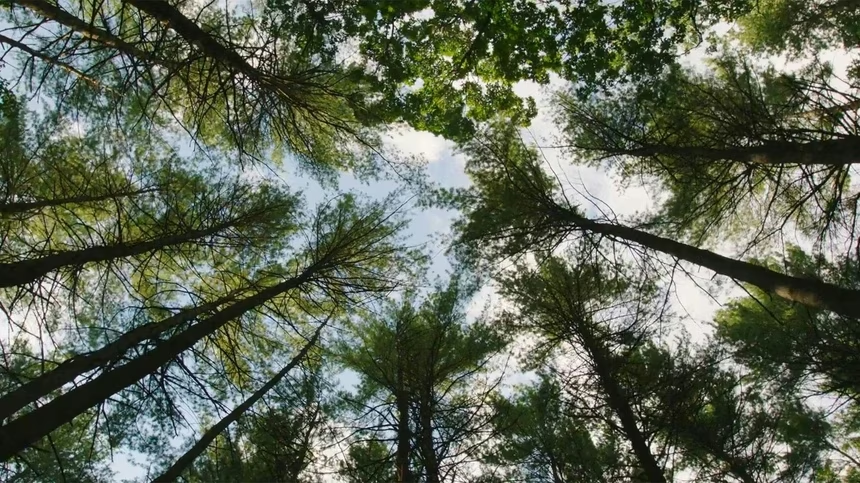
Share Meditative Moments from the Film
Explore the PBS Giphy collection for Henry David Thoreau.Announcer: Major funding for "Henry David Thoreau" was provided by... The Better Angels Society, Jeff Skoll, the Mansueto Foundation, Tyson Foods, and The Arthur Vining Davis Foundations.
Funding was also provided by the Tyson Family Foundation, The Neil and Anna Rasmussen Foundation, and by The Better Angels Society members: The Keith Campbell Foundation for the Environment and Mark A. Tracy.
Additional funding was provided by Roxanne Quimby Foundation, Jim and Mona Mylen through The HeartSpace Fund, and Elizabeth Kenny.
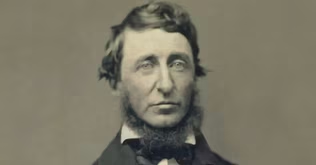
[Horse neighs, birds chirping, carriage creaking] Narrator: In the Spring of 1845, Henry David Thoreau was 27 years old.
For years, he had dreamed of spending time away from society, so he asked his friend and mentor, Ralph Waldo Emerson, if he could build a small one-room house on land that Emerson's family owned not far from the village of Concord, Massachusetts.
Emerson agreed.
[Clock ticking] ♪ Henry David Thoreau: I want to go soon and live away by the pond, where I shall hear only the wind whispering among the reeds.
It will be success if I shall have left myself behind.
But my friends ask what I will do when I get there.
Will it not be employment enough to watch the progress of the seasons?
Henry David Thoreau.
Narrator: Still mourning the loss of his brother John, who had died three years before, and facing an uncertain future, Henry was ready to try what he called "my own experiment."
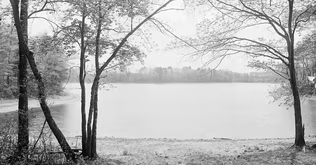
For the next two years, he would live in a small cabin at Walden Pond.
There he could focus on his writing, while contemplating the natural world and himself.
Michael Pollan: He begins a lot with Emerson's ideas about nature and civilization.
He has to try to put them into practice and see how they hold up.
Robert Thorson: He's not going into the wilderness, he's not trying to be a hermit.
He wants to position himself on the edge of society to see if he could live there, get by, and be happy about it.
Narrator: His stay would be interrupted by an expedition to the wilderness of northern Maine, and by a night in prison at the local jail, both of which would expand his understanding of freedom.
Writing about his experiences would change the lives of countless others around the world for generations to come.
Kristen Case: "I have to figure out how to live, but what does that mean?"
He really reduces that question to its absolute barest terms, and then proceeds to see what he can learn about being alive.
♪ [Insects calling, birds chirping] Henry David Thoreau: July 5, 1845.
Yesterday I came here to live.
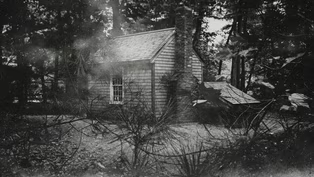
[Wind blowing, birds chirping] Narrator: On July 4, 1845, Henry David Thoreau moved into a 10-by-15-foot house on the northern shore of Walden Pond.
He had built most of it himself, cutting down trees to make a post and beam frame, which friends helped him raise.
He then attached siding from a shanty he had purchased from an Irish railroad worker, hauled up rocks from the pond for a chimney, and dug a root cellar.
He moved in, bringing along his cane bed, green writing desk, a small table, and three chairs: "One for solitude," he said, "two for friendship," and "three for society."
Some people called it a "lonely hut" and a "wooden inkstand."
For Henry, it was home.
Henry David Thoreau: My dwelling was small, and I could hardly entertain an echo in it.
It was kitchen, chamber, parlor, and keeping-room; I enjoyed it all.
[Thunder] [Rain] July 6th.
I wish to meet the facts of life-- the vital facts, which are the phenomena or actuality the gods meant to show us.
Life!
Who knows what it is, what it does?
♪ July 7th.
Tonight as I sit by my door, I hear the far off lowing of a cow.
[Cow mooing] Why should I find anything to welcome me in such a nook as this?
[Train whistle blowing] After the evening train has gone by and left the world to silence, and to me, the Whippoorwill chants her vespers for half an hour-- and when all is still at night, the owls take up the strain like mourning women their ancient ululu.
[Birds calling] Narrator: On most mornings, Henry got up at dawn to tend to his vegetable garden, including row after row of beans-- an endless task, only made harder by the woodchucks that dined on the shoots.
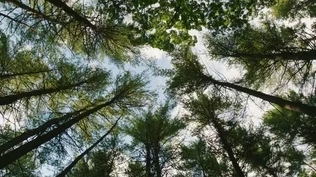
Henry David Thoreau: Every morning was a cheerful invitation to make my life of equal simplicity, and I may say innocence, with Nature herself.
I got up early and bathed in the pond; that was a religious exercise, and one of the best things which I did.
"Renew thyself completely each day."
Lawrence Buell: His morning bath he describes as a "religious exercise," not just as some sort of random dunk that he took in the pond, but as a sort of ritual act that has suddenly a significance beyond itself.
Clay Jenkinson: Thoreau also said, "I needed to clean the house, so I took all the furniture out," and "the furniture was happy to have a little excursion into nature."
He said, "I almost regretted having to bring it back in."
Michael Pollan: He waited till November to plaster his house, and before that, there were all these cracks, where, you know, animals came in, bugs came in, and the air came in.
And he loved that.
Narrator: In the afternoon, he often took long walks and made detailed field notes of everything he heard and saw-- a practice he would continue for the rest of his life.
♪ Laura Dassow Walls: Walking was a writing practice, a process of taking notes that would become the content of his journals, as inspiration or a spark to turn it into a kind of larger mythology.
Kristen Case: What he observed fed what he would write about, but what he wrote about would also lead him deeper back into observation.
♪ Narrator: Thoreau filled page after page of his journal with reflections on nature and the human condition, often referencing Greek and Roman literature, as well as ancient Eastern texts like the "Bhagavad Gita" and Buddhist sutras.
Rebecca Kneale Gould: He's saying, "All of these texts and traditions have something to teach me."
Thoreau's taking his own experience, and he's elevating it.
Pico Iyer: The vision of simplicity had been explored in Hinduism, Islam, Buddhism.
But in Concord in 1845, I think it was something radical and liberating.
So whether he knew those works or not, he inwardly rhymed with them.
♪ Narrator: Thoreau would find a way to incorporate many of these ancient teachings into the project he went there to write: a book about the trip he took on the Concord and Merrimack Rivers with his late brother John.
♪ Kristen Case: He strengthened and oriented himself in writing.
Writing was a way of being alive that was deeply nourishing to him.
♪ Henry David Thoreau: I am convinced that to maintain one's self on this earth is not a hardship but a pastime, if we will live simply and wisely.
Narrator: Throughout his stay at Walden Pond, Henry kept meticulous track of his finances.
He needed to spend money on seed and other garden expenses, but he actually made money selling his produce.
It cost him less than $20 to live there for the first six months.
Henry David Thoreau: The cost of a thing is the amount of what I will call life, which is required to be exchanged for it.
Michael Pollan: His goal is to remind us how much energy it takes, how much work it takes to make a living.
But why are you making a living?
Well, to buy these things.
Well, why do you need these things?
Henrik Otterberg: His focus was on, "How much do I have to work to secure my sustenance so that I can do what I really want to do?"
Henry David Thoreau: Our life is frittered away by detail.
Let your affairs be as two or three, and not a hundred or a thousand.
Simplify!
Simplify!
I went to the woods because I wished to live deliberately, to front only the essential facts of life, and see if I could not learn what it had to teach, and not, when I came to die, discover that I had not lived.
[Indistinct conversations] Michael Pollan: We all get lost in the challenges of everyday life.
And our world has been set up to help you do that.
As I understand it, the root of "deliberate" is from "freedom."
And it's to do something because you choose to, not because fate dictates it.
Narrator: On some days, he simply chose to do nothing.
♪ Henry David Thoreau: There were times when I could not afford to sacrifice the bloom of the present moment to any work, whether of the head or hands.
Sometimes, having taken my accustomed bath, I sat in my sunny doorway from sunrise till noon, rapt in a revery, amidst the pines and hickories and sumachs, in undisturbed solitude and stillness, while the birds sang around or flitted noiseless through the house, until by the sun falling in at my west window, or the noise of some traveller's wagon on the distant highway, I was reminded of the lapse of time.
I grew in those seasons like corn in the night, and they were far better than any work of the hands would have been.
Pico Iyer: He practiced doing nothing, which can be the hardest thing of all for many of us.
He saw the beauty of sitting still, and he knew that if he just sat by his pond reflecting, in every sense of that word, he could find everything he needed.
Clay Jenkinson: He says that one of his job descriptions is to know the nick of time, to be able to notch it on his stick.
He wants to be present.
He gets down and on the ground to look at the battle of the black ants and the red ants.
At the pond, he goes into the shallows and he finds a way to pet fish.
Try that sometime.
You have to surrender to nature and nature's rhythms if you want to be whole.
And you will see things you never saw before.
And what you see will mean more than it ever did.
♪ Henry David Thoreau: What sweet and tender, the most innocent and divinely encouraging society there is in universal nature.
There can be no really black melancholy to him who lives in the midst of nature and has still his senses.
While I enjoy the sweet friend-ship of the seasons, I trust that nothing can make life a burden to me.
Here I know I am in good company.
[Insects calling] John J. Kucich: In his beanfield, as he's hoeing his beans, he came across these arrowheads and stone implements of Native peoples, and he gets a sense that people have lived here for thousands of years, whose lives are very much written on the land.
Elise Lemire: He notices other signs in the landscape.
He saw bricks; he saw cellar holes; he saw trees and bushes that are not native to Walden Woods.
This meant someone had been there before.
Who were they?
Where had they gone?
What was their story?
Henry David Thoreau: For human society, I was obliged to conjure up the former occupants of these woods.
The woods which border it were notched and dotted here and there with their little gardens and dwellings.
John J. Kucich: In this 19th-century American New England town, you think of this kind of thriving, very close-knit community, which Concord really was to a large degree.
And then on the outskirts, there are other people.
And Thoreau is fascinated by these people who are living on the edge, living very close to the land.
Elise Lemire: These were people who had been enslaved in his hometown.
Narrator: In the 1780s, Massachusetts became the first state to make slavery illegal.
But most Black people in Concord had to choose between working as servants or scratching out a living on poor-quality land that no white person wanted to farm.
Lois Brown: Sentiments don't change just because a law is enacted.
The conditions of enslavement of labor, those may change in the law, but in practice, it's really servitude for life.
Narrator: Using local lore and his own observations, Thoreau pieced together the stories of what he called "these former inhabitants," which otherwise would have been all but lost from the historic record.
As he's writing a biography of the green space that we know of as Walden Woods or Walden Pond, he's also writing the biography of a Black space.
Henry David Thoreau: Down the road lived Brister Freeman, slave of Squire Cummings once, there, where grow still the apple-trees which Brister planted and tended; large old trees now... Elise Lemire: We're learning about a man who decided to claim for himself his new status as a free man.
But he couldn't plant a larger crop, something more in line with what other Concord farmers were planting because it's not fertile soil, so he's barely able to make his way.
Henry David Thoreau: Here, by the very corner of my field, still nearer to town, Zilpha, a colored woman, had her little house, where she spun linen for the townsfolk... Lois Brown: He describes the life of Zilpha White, who is eking out an existence.
She spins, threads, and silks for the Concord women.
Henry David Thoreau: She led a hard life, and somewhat inhumane.
One old frequenter of these woods remembers her muttering to herself over her gurgling pot, "Ye are all bones, bones!"
Lois Brown: And he describes her as living a life that is cruel and witch-like, this woman in the woods who's overheard stirring a pot and saying, "Bones, all ye are are bones."
And later he comes to a place where he says, "You know what?
She wasn't witch-like.
She's hungry."
Henry David Thoreau: East of my bean-field, across the road, lived Cato Ingraham, slave of Duncan Ingraham of Concord village, who gave him permission to live in Walden Woods.
Lois Brown: And the man to whom Cato is enslaved says, "You have freedom," but "You will receive nothing from me," So Cato begins to try to make a life for himself.
Elise Lemire: Cato has tried to secure a future by planting walnut trees, but he's preparing for a future that he never gets to enjoy.
Lois Brown: What remains in the earth is central to African-American history.
So planting walnut trees is a way of understanding that they were there, and also, they have ownership.
Ultimately, it is enslavement that kills him, because the terms of his freedom are so qualified, they're so mean-spirited.
Elise Lemire: And this is the story Henry tells us.
Narrator: Why did this small village fail, Thoreau asked, "while Concord kept its ground?"
Elise Lemire: Thoreau is asking the question at the heart of American history, at the heart of America itself: the question of why, after slavery, a community of formerly enslaved people could not be included, could not make themselves into a town that could survive and blossom.
The gentlemen of Concord abandon them to their freedom.
Lois Brown: He's trying to negotiate how there can be different histories alongside his at Walden because he gets to move wherever he wants to, because he's a person of privilege.
And all of that paves the way towards his increasing involvement in anti-slavery work and his outrage about injustice.
[Bell ringing] Robert A. Gross: The minister of a Congregationalist church once said, "Who but some half crazy, disgusted hermit would live alone and independent?"
So Thoreau's choice is a choice that his neighbors are gonna think is really strange.
Why would you live alone?
I think he went to Walden, not to escape human society but to find a vantage from which to look at it, criticize it.
♪ Henry David Thoreau: I am no more lonely than the loon in the pond that laughs so loud or than Walden Pond itself.
What company has that lonely lake, I pray?
I am no more lonely than a single mullein or dandelion in a pasture, or a bean leaf or the northstar, or the south wind, or the April shower or the first spider in a new house.
[Owl hooting] I had more visitors while I lived in the woods than at any other period of my life.
Laura Dassow Walls: Walden was basically the town's backyard.
It turned out not to be a place of solitude at all, because he's right by the road, and this is the town's favorite fishing hole and picnic spot.
Narrator: He received visitors regularly.
His friend Ellery Channing stayed with him for two weeks, sleeping on the floor.
Bronson Alcott visited weekly.
Others came by just out of curiosity.
Laura Dassow Walls: People are stopping by, and he wants to tell them what he's doing and why he's trying to simplify his life.
Henry David Thoreau: Every day or two, I strolled to the village to hear some of the gossip, which is incessantly going on there, circulating either from mouth to mouth, or from newspaper to newspaper, which, when taken in homeopathic doses, was really as refreshing as the rustle of leaves and the peeping of frogs.
Narrator: He frequently headed into town to spend time with family and friends, work at the Thoreau Pencil Company, and do chores at home.
He also picked up supplies he needed, and sometimes, dropped off his laundry.
Rebecca Solnit: When everyone pretends to hate Henry David Thoreau for exploiting female labor, they're pretending that the women in his family were just domestic drudges, that all they did was cook and wash clothes.
These women were leaders.
They were taking in the dirty laundry of America that is slavery.
So the laundry question is dismissive of all that and all the other ways he was contributing.
He paid rent to the family his whole adult life.
He did a lot of manual labor, as well as being a teacher, a nanny, and housekeeper.
Henry David Thoreau: After learning the kernels and very last sieveful of news-- what had subsided, the prospects of war and peace, and whether the world was likely to hold together much longer-- I was let out through the rear avenues, and so escaped to the woods again.
Michael Pollan: He kept himself unencumbered-- no romantic relationships that we really know about.
He didn't have children.
So the ties that bind ordinary people, he was free of a lot of those.
And that was partly the basis of his freedom.
Laura Dassow Walls: He was one of the town's, in many ways, most social people, because he walked around and talked to people constantly.
Henry was a good friend, but he was a difficult friend sometimes.
Cristie Ellis: He expected so much of friendship.
It's difficult for him to disagree with someone and still feel like he can go on being friends with you.
One of his friends said of Thoreau that his thoughts burned like a flame in him because of the earnestness of his convictions.
One of the ways you put ideas into practice is test them against other people's ideas.
So he enjoyed the argument, and it helped him refine his ideas.
But he also had a sense of the other beings we share this planet with.
This is a time when nature is either a threat or a resource.
He's finding a whole other way to think about it.
Kristen Case: It was a real series of particular relationships with particular species, kinds of weather, even individual organisms.
[Frog croaking] Pico Iyer: He considered the plants and the beans and the moon his friends as well.
And he said, How could he ever be lonely when we're part of the Milky Way?
Not all of us have such an expansive sense of friendship.
♪ Narrator: One day in the summer of 1846-- after a year in his cabin-- he went to town to pick up a mended shoe.
There, he ran into the constable and tax collector, Sam Staples, who pointed out that Henry owed four years of state poll taxes-- an annual fee that every adult male citizen was required to pay in order to vote.
Sam offered to pay it for him, but Thoreau adamantly refused.
[Cell door shuts, key turns in lock] Henry David Thoreau: I was seized and put into jail, because...I did not pay a tax to, or recognize the authority of, the state which buys and sells men, women, and children like cattle at the door of its senate-house.
Lois Brown: The economy of Massachusetts had depended on trade with the South, and they were still constrained by the times that actually permitted enslavement to exist in the first place.
Clay Jenkinson: So by paying Massachusetts taxes, he continued to sustain this appalling, immoral, anti-American economic system.
[Rifles firing] Lois Brown: And then there's the Mexican-American War, which is not just a war between two nations, it's actually an American provocation and campaign to expand enslavement.
It's a territory grab.
Henry David sees this and decides, "Well, how is my name actually attached to these enterprises?"
Through taxes.
The dollar can now have a different kind of currency.
Narrator: Henry was placed in an upstairs cell.
He spent the night there, viewing his hometown from the fresh perspective of a prison window, seeing more clearly, he said, "the State in which I lived."
Someone--probably his Aunt Maria--bailed him out.
He was "mad as the devil," Staples remembered, that someone had "interfered and paid that tax."
Within 30 minutes of his release, Henry found himself picking berries on Fairhaven Hill, surrounded by children.
"I joined a huckleberry party on one of our highest hills," he mused, "and then the State was nowhere to be seen."
Cristie Ellis: The question of how to live a life of conscience is a major question for him.
"How do you go on living at a time when simply living your life seems complicit with something you find morally intolerable?
[Indistinct chatter] Narrator: Just a week after his night in jail, Thoreau invited the Concord Female Anti-Slavery Society to host their annual event at his cabin, commemorating the end of slavery throughout the British Empire.
From Henry's open doorway, a slate of speakers addressed the small crowd, including William Henry Channing, a Unitarian minister, who called for a new U.S.
Constitution that excluded slaveholding, and Lewis Hayden, a rising abolitionist who had escaped from the plantation of the powerful Kentucky Senator Henry Clay.
Hayden told the audience the tragic story of his wife and child being sold away from him.
Laura Dassow Walls: And Thoreau starts to realize that he had a social and ethical responsibility to speak out.
He needed to give this his time and attention in a deep way as well.
Narrator: Thoreau began to write in earnest on society's obligation to uphold the principles of freedom and justice, culminating in an extensive essay that would be published three years later.
It would eventually be called "Civil Disobedience."
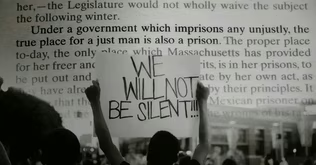
Henry David Thoreau: Under a government which imprisons any unjustly, the true place for a just man is also a prison.
It is there that the fugitive slave, and the Mexican prisoner on parole and the Indian come to plead the wrongs of his race, should find them; on that separate but more free and honorable ground, where the State places those who are not with her but against her-- the only house in a slave-state in which a free man can abide with honor.
In order to challenge the status quo, in order to recreate a new sort of society, there needs to be what Thoreau calls "counter-friction."
Slavery is a machine that is moving forward constantly.
Friction creates heat, and the machine itself breaks down.
Clinton Bembry: The human revolution in a single person can change the course of history.
♪ My Uncle Johnny went to prison.
He encountered a young man by the name of Malcolm Little.
And Uncle Johnny introduced Thoreau to Malcolm.
"The only place that a free man can abide with dignity in a slave state is in a jail cell."
That resonated with Malcolm-- that Thoreau would choose as a matter of honor a jail cell.
Malcolm Little would later be known as Malcolm X. During his prison years, he was often found reading the works of Thoreau.
Martin Luther King Jr.
: I have a dream... Kerri Greenidge: People just don't have brilliant ideas about justice and redemption from an empty, blank slate.
[King's speech continues, indistinct] Kerri Greenidge: Martin Luther King was reading Thoreau.
"Civil Disobedience," the words of Henry David Thoreau, could be used to disobey laws because they were unjust.
So a person like a King or a Malcom X found solace in what Thoreau was talking about.
[People shouting, whistle blows, cell door shuts] Arun Gandhi: The first time Gandhi was imprisoned, somebody gave him a copy of Thoreau's "Civil Disobedience" for him to read.
Thoreau was thinking on the same lines as he was.
That's how Gandhi began his civil disobedience campaign.
You need some adrenaline once in a while, you need a booster shot, and his essay provides that, even this late in the 21st century.
Cristie Ellis: How do we talk about problems of conscience when you're in the minority and you feel like your country is moving in the wrong direction?
He said, "I feel called upon to right the wrongs of my country."
[Protestors chanting, indistinct] Henry David Thoreau: The tops of mountains are among the unfinished parts of the globe, whither it is a slight insult to the gods to climb and pry into their secrets, and try their effect on our humanity.
[Wind blowing] Their tops are sacred and mysterious tracts never visited.
♪ Narrator: On August 31, 1846, Thoreau left Walden Pond to join his cousin, George Thatcher, on an excursion to Katahdin in Maine-- the highest mountain in the state.
♪ He brought along a small notebook and pencil to write about what he discovered there.
[Waves breaking] James Finley: He wanted to time travel, to see what Massachusetts looked like a few generations before.
And then come back and tell the tale of what he'd seen.
That feels like the exact opposite of what he has at Walden Pond.
It was a frontier that was very nearby.
James Finley: At the same time, he recognizes that it's not a pristine, untouched wilderness.
James Eric Francis Senior: You see industry.
Bangor was the lumber capital of the world.
Thoreau describes Bangor in 1846 as this cosmopolitan city right on the edge of wilderness.
He also recognized that he was going through spaces that people had worked, traveled, and lived on for thousands and thousands of years.
Narrator: Thirteen miles north of Bangor, Henry stood on deck as their steamship passed a Penobscot reservation on Indian Island.
♪ He watched a Native hunter get out of his canoe, carrying a bundle of fur skins and an empty keg of alcohol.
Henry David Thoreau: This picture will do to put before the Indian's history, that is, the history of his extinction.
I observed some new houses among the weather-stained ones, as if the tribe had still a design upon life; but generally they have a very shabby, forlorn, and cheerless look.
The church is the only trim-looking building.
Good Canadian it may be, but it is poor Indian.
These were once a powerful tribe.
I even thought that a row of wigwams, with a dance of powwows and a prisoner tortured at the stake, would be more respectable than this.
[Boat's horn blowing] Carol Dana: Oh, they're always saying that!
We're the last of this, the last of that.
If you knew what the hell we had to go through, yeah, we look woebegone.
This was our homeland.
John J. Kucich: These are people who have been robbed of their territory and forced to live a very impoverished existence on the margins of society, and what Thoreau cannot see is that he is part of this world as well and part of the process that makes this happen.
James Eric Francis Senior: Standing there with that postcard view of Indian Island, looking for that "noble savage," he's disappointed.
All his life, he's looking for relics.
He's looking for relics in people, too.
Thoreau is not coming to Maine really to engage with Native people at this point.
He's going to find the biggest, wildest mountain he can find and see what's on top and bring that back.
Narrator: Once they reached the wilderness, they continued under the guidance of two white settlers who knew the terrain well.
♪ On September 5th, 73 miles north of Bangor, they paddled across Quakish Lake.
♪ Henry David Thoreau: We had our first but a partial view of Ktaadn, its summit veiled in clouds, like a dark isthmus in that quarter, connecting the heavens with the earth.
Narrator: After three more days of paddling, they arrived at the base of the mountain.
Carol Dana: At the summit of Mount Katahdin, it's unpredictable weather up there.
If you are up there, be ready for anything.
You're gonna be tested.
Narrator: While the others set up camp, Henry tried to reach the summit alone but failed.
The next morning, the party set off together.
Thoreau scrambled upward in earnest, leaving his fellow travelers far behind.
♪ Henry David Thoreau: I was deep within the hostile ranks of clouds, and all objects were obscured by them... the cloud-line ever rising and falling with the wind's intensity, the mist driving ceaselessly between it and me.
It was vast, Titanic, and such as man never inhabits.
Rebecca Kneale Gould: He's freaked out.
He was scared up there in a way that he had not been scared anywhere before.
Narrator: Henry never made it to the summit.
He was forced to turn back.
His companions were waiting for him below, and, following a stream, they made their way to a meadow farther down the mountain.
There, Thoreau made an exhilarating discovery-- far more transcendent than what he had hoped to experience on the summit.
♪ Laura Dassow Walls: He has this eerie feeling of displacement that really throws him.
He's thinking about the fields in Concord and the field on the side of Mount Katahdin.
These two places together, familiar and strange.
I'm not even sure he quite understood what had happened to him at the time, because it's not until he's down the mountain and really letting it sink in and reflecting on it that he actually writes the memorable passage "Contact!
Contact!"
♪ Henry David Thoreau: I most fully realized that this was primeval, untamed, and forever untamable Nature.
Here was no man's garden, but the unhandselled globe.
It was the fresh and natural surface of the planet Earth, as it was made forever and ever... I stand in awe of my body, this matter to which I am bound has become so strange to me.
Talk of mysteries!
Think of our life in nature-- daily to be shown matter, to come in contact with it-- rocks, trees, wind on our cheeks!
The solid earth!
The actual world!
The common sense!
Contact!
Contact!
Who are we?
Where are we?
[Insects calling] John J. Kucich: You can see Thoreau finding language failing him.
"Who are we?"
and "where are we?"
aren't questions you want to answer; they're questions you want to live.
♪ Henry David Thoreau: Not till we are lost, in other words not till we have lost the world, do we begin to find ourselves, and realize where we are and the infinite extent of our relations.
Rebecca Kneale Gould: The membranes between him and nature are completely dissolved.
That sort of mystical, scary experience he brings with him.
Narrator: After two weeks in Maine, Henry arrived home.
As he looked upon the familiar landscape that surrounded him, he realized what he had experienced at Katahdin could be experienced everywhere.
Laura Dassow Walls: And it was a feeling of "wildness."
And his writing starts to bubble with all the extraordinary observations he's able to make.
Robin Wall Kimmerer: Nature is all around us.
It's right in the tree that you have walked by every day of your life, and then you see something new that you've never seen before.
It blows you away.
♪ Michael Pollan: Speaking of autumn leaves, he said, if this had happened only once, it would've gone down in mythology as one of those events we read about in Greek myth or whatever, that suddenly all the leaves turned red and yellow... [Laughs] and the forest was on fire.
But, of course, it happens every year and, you know, we take it for granted.
This is the wonderful way in which Thoreau sometimes shocks you into an awareness that you should have had yourself, but you didn't.
♪ Laura Dassow Walls: He did some of his most brilliant writing in the winter.
It was the time he went to his journal with new inspiration and a sense of digging in, exploring inner worlds.
And then he'd go out and do things like study ice crystals and come to great cosmic realizations from the smallest of things to the largest of things.
He loved cold.
♪ Narrator: In the winter of 1847, Henry ventured outside not only to take long walks and ice skate, but to drill hundreds of holes in the ice to collect data about Walden's temperature and depth, culminating in a unique map of the pond.
That same winter, a team of Irishmen came from Cambridge to harvest ten thousand tons of ice to sell for refrigeration.
Henry studied the ice, noting the gradations of color, its changing texture, and how quickly it melted, and imagined just how far it could be shipped.
Perhaps the "inhabitants of Madras and Bombay and Calcutta" will "drink at my well," he wrote, so that "Walden water is mingled with the sacred water of the Ganges."
Rebecca Kneale Gould: This is a way for him to say profound sacredness can be found anywhere if you commit to seeing it.
♪ Henry David Thoreau: March 26.
Suddenly an influx of light filled my house.
I looked out the window and lo!
Where yesterday was cold gray ice, there lay the transparent pond, already calm and full of hope.
[Robin calling] I heard a robin in the distance, the first I had heard for many a thousand years.
It was no longer the end of a season, but the beginning.
Narrator: Spring rain brought new life to the woods and fields around Thoreau's cabin, and revealed an intriguing phenomenon that appeared in what he called "the Deep Cut," a man-made excavation carved into the earth so that railroad tracks could be laid flat.
When there was just the right amount of water, it would burst forth on the surface and start giving miniature rivulets of sand flows.
He could see what looked like leaves of ferns or leaves of trees that would just be created on the bank.
Henry David Thoreau: I am affected as if in a peculiar sense, I stood in the laboratory of the Artist who made the world and me-- had come to where he was still at work, strewing his fresh designs about.
What is man but a mass of thawing clay?
There is nothing inorganic.
Laura Dassow Walls: He sees life organizing itself through matter, and he realizes that there is not only no divide between human and natural, there's really no divide between organic and inorganic.
Kristen Case: So we are in there, we're like the dirt, we're like the trees, we're matter.
Cristie Ellis: We have been created by this world, and we are of it and part of it.
He's starting to recognize the interconnection of everything.
J. Drew Lanham: Even though we may not all speak the same language, we ultimately all depend upon the same air, the same water, the same soil.
So the whole idea of a kinship with nature puts us in a place where we're responsible.
[Chimney hissing] [Frog croaking] Henry David Thoreau: Why I left the woods?
I do not think that I can tell.
I have often wished myself back.
Perhaps I wanted a change.
There was a little stagnation, it may be.
♪ Perhaps if I lived there much longer, I might live there forever.
One would think twice before he accepted heaven on such terms.
Narrator: On September 6, 1847-- after two years, two months, and two days-- Henry David Thoreau left Walden Pond.
He had completed the first draft of a manuscript about his river trip with John.
And he had also begun drafting a second one about his experiences at Walden.
Over the next seven years, he would revise it multiple times, incorporating ever deeper insights with each draft, and combining his two years of experiences into one cycle of seasons.
"Walden; Or, Life in the Woods" would be released in 1854.
The book would eventually sell millions of copies, reaching into every corner of the globe.
He's not someone who turned his back on his society to go live in the woods.
He was writing a critique of the world he was born into.
And he thought that what nature gave us was a firmer place to stand.
John J. Kucich: I think there's a sense that if you walk and travel thoughtfully, then the land will tell you things about what it means to be a part of this rhythm of life that feels very different from the frenetic pace of the village.
♪ Henry David Thoreau: I learned this, at least, by my experiment: If one advances confidently in the direction of his dreams, and endeavors to live the life which he has imagined, he will meet with a success unexpected in common hours.
He will put some things behind, will pass an invisible boundary; new, universal, and more liberal laws will begin to establish themselves around and within him; and he will live with the license of a higher order of beings.
Clay Jenkinson: He says, "you will cross an invisible boundary."
Crossing the invisible boundary is the experiment that he was in.
Laura Dassow Walls: Thoreau is trying, I think, to show us that the divide that we assume is out there somehow dividing us from the natural world really doesn't exist.
Henry David Thoreau: We must learn to reawaken and keep ourselves awake not by mechanical aids, but by an infinite expectation of the dawn... To carve and paint the very atmosphere and medium through which we look... To affect the quality of the day, that is the highest of arts.
Michael Pollan: His insistence on practice.
It wasn't enough to have an idea.
You had to live it.
And if you wanted to reduce Walden to its essentials, I would say its message is wake up.
We're sleepwalking through life a lot of the time.
We have technologies for the avoidance of what's important.
Look around you.
Pay attention to what matters.
Be conscious.
Be.
Rebecca Kneale Gould: He never is asking people to go put up a shanty by a pond.
He's saying each person is an individual.
So his message is to wake you up to your own life.
And then you follow it.
Narrator: Shortly after leaving Walden, Thoreau wrote to his Harvard class secretary in response to a survey marking the ten-year anniversary of their graduation.
Henry David Thoreau: I confess that I have very little class spirit.
However, I will undertake at last to answer your questions as well as I can.
I am not married.
I am a Schoolmaster-- a Private Tutor, a Surveyor-- a Gardener, a Farmer, a Painter-- I mean a House Painter-- a Carpenter, a Mason, a Day-Laborer, a Pencil-Maker, a Writer, and sometimes a Poet.
For the last two years, I have lived in Concord woods alone, something more than a mile from any neighbor, in a house built entirely by myself.
I have found a way to live without what is commonly called employment or industry, attractive or otherwise.
Indeed my steadiest employment, if such it can be called, is to keep myself at the top of my condition, and ready for whatever may turn up in heaven or on earth.
Laura Dassow Walls: Isn't the whole point of living an experiment is to try something out, and if it works, you can then take it out into the world.
But I think maybe he understood that the problem of how to live was not something he was gonna solve once, that that was gonna be an ongoing problem, and that he was gonna solve it different ways on different days, in different experiments through the rest of his life.
Henry David Thoreau: It seemed to me that I had several more lives to live, and could not spare any more time for that one.
♪ ♪ ♪ ♪ ♪ ♪ ♪ Announcer: Next time on "Henry David Thoreau"... Henry David Thoreau: I had several more lives to live.
Laura Dassow Walls: The point was to take Walden back out into the world.
Announcer: new pursuits... Henry David Thoreau: Let your life be a counter-friction to stop the machine.
Announcer: and new discoveries.
Henry David Thoreau: To hear this unaltered Indian language, it took me by surprise.
Cristie Ellis: The thing he models for us is a life committed to ongoing investigation.
Henry David Thoreau: Rustling leaves...They teach us how to die.
Announcer: Don't miss the conclusion of "Henry David Thoreau."
Announcer: Scan this QR code with your smart device to watch the whole series and learn more about Henry David Thoreau.
Announcer: The "Henry David Thoreau" DVD is available online and in stores.
The series is also available with PBS Passport and on Amazon Prime Video.
The digital companion soundtrack is also available online.
♪ ♪ ♪ ♪ ♪ Announcer: Major funding for "Henry David Thoreau" was provided by... The Better Angels Society, Jeff Skoll, the Mansueto Foundation, Tyson Foods, and The Arthur Vining Davis Foundations.
Funding was also provided by the Tyson Family Foundation, The Neil and Anna Rasmussen Foundation, and by The Better Angels Society members: The Keith Campbell Foundation for the Environment and Mark A. Tracy.
Additional funding was provided by Roxanne Quimby Foundation, Jim and Mona Mylen through The HeartSpace Fund, and Elizabeth Kenny.
 New
NewHenry David Thoreau Moves to Walden Pond
Video has Closed Captions
Clip: Ep2 | 11m 14s | On July 4th, 1845, Henry David Thoreau moves into a 10x15-foot house on Walden Pond. (11m 14s)
 New
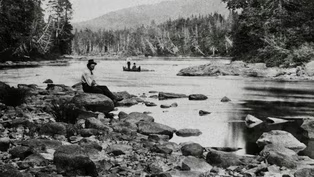
NewJourney to Mount Katahdin and Untamable Nature
Video has Closed Captions
Clip: Ep2 | 9m 22s | Leaving Walden Pond, Thoreau joins his cousin on an excursion to Mount Katahdin in Maine. (9m 22s)
 New
NewThoreau Challenges Justice with His Essay "Civil Disobedience"
Video has Closed Captions
Clip: Ep2 | 7m 14s | Thoreau's refusal to support what he saw as injustice culminates in his essay "Civil Disobedience." (7m 14s)
 New
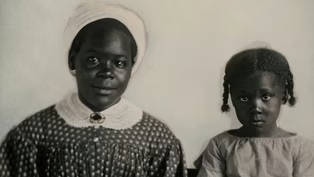
NewThoreau Tells the Stories of the Black Community in Concord
Video has Closed Captions
Clip: Ep2 | 5m 50s | While slavery is illegal in Massachusetts, Black communities are forced to the margins of society. (5m 50s)
Providing Support for PBS.org
Learn Moreabout PBS online sponsorship













Support for PBS provided by:
Episodes presented in 4K UHD on supported devices. Major funding for HENRY DAVID THOREAU was provided by The Better Angels Society and its members: The Keith Campbell Foundation for the...