
Castle Farms , Hour 1
Season 30 Episode 10 | 52m 24sVideo has Closed Captions
ROADSHOW visits charming Charlevoix, MI in search of hidden treasures and their stories.
ROADSHOW visits charming Charlevoix, MI in search of hidden treasures and their stories. One inherited artwork is valued at $150K!
Problems playing video? | Closed Captioning Feedback
Problems playing video? | Closed Captioning Feedback
Funding for ANTIQUES ROADSHOW is provided by Ancestry and American Cruise Lines. Additional funding is provided by public television viewers.
Support provided by:


Castle Farms , Hour 1
Season 30 Episode 10 | 52m 24sVideo has Closed Captions
ROADSHOW visits charming Charlevoix, MI in search of hidden treasures and their stories. One inherited artwork is valued at $150K!
Problems playing video? | Closed Captioning Feedback
How to Watch Antiques Roadshow
Antiques Roadshow is available to stream on pbs.org and the free PBS App, available on iPhone, Apple TV, Android TV, Android smartphones, Amazon Fire TV, Amazon Fire Tablet, Roku, Samsung Smart TV, and Vizio.
Buy Now

ANTIQUES ROADSHOW's 2026 Production Tour
Enter now for a chance to win a pair of free tickets to one of the three stops on ANTIQUES ROADSHOW's 2026 Tour. Sweepstakes entry deadline is April 6.Providing Support for PBS.org
Learn Moreabout PBS online sponsorship♪ ♪ CORAL PEÑA: "Antiques Roadshow" is storming Castle Farms in a friendly way as we visit Charlevoix, Michigan.
GUEST: I received that from a dear friend.
Her husband had passed.
Was her husband's name Ed by any chance?
It was, it was.
(laughs) ♪ ♪ PEÑA: Over the decades, Castle Farms has served as a venue of different purposes to different people.
The former farm complex, located near the shores of Lake Charlevoix, started as part of a summer residence when it was built in 1918.
Since then, it's been a dairy farm, an artists' haven, a rockin' concert venue, a popular wedding destination, and today, the regal backdrop for "Antiques Roadshow."
What treasures coming in today will be treated like royalty?
Take a look.
♪ ♪ Good, have fun.
Go through the white arch.
Woo-hoo!
(laughter) APPRAISER: So tell me about your chair.
GUEST: It was left in the cottage that my parents bought, like, 65 years ago.
APPRAISER: Okay-- it's really cool.
First of all, it's got the lion head, it's very decorative.
It's also made out of quartersawn oak.
I think the green eyes are unbelievable.
It's worth probably $300, $400 bucks somewhere in there, Give or take.
Okay.
Well, I have a E-Evelyn Ackerman mosaic that I picked up a few years ago in an antique mall locally.
I-I paid $100 for it.
Well, I love that this has turned up in Michigan because this has a Michigan origin story.
Does it?
Both Jerome and Evelyn Ackerman were born in Detroit in the 1920s.
Evelyn and Jerome Ackerman were really influential mid-20th century modern artists.
Mm-hmm.
And they both studied here in Michigan.
What you have here is, is one of their glass mosaics that Evelyn started designing in 1955.
Originally, Evelyn did the design and production of these herself, but the orders were coming fast and furious... Yeah.
...and it was just too much for them to keep up with.
So eventually they handed off the manufacture of these to a family of artisans in Mexico City.
Okay.
And that's where this was made.
Okay.
We looked at the original order form from 1958.
So we know the title of this work is "Birds in...
...Cage."
Cage.
And at the time that this particular mosaic was produced, uh, it was sold for $70 retail or $35 to the trade.
Okay.
And a lot of what the Ackermans did was selling to the trade.
They sold to interior designers.
Yeah.
They sold to architects and they sold to department stores.
Yeah.
And they're composed of Venetian glass tesserae, pieces that are arranged in this way so that you could create these types of patterns.
And what Evelyn did is she designed these in like, a small cartoon sketch... Mm-hmm.
...and then she blew them up, uh, to full size, and she would ship over to Mexico City the original drawing, as well as a color key code.
How she wanted the birds to look... Yeah.
...what was the color of the cage and the background.
And they were issued in a few different sort of color ways.
Yeah.
And they're always on this, this Masonite backing.
Okay.
Which was great to see.
This is its original wood frame, exactly as it was produced.
The Ackermans' work has been receiving a lot of attention... Mm-hmm.
...particularly in the last ten to 15 years.
Yeah.
In 2005, this panel came up to auction with another panel; a companion piece, you might call it, that also had birds in it.
Okay.
And in 2005, those two panels sold at auction for $650.
So about $325 each.
Yeah.
In today's market, if this panel were to come to auction, we would conservatively estimate it between $4,000 and $6,000.
Oh, my.
(chuckles) I see a lot of their pieces online, and I kind of keep an eye out for their work.
I mean, it doesn't turn up a whole lot.
Um, this is actually a coin bank.
We thought that a cork belonged in here, but it actually is a lid where you can put coins and save up.
There's Ball, Anchor Hocking, Turner Glass, all kinds of things.
So it was really cool to learn about.
These belong to my husband's grandmother, and then his parents.
And when they sold their home, we were divvying up stuff, and we were lucky enough to get-- this is one of a pair of andirons and fireplace tools.
She made up a lot of stories, so we are not quite sure where they're from.
I love golf.
I've played since I was a kid.
This locket was given to the architect of the Eisenhower Cabin at Augusta National.
The picture was given by Dwight Eisenhower to all the individuals that donated money for the construction of the cabin.
I bought the locket on an online auction in 2014.
And I believe it was a little over $2,000.
The picture, I really do not remember.
I don't know where I bought it, or honestly, what I paid for it.
This locket, for golf fans, they'll instantly recognize the map and flag logo.
Augusta National Golf Club was founded in 1931 by the Grand Slam-winning golfer of 1930, Bobby Jones and his partner, Clifford Roberts.
Now, let's fast forward to 1952.
That year, they decided to create and give out lockets in the form of the map and flag logo to the winners.
And it's almost the certificate of membership into the Masters Club.
Sure.
You get one when you win the first time.
Okay.
This is a locket that was designed after the lockets that were given out to the Masters winners.
Dwight D. Eisenhower started playing golf in the 1920s.
He became infatuated with it.
It was one of his favorite hobbies.
In 1948, he was brought down to Augusta by one of their members.
Bill Robinson loved the club, became a member.
He becomes President Eisenhower in 1952.
They realize that they have to build a special cabin for him so he can have privacy when he goes back to Augusta National Golf Club... Sure.
Yeah.
...every year-- they hired H. Lowrey Stulb.
Okay.
And his firm, Stulb and Eve, had six months... Okay.
...to build this cabin.
Now it's not a cabin as we can see here.
It's a three-story, seven-room structure.
Really nice house.
With-- and they built a basement for the Secret Service.
(chuckling): Okay.
So because they finished on time and in such, and in such a great manner, Bobby Jones, Clifford Roberts and the Eisenhowers wanted to gift something special... Okay.
...to Stulb, the architect, and to the interior designer, Edith Hill.
Okay.
What could be more special than this locket?
Sure.
So they went to this jeweler, October of '53.
Okay.
And had lockets made for both of them.
Okay.
So you see the map and flag logo and then you open it up, and look, there is the cabin and there are the engraved signatures of Mamie and Ike.
Yeah.
And then you open this, and now you see the signatures of Cliff Roberts and Bobby Jones.
And you see the portraits... Yeah.
...of Mamie and Ike.
Right.
Now we flip it around.
How do we know that it was Mr.
Stulb's?
Well, there's his name engraved right there.
Sure.
The photo, which we did examine, we're not professional authenticators... Okay.
...but we believe the signatures to be authentic.
So this photo, I would put an auction estimate of $2,000 to $3,000 on it.
Really?
Wow.
(chuckling): That's incredible.
Now, let's get to the locket because it also has the box, that does add value.
I would put an auction estimate of $25,000 to $30,000.
God.
Wow, that's crazy, I can't wait till my kids hear this.
(chuckling): So... They think I'm nuts, so, uh, this will... that is awesome.
Wow.
Okay.
Great.
PEÑA: Castle Farms was originally part of a 1,500-acre estate owned by the Loeb family.
JESSICA ANDERSON: Albert Loeb was the acting president of the Sears and Roebuck Company.
The original and the best mail-order catalog.
The inspiration for the castle came from Albert and Anna's honeymoon in France.
And they based all of their architecture on French Normandy-style castles.
He wanted to show how successful you could be if you used all of the farming equipment that was sold in their catalog.
So he built this as a working model dairy farm.
So Albert had 200 head of Holstein Friesian cattle and had an award-winning cow.
She set a world record.
Named Marian, she produced 35,000 pounds of milk in one year and had to be milked six times a day.
So it was really great that we were the first farm in Michigan with automated milking machines.
GUEST: I've got a Super Nintendo "Donkey Kong Country" competition cartridge.
It starts up in the game, like, right at the first level and just goes for, I want to say, five, ten minutes, and then just shuts the game off-- I'm assuming that either a friend gave it to me or I could have bought it and not known that I accidentally got the competition cartridge.
I love going to flea markets, though.
And I've had like a game reseller there offer me $1,000 for it.
And that was probably around 2012, which made me realize even more so I should probably hang onto it because it must be worth a little more than that at least.
It's a particularly rare and iconic video game.
This was from the Super Nintendo Entertainment System, S.N.E.S., which is a great system, I grew up playing it.
Yeah.
Um, I loved this game as a kid.
So this was made for competitions.
Mm-hmm.
There were two competitions.
The first one was in 1994.
It was Nintendo PowerFest.
Oh, wow.
And then in 1995, there was a Blockbuster Championship.
And the goal of the competition was to get the highest score within five minutes.
So then after the competition was done, some of the copies were sold through-- Nintendo had a magazine, "Nintendo Power," which was to subscribers.
Those subscribers were offered the opportunity to buy the cartridges, 'cause they weren't-- didn't need them for the competition anymore.
Okay, interesting.
So I don't, it's not clear how many or if all of them were sold that way.
Mm-hmm.
Some of the literature suggests that there were only 2,500 copies of the competition cartridge made.
Oh, wow.
And very few wind up getting into the market.
A lot of them are in collector hands.
Wow.
As you can see, this cartridge has Hollywood Video stickers on it.
Mm-hmm.
Uh, which is interesting.
And I wasn't able to find any record of the competitions being done at Hollywood Video.
The 1995 competition was a Blockbuster competition.
Mm-hmm.
A major competitor or the major competitor of-of Hollywood Video.
Yeah.
I see there's writing on it.
Yeah, that's my initials.
Just at some point, my brother and I, friends, trying to keep games separate.
And by then I had already had this one just inexplicably in my possession for a while.
So I was like, it's mine.
These sell not frequently.
Okay.
Conservatively, at auction, I would estimate it between $2,000 and $4,000.
Oh, right on.
And it could be more.
One recently, a graded copy that didn't have the-the initials Sharpied, the label on the top, which was added... Okay.
...and it didn't have the slight damage to the back sticker.
That sold for $5,500.
Oh, wow.
Geez Louise.
So it could-- I would keep it as-is.
You could always submit it for-for grading, but with the, with the-the writing on it, they probably would give you some kind of qualification on the grade.
I gotcha, okay, cool.
Yeah.
Well, thank you so much.
I don't know that much about it.
Um, I know that it was purchased in, I think, the early '90s from a charity auction for a private school.
And it was given to me by my best friend.
It was her mother's, um, and she was just like another mother to me.
So it's very special to me.
It feels like it's marble.
It's very, very heavy.
GUEST: They were acquired by my grandmother in maybe the 1940s or early '50s in the Southwest.
She wintered in Tucson, Arizona.
These are really wonderful paintings.
These are coming out of New Mexico.
There are eight northern pueblos.
This is all along the Rio Grande Valley.
So this would be right north of Santa Fe by maybe 20 miles.
Oh, for heaven's sakes.
Yeah, it's called San Ildefonso Pueblo.
And these were probably done in the, uh, you-you know, late '20s, early '30s.
These paintings were done by Tonita Peña, who often signed her name Quah Ah.
That was her Indian given name.
She was born in 1893, and she died in 1949.
She's one of the earliest Native American women painters.
Prior to this, people were predominantly working on pottery.
Mm-hmm.
They're doing textiles, and so this is sort of a new industry.
These are watercolors.
The condition is fantastic.
This is actually a ritual dance of the pueblos, which is a basket dance.
Look at the details that we have in the baskets.
Look at the necklaces.
There's coral and there's shell and turquoise, but also these great greenery.
Over here, in this painting closer to you, we've got two hunters and two attendants, singers and a drummer.
And then we've got, this is a deer dancer, which is part of an animal dance.
Mm-hmm.
But I love all of the details, and that's what she was really known for was she was very specific.
These are ceremonies that are autumnal and-and about harvest.
They're about hunting, and they're about sustaining life within that village.
Mm-hmm.
I have, uh, six more of these paintings.
Okay.
My husband and I chose these three to keep.
And we were going to put the other, which were much smaller, in a garage sale.
And my daughter said, "Oh, Mom, don't do that."
Yeah.
(chuckles) She said, "I love those."
And I said, "Well, do you want them?"
And she said, "Yes."
And so they're hers.
She saved them from a garage sale?
(laughing): She saved them from the garage sale.
Oh, I love this, yes.
Yeah.
We did not think that they were maybe valuable.
We just love them.
Yeah.
I'll start with this one closer to me, the basket dance.
Mm-hmm.
So this particular painting, if it were coming up for sale in a retail situation, would be worth about $4,500.
Oh, my word.
(chuckles) Yeah.
That's a real surprise, yeah.
Yeah.
So the one closer to you... Oh, my goodness.
...maybe just a little less, maybe around $3,800?
Yeah.
Yeah.
This smaller one is going to be worth around $1,600.
That's beautiful.
Thank you.
That's a surprise.
Fantastic.
They may have been sold for $20, $15 at the time.
(chuckling) GUEST: This is a silk tapestry.
It was given to my dad by a client of his back in the early '50s, I believe.
Okay.
My mother took it to an appraisal.
She was told that it was probably circa 1900, and that it was worth around $700.
How long ago did you have it appraised for $700?
I think it was somewhere in the neighborhood of 20 years or so.
It went from my folks to me, but it's always just been stored either in their basement or in my basement.
(both chuckle) Country of origin: Chinese.
And very, very overtly Chinese.
But in terms of the date, this is where it's really interesting.
If they were to identify this border, for example, 1900, not so far off.
But, the majority of this so-called tapestry or textile, 18th century.
Oh!
So this is quite, quite old.
And this would date, I would say, likely the last quarter of the 18th century, 1775.
It has this lovely horizontal shape, but it didn't begin its life this way.
This textile that you have, very symmetrical with these seams that sort of separate four panels.
This was originally a robe, a garment, mind you, that not just had these four dragons, but would have had five others, too.
Wow.
(chuckling): Five dragons are elsewhere, who knows, hopefully still in existence.
But this is the configuration that has nine dragons in all.
It would have been in the style of an imperial court robe, but it also has some Buddhist iconography on it.
So this may have been a priest's robe done in the imperial style.
In the 18th century, the emperors, specifically, were devout Buddhists.
So Buddhist iconography and imperial iconography really sort of came together.
It's a roiling sea with mountains that come out of it.
The mountains are the earth.
And then finally, this realm in which the dragons fly, this is the heavens, the celestial realm.
Furthermore, though, these creatures right here, which somewhat resemble butterflies, these are actually bats.
And bats only have the significance that they do here in Chinese.
Why?
Because the word in Chinese for bat, "fú," is also the word for prosperity.
Even the clouds, the shape of the clouds are reminiscent of a, of a particular fungus called the lingzhi fungus, which bestows immortality.
So everything in this has meaning, it's auspicious, and it is in some respects associated with the divine.
So this is an altar frontal.
So in a shrine or in a Buddhist temple... Oh... ...they would repurpose these robe panels to go into the front of an altar.
Right.
There is a strong market right now for Chinese textiles, and this is driven by Chinese interest.
I think that this particular textile would have an auction value from $4,000 to $6,000.
(laughing): Oh, my goodness.
I'm speechless.
(laughs) You know, I think about it just being stored in the pole barn.
(laughs) Well, I'm a collector of lanterns and, uh, I found this about 20 years ago at an estate sale.
And from the limited research that I could find about it, it was, I believe, made in, uh, Ohio Brass Works, uh, in Ohio.
And it was one of the very first pneumatic pump-up type lanterns.
I think I only paid $20 for it back then.
Um, I don't really know too much about it.
I picked it up at a local Salvation Army store and I just thought it was pretty.
And, uh, I'm hoping we find out something about it today, 'cause I have no idea about it.
It was four dollars, so.
Four or more, I'll be happy.
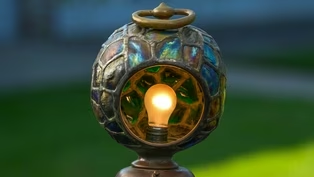
GUEST: Well, this is a, um, Tiffany-- maybe, right?-- diver's helmet, I think.
APPRAISER: Okay.
That's all I know.
I-I bought it in 1974 from an antique friend of mine, antique dealer.
He never told me what it was, really.
He just-- I bought it.
It's a great nightlight.
Yeah?
Yeah.
How much did you pay for it?
Uh, about $1,100.
Okay, do you think that was a good deal?
Yep.
Yeah?
All right, so what would you like to know from me today?
Is it really a Tiffany?
The good news is, yes... It is?
...it is a Tiffany Studios lamp.
Well how-- I don't see a signature on it.
Because it would have been on the base plate, and it's missing.
Oh... oh okay.
Ah, yes.
So this is actually a diver's lantern.
Okay.
Not a diver's helmet.
Not.
Okay.
It's had kind of a hard life, sir.
It has?
Yes-- the handle's a little worn.
You can see that some of the leading, it's not patinated... Mm-hmm.
...it's painted.
And some of the painting's come off.
Oh.
Okay.
And the switch is replaced.
Oh, God.
Oh, gosh.
Oh, no.
But it's still a Tiffany lamp.
Yes, it is.
Okay, good.
And it's an early Tiffany lamp.
And it's one that everybody's looking for.
Oh, great.
So we would date this to be circa 1900 to 1910.
Okay.
If we had the base plate, we'd be able to narrow that down to a specific date... Mm-hmm.
...but it's missing and it can't be replaced.
So that's why we've given a little bit of a range.
Have you seen these before?
I have seen one before.
With the base plate?
With the base plate.
So, looking at this piece, and knowing that it's had a hard life, and knowing that there's some damage to it, and knowing that it's kind of rough, at retail today, $25,000 to $30,000.
Holy Toledo.
Wow.
Ooh!
My ex-wife is gonna know about you.
(chuckles) Oh, my gosh, $25,000 to $30,000?
Wow, I never-- okay.
I never thought it'd be worth that much money.
Wait till I tell my buddy who I bought this from.
I'll be darned, well, thank you very much, I appreciate it.
I'm going to enjoy happy hour tonight, I can tell you that.
GUEST: In, like 1989, I was working at a government facility in Lexington, Kentucky.
They were getting ready to do a bunch of renovation.
I kept seeing all these dumpsters and I saw some stuff, lamps and things, I thought was pretty nice.
So I asked my boss, "Where is that stuff all going?"
He says, "To the dump."
I said, "Well, if there's anything in there, that's, that I would like, could I have it?"
He said, "Well, sure.
Tomorrow, it's going to the landfill."
Okay.
So after work, I went out and looked around a little bit.
This was kind of hanging, kind of, precariously out of one of the dumpsters.
(chuckling): Okay.
And I picked it up and looked at it and I said, "Well, this is kind of interesting."
I took it home and cleaned the glass off.
It had a lot of smoke and nicotine on it.
So it's been hanging in our house off and on for a number of years, and we enjoy it.
The building started in the early '30s as a federal reformatory for drug users.
Okay.
And then later on in its life, the federal prisons moved in there.
Gotcha.
Okay.
And when I was there, it was just a minimum security, so there was no fences or anything like that.
But then due to demands, they decided they were going to put fences up.
And so that was... that started the renovation; opening up walls and pushing things back and... I think it's kind of sad that they didn't want this in a prison, I think this could cheer up a prison.
Yeah, that's-that's what I think the whole purpose was, I think, originally, because it is kind of a happy scene.
Mm-hmm.
And, and it could have worked very well there.
(chuckles) Yeah, absolutely.
This work is by Ethel Spears.
It's, uh, signed here, lower right.
You can see it's very tiny.
And it is watercolor and gouache and pencil on paper.
Ethel Spears was born in 1903 and she died in 1974.
She initially trained at the School of the Art Institute of Chicago in tapestry and textiles.
As I understand it, she finished her training and then decided, no, I don't want to do that, and then moved over to paintings.
And she studied with a, a modernist muralist, a guy named John Norton.
From there, she went to Woodstock, the art colony there, a few years in New York, and then back to Chicago, actually, to the School of the Art Institute, where she became a teacher, and that was in 1937.
Before that, she was doing some work for the government.
And I think this, this work would have been done right around that time, right around the mid-'30s.
Okay.
She was an artist that worked in a lot of different mediums.
Tragically, I-I think that ultimately led to her death.
while she was at the, uh, School of the Art Institute, she started an enameling program there in '53.
Mm-hmm.
And it seems pretty clear that, that she got lead poisoning through that work; inadequate ventilation.
But there were some great things at the Art Institute as well.
She met her partner, Kathleen Blackshear, who's another fairly well-known artist, uh, there at the Art Institute.
This picture has sort of signature elements of, of Ethel's work.
It's very dense-- there's a lot of figures in it, they tend to all be doing fun things.
And even where there's not figures, there's a real density of decoration.
There's no part of it that's lazy.
It looks like this is the original frame, too.
At auction, I would think this would be worth in the realm of $4,000 to $6,000.
(chuckling): Oh, interesting.
Yeah.
You're not kidding?
(chuckles) Well, not bad for picking it out of a dumpster.
Straight out of a dumpster.
(chuckles) Yeah.
Yeah.
Well, my name is Linda Mueller, and I like to say that the castle owns me.
(laughs) Sometimes, the castle will kind of hint that it needs something, and I do my best to put it in.
Even when it was a wreck, it was beautiful.
And I loved the stone.
I'm just crazy about stone.
(laughs) PEÑA: When the former farm came up for auction in 2001, it was in rough shape.
But the opportunity for Linda and her husband Richard, to own the castle was too good to pass up.
MUELLER: We all thought it was just the neatest property, but we worked with the State Historic Preservation Office to make sure that we were doing it by the book.
I even had original building plans that came from the Loeb family.
And the big barn had been dirt and sky and it took two years to complete that.
I had planned to take ten years to restore the property.
And we got it done in five years.
GUEST: I brought today three dolls that belonged to my grandmother.
I know they were important to her because she always kept them boxed up in her hope chest.
Never let my dad or his brother play with them.
They didn't even bring them out to display them.
We only actually just recently found them about three months ago, cleaning out my dad's office.
I know that they're from the "Blondie" comic strip.
And it's Dagwood, Blondie, and Baby Dumpling.
The dolls relate with the comic strip "Blondie" that came out in 1930 as "Blondie."
And she wasn't married at the time... Oh.
And she was dating other guys.
And the public didn't really just love that.
So, she met and married Dagwood.
And of course, when you get married and love someone, Baby Dumpling will come along.
(chuckling): Right.
They were made in 1935 by Knickerbocker.
They're made of composition, which is a wood and glue recipe that molds really well.
They're this great middle class, average family, where Blondie's sort of the one that anchors the whole family.
She's the one that kind of (chuckling): glues the other two crazy kids together.
Right.
They have hand-painted faces, they have molded hair, and of course, Dagwood and Baby Dumpling have to have the exaggerated ears like they did in the comic strip.
These dolls were sold as a group.
They've always been together since day one.
So, that adds extra value for that originality.
Mm.
Um, all original costumes.
Everything about them is glossy and nearly new looking.
So I would say that a retail value for these dolls would be somewhere between $1,500 and $2,000 for the group.
Mm-hmm.
Wonderful.
GUEST: I received that from a dear friend.
Her husband had passed, no one in her family was that into music.
And she gave it-- gifted it to me.
It went from under her bed to under my bed, and really hasn't been seen a whole lot.
Was her husband's name Ed, by any chance?
It was, it was.
(laughs) It was his pride and joy.
He took really good care of it, as-as with the amplifier.
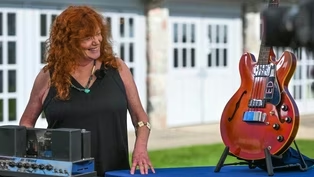
What you have here is a 1968 Gibson EB-2D electric bass guitar.
Uh, this is the bass version of Gibson's famous semi-hollow body guitar, the ES-335.
This was actually made in Kalamazoo, Michigan.
We have a 30.5-inch scale length, mahogany neck.
We have thin line construction.
Two pickups, which is great, because the original models only had one in the neck position.
A lot of players found it kind of muddy, kind of woolly, impossible to get a bright tone out of, which is why we have the second pickup near the bridge.
Gives some much needed clarity to the instrument.
This is such a cool instrument, and the fact that it has a nameplate on it really tickles me.
It's in one of my favorite Gibson custom colors known as sparkling burgundy, which you can see originally was a very deep red, but because of UV rays, sun exposure, all of that, the red dye in the finish, as well as the clear coat, have both aged.
So we've got this kind of orange copper thing going on that I love, and it doesn't hurt the value at all.
Some people prefer a redder instrument, some people prefer it to look orange or even gold when they get a lot of sunlight.
Now, the amp you have here is an Ampeg B18-N Portaflex.
It was made in New Jersey in 1966.
All-tube, 18-inch speaker, and a very cool fliptop, where the amp lives inside the cabinet for storage until you're ready to play-- you flip the top over, lock it down, plug it in, and you're ready to go.
For this instrument, at retail, you're looking at between $4,000 and $6,000 for this instrument... Oh, wow.
...in its color and condition.
You also have the original case.
What a great gift.
Yeah.
The amp, at retail, we are looking at about $2,000 to $2,500.
Okay.
Wow.
It's one of my favorite things about guitars, that they age like this.
Well, clearly we both love copper.
Yeah, yeah, we're-we're big copper fans.
(laughs) GUEST: These are, I think military goggles from my grandfather.
My grandfather served in World War II in the Navy.
You can change the like, brightness, dimness, when you turn the knob.
The elastic's a little worn out.
Uh, well, I have a Sean Connery action figure from "Dr.
No" with a number of accessories that I'm sure are not appropriate for children.
So... this was actually from my grandmother, who is a giant James Bond fan.
I know she got it as a gift from my dad, who's over in line, who's probably so jealous right now.
He gave it to her as a gift, and, uh, but I'm not sure when.
GUEST: So, I got this from my mom, who got it from my great-grandfather.
My great-grandfather was a master carpenter for Euclid Beach Park, which is a now-closed amusement park on the east side of Cleveland.
Mm-hmm.
And he was leaving work and found it in the trash.
He decided to take it home.
He had two daughters, so he thought they might like it.
It's from Philadelphia Toboggan Company.
They made small ones to sell, and that's what they would bring to sell the carousel.
And when did he work at the amusement park?
I believe 1936 or '38, to the 1940s.
It was made by the Philadelphia Toboggan Company.
Okay.
It's a company that specialized in the production of carousels as well as, uh, roller coasters.
So with the company being founded in 1904, and your great-grandfather working at the park by the sort of late 1930s, we can obviously very safely date this to perhaps the 1920s, early '30s.
They were known for their very detailed, very lifelike figures that they made.
And, and-- and I agree with you.
This is almost certainly a salesman's model to show both the, the style of figures that they made for carousels, but also the quality of their work.
It's constructed of carved and painted wood.
It has glass eyes.
I love the fact that it is... it has a complete array of very lifelike details, including the teeth and tongue in the mouth.
Yeah.
Very nicely carved and painted.
The saddle has all of the, the tooling marks in black there that you would see on a, on a full-size real saddle.
And of course, the, uh, the saddle blanket being red with the yellow striping and then the gold-painted trim at the bottom representing fringe.
And I also really appreciate the fact that at the back corner of the saddle blanket, you have carved there the PTC for Philadelphia Toboggan Company.
Yeah, it was... Mm-hmm.
There's a little bit of very nice restoration to it.
The artist captured the muscle structures, the hooves, took great care to very carefully repair the top of the ear there, and as well as the rear hoof and joint in the leg there.
And I actually really personally like the fact that they didn't repaint those restored areas.
Yeah.
It's restored to show the form and the elegance of the piece, but not trying to hide the fact that it is a restoration.
Carousel horses are quite collectible.
Oh, okay.
But they're very large.
Something like this, being a small version of that, as a salesman model... Yeah.
...we think would likely appeal more so to collectors than a full-size horse.
Because think about it, if you had a full-size carousel horse... Yeah.
...where are you going to put it in your house?
If it were to be offered in an auction setting... Mm-hmm.
I would suggest an, an auction estimate of between $4,000 and $6,000 for it.
Oh, wow.
Okay.
That's more than I thought.
I think a very fair insurance valuation for it would be about $8,000.
Okay.
Well, I wasn't really expecting to come, uh, ended up, uh, volunteering to drive my brother over.
And so, uh, as I was coming out the door, my wife said, "Take Charlie with ya."
Tell me the story behind Charlie.
Well, Charlie is from my wife's childhood home, along with a number of posters that were glued to drywall at one time.
Uh, this was among those.
And of course, during remodeling, we needed to save some things, and... and this came off the wall.
How did this come to be in the house in the first place?
My wife's brother traveled a lot and, uh, uh, picked these up, uh, picked up posters when he traveled.
And my other question is, how did it end up stuck on drywall?
Uh, he did that to a lot of posters.
Um, he, uh, things from Fillmore East and Fillmore West, and, and concert posters, uh, ended up just, uh, uh, glued to the wall.
And how did you get it off the drywall?
Um, uh... drywall knife, and, uh, careful lifting.
So, yeah, it's, uh... There is a little hole that we think, uh, is from a drywall nail pop, which drywall does.
Is it still mounted on the drywall?
Um, ah, no, it's on the paper.
Just on the paper itself.
So, "City Lights" was, uh, a Charlie Chaplin film in 1931.
Mm-hmm.
And it was four years after the silent movie industry became the sound movie industry.
And Charlie Chaplin stubbornly and defiantly and rather proudly decided he didn't want to do a sound movie.
He wanted to keep up with the silent movie tradition that had been so kind to him and that he-- that he had dominated.
And so this movie, done in 1931, even though sound technology existed, was still done silently.
That's a pretty extraordinary and a pretty bold step indeed.
Mm-hmm.
Charlie Chaplin himself was an iconic image in the film industry.
He was the biggest star.
My news to you, on, on this particular beautiful Sunday afternoon, is that this is an original lithograph... Mm-hmm.
...from 1931, advertising the movie when it came out in Chaplin's time.
Wow.
That's really amazing.
Um, the colors are beautiful, yeah.
The colors are beautiful.
There's something else about this, condition-wise, which we can't quite see because of the frame.
The poster had a larger blank area at the top, originally... Uh-huh.
...for text of the theaters it was in.
Yeah.
Uh, and there also would've been a margin at the bottom.
Mm-hmm.
So, it's... I don't know if you remember when it was framed, were those areas still there?
Yes-- those are not there.
Oh, so they, they had been trimmed off.
Yeah.
Um, so you have a poster that is an original lithograph... Mm-hmm.
...from 1931.
Uh-huh.
That has, by all accounts, seen better days.
Yes.
With posters like this, they can be restored.
In this condition, were it to come up for auction, it would sell for between $3,000 and $4,000.
All right, all right.
Wonderful.
That's, uh, that's, that's nice to know.
In perfect condition... Mm-hmm.
...this most recently sold for almost $7,000.
PEÑA: Because of Castle Farms' earliest connection to Sears and Roebuck, there's a small building dedicated to materials found in the retail giant's mail-order catalogs.
The focus of the collection is on items from the time when these castle-like barns were built, around 1918.
If there was anything you wanted, from tools to food... houses, you could buy a house, you could buy a barn.
You just looked in the Sears catalog, and they would send it to you.
PEÑA: One smaller example, this Gong Bell toy.
A bear in a blue sweater standing atop a wheeled platform.
When the toy moved, the bear hit the silver bell.
The price for this entertaining piece?
Just 50 cents.
GUEST: In 1967, we were on a family trip; my parents, my sister, and my brother.
Uh, and it was to Washington, D.C., primarily.
But then we did a little side trip to Monticello.
And back then it had an antique/thrift shop.
And my mother fell in love with this vase.
And, so, um, my father bought it for her.
And, been a treasure.
It's been in a china cabinet in my dining room in my home.
The top shelf, center, so I see it every day.
When we bought the vase-- and the tag is still on the bottom-- um, it was $40 in 1967.
The mark on the bottom... You can see the initials, KPM.
Right.
KPM stands for the King's Porcelain Manufacturing.
I'm translating from German.
Okay.
In Berlin.
Then the orb and cross above that, and further on is the scepter, which is another typical KPM mark.
Okay.
The other labels are from the gift shop at Monticello.
Correct.
So, KPM is known for a few things.
Beautiful portraits, plaques of... Okay, okay.
...mythological figures, biblical figures, beautiful women with long flowing hair.
Okay.
They also made vases that were... Okay.
...kind of over the top.
Okay.
Very Victorian kind of stuff.
Oh, okay.
So then, something unusual happens at KPM in 1908, when a young man named Theo Schmuz-Baudiss became the artistic director.
Okay.
And I think Theo said, "Hey, we've been doing kind of Victorian stuff for years.
"Look at what they're doing at Royal Copenhagen, "at Rookwood.
Beautiful high-glazed porcelain pieces..." Right.
"...with Art Nouveau-style decorations."
Oh, so that's where it comes in.
So, you see a subtle change coming around that time... Okay.
...thanks to Baudiss.
And this is a perfect example of his influence.
I would think this vase dates from around 1910.
I think these are stylized ferns.
Okay.
Little fiddlehead ferns.
Oh, yeah.
And you see all the dots?
Yes.
The porcelain, it all had to have been done with an eyedropper, probably.
Wow.
Very detailed work.
There are four panels.
Each have the same design on them.
Yeah.
All ferns, I think.
So it's porcelain body with enamel decoration.
Okay.
These pieces are rare.
They still don't show up a lot.
Yes.
I mean, when you unwrapped this, I was shocked how pretty it was.
(chuckles) I mean, it's just one of those pieces that grabs you.
It is beautiful.
I think, probably an auction value, we're looking at $2,000 to $3,000.
Okay!
Ver-- that's pretty exciting.
It's special.
Yeah, I love it.
She's a beauty.
I grew up with this clock, um, in my grandmother's house.
It was the one-- one of the items from my grandmother's house that I remember more than anything.
And, uh, the big story that I remember the most with this clock is my mom always used to tell a story about how, uh, it magnifies sunlight.
And so, it was on there-- on a little end table by one of their couches.
And all of a sudden, the couch started smoking.
(laughs) So, it caught-- yeah, the couch at my mom's house on fire.
So now we always need to make sure that we don't have it anywhere near the sunlight.
Yeah.
So, it's got to be in the center of the room, not by a window, uh, so we don't start any more fires with it.
It's unbelievable.
Yeah.
Do you know what it's called at all?
I don't know anything about it, I just always loved it.
I've never seen anything like it.
I don't, I don't know what it's called, no.
It's called a crystal ball clock.
Okay.
And there's two reasons why it's exceptional.
First of all, the size.
It's just a little smaller than a volleyball.
This is scaled up ten times the norm, and, and I've only seen one other that's this big.
And the second thing is the complications that it has.
It has, uh, the calendar, uh, numerical date, the day of the week, and then the moon phase at the bottom here.
And all the hands you said are off of it, but they're inside of it, because it got shaken.
Right, they're inside it.
Yeah, it got-- it got shaken, so.
And that's a great thing, that you have the hands inside of it.
Probably made circa 1890, and it's of French origin.
It was really nice quality thing.
I would put a value on this clock that burns couches, uh... (both laugh) Probably about $3,000 in its present condition.
If you put the hands back on it and you get it serviced, I could see it being worth as much as say $4,500.
That's great.
It's going to stay in my living room for the foreseeable future.
I love it.
Right.
And maybe put a fire extinguisher next to it.
(laughs) I believe this is a, uh, a Puget Sound felling axe from the Pacific Northwest.
This is a Sager Chemical.
That was a, a company that made, uh, felling axes.
Uh, it was made to take down the large trees.
It's got a 42-inch handle on it.
Uh, I got it in trade-- I'm a saw filer, and I was filing saws for a guy; big saws.
And he said, "I didn't want to pay you, but I'll-- I'll give you an axe if you file my saw."
So I said, "I can do that."
GUEST: This belonged to my father.
He was an architect during the '60s and '70s and '80s.
He was very much into mid-century modern.
I remember it first... in probably about the mid-'60s, when my dad acquired it.
Uh-huh.
You remember growing up with it as a kid?
Oh, yes.
And like you point to that thing up on the shelf?
Oh, yes.
We always looked at it and wondered why it was so strange-looking and why he even bothered to buy it.
(chuckling) We always in the family called it an anteater, but he said it was a polar bear.
Ah.
He was wrong, it's an anteater.
(laughing): All right.
It's made out of ceramic.
Uh-huh.
It is fragile, it is made out of porcelain, and it has this wonderful glaze, and of course it has this wonderful form to it and it has a conforming base.
The artist is Gordon Newell, born in 1905 in California.
And he went to a number of art schools out in California and eventually became a teacher.
The 1930s, during the Depression... Mm-hmm.
...there was something called the WPA, the Works Progress Administration, which hired artists, painters, sculptors to keep them employed.
And Gordon seemed to be involved with architectural things.
So, you know, kind of commissions he got... Sure.
...he got post offices, so... (laughing): Oh, I see.
Yeah.
So there'd be like a relief over the entrance of the post office or maybe something inside.
Very interesting commissions.
He lived in Carmel, California and he exhibited widely other things, non-WPA pieces.
His work is in a number of collections.
Yeah.
There's something at the White House of his.
Wow.
And he exhibited at the famous 1939 World's Fair in New York City.
It's a spectacular piece, the way it's stylized, simplified, and I think it captures the whole spirit of the artist.
This piece was made in the mid-1950s, probably around 1958.
It's not signed, and it's also on a very nice, uh, wooden base.
Yeah.
I don't know if it was original, but it could be original, because it's tapered perfectly.
A number of these have come up for auction.
They do very well, especially because in the last ten, 15 years the interest in mid-century modern design has skyrocketed.
Mm-hmm.
Very, very popular, especially among young new collectors.
One recently sold at auction for $7,500.
Wow... that's amazing.
An auction estimate would be in that $7,000 to $10,000.
Wow.
An insurance evaluation might be closer to $12,000 to $15,000.
Very nice.
So, I'm glad you have it out.
It's a spectacular piece.
Well, thank you very much, and I'm, I'm very surprised and very pleased.
GUEST: My mom bought it 60 years ago at an antique shop.
I don't really, don't know, trying to find out what it is.
And it weighs about 40 pounds.
(both laugh) That's all we know.
PRODUCER: Ever cook anything on it?
(laughs) (laughing): No.
It's been in a box for years.
Yeah, it's in pretty good shape for being however old it is.
I don't know.
GUEST: I don't really know anything about the artist.
It was in my parents' home my entire lifetime.
Right.
And I know that my mom used to tell us that this picture was in her childhood home.
Well, the artist is John George Brown... Mm-hmm.
...and he was born in Durham, England in 1831.
He had artistic talent early on, but his parents decided he needed a trade, so they sent him to be a glass cutter in Edinburgh.
Oh, wow.
While he was there, he attended the, the Royal Scottish Academy... Okay.
...so that he could keep up with his interest in art.
And by the age of 22, he decided to move to London and started painting portraits.
But he was enamored with the idea of going to America.
So in 1853, he emigrates and he settles in Brooklyn.
And we can see his signature there with the initials "N.A.
", which means that he was a member of the National Academy in New York.
As an artist, he is probably one of the most prominent genre painters in America in the 19th century.
He actually had the claim of fame to be at the important Tenth Street Studio, which was a major studio of artists that included Winslow Homer and, and Frederic Church and Albert Bierstadt.
Okay.
So he was among the best of the best.
Okay, wow.
He was best known for painting children, and he was very masterful at it.
Most of his paintings tend to feature little boys, and they tend to feature street urchins, bootblacks, and newsboys on the streets of New York.
Mm-hmm.
Often they're immigrant children.
They're wearing tattered clothes, and yet they have cheerful smiles.
Mm-hmm.
They often have a dog with them, so... (chuckling): ...it's, it's a very typical kind of thing.
And he was very prolific as a painter.
The subject here is really more unusual for him.
It's a little girl.
Mm-hmm.
And although he did paint girls from time to time, he did so more readily in the 1860s.
And this painting is probably done circa 1880, and it, of course, focuses on such a charming child, and he's really reflecting the innocence and playfulness of childhood here... Mm-hmm.
...which was a very popular topic in the Victorian era.
The painting has a label in the back with the title, which is "Making Houses of Sand."
The composition is quite interesting, because J.G.
Brown was just known for painting very realistic images of the children.
And what makes this a little more interesting is that in the background, there are all sorts of figures, and they're a little bit more abstract.
So I find that really creative in terms of his work and not something we normally see.
The painting is oil on canvas, and it's in excellent condition.
Because of the subject, I think that in a gallery, in New York in particular, the painting would sell for $150,000.
(laughing): Oh, my gosh!
(laughing): Oh, my gosh.
(voice breaking): I had no idea.
I'm gonna start crying.
I had no idea.
Thank you.
(laughing): I had no idea, oh, my gosh.
It's-it's just stunning.
And when I saw it, I thought, oh I was just-- it's breathtaking.
It's really cute now, because I have one granddaughter.
Oh!
And we live up on the water in northern Michigan... Yeah.
...and she can be the little girl in the sand.
Oh, yeah.
Oh, wow.
(choked up): It's so... Wow.
Thank you.
Oh, you're welcome.
Thank you.
PEÑA: And now it's time for the "Roadshow" Feedback Booth.
And it turns out that our baseball signed by the Yankees, along with Mickey Mantle, is actually stamped.
Looks like we're going back to work tomorrow.
We wanted to find out some history about our scary eggplant baby.
We knew it wasn't too old, but we found out it's mass-produced, not worth much.
Our daughter even says it wasn't worth the quarter we paid for it.
We found out that my grandmother's, uh, silver candy dish is worth about $1,000 to $2,000.
I brought this ancient pottery that's actually as old as I thought it was, but it's restored.
But we got to find out that it was actually real and comes from the era in Nicaragua.
And we're happy to be here.
Ten years.
Ten years married.
So, thanks for having us.
Yes.
We both brought in a couple items.
I brought some pocketknives and a Kewpie doll that I dug up by my chicken coop.
Found out that this is worth about as much as everything else buried by it.
And this is about $250.
And I'm just glad to be here instead of crying in my basement about not coming to "Roadshow" today.
(laughs) Today we brought our little Friar Tuck cookie jar and found out that even though he's been in our family forever, he is worth about $13.
Uh, so he'll be holding cookies for the foreseeable future.
Uh, but we had a great time.
Thanks, "Antiques Roadshow."
PEÑA: Thanks for watching.
See you next time on "Antiques Roadshow."
Appraisal: Tiffany Studios Turtleback Diver's Lamp, ca. 1905
Video has Closed Captions
Clip: S30 Ep10 | 2m 33s | Appraisal: Tiffany Studios Turtleback Diver's Lamp, ca. 1905 (2m 33s)
Video has Closed Captions
Preview: S30 Ep10 | 30s | Preview: Castle Farms, Hour 1 (30s)
Providing Support for PBS.org
Learn Moreabout PBS online sponsorship
- Home and How To

Hit the road in a classic car for a tour through Great Britain with two antiques experts.













Support for PBS provided by:
Funding for ANTIQUES ROADSHOW is provided by Ancestry and American Cruise Lines. Additional funding is provided by public television viewers.