
Coastal Maine Botanical Gardens, Hour 3
Season 30 Episode 9 | 52m 26sVideo has Closed Captions
Treasures abound in Midcoast Maine during ROADSHOW’s first-time stop in Boothbay!
Treasures abound in Midcoast Maine during ROADSHOW’s first-time stop in Boothbay! Which family heirloom is the hour’s top find?
Problems playing video? | Closed Captioning Feedback
Problems playing video? | Closed Captioning Feedback
Funding for ANTIQUES ROADSHOW is provided by Ancestry and American Cruise Lines. Additional funding is provided by public television viewers.
Support provided by:


Coastal Maine Botanical Gardens, Hour 3
Season 30 Episode 9 | 52m 26sVideo has Closed Captions
Treasures abound in Midcoast Maine during ROADSHOW’s first-time stop in Boothbay! Which family heirloom is the hour’s top find?
Problems playing video? | Closed Captioning Feedback
How to Watch Antiques Roadshow
Antiques Roadshow is available to stream on pbs.org and the free PBS App, available on iPhone, Apple TV, Android TV, Android smartphones, Amazon Fire TV, Amazon Fire Tablet, Roku, Samsung Smart TV, and Vizio.
Buy Now

ANTIQUES ROADSHOW's 2026 Production Tour
Enter now for a chance to win a pair of free tickets to one of the three stops on ANTIQUES ROADSHOW's 2026 Tour. Sweepstakes entry deadline is April 6.Providing Support for PBS.org
Learn Moreabout PBS online sponsorship♪ ♪ CORAL PEÑA: "Antiques Roadshow" is sowing the seeds of knowledge for treasure hunters at the Coastal Maine Botanical Gardens.
GUEST: He scared us as children.
This is the stuff of nightmares.
No way!
(gasping): Holy cow.
Yeah.
♪ ♪ PEÑA: "Antiques Roadshow" has set up at the Coastal Maine Botanical Gardens in Boothbay.
Celebrating the biodiversity of the region is the name of the game here.
And part of the garden's mission involves the research of native plants.
Have an interest in botany?
The herbarium, a collection of dried and pressed plants used for research, contains plant specimens from the 1840s right up to the present day.
"Roadshow" will leave the plant collection to the botanists as we check out collections of valuable and not-so-valuable antiques.
This little guy is a handcrafted little wooden boy by an artist named Don Ellefson from Chicago.
I got him for my boyfriend, uh, for his birthday, and took him apart and sanded him down and conditioned him and re-put him together.
He's poseable with a wrench.
So at home, we keep him upside down and he holds our plants.
He needed a little work, but now he's super cute.
I probably paid like maybe $70.
GUEST: So, this is a Picasso print.
As far as I know, it came from my wife's great... aunt, who lived in California for a long time, and she collected some art.
And I believe it is a numbered print.
I think 20 prints is what the paperwork says on the back, if that is authentic.
(chuckles) GUEST: They were a gift to me from my mother-in-law and her aunt.
They were from a cottage, a seaside cottage in Maine, outside of Portland, that I think my great-aunt-in-law got in the late '50s, maybe early '60s.
Great.
And when-when did you get them?
Um, maybe six or seven years ago.
What we have is a pair of cast-iron, obviously lobster-form andirons, or fire dogs they're sometimes called, designed to stand permanently in a fireplace.
They're so obviously related to the state of Maine.
Lobsters are not unique to Maine, but come on.
Right.
This is cast-iron, very crudely and simply made.
They're made in the sand casting technique whereby someone took a mold-- I'm pretty confident they took a lobster.
You make a mold, you press it into fine sand, and then you have most of what you need to cast iron.
I suspect they're very local, found in Portland, and almost certainly made somewhere near in the state of Maine.
It's hard to date them precisely.
I think they were made in the second half of the 19th century... Mm-hmm.
Probably in the third quarter.
You can see that both of them, on the arms at the back, have been repaired.
This one with a kind of sleeve to hold the two elements together, and this snapped in probably the same place and has been bolted together.
Both rather crude and amateur repairs.
But I love the fact that someone has loved them enough to repair them.
Mm-hmm, right.
In a good antique shop in Maine, I see them at least $2,000.
Mm-hmm.
Possibly $2,500.
Okay.
Great.
But I love them.
APPRAISER: This beautiful gal here is...?
GUEST: My mother.
Wow.
Probably this picture was taken in the early '40s.
Dad was gone for four years in the Second World War, Europe.
Ended up as an aide to Eisenhower, was part of the Corps of Engineers.
And somewhere along the way, he had this commissioned, but I don't know exactly where he commissioned it.
I, I assumed it was near Naples, Italy.
And you can see that this is exactly her.
Absolutely, and the detail is incredible.
Incredible.
So, I think you're right about Naples.
It's the home-- Italy, the home of... Right.
...cameo production.
It's made out of, carved out of conch shell.
Almost every cameo I see, they're facing right.
Really?
It's very rare to see one facing left.
The frame, also, is fabulous, with the garland and the ribbon.
With gold being at record-high prices, there's $1,000... Wow.
...just in gold.
I would say, at auction, probably... $1,500 to $2,000.
That's great.
You're not selling?
No.
For insurance, $3,000.
Terrific, that's great to know.
But I'm telling you, I just... All the years we're doing this... (chuckles) ...never did it match up like this.
GUEST: I own a school building in Waldoboro, Maine, and we've been renovating the building, turning it into a creative compound.
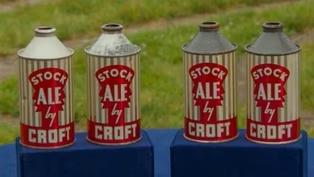
And as the guys were doing demo in the ceiling, they found a whole bunch of alcohol bottles and these beer cans.
They almost kind of threw them all away.
I'm like, "Oh, these look so cool."
They're super graphic.
In the world of breweriana, these are actually very important cans.
This is called a cone top can.
Mm.
And it was available as both a 12-ounce and a quart size.
And the cone top just specifically relates to the form in which you would drink the beverage.
The cone top can was first introduced in 1935 and it was phased out by 1960.
When we look at the side of the can, we can see the full company mark here.
"The Croft Brewing Company, Boston, Massachusetts."
The company first opened in 1934 and they were closed by 1952 when they were bought out by the Narragansett Company.
They were part of that post-Prohibition boom.
Mm.
Alcohol is now legal again, so money's flowing, and people want to open breweries.
And this is their stock ale.
They had a cream ale, they had an all-malt red label.
But for collectors today, the Stock Ale can graphically is very attractive as it hones into Art Deco design.
When it comes to beer can collecting, one of the first major factors is, is it an indoor can or is it an outdoor can?
Literally meaning, did you discover these beer cans in the ground covered in dirt, or did you find them inside?
You clearly found them inside.
The lithography is vibrant.
There's minimal oxidation to the tops of them.
When we look at the can closest to me, it has the biggest apology out of them all.
Has a large dent with a crease.
Also a scratch here with some paint loss.
Otherwise, they all have little apologies.
But, they're 80-year-old-plus cans.
So, you would have a scratch or a nick too, along the way.
To find cans in this condition is exceptionally rare.
Mm.
And with exceptional condition comes exceptional jumps in value.
Conservatively, at auction, for the group of four cans, it would easily be $10,000 to $15,000 for the collection.
Oh, wow.
Amazing.
Oh!
That could help pay for the renovation.
(laughs) It's amazing.
Oh, wow.
Too bad there wasn't one that still had beer in it.
(laughs) Most recently at auction, one exceptional condition comparable to these, but had the original cap... Mm.
...in a quart size, brought over $18,000 at auction.
Oh, wow.
Amazing.
So, surprised?
Yeah!
So crazy.
I thought it was gonna be like, I don't know, like $100.
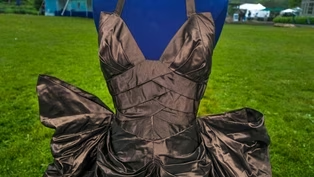
So, this dress belonged to my mother.
She lived in Philadelphia and somewhere, I think, around when she was 18, 19, 20, she would be a runway model for the Nan Duskin department store.
And I know the dress came from Nan Duskin, but I don't know how my mom acquired it.
I believe she wore it once.
And I know that I wore it once, (chuckling): if you can believe it.
Um... but I always thought it was extraordinary, and just... wild.
And who makes a dress like this?
So, what you have here is a black silk taffeta evening gown... Mm-hmm.
...made by Gilbert Adrian, and it's for his 1948 collection.
He was born in Naugatuck, Connecticut, in 1903.
Okay.
A very, very, uh, artistic and precocious drawer and creative young man.
Mm-hmm.
He went to Parsons in New York, and they quickly said, "We have no more to teach you, go to our Parsons school in France."
Wow.
So he started in Paris in 1920.
Cool.
And he then meets up with Irving Berlin, he is invited at the age of 19 to go back to America... Mm-hmm.
...and he designed costumes on stage for Irving Berlin and Broadway.
Wow.
He then goes to Hollywood, and in 1928, he starts to work for MGM.
Gotcha.
Okay.
So he becomes the MGM head costume designer from 1928 to 1941.
Wow.
One of the things that Adrian is most well-known for... Mm-hmm.
...is he designed all the costumes for "Wizard of Oz."
I just heard that recently.
(chuckles) Yeah, I didn't-- I had no idea.
Yeah.
So, so cool.
In 1941, he says he's leaving MGM and he's gonna start his own label.
1942, he has his very first collection.
He had two different labels under his name.
Mm-hmm.
One was called Adrian Originals... Mm-hmm.
...which is what this is.
Okay.
And there's a label in the back.
Yeah.
Along with the Nan Duskin label... Yeah.
Yeah.
Yeah, yeah.
...which was the retailer in Philadelphia.
Mm-hmm.
The top of the top in, in Philly.
He also had Adrian Customs, and those were the couture.
Okay.
So if you can believe, this was a ready-to-wear.
His ready-to-wear went from the very low sort of bread and butter... Uh-huh.
...$69 suits up to $395 gowns.
Gotcha.
Which is the height of, again, that lower end.
Yeah, right, right.
And in today's money, it's about $5,000 for, for this.
Had you thought about... the value at all?
I was sort of in the $1,000 to $3,000, hoping for $3,000...ish, plus.
Just because it seems so extraordinary.
I would put an auction estimate of $1,500 to $2,000 on this.
Okay, okay.
For insurance purposes... Yes.
...I would have an insurance value of $8,000.
Oh, my gosh, wow.
Okay.
Very, very cool.
Um, I'm so happy to know more about it.
Thank you.
Thank you so much.
Well, absolutely, my pleasure.
Yeah.
PEÑA: Coastal Maine Botanical Gardens, which opened in 2007, is also known as the People's Garden.
It's one of the few public gardens that's right on the water with over a mile of saltwater frontage.
The idea for the gardens came about in 1991 when a group of local residents had the somewhat remarkable idea of creating a botanical garden here, and actually mortgaged their own homes to buy it.
That's where the People's Garden comes from.
Everyone who works here, and who volunteers here, and who is involved here really feels like it's their place.
Like they have this sense of ownership that you don't necessarily find other places.
So, we really pride ourselves on being a place for everyone.
GUEST: I brought a necklace that was given to me as a wedding gift.
It belonged to my great-grandmother.
I believe it was actually a gift for her 18th birthday.
So I imagine it would be the 1910s is when she received this.
It was given to me from my aunt, and with it, she sent a note that said that it was given to my great-grandmother, grandmother, aunt, and now me.
What year did you receive the watch?
2016 was the year we got married.
It's kind of fun, because today happens to be my wedding anniversary, too.
Oh, congratulations.
(laughing): Thank you.
It's Cartier ladies pendant watch.
Cartier, it's a Paris firm.
They were founded in 1847.
The time period.
You are right about on the money.
1910, 1915, Edwardian period.
Also, Belle Époque.
Belle Époque is not just a time period, it's also a style.
This has pearls, it has diamonds, it has enamel work, the blue enamel throughout.
It's set in platinum, it's set in yellow gold.
Oh.
The diamonds in here are rose cut diamonds.
The pearls are all natural.
The back here, it's blue guilloché enamel, which is hard-fired enamel on top of the metal.
There's diamond-set initials.
Are those Grandma's initials?
E.S.
was her initials.
It's flowery letters, so I wasn't sure if it was just a design or if it was in fact initials.
If that looks like an E.S.
to you, (chuckling): then I'll trust your judgment on it.
It's an E.S., and that was a custom order.
Everywhere on here are jewels.
There's something a little extra special, there's something a little fancy.
The quality of an object like this, it-it's absolutely phenomenal.
Second to none.
Cartier had special movements made.
This was a collaboration with Cartier with another famous company, Jaeger-LeCoultre.
You have the original box.
Yes.
Or presentation case.
You open the double door, there's a beautiful treasure inside.
And Cartier made that famous.
Retail price on this watch is gonna be $25,000 to $30,000.
(chuckling) Holy smokes.
That's... that's wild.
(laughs) Well, I better keep care of it.
Safety deposit box, here we come.
(chuckles) Unbelievable condition, and unbelievable to find it in the original box.
It's awesome.
GUEST: So this belonged to our step-grandmother's aunt and we believe it is by... Toshiko Takaezu, who is a-- Who is a Japanese American ceramicist born in Hawaii.
So it's possible this is actually a student of hers.
GUEST: I got it at a, uh, sports memorabilia show in probably like ten years ago.
Paid a couple hundred bucks for it.
It's probably from the early '60s.
The only thing I really know is about Nat Allbright.
He used to read the games and kind of like recreate the game with noises and pretend like the game was actually live off the radio, but he was actually getting it through like Morse Code.
GUEST: I came across this fan and it was probably in the 1990s and I used to go to some West Hartford, Connecticut shows and they were vintage shows with various jewelry and materials.
And the fan just spoke to me.
So I've always loved Victorian pieces... Mm-hmm.
...and it's the cra-- Victorian craftsmanship.
This one looked beautiful.
I saw it was Tiffany.
What did you pay for it back then?
$50.
Wow!
That's a-- that was a great... It was a great price.
Yeah!
So you have a 19th century Tiffany lace fan.
It's in its original silk-covered Tiffany box.
It has wonderful hand needle lace in the fan... Mm-hmm.
with mother of pearl guards and sticks.
And then what was really exciting was the loop at the bottom which is also marked Tiffany.
And then we also found another marking next to the "Tiffany" which was "14K."
Mm-hmm.
And that's what was really exciting.
You have a little bit of gold there.
And as we know, the value of gold is just going up and up and up.
The condition is, is really nice.
You do have some discoloration along the bottom, where I think that's where it adhered to, uh, the sticks.
Tiffany would have put these out in the stores as kind of like an entry point for maybe a husband to buy his wife a Tiffany gift.
Mm-hmm.
Oh.
So didn't have to go straight to the jewelry.
Yeah.
You know, they also offered these other ladies' accessories during this time period.
Mm-hmm.
If it was just a lace fan with mother of pearl, I'd give it an auction estimate of about $100.
Mm-hmm.
With the box, $350.
Mm-hmm.
Then you have the golds.
Mm-hmm.
And that's really where-- where the value is coming from.
I'd give it an auction estimate of $800 to $1,200.
(chuckling): Ooh, that is just wonderful.
Yeah.
I've enjoyed the show tremendously today.
Mm-hmm.
So, it's been fantastic.
GUEST: They were my great-grandfather's.
So my great-grandfather grew up in the same village as Josef Hoffmann in Czechoslovakia.
Uh-huh.
And then they both moved to Vienna.
Mm-hmm.
And then my great-grandfather wanted to support him... in his, in his designs, and so he acquired these.
Josef Hoffmann, he was born in 1870, and he actually lived until 1956.
He was classically trained, and he won the very prestigious Prix de Rome.
And he actually started out as an architect.
Okay.
And he continued to do architecture throughout his life.
He also designed furniture, he designed silver, he designed glass, he designed textiles.
And early 20th century, 1903, he started something called the Wiener Werkstätte.
And it was actually a group of different designers who worked together.
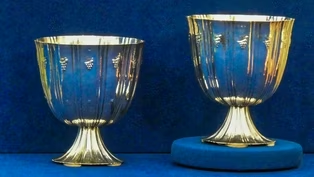
Josef Hoffmann designed these for the Wiener Werkstätte.
We're not sure what these are used for.
They can just be decorative vases.
Uh, they could be cachepot and had, uh, flowers or greenery in it.
The Wiener Werkstätte did last until the 1930s, but they ran out of steam.
And I think these are examples from the high point of their production.
Sort of 1910, '15.
Each of these is hand-hammered.
On the underside... it has the Wiener Werkstätte mark.
And up here we have Josef Hoffmann's initials.
And then we have the Wiener Werkstätte mark.
And then we have the mark of the person who actually fabricated it.
900 refers to the grade of silver.
Okay.
So most of us talk about sterling silver.
Sterling silver is 925 parts of silver per thousand.
This is the high point of design in the early part of the 20th century.
And then Hoffmann was the master of design.
I think a retail replacement value for them would be in the $30,000 to $50,000 range.
Are you serious?
Mm.
(laughing): Oh my God.
Wow.
I had no idea.
Holy cow.
I... should probably keep-- better keep... (laughing): I should probably take better care of them.
Keep them better.
Wow.
Oh, my God.
That's amazing.
Thank you so much.
GUEST: It was my husband's father's... APPRAISER: Okay.
...in his office at Christ Church Chapel in Grosse Pointe, Michigan.
Mm-hmm.
Parishioners such as Dodges or Fords... Mm, okay.
...would take his father to England and they would find things to bring back to Christ Church.
Interesting.
And clearly, if you have a Dodge or a Ford with you, they're going to have quite deep pockets.
Yes.
When do you think that that would have been roughly?
1930s.
It's definitely a very early piece.
I think the youngest, let's say... All right.
It's going to be 16th century.
It's a Nativity scene.
Okay.
This could be an 18th century frame or a 17th century frame.
Probably somewhere in the region of $3,000 to $5,000 at auction.
Mm-hmm.
GUEST: Well, it's a, uh, Lichtenstein print that I received from my grandparents a long time ago.
And I believe that it's titled "Shipboard Girl."
My grandparents were living in D.C.
at the time.
They had a large condo.
They were at the age where they needed to downsize a lot.
Mm-hmm.
So they actually rented a second apartment, filled it with all the things that they were giving away.
This was in a poster tube, and actually this one wasn't noticed in the poster tube.
There was a, a different poster that I was more attracted to, and they said that I could take it away, and that's how it ended up in my possession.
You're absolutely right.
Roy Lichtenstein's "Shipboard Girl"... "Shipboard Girl."
...from 1965.
So this is really the beginning of Pop Art.
Mm.
And in 1965, Roy Lichtenstein was represented by the Leo Castelli Gallery, which really, uh... was the pioneering gallery in New York for these pop artists; Lichtenstein and Warhol.
Hm.
Part of the Pop ethos was to embrace commercial printmaking.
Mm-hmm.
So this poster is an offset lithograph, which is like photomechanical printmaking.
It's done in sort of industrial strength colors in a commercial kind of press.
Mm-hmm.
And there's a couple of things about this print that really stand out, which make it very exciting.
Yeah.
First of all are the colors.
Mm.
And they're really spectacular, so fresh.
Yes.
It seems to me that it never came out of the tube.
It's quite possible it was brought home from a gallery... (both laugh) (laughing): I think so, yeah.
And hasn't seen daylight for 60 years.
The other curious thing about your print is how it's signed.
Yes, I've always wondered about that.
Yes.
Yeah.
(both laugh) So, it bears the pencil signature, upper left, of Roy Lichtenstein.
Mm-hmm.
And this is typically signed lower right.
Mm.
And you can see that he signed it lower right at the time... (laughing): Right.
...but its orientation was the wrong way... Mm-hmm.
...so he ended up signing it upside down.
Mm-hmm.
This is a well-documented print.
It's in his catalogue raisonné.
It's in many museum collections.
Mm.
But we-- no one really knows exactly how many were printed.
Okay.
They were never numbered.
Yeah.
But the... the signature is absolutely right.
And we actually did find some other examples of this print... Oh.
...with the signature this way.
Oh, well, that's encouraging.
Good.
(chuckles) So, in the moment of giving it to somebody, a stack of p-prints being signed by the artist, some got turned around... Mm-hmm.
...and were signed the wrong way.
Oh.
Which makes it a curiosity.
Yeah.
Do you have any sense of the value?
I had, uh, looked it up a long time ago, and I've seen a wide range of numbers for it.
Right.
I think the high range was around $20,000 to $30,000 that I had seen at that time... Yeah.
...but the low is around $5,000, so I've never really known.
Yeah.
Right.
Well, there is a wide range of values for these.
Uh, often that's dictated by the condition.
Sometimes they're quite faded.
Mm-hmm.
Your colors are as good as you would expect.
Mm-hmm.
Because it's signed in this peculiar fashion, though we do have to consider that into the valuation.
Mm-hmm.
So I would estimate this at auction at $20,000 to $30,000.
Oh, great.
Well, that's wonderful.
Yeah, I love seeing it out.
The colors are amazing.
If this had been signed the right way, it would be conservatively $30,000 to $50,000.
Okay.
DYLAN DUBAY: An herbarium is sort of like a library, but instead of a collection of books, it's a collection of plants.
Kate Furbish was an incredible botanist who made it her life's mission to collect all of the plants of Maine, or as many as she could.
She did this through collecting herbarium specimens and also by creating really detailed botanical illustrations.
One of the things that she's most well-known for is actually discovering a species that is only found in Maine and New Brunswick, Canada.
It's called Furbish's lousewort.
We're really grateful to have a handful of Kate Furbish's actual specimens here in our collection.
Her specimens of yellow avens are the specimens she used to reference while creating the botanical illustration.
GUEST: I brought in a crock from 1818.
It's been in the family.
There was a farm at one point outside Philly that my grandfather had, and he rented out the barn and, and all, we had a place we could go and stay there.
And whether that came from that area, I don't know.
Is that in Chester County?
I believe so, yes.
Because I do think you have a Chester County piece.
Wow.
This redware jar would've been made of locally sourced clay.
Potteries in Chester County in the late 18th and early 19th century, they used a lot of slip.
When you add up the fact that this has this specific ovoid form with these handles, with this type of slip, and in the fact that this manganese decoration is there, it all points to Chester County, Pennsylvania.
And in Chester County, because it's near Philadelphia, of course... Yup.
...they-- were influenced by Philadelphia pieces.
So it's similar to Philadelphia, but has much more... personality.
Yeah.
A little more provincial.
So it has, has an accent.
Yeah.
And that accent is rural Pennsylvania, specifically Chester County.
So it's "L.L."
in script on one side with that eight... 1818 with a serif there.
And then on the other side, We had this "L.L."
in block letters, and 1818 without a serif.
I think that these are two different people decorating it within the pottery.
Oh, wow.
Which is-- I've never seen before.
We looked for a pottery where the L.L.
initials would make sense.
Mm-hmm.
We didn't find one in Chester County, Pennsylvania.
So it makes better sense, I think, that it be an owner.
So you have manganese vertical little slashes... Mm-hmm.
Kind of drips that add depth to the decoration.
You had this copper oxide, this greenish color in this area, which gives it great color.
It adds interest to the glaze.
Mm-hmm.
And redware jars like this were utilitarian.
They kept liquids in them.
They kept dry goods in them.
This is a, a fairly large example.
You have some chips on the piece, but they're small.
Yeah.
You know, there's a nip over here.
You do have a chip to the base.
Mm-hmm.
The damage on here, although damage is expected on a piece of redware, when you add it all up, it does affect the value of the piece.
I grew up collecting, uh, red-- and dealing in redware and stoneware, so, before I found out about girls, my brother and I, after-- after dinner we'd, we'd hug our jars, you know.
(laughs) That's literally, we, we... talk about our collection, hug our collection.
So just to see an ovoid form like this... Mm.
...is pretty exciting.
A piece like this, you could put at auction in the range of $6,000.. Oh.
...to $8,000.
Wow.
And I used to keep it at the top of the stairs.
And then when I saw something on "Roadshow," I was like, "Maybe I shouldn't leave that at the top of the stairs."
(both chuckle) GUEST: So this my future father-in-law bought at an antique store in New Hampshire.
I think it was $19.
It looks to be wood, and then parts of it are plaster.
GUEST: This is an 1852 Shields map of Boston.
I used to work at a frame shop in Brookline, Mass.
And when you're at a frame shop, you meet lots of collectors.
And I made friends with a woman who that was her business.
And she found this in Brookline Town Hall attic, so she gave it to me.
Eventually, I framed it.
It used to have wood on the top and the bottom; like a map you hang on the wall.
GUEST: My great-grandfather purchased it at a flea market for one dollar in South Paris, Maine in the 1920s.
Well, what you have here is a Dutch musket.
The original variant of these guns had iron furniture.
This has a brass butt plate and trigger guard.
So it's a little bit later.
But the Dutch were making these certainly by about 1730.
Which probably dates its production to circa 1735 to 1745.
The Netherlands was one of the largest sources of firearms during that period, really on until the advent of the Birmingham gun trade in the mid-19th century in England.
The Dutch guns of this period are often thought to be copies of British Brown Bess-type muskets.
But the reality is, is the Dutch were using these patterns actually a little bit earlier than the British.
And in many ways, their design sort of influenced what becomes known as the Brown Bess musket circa 1730 when they officially adopt a pattern for the Long Land Pattern musket for the British military.
The best part about this gun, other than that it's completely untouched, hasn't had anything done to it, and remains an original flint, is the marking on top of the barrel that says "S.
Carolina."
South Carolina starts off as a British colony.
The colonies were important to the British, but they weren't necessarily worth spending a lot of money on in terms of their defense.
So as early as 1731, the British government started buying used Dutch muskets to arm the colonials.
The gun almost certainly came here from a British purchase.
Probably around the time of the, uh, Seven Years' War, better known as the French and Indian War here.
One of the ways we know that the gun was actually purchased out of a Dutch arsenal is that on the barrel at the end, there is a rack number that was the Dutch arsenal rack number for the gun.
Dutch musket, unmarked, just original flintlock Dutch musket in kind of attic condition.
The gun would probably sell somewhere in the range of $3,000 to $5,000, maybe a little bit more.
Wow.
But it gets a whole lot better because of that mark.
I think a conservative auction estimate for this gun is between $20,000 and $30,000.
Oh, my goodness, I was not expecting that whatsoever.
I would probably insure it in the range of $30,000 to $35,000.
It's an incredibly difficult gun to replace.
There are only a handful of known examples, and this is the best marked one I have seen.
Wow, really?
It's just everything that makes my heart go aflutter when I see a, just a, a wonderful piece of history like this.
GUEST: I brought in a pamphlet from a 1933 banquet at Notre Dame.
My father was maybe a water boy for the football team from '32, '33 until he graduated in '36.
If you're going to be a water boy, Notre Dame is a pretty good team to be a water boy for, right?
(laughs) True.
The best.
So, what, he goes to this banquet in 1933.
And who's there?
The Four Horsemen.
The Four Horsemen of Notre Dame, called that because famous writer Grantland Rice deemed them to be the Four Horsemen when they won... Okay.
...the College Championship and the Rose Bowl in 1924.
Mm.
Okay, so the four of them are Don Miller, Elmer Layden, Jim Crowley, and Harry Stuhldreher.
The four autographs together featuring the Four Horsemen is quite a find.
Uh, we think at auction this would sell for $3,000, $3,500.
No way!
(gasps) Holy cow!
Yeah.
That's awesome.
Now, I-I do have to make a comment about the fact that the autographs aren't authenticated-- we have the provenance.
We believe them to be authentic-- when they're graded, values go up.
We've seen examples as high as $5,000.
$7,500 for the Four Horseman autographs.
I'm speechless.
Oh, my gosh.
Thank you!
(chuckling): You're welcome.
That is so awesome.
Thank you.
GUEST: My great-great grandmother was an assistant in the Hamilton House, which was where the Tyson family resided in South Berwick, Maine, during the summer.
She worked with Ms.
Tyson quite a while, and she gave this, among many items, to my great-great grandmother as gratitude for her service.
They knew Celia Thaxter, who was a painter of pottery.
On the bottom, it says, "Celia Thaxter, 1888."
Then below that it says "H&C" over the "L."
Okay.
H&C stands for "Haviland & Company."
Mm-hmm.
And "L" stands for Limoges, the city in France.
So this is made of porcelain, uh, and it would have been shipped to America as a plain white pitcher.
And then she would have selected this to hand-paint on it.
She has hand-painted all the way around these beautiful purple iris and the wonderful long, spiky leaves.
Celia Thaxter was born in 1835 and she died in 1894.
She was in a fairly educated, affluent family.
She moved to live at her father's hotel, which was named Appledore Hotel, which was on the Isle of Shoals... Mm-hmm.
...which is off the coast of Maine.
And lots of famous people came and stayed there.
Now, she was a writer and she published a lot of books and poetry.
She was a writer's writer.
Some of her biggest fans were some of the greatest writers of the time.
And they were her friends... Oh, wow.
...because they came and stayed in the hotel.
She was friends with Hawthorne, Longfellow, and Ralph Waldo Emerson.
Wow.
She was also good friends with a lot of famous artists of the day.
She's most known for her writing about the ocean.
But when she painted, she didn't paint the seashore; she painted her garden, her flowers.
Right.
Many of them actually include hand-painted quotes from some of her poetry.
Oh, wow.
As a beautiful, well-painted piece of antique porcelain, if it was unsigned, it would probably be worth $100.
But because it's signed by her, there are people who are avid collectors of her work.
I would estimate a retail price to be between $3,000 and $5,000.
Oh, my gosh.
She-sh-- her work is very desirable.
Wow.
There are significant collectors.
Yeah, oh, my goodness.
Wow, what a treasure.
This is wonderful.
Yeah, it-it is a treasure.
GUEST: I brought in a letter that was written to my father-in-law from Martin Luther King, Jr.
My father-in-law was a Unitarian minister and he worked with Dr.
Martin Luther King, Jr.
during all of the Civil Rights unrest.
It's such an intense, powerful letter.
This letter was written in October of '62 at the end of the Albany, Georgia campaign.
To your father-in-law, who must have been present at the Albany campaign.
And he was a religious leader and he was there to support King and the movement.
Let me just read the first paragraph.
"Dear Reverend Papandrew, for several weeks I have "intended writing to express my personal appreciation "to you for your marvelous witness in Albany, "but the accumulation of a flood of mail has stood in my way.
"The smoke is gradually clearing from "the non-violent battle at Albany.
"And as we assess the results, we all agree "that one of the high points of the summer "was the contribution rendered by our brothers from the north who came to share with us in the fight against injustice."
It goes on for two pages, and it sort of closes with another kind of really meaningful, heartfelt paragraph, it-- he says, "Your continued help and prayer "will be greatly appreciated.
"You have now become sensitized to the problem in a new way.
"We are counting on you to discern "some methods of action which will contribute "to our national problem in race relations.
"Our nation suffers when churches are burned "or when mobs kill and ravish in protest "of a single person of color being admitted to an institution of higher learning."
So he's talking about integrating the universities.
Right, so we need, we continue to need your help in this long battle.
So terrific letter, signed by King, great content.
And then you have some other supporting materials that come with it.
So your father-in-law participated in the 1963 March on Washington, right?
Yes, yes he did.
He's-he's in that photo, right?
And he's right there in that photo.
In "Life" magazine.
This is summer of '63.
And then this is-- must be the December of 1963 holiday card... '63.
...from King.
It has a really emotional image of the four little girls that were killed in the Birmingham church bombing of the fall of 1963.
There's a message inside that is actually printed.
This is not handwritten by King, this is a printed card.
But, um, it does actually show that more than a year after this... Mm-hmm.
...your father-in-law is still in the movement.
He's still connected to the Civil Rights battle.
The value is in the letter itself.
This, these other items are supporting material.
It's great to have them.
They tell the story, but independent of the letter, they don't really have much value.
At auction, I would estimate this letter at $20,000 to $30,000.
And I would expect it to do as well or better because the content is terrific.
The, the letter is amazing.
The content is amazing.
That's i-incredible, I never-- I could never have imagined that.
It was so wonderful to see it in person and read it for myself.
It really just totally overwhelms me when I... when I read the words.
Yeah.
If you were going to insure this, I would tell your insurance company to put a number of $50,000 on it.
Okay.
GUEST: This is a hand-shaped Greg Noll's mini-gun surfboard.
The guy brought it into our surf shop looking for boards for his grandkids.
So I swapped him for it.
It's short.
It's a mini-gun that's short.
So I'm hoping it's worth a little bit of money 'cause it's kind of unique.
GUEST: I picked this up about 20 years ago at a flea market for $20.
I've been, for the last 20 years, trying to decipher this signature and I'm hoping to learn more about it today.
GUEST: All I know is, uh, my grandfather brought it back from, from Europe, uh, when he served in World War II.
Um, France, obviously, but then his divisional symbol's on the front, and I just kind of wanted to find out more about it.
GUEST: This is a painting that belonged to my grandfather.
It was given to him as a gift from a grateful patient.
He was a surgeon at, at Yale New Haven Hospital.
I never got to meet him, but the painting hung in my aunt's house my whole life.
And then it went to my mother.
And when my mom passed away, my four siblings and I had a, a lottery and... I won it.
I think it's Charles Ebert.
Mm-hmm.
I've been told it's Monhegan Island and it's off the coast of Maine.
Right.
And that he liked sailboats.
It's an oil on canvas.
I would date it around the 1920s, 1930s.
Okay.
The subject is Monhegan Island, but he's sort of standing on Monhegan Island.
Okay.
It doesn't have an official title, but I would give it the unofficial title of "View of Manana."
Okay.
This is Manana Island.
You can see here, there's a little bit of a, of a boat landing here.
Mm-hmm.
Mm-hmm.
And that boat landing belonged to a guy named Ray Phillips, who was known as the Hermit of Manana.
He was the only person who lived on Manana.
Huh.
And what's interesting about Monhegan is that it was an artist colony... Mm-hmm.
...starting in the 1890s.
It's about 12 miles off the coast of Maine.
You can only go by boat.
There are no cars there.
And it's been an artist colony since the 1890s where artists like Robert Henri and Edward Hopper and George Bellows all painted.
Ebert was a member of that colony.
He was also a, a Parisian-trained American Impressionist painter... Mm-hmm.
...who was a member of the Old Lyme, Connecticut artist colony.
Ah... He summered in Monhegan... Mm-hmm.
...starting in about 1909, eventually building a house there with his wife, who was also an artist.
And what I love about this painting, which is of really, really excellent quality-- and I've been to Monhegan many times-- Mm-hmm.
...is that this is like late summer color.
He's captured the summer clouds.
Yeah.
There's a little bit of a breeze.
Boats and figures and paintings like this always are very attractive, very desirable and add value.
Tell me about the condition when you first got this painting.
Yeah, well, growing up, I remember seeing it in my aunt's house.
It was really a mess, it was... Mm-hmm.
...it kind of sagged and cracked.
I really just thought it was worthless.
And I think when my mother got it, she had it conserved.
Mm-hmm.
And when it came back, I just was amazed.
It's in beautiful condition now.
The American paintings market is not at the best place at this current moment.
Mm-hmm.
The height of the American paintings market was, kind of, like the 2008 period.
And prior to 2008, never really came back to its previous levels.
That said, it is a really gorgeous painting.
Even in the current market I would, for insurance purposes... Mm-hmm.
...say it's probably around $30,000 would be the price.
Okay, okay.
Great, thanks.
Wonderful.
ANDY BRAND: The eastern white pine is an iconic tree here in Maine, and we have it throughout our, our woodlands.
It's got a long history.
It was used back in the 1800s for masts for ships, and it's still a very popular and useful lumber tree.
The state flower of Maine is actually a pine cone in the tassel.
And on a white pine tree, they have both male and female reproductive parts.
The pollen comes from the male reproductive parts, pollinate the female cones, and then you end up with a cone that looks like this; we get what we're familiar with, those beautiful white pine cones that people use in holiday decorations.
And they can range from what you see here, like three or four inches, but they can get up to six, seven, eight inches.
GUEST: My grandmother passed away in 1982, I believe.
One of her helpers sent us a box of stuff, and this was in there.
We saw one very similar to it on "Antiques Roadshow" many, many, many years ago.
It's called a shabti and would be called upon during death by the gods to do work.
I'm thinking that it was one of a number that would have been in the tomb.
Sometimes there'd be 500, depending on how wealthy they were... Yeah.
...because you would want as many people to help you in the afterlife as possible.
The shabti is in typical mummified form with a tripartite wig and a pick and a flail.
These are the tools used to work the fields and the farms.
It has a seed packet on the back of its shoulder.
The writing on them, it's usually chapter six from the Book of the Dead, which also has a spell.
And when that spell is spoken, the ushabti comes to life.
He says, "I hear and I obey."
This one is from the 26th dynasty, 664 to 525 BC.
And this is when Psamtik became the pharaoh and he'd thrown out the Assyrians.
Egypt had been rather a mess before then, and he sort of got it together and made more of an association with the Greeks.
And this was really a renaissance-- the last major blooming of Egyptian art, the 26th Dynasty.
And the headquarters were in a place called Saite in, in Egypt.
It's known for its extraordinary quality.
A piece of this quality was absolutely for a particular person.
He was probably a very important official or a priest in the 26th dynasty.
Mm-hmm.
It's a glazed ceramic-- it's called faience.
And they vary in color a lot.
They go from white to dark and some are vivid blue; the cobalt ones.
The 26th dynasty usually ends up being this pale green.
Mm.
Very desirable.
You can see the staining on the sides and the bottom.
Yeah.
That's really come from oxidation in the ground where it's been lying.
But the quality is just so sublime.
You look at it and it's the quintessential Egyptian mummy-formed face as we know it.
Yeah.
I think retail value would be in the region of $8,000 to $10,000.
Okay.
And I would insure it probably for about $15,000.
Very good.
(chuckles) GUEST: When I was 11, my mother decided to take a leave from her job at the Museum of Modern Art, New York, and took us to France, the south of France, for six months.
We biked all over.
One trip, we biked all the way to Vallauris because we lived in Saint-Laurent-du-Var, which is outside of Nice.
And she bought the plate.
And the year was?
1967.
It is a glazed ceramic plate made... Uh-huh.
...at the Madoura Studios in Vallauris... Mm-hmm.
...in the south of France.
The first one... Mm-hmm.
...of this particular group... Okay.
...was designed in 1963.
Picasso had been doing ceramics at Madoura since about 1947.
And I love to use this as a snapshot... Mm-hmm.
...of where he was in his life.
Do you know how old he was when he designed this plate?
No, I don't.
He was 82 years old.
Oh, my goodness.
So he was very prolific.
Yeah.
And he never stopped creating.
In '63, of the plates he did that year... Yeah.
...this is my favorite.
Oh!
It's mine, too, but then again, I... (chuckling): it's, it's always been in my house.
But that's so nice that I brought you a favorite plate!
I love this one.
This plate, like many, many others, is called in French "visage" or face.
Okay.
Face.
The editions are as small on these plates as 100... Mm-hmm.
...and they go up to 500.
Okay.
And this one is 150, so that is considered a small edition.
It is numbered 147 out of 150.
Mm-hmm.
So we assume he did all 150.
If this was offered at auction... Mm-hmm.
...being conservative, I would probably go with a pre-auction estimate of $6,000 to $9,000.
Okay.
They have been bringing... Mm-hmm.
...over $20,000.
(whistles) That's a lot.
I-it's all right.
I'm not selling it.
(laughs) I-it is my plate.
(laughs) It's just a period of life that I wouldn't trade for anything.
And this is, this is sort of emblematic of it.
And if I were to insure this... Mm-hmm.
...I would probably go around $10,000.
Okay.
GUEST: Came out of Megunticook Lake, I believe.
We have a picture here of it with it on the top of this building.
But I took it out of a building when I was restoring a building, working on it in Washington Street in Camden; it was in a shed as a shelf.
So I took it down and found the sign, and a friend of mine found this picture at a lawn sale years later and gave it to us.
GUEST Well, it's a Bacon Belmont claw hammer-style banjo.
I think that it was, uh, manufactured in the, in the '40s.
I got it from my father, um, and I think he got it for trade for something back in the '70s.
My grandfather had been traveling around the globe around 1909.
We think this is one of the pieces that he brought back, possibly from Japan.
He was at the base of the home that my father grew up in, at the staircase.
When my grandfather passed away, he came into our home in New Jersey.
I inherited him in 2012.
I've always been told that he was some type of an idol, a Japanese idol.
It is Japanese.
Okay.
It's enormously heavy.
Yes, yes, we weighed this section.
It was 80 pounds.
Just that section?
Yes.
Right, and it's because this is made of bronze.
It's a lantern.
What you see on the surface is not the way the metal appears when it comes out of the foundry.
Also what they do in that process, when it comes out of the foundry is they are finishing the details.
Then you need to do something to give a uniform appearance that takes away that, those kind of inconsistencies.
And that is called a patina, and one of the things that you can see on the shoulder here is the first coat was a deep, reddish brick color.
Yes.
How much light do you think is going to come through this?
With a candle?
Not a lot.
Not a lot.
(chuckles) It's supposed to be more atmospheric.
It's supposed to be something that is going to conjure up some sort of an emotional response.
What kind of emotional response does he conjure up?
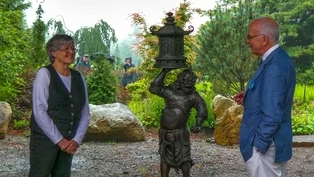
Well, he scared us as children.
(chuckling): That's exactly right.
This is the stuff of nightmares.
Yes.
Yes.
And that's exactly who that is.
This is an oni.
And an oni is a mythical figure that we can best describe as a devil who has superhuman powers.
The eyes have a kind of off-white appearance that is been achieved with some sort of enamel that would have shown and been penetrating in low light.
This dates to about 1909.
Okay.
Which is at the end of the Meiji period, which ended in 1912.
During the Meiji period, Japan was rapidly industrializing.
One of the ways they did that was by creating works of art that would be astounding.
That would be sold to people who had influence, which would be seen by the other people of influence that would then have an effect on commerce with Japan.
For insurance purposes, a reasonable figure would be in the $60,000 range.
Oh, that's very nice.
How nice.
One of seven, I have to-- sure I'll have a discussion with them.
(chuckles) PEÑA And now it's time for the "Roadshow" Feedback Booth.
Tomorrow's my 31st birthday, and while we're not going to retire early, we did learn that this March on Washington button is worth $250.
And we got a bonus appraisal when the, uh, appraiser said that she thinks she owned that sweater in the 1980s.
So we had a great time at the "Roadshow" today.
(chuckles) And we've carried this around for 50 years.
And it's an 1840 mantelpiece from the top of a building in Canton, China, that could be worth up to $1,200.
And I said I would throw it away if it wasn't worth anything, but I guess we're gonna have to keep it.
And I brought my mother's pearls that she brought in from Japan when she got married and came to the States over 50 years ago.
And, uh, I didn't know there was a clamp, a clasp here that you could use it for, both as a bracelet and a, and a necklace, which I will tell my Mom that it was for.
And it was-- we didn't really know how much it was worth, but it's worth a couple thousand dollars, which is pretty cool, but-- So we're so excited to have met the appraisers here as well.
Mahalo.
Thank you.
Aloha.
We brought two dolls.
This one is from Germany, and it's from the 1890s, and worth about $200.
This one's from America from the 1990s, worth about $50.
We had a lot of fun.
Even the lines were fun.
And I got to see all my favorite appraisers.
Thanks, "Antiques Roadshow!"
Thanks, "Antiques Roadshow!"
PEÑA: Thanks for watching.
See you next time on "Antiques Roadshow."
Appraisal: 1948 Gilbert Adrian Silk Taffeta Gown
Video has Closed Captions
Clip: S30 Ep9 | 3m 3s | Appraisal: 1948 Gilbert Adrian Silk Taffeta Gown (3m 3s)

Appraisal: 1962 Dr. Martin Luther King Jr. Letter
Video has Closed Captions
Clip: S30 Ep9 | 3m 43s | Appraisal: 1962 Dr. Martin Luther King Jr. Letter (3m 43s)

Appraisal: 1963 Picasso Madoura Plate
Video has Closed Captions
Clip: S30 Ep9 | 2m 25s | Appraisal: 1963 Picasso Madoura Plate (2m 25s)
Appraisal: Croft Stock Ale Cone-top Beer Cans, ca. 1940
Video has Closed Captions
Clip: S30 Ep9 | 2m 36s | Appraisal: Croft Stock Ale Cone-top Beer Cans, ca. 1940 (2m 36s)
Appraisal: Josef Hoffmann Silver Cups, ca. 1910
Video has Closed Captions
Clip: S30 Ep9 | 2m 25s | Appraisal: Josef Hoffmann Silver Cups, ca. 1910 (2m 25s)
Preview: Coastal Maine Botanical Gardens, Hour 3
Video has Closed Captions
Preview: S30 Ep9 | 30s | Preview: Coastal Maine Botanical Gardens, Hour 3 (30s)
Providing Support for PBS.org
Learn Moreabout PBS online sponsorship
- Home and How To

Hit the road in a classic car for a tour through Great Britain with two antiques experts.













Support for PBS provided by:
Funding for ANTIQUES ROADSHOW is provided by Ancestry and American Cruise Lines. Additional funding is provided by public television viewers.