
Declarations: Black Americans and the Revolutionary War
6/29/2026 | 55m 36sVideo has Audio Description
Uncover the stories of Black Americans who fought to define democracy during the Revolution.
In 1776, the Founders’ promise of “all men are created equal” remained distant for many. Trace the heroic stories of the enslaved and freed Black Americans who fought to define democracy and their liberty through the Revolutionary War.
See all videos with Audio DescriptionADProblems playing video? | Closed Captioning Feedback
Problems playing video? | Closed Captioning Feedback
Declarations: Black Americans and the Revolutionary War
6/29/2026 | 55m 36sVideo has Audio Description
In 1776, the Founders’ promise of “all men are created equal” remained distant for many. Trace the heroic stories of the enslaved and freed Black Americans who fought to define democracy and their liberty through the Revolutionary War.
See all videos with Audio DescriptionADProblems playing video? | Closed Captioning Feedback
Where to Watch Declarations: Black Americans and the Revolutionary War
Declarations: Black Americans and the Revolutionary War is available to stream on pbs.org and the PBS app.
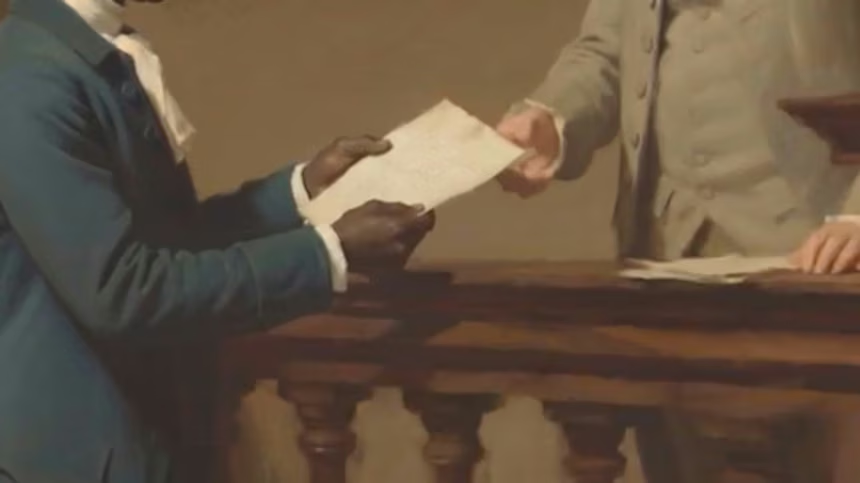
Q&A with the Filmmakers
Learn how the filmmakers used AI tools to supplement historical depictions in "Declarations: Black Americans and the Revolutionary War."Providing Support for PBS.org
Learn Moreabout PBS online sponsorshipANNOUNCER: This program includes visuals generated with the help of AI tools to supplement historical depictions.
These are based on the work of a fine artist and clearly distinguished by a rough black frame.
To learn more, visit pbs.org/declarations ♪ LESLIE: One of the challenges of studying and seeking to understand the stories and the histories of enslaved and free Black people in the 18th and 19th centuries is a problem of sources.
How do we reconstruct the lives of people whose lives and stories were considered unimportant of acknowledgement, considered unimportant to historical documentation?
How do we take people who were not even fully considered human and try to reconstruct their lives?
What is fortunate is that we do have little tidbits that we are able to use to draw upon to learn more about their lives.
And from those little fragments, we are at least able to salvage something about them that then we can fully render from that the story and the life of a person who changed the course of the history of this country.
♪ STEPHEN: The unanimous Declaration of the thirteen United States of America.
CHRISTOPHER: We hold these truths to be self-evident.
ANDREW: That all men are created equal, that they're endowed by their Creator with certain unalienable Rights.
DESIREE: That among these are Life, Liberty, and the pursuit of Happiness.
WOODY: That to secure these rights, Governments are instituted among Men, deriving their just power from the consent of the governed.
ENJOLI: Whenever any form of government becomes destructive of these ends, it is the right of the people to alter or to abolish it.
EDWARD: And to institute new government, laying its foundation on such principles and organizing its power in such form as to them shall seem most likely to affect their safety and happiness.
SESHA: But when a long train of abuses and usurpations, pursuing invariably the same object evinces a design to reduce them under absolute despotism.
GARY: It is their right, it is their duty, to throw of such government and to provide new guards for their future security.
GRAHAM: The words and the message of the American Revolution and the Declaration of Independence continue to inspire the world today.
America, of course, is an unfinished project.
We know this.
We still have people who do not have their rights.
But the possibility, the framework for getting those rights is still there.
♪ TEACHER: Who remembers our conversation yesterday about the Declaration of Independence?
STUDENT 1: Britain wanted to take over America and the United States didn't want that so they wanted independence.
TEACHER: Yes, and what does independence mean, Max?
MAX: It says, "We hold these truths to be self-evident that all men are created equal."
TEACHER: That is a awesome remembering.
And does anybody else want to take a crack at what's that really mean?
STUDENT 2: That we have something that other people can take away.
TEACHER: Absolutely right.
There are some things that you are entitled to.
Rights.
♪ ADAM: The American Revolution does a lot of things.
It obviously creates a new nation, but it also creates portals for advocacy for Black people.
DESIREE: Hearing that everyone's supposed to be free and equal, but then looking at our situation and saying, "Does that not apply to me too?"
ADAM: We have to then think, what's the disconnect between the drafting and the living of these particular words?
EDWARD: The Declaration of Independence, we read it now as a kind of optimistic statement, but in many ways it's a very pessimistic statement that we have to be independent because we're under threat from so many different directions.
♪ DANIELLE: 1776 is really the culmination of more than a decade of effort on the part of the colonists to explain their grievances to the king and also to articulate principles for how they wanted to organize their lives.
There were many different voices and streams that came together.
WOODY: Most of the guys who wrote and signed the Declaration of Independence did not see it as a freedom document.
For instance, it never says anything bad about the idea of monarchy.
For them, it was not an equality document.
It was an independence document.
They are all about creating free and independent states.
DOUGLAS: White revolutionaries began to call themselves slaves of King George and talk incessantly about liberty and freedom.
♪ DESIREE: I am not so sure the founders really meant "We believe these truths to be self-evident" for everyone.
We believe them for ourselves because we are feeling the weight and the pressure of what we believe is our own kind of enslavement or our own bondage.
♪ CHRISTOPER: Regardless of whom you're talking about in terms of familiar names, whether it's George Washington or Thomas Jefferson, James Madison, they share a commitment to American liberty and a commitment to slaveholding.
DESIREE: What we forget sometimes is that the basis of these words assumes full personhood.
And so if you do not assume that someone is fully human, fully person, then you're not even thinking about them.
I don't think that they were even considering slaves when they wrote this because they couldn't see their full humanity.
CHRISTOPHER: The Declaration of Independence doesn't create new beliefs or ideals among Black people, but it does create a sense that there's an opportunity here that we've not had before.
CASSANDRA: We hold these truths to be self-evident, that all men are created equal.
There is no mention of ethnicity, there's no mention of race, there's no mention of who it applies to and who it doesn't.
ADAM: Black people were not loyal to a cause, they were loyal to the principle and ideas of freedom.
CASSANDRA: And they didn't care who gave them that freedom or who arranged for them to have that freedom.
It is part of this enduring journey that has defined, not only the life of African Americans in this country, but actually has defined what this country is really all about.
♪ DANIELLE: It's a paradox, I think, for African Americans that there were two different paths to freedom.
One, potentially through self-government in the American experiment, and the other through the British.
ADAM: When the Declaration of Independence is authored and certainly lived out, Black people fought for their inclusion in the country, even at times when the country wouldn't necessarily want them there.
♪ GRAHAM: The stories of Mum Bett, Skipwith, James Lafayette, Harry Washington, these people are exceptional, but they're also representative.
They provide us with a window into a much, much larger world of Black embrace of revolutionary ideals and action about that.
So all of these people in their own lives demonstrate to us the important power, influence, and action of the American Revolution and the Declaration of Independence.
♪ ADAM: When I think about what life, liberty, and the pursuit of happiness means with a guy like James Lafayette, it's complicated.
♪ STEPHEN: My name is James.
I'm owned by a man by the name of William Armistead.
Living history interpretation is a whole 'nother beast because you have to understand the foundations of the period in which you're interpreting.
When I say, "We hold these truths to be self-evident, "that all men are created equal, "that they are endowed by their Creator "with certain unalienable Rights, that among these are..." what?
CROWD: Life, Liberty, and the pursuit of Happiness.
STEPHEN: Nearly everybody sitting here knew it, didn't they?
And even back then, we knew it.
When I started here 17 years ago, I almost quit.
So much of what I deal with daily as a Black man in America, I saw it being codified in the documents of colonial era America, and I got depressed.
I'm owned by some of the very same men that are fighting for that document.
So I knew that I couldn't trust the American side.
But you're giving a voice to people who might not have had a voice during the time that they were alive and you're finally making sure that- that they're heard.
♪ For the enslaved, there isn't a side that is truly working for you.
Neither side is saying, "Slavery is wrong."
So I had to figure out the why.
Why did James decide to join the American cause and not the British cause?
♪ He was born into enslavement in 1748.
He ends up meeting the Marquis de Lafayette, who had come from France to fight the Revolutionary War.
The Marquis de Lafayette was a very young Frenchman in 1777.
He became a Major General under General George Washington at 19 and was one of the most successful generals of the war.
WOODY: The Marquis de Lafayette managed spies, one of whom was James Lafayette.
And the deal was, you spy for the American side, and then after the war you'll get free.
♪ James posed as a person who supported the British side, spying on the Americans, but he was actually on the American side, spying on the British, and providing really valuable information.
♪ STEPHEN: The stakes that an enslaved individual would have been dealing with as a spy, the dangers, the worries of being compromised, the worries of death, but those worries are the worries that the average enslaved person has every single day.
♪ GARY: Virginia represents ground zero for the American empire.
Six of the first ten presidents, Virginians, among them Thomas Jefferson, who so eloquently penned lofty words.
All men are created with certain unalienable Rights, among them Life, Liberty, and the pursuit of Happiness.
But life was not afforded to Black people.
Liberty was not afforded to Black people.
And the pursuit of happiness was a distant dream.
GRAHAM: There is no linear path to freedom.
So how to deal with that?
Well, you can live a life of slavery, try to work out the best deal within that, or you can, as people often did, run away.
♪ EDWARD: This is the golden age of Virginia, because this is when the big plantation houses are built, this is when families like the Jeffersons and the Washingtons consolidate their wealth, and it's all based on the backs of enslaved people.
And it's so prosperous.
♪ Virginia is the largest and richest colony.
And by 1770, nearly 40% of Virginia's population is Black.
SESHA: One in four Blacks in America are said to be able to retrace their roots to the rivers in the Richmond region.
♪ ENJOLI: We are on what we consider to be sacred land.
This is the future site of the Skipwith Roper Cottage.
This is a reconstruction project so that we can honor the legacy of Abraham Peyton Skipwith, one of the first homeowners in what will become Jackson Ward.
Skipwith has direct connection to some of the founding fathers.
And through that connection, he was able to amass a level of knowledge, know-how, and finance to be able to purchase a plot of land in what would become Jackson Ward, not only as the first Black resident, but one of the first residents period.
Jackson Ward is one of those spaces that's been celebrated for its Black entrepreneurial spirit.
It was once known as a Black Wall Street, the Harlem of the South.
There is just a boom of Black entrepreneurship.
♪ When we think about this idea of generational wealth, what it means for us to have this land and for us to be gifted this land, something that actually has real, tangible value, means a great deal.
One, two, three, Skipwith!
GROUP: Skipwith!
♪ SESHA: Abraham Peyton Skipwith is a Black man whose life we can retrace to 1767.
He was enslaved by a family known as the Amblers in Williamsburg, Virginia.
Jaquelin Ambler worked for Thomas Jefferson, and he was part of his council.
He served as the collector of debts in the Williamsburg area.
The house that we're interviewing in was owned by the daughter of Rebecca and Jaquelin Ambler, and she was married to John Marshall, who was on the Supreme Court.
ENJOLI: So Skipwith was enslaved by some of the country's most celebrated dignitaries at the time.
♪ SESHA: 1775, there is this document by the daughter of Jaquelin and Rebecca, and she is writing an account of watching her parents in conversation.
They have heard of people throwing chests of tea in the water up north, not realizing that they're describing the Boston Tea Party.
They're talking about liberty and freedom in juxtaposition of being oppressed by the mother country and starting to describe, but they have no clue, what would be the American Revolution.
What's so perplexing about the document is that the very first sentence is, "Surely Abram knows to bring me my tea."
So while you're talking about these concepts of freedom and liberty and being oppressed, you're actively oppressing someone in your parlor.
Around 1782, Jaquelin and Rebecca sell him to a gentleman named Thomas Bentley.
Thomas Bentley is known as an explorer, and so when he was exploring, he left Skipwith in charge of his affairs.
He worked as a clerk in the store.
This is a man who is enslaved, but also running stores on behalf of people directly connected to the founding fathers.
♪ LESLIE: In places like Richmond, you have an increasing number of both enslaved and legally free Black people who are actually being intentionally trained for the purpose of advancing the institution of slavery.
And they are now becoming blacksmiths, tailors, shipbuilders, and navigators.
♪ Abraham Skipwith represents a very different experience from most other enslaved people at the time, in the sense that in order to serve his own interests, his enslaver is willing to let him learn to read and write.
SESHA: Skipwith applies for his legislative petition for freedom in 1785.
How does he even know how to get in touch with them?
How does this enslaved man even know how to send a letter?
CASSANDRA: Black people were very aware of the law and of their status.
They were the unseen servants in the room who heard everything, understood everything, and communicated that information to others.
That always created fear in white society.
SESHA: What dawned on me is that we can sometimes be trained around the white gaze.
Where when we see a narrative, we see the white object as the center.
When he was serving tea, he was getting the tea.
And he was able to realize these concepts of freedom and liberty and business and to develop an acumen to know how to file for a legislative petition a couple of years later.
GARY: Legislative petitions in the Commonwealth of Virginia, as with other colonies, were a way that Black people could petition for their freedom or have a white male petition on their behalf.
Some were successful, some weren't.
Much of the good, the bad, and the ugly that has made America, America began here.
Skipwith is a part of that grand legacy.
♪ CHRISTOPHER: 1775 is the height of the political crisis before the war begins.
It's the moment in which the 13 colonies are having a fallout with the British government.
1775 is the year of Lexington and Concord, the shot heard around the world.
It's the year in which a political crisis turns to war.
♪ DANIELLE: Politics got very hot in Virginia in the fall of 1775.
DOUGLAS: As long as Virginia was a colony, it was a world of hierarchy.
Power flowed down from kings and parliaments and royal appointed governors.
DANIELLE: The King appointed governors for all of the royally chartered colonies.
The colonies had different forms of administrative structure.
The governor would translate British policy to the American context.
EDWARD: The British keep adding more and more constraints and taxes on white Americans.
DANIELLE: When Parliament and the King, for example, passed new taxes, it was the job of the governor to enforce those taxes.
DOUGLAS: John Murray had the title of Lord Dunmore, was the last royal governor of Virginia, was appointed by Parliament and by the crown.
What he was looking for was young men who would fight on the side of the British.
ANDREW: Most of the British troops are located in Boston.
British ships are in Boston.
So he really has to make his own fighting force.
He has to create his own homegrown group of people to battle the patriots.
And there's one obvious candidate.
GRAHAM: Kemp's Landing battle in November 1775.
Black forces fighting against the Patriots and the British win.
This is exactly what the Patriots have always feared.
The English look upon this and they say, "These people are going to be good soldiers."
♪ ADAM: Virginia had the largest slave population in all the colonies.
Lord Dunmore saw an opportunity.
ANDREW: He decided, after winning a battle at Kemp's Landing, that it was time to offer them freedom in exchange for their service.
He needed soldiers, but he also had to promise them something to get them to fight.
♪ ADAM: November 7th of 1775, Dunmore put out to the world he is going to declare martial law and provide freedom to indentured servants and Negroes appertaining to rebels.
DANIELLE: It's very clear that people were thinking about freedom, articulating it, understanding its value.
WOODY: The only people making that offer of freedom south of the Potomac River, that is Virginia on down, were the British.
There's a sense in which the Revolutionary War, among many other things, was an involuntary Black civil war, meaning that there were Blacks fighting on both sides.
EDWARD: If you're a Black American, you've got additional factors to weigh in.
Black Americans are alert to every kind of opportunity and are taking whatever they can find.
A lot of them would just run away, just escape, and I'll calculate which side I'm on when I have to.
WOODY: There's a debate among historians about what to call the African Americans who joined the British and some have said for a long time - Black loyalists.
Well they weren't really loyal to the British and they weren't loyal to the Americans they were loyal to the principle of the rights of man.
They were embroiling themselves in this white conflict in hopes of attaining freedom for themselves.
ANDREW: So large numbers of men, women and children begin to show up behind British lines They come from all over the colony and actually as far away as Massachusetts.
We're talking about hundreds and maybe even thousands of people who begin to leave their plantations in the hope of finding freedom.
WOODY: Enslaved people literally knocked on the door of the governor's palace in Williamsburg and said, "We will bear arms on behalf of the King "and help him put down the Patriot rebellion.
All we want in return is our freedom."
DOUGLAS: Young men brought with them their wives, their children, their parents.
ANDREW: Dunmore set out to make soldiers as quickly as he could and created Lord Dunmore's Ethiopian Regiment.
This is the first Black regiment in the British Army in history.
He gave these men red coats, he gave them training, taught them how to fire guns, how to use their muskets, and pretty quickly he had a fighting force ready to take on the Patriots.
♪ ADAM: Black people have been running away since they were brought to this land.
But for the first time in Virginia's history, you have a chance to actually run directly to something.
There are numerous Black people who fled from prominent founding families.
Probably the most important one is Harry Washington.
Formerly a slave of George Washington.
DOUGLAS: He was born around 1740, somewhere near the Gambia River region.
In 1763, George Washington bought him at an estate sale and rechristened him Harry.
CHRISTOPHER: George Washington puts him to work in Great Dismal Swamp where he does really arduous labor for years.
Then brings him to Mount Vernon.
He runs away.
DOUGLAS: George Washington placed ads and they captured Harry.
Washington was a very shrewd manager.
He would have had the option of selling him farther south and so the fact that he kept Harry indicated that- that Harry was a very valuable field hand.
GRAHAM: It's kind of common for people to run away, be caught, and be returned.
So even though Harry Washington runs away, this is a guy who's working on a plantation in Virginia that the freedom idea is intrinsic to his being.
The freedom idea is something that's part of his soul, and he's not going to give that up.
CHRISTOPHER: From 1775 through 1782, George Washington is busy with the Continental Army.
The fate of his estates is very much in question.
When the political crisis emerges and Governor Dunmore decides that he's going to offer freedom to enslaved men and women owned by rebels who are willing to come to British lines, Harry Washington escapes.
He joins Dunmore, and he ends up assisting the fight on the British side all throughout the war.
DOUGLAS: Harry was going to work hard and die young if he stayed at Mount Vernon, and so leaving with the British became his- his best option.
LESLIE: George Washington is fighting for freedom while at the same time he is holding hundreds of people in bondage, including Harry Washington.
Harry Washington is deeply committed to freedom.
This is actually something they have in common, but George Washington believes in it for himself, not for Harry.
Harry managed to flee to the British, taking up arms against his former owner.
CHRISTOPHER: There are gambles on top of gambles for somebody like Harry.
Nobody knew who was going to win.
So choosing the winning side for a war that's going to run six or seven years, you don't know when you escape to Dunmore's boats that he's going to keep his promises, or that he's not going to turn around and sell you into enslavement.
DOUGLAS: Harry rose to the rank of corporal in the British Army.
LESLIE: There are examples of enslaved people who are using the spirit, the language, the ideology of the American Revolution, of the Declaration of Independence, and they're all leveraging it to gain their freedom.
They're all using very different strategies.
♪ TEACHER: The title of this book is "Mum Bett's Declaration of Independence."
Mum Bett lived in the late 1700s, but a lot of documents about this woman's life were written by people that were not her.
She couldn't read or write.
Amaya?
AMAYA: Why can't she read or write?
TEACHER: Because she was enslaved.
DESIREE: There's not a lot that we know about the origins of Mum Bett.
We do know that she ended up in the home of Colonel John Ashley and Hannah Ashley.
DANIELLE: The question of the relationship between the Declaration of Independence, the Revolution, and the trajectory of enslavement is immensely complicated.
In the South, the question of emancipation was just off the table because of the economic dependence on the plantation economy, and so that locked the South in.
So in the North, they actually moved relatively quickly to the idea that enslavement itself was a violation of basic rights and should be ended.
GRAHAM: Mum Bett lives in Massachusetts.
Massachusetts is one of the first states to establish gradual emancipation.
Their constitution declares, you know, that all people are equal and are free.
And so Mum Bett knows about this, and at the same time she's living with a master, John Ashley, who denies this to her.
CHRISTOPHER: So in Massachusetts, the fall of slavery is directly related to the American Revolution.
DESIREE: The Sheffield Resolves, written in 1773 by Colonel Ashley, Theodore Sedgwick, and others.
It was their response to the atrocities that they felt they were experiencing by the British Empire, saying, "We are all free and equal, "and we should not be under the tyranny of the British Empire."
Later, the Declaration of Independence and the Massachusetts Constitution picks up some of that same language.
So in this home, as Mum Bett is working, she is hearing the Sheffield Resolves being formed.
She is living her life as a- a slave.
LESLIE: We tend to associate Massachusetts with freedom.
The Boston Massacre, the Boston Tea Party, the heart and soul of the American Revolution.
And that is certainly true as a practical matter.
But at precisely the same time, Massachusetts is also the heart and soul of slavery in the North.
DESIREE: Northeastern slavery was looked at as a kinder slavery.
You were not being brutalized in the same type of way, but nonetheless you were still not free.
♪ TEACHER: The colonel's wife, Mrs.
Ashley, owned the sharpest tongue in town.
Does anybody know what that means?
Yeah.
STUDENT: That they aren't as kind as other people, like, kind of mean.
LESLIE: Hannah Ashley had a reputation for being a particularly violent mistress.
DESIREE: At some point there's another slave known as Lizzie.
We are unsure of whether Lizzie is Mum Bett's daughter, her sister.
One day Hannah goes to attack Lizzie.
Hannah tried to hit her with a hot shovel.
Mum Bett puts her arms up to protect Lizzie.
LESLIE: And as a result of it, received a cut that she bore the scars of for the remainder of her life.
DESIREE: This is when she decides enough is enough.
And so directly after that event, she goes over to Sedgwick's house and asks him to help her sue for her freedom.
CHRISTOPHER: Massachusetts courts were the only courts at the time of the Revolution that were allowing enslaved men and women to bring their cases before the court to make the case that they had a right to freedom.
DESIREE: Theodore Sedgwick eventually decides that they're going to represent Bett, which is an interesting thing, given that he had a great relationship with Colonel John Ashley, he had actually helped form the Sheffield Resolves in their home.
♪ DANIELLE: It's hard to imagine her position, working for somebody as an enslaved person and then litigating against them at the same time.
Her courage, I think, just is evident from her actions themselves.
DESIREE: There was a lot of fights within the courts.
There was a lot of stalling to keep Bett from seeing her day in court.
♪ GRAHAM: Mum Bett is an ordinary woman.
I mean, she's extraordinary in the fact of what she does, but her actual position in society is pretty ordinary.
She's not a soldier.
Lafayette is.
He is a highly skilled military practitioner.
And these are the kind of people who are promised their freedom by their masters.
But he's someone who works for both sides.
ADAM: James is at these important timeframes of the war, 1781 in particular.
He wanted to contribute to the war on the side of the Patriots, but he saw the avenue because of the fact that there were so many Black refugees with the British in a way that he can spy by mingling with them.
He's right there with them.
He's right next to Lord Cornwallis, working for him.
♪ WOODY: James Lafayette got work as an aide to the British commander-in-chief in the South named Cornwallis.
What Cornwallis didn't know was that he was listening in on Cornwallis' conversation and then transmitting the gist of those conversations back to the Marquis de Lafayette who was on the American side.
STEPHEN: James helped to bring that intelligence to the Americans that the British were heading to Yorktown in the first place.
That, in many ways, made it possible for General Washington, when he made it in secret to Virginia, to surround the British and to, in essence, prevent them from being resupplied.
WOODY: For that reason and many others, the Americans and French were able to force the British to surrender at Yorktown.
STEPHEN: In essence, that siege of Yorktown ended the war.
That's partly because of the contributions of James Lafayette.
♪ WOODY: His deal with the Marquis de Lafayette was, "I will spy for you and then when the war's over I get freed."
But he was not freed.
After the war, the Marquis de Lafayette went back to France and assumed that that promise would be kept, but it wasn't.
STEPHEN: I was sent back to slavery, sent back to Master William, for six more years.
So what changed?
The Marquis de Lafayette.
WOODY: The Marquis de Lafayette came back to Virginia in 1784, and James went to him and said, "You know, they never did free me."
The Marquis de Lafayette was furious at that and finally got the Virginia legislature to free James Lafayette in 1787, so six years after the war.
ADAM: For him, life, liberty, and the pursuit of happiness, even though he might not have actually known those words and the way that they were professed, but in how he lived his life and in the choices that he made, it shows that for him, he believed in the cause, even if it meant that he wouldn't actually free himself from bondage until almost a decade after his service.
♪ LESLIE: Unbelievably, the Americans are victorious and the war comes to an end.
But now, the country finds itself with a whole new set of challenges.
What kind of a country are they going to build?
In their founding documents, they implied, at a minimum, that they are committed to life, liberty, and the pursuit of happiness for everyone.
But the question becomes, who- who did they actually mean?
Who is included in the brotherhood of man that they are imagining?
♪ CHRISTOPHER: When the United States defeated Britain and secured its independence, one of the pressing questions is what will happen to those enslaved men and women who ran away during the course of the war and got their freedom by going to British lines.
DOUGLAS: Harry Washington was evacuated back to New York City, which was still under British control.
He brought with him his fiancée, a South Carolina runaway named Sarah Jones.
At the same moment, American and British negotiators were hammering out a peace treaty.
They would write into the treaty that when the British left, they could not take with them any Negroes or American property.
WOODY: Harry Washington, who got away and who tasted freedom for all those years, and now you're going to be dragged back into slavery.
George Washington arranged meetings with Guy Carleton, the commander-in-chief on the British side, and Washington said... DOUGLAS: "I know you have slaves that belong to me."
He knew Harry was there.
And according to this article, you cannot take them with you.
GRAHAM: And Carleton says, "They're gone."
"Gone, you say?"
So Washington is astonished and appalled.
DOUGLAS: Carleton simply would not back down.
He thought it would be dishonorable for Britain, having made promises in '75 and '79 to Black Americans.
CHRISTOPHER: The British government could have gone back on its promises, and that it did not says something about the kinds of ties that were forged during the war.
And that's not the same thing as believing in racial equality, nor is it the same thing as believing that slavery should be overthrown.
The commanders like Guy Carleton who made these decisions were not abolitionists.
They wanted to keep the word to the specific people that they had made promises to.
GRAHAM: The governor had made these proclamations in the King's name.
And so therefore to go back on that, that would be highly dishonorable to the King.
So he's not going to do that.
And so they list all of these people with the idea that later on there may be some compensation.
DOUGLAS: So the final agreement was that he would allow for a very detailed accounting of everybody under his jurisdiction.
Called the Book of Negroes.
CHRISTOPHER: The Book of Negroes is an administrative document, but what it records are the individual initiatives to secure freedom.
But it's also one of these very rare instances where we get the names of all of the people who had made a decision to flee the world that they had known and to take a chance to pursue a better life outside of the United States.
♪ DOUGLAS: It gives us a real picture of who was on the British side during the Revolution.
And there's Harry Washington, listed as a stout fellow, owned previously by General George Washington.
WOODY: In the summer of 1783, Harry, with about 300 people, sailed out of New York Harbor to Nova Scotia.
And their story is bittersweet.
DOUGLAS: Everything there went wrong.
3,000 Black refugees arrive in Nova Scotia and white Canadians didn't want them.
They build a church and Canadians literally tear it down.
They build a house and white sailors tear down the house.
The British had the idea of getting land in West Africa and setting up what became the colony of Sierra Leone.
CHRISTOPHER: It's a sort of charity colony, a place to settle Black loyalists.
WOODY: And so they jumped at an opportunity to return to the West African coast.
♪ LESLIE: So enslaved people are exploring all different types of avenues to gain their freedom.
And one of the ways is through voluntary manumission.
When such strategies failed, they would turn to legislative petitions or legislative appeals, where they would use the court system and file a petition appealing for their freedom.
♪ SESHA: One of the things that we do know is that when Skipwith files his legislative petition, he makes sure to say, "I am not the unfortunate characteristic of a slave."
Those who were his witnesses for his legislative testimony, it includes Benjamin Harrison, who was one of the founding fathers and signers of the Declaration of Independence.
When I think about Skipwith's proximity to not only the people who helped develop the United States of America as an institution, but those who had vouched for him.
And in 1789, he purchases his freedom, and he builds this three-level gamble-roof cottage.
ENJOLI: And he's able to not only purchase his own freedom, but the freedom of his wife and his granddaughter.
He was not able to purchase the freedom of his direct children, but he was able to establish a legacy.
CASSANDRA: Skipwith was part of a whole line of free Blacks who understood that purchasing property, establishing your business, and establishing a legacy of inheritance for your children and their children's children's children was an important avenue to agency and to protecting your loved ones.
And you would see a lot of free Blacks who, if they had the capability, if they had the money, they purchase a lot of property.
♪ ♪ SESHA: In 1797, he writes this will.
EDWARD: In the name of God, amen.
I, Abraham Skipwith of the county of Henrico, being sick and weak in body, but of sound mind, memory, and understanding, do make my last will and testament in manner and form following.
SESHA: I leave to my beloved wife, Chloe Skipwith... It's the beloved for me.
...The house wherein I now live, which stands on the street, a road together with 30 yards of ground on front, beginning at the west corner of Mr.
Isaac Judah's lot.
ENJOLI: Skipwith passes down the home to his family members.
He really understood the value of what it meant to have a piece of property that you could pass down, how it could be leveraged, and he was one of the first Black people, if not the first, in the state of Virginia to be able to do so.
DESIREE: I give to my son Samuel Jarret his choice of ten suits of my wearing apparel, my silver watch, a gold brooch, and my silver knee buckles.
SESHA: And he has things that you just would never hear of a Black person having.
He had gold and silver, a gun!
I mean a gun unapologetically exercising his second amendment.
Beyond the gun, it's the horse and buggy.
I cannot even imagine a Black man riding around in a horse and buggy not in service to an enslaver.
It disrupts everything I've ever heard of what it was like to be Black in the 1700s.
EDWARD: And the residue of my wearing apparel after my son Samuel has made his choices, I give to Benjamin Skipwith, who at present is the property of Mr.
Thomas Reynolds of Gloucester County.
SESHA: He goes in and out of realizing the American dream and then has to end the sentence, but you're still the property of someone else.
It's like a dream deferred a little bit when you think about it, because when he died, all of his family still wasn't free.
♪ LESLIE: A story like that lets us know how deep and powerful the legacy of slavery was and how ultimately it was impossible to fully escape the cruelty of enslavement, because even when you gained your own freedom, you knew you were leaving other people behind.
♪ On the other hand, you have someone like Mum Bett.
If not for the precedent that her case sets, slavery in Massachusetts probably would have died a very different death.
CHRISTOPHER: You wouldn't find a story like Mum Bett in the other colonies.
Mum Bett is able to bring her case before the Massachusetts court in part because of their Constitution of 1780, which essentially takes the words of the Declaration of Independence and enshrines them into the institution, the fundamental laws of Massachusetts itself.
GRAHAM: Her suit is based upon very careful reading of the Massachusetts Constitution.
She knows that this is the law and that she has rights under it.
DOUGLAS: Sedgwick's argument in court was that the second Massachusetts had ratified the Constitution, they'd also essentially abolish slavery in the state.
♪ DANIELLE: There is a straight line from the choices made in the Declaration of Independence to the lawsuit that Mum Bett is able to bring.
TEACHER: What is Mum Bett arguing?
STUDENT 1: That she should be free if the Constitution says so.
TEACHER: And why does the Constitution matter?
Why can she use that as an argument?
STUDENT 2: Because they clearly said that every person is born to be free and should be free, and she is a person.
♪ DANIELLE: And the result of her lawsuit is that slavery comes to an end in Massachusetts.
And of course she wins her freedom.
CASSANDRA: Slavery ended in Massachusetts not because the whites of Massachusetts decided they wanted to end slavery but because Mum Bett decided to file a lawsuit.
DESIREE: The idea that the all-white male jury made this decision that would literally change kind of the landscape of their community and their lives.
LESLIE: She changes her name, she becomes known as Elizabeth Freeman, and she lives the rest of her life as a free, emancipated person who has the ability to move and to make choices about her own life and her own destiny.
♪ DESIREE: She was a midwife, she could cook, she was the person you kind of came to if you needed a balm or a salve.
DOUGLAS: Then in 1790, married a Black veteran.
DESIREE: Elizabeth Freeman, we'll call her that now, a woman who was enslaved, who could not read or write, who just because of her bravery and her willingness to step out for the sake of herself and others, was able to carve out a life that was one of the pursuit of life, liberty, and happiness.
♪ TEACHER: What words come to your mind when you think about Elizabeth Freeman's life?
You will notice different things about the same story.
That's what history is all about.
Did you choose to draw her in any time period?
STUDENT: After she was free.
TEACHER: After she was free.
Why did you choose to draw her then?
STUDENT: Because she was happy.
GRAHAM: Mum Bett creates a blueprint, her case ends slavery in Massachusetts.
Harry Washington returns to Africa after years living in North America.
CHRISTOPHER: In Sierra Leone, Black loyalists were hoping to establish a new home where they could have freedom, liberty, security, autonomy, property, all the rights that they had been denied in North America.
♪ DOUGLAS: The colony of Sierra Leone was designed to make money.
The colony demanded that before a land title could be given to people like Harry, they paid.
♪ WOODY: The British said, "Well, we're going to have to tax our Black colonists in Sierra Leone."
DOUGLAS: They were barely making any sort of living.
CHRISTOPHER: There ends up being a rebellion against British rule.
Former Black loyalists who get accused of having sort of carried with them American political principles to Sierra Leone.
WOODY: Harry Washington became the leader of a new tax revolt.
DOUGLAS: The British brought in the redcoats of Jamaican maroons and put down the rebellion.
Harry was last seen about the age of 60.
He'd been exiled, he was walking up the coast, probably heading back toward the Gambia, which is where he was sold out of.
And that's when Harry vanishes from history.
♪ ENJOLI: Jackson Ward is foundational to this city and indeed its story is foundational to this country.
SESHA: And we decided that for America 250 we wanted to tell the truth about this country through a more holistic and honest lens.
WOODY: I desire to be buried in a plain and decent manner on my own lot, my grave.
GARY: In the 1950s, Federal Route 1 was the main artery from Maine to Florida.
Because we had had a growth in the auto industry, Route 1 was just too small to accommodate that many motor vehicles.
And so the Federal Highways Act expanded Route 1 and made expressways.
Through every city that Interstate 95 traversed, it went through the Black neighborhood.
♪ SESHA: The first public cemetery for Black people in Richmond wasn't established until 1799.
So if he made this will in 1797, he is practicing the custom of being buried at your home.
And so when I think about where his body now rests, I think it's very telling that as we think about what Interstate 95 took, it was bodies along with people's belongings.
♪ So the house was sold for $25.
It was placed on a flatbed, and it was dislocated to the former tobacco plantation for the Secretary of War for the Confederate Army.
And it sits there to this day.
♪ Our work right now is to ensure that he can rest in peace by reconstructing his cottage as a historic site for America 250.
♪ ENJOLI: While it's an absolute blessing that Skipwith's home was not destroyed, I read his will with a level of heartbreak over the reality of what happened, but also with a heart full of gratitude for having the opportunity to be able to bring that property back to its rightful place and unearth this legacy that is so deeply important to not only Virginia but the nation.
♪ GARY: We are setting a precedent for the nation of reclaiming property that was stolen from its ancestral home by returning Mr.
Skipwith's cottage.
And so once again, Virginia will set the lamp and blaze the trail.
♪ SESHA: I hope that it can be a restorative, but also a reconciliation of sorts through his story, because it was complicated, as is America, as is Virginia, and definitely as is Richmond.
♪ ENJOLI: I'm going to open up today in the spirit and words of Abraham Peyton Skipwith.
In the name of God, Amen.
♪ It all started with one really simple question: Who is Jackson Ward named after?
In search of the actual namesake, we came to realize it was named in honor, and to create legacy for, one of the fathers of the Confederacy.
And we knew that one of the things we had to do was rededicate the street names to the Black legacy holders.
Throughout Jackson Ward, that's where we came across Abraham Peyton Skipwith.
JENNIFER: Today we commemorate 250 years of the ideal upon which this country was founded.
That all men are created equal and endowed by their Creator with the unalienable Rights of Life, Liberty, and the pursuit of Happiness.
We remember those who it took a lot longer to see just a little bit of that promise come true.
SESHA: If anybody were to ask me what do we hope that you all walk away with today, I think it's the fact that the founding generation included Black people of means, of fortitude, and so we hope that Skipwith is a disruption to the model that we've been told about what it meant to be Black and American during the American Revolution.
ENJOLI: Two, three... Whoo!
(cheering and applauding) DESIREE: We hold these truths to be self-evident, that all men are created equal, that they are endowed by their Creator with certain unalienable Rights, that among these are Life, Liberty, and the pursuit of Happiness.
DANIELLE: Lots of people think of the Declaration of Independence as kind of an exclamation point that launches the Revolution.
It's actually much bigger than that.
What it really does is let people who are fighting for freedom, it lets them coalesce their efforts.
So yes, it's a turning point from maybe revolution to definitely having a revolution, but it's also the point that we start to get the crystallization of the abolition movement to end slavery and even the beginning of conversations about women's rights.
(fireworks crackling) ♪ Basic human moral equality is where the Declaration begins and it gives us the incredibly powerful picture of what it means for humans to live together.
♪ ♪ ♪ ♪
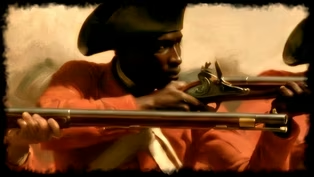
Video has Closed Captions
Uncover the stories of Black Americans who fought to define democracy during the Revolution. (2m 48s)
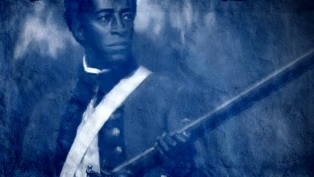
Video has Closed Captions
Uncover the stories of Black Americans who fought to define democracy during the Revolution. (30s)
Providing Support for PBS.org
Learn Moreabout PBS online sponsorship












Support for PBS provided by: