
Extreme Heat: Arizona to Australia
Episode 3 | 27m 30sVideo has Audio Description
Extreme heat is the deadliest climate disaster. Scientists in Phoenix and Sydney race to adapt.
Heat kills more Americans than hurricanes and wildfires combined, yet it remains the most invisible threat of climate change. Miles O’Brien travels from a Phoenix playground redesigned to fight scorching pavement, to an Australian shade lab, to a climate chamber where he’s put under the broiler, to meet scientists engineering how humans might adapt to a hotter world.
See all videos with Audio DescriptionADProblems playing video? | Closed Captioning Feedback
Problems playing video? | Closed Captioning Feedback
Made possible in part by support provided by Sue Hart-Wadley and Searle Wadley with additional support from Jerry Cox.
Extreme Heat: Arizona to Australia
Episode 3 | 27m 30sVideo has Audio Description
Heat kills more Americans than hurricanes and wildfires combined, yet it remains the most invisible threat of climate change. Miles O’Brien travels from a Phoenix playground redesigned to fight scorching pavement, to an Australian shade lab, to a climate chamber where he’s put under the broiler, to meet scientists engineering how humans might adapt to a hotter world.
See all videos with Audio DescriptionADProblems playing video? | Closed Captioning Feedback
Where to Watch Resolve to Solve with Miles O'Brien
Resolve to Solve with Miles O'Brien is available to stream on pbs.org and the PBS app.
Providing Support for PBS.org
Learn Moreabout PBS online sponsorship♪ ♪ O'BRIEN: Welcome to Phoenix, where it's another scorching day on the south side of the city.
At the Paideia charter school, it's recess-- and the kids are having a ball.
This playground was designed for safe fun, with just enough risk to build confidence while reducing the far greater risk posed by the relentless desert heat.
Jenny, so good to meet you.
JENNIFER VANOS: Yeah, welcome to Paideia.
O'BRIEN: And this is where I met an expert, working hard on helping humans adapt to extreme heat.
Her name is Jenny Vanos.
She's an atmospheric scientist and environmental health researcher at Arizona State University.
She studies how rising temperatures affect people, especially children, in places where they live, learn and play.
Is this, like, a good playground?
VANOS: Yeah, this is a playground that has some of everything, right?
O'BRIEN: Everything under the sun.
And shaded from it, too.
There's a big shade sail, rows of young trees and even a bioswale the kids can pump to life.
They are reprieves from the heat-- by design.
VANOS: There's this nice mix of, uh, the ability to seek shade, to seek water, to seek these special spaces like the garden and sanctuary, while also having the ability to play with your friends.
O'BRIEN: This playground has become an incubator for ideas on how to protect kids from heat.
VANOS: There's not gonna be a silver bullet that, that solves this problem.
We want open spaces for play, but at the same time, this cooling.
You have to have a mix of things.
O'BRIEN: It all sounds like common sense.
But this is science, and she needs to prove it with data.
She walked me through the playground with a thermal camera.
VANOS: You can really see the impact of that shade just today.
O'BRIEN: Yeah, yeah.
VANOS: It goes 80 Fahrenheit on that shaded surface.
And then it, it goes up to about 150 Fahrenheit on some of the hottest surfaces like the concrete here.
So that's a really big difference just in surface temperature.
And we're not even at the hottest part of the day yet.
O'BRIEN: And it's a tiny little tree.
VANOS: It's a tiny little tree.
O'BRIEN: Jenny leads a multidisciplinary team, and often collaborates with Ariane Middel, an urban climatologist at A.S.U.
who's built a sophisticated mobile lab she calls MaRTy, for Mean Radiant Temperature-- a measure of the total heat the human body feels in any environment.
MaRTy is equipped with net radiometers that capture radiant heat directly from the sun and from the hot surfaces around us.
ARIANE MIDDEL: So we have three pairs, and they point in all directions.
So they give us the heat load that the body experiences when you're outdoors in the sun.
O'BRIEN: It's the temperature we live in, not just the one we see on the weather app.
The difference between the two really surprised me.
So now air temperature is about 20, 21 degrees Celsius.
That's 68 degrees Fahrenheit-- but, the mean radiant temperature with the direct sunlight is 56 degrees Celsius, so that's 133 degrees Fahrenheit.
O'BRIEN: Wow.
MIDDEL: And it's only 8:45.
Yeah.
O'BRIEN: She routinely tows MaRTy through the playground, and all over the city for that matter, gathering data on air and radiant temperature, humidity, wind speed and direction.
Together, those readings reveal how different types of shade-- from trees to sails to buildings-- can help beat the heat.
The artificial shade which humans can create, um, gets you part of the way, but it's not gonna be as good as a tree.
Is that the idea?
MIDDEL: Yes, I mean, trees, if you can plant trees, definitely you would want the tree, there's just a lot of places where there are infrastructure restrictions.
And then the question is, is there alternatives to trees?
Um, can we use umbrellas or pergolas to shade people?
And is it as effective as a tree?
O'BRIEN: Trees do make a big difference.
But in this part of Phoenix, there aren't many of them.
There's a reason wealthier neighborhoods are often described as "leafy."
There's still not enough shade, uh, in this city, especially for South Phoenix.
It's an area that's not as wealthy, and there's just less shade in general because people don't have the resources to plant and maintain trees, and it's just a more dry and barren landscape.
O'BRIEN: It's hard to argue against planting more trees.
But if you're worried about protecting these kids, you need a solution that works before they're old enough to vote.
On the other side of the planet, in the hot suburbs west of Sydney, Australia, Jenny Vanos's playground-science counterpart Down Under is Sebastian Pfautsch.
He is a professor of urban management and planning at Western Sydney University.
He, too, comes to a playground equipped with what seems like a cop's radar gun.
PFAUTSCH: We're trying to look at surface temperatures and document the importance of shade.
O'BRIEN: He says the squishy surfaces often used by playground designers to protect kids from injury actually do the opposite.
Because they become so hot that if you fall on this, and you're a toddler and you use your hands to push yourself up again, you probably get second-degree, third-degree burns on your hands, because this is so hot.
O'BRIEN: He logged a surface reading of 65 degrees Celsius-- 149 degrees Fahrenheit-- a temperature that belongs in an oven, not a playground.
Oh, yeah, you aren't kidding around.
PFAUTSCH: Yeah.
O'BRIEN: That's hot.
So this is not a great thing for kids to be playing on, really, in the summer.
Once you shade it, you'll be fine.
O'BRIEN: But he says 80% to 85% of playgrounds here in the Australian state of New South Wales don't have enough shade.
And as the climate heats up, that means fewer days when kids can safely play outside.
We want to extend the time where we can play outside.
And that means we need to change how much shade we provide, which materials we use.
Because we know that play in playgrounds is so important for physical and cognitive development and all those other things that are important for the kids.
O'BRIEN: It turns out this is Sebastian's intellectual playground.
It's smart and cool-- a first of its kind in Australia.
So this is, as much as anything, a little bit of an experiment for you to see.
PFAUTSCH: Correct.
Albert Einstein was the one that said that play is the greatest science there is.
So, that's exactly what we're trying to do here.
O'BRIEN: He and his team played with the design of a solar sail and came up with something that takes the idea to a new level.
The sails are optimized depending on the direction they face.
On the sunniest sides, they designed a second layer to block nearly all the UV radiation.
On the cooler sides, there is only one thin layer, just enough to do the job.
So, four very different approaches to make the shade work for us, as a structure.
O'BRIEN: They also installed soft, heat-smart play surfaces that don't scorch under the sun, planted new trees, and added a water fountain for instant relief.
We do this to demonstrate what can be done.
This is what we can do right away.
O'BRIEN: And while it is more expensive relative to... PFAUTSCH: Well, tell me, tell me expense, I mean, if you keep the kids happy, they can play longer.
How much is that worth compared to a few tens of thousands of dollars that you need to invest into your playground to help the community to deal with the, with the climate conditions that they're exposed to?
O'BRIEN: The kids we talked to here have endorsed the experiment wholeheartedly.
So you used to come here before they had the tenting and everything?
KID: Yeah.
O'BRIEN: What was it like then?
KID: It was not fun.
KID 2: Yeah.
KID: Now it's very fun.
O'BRIEN: Give him some ideas.
KID: Yeah, he should add a toilet around here.
PFAUTSCH: Oh, that's a good idea.
I was pushing for that.
O'BRIEN: You might say it's a "number one" priority.
When you think of all the things that have to be modified as we face a warming future?
PFAUTSCH: Yeah.
O'BRIEN: Can we adapt?
Yes, we will adapt.
There's just no choice-- we ran out of choices about ten years ago.
So now the only thing we can do is adapt.
O'BRIEN: Sebastian is focused on both reflecting and deflecting sunshine.
He took me to a nearby neighborhood, and we stopped in the middle of an intersection where old-school asphalt meets something new.
Pavement coated with a reflective polymer surface called CoolSeal.
He pulled out his infrared camera to show me the temperature difference.
All right, here we go.
46, 47 Celsius.
O'BRIEN: Okay.
About 115 degrees Fahrenheit.
Then he pointed at the CoolSeal.
PFAUTSCH: And we're down to 43-and-a-half.
So, three degrees at the moment.
O'BRIEN: It was late afternoon.
A few hours earlier, the difference would've been more dramatic.
This surface is 13, 14 degrees cooler than asphalt at about the early afternoon when you have the steepest sun angle.
O'BRIEN: That's about 25 degrees cooler in Fahrenheit.
♪ ♪ In Phoenix, they are on the road to making CoolSeal a big part of the solution.
That brought me to the Desert Ridge Marketplace, 1.2 million square feet of air-conditioned retail heaven, surrounded by 60 acres of blazing hot asphalt hell.
But about an acre-and-a-half of it is slightly less blazing.
And under the microscope of this guy: Dave Sailor.
Good to see you!
How's everything going?
SAILOR: Very good, thanks.
O'BRIEN: All right, show me your cool parking lot.
Let's go take a look.
SAILOR: All right.
O'BRIEN: Cool, right?
SAILOR: Just this way.
O'BRIEN: Dave is a professor at Arizona State University who studies urban climatology and environmental engineering.
And for the past few years, this parking lot has been his laboratory.
Part of it is coated with CoolSeal.
Dark pavement absorbs nearly all the sunlight that hits it, turning that energy into heat, and radiating it back into the air long after sunset.
That's what drives the urban heat island effect, and in a fast-growing city like Phoenix, it's a big problem.
The city has now coated more than 140 miles of pavement with CoolSeal.
But it's difficult to know whether the extra cost is truly worth it.
Getting reliable, apples-to-apples data from streets across different neighborhoods is almost impossible.
SAILOR: There are so many factors that vary that it's really difficult to have a controlled experiment.
And determine with any confidence that in fact the cool paving is cooling the air.
So that's why this project was a great opportunity for us, because it's a very large uniform parking lot and we're able to make measurements on both sides, dark and light, almost instantaneously.
O'BRIEN: They buried thermometers to capture temperatures below the surface.
Vehicles roamed the lot carrying sensors at different heights.
Helicopters flew overhead, collecting infrared images to reveal the contrast between lighter and darker pavement.
The results?
Pretty cool.
SAILOR: During the middle of the day, we see the largest effect of about one-and-a-half degrees Fahrenheit temperature reduction over the cool surface as compared with over the dark surface.
O'BRIEN: Over time, the dark surfaces get lighter and the light surfaces darker, so that effect is diminished.
To track that change, Dave uses a device called a reflectometer to measure how well the surface is still bouncing sunlight away.
He determined the traditional dark asphalt is 5% reflective.
The cool pavement?
SAILOR: So it's, it's 22%, 20%, 17%.
O'BRIEN: So at least three times the reflectivity.
SAILOR: About three times a reflectance.
O'BRIEN: Yeah-- even after all these, the fading... SAILOR: And when it's fresh, it's more like five to six times the reflectance.
O'BRIEN: There's a bit of a double-edged sword here.
When I walked across the reflective pavement, it actually felt hotter-- and it was.
After all, it is reflecting more solar radiation into the environment.
That's why you wouldn't want to put this surface on a playground.
But on a busy road or a parking lot, where people spend only a few moments walking from their cars, it still adds up to a net improvement.
SAILOR: That beneficial cooling of the air shed is much more valuable than, than the downside of the five, ten seconds that you're walking across the street.
♪ ♪ O'BRIEN: The city of Phoenix is confronting the intertwined challenges of shade scarcity and heat inequity, where extreme heat disproportionately harms, and too often kills, those living on the economic margins.
It's an urgent and complex problem to solve.
Pleasure to meet you.
DAVID HONDULA: Mr.
O'Brien, welcome to Phoenix.
O'BRIEN: And it lands squarely on the desk of this man.
He is David Hondula, Director of the city's Office of Heat Response and Mitigation.
Phoenix's Heat Czar-- one of the first in the nation.
I know, you would probably think this is cool.
This feels hot to me.
We met in the Garfield neighborhood, just east of downtown-- a diverse, working-class community that's spent decades baking under the sun with too few trees and too little shade.
The city, along with some local non-profits, has been planting here for years.
And I think it shows that it's possible, even in a place like Phoenix, to have relatively continuous shade along the streetscape for pedestrians.
O'BRIEN: As we walked, David and I were enjoying the fruits, or more accurately, the leaves, of all that labor.
HONDULA: When we think about keeping people safe in the city, even in the summer, shade has a huge impact on the body heat load.
It can reduce the temperature that the body experiences by 30 or 40 degrees.
So it's really, really transformative.
O'BRIEN: During one heat wave here, researchers took temperature readings in two neighborhoods just a few miles apart.
The one with more shade, less asphalt and fewer sources of waste heat was 13 degrees cooler than the other.
Suddenly, we see a lot of trees.
Are we moving into a different, uh... We probably have twice the tree canopy in this neighborhood as we did, uh, where we were, maybe even three times.
Depending on how we slice the numbers, it might be five times difference, or in an extreme case, a ten time difference in tree canopy cover between the neighborhood that has the most and the least.
O'BRIEN: In the past five years, nearly 2,500 people in the Phoenix area have died from heat related causes.
It's the deadliest climate hazard of them all.
Can you say categorically Phoenix is a sustainable city?
Yes.
And I think it's on us to help craft the path to not just ensure the sustainability of Phoenix, but cities all across our country, and indeed many cities around the world.
We've gotta make it happen, the health of our community depends on it.
O'BRIEN: Understanding the heat around us is only half the story.
The real question is how that heat affects the human body.
Which brings us back to Australia.
At the iconic Sydney Opera House, I met a scientist looking for an answer.
Ollie Jay runs the Heat and Health Research Center at the University of Sydney.
Lay the context for us a little bit on Australia, its climate, and the heat impacts you deal with here.
We have an increased prevalence of heat waves.
They're greater intensity, the maximum temperature records are being beaten regularly.
Among, uh, high income countries, we're actually the most susceptible to the impacts of extreme heat on human health and well-being.
For a researcher such as yourself, trying to find solutions, ways to adapt, this is the perfect laboratory, isn't it?
JAY: Absolutely.
We take time to understand the nature of the problem before we start trying to develop solutions, because we don't want to go down that route that a lot of academics do of finding solutions to problems that don't exist.
O'BRIEN: Ollie and his team are looking for smarter, more efficient ways to keep people safe and cool as the global thermostat rises.
♪ ♪ That was on his mind when I met him on a steamy Saturday at the University of Sydney Cricket Club Oval.
(bat cracks) A match like this can last two long days, six to eight hours each.
That was big!
(cheers and applause) On the sidelines, Ollie Jay and his team were setting up a curious contraption they call the EMU.
It's a flightless Australian bird, but also something called the Environmental Measurement Unit.
O'BRIEN: Mm-hmm.
Like MaRTy in Phoenix, EMU measures four key parameters: air temperature, humidity, radiant temperature and wind speed.
We measure temperature in this device right here.
We can move air in a certain way across that temperature sensor to get a very accurate read on what the temperature of the air is in the shade.
O'BRIEN: Humidity is measured in that same white chamber.
Above it is a copper sphere that is painted matte black.
It measures radiation that comes directly from the sun and bounces off the various surfaces surrounding an athlete.
JAY: And then using all of this information, we can model how hot someone's going to get, and therefore what their rate of dehydration might be.
And, you know, potentially how much water they need to drink in order to maintain hydration.
O'BRIEN: A short walk away from the cricket oval is Ollie's lab.
And that's where he's built another novel tool to better understand how heat affects the human body.
It's a climate chamber.
Think of it as a science oven, and I'm on the menu.
JAY: Just be careful of the step there.
Here we go, Miles.
O'BRIEN: You're not messing around.
JAY: No, we're not messing around.
O'BRIEN: All right.
Reporting for scientific duty.
I was finally going to find out what it's like to be an order of French fries, waiting under the heat lamp on a short-order shelf.
Before I got this far, I swallowed a horse pill.
Right down the gullet there.
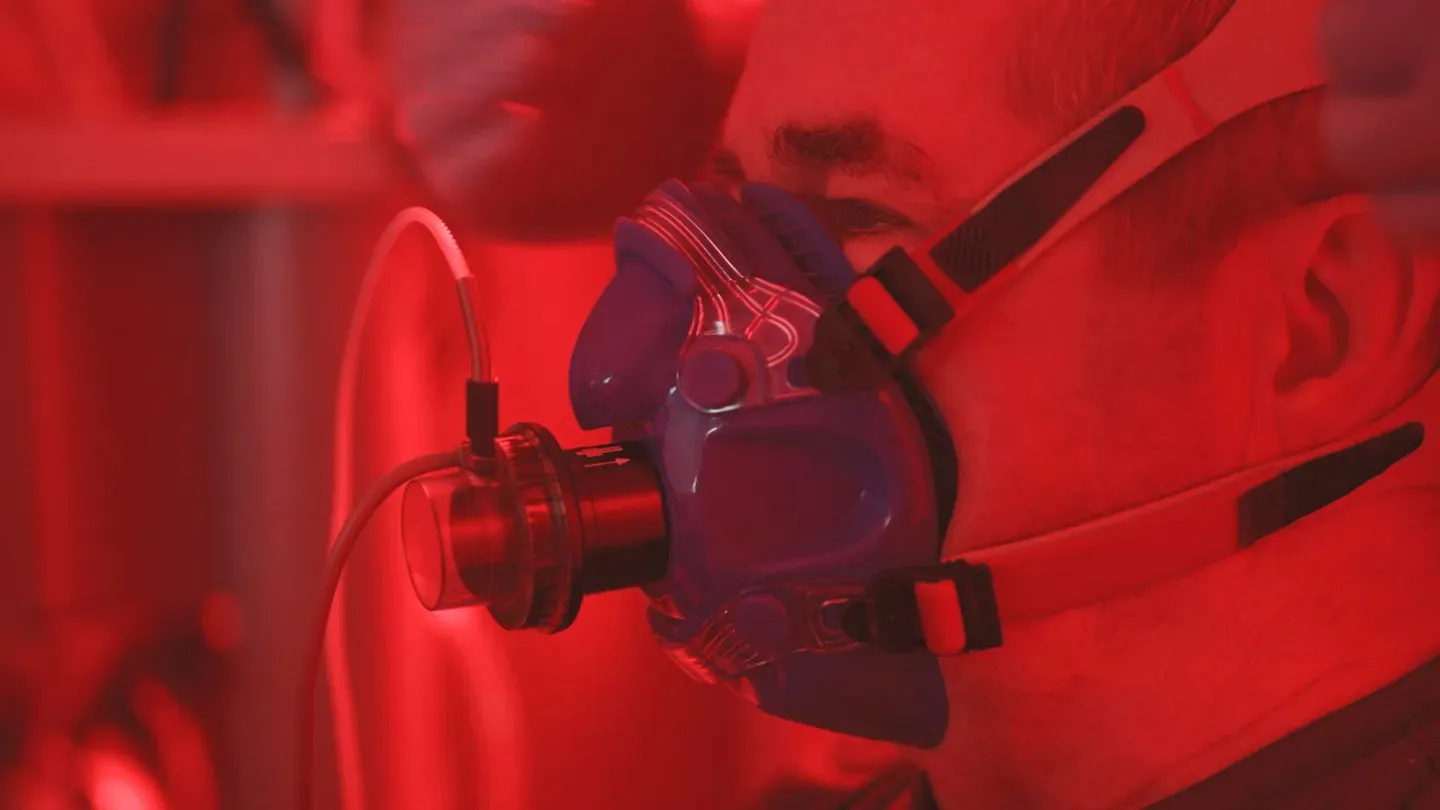
A thermometer with a tiny transmitter inside that tracked my core temperature.
I'm hot stuff.
They took my blood pressure.
Applied a strap to track my heart rate and a mask that measured the amount of oxygen I was consuming, to help estimate how much heat my body was generating on its own.
JAMES SMALLCOMBE: If you can just blow out for me.
(blows) Yep, that's tight enough, that's perfect.
Your cardiovascular system seems to be in pretty good nick, uh, Miles, we've got, you know, great blood pressure and your resting heart rate's nice and, uh, nice and low, so.
Objective evidence demonstrating your very good health.
O'BRIEN: He put it to the test by simulating one of the worst weather disasters in modern U.S.
history: the heat wave in Chicago in 1995.
More than 700 people died.
Researchers concluded a working air conditioner would have prevented half the fatalities.
And living alone doubled the risk of death.
It became a stark lesson in how vulnerability and isolation can turn extreme heat into a mass-casualty disaster.
Almost for the first time, it placed extreme heat on the radar of public health officials and actually seeing that it is responsible for excess death and morbidity.
O'BRIEN: The tragedy exposed something deeper than weather.
It was about inequality, and neglect.
That summer, Chicago made it painfully clear heat doesn't strike evenly, and it kills quietly.
We're doing this from the perspective of trying to understand the settings that the most vulnerable are going to be in, and then developing solutions that are fit for purpose in those settings.
O'BRIEN: Here in the chamber, the temperature was 104 degrees Fahrenheit, with humidity between 50% and 60%.
It was pretty miserable.
I feel like a cheeseburger just off the grill.
The human body cools itself by sweating, but that only works if the sweat can evaporate.
At this temperature and humidity, it can't.
The air is nearly saturated.
The sweat just sits there, and the body keeps heating up.
It's a huge challenge for human survival.
What we know is that the people who are most vulnerable won't have access to air conditioning.
They most likely won't have access to things like cooling shelters as well.
They'll be sheltering at home in place.
So the question is, what type of activities, what type of risk reduction cooling strategies can these people use that is most effective at blunting that physiological heat strain that generates inside the body that we know is harmful to human health?
O'BRIEN: He's exploring cooling strategies for people who can't afford to live in air-conditioned comfort.
Practical, low-cost ways to survive the heat.
Things like immersing your feet in water so they act like radiators.
And using fans which, under the right conditions, can significantly reduce the effects of heat stress.
These are the kinds of things that can help the most vulnerable among us, during a heat wave like Chicago in 1995.
With the proper prior planning on that, could those deaths have been preventable?
Most of them?
There's a, there's a saying, um, in the heat health space that every heat-related death is preventable.
O'BRIEN: Globally, heat kills about a half-a-million people every year.
And in the U.S., the fatalities are growing at an alarming rate.
In 2023, more than 2,300 died from heat in the U.S.
About three times more than a decade ago.
Far greater than the average toll for hurricanes and wildfires.
They grab the headlines, but heat has always been the most lethal consequence of climate change, by far.
Outside this window in Sydney, intense heat is everywhere-- quiet, invisible and relentless.
Ah.
(sighs) Sheesh.
After I'd mopped myself up, Ollie and I went from the frying pan to the fire.
He took me on a walking tour of the University of Sydney campus.
Born and raised in Wales, with a stop in Canada along the way, Ollie actually earned his PhD studying cold temperatures.
But in 2014, Sydney beckoned.
Suddenly, he was on the opposite end of the earth and the thermometer.
Australia being a hot place, and it is a hot place, I figure that if, Australian-based researchers, if we can't get a handle on these problems, and we can't find a solution, then there's very little chance that anyone else will.
O'BRIEN: Plenty of scientists study the climate and the relentless rise of temperatures.
But far fewer connect the dots to the impact on human health.
How heat affects real bodies, in real time, in a warming world.
It's a mistake to overlook human physiology as you try to come up with some answers here, right?
If you think about it from a health perspective, obviously, the hot weather is a problem.
But the real problem is the hot person in the hot environment.
♪ ♪ O'BRIEN: It was time for us to solve that problem.
We met up with his partner Allison and their adorable, precocious daughter Lottie.
ALLISON: Ready to go to the beach?
O'BRIEN: They took me to Coogee Beach, a short walk from their home in Sydney.
Becoming a parent has changed the way he thinks about his work.
It's sharpened his focus and redoubled his resolve to solve.
There are lots of solutions, but I think what we've got to do is focus on not just climate change mitigation, ensuring that the choices that we make don't aggravate the problem in the future, but also got to face that we've got to adapt to a warmer world.
We need to do both of them at the same time.
It would be bad if all of that back and forth led to inertia and apathy.
JAY: Well, it's exactly right.
People need to have hope in order to act.
Otherwise, we just bury our head in the sand and try to pretend it's not happening when it is.
O'BRIEN: In the sand.
JAY: Here we are.
O'BRIEN: I see what you're doing there, man.
Nicely done, nicely done.
(Ollie laughing) ♪ ♪ ♪ ♪ ♪ ♪
Video has Closed Captions
Clip: Ep3 | 2m 26s | Extreme heat is the deadliest climate issue, and scientists struggle to cool things off. (2m 26s)
Providing Support for PBS.org
Learn Moreabout PBS online sponsorship

- Science and Nature

Explore scientific discoveries on television's most acclaimed science documentary series.












Support for PBS provided by:
Made possible in part by support provided by Sue Hart-Wadley and Searle Wadley with additional support from Jerry Cox.