
Friends Forever
Episode 4 | 55m 57sVideo has Closed Captions
Relationships aboard the ISS are tested when war breaks out on Earth.
Far from their home planet, astronauts living aboard the ISS face the emotional realities of isolation. When war breaks out on Earth, relationships are tested and the future of international cooperation in space is thrown into question.
Problems playing video? | Closed Captioning Feedback
Problems playing video? | Closed Captioning Feedback
Friends Forever
Episode 4 | 55m 57sVideo has Closed Captions
Far from their home planet, astronauts living aboard the ISS face the emotional realities of isolation. When war breaks out on Earth, relationships are tested and the future of international cooperation in space is thrown into question.
Problems playing video? | Closed Captioning Feedback
Where to Watch Once Upon a Time in Space
Once Upon a Time in Space is available to stream on pbs.org and the PBS app.
Providing Support for PBS.org
Learn Moreabout PBS online sponsorship[ethereal music] MISSION CONTROL: Columbia Houston, state vectors coming on board.
MALE SPEAKER: We copy.
MALE SPEAKER 2: This is mission control Houston.
This is a live television view of the shuttle landing facility runway at the Kennedy Space Center.
DAN TANI: It was a Saturday.
I was at home, and the space shuttle Columbia landing was going to be at about 7:00 in the morning Houston time.
MALE SPEAKER 2: Columbia is 176 miles above the Indian Ocean.
Also, flight controllers standing by for tracking data of Columbia.
I turned on NASA Select and... you know the patter.
You know exactly what landing is supposed to sound like.
And so everything sounded great.
The the dots were coming down over Texas.
MALE SPEAKER 2: 14 minutes to touchdown for Columbia at the Kennedy Space Center.
MISSION CONTROL: Columbia Houston, comm check.
But then I heard "Columbia Houston, comm check."
I sat up, right.
I'm sitting up.
Now I'm sitting up, like, uh oh, I don't like this.
This is not... this doesn't look good.
And then the worst was, they go to a backup radio system, the UHF, and they go, Columbia Houston, comm check on UHF.
MISSION CONTROL: Columbia Houston, UHF comm check.
DAN TANI: If all else fails, that's when you reach them on the backup radio.
MISSION CONTROL: Columbia Houston, UHF comm check.
That's bad news.
So I get up, I start getting dressed because I know I got to go in.
So... INTERVIEWER: What are you feeling?
It's dread.
Right?
This is... This is kind of the worst case, right?
RADIO: TC flight.
- Lock the doors.
- Copy.
GINGER KERRICK: I was on console in the space station flight control room, and I was listening on the loops, and I could hear my counterpart in the shuttle room trying to call the shuttle crew, and them not answering.
And we have CNN on in the control rooms, and I... I saw what was happening.
NEWS REPORTER: What we're seeing here is very ominous indeed.
These are pictures which tell the story that is clearly the shuttle breaking up as it passes south of Texas.
GINGER KERRICK: As I'm trying to figure out more details, Ken Bowersox calls down.
He was on board the International Space Station and he says, hey, Gin, according to my watch, the crew should have landed by now.
How's it going down there?
And I looked over at the flight director and she shook her head and I said, hey, there's not going to be a landing today.
And he said, well, what do you mean?
I said, there's been an accident.
A serious accident.
GEORGE W. BUSH: My fellow Americans, this day has brought terrible news.
Debris was seen falling from the skies above Texas.
The Columbia's lost.
There are no survivors.
[plaintive music] DAN TANI: We don't hesitate to talk about it.
It's, you know, I'm... I'm incredibly sad for the friends that I lost, you know?
[indistinct chatter] I know that this incident carries huge consequences for NASA.
You know, they've built six shuttles, and we've lost two of them.
Both Challenger and Columbia.
You know, we couldn't afford to lose another shuttle.
You know, we were halfway building the space station, and, you know, we needed the shuttles to fly to continue the job.
[dog barks] [wind rustles] [serene music] [birds chirping] TERRY VIRTS: When I was 16, I lived in Finland and I was an exchange student.
I live with a Finnish family, and we lived in the eastern part called Karelia, right on the Soviet border.
[horse neighs] So I literally lived on a lake, and on the other side of the lake, I could look over there and see the Soviet Union.
They had one of these little wooden guard shacks.
A year later, when I graduated from high school, I joined the Air Force when I was 17 to defend Europe from the Russians.
[jet engine roars] I was an F-16 pilot for about a decade, and then I became a test pilot and then eventually went to NASA as an astronaut.
[upbeat music] When I first joined NASA, we had a great relationship with Russia.
We had just done shuttle Mir.
Russia was not the Soviet Union anymore.
And they had this young president who was promising to reform things and get rid of corruption.
[applause] FEMALE SPEAKER: The International Space Station will be a continuous operation to orbit the Earth for a minimum of 15 to 20 years.
The object now is cooperation, not domination, a launching point for the future of humankind.
The excitement about the ISS was really palpable.
Everybody felt it.
We used to say, "Off the earth, for the Earth."
There was this excitement that, hey, this is how people can and should work together.
[crowd cheers] MAN: Morning, everybody!
[intense music] MISSION CONTROL: T-minus ten, nine, eight... MALE SPEAKER: It's the end of an era.
The shuttle Endeavor takes up the final parts of the International Space Station on a two week mission to fit what is essentially a bay window in space.
On my first spaceflight on the space shuttle Endeavor, we brought up two modules.
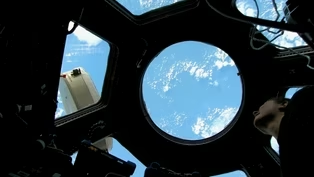
Node three, which is a big living module, and the cupola.
And the cupola is everybody's favorite place in space.
It's a really cool module.
It's got seven windows.
You go in there, you put your whole body inside of it, and you're surrounded by six windows.
And then there's a seventh big window above you.
I moved it to the bottom of node three, so it's on the bottom of the space station.
So when you look up, there's Earth.
It's really an amazing experience.
And the cupola makes you feel emotional, which is an unusual experience for fighter pilots to feel emotions.
But it's it's an intense emotion to go, man, this is so beautiful.
Just see things that you don't see on Earth.
[Russian chatter] [laughs] [laughs] [Russian chatter continues] [indistinct chatter] TERRY VIRTS: We had obviously several cosmonauts.
We had a Japanese astronaut.
We even had a international crew dinner one night where we shared food from all the different countries.
[Russian dialogue] Japanese food and Russian food and Alabama Creole food.
So it was a fun international plan.
It was great.
What is that?
Sushi?
- It's a space sushi.
- With salmon.
Space cooked sushi.
[indistinct chatter] TERRY VIRTS: We all grew up at Cold War with each other, right.
So it took time to build trust, to build relationships, to bridge that language gap, which was very real, especially early on.
And it worked.
We thought that we were going to be friends forever.
WOMAN: Group hug.
[laughter] MISSION CONTROL: Good morning to Janet and the rest of the crew.
I hope you had a good night's sleep.
And it looks like a beautiful day to take a walk.
FEMALE SPEAKER: Good morning, Lima.
We'll try to get our boys out the door today and get the [indistinct] on the spaceship.
MISSION CONTROL: Fantastic.
GINGER KERRICK: After I finished training astronauts for the ISS, I just kind of took some time to reassess what was next for me.
And I went to talk to my boss at the time and he says, you know, you know what would be a really good place for you is in the control room as a capcom.
And capcom is short for capsule communicator.
It's the person that talks to the crew.
And as soon as he suggested that, I thought he was crazy and I said, Randy, I can't be a capcom.
Capcom's are always astronauts.
And he said, this is a brand new space station, and you're one of the few people that know the space station really in-depth.
[indistinct radio chatter] So why don't you give it a try?
I was honored, of course, to be the first one, but there's also a lot of pressure any time you're the first one to do something.
You know, don't screw this up, Ginger.
So I dedicated myself to the training.
And I remember my first day on console.
I was so nervous.
And I walk in there and I sit down and the crew calls down.
So it's my first time talking to space.
I look at the flight director, he gives me a go, and I answer the crew, and then all of a sudden you hear, "Oh, Ginger, was that you?
Oh my gosh, congratulations!
I heard this is your first day and you sound really professional."
And I'm thinking, unlike what you sound like right now, Frank, but thanks a lot.
And the flight director's looking at me, and he's like, how did you know him again?
And I always thought it was my job to kind of keep it light, keep them entertained.
So a lot of the crew members will celebrate their birthday in space and they also deserve a birthday party.
Happy birthday, Daddy!
Happy birthday, Daddy.
We love you, Daddy!
And for Christmas, we sent up Christmas trees.
So they can put their Christmas tree out.
[indistinct chatter] We try to make sure that they don't feel isolated, that they feel a part of what's going on on Earth.
INTERVIEWER: Beyond just sort of making them feel connected to Earth, you had to deliver bad news.
Um, yes, I have had to deliver bad news sometimes.
[light tense music] [melancholic music] DAN TANI: It was December.
I'd been on the ISS for about two months, and, uh, I was just talking to Jane on the phone, sort of like I normally do.
And it was probably 10:00 or probably a little bit after 10:00 my time.
[melancholic music] It was kind of a, you know, a normal Dan's in space day.
Dan would phone me during his evening time before he went to bed.
DAN TANI: And so I was just talking to Jane.
We were talking about the day and out of the communication system, capcom says, hey, station Houston on space to ground one, that's the communication channel.
We're going to set up a private call on space to ground two for Dan.
And so first of all, nobody should be talking to you during the sleep period.
Something's happening.
There's no reason to call.
There's some dire news.
[emotional music] My personal phone started ringing, and it was our NASA flight doctor calling, and he said, maybe you should come in.
I walked into this small room in Mission Control, and, um... they had set up a conference for me.
Dan was already on the screen.
Yeah, I had to tell him what had happened.
There was an accident.
I said his mom had died.
Yeah.
[ethereal music] MALE SPEAKER: Daniel Tani's 90-year-old mother died after a train hit her car at a vehicle crossing.
His mother stopped behind a school bus at the crossing, then drove around the bus, bypassing the lowered crossing gate.
She was pronounced dead at the hospital.
Tani is grieving in space.
[ethereal music] [stuttering] And you just... You know, nobody gets training for this.
You know, nobody gets training for losing your mother.
[ethereal music continues] You know, I would be on the phone for hours talking to my family, talking to Jane.
And that would make me feel better.
Helping make arrangements or helping, you know, the way, you know, families all pitch in into that in times of crisis like that.
[indistinct conversation] What you want to do then is hug each other and hold each other and support each other like that.
Um... And yeah, we couldn't do that.
INTERVIEWER: Was there ever any thought that he could come down?
No, no, no.
He would not have wanted that.
I wouldn't have wanted that for him.
This was his mission.
And, um... No, not at all.
Good afternoon.
[deep sigh] I have feared this moment for most of my adult life.
Of course, I never suspected that I'd have to speak on this occasion on videotape.
That sounds funny to say, but at age 90, I think we lost Mom in the prime of her life.
All of us know how active and involved and passionate she was.
And she seemed to get better and better as the years went on.
I just want to say that Mom has been and will continue to be my hero.
My role model as a citizen and as a friend and as a parent.
Mom, I love you so much.
[plaintive music] [click] We have the International Space Station because we want to learn what it's like to live off this planet.
But if you're going to live not on the planet, all of the aspects of life are still going to happen.
And so there's going to be wonderful things, and there's going to be terrible things.
[gentle music] TERRY VIRTS: My space shuttle mission, STS-130, we were actually the final assembly flight.
It was called 20A in the assembly sequence.
And we finished building the International Space Station.
And once that was complete, the space shuttle was to be retired.
MAN ON RADIO: You can see behind me, there is the laptop that shows... TERRY VIRTS: It was the highlight of my career to be the pilot of the space shuttle Endeavor.
I loved flying it.
Hundreds of years from now, people will look back at the space shuttle.
We're never going to build anything like that again.
This week marks the beginning of the end of an era.
The final countdown for America's space shuttle program.
The space shuttle Atlantis is on its last and final mission of NASA's 30-year shuttle program.
Kristin Fisher, a reporter with our Washington station, WUSA, was not only covering history, she has been a part of it.
And she's at the Kennedy Space Center in Florida.
Kristin, good morning.
Good morning.
Well, you know, I think so many people my age take the space shuttle program for granted.
And I used to be one of them.
I grew up five minutes away from the Johnson Space Center in Houston, Texas, and everyone in my neighborhood worked for NASA, including my mom and dad.
So basically, ever since my first little psychedelic mushroom trip in college, I... I've been obsessed with space.
I caught the space bug.
And I never really felt the... the call to be an astronaut like my parents.
ANNA LEE FISHER: Give Daddy a chance.
I think there is something kind of psychologically as a kid, when you grow up your entire life with people saying, oh, are you going to grow up to be an astronaut, too?
RONALD REAGAN: Anna, I couldn't help but wonder if you'd recommend a career as an astronaut to your daughter, Kristin.
ANNA LEE FISHER: Oh, that I would, Mr.
President.
It's a truly incredible experience, and I'm going to recommend this very highly.
RONALD REAGAN: That's wonderful.
The President of the United States asking if I'm going to be an astronaut, too.
It was something that was just like, oh, all of you think that this is what my path in life is.
It just, for whatever reason, made me want to do something different.
And I went into political journalism.
Whether the President is pushing his health care plan in person or online, he's really doing the same thing and that is selling it.
Right now the top story on the white House website... The older I got, though, the more I felt this kind of primal pull to space.
In the days leading up to the last shuttle launch, I went to my news director and begged.
I was like, please, like, I have to go cover this.
Like, if you don't pay me to go cover this, I'm going to take a week of vacation and go do this by myself.
[dramatic music] FEMALE ON RADIO: Atlantis, on behalf of KSC launch teams past and present, have an excellent mission and godspeed.
It was just a really special experience to get to be there with my mom.
It's sad.
It's very, very sad.
But it's time to move on to the next program, I guess.
But they'll never be anything like the shuttle.
MALE SPEAKER: All three engines up and burning Liftoff!
The final liftoff of Atlantis.
[whooping] ANNA LEE FISHER: That's incredible.
[exciting dramatic music] GINGER KERRICK: This vehicle had been flying since 1981, and it lasted 30 years.
So I was proud from that perspective.
[jet engine roars] MALE SPEAKER: Having fired the imagination of a generation, a ship like no other, its place in history is secured.
The space shuttle pulls into port for the last time.
Its voyage got an end.
[melancholic music] GINGER KERRICK: And then I was concerned because we didn't have U.S.
launch capability.
We had no way, as a nation, as a very proud, space faring nation.
I couldn't get the crew up into orbit if you asked me to tomorrow.
The shuttle was so prominent in the space industry, every country knew that we had that capability.
And I'm sure that every country knew that we had lost that capability.
[indistinct radio voice] FEMALE NEWS ANCHOR: Early this morning, China boldly went where very few others have ever gone before.
It's become the third country to send a man into space.
Meet Lang Liwei, China's first space man and soon to be national hero.
INTERPRETER: I will not disappoint the motherland.
I will gain honor for the Chinese nation.
MISSION CONTROL: Three, two, one, zero, plus one.
It's taken years of planning and has cost $80 million, but India has now successfully launched a mission to the moon.
It's a historic moment as far as India is concerned.
We have started our journey to the moon.
FEMALE NEWS ANCHOR: China has taken its first step towards building a rival to the International Space Station.
A rocket containing the Tiengong-1 apace laboratory was launched today from a site in the Gobi Desert.
MALE SPEAKER: This mission is being seen as a milestone for China's space program.
[music crescendos] KRISTIN FISHER: The space shuttle was retired because it was old.
Most importantly, it was dangerous and it was really expensive.
The end of the shuttle program really was a low point for human spaceflight in this country.
But very quickly, it emerged that the most immediate plan was going to be for the U.S.
government to take a risk that it hadn't really taken before, which was enter into a truly public-private partnership with these commercial space companies.
MALE SPEAKER: After half a century of flying astronauts into space, NASA is hoping commercial companies will soon be ready to take over its responsibility of flying astronauts and cargo to the International Space Station.
Several companies are developing commercial rockets.
SpaceX is furthest along.
ELON MUSK: I hope SpaceX will be one of the principal means by which NASA astronauts go to space.
But SpaceX's lack of experience bothers some NASA legends, like Apollo astronaut Gene Cernan.
Now is the time to overrule this administration's pledge to mediocrity.
Gene Cernan testified against commercial spaceflight in the way that you're developing it.
And I wonder what you think of that.
I was very sad to see that because those guys are yeah... Those guys are heroes of mine.
So it's really tough.
They inspired you to do this, didn't they?
Yes.
And to see them casting stones in your direction.
It's difficult.
[engine roars] SpaceX were still, you know, babies [laughing] at the time that the space shuttle retired.
And NASA was skittish about bad headlines from failures or explosions, right?
[static] [explosion] So SpaceX was years away from being ready to carry humans into space.
And the answer in the short term was to pay Russia up to $90 million per seat to get American astronauts on a Russian Soyuz rocket and then hitch a ride with Russian cosmonauts to and from the International Space Station.
That was there... That was the short term solution.
MALE SPEAKER: American astronaut Dan Burbank will launch on a Russian rocket late Sunday night, the first American to take a Soyuz into orbit since America's space shuttle fleet retired in July.
The U.S.
now faces the prospect of relying on the Russians for several years to take our astronauts into space, because NASA does not have a replacement for the space shuttle.
It felt like an abandonment of prioritization of our nation's spaceflight program, is what it felt like.
But I don't think we should have done that.
You don't give up a capability before you have a replacement capability.
And we put ourselves in a very precarious situation.
It has been a day of high tension in Ukraine, in particular the southern peninsula known as Crimea.
FEMALE SPEAKER: As many as 20,000 Russian soldiers have been on the move across Crimea in the past 24 hours.
[crowd chanting] Many people in this region don't feel Ukrainian at all.
[chanting] [indistinct Russian dialogue] TERRY VIRTS: In 2014 I was finishing my training.
I was getting ready for what was supposed to be a 169-day flight on the space station.
So in the months leading up to my launch, Russia invaded Crimea.
It was like they were proud of that.
Like, and my my crewmate Anton Shkaplerov would run around and [speaking Russian] which means "Crimea is ours."
And he's from Crimea, he's from Sebastopol.
And he was running around all gung ho about what they're doing.
INTERVIEWER: And how did that make you feel?
TERRY VIRTS: I didn't understand fully what had happened.
Every Russian I knew had friends in Ukraine, and they had cousins or uncles or they were born in Ukraine or their spouse was Ukrainian.
They were just connected.
And so I thought, well, these people are kind of the same, and the language is kind of the same.
I'm learning to speak Ukrainian now.
It is not Russian.
But I didn't understand any of this at the time.
I was blinded to the excitement of having these Russian partners, and I did not understand the magnitude of the situation.
In Moscow today, just like that, Vladimir Putin signed a document and made it official.
And now tonight, Crimea belongs to Russia.
Today, the United States is imposing new sanctions in key sectors of the Russian economy.
The major sanctions we're announcing today will continue to ratchet up the pressure on Russia, including the cronies and companies that are supporting Russia's illegal actions in Ukraine.
We were very aware that sanctions had happened.
In fact, during that time, we sanctioned a guy named Dmitry Rogozin who was in charge of the Russian space program.
Dmitry Rogozin is just full of bluster.
[chuckles] [speaking Russian] Gospodin is like "Mister."
So we called him Mr.
Trampoline.
He was threatening to take away our ability to get to space.
He was like, hey, you're not flying on our spaceship.
You can launch yourself on a trampoline.
[crowd cheers] So when I'm going to launch, you're in your space suit and you're carrying this cooling thing and you walk up to the rocket like John Glenn in the 1960s, and there's somebody walking with you and Dmitry Rogozin, the guy that told us we could take trampolines, was actually the guy that walked me up to my rocket.
[tense music] There was a dichotomy like I've never seen before.
MISSION CONTROL: One and liftoff.
MISSION CONTROL 2: First stage engines.
[engines rumble] TERRY VIRTS: I was just excited about the mission and excited to fly with Russians.
So there was one night, January 2015.
I was with Sasha Samokutyaev, a Russian cosmonaut.
And we were just looking out at Europe as we flew over and we flew over Ukraine.
As we went over the eastern part of Ukraine, all of a sudden there were little red flashes and we were watching bombs go off.
We were literally watching people being killed [scoffs] on planet Earth.
We were watching Ukrainians being killed by Russians.
And it was a profound moment.
We didn't say anything.
We were both... I remember distinctly being like, holy cow, I can't believe what I'm seeing.
And Sasha saw it, too.
It was probably the most poignant moment of my time in space.
[ominous music] That age of innocence ended for me.
Everything kind of started to click in my brain that, yes, there are geopolitics on Earth heretofore that had not affected the space station.
And I realized that this is going to affect space.
We were going to need to launch our own astronauts and not be dependent on the Russian Soyuz.
[dark intense music] MALE NEWS ANCHOR: We move on now to the countdown to history.
NASA and SpaceX set to launch a pair of U.S.
astronauts into space in less than 48 hours.
The first astronauts to lift off from U.S.
soil in nine years.
KRISTIN FISHER: 2020.
That was the year that everything changed.
That was the year that SpaceX returned the ability to launch American astronauts from U.S.
soil once again, for the first time in almost a decade.
[dramatic music] A stunning new era of space travel started today, when two NASA astronauts launched in a rocket built by a private company.
MISSION CONTROL: Five, four, three, two, one, zero.
Ignition.
Liftoff of the Falcon 9 and Crew Dragon!
Go NASA!
Go SpaceX!
Godspeed, Bob and Doug!
We're still America.
We're still strong.
We can overcome these challenges, and we still press forward.
I was at the white House at the time, and I remember once again, kind of begging my bosses to let me cover this.
What a day for both NASA space X and Elon Musk.
What he has been able to accomplish in just a few short years.
There were a lot of people who didn't think he would be able to do it.
Now his company has become the first to put astronauts from any country into orbit.
So proud of the people at NASA.
All the people that worked together.
Public and private.
When you see a site like that, it's incredible.
This event is something that all of humanity can get excited about.
It's just a fundamentally positive good thing.
MALE SPEAKER: Have you heard from your Russian counterparts?
So, Dmitry Rogozin is the head of Roscosmos in Russia.
They believe in the partnership.
So I think it's going to remain strong.
The trampoline is working.
[laughter] That's right.
[laughter] It's an inside joke.
Inside joke, yeah.
[laughing] MAN ON RADIO: We're inside ten meters.
We cannot make out the [indistinct] but we do see the outline.
FEMALE ON RADIO: We copy and concur.
Ten meters.
Soft capture confirmed.
Stand by for retraction and docking.
SpaceX makes it possible for the United States to launch American astronauts from U.S.
soil in 2020.
An absolutely critical milestone that the United States was already really desperate for.
But when you look back, it's just incredibly lucky because look what happened just two years later.
[pensive music] MALE SPEAKER: U.S.
officials estimate Russia has likely amassed up to 190,000 troops in and around Ukraine.
MALE SPEAKER 2: Russia is poised with its military forces to conduct an invasion at any time.
It could be imminent.
[heavy machinery clanking] MALE SPEAKER 3: Russian forces attacking Ukraine from nearly every direction.
MALE SPEAKER 2: Vladimir Putin gave this warning for anyone trying to stand in his way.
[Vladimir Putin speaking in Russian] INTERPRETER: Whoever tries to interfere with us will threaten our country and should know that Russia's response will be immediate and lead to such consequences that have never been experienced in history.
[ominous music] GINGER KERRICK: When Russia invaded Ukraine, I couldn't believe it at first.
I... I couldn't believe that somebody I knew now was going to be impacted by war, because that was my home for four years.
I know the people there.
I love the people there.
JOE BIDEN: Putin is the aggressor.
Putin chose this war and now he and his country will bear the consequences.
Today, I'm authorizing additional strong sanctions.
MALE SPEAKER: Tonight, the Kremlin is accusing the U.S.
of an economic war on Russia.
MALE SPEAKER 2: New penalties daily as the effects of those Western sanctions sink into the Russian economy, the currency collapsing.
MALE SPEAKER 3: McDonald's also temporarily closing over 800 locations.
I would say there is a creeping realization that 30 years of progress may be about to end.
We're going to turn now to the future of the International Space Station.
The controversial head of the Russian space program threatening to end cooperation on the ISS unless sanctions on Russia are lifted.
GINGER KERRICK: Word started coming that, oh, we're going to cancel the space station.
So now I'm... I'm just worried.
Is this going to destroy what we created?
Is somebody going to come in and tell us now that because the country that we've been partnering with for so many years peacefully, that because they have declared war on another country, are we no longer going to be able to work together?
It's not the people that I work with that declared war.
Are we still going to be allowed to continue operating the space station, or is someone just who's not connected with it going to take it away?
A few months after the invasion in 2022, the Russians went out and did a spacewalk and unfurled this Soviet flag on the outside of the Russian segment.
And it was a terrible thing to do, like something out of the Cold War.
The message is Russia's back, is just them remembering this time when they were powerful and they were co-equal with the United States.
It's them wanting to make their country great again.
[indistinct Russian radio chatter] Russia has claimed full control of Luhansk, one of the two regions of the Donbas at the heart of the war in Ukraine.
MALE SPEAKER: The Russians are overwhelming the Ukrainians out in the east in that offensive right now.
[explosions and gunfire] INTERVIEWER: How do you feel about the ISS being politicized in this way?
TERRY VIRTS: After Russia invaded Crimea, it was a really strange time on the ISS.
I call it cognitive dissonance.
On the one hand, I love these guys that I'm with.
And on the other hand, their government is doing these horrendous things.
So on the ISS, there is a Russian segment and an American segment.
US astronauts don't do a lot of work on the Russian segment, but sometimes there's things you need to do.
And I remember it was 2015.
I had to go down there one day to do something.
And as I went down there, the laptop was open.
On our laptops, we have this software that tells us where we should take pictures, like there's a volcano, take a picture.
[camera clicks] And the Russians had left their laptop open... to Aviano Air Base.
[camera clicking] It's a US F-16 base in Italy.
And I saw that, and I was like, come on, guys, seriously?
We have satellites to take pictures of that stuff.
I never did anything, you know, spy pictures from the space station.
That was like, all right, this is not cool.
But my goal was just to survive and not die.
I mean, we're in a super dangerous situation living in space.
So I did my best to not let it affect my relationships.
INTERVIEWER: How are those relationships now.
TERRY VIRTS: All of the relationships I had with Russians have ended.
And that was really, probably angering more than anything, but also disappointing.
So since shuttle Mir, America and Russia, it feels like they got on pretty well.
But with the war in Ukraine, things really started to go wrong.
FEMALE SPEAKER: We've got breaking news out of Libya today where the assault on Gaddafi intensifies.
[explosion] MALE SPEAKER: America's bombers are poised to take part in the air assault on Yugoslav military forces.
FEMALE SPEAKER: At least 12 people were killed and some of them children.
After Russia unleashed a barrage of more than 20 cruise missiles that keep... FEMALE SPEAKER 2: Ukrainian forces have reported finding hundreds of bodies and mass graves.
MALE SPEAKER: ...are taking place to try to find survivors after a theater was bombed in the besieged city of Mariupol.
TERRY VIRTS: My feelings about my NASA career, which was all about the space station, are kind of mixed.
I'm very proud of what we did as a country.
America and NASA.
We built an amazing space station, an amazing partnership, and I'm proud of that.
And I'm disappointed -- is not nearly a strong enough word -- in the Russians.
INTERVIEWER: What do you see as the future for the ISS?
TERRY VIRTS: The ISS won't last forever.
And there's other things we want to do.
We do want to go back to the moon and hopefully eventually to Mars.
So... it's supposed to deorbited in 2030.
And then cooperation with Russia will end after the International Space Station.
Um, I hope the cooperation ends.
[chuckles] but I can't say that it will for sure.
That's a crazy thing to say.
"I hope the cooperation ends."
For an International Space Station commander who launched on a Soyuz to say, I hope the cooperation ends.
But here we are.
I wish I'd... It's like the worst thing I could say, except for it's not.
It's true.
But what a terrible place that we've come to.
DONALD TRUMP: The United States will once again consider itself a growing nation, one that carries our flag into new and beautiful horizons.
And we will pursue our manifest destiny into the stars, launching American astronauts to plant the stars and stripes on the planet Mars.
[applause] FEMALE SPEAKER: Good morning, Texas.
It's going to be a beautiful day here in Boca Chica.
Are you driving down the highway to Mars?
Because later today, Elon Musk and his team at Starbase are due to launch Starship seven.
This is your Space Coast update this morning.
More after the break.
Boca Chica -- it's the wild west.
Like you can get right up to the rocket.
Right here.
Swing around and look at that.
This is what it's all about.
It gets me this close to the rocket.
KRISTIN FISHER: I wouldn't be the first person to suggest that the rockets of the modern age are like the cathedrals of hundreds of years ago.
Drawing a rocket.
It isn't every day you get to do something like this.
KRISTIN FISHER: I mean, these are where a lot of people go to worship, in the sense that this is where you're going to reflect on, what is my place in all of this?
Why am I here?
What does this all mean?
It feels like the future.
Like it really does feel like the launch pad.
The base.
Starbase, as they call it, for where humans are going to become multiplanetary.
I would be more than happy to live on Mars.
I would be happy to go work there and stay there.
I don't even need to come back.
I know it's difficult.
This earth is not going to last forever.
The only chance we have is Mars.
So I can go on a one-way ticket.
KRISTIN FISHER: I think the symbolism of landing humans on Mars would be one of those moments in history that would be seared into a nation's consciousness.
Now, the big question is, who gets there first?
[cheering] FEMALE SPEAKER: Tonight, Chinese astronauts making history on their longest mission yet, a six-month stay on board China's space station.
All signs point to this new space race, only instead of Russia, the United States' big contender is now China.
[tense music] [engines rumble] [intense music] [music intensifies] There we go!
There we go!
Go, [indistinct]!
Oh!
[laughing] WOMAN: There it is!
Stage separation.
There it is!
Yes!
Come on!
Come on, baby!
Come on!
Come on!
We got it!
Come on, come back, come back, baby.
Come on, baby.
Here it comes.
Here it comes, guys.
MAN: Oh, yeah.
WOMAN: There we go!
Oh my God!
Oh my God.
Come on, baby, go!
[excited chatter and shouting] WOMAN: Yeah!
Yes!
Yes!
Yes!
We did it!
[applause] [engines rumble] [bright pensive music] Well I'm not aware of any other programs that we are currently planned to partner on.
And so to me, you ask me that, it could be the end of our partnership.
I sure hope not, because I can't even imagine, um... everything that we've learned in all these years just going to waste.
You know, if we can accomplish this together, along with the other countries that we collaborated with, just think about what we could do together on the moon or going to Mars.
But I know that's not the world we live in.
You turn on the news and you know that there's these horrid things happening everywhere.
And, you know, [sniffles] people used to make fun of me because, you know, in my utopia bubble today, here's what we did.
And they just can't believe it.
[hopeful music] World leaders are not interested in things that benefit the human race.
They're interested in things that benefit their nation.
But for a little while, I lived in a world that didn't operate that way, and it was beautiful.
And any of us that have lived that life really believe that there's more we can accomplish together.
[pensive music] It's hard to explain.
Um... But it's real.
I lived it.
So we know what we're talking about.
It happened.
[sniffles] Yeah.
And it would be a tragedy not to continue to build on it.
[triumphant music]
Video has Closed Captions
Clip: Ep4 | 1m 44s | Terry Virts helps build the cupola, a window that forever transformed how we see the Earth. (1m 44s)
Providing Support for PBS.org
Learn Moreabout PBS online sponsorship New Episode
- Science and Nature

Explore scientific discoveries on television's most acclaimed science documentary series.









 Recently Added


Support for PBS provided by: