Washington Grown
From Bog to Bite
Season 13 Episode 1311 | 26m 46sVideo has Closed Captions
We find tides of flavor on our journey to the wild and beautiful Washington Coast
We find tides of flavor on our journey to the wild and beautiful Washington Coast to explore how cranberries, conservation, and coastal life intertwine. We visit Matt Reichenberger’s farm and the Pacific Coast Cranberry Research Foundation to see tradition and science at work. Enjoy a juicy smash burger at Ilk Lodge and a sweet scoop from Sweet Alchemy, then uncover the history of the coast.
Problems playing video? | Closed Captioning Feedback
Problems playing video? | Closed Captioning Feedback
Washington Grown is a local public television program presented by KSPS PBS
Washington Grown
From Bog to Bite
Season 13 Episode 1311 | 26m 46sVideo has Closed Captions
We find tides of flavor on our journey to the wild and beautiful Washington Coast to explore how cranberries, conservation, and coastal life intertwine. We visit Matt Reichenberger’s farm and the Pacific Coast Cranberry Research Foundation to see tradition and science at work. Enjoy a juicy smash burger at Ilk Lodge and a sweet scoop from Sweet Alchemy, then uncover the history of the coast.
Problems playing video? | Closed Captioning Feedback
How to Watch Washington Grown
Washington Grown is available to stream on pbs.org and the free PBS App, available on iPhone, Apple TV, Android TV, Android smartphones, Amazon Fire TV, Amazon Fire Tablet, Roku, Samsung Smart TV, and Vizio.
Providing Support for PBS.org
Learn Moreabout PBS online sponsorship- "Washington Grown" is made possible by funding from the Washington State Department of Agriculture and the USDA Specialty Crop Block Grant program, and by the Potato Farmers of Washington.
Learn why Washington is home to the world's most productive potato fields and farmers by visiting potatoes.com.
- Hi everyone, I'm Kristi Gorenson and welcome to Washington Grown.
Ever since our first season, we've been focusing on showing you the partnerships and people that put food on our plates.
In this episode, we're going to be talking with a special group of farmers and community members here on the coast that are doing more than growing food.
- I'm visiting Reichenberger Farm.
- I was raised to do it since I was two, so I'm kind of used to it.
- And I'm making a special Smash Burger at ilk Lodge in Olympia.
Happy Breakfast or lunch or dinner or whenever.
Then I'm learning how a conservation district is working with the community to save a receding shoreline.
- You've got a big project on your hands.
[laughs] - We do.
- All this and more today on Washington Grown.
[lively music] - Cooking with Kristi.
Sweet Pete.
- Jiminy gee Willickers.
- Watch my bangs.
Go big or go home.
- Ah!
Right in my eye.
- You made me a believer.
[laughs] Oh, I am making a mess.
- Oh Val, I love you.
- Heaven on a plate.
That's yummy.
- We're gonna get a to-go cup for these.
- Yeah.
[laughs] - You keep talking.
I'll keep eating.
[lively music] Right near the heart of downtown Olympia, there's a special spot to gather with friends and family after a long day's work.
That place is ilk Lodge where you can always find a perfect pour and enjoy some classic American food hot off the grill.
- It's very local.
- It's like a family kind of environment.
- I love the atmosphere, I love the people and the food and the beer so it's all a nice combination.
- Patrick Jansen is the head brewer and owner of ilk Lodge.
During the pandemic, Patrick began a smash burger pop-up around Olympia.
Little did he know that this pop-up would later grow into the lodge we see today.
- I think it was a relief for a lot of people during that timeframe because they could get out of the house, they could be safe, you know, and it was just really social.
The joke was just like one of these days when we get back inside, maybe I'll start a spot with the burgers and the beer, you know.
- Here you are.
That focus on community extends beyond just creating a place to gather.
ilk Lodge's menu and tap list give people a taste of what Washington farms have to offer.
- So I think 80% of our ingredients are local.
The cool part about that is like you get some unique produce.
Working with your community is first.
You know, start there and move your way out.
- I do get the Smash Burger regularly and it's actually the only red meat I eat.
- To know that it's locally grown that just make it all the better.
- Don't miss later in the show when I get the chance to cook the Wobbly cart Farmer's Deluxe Smash Burger with ilk Lodge's Chef Shane.
- Mainly you just want this ripping hot.
- It's smoking.
So does that mean it's ripping hot?
- Looks like it's ripping hot.
[both laugh] [lively music] - Coming from eastern Washington, I'm pretty used to warm sunny summer weather.
But today we're in rainy Grayland where Reichenberger Farm is growing something so special that even the animals have to come check it out.
- There goes a deer.
- Wants to be on camera.
- Yeah.
- Matt Reichenberger and his family grow cranberries on their farm and with this wet weather and sandy soil, it's the perfect spot to grow them.
And if you need to know anything about cranberry growing, just ask Matt 'cause he's been doing this for a long time.
- I was raised to do it since I was two.
So kind of used to it.
[chuckles] - It's in your blood.
- Yeah.
Yeah.
My sister and I would go out and drag the booms around and try to be helpful.
- Today Matt and his family harvest cranberries without the use of the watery bogs we see on television.
Instead they harvest with an interesting machine that was invented only a few miles away.
- This is a Furford picker- - Okay.
- For dry harvest, it's a picker and a pruner.
And so this basically rides right on the ground.
And then there's these sets of knives right in here, which will prune the vines that are running this way, all the fruit and the vines, prunings ride up this elevator into a burlap sack.
- Yeah.
- Take that one off.
If it's full- - Set it down and then- - Set it down.
- Someone comes back behind you and picks it up.
- Right.
- Cool.
- In the in the bog buggy with the trailer.
- In the bog buggy.
- And it all goes back to the warehouse to get devined and put it into trucks.
- I have to say you have fun names for your implements.
[laughs] - The one that's produced, I think it's Massachusetts, it's called a Northern.
It doesn't prune, so you have to go back afterwards and prune your vines manually.
- I like this way better.
- Yeah.
This is way better.
Yeah, get two things done at once.
- Yes.
- This is a newer variety compared to some of my old varieties.
Some of my fields are close to a hundred years old.
The Grygleski's will do a higher yield, so it's a little bit larger compared to the Max and Grygleskis are better for fresh fruit 'cause they're bigger and darker.
- They look like normal sized cranberries to me, but- - Well, they're small right now.
They still got a lot of colorin' to do.
- So these will get how much bigger?
- Those will get about that big.
- Wow!
- This is pretty much a proven variety in Grayland.
You don't want to jump in and plant something that's not quite proven in your area.
- Being a cranberry expert means Matt has a few great recipes for Thanksgiving or just for every day.
- We do like a a cranberry conserve 'cause I also have put pigs.
So we'll put that over the pork chops and whatnot.
- Oh, I bet that's delicious- - That's pretty good.
- Yeah.
- Make cranberry apple sauce with Red Hots, little cinnamon candies.
- Really?
- Yeah, that's something mom used to make when we were little.
- Well, I think it's time for the crew and I to get out of the rain and get dry.
But if you're looking for other cranberry recipes, head to wagrown.com.
- It's springtime, which means the cherry blossoms are in full bloom at the University of Washington.
My advice, take a stroll through these fragrant blossoms with a sweet treat that's just as incredible and draws its very inspiration from these beautiful trees.
Our friends at Sweet Alchemy have an ice cream that's perfect for this very occasion.
Owner Lois Ko uses local ingredients and an imagination like no other to create some incredibly magical flavors.
- We actually have over a hundred flavors that we make.
- What?
- But we can only sell 16 at a time.
[Tomás laughs] - And you've got some stuff that we're gonna try today, this blueberry lavender.
- A few years ago, we've met a guy who was so passionate about lavender and I never knew lavender had so many different strains and each strain smelled and tasted so different.
- Yeah.
- We started buying his lavenders to use in our ice cream.
The blueberries that we use are from Mt.
Vernon.
- Immediately you get that lavender and then the blueberry comes a little later.
- And I love our ice cream because all of them have like a not immediate flavor punch, but like a journey inside your mouth.
And the milk came from the farm probably this week.
- Okay.
- Freshest you can get.
- Well, we can't stop at just one flavor.
Now it's time to try Lois's homage to the cherry blossoms here on campus, the Sakura.
Dried cherry soaked in sake overnight, cooked in puree with orange blossom water.
So let's see what we got here.
I get the blossoms first and then the cherries arrive.
- Yeah.
- Hmm.
- This one's called London Fog.
- Okay.
And I love tea, so I'm excited to try this.
- I love tea.
- I really get that sensation of drinking Earl Gray, but that is delicious.
This Persian rose, you're using cardamon and rose water and pistachio.
- A customer came in and they said that cardamon ice cream is the best ice cream in the world.
- That cardamon just punches you like it's immediate.
- Yep.
- And that rose is subtle.
Oh, that is so cool.
You're going on this little journey.
- Yep.
- You need to come down here and try this as well.
Sweet Alchemy right here in Seattle.
Thank you so much.
- Thank you.
- All right.
[lively music] - There are two different ways to harvest cranberries.
Can you name them?
We'll tell you right after the break.
- Coming up, I'm making a Smash Burger at ilk Lodge in Olympia.
- Mainly you just want this ripping hot.
- It's smoking.
So does that mean it's ripping hot?
- It looks like it's ripping hot.
- Then I'm visiting a museum to learn the history of cranberry farming in Washington.
- This place hasn't changed really in a hundred years so it's kind of a step back in time.
- Yeah.
[lively music] - There's two different ways to harvest cranberries.
One is by flooding the fields, agitating the water because cranberries float and corralling the fruit to a corner and going into a truck via fruit pump or an elevator.
The other way is dry harvesting where you don't flood the fields and you're on a Furford Picker or a Northern.
The Furford Picker is what I use on my fields, and it was invented right down the road about five to seven miles away by Julius Furford in the '40s.
- We're back at the ilk Lodge in Olympia.
An eclectic ambiance and great food make this the perfect place to unwind with those close to you, just as owner and head brewmaster Patrick Jansen intended.
ilk Lodge.
What does that mean?
- It's old Scottish for your group, your clan, your people you live with, your family.
And that was kinda the idea was recognition of where we're at and the people that are here.
- Feels warm, community kind of thing.
They've kept it really a nice special vibe.
It's very relaxed.
It's just really, really welcoming and open and easy to come in.
- While you are here enjoying a pint of ilk Lodge's handcrafted brews, they have just what you need to satisfy your stomach using fresh Washington grown ingredients to bring a Midwestern classic to the PNW.
- And you just chop some off with a spatula and just smear it across the griddle and that's your burger.
So you get a huge amount of sear, which is like the main part of the flavor, right?
The deluxe is the special right now.
We only make that burger when we can get fresh lettuce, onion and tomato from one of our farms around here.
As soon as any of those go away, that burger goes away.
I feel like it's such a special burger.
That kinda thing is such a special thing that you gotta do it like when you can, right?
- Like I'm so addicted to it.
That's pretty much all I ever get.
- Now I get to hop behind the grill with Chef Shane to make the Wobbly Cart Farmer's Deluxe Smash Burger.
Before we can grill our burger, we have to make a special ingredient.
- We're gonna start with goop.
Everybody in Olympia is crazy about goop.
- Everywhere you go in Olympia, if there's a burger or something, goop is going to be there?
- That's your- - Pretty much.
- Normal staple, yeah.
- We start with mayonnaise and add pickle brine.
Then we add in a blend of pickles and garlic to give the goop more texture.
Then we add some classic yellow mustard to our mixture.
- Just whisk it up.
- Whisk it up.
- Yeah.
- Right on.
- And it gets a little looser from the pickle brine, which makes it very easy and spreadable.
- Awesome.
Well that's easy.
- Yeah.
Yep.
- So is there a key to Smash Burgers?
- Mainly you just want this ripping hot.
- Ripping hot.
- You want it to kind of stick and it gives you a nice little crust on one side.
- It's smoking.
So does that mean it's ripping hot?
- Looks like it's ripping hot.
[both chuckle] - For a burger, we start by toasting our house-made bun on the side of the grill.
While the buns turn golden, we put two two ounce meatballs on the grill.
Then crush and smear them as flat as we can.
- It actually stays juicy as long as you only smash it one time.
- Once we reach a nice sear, we flip the meat and immediately put on our smoked Gouda cheese.
While the second side of the meat cooks, it's time to assemble our burger.
We add a circle of goop to the bun, then add an even layer of pickles.
Now we add sweet onions, fresh lettuce, and two slices of heirloom tomatoes.
Then stack on our burgers, top it with a bun, and it's finally time to enjoy.
[lively music] Look at that gorgeousness.
- Yeah.
- Oh man!
That's so good.
The meat is really fresh and tasty and a little crispy.
The buns are super soft and awesome.
- Yeah, I'm getting a lot of the pickle and pickle from the goop.
- Mm hm!
- Tomato shines through.
- Mm hm!
Happy breakfast or lunch or dinner or whenever.
[Shane chuckles] Good job.
All right Cheers!
- Cheers.
- For more recipes adapted for the home chef, visit us at wagrown.com.
Down in Long Beach, there's a little shop that's celebrating one of the area's most important crops, cranberries.
With a research scientist on the property, as well as a museum and a gift shop, if you ever wanted to know anything about this special fruit, you can find it right here.
- Really our main goal is to educate people about cranberries.
- As manager, Paula Reagor spreads the good news about local cranberries to everyone after all, she uses them for just about everything.
- I drink unsweetened cranberry juice with an herbal apple spiced tea.
- That's why you look so fantastic.
- Thank you.
[Kristi chuckles] I use nine different cranberry based products.
- Wow!
- I'm talking about supplements, a skincare, there's more to it than just cranberry sauce for thanksgiving.
- We're standing right in between two different pots right now.
- Oh, okay.
- So we're looking at several different varieties here to see which one grows best.
- Dr.
Laura Kraft is the Cranberry and shellfish extension specialist with WSU.
Here on site she studies cranberry growth through a variety of different experiments.
- This is a research project behind us.
These are our warming chambers.
So this is some greenhouse grade plexiglass that's being used.
And the idea is we're trying to understand which varieties will best tolerate heat.
And you can see pretty clearly that they grow even taller.
- They do seem to like the warmer.
- I'm not sure that I would say that they like it though.
Just because they've grown taller, which is typically a bad thing in cranberries.
So we like cranberries to grow really low and put a ton of fruit on.
When they start to grow tall like that, we're a little concerned that they're spending more energy on creating green leaves than they are fruit.
By doing this type of research in order to understand how will heat, which might be changing the next 10, 15, 20 years, which varieties can best kind of tolerate increasing heat, that's gonna help growers be able to make the best decisions for replanting cranberry vines.
- Yeah.
- Here, we are using a pheromone for blackheaded fireworm moth.
- Okay.
- These have laid their eggs and now that larvae is just at the right size to make that pest management treatment.
But when we go along with a sweep net, we definitely pull up those larvae.
- Time for me to try out the sweep net.
- It's a little more vigorous than most people expect, so don't be worried about kind of hitting the plant a little bit.
- Okay.
All right, I can see why the bees might not necessarily appreciate this.
Let's see what we got.
- Ooh, these are blackheaded fireworm moths.
Very nice.
That was some good sweeping.
- Should I kill it?
- You're welcome to kill it if you'd like kill.
- I'll kill it.
- Just squish it.
[Kristi chuckles] - Now Paula is taking me on a tour of the museum.
- This is back when pipes were made out of wood.
There's no PVC.
- That's what this is?
- This is a pipe that would've been an irrigation pipe.
- Oh my god.
- And it was dug up.
And then we have a couple of cranberries sorters over here.
And the cranberries, since they have hollow seed chambers inside, they're kind of like a ball, they bounce.
- Okay.
- And so the ones that bounce are good and the ones that don't are rotten and forgotten.
These would've been moving conveyors.
You would've have people standing here.
- So I heard you have cranberry ice cream.
- Yes, we do.
We make it.
- What you say we go taste some?
- I'm game, always.
[Kristi laughs] - This reminds me of when I was a kid.
- And look at that color.
- Oh, that's beautiful.
- It is.
We make this every week, sometimes twice a week in the summer.
- This is super refreshing.
- That's right.
- Great on a warm day.
- Exactly.
That's what I like.
This place hasn't changed really in a hundred years, so it's kind of a step back in time.
- Yeah.
- Coming up, I'm learning how a conservation district is working with their community to save a receding shoreline.
You've got a big project on your hands.
[chuckles] - We do.
[lively music] - Hey everybody, Anna Lucia and I are here camping at Lake Crescent in Washington.
What do you think so far of the lake?
- It's beautiful.
The water is super blue and it's gorgeous.
- Yes, this is a gorgeous lake for sure.
Before we go out on our little hiking adventure, we thought today we'd make some trail mix.
- Yeah.
- Today we're using a variety of nuts, fruits, seeds, and a bunch of fun stuff to make our own custom trail mixes.
When you're making your own trail mix, make it your own.
Have some fun with it.
Look for those ingredients that you really enjoy.
So I'd say go for it.
Make what you wanna make.
And now it's time for the fun part.
We start by mixing and matching all of our favorite ingredients, all while making sure to include nuts, fruits, seeds, and something fun to round it all out.
So tell me about your trail mix.
What'd you make?
- I did pretzels, popcorn, some coconut shavings on top, some almonds and peanuts, sunflower seeds, pumpkin seeds, cranberries, banana chips.
- All right, so it's a pretty good mix.
I went with some cashews, some dark chocolate, some dried cherries and some coconut.
I just kept it simple.
I didn't put too many ingredients in it.
Mm!
That's a good combo right here.
Let me see yours.
So now that we have our trail mixes all finished up, we're gonna put these in the baggie and we're gonna put them in our backpacks and we're gonna head out.
Remember when you're making your own trail mix, remember the four main ingredients.
You want nuts, you want seeds, you want fruit, and you want fun stuff.
- Yeah.
- All right, are you ready to hit the trail?
- Yep.
- All right.
Let's bag these up and we'll see you guys later next time.
To learn how to make this recipe and many others, head on over to wagrown.com.
- Growing up, I remember taking family trips to Washington's southwest coast.
We drove by Washaway Beach, which is an area where erosion has literally been washing away the community of North Cove.
Homes and businesses were lost and over time, the ocean erosion threatened 800 acres of cranberry farms.
This would jeopardize more than half of Washington's total cranberry production in addition to more homes and tribal lands.
The future of North Cove was at risk.
Jackson Blalock of the Pacific Conservation District showed me an example of the ocean's impacts here.
- We're at the end of the road, right?
- We're here at the end of the road.
- The road used to extend on out that way into what's now water.
- That was a farm out there.
There were cows out there, there was a school, there was a store, there was a hotel.
There were several canneries.
- North Cove resident, Connie Allen and her late husband David, a cranberry farmer, rallied the community to form Washaway No More, a group that changed the area's future using cobble berms and rock.
- At the end of 2017, we dropped our first load of rocks.
This is a perfect area where you can back a truck in, unload it, and it falls down to, you know, approximately where it needs to be.
The water does the rest.
- And so what do the rocks do that helps with the restoration?
- Well, part of why this is a problem area is there's very large rock out there.
The water hits that, it scours underneath, takes the sand out.
So you have no beach when you do that and it scours around.
- Oh, okay.
- That.
So the idea here is you're building something that's meant to move.
- And it softens the blow a little bit.
- It softens the blow.
- If you're looking back here, you know, you see kind of that, you know, the beach goes up obviously, and then there's the high point.
Well behind that it really just drops down, right.
And then you have the cranberry bogs, right?
So they're basically at sea level.
So when we're talking about this area right here we're working at, it's kind of the last line of defense for miles being inundated of active ag.
That's not just a local economy, but a local culture.
- Between that and some planting and some other kind of adaptive management nature techniques, we have not lost any land there and in fact, the beach is completely covered with new vegetation.
- Yeah.
But this work isn't cheap.
Partners like the Shoalwater Bay Indian Tribe and the Pacific Conservation District helped Washaway No More secure funding for shoreline restoration and the process is ongoing.
- Part of our continual maintenance will be to restore rock in this area.
- We've been involved in continual adaptive management of the work that's been happening, right?
You gotta say, well, how's this working?
Well, let's come back and tweak it.
And that's where ongoing funding through the Conservation Commission at the state has been really useful.
- You've got a big project on your hands.
[chuckles] - We do.
We have to get away from the thinking of it as a project- - Okay.
- As in a one and done thing.
- Yeah.
- And think of it as this is a process.
But we're hoping to be here and be farming cranberries for a long time.
- A long time.
- Yeah.
The alternative is not acceptable.
- Right.
[instrumental music] - When people think of Washington agriculture, they often picture wheat fields, apple orchards, or rolling vineyards.
But along the wild west coast, farming has always looked a little different.
Shaped by salt water, rain, and the thin line where forest meets tide flat, here the story of agriculture begins not just on land, but in the water.
For countless generations, indigenous communities along the coast relied on shellfish as an essential food source, especially the native Olympia oyster, which once flourished in places like Willapa Bay and Southern Puget Sound.
Long before roads or rail, the coast shellfish beds were a living pantry, harvested, traded and sustained through deep knowledge of seasons and place.
Then in the mid 1800s, a growing non-native population and booming demand down the coast helped turn oysters into big business.
Shipments of Washington oysters to San Francisco began as early as the 1850s, tying coastal tidelands to west coast markets.
By the late 1800s and into the 1900s, growers experimented, expanded, and adapted, introducing new techniques and even new oyster varieties as the industry face cycles of boom, decline and reinvention.
Today, Washington remains a powerhouse in oyster culture with Willapa Bay, still one of the most iconic names in American shellfish.
- I think one of the things that make Washington Shellfish so special is that it's a unique environment.
Not a lot of people have the nutritious Sounds like we do.
It just grows a really amazing quality product.
- Washington's got a great reputation, you know.
It's kind of, you know, internationally, it's the clean green state.
And so our shellfish are prized for that fact that, you know, they're produced in these pristine waters.
And you know, it's just that emblematic clean green that gets us a premium demand and price for our shellfish.
They're definitely prized throughout the world.
- Not far from the surf, another kind of coastal farming took root, literally.
Cranberries thrive in acidic, peat-rich soil and wet conditions.
And the Washington coast offers exactly that.
On the Long Beach Peninsula, commercial cranberry harvesting began in 1883 using vines imported from New Jersey.
Cranberries didn't just become a crop.
They became a culture, especially in places like Ilwaco and Grayland, where growers built their lives around the rhythm of bogs, water and harvest.
In 1914, the Ilwaco Cranberry Company incorporated reflecting how organized and ambitious the cranberry economy was becoming.
- Most of the cranberries in the country are flood harvested.
That was a technique that was developed during the Second World War.
When there was a labor shortage, they used to hand pick them all.
- Through the decades, cranberry farming remains a signature coastal industry, one that still defines the landscape each fall when the bogs turn into pools of floating red.
But coastal agriculture didn't stop at shellfish and berries.
In Pacific County, dairy farms were established on stump farms in the hills after the trees were logged.
A reminder that, on the coast farming often meant rebuilding soil and livelihoods from the leftovers of timber.
By the mid 1900s, dairy had become a serious part of the coastal economy.
In 1950, there were about 150 dairy farms in Pacific County.
And even as farm numbers later declined, production increased as operations consolidated and modernized.
And of course, where you have dairy and cattle, you have feed, especially hay, one of Washington's long running agricultural mainstays.
Hay has been harvested in Washington since early settlement.
And it remains a key crop because it underpins so much of the livestock economy.
Put it all together and the coast tells a unique agricultural story.
Food grown in tide water and fresh water, in bogs and pastures, shaped by rain, by salt, and by resilience.
- From growing cranberries to beach preservation, our Washington farmers are working hard to make sure our communities remain strong.
That's it for this episode of Washington Grown.
We'll see you next time.
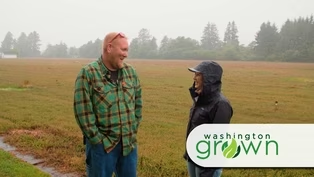 New
NewVideo has Closed Captions
Preview: S13 Ep1311 | 30s | We find tides of flavor on our journey to the wild and beautiful Washington Coast. (30s)
Providing Support for PBS.org
Learn Moreabout PBS online sponsorship

- Food
Christopher Kimball’s Milk Street Television
Transform home cooking with the editors of Christopher Kimball’s Milk Street Magazine.






Support for PBS provided by:
Washington Grown is a local public television program presented by KSPS PBS