
Inside Antarctica's Doomsday Glacier
Episode 6 | 27m 16sVideo has Audio Description
Scientists race to reach Antarctica’s “Doomsday Glacier” before it’s too late to understand it.
Thwaites Glacier is melting faster than any glacier on Earth, and its collapse could raise global sea levels by feet, not inches. Miles O’Brien sails to Antarctica aboard a Korean icebreaker with scientists drilling through 3,000 feet of ice to reach the water below and explore a radical idea: an underwater curtain that might buy the world some time before the “Doomsday Glacier” gives way.
See all videos with Audio DescriptionADProblems playing video? | Closed Captioning Feedback
Problems playing video? | Closed Captioning Feedback
Made possible in part by support provided by Sue Hart-Wadley and Searle Wadley with additional support from Jerry Cox.
Inside Antarctica's Doomsday Glacier
Episode 6 | 27m 16sVideo has Audio Description
Thwaites Glacier is melting faster than any glacier on Earth, and its collapse could raise global sea levels by feet, not inches. Miles O’Brien sails to Antarctica aboard a Korean icebreaker with scientists drilling through 3,000 feet of ice to reach the water below and explore a radical idea: an underwater curtain that might buy the world some time before the “Doomsday Glacier” gives way.
See all videos with Audio DescriptionADProblems playing video? | Closed Captioning Feedback
Where to Watch Resolve to Solve with Miles O'Brien
Resolve to Solve with Miles O'Brien is available to stream on pbs.org and the PBS app.
Providing Support for PBS.org
Learn Moreabout PBS online sponsorship♪ ♪ ♪ ♪ (device beeping) I've always said I'd go to the ends of the Earth for an interesting solution.
That's what's brought me to 75 degrees south on this research icebreaker, where I'm waking up.
Good morning.
It's a little after 8:00.
Had a good night's sleep, overslept a little bit.
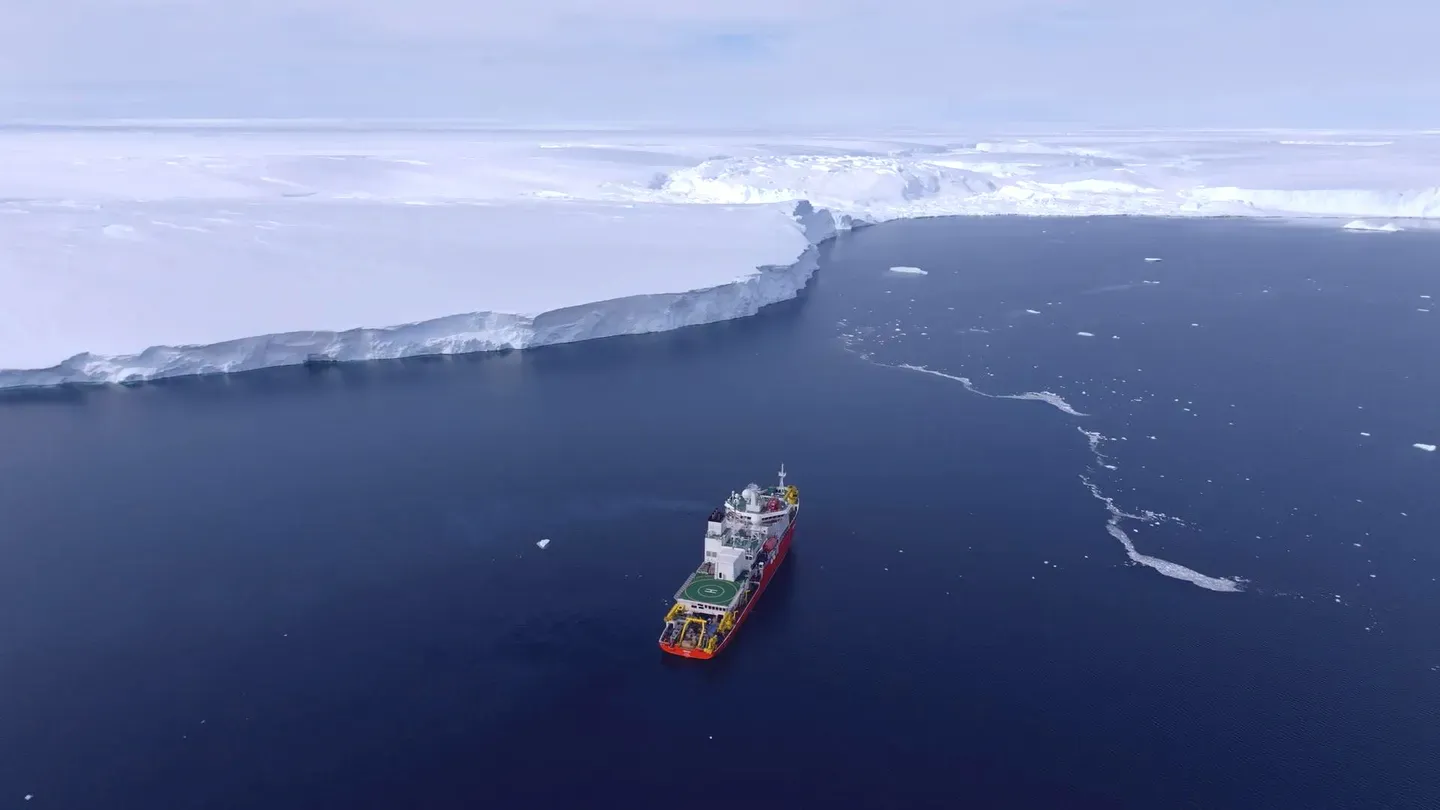
I'm on an icebreaker in the Amundsen Sea in West Antarctica.
We're station-keeping in one of the most inaccessible places on the planet.
Wow, that's pretty amazing.
What a view to wake up to.
This is Thwaites, a glacier on the edge of the earth teetering on the edge of collapse-- the most consequential glacier on the planet.
No ship has ever made it this far.
For the scientists aboard, many of whom have tried and failed to reach this place before, the anticipation is as palpable as the beauty.
I can't even believe what I'm looking at!
It's just beautiful.
That's the face of the Thwaites Glacier.
We have made our way to an absolute ideal location in order for helicopters to reach the grounding line, that's where the glacier meets the land meets the ocean.
That's where scientists want to be.
They hope to establish a camp at the grounding line, drill a narrow hole through the ice, lower instruments into the Amundsen Sea, and leave them behind to report back for at least a year.
The data might help scientists explain why no glacier this size on Earth is melting faster and perhaps allow them to predict when it might collapse.
♪ ♪ Our two-month voyage south began 13 days before, the day after Christmas.
All right.
This is the big day, this is getaway day to Antarctica!
We embarked from Lyttelton, New Zealand, heading southeast across the Southern Ocean for 3,200 miles to Thwaites.
MAN: 090... (man speaking indistinctly) O'BRIEN: The Araon is operated by the Korea Polar Research Institute, KOPRI.
(man speaking over P.A.)
O'BRIEN: South Korea is moving aggressively into a leadership role in polar science, even as the United States pulls back amid deep budget cuts to Antarctic research.
Won Sang Lee is the lead scientist aboard.
So help me understand why Korea has made polar research a priority.
My country is the, um, kind of, um, peninsula, so facing everywhere the ocean, so it's really vulnerable to sea level change.
We're concentrating and focusing on the future in sea level rise.
(talking in background) O'BRIEN: He has assembled a kind of scientific ark, with about 40 researchers aboard.
How would you describe this mission, overall, to somebody?
People are used to saying that it's kind of orchestra.
Right?
So we have experts, kind of violin, and then kind of piano and then everything.
If you're missing something here, just kind of let us know, and then I'll put your information into this diagram here.
My role in this expedition is that, how to harmonize them.
I mean they, how to orchestrate them.
♪ ♪ O'BRIEN: The biggest troupe is with the British Antarctic Survey, still smarting from what happened in 2022.
After they couldn't make it to Thwaites, they drilled a hole in a nearby glacier called Dotson.
It was a useful but scientifically less interesting consolation prize.
Keith Makinson is a veteran oceanographer and drilling engineer.
When you don't have a lot of time and you want to get through the ice quickly, they call you up.
Absolutely, yes.
(machine whirring) We just want to get to the ocean.
We're not particularly interested in the ice, so melting it is a perfect and quick way of getting through.
The complication comes is that we're in a freezing environment, so, nature's fighting back, uh, all the time.
(drill whirs) O'BRIEN: No one aboard understands that reality better than David Holland.
So, first, we need to do a CTD profile to get the water density.
O'BRIEN: A mathematician and climate scientist at New York University, he has spent much of his career studying glaciers, and has already made roughly a dozen trips to Antarctica.
He's excited about the prospects of leaving instruments in the Amundsen Sea for as long as two years.
They would yield unprecedented data.
Aside from satellites, how much data right there on site have scientists been able to gather on Thwaites over the years?
Very little.
It's like a television picture from the 1950s.
It's very blurry and spotchy.
We know something's going on.
We know that warm water, where it is, but we have no ability yet to forecast that warm water.
By putting sustained measurements, you get a sense of how things change over time, and a forecast is all about time.
♪ ♪ Starboard bow.
MAN: Starboard bow.
O'BRIEN: As we spoke, the Araon-- a Korean portmanteau meaning "all seas"-- was struggling to live up to its name.
The ship plowed into thick sea ice, shuddering, lurching, and retreating.
In 2022 and 2024, the sea ice was so thick, the ship couldn't reach Thwaites.
But this time, we made it.
(caws) We broke through after two days in the thick of the ice.
So why Thwaites?
Why is it such a singular, urgent focus for researchers?
What happens in the atmosphere affects the ocean.
What happens in the ocean affects the atmosphere.
O'BRIEN: Before we shoved off, I paid a visit to David at his lab in New York City.
A conveyor belt of warm water flows from Greenland to Antarctica and back again.
It has a huge effect on global weather patterns generally, and it has a specific impact on Thwaites.
This warm water, which is part of the blue one just below the surface, is actually reaching in and touching Antarctica right here at Thwaites.
O'BRIEN: Cold, fresh meltwater is less dense than the warmer, saltier water below, so it stays near the surface while the warmer water moves in beneath it.
David showed me a 3-D model of the rugged seafloor near the glacier.
It's quite a coincidence that this particular slice of Antarctica is the place where the warm water is abutting up against the continental shelf break.
O'BRIEN: For thousands of years, the continental shelf protected Thwaites from exposure to the warm water, like a natural dam.
But researchers believe climate change has altered wind patterns around Antarctica.
As a result, more cold, fresh water near the surface is flowing out to sea.
This creates a pathway for deep, warm water to spill over the continental shelf and flow to the Thwaites grounding line.
The continental shelf all around Antarctica is reverse slope, meaning, as you go inland, it gets deeper, deeper, and deeper, so, warm, salty water coming up onto it, for some reason... - Mm-hmm.
...will fall downhill towards Antarctica.
O'BRIEN: The warm water eats away at the glacier from below.
And it is vanishing at an astonishing rate.
It is losing about 300 feet of thickness every year.
Typical melt in Antarctica is less than one foot at the base.
-Okay.
So way, way beyond... Way outside-- yeah.
-...the norm here.
Are there other glaciers that come close to this?
Nothing.
Nothing comes close to that.
Thwaites is the size of Florida.
It holds enough water to increase global sea levels by two-and-a-half to three feet.
And it serves as a keystone for the West Antarctic Ice Sheet.
If it and all the ice it holds back slid into the sea, it would add up to about ten feet of sea-level rise worldwide.
Thwaites is called the doomsday glacier.
By the media.
(chuckles) You just have to say what the evidence is.
It's changing, we've changed it, and the tipping points are unlikely to un-change it.
O'BRIEN: So Thwaites' demise is inevitable.
Uh, it looks that way.
O'BRIEN: It may be inevitable, but could it be delayed?
♪ ♪ Glaciers are like rivers of ice, and there's an undersea river valley 60 miles wide that funnels the warm water toward Thwaites.
HOLLAND: This is such a small region of the Earth that it just might be possible to block it and pinch it.
O'BRIEN: David is interested in researching a crazy-sounding idea: could it be possible to build an underwater barrier to deflect the warm water, a so-called sea curtain?
HOLLAND: This modification could potentially stop that warm water and block it up.
And if this height is adequate, the water will be at bay.
O'BRIEN: Really?
So many questions.
What will it be made of?
How could it be built?
Who would authorize it?
Who would pay for it?
What about the unintended consequences?
The list goes on and on.
But David Holland says, "Let's not get ahead of ourselves."
Right now, the, you have to ask the question, is this scientifically feasible?
And I don't understand why people would be opposed to such a question.
(speaking indistinctly) O'BRIEN: Before we embarked for Thwaites, I reached out to veteran glaciologist Mike Bentley at Durham University in the U.K.
He welcomes the data David Holland is seeking.
BENTLEY: Any data that we can get on the warm water, the rate at which it's inflowing, how thick it is, the volume, its temperature, all those data are incredibly useful.
O'BRIEN: But that's where he draws the line.
He helped write a critical assessment of five concepts aimed at preserving polar ice, including the sea curtain.
None of them passed a set of objective criteria on feasibility, challenges of logistics, scaling-up cost, and, and the governance issues.
We want silver bullets, don't we?
Silver bullets are very seductive, Miles.
I really hope we can find some technical ways out of this problem to, to go along with decarbonization, but the ones we've evaluated are not silver bullets.
O'BRIEN: The scientists wonder if money spent on a sea curtain might be better deployed to hasten the transition away from burning fossil fuels.
BENTLEY: If you're spending, let's say, $100 billion on, um, sea curtains, and I suspect it might cost more than that, that's money that's not being spent on decarbonization, on adaptation elsewhere in the world.
It's just gonna be treating some of the symptoms, and it may not work.
In this realm, we can't confuse urgency with haste.
♪ ♪ O'BRIEN: On board the Araon, there is growing urgency about the weather.
The ideal site for the drill camp is just 18 miles away-- a short helicopter flight, but for now, an air bridge too far.
The air is too moist, and when that moisture meets a featureless expanse of ice, it creates whiteout conditions.
Deadly.
Just be gentle, nice and gentle.
(man speaking indistinctly) O'BRIEN: Chief pilot Dominic O'Rourke took me on a quick flight so I could see the dilemma.
See that?
That looks terrible.
O'BRIEN: Yeah.
O'ROURKE: We're not flying over that.
If we go charging off in there, you're just in the white.
You don't actually know which way is up anymore.
O'BRIEN: The hot-water drilling team watches the clock tick down, checking and rechecking their gear, already thinking about what they might have to leave behind.
Getting it all off the ship will take more than 40 helicopter sling loads.
-But the, the radar... O'BRIEN: Pete Davis leads the logistical effort.
So it's all been that process of working out what we, what we don't need, what's essential, what's, what's desirable, what's optional.
♪ ♪ O'BRIEN: While we wait, other science moves ahead.
The team repeatedly deploys a water-sampling probe to measure salinity, temperature, depth, and currents.
Researchers launch a glider that autonomously patrols beneath the surface, gathering data.
The ship noses into the sea ice, allowing scientists to extract core samples.
(drill whirring) It's now been ten days since we reached Thwaites, and a deadline looms.
The ship will make one more scientific voyage to Antarctica this season.
We must be back in New Zealand by February 19.
Is that enough time?
-Fingers crossed-- it should be.
You know, we've used all the weather contingency in the previous week, so admittedly, if we have major problems once we're drilling, that will, that will present a challenge.
♪ ♪ O'BRIEN: And then, eight hours after Pete and I spoke, the sky turned from white to blue, and the choppers began ferrying people and gear to the glacier.
At last.
They have to hope that everything goes perfectly well from here on out in a place where nothing seems to ever go exactly as you plan it.
While Antarctica stubbornly refused to cooperate with even the best-laid plans, life aboard the Araon followed a comforting routine.
A small island of predictability in a sea of uncertainty.
We're going from three-- whoa, whoa, whoa, whoa, whoa, whoa.
That was a big one.
The galley and the mess hall are on the main deck.
The food was good.
Mostly Korean, of course.
Little kimchi there for a starter, that's, that's a given.
The main course on this day?
Spicy seafood.
Wow, absolutely delicious.
(coughing) And then I swallowed a pepper.
Water?
-(coughs) (hoarsely): Yeah, I need some water.
I think Dave is getting me some.
Wow, that was a, that's a zinger.
The ship has six levels, plus two for the massive power plant.
There are four locomotive-sized diesel-electric engines.
There's a gym, with Ping-Pong, weights, treadmills, and a StairMaster, all of which can be an adventure in rough seas.
I think it's time to do a little bit of spinning.
♪ ♪ The laundry rooms were well-equipped.
The only challenge was the Korean instructions.
Let's see, we'll turn that on.
And, uh... I don't know, it's got a whole bunch of lights.
♪ ♪ (pan sizzling, people talking in background) So the rope goes in, goes around, comes out.
O'BRIEN: We met frequently in the conference room to hear more from the scientists about their work.
The hot-water drill team had the most ambitious, risky plan: drill a hole through the ice using near-boiling water.
The ice here is 3,000 feet thick.
First, they will deploy instruments that will provide a snapshot of conditions below: temperature, salinity, currents, and more.
Then the main event-- sensors left behind to keep watch long after we've sailed away, transmitting data that could help them understand exactly what is happening in the ocean to cause the glacier to melt so quickly.
(engine whirring) Coming for you, Nevan!
(woman laughs) O'BRIEN: But none of that can happen until they set up their camp.
We flew out to see how they were doing.
Pete Davis was there with an important warning.
The glacier is like Swiss cheese, layered with numerous unseen caverns or crevasses.
So we carefully stayed inside the markers.
DAVIS: There are crevasses out there.
We know there's none here, but there are crevasses out there.
So we don't go outside there, we don't know where they are.
O'BRIEN: You don't want to find out the hard way, all right.
DAVIS: We don't want to find out the hard way.
O'BRIEN: While they built the camp and assembled the drill rig, they shoveled and shoveled and shoveled some more.
They needed 20 tons of snow to make enough hot water to drill a 3,000-foot hole.
(man talking in background) ♪ ♪ We shoveled for days, uh, and then the wind, the wind was too strong, we had to delay.
Partly, it's uncomfortable for us, but it also, the windchill factor, it just makes everything freeze, and freezing is obviously our worst enemy.
O'BRIEN: After ten days of hard labor, they were ready to drill.
23 hours after they began, they broke through to the sea.
We got it!
(laughs) O'BRIEN: It was just after 5:00 p.m.
on January 29.
With the borehole complete, Pete Davis walked me through the instruments that would soon take the first measurements from the ocean below.
They're designed to measure salinity, temperature, depth, current, and dissolved oxygen.
What oceanographers call a profile.
If we get this down to the bottom of the ocean, even if we don't recover it, we have a profile, and we can do a lot with that.
We can, we can tell a lot about the circulation just from that one single profile.
O'BRIEN: On the other side of the tent, the mooring instruments were laid out on a table.
They are designed to gather data at different depths continuously for at least a year, transmitting the data in near-real time.
DAVIS: What we're trying to study here, more to do with kind of processes and the process of melting.
A year is more than enough to see the processes in action and to get the, get the understanding that we want.
O'BRIEN: The team gave the instruments a warm bath, then sent them down, collecting five snapshots of the water below.
So far, so good.
(drill whirs) After pulling the snapshot rig back out, it was time to deploy the sensors that they hoped to leave behind.
♪ ♪ DAVIS: And three, two, one, stop!
O'BRIEN: And then, around 1:30 p.m.
on January 31, something strange.
Pete Davis logged in to the sensors.
At first, everything looked fine.
But then he noticed that every instrument was reporting almost identical pressure and temperature readings.
Then it dawned on him.
DAVIS: Okay, actually, I'm pretty sure we're stuck.
I think we are stuck at about 650 decibars.
Um... I'll come down and discuss options.
(radio beeps) SCOTT (on radio): Thank you.
(radio hisses) (Davis clears throat) It's stuck in the borehole.
(machine whirring) O'BRIEN: The sleep-deprived crew didn't see it when it happened.
They tried to pull it free, but everyone here knew this tug-of-war was futile.
If you linger at any one location with equipment, it could freeze to the side, and unfortunately, something along those lines happened.
O'BRIEN: The instruments are frozen solid 2,300 feet below the surface, 650 feet from the bottom of the ice.
There wasn't enough time, fuel, or another suite of instruments to try again.
The exhausted, tight-knit team tried to console each other, but there's a deep well of sadness.
The whole team has, has worked really hard, uh, for many years.
It's a really hard blow.
O'BRIEN: And yet, they did not walk away empty-handed.
They have a snapshot of data from a place where none existed before.
And it's not a pretty picture.
The water temperature down here is nearly 34 degrees, more than six-and-a-half degrees warmer than the freezing point of glacier ice in seawater.
More proof of what they already know: the glacier is melting from below.
But the forecast they hope to give the world remains elusive.
It's a tough moment for David Holland.
But he's not giving up.
(both groan) O'BRIEN: Oh, man.
That's brutal.
-Oh, sorry.
Sorry about that.
O'BRIEN: On the same day the mooring instruments got stuck, he flew out to the glacier to install surface equipment for a sophisticated fiber-optic temperature sensor-- another instrument that is frozen in the ice.
HOLLAND: You know what, if we both drag it... (O'Brien yells) HOLLAND: How about if we... O'BRIEN: Let's go!
HOLLAND: Let's drag it.
O'BRIEN: Are you doing your end?
HOLLAND: No, I think we'll just drag it.
O'BRIEN: All right.
He asked me for a hand, which, as an arm amputee, is all I got.
Just think, if you had a two-handed partner, how much easier this would be.
HOLLAND: It wouldn't be as much fun, though.
O'BRIEN: That's right!
He's setting up a communication tower to transmit data from the temperature probe via satellite.
The data itself may be limited, but refining the techniques for building and operating a remote system like this makes the effort worthwhile.
We flew back to the ship low through one of the glacier's fractured ice canyons, like something out of "Star Wars."
There's no mistaking it: this is not a graceful vanishing act.
It is an accelerating collapse into the sea.
This is a glacier that is just falling apart before our very eyes.
-Absolutely-- it's just, it's this thing.
When glaciers seem to go at a certain speed, critical speed, they just seem to rip apart, and that makes the whole physics of it overwhelming and difficult, and that's what you need for a forecast.
O'BRIEN: It underscores the urgency of the need for the world to know when.
We don't have a forecast of the ice.
And I am very determined to see that happen.
I don't know if it'll happen in my lifetime, my career, but I'm making bricks and building blocks of a structure that I hope eventually leads to this outcome.
O'BRIEN: At the same time, he's exploring the audacious idea of stopping the warm water with an underwater sea curtain.
Five days after the hot-water drill came up short, we found ourselves 80 miles from Thwaites, 3,000 feet above that underwater valley that is funneling warm water to the glacier.
The rope is 500 meters.
O'BRIEN: David Holland was on the poop deck orchestrating the deployment of a pair of robotic moorings.
This goes first, right?
Yeah, this goes first, and the line will go out... -Come out?
O'BRIEN: The sensors are on robots that will continuously climb and descend on a 1,500-foot section of cable, recording temperature, salinity, and, most crucially, the speed of the current.
If the water is moving too quickly here, the sea curtain idea will be impossible.
So this is the first time you've done this kind... The robot, yeah-- well, we've... But this has a lot of advantages.
HOLLAND: Yeah, because it's continuous.
O'BRIEN: Yeah.
HOLLAND: Up and down, instead of discrete points.
O'BRIEN: Right.
HOLLAND: You see the thermocline wherever it goes.
O'BRIEN: There's no real-time data.
The moorings store everything onboard, but once they disappear below the surface, they're on their own.
Till then... -You'll have no idea if it's working.
Absolutely no idea, because there's no acoustic communication.
The delicate part is how this is going to get into the ocean.
O'BRIEN: Before they deploy it, the crew signs the robot, a small ritual before it disappears below.
David dedicates it to his wife and lab director, Denise Holland.
I get my turn, too.
"Resolve to solve!"
We're doing it.
David drops a pin on his phone, a digital breadcrumb, to make doubly sure they can find it again two years from now.
If all goes well, it will be brimming with data that could help answer the question, is a sea curtain possible?
A lot of scientists really look down upon this.
I assume you have some theories about that.
What would that be?
They're saying, "I don't believe you.
"I don't trust you.
This could go really bad."
And that is absolutely the correct critical position.
If you just sign on to this, I think you're just wishing that this is a solution.
Can it solve it completely forever?
No.
Because if you keep warming the atmosphere, this is going to retreat faster.
♪ ♪ O'BRIEN: The time for science is now over.
The Araon sets a course back to New Zealand, its mission a mix of progress and setback.
The data gathered will help.
The failures will, too.
But Thwaites continues to change, faster than scientists can fully grasp.
The idea of building a barrier to hold back warm seawater may sound improbable, but so does the scale of the problem.
What's clear is this: doing nothing isn't a solution, either.
♪ ♪ ♪ ♪


- Science and Nature

Explore scientific discoveries on television's most acclaimed science documentary series.













Support for PBS provided by:
Made possible in part by support provided by Sue Hart-Wadley and Searle Wadley with additional support from Jerry Cox.