
Junk in the Trunk 15
Season 30 Episode 25 | 53m 56sVideo has Closed Captions
Visit all five cities from ROADSHOW’s celebratory Season 30 for never-before-seen finds!
Visit all five cities from ROADSHOW’s celebratory Season 30 for never-before-seen finds, including a 1961 JFK Santa Claus Letter, a 1979 Ed Ruscha Stage Fright ink on paper, and a John Juzek violin, ca. 1950. Guess the hour’s big find!
Problems playing video? | Closed Captioning Feedback
Problems playing video? | Closed Captioning Feedback
Funding for ANTIQUES ROADSHOW is provided by Ancestry and American Cruise Lines. Additional funding is provided by public television viewers.
Support provided by:


Junk in the Trunk 15
Season 30 Episode 25 | 53m 56sVideo has Closed Captions
Visit all five cities from ROADSHOW’s celebratory Season 30 for never-before-seen finds, including a 1961 JFK Santa Claus Letter, a 1979 Ed Ruscha Stage Fright ink on paper, and a John Juzek violin, ca. 1950. Guess the hour’s big find!
Problems playing video? | Closed Captioning Feedback
How to Watch Antiques Roadshow
Antiques Roadshow is available to stream on pbs.org and the free PBS App, available on iPhone, Apple TV, Android TV, Android smartphones, Amazon Fire TV, Amazon Fire Tablet, Roku, Samsung Smart TV, LG TV, and Vizio.
Buy Now

ANTIQUES ROADSHOW's 2026 Production Tour
Enter now for a chance to win a pair of free tickets to one of the three stops on ANTIQUES ROADSHOW's 2026 Tour. Sweepstakes entry deadline is April 6.Providing Support for PBS.org
Learn Moreabout PBS online sponsorship♪ ♪ CORAL PEÑA: Come along with "Antiques Roadshow" as we hit every stop on our 30th anniversary tour.
GUEST: It was $7.99.
Really?
Wow.
APPRAISER: Yes.
APPRAISER: He's an absolute star.
PEÑA: It's the best of the rest.
It's "Junk in the Trunk."
♪ ♪ PEÑA: At the "Roadshow" tour stop in Charlevoix, Michigan, everyone felt like royalty at Castle Farms.
While most of our guests learned about their objects at the appraisal tables positioned all around the grounds... APPRAISER: Did you find a signature of his on here?
I did not, so, that's why I... That's why we questioned it.
APPRAISER: I would put this at auction between $200 to $400.
PEÑA: Some extra special items got the full "Roadshow" treatment in front of our cameras.
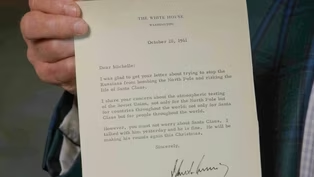
GUEST: I brought in a letter from John F. Kennedy that he wrote personally to me, because I wrote to him when I was eight years old to ask him to stop the Russians from bombing the North Pole because they were going to kill Santa Claus.
(chuckles) And he wrote me back this letter saying Santa Claus was fine.
"Dear Michelle, I was glad to get your letter "about trying to stop the Russians "from bombing the North Pole "and risking the life of Santa Claus.
"I share your concern about the atmospheric testing "of the Soviet Union, not only for the North Pole, "but for the countries throughout the world, "not only for Santa Claus, "but for the people throughout the world.
"However, you must not worry about Santa Claus.
"I talked with him yesterday, and he is fine.
"He will be making his rounds again this Christmas.
Sincerely, John F.
Kennedy."
I couldn't believe I got one back from him.
One of the things that I think might be interesting is to figure out what type of Christmas present you just got.
Have you ev-- did you ever wonder what this might be worth?
Oh, yes, I... all my life, I've been wondering what this would be worth.
People collect Kennedy.
He was president, it's on White House stationery.
Right.
But the wonderful thing about this: there are avid collectors about anything with Christmas.
Okay.
And-and you can't get a better Christmas letter... (laughing): No.
...than assuring you that S... Christmas will come.
I would say that easily, this would be $2,500 to $3,500.
Oh, wow.
Very good.
Very good.
The letter is fantastic.
Thank you.
GUEST: This is a, a lithograph.
My father actually worked for a company; they were redecorating the office.
He happened across a number of, uh, framed, uh, pieces of art in a, in a utility closet that was going to be thrown away.
And he didn't know what the art was, and quite frankly, wasn't really interested in the art.
He was more interested in the frames.
And he said, "Can I take the frames?
My son might want to use those."
So, that's the story.
This was in the '90s.
So, essentially, we put the artwork in a tube.
For about 25 years or so, it was in-in, in our-- in our basement.
Maybe about five, six years ago, we moved into a new house that is a little bit more modern in design.
So I pulled this out and said, "Hey, this looks good.
(laughing) "This is something that I think could, "could really fit into, uh... Yeah.
...into my office."
And so I hung it there.
So, you know who the artist is?
Do you... Yeah.
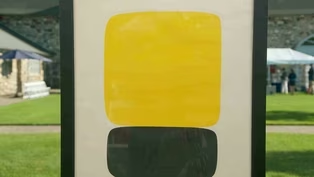
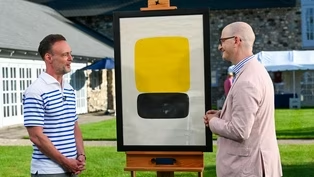
So, Ellsworth Kelly.
This really epitomizes Ellsworth Kelly.
He's best known for this type of work.
He's one of America's great 20th century artists.
He's a, uh, famous painter known for this form of minimal abstraction.
Mm-hmm.
And this was really what he and other artists trailblazed in the late '50s, early '60s.
It was really a response to abstract expressionism and infused with a sense of design.
This print comes from his series of 27 lithographs, uh, printed by Ellsworth Kelly from '64 to '65.
And the title is "Yellow over Black."
Mm-hmm.
In French, it was "Jaune sur noir," because it was printed and published in France.
At this time, in the mid-'60s, Ellsworth Kelly was really coming into his own.
He had really, uh, begun to be known as a trailblazing abstract artist in New York and abroad.
They were all done in an edition of 75.
Mm-hmm.
They were first exhibited and shown in Paris by the printer and publisher Maeght-- M-A-E-G-H-T.
A very famous publisher.
They printed the works of Picasso and Chagall and then in the post-war period started working with, uh, many American artists, like Ellsworth Kelly.
Mm.
This print is found in the collection of MoMa.
Mm.
In the Museum of Modern Art in New York.
As you said, it came out of a poster tube.
Yes.
So, we, we-- we do have some rolling creases here.
Mm-hmm, yes.
Luckily, as a color lithograph, the color area is not really affected.
Mm-hmm.
The colors are bright.
The sheet is full; it's not been trimmed.
Mm-hmm.
You, you just put it in a new frame.
Right.
So as is, I would estimate this at auction at $4,000 to $6,000.
Mm-hmm, great.
Wow.
That's outstanding.
Yeah.
Yeah, great.
Now, that's just as is.
(laughing): Okay.
Now, that said, a professional paper conservator... Mm-hmm.
...could flatten the paper.
Then I would say $5,000 to $7,000.
very good examples of this at auction now sell for $10,000, $12,000.
Wow.
Wow, that's great.
Well, we, uh, paid $100 for it, and, uh, it was online, is where we found it.
Uh, well, I like planes.
I fly RC planes, and crash 'em, too.
(laughs) It's my mother-in-law's.
She collected Royal Worcester.
Little birds and everything, that's all porcelain.
It's a really beautiful piece, but very different.
Very unusual for Royal Worcester.
I've never seen one before.
GUEST: My Aunt Karen gave it to me.
She gave it to me when I was a bit younger.
All I know is that it's been refurbished.
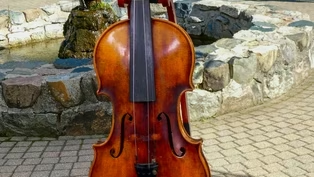
GUEST: I inherited it from my grandfather, my mom's dad, my Grandpa Eddie, about 25 years ago.
All my family, they all picked out things, and I'd always really been fascinated by the violin.
I said, well, I would really love to have that of his, so... so that was how I got it.
I never knew him to play it.
I always envisioned him playing it, but I never did get to hear him actually play it.
As a young kid, I played violin.
That was the instrument that I chose.
(chuckling): But they would've never let me use this.
When I first got it, I went online and I got a reply back from somebody in Britain.
They gave me a pretty wide range of somewhere between £1,500 to £2,500.
Well, as you know, the violin is a bit of a mess.
(chuckling) Right?
Yes, we know that.
Yes.
(laughs) So, the bridge is down here... Yeah.
...and it should be up here.
Yes.
And the fingerboard is totally loose.
It's ready to fall off any second.
Yes, yes.
It's also missing the saddle up here.
Oh... Okay.
But I wouldn't worry about that.
That's easily repairable, all those things.
Okay.
And the label that's on the inside says, "John Juzek, Prague."
And then in English, it says "made in Czechoslovakia."
So that, to me, means that it was made for the American market.
Okay.
John Juzek started violin-making in the 1920s.
Okay.
Mm-hmm.
And in the 1930s, late 1930s, the company moved to the United States.
When do you think your grandfather acquired this violin?
My guess, it would probably have been in the '40s or '50s.
Right, so it's about 75 years old.
Yeah.
The company has continued on in Vermont, and they make many different levels of violins.
So, our trick is to figure out what level of the Juzek line of instruments this represents.
Okay.
So, the first thing I look at is the quality of wood.
Mm-hmm.
So, the spruce on the top is just a magnificent piece of spruce with absolutely straight, regular grains.
And then, on the back, the maple... Has this beautiful, distinct, pencil-thin flame all the way from top to bottom.
This is not a slouchy piece of wood.
Okay.
This is a rare piece of wood that they would have used for their finest instruments.
In today's market, as is, this violin would have a value of at least $8,000.
Really?
Yeah.
Really?
Yes!
Wow.
$8,000, in this condition?
In this condition.
Wow.
That's a retail value.
Okay.
And to fix it up, you've probably got maybe $500 to $750's worth of repair work.
Wow, okay.
And then it'll worth at least $9,000.
Really?
Okay.
So it would definitely be worth it to get it into tip-top playing condition.
♪ ♪ PEÑA: Discovering treasures... Date-wise, it's... very early 20th century, 1910-ish.
Around then.
Oh, wow.
PEÑA: ...and making memories... Dream come true!
PEÑA: ...were all part of "Roadshow"'s visit to beautiful Red Butte Garden in Salt Lake City.
"Antiques Roadshow" rocks.
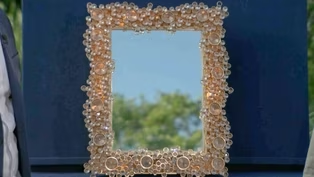
GUEST: I brought a mirror that lights up, and it's got some kind of crystals on the outside.
I found it at a thrift store, and it was $7.99.
You're kidding.
No.
What about it made you look at it?
I loved the crystals, although, I thought, maybe they're... fake crystals, I don't know.
It was just very interesting, and I've never seen anything like it before.
I know that it was made in West Germany, which means that it's probably pre-1990s, 1980s, and it has old wiring.
I don't know how sturdy it is, but I have plugged it in and it works.
How long ago did you get it?
Uh, four years ago.
This is an illuminated mirror by Palwa, and it was made around 1970.
Palwa, first and foremost, was a lighting company.
So inside these, these channels, underneath the crystals, there's, there's lights.
Okay.
When you had it on, did you look at it?
Did you, you see the reflection?
Yeah, you-- you kind of glow, yes.
Okay.
Flattering?
Yes.
Okay.
They were good at this.
And what's really wonderful about it is the materials they, they used, helped complement the reflection.
So this is gold-plated brass, and they use crystal, and typically they use Swarovski crystal.
Okay.
So, this is very high quality, very nice glass that they would use.
This company made lights and illuminated mirrors in all kinds of different styles.
But this style that they made in the late '60s and '70s, it's very groovy, it's very fabulous.
There's an optical effect by the way that they layered the crystal in.
Large ones, small sizes, ones that are in the front, others that are kind of behind... Yeah.
...recessed further.
And so it has this great kind of, kind of optical effect.
We've seen round ones, we've seen different sizes-- and again, they made all kinds of different lights.
And they sell; there's a great market for these pieces.
This, at auction, is worth more than $7.99.
(laughing): I hope so.
Well, it's worth $2,000 to $3,000 at auction, conservatively.
(softly): Wow.
Wow.
Oh, that's amazing.
That is amazing.
Do you go thrifting a lot?
Uh, every day.
(chuckles) GUEST: My dad was an aeronautical engineer for Grumman, and he was on the Lunar module.
The things on here were from when they had the moon landing.
Part of his design was to hold all the scientific equipment, and so he would always have to be there in case, when they were on the moon, they had trouble getting anything out.
Sapphire bracelet and a couple rings.
Got 'em from my grandma.
This one's gold, this one's gold.
Not sure about this one.
This one looks older than these two, but... mm.
PRODUCER: And do you have a, a significant other that wears these?
(both laugh) Occasionally.
She, she wants-- she wants them to be hers.
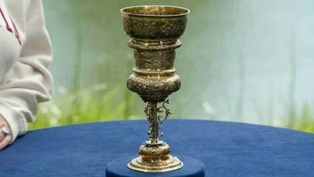
GUEST: This is a chalice that's been in my family for at least four generations.
My great-grandmother was gifted it by the nanny that looked after my grandmother, because she arranged to have the nanny's daughter, uh, received in America when they were fleeing after World War II.
My great-grandparents were stationed in Germany shortly after World War II.
I believe it's from Germany.
It was gifted to my great-grandmother by a German resident.
Um, it actually comes apart in three pieces, and the nanny that gifted it to my great-grandmother said that they used to take it apart so that each family could leave with a piece after they had had communion in secret.
Mm-hmm.
And that way, if they were stopped by the Gestapo with each of the pieces, it was less apparent what it was and what they were doing with it... Mm-hmm.
...because my great-grandmother was Catholic and so was the nanny, and they were being persecuted for that.
Mm-hmm.
And indeed, uh, Germany is where it's from, but it's from a very specific place in Germany called Augsburg.
It was described, Augsburg, as the, uh, center of capitalism in Europe... Wow.
...in the 15th, 16th, and 17th centuries.
Uh, so, it was a very important manufacturing area.
When I saw you bring it towards us, I thought, "Oh, my gosh, it's probably a 19th century Renaissance copy."
Mm-hmm.
Uh, but in fact, this piece is a period piece.
Uh, it is 16th and 17th century.
There are marks on it.
The first mark that we see is for the city of Augsburg.
There's like, a pinecone shape.
It looks like it's cross-hatched.
And then the second mark appears to be a "KB" or a "BK."
You can see that the "K" is backwards.
There's still a lot of research that needs to be done on who exactly this maker is.
You can see all along, the animals.
So, it has this sense of, uh, hunting.
As you can see, there's a little bit of religion going on here.
We, we have a cherub with angel wings.
I wonder how much of it was actually used for religious purposes, ecclesiastical purposes, or whether it was probably just a... a guy who had made a lot of money in Augsburg (laughing): at the time... and was kind of showing off to his friends.
This is a silver gilt goblet.
It probably originally had a lid to it.
It was an expensive piece in its day.
I mentioned silver gilt.
So, you see, it's golden... Yeah.
...but there's silver underneath.
And then, along these edges, you see they haven't gilded that little frill.
So, they're giving you this two-tone effect of silver and gold.
It's just a, a real masterpiece of... of silversmithing.
We're looking at a piece 16th, 17th century.
It's missing its lid, however.
Yeah.
So I would probably put an auction estimate on it of $5,000 to $7,000.
Oh, wow.
Yeah, yeah.
Okay.
It's really quite, uh, quite wonderful.
It's pretty astounding... Yeah.
...to have something that old.
GUEST: Well, we brought in our-- a lithograph, uh, by Mucha.
I inherited it, actually.
My husband's great-aunt acquired it in 1923, and she found out that I was an artist and she said the lithograph would be mine when she dies.
And she died in 1974.
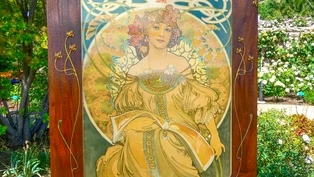
So, yes, the artist is Alphonse Mucha, one of the most famous Art Nouveau artists, uh, in the world.
The poster comes from 1897.
Now, one of the biggest books that was written on Alphonse Mucha counts seven different variations of this image.
One of the reasons I think it's authentic is there is metallic ink in the background.
Right.
The gold behind her head is metallic ink.
Right.
Yes.
And that is something that wouldn't be used on a reproduction.
So what this was really referred to as, not as a poster, but as a decorative panel.
It is authentic.
But... ...this is not one of the seven variations that are listed in the "Mucha Catalogue Raisonné."
This is a different variation.
And the things on this that differ from the other copies are these sort of golden wings... and this almost looks like a decorative letter "H."
And then, these six gold dots that are also done with gold ink.
Those don't exist on any other of the variations.
The other thing of great interest to me on this piece is the frame.
The frame with these beautiful Art Nouveau tendrils.
And I found out that in 2002, this piece with these unusual variations in the top, with this beautiful frame, came up for auction at a major New York auction house.
And I was like, "Hm."
To me, I thought these were added by hand, is what it looks like.
And then, I looked at the back of the frame, and on the back of the frame, there is a label from an Indianapolis art shop that was selling this piece with the title "Reverie" without the author's name.
And it said to order more copies of these, call and ask for it by name.
So, this variation is an American version, and this is the second known copy.
We know for sure it was sometime before 1923, because that's when it was given to your relative.
As we know from the label on the back, the name of the company in Indianapolis is The H.L.
Company.
And if I look at that closely, I see a stylized "H" and a stylized "L" in there.
And I do not know this for sure, but just maybe the company put their own imprint on this American version of Mucha's poster.
(chuckling): Oh.
I would think at auction now, the estimate would be between $8,000 and $12,000.
Mm-hmm.
Okay, that's... actually what I estimated myself.
I was thinking that might be in the-- that category, yes.
I knew you knew.
(laughs) The French version of this poster would be slightly more expensive.
Mm-hmm, right.
It would be $10,000 to $15,000.
Right.
The insurance valuation would be about $15,000 would be-- would be appropriate.
PEÑA: A little rain wasn't going to stop hardy Mainers from coming to "Roadshow" at the Coastal Maine Botanical Gardens in Boothbay.
It's Italian, it's from Sicily.
It's not a camel saddle.
Oh.
It's a pack mule saddle.
PEÑA: And at every opportunity, people shared their stories and their treasures.
PRODUCER: And how did you come to own these?
Well, my father, um... was the art editor of "The New Yorker" magazine from 1939 to 1973.
GUEST: When I was a little girl, about five years old, my parents had a really huge fight that I can remember, and it was due to this little vase.
Somebody owed my dad some money, and didn't have... money to pay him back, so he offered my dad this vase, which my father accepted.
And my mother was not happy, because a vase will not pay the mortgage.
And then my mom gave it to me right after I got married.
So, probably 35 years ago, because she knew how much I loved this little vase.
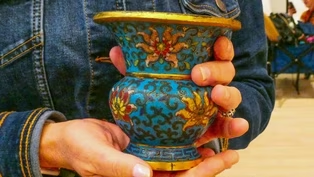
This is an 18th century waste bowl, called a "zhadou."
Zhadou means essentially waste bowl... Like chamber pot.
Well, it's a very small chamber pot.
(laughs) It was used for the remnants of tea or the remnants of food on a table.
Mm-hmm.
It's made of cloisonné enamel.
It's a Ming dynasty form... Mm-hmm... ...um, that actually had its history in an archaic bronze vessel, which was called a "zun," or a wine vessel.
"Zun" means respect.
That form started in the Shang Dynasty, a millennium before the birth of Christ, okay.
Oh, whoa.
And then that form evolved, and some scholars think that, that it evolved into this form.
There's some dispute about that.
Ming Dynasty form, however, what makes this a later piece-- that is, a Qing Dynasty... Oh.
...imperial Qianlong piece, is the use of this pink enamel... Oh.
...which was brought into China by the Jesuits in around 1720, 1740, resulting in a piece that was made by the imperial workshops.
But, in the Qianlong era, between 1735 and 1795.
Wow.
At auction, a piece like this would bring you between $6,000 and $9,000.
Wow.
(laughing): I guess it would have paid the mortgage.
Wow.
Thank you so much.
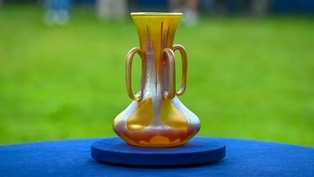
GUEST: I inherited this from my mother about three years ago.
It entered my family probably around 1900, having been purchased by my grandfather, probably in Chicago, because he would have attended the 1893 World's Fair there.
And I think it was purchased somewhere around that time.
We did have one person take a look at it a couple years ago, who-- his original thought was that it was Tiffany.
He spent a fair amount of time trying to find marks on it, couldn't find any, and finally concluded that it was probably from Austria and was Loetz.
I think it's Tiffany, partly because my memory is that you one time said that Tiffany had a branch of their store in Marshall Field's in Chicago in the late 1800s.
I'm wondering if that's where this was purchased.
It's not Tiffany.
Okay.
It is Loetz.
L-O-E-T-Z.
Okay, okay.
An Austrian company, and they were working at the same time... Yeah.
...but this particular piece was made between 1902 and 1904, which means it couldn't have been bought at that exhibition.
Okay, yeah.
What is important to know is that Loetz and Tiffany were competitors.
Mm-hmm.
They were making iridescent glass at the same time.
Loetz looks very different.
Okay.
And this is a particular design technique or genre that we call phanomen-- P-H-A-N-O-M-E-N.
Okay.
And it's characterized by these beautifully swirling decorative designs in this silvery blue iridescence that you see.
Mm-hmm.
If you look down inside the vase... you can see that the interior of it has been iridized.
Oh, yeah.
Yeah.
What makes your piece unusual is first of all, the scale, which is great, but also it has four handles.
Mm-hmm.
When handles were put on pieces of Loetz, they were done two different ways.
One, they would actually extrude the glass from the body, or they applied them.
These are applied handles.
Applied, yeah.
So they're individually done.
There are no marks on the bottom.
Right.
And if you see, you have this beautiful ground pontil... Mm-hmm.
...which is typical of a Loetz finish... Loetz finish, okay.
...on the underside of the vase.
And the reason it wasn't signed is it probably was sold in Austria.
When Loetz exported their pieces, they would put "Loetz Austria" on the underside.
In a retail setting, this would be between $7,500 and $9,500.
Wow, okay.
(laughing): That's a lot of money.
That's way more than the estimate that the gentleman gave me when he thought it was Loetz, so, I'm thrilled.
That's... that's wonderful.
When the other person looked at this piece, what kind of value did he put on it?
He said it was worth about $1,000.
If this had been the extruded handles, the piece could've been worth double the price I told you.
Wow.
Okay.
But it's still good.
(laughing): I'm-- I'm thrilled.
If I were to put an insurance value on this... Mm-hmm.
...I would make it $10,000.
Okay.
GUEST: It's a lithograph self-portrait from Rembrandt.
PRODUCER: Was he very surprised?
It looks like he was surprised.
Yeah, definitely.
GUEST: This painting was from my husband's grandmother.
She acquired it from her uncle, an executive at Coca-Cola.
And we don't know much.
It looks like it's an original painting, but we-- we don't really know.
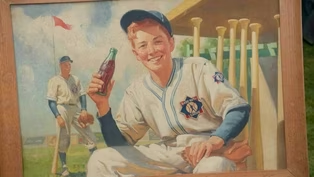
Well, this is a 1951 painting that was done for Coca-Cola advertising.
Coca-Cola and advertising has had a long, long, long history and a long history with sports, because what better Americana is there than-- than a Coke and baseball?
Now, it's interesting-- here, we have this Babe Ruth patch on there instead of an O, which is what you see in the ad.
Yes.
Now, this was done for the 65th anniversary of Coca-Cola.
My guess is that they did afterwards a special promotion for Babe Ruth, because in 1951, the Babe Ruth League was established.
Because it's Coca-Cola, because it's baseball.
I would put an auction estimate of $6,000 to $8,000 on this.
Wow.
Wow, that's... that's amazing.
We had no idea.
(chuckle) GUEST: It's been in my family since the 1960s.
My father was out visiting some cousins of mine in Arizona, and, uh, they were friends of Charles Loloma.
So they visited the studio, and my father, who had a good eye for things, saw this bird on the shelf.
I don't think it was for sale, but as the story goes, he was able to convince Mr.
Loloma to sell it to him.
I think it was 1969.
I see.
What can you tell me about the piece of jewelry?
There was a retrospective of Mr.
Loloma at the Wheelwright Museum in Santa Fe.
My husband was with me, and he knew that Charles Loloma was a prominent jeweler, so, a couple years later, he contacted Martha Struever, who was the curator of the show, and asked if she had any jewelry that he could buy as a present for me.
So I acquired this beautiful piece of, uh, jewelry.
I think it was 2006, 2008.
It's ornamented on both sides.
Do you have a favorite side?
Yes, actually, the other side is my favorite side.
Charles Loloma was born in 1921.
He passed away in 1991, and his, his creative period lasted for half-a-century.
He was just extraordinary and very innovative.
The jewelry is set in gold.
The turquoise is called Lander Blue.
Extremely rare.
Very, very desirable.
Tell me why this is your favorite side?
Well, I like the coloring.
I-I guess I'm-I'm an orange person.
(laughs) Mr.
Loloma would love what you just said.
He was fixated on color.
He believed that color reflected beauty.
The orange is coral.
There's turquoise, ivory down at the bottom and up at the top on that little horizontal bar is ironwood.
If you were to wear this with the opposite side facing, which is, I think, how most people might, the side that you prefer actually is facing inward.
Oh.
Charles Loloma did this purposefully.
He also used this approach on bracelets.
He not only ornamented the exterior, he ornamented the interior so it would reflect to the person who's wearing it; a hidden beauty, if you will.
(laughs) He was one of the most important, prominent artists of the entire 20th century, both in North America and Europe.
Hugely influential.
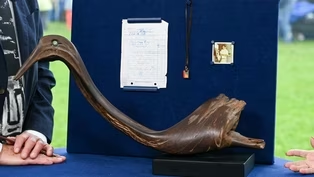
Tell me a little bit about the bird.
Well, what I know... Yes.
...is that, uh, it's ironwood.
Ironwood grows in the Sonoran Desert.
It's very dense.
It's a long, hard wood.
He would walk on the desert and pick up stones on the desert floor.
And he undoubtedly encountered this ironwood natural form.
And he enhanced it just very minimally with turquoise for the eyes.
You can sense its rough form here.
Oh, right.
This is how it broke off of the tree.
He did a little bit of polishing and then just the slightest amount of carving to delineate the beak of the bird.
I want to point out this photograph of Charles Loloma.
He seems to be wrapping this for your dad.
(laughs) I can't believe we have the original invoice.
Someone seems to have suggested in 1976 that it may have risen from $65 to $300.
Oh, okay, yup.
This photograph and this invoice immeasurably adds to the historic importance of this sculpture.
The jewelry, on a retail basis in particular, because of the Lander Blue on the other side, very, very desirable.
On a retail basis, this would be worth, in the neighborhood, of $20,000.
(laughs) (laughs) Interesting.
I think this sculpture would value at about $35,000.
Hm.
Interesting.
(laughs) Do you think your dad overpaid?
(laughs) My dad would be proud.
(laughing) I'm sure he would.
I'm sure he would.
I have to thank my mother for saving the bill.
I don't think it was my father.
(laughs) She, she did good.
She did good.
Welcome to St.
Louis, guys!
Welcome to St.
Louis!
PEÑA: "Roadshow's" visit to Grant's Farm in St.
Louis... Hi!
PEÑA: ...drew a big, enthusiastic crowd.
What brought us to "Roadshow" is our dog.
This is his absolute favorite show.
PEÑA: Feathered fans also showed up to see what treasures were brought in, like this artwork with a local connection.
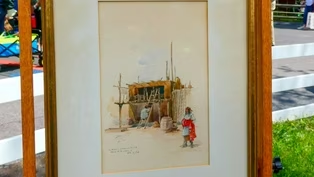
This is an Oscar Berninghaus watercolor.
Oscar Berninghaus and my great-grandfather were friends.
My great-grandfather was Francis Healy.
He owned an art gallery here in St.
Louis, and he was president of the art commission.
And Oscar Berninghaus signed this over to my great-grandfather.
My great-grandfather gave it to my dad.
Signed it over to my dad.
So then my dad passed away in 2004.
It was specifically meant to go to me.
So he knew that you liked it.
Oh, yeah.
Down at the lower left, it is inscribed.
Can you read it?
Yes.
"To F.D.H," which is Francis Dennis Healy.
That was my great-grandfather.
In addition to being the, uh, arts commissioner here, he had a very prominent gallery.
And he was the first gallery to give Berninghaus an exhibition... Oh!
...actually, when Berninghaus was 25 years old.
And this is right when Berninghaus went to Taos for the first time.
Now, when we talk about Berninghaus today, a lot of people know that he came from St.
Louis, but most people, when they think about him, they think of him as one of the founders and one of the most important artists of the Taos Society of Artists.
And he did go there, originally, around 1899.
Oh... He really instantly fell in love... Yes.
...with that part of the world and with Taos itself and the Pueblo, which this is a depiction of.
And then he came back and he showed a lot of these watercolors and other paintings at your great-grandfather's, uh, gallery, yeah.
Oh, at his gallery.
Oh, wow.
So in a way, he was, uh, your great-grandfather was very, very important to the history of American art and history of American Western art.
I didn't know that.
Neat.
There's a sticker on the back that still has the label from Healy Galleries.
Mm-hmm.
Berninghaus started as a commercial illustrator.
One of the first art patrons... Mm-hmm.
...of-of Berninghaus was the Busch family.
Wow.
And they supported him throughout his artistic career.
Really?
Both as a commercial artist and as a fine artist.
Later in 1914, Berninghaus did a printed booklet of illustrations of scenes from the American West that was done and promoted for the Busch family.
Oh, okay.
So he always considers himself a St.
Louis artist who would spend some time in Taos.
Okay.
What I think he was instrumental in doing was in, um, really bringing this love of the American West... Mm-hmm.
...back to the... back to here, which is really the city of... that is the gateway to the West.
Right.
The medium is watercolor and gouache on paper.
So it's mostly watercolor... Okay.
...highlighted with, uh, some gouache painting, like in the white parts.
And it just depicts a scene from daily life.
Right.
So it is signed and dated lower left.
It says 1900, and it even has a day and, and month.
A work like this is going to be conservatively estimated, at auction at around $3,000 to $5,000.
Okay.
Sounds good.
If you were to insure this... Mm-hmm.
...I would insure it at around $8,000.
Okay.
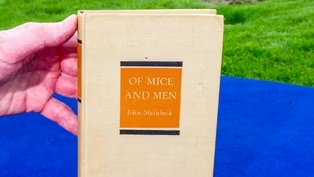
I have brought a, a signed copy of "Of Mice and Men" by John Steinbeck.
I inherited it from my mother, who inherited it from my maternal grandmother.
Not only is this a first edition, also it's what we call a first issue.
That means it's from the very first printing.
Now, here's the title page, published 1937.
And this one, you mentioned, was inscribed.
Inscribed and signed.
Right-- his handwriting, as you can see is, it's neatly illegible, I would describe it.
In two lines or one line and a word, he really sums up something that's really relevant.
He says, "Perhaps Lennie is the best of us.
John Steinbeck," which Lennie, tragic figure in literature.
A gentle giant who doesn't know his own strength and ends up in a lot of trouble.
And it's a tragic ending for Lennie.
He's not inscribing it to someone that we may or may not know, but he's really broadly opening it up for any and all people who handle this book.
So it's very special.
And he's mentioning, really, probably his most tragic and dearest character, most memorable character.
So it really, when I saw that, I was like, wow.
Mm-hmm.
I looked to see other inscriptions of Lennie.
There's very few that, that he brings in a character.
Do you have any sense of value or what what, she paid for it way back then?
Well, we have the original receipt, and it was $13.
$13.
In 1938, I believe is the date.
Wow, so it was right around the time, it was published a year before.
Right.
I would say if you were going to auction this copy, with that great, simple line, I would put an estimate of about $5,000 to $7,000, okay?
Okay.
I would insure it for double that-- for $10,000.
Okay, okay.
$12,000.
GUEST: It belonged to my great-great uncle.
He and his wife owned a store nearby, and then, uh, they also owned some apartments.
And my grandmother bought the apartments from them and this was in it, and they got to keep it.
It works, that's all I know.
GUEST: I picked it up at a flea market.
I paid five dollars for it, and it had the original box and the key.
The bottom part of it says 1941.
GUEST: I know it's a Trova.
And I got it from my father about 30 years ago.
And he got it from a friend who was a fishing buddy of his.
And the man said he had worked at the foundry where it was made and he was using it as a boat anchor.
We had it in the house, just propped up in a corner for a while, but it kept falling over.
And so we welded a small angle iron onto the bottom and put it on this copper pipe, and we display it in the garden now.
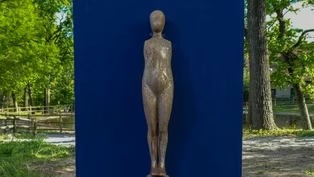
Well, Ernest Tino Trova was born in St.
Louis in 1927, and he lived here his whole life.
In his early career, he worked at Famous-Barr department store, designing windows.
And in exchange for his work, they offered him studio space and materials for him to make art for the 1964 Bicentennial Exhibition, which is when he created this theme that he visited over and over again in his career, "The Falling Man."
He said that "The Falling Man" represented the imperfection of man.
The sculptures of "The Falling Man" are certainly very representational of Trova and his career.
But he also made "Falling Man" in paintings, prints, collages, assemblages, many different media.
It was really the recurring theme of his artwork.
Sometimes Trova is associated with Pop Art, but in fact, he really doesn't fit into that kind of category or any other kind of art movement.
He really did his own thing.
He often said that Ezra Pound and Willem de Kooning were two of his greatest influences.
But on the flip side, he also loved Disney, and he collected Mickey Mouse figures.
(laughs) He was represented in New York by a major gallery.
His work was very popular, and he had a big reputation.
But then he focused more on being back in St.
Louis, and he actually donated 40 sculptures to Laumeier Park.
So he helped create that park, which was a great thing for St.
Louis.
Yes, I've been there.
We're not really sure when it was made.
And you told me that the material he used here was...?
We believe it's solid, stainless steel.
And you said it weighs 60 or 70 pounds, but does that include the pipe or...?
Uh, yes, and the pipe is filled with concrete, Yeah.
(chuckling): ...unfortunately, so it makes it even heavier.
Well, often when you see these sculptures by Trova, they are polished to a very high degree, very shiny... Mm-hmm.
...and you could certainly have that redone.
Since you have it outside, what you could do is a lot of times for sculptures that are outside, they cover them with a thin coating of wax and that helps protect them... Okay.
...from the weather, so that might be something to consider.
Okay.
I think, in its present condition-- and luckily, when you explained how you had mounted it on this other piece, that sounds easily reversible... Oh yeah.
...which I think is the important thing to always remember.
But I think in the present condition, at auction, it might be around $5,000 to $7,000.
(laughs) And if it were in non-anchor condition... (laughs) ...it might be a few thousand dollars more.
(laughing): Okay.
So thanks so much for bringing in this icon of St.
Louis to the Roadshow.
Thank you so much for your information.
I can almost hear the old man laughing now.
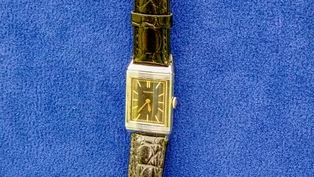
(laughs) GUEST: This was my father's watch.
I never saw my dad wear the watch.
I was looking through photo albums about five or six years ago and noticed the watch on him.
And I thought, I have this watch in a jewelry box that I saved from him after he passed away.
Okay.
I believe it to be his graduation gift from high school.
That would be my guess.
He graduated in 1938.
Let's go back to 1930.
We're at a polo match in India.
The British army is, is playing, and one of the players smashed the crystal on his watch.
Somebody watching happened to be in the watch business.
There must have been some conversations.
Can't they make a watch that will be protective so we can wear it in a sport?
Mm.
And from there it got brought to Jacques LeCoultre, who was a watchmaker in Switzerland, who then talked to a friend of his, Edmond Jaeger.
And over a period of a year or so, designs came up to make a watch called the Reverso.
And the watch was introduced to the public in 1931.
The watch is made out of stainless steel... Mm-hmm.
...and at the time in their advertisements, they called it Staybrite.
So somebody could be wearing the watch and then... ...it snaps right to the back.
And now the crystal and the dial and hands are protected.
Now, what's on the back here?
That is my father's initials, R.W.
The watch of your dad's was actually made in the first batch.
Made in 1931.
Wow.
On the back of the watch is the word "patent" and the serial number, which is 6124.
Mm-hmm.
It's one of the earliest recorded serial numbers of the original Reverso from 1931.
Oh.
The model is called the 201.
The movement is a Tavannes 064.
Because it's so famous, in 2011, for the 80th anniversary of the Reverso, Jaeger produced, basically, the exact copy of this watch.
And it was a complete sellout at the time.
The dial is a black enamel, and all the markers are gilded in gold.
This watch is probably one of the finest examples that I've seen.
Oh, my.
He couldn't have worn it a ton.
Right.
In the retail market, this would probably be a fairly easy sale.
Somewhere in the $17,000 to $22,000 price range.
Awesome, that's great.
That is really good to hear.
(laughs) It's, it's the real deal.
(laughs) Okay.
All right.
PEÑA: Savannah was a hot spot for cool stuff when "Roadshow" chugged into the Georgia State Railroad Museum.
I've never seen anything like it.
Yeah, it's an interesting piece.
PEÑA: "Roadshow" may not know what's coming down the line, but there will always be surprises.
GUEST: Well, I brought in a picture that my husband inherited from his great-aunt and great-uncle.
That was painted by Gustav Muss-Arnolt, who was a German artist that was born in the 1850s.
And you can see right here his first initial, "G, Gustav Muss-Arnolt."
He was a, uh, a German American artist, rose to prominence in the late part of the 19th century, 1880s, '90s.
He lived from 1858 to 1927.
I would say this is probably around 1900.
There are very specific types of hunting dogs; this would be a English Setter.
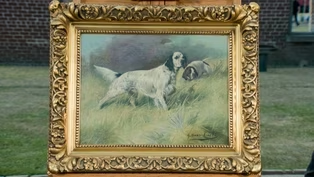
Mm-hmm.
And this guy back here looking out is a, a Pointer, an, an English Pointer.
Well, it's interesting, in the world of dog paintings, a couple of the groups, the terriers, the many of the purebred dogs, the working dogs, the non-sporting dogs, they haven't really fared as well in the art market.
The one area that has really remained strong is American bird dogs like these.
Oh, interesting.
Um, by American artists such as Muss-Arnolt... Mm-hmm.
...Percival Rosseau and Edmund Osthaus.
This is not that big, about 12 by 16 inches.
If I put it into an auction, it would be an estimate of about $10,000 to $15,000.
Oh, my goodness.
It would certainly make that.
Wow.
Very interesting.
Not expecting that.
(chuckle) Yeah.
It's a beautiful painting, and we enjoy it very much in our home.
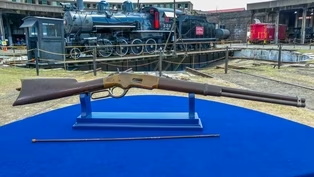
GUEST: Well, it was my grandfather's rifle that my dad had and handed down to me.
I can read "Winchester" on it.
I was interested if it's Yellowboys, like from the westerns and stuff.
And, I-- because of the color of it, I always figured it was probably a Yellowboy.
Well, you would be correct.
It is a Yellowboy.
And it was called the Yellowboy because of its distinctive brass color.
And it is the Winchester Model 1866.
The '66 was produced from '66 through 1898.
There are about 170,000 of rifles and carbines.
This is a carbine, which is essentially a short rifle, preferably be for use on horse.
It is one of those guns that is, qualifies as "the guns that have won the West."
The thing that is remarkable about this, your father... ...didn't appear to touch it.
No, it, it hung up on the mantel above our fireplace.
Mm-hmm.
Because there's a lot of '66s out there, but this one, it's not in pristine condition.
It's in an untouched condition, except for of course, one screw, which appears to have been replaced.
But it appears that it's also been there for a very long time.
You have the original cleaning rod which goes into the stock.
And it's incredible-- this carbine dates to 1869, three years after the introduction of the rifle.
It's known as the Third Model Winchester, because it was the first time that the serial number appears underneath the loading lever.
At auction, I believe that it would fetch somewhere between $6,000 and $8,000, conservatively.
Okay.
Right.
Again, because the market will get quite enthusiastic over the fact that nobody's played with it, and that it's been in a family and it hasn't traded hands.
It came down through my family.
It's been around as long as I've been around, so I don't know much about it.
But we're from North Georgia, so we assume it's from somewhere up there.
My mother was a doctor and, uh, she took care of, uh, Bethany Yarrow, uh, when she was in her teenage years and, uh, became lifelong friends with Peter Yarrow.
My mother bought this guitar and gave it to him to sign.
And this is what he gave back to her.
Obviously we're talking about Peter-- Peter, Paul and Mary.
Yeah.
And he was such a generous human being.
He really lived what he preached.
And he... we sadly just lost him.
He made a beautiful original piece of artwork with the little portrait of himself.
And he signed it and you've got all the colors and that's, that's just who he was.
He did do stuff like this occasionally for charity.
But it's-- it-- this is really nicely done.
The guitar is probably a few hundred dollars, just as a guitar.
Yeah.
But because you have the artwork on it, and we've just lost Peter, I think this makes it more like a $3,000 to $5,000 guitar.
Yeah.
(chuckling): Yeah.
Damn.
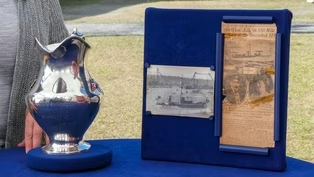
GUEST: My great-great-aunt Rebecca's daughter, on my mother's side, she was married to L.B.
Lindeman, and he was the captain of the Snapshot III, and she was a crewmate.
There was a journey from Halifax to New York that was put on by Hearst, and it got... off course, to the point where I guess they assumed that they were lost at sea.
And as the story is told is there was dense fog, he got off course, she got on the helm of the boat, and she corrected the boat the 100 miles that it had gotten off course.
And two days later, when the boat came to shore in New York, the person that was the captain, or at the helm, was my great-great-aunt Rebecca's daughter.
Pretty unusual for a woman in that time, this is like 1911.
1911, yeah.
Yeah.
I'm a girl dad.
It sits on our mantel.
It's an incredible story to tell my daughter.
The silver pitcher is a presentation pitcher by Gorham Silversmiths in Providence, Rhode Island.
It does have the Gorham marks.
It has the "G" for Gorham, the anchor for Providence, Rhode Island, and also the lion for sterling.
Then it has a little, uh, little mark over here, which is, sort of, a figure eight rope, which dates it to 1910-- it sounds like a fantastic race.
So it was from New York to Halifax.
It was a powerboat-- we got a nice picture of the boat here.
And what's interesting is that it seems, sort of, from the news articles that they were missing for quite a while.
They were presumed lost.
They arrived quite... Two days.
Two days after the winning boat, but they won third place.
So you've got the enamel flags that represent the yacht clubs that were involved.
Mm-hmm.
William Randolph Hearst, the media mogul of the time, was, I think, very interested in boating, who sponsored this race.
And really, a, a very elegant trophy.
It was an elegant age and an interesting piece of, sort of, early sporting history.
Putting a value is a little tricky.
Gorham is a very good maker.
The design is wonderful.
The fact that it's related to boating, and it's really the story of how it all comes together... Right.
...as a package that sort of enhances the value.
And my sense is, for insurance purposes, I would look at a figure around $8,500.
Okay.
Great.
Thank you so much.
GUEST: This was purchased by my late mother-in-law... APPRAISER: Mm-hmm.
...as a gift for my husband sometime around 2011.
She purchased it in California.
And I understand it's not typical of his work.
Mm-hmm.
We were contacted by an editor who was preparing a catalog of his works in 2016.
They said they did not have a good image of this work... Mm-hmm.
...and we gave them permission to come to our home and photograph it.
Well, that's perfect that it's in the "catalogue raisonné."
Ed Ruscha is one of the most important American artists... uh, of international renown.
He's so hard to categorize.
Mm.
You know, some people think he's a pop artist, some people think he's a conceptual artist, some people even think he's a surrealist.
Ah.
He could be all of the above, some of the above, none of the above.
(chuckles) But his... chosen subject is painting words and phrases.
He's really capitalized on that notion of words and power.
Mm-hmm.
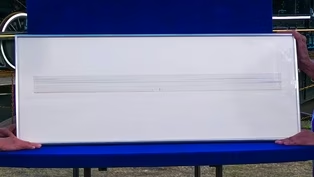
This piece is, as you discussed, atypical in that we have a figure.
But when I was thinking about it, I was also thinking about the title... that's on the back.
The title is so integral to the appreciation of the piece.
Tell me the title.
The title is "Stagefright."
That's as magical as any of the pieces he's done, I mean, this figure standing in the middle of a proscenium to nowhere.
Mm-hmm.
The wonderful regularity and monotony and mystery of the lines with that single figure is, is just amazing to me.
Mm-hmm.
Mm.
It's ink on paper.
It appears to be in quite good condition.
The piece is signed and dated "E. Ruscha, '79."
He was born in the '30s.
And so this is prime... And he's still alive, I understand.
He is.
And this is prime time for Ed Ruscha.
Wow.
He's a star.
He's an absolute star.
Do you have any idea what your mother-in-law paid?
I have no idea.
His market has gone up and up.
And up.
Oh, my.
I would estimate this, at auction, between $50,000 and $75,000.
Oh, my word.
Yes.
Oh my word, oh, thank you for that information.
Oh, good.
What should I insure this for?
$150,000.
PEÑA: And now it's time for the "Roadshow" Feedback Booth.
And we brought my doll, Samantha, an original American Girl that my nana bought me when I was a little girl in the early '80s.
And every birthday and Christmas, she added something from Samantha's collection.
Um, so I have the whole collection.
And we found out today that she's worth $350 to $500.
So that was very exciting.
I brought my, um, Art Nouveau, French... ...mirror frame and I thought it was by a famous French, uh, sculptor, but turns out I was just framed.
My mom bought it at Goodwill back in the early '60s and she paid ten dollars for it.
And she didn't have a lot of money because she had seven children to bring up by herself as my dad passed away young.
So this has always been cher-cherished in our family.
Um, we brought it here 'cause we wanted to honor her memory, too.
Um... (voice breaking): ...and we were so excited to find out that it's worth just under $1,000.
So she did really well.
She was always a thrifter.
So, thanks, Mom.
I came to "Antiques Roadshow" to see if my koala bears were worth anything.
Come to find out they are worth as much as people are willing to pay for koala bears, um, which is not that much, maybe $200 to $300.
But they got a whole lot of attention, were really cute, and I love them.
Our stuff wasn't worth a dime.
But we had a great time.
PEÑA: Thanks for watching.
See you next time on "Antiques Roadshow."
APPRAISER: This is your husband's?
GUEST: It is, his father bought it for him in the early '70s.
He actually bought it from a co-worker, he paid $100 for it.
My husband, Butch, this is the guitar that he learned to play on in high school and then in college, he was rhythm guitarist for a small band in Greensboro, North Carolina.
Greensboro, North Carolina.
Mm-hmm.
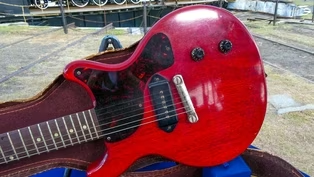
This was basically a student guitar when it came out in 1954.
In 1958, they went to the double cutaway and the original ones were single cut.
In '58, they started using this color, cherry.
Fabulous guitars, they were $132 new.
This is a 1960 Gibson Les Paul Junior.
Beautiful example.
It also has the original case and the original strap.
What if I told you it was about $12,000?
I would say "oh my, that's excellent."
Well, you can say, "Oh, my."
Because it's about $12,000.
Wow!
Retail and/or insurance value.
He'll be so happy.
(laughs) Good.
GUEST: When my great-aunt died, my mom got it.
APPRAISER: Mm-hmm.
And I've had it since I was 20 years old.
This is a Japanese oil dish.
They put it under the lamp.
The maker was unknown.
It was from Seto area.
This was made in the very late Edo period, maybe 1850s, 1860s.
In a shop, maybe $1,000 to $1,200.
Wow.
I was hoping like $500.
But you doubled it, so.
Yes.
No.
(laughs)
 New
NewAppraisal: 1869 Winchester Model 66 "Yellowboy" Rifle & Carbine
Video has Closed Captions
Clip: S30 Ep25 | 1m 57s | Appraisal: 1869 Winchester Model 66 "Yellowboy" Rifle & Carbine (1m 57s)
 New
NewAppraisal: 1900 Oscar Berninghaus Watercolor
Video has Closed Captions
Clip: S30 Ep25 | 2m 43s | Appraisal: 1900 Oscar Berninghaus Watercolor (2m 43s)
 New
NewAppraisal: 1911 Gorham Silver Powerboat Race Trophy
Video has Closed Captions
Clip: S30 Ep25 | 2m 28s | Appraisal: 1911 Gorham Silver Powerboat Race Trophy (2m 28s)
 New
NewAppraisal: 1931 Jaeger-LeCoultre Reverso Watch
Video has Closed Captions
Clip: S30 Ep25 | 2m 41s | Appraisal: 1931 Jaeger-LeCoultre Reverso Watch (2m 41s)
 New
NewAppraisal: 1937 Inscribed "Of Mice and Men" First Edition
Video has Closed Captions
Clip: S30 Ep25 | 1m 46s | Appraisal: 1937 Inscribed "Of Mice and Men" First Edition (1m 46s)
 New
NewAppraisal: 1951 Coca-Cola Baseball Advertisement Painting
Video has Closed Captions
Clip: S30 Ep25 | 1m 10s | Appraisal: 1951 Coca-Cola Baseball Advertisement Painting (1m 10s)
 New
NewAppraisal: 1960 Gibson Les Paul Junior Guitar with Case & Strap
Video has Closed Captions
Clip: S30 Ep25 | 1m 4s | Appraisal: 1960 Gibson Les Paul Junior Guitar with Case & Strap (1m 4s)
 New
NewAppraisal: 1961 JFK Santa Claus Letter
Video has Closed Captions
Clip: S30 Ep25 | 1m 36s | Appraisal: 1961 JFK Santa Claus Letter (1m 36s)
 New
NewAppraisal: 1964 - 1965 Ellsworth Kelly "Yellow over Black" Litho
Video has Closed Captions
Clip: S30 Ep25 | 2m 59s | Appraisal: 1964 - 1965 Ellsworth Kelly "Yellow over Black" Litho (2m 59s)
 New
NewAppraisal: 1979 Ed Ruscha "Stagefright" Ink on Paper
Video has Closed Captions
Clip: S30 Ep25 | 2m 28s | Appraisal: 1979 Ed Ruscha "Stagefright" Ink on Paper (2m 28s)
 New
NewAppraisal: 20th C. Ernest Trova "Falling Man" Sculpture
Video has Closed Captions
Clip: S30 Ep25 | 3m 31s | Appraisal: 20th C. Ernest Trova "Falling Man" Sculpture (3m 31s)
 New
NewAppraisal: Alphonse Mucha American "Reverie" Print, ca. 1910
Video has Closed Captions
Clip: S30 Ep25 | 3m 11s | Appraisal: Alphonse Mucha American "Reverie" Print, ca. 1910 (3m 11s)
 New
NewAppraisal: Augsburg Silver-gilt Chalice, ca. 1600
Video has Closed Captions
Clip: S30 Ep25 | 3m 9s | Appraisal: Augsburg Silver-gilt Chalice, ca. 1600 (3m 9s)
 New
NewAppraisal: Charles Loloma Necklace & Ironwood Bird
Video has Closed Captions
Clip: S30 Ep25 | 4m 4s | Appraisal: Charles Loloma Necklace & Ironwood Bird (4m 4s)
 New
NewAppraisal: Chinese Cloisonné Enamel Waste Bowl, ca. 1750
Video has Closed Captions
Clip: S30 Ep25 | 2m 24s | Appraisal: Chinese Cloisonné Enamel Waste Bowl, ca. 1750 (2m 24s)
 New
NewAppraisal: Gustav Muss-Arnolt Hunting Dogs Oil, ca. 1900
Video has Closed Captions
Clip: S30 Ep25 | 1m 28s | Appraisal: Gustav Muss-Arnolt Hunting Dogs Oil, ca. 1900 (1m 28s)
 New
NewAppraisal: John Juzek Violin, ca. 1950
Video has Closed Captions
Clip: S30 Ep25 | 2m 46s | Appraisal: John Juzek Violin, ca. 1950 (2m 46s)
 New
NewAppraisal: Loetz 4-handled Phänomen Vase, ca. 1904
Video has Closed Captions
Clip: S30 Ep25 | 3m 24s | Appraisal: Loetz 4-handled Phänomen Vase, ca. 1904 (3m 24s)
 New
NewAppraisal: Palwa Illuminated Mirror, ca. 1970
Video has Closed Captions
Clip: S30 Ep25 | 2m 28s | Appraisal: Palwa Illuminated Mirror, ca. 1970 (2m 28s)
 New
NewVideo has Closed Captions
Preview: S30 Ep25 | 30s | Preview: Junk in the Trunk 15 (30s)
Providing Support for PBS.org
Learn Moreabout PBS online sponsorship

- Home and How To

Hit the road in a classic car for a tour through Great Britain with two antiques experts.













Support for PBS provided by:
Funding for ANTIQUES ROADSHOW is provided by Ancestry and American Cruise Lines. Additional funding is provided by public television viewers.