
Lamar Alexander
Season 4 Episode 6 | 27mVideo has Closed Captions
Becky talks with Lamar Alexander, the former Tennessee senator and governor.
Becky talks with Lamar Alexander, the former Tennessee senator and governor.
Problems playing video? | Closed Captioning Feedback
Problems playing video? | Closed Captioning Feedback
Clean Slate with Becky Magura is a local public television program presented by WNPT
Lamar Alexander
Season 4 Episode 6 | 27mVideo has Closed Captions
Becky talks with Lamar Alexander, the former Tennessee senator and governor.
Problems playing video? | Closed Captioning Feedback
Where to Watch Clean Slate with Becky Magura
Clean Slate with Becky Magura is available to stream on pbs.org and the PBS app.
Providing Support for PBS.org
Learn Moreabout PBS online sponsorship(gentle music) - [Becky] Sometimes life gives you an opportunity to reflect on what you would do with a clean slate.
Our guest on this episode is Lamar Alexander, former Tennessee governor, US Senator, and accomplished author.
♪ But I've thrown away my compass ♪ ♪ Done with the chart ♪ ♪ I'm tired of spinning around ♪ ♪ Looking for direction, northern star ♪ ♪ I'm tired of spinning around ♪ ♪ I'll just step out ♪ ♪ Throw my doubt into the sea ♪ ♪ For what's meant to be will be ♪ - Lamar Alexander is a seventh-generation Tennessean with over six decades of service in government.
A statesman with skill at bipartisan leadership, Alexander has worked with 10 US presidents, served two terms as Tennessee's governor, three terms as US Senator, and saw the public arena from as many angles as any living American, including as a university president and US Secretary of Education.
From the time he started his journey as Boys State governor to working for the Kennedy Justice Department, then as part of the team for Tennessee Senator Howard Baker and on to the Nixon White House, with his final weeks in the waning days of Biden's administration, Lamar Alexander has always been a man for the moment.
Currently that still seems to be the case, as he is the author of a new book, "The Education of a Senator," which follows Alexander's journey through good times and bad from JFK to Trump, in the heat of Tennessee politics, and always with his beloved wife, Honey, and their family by his side.
This is his 10th book.
Known for campaigning in a plaid shirt and performing on the piano with 27 orchestras and on the Grand Ole Opry, Lamar Alexander has been a known figure.
His contributions to the state, as well as the nation, have been significant, including laws that govern K-12 education, medical innovation, and the maintenance of our national parks.
He is also credited with bringing the auto industry to Tennessee.
Senator Alexander, what a joy it is to see you, and thank you.
I'm excited about your new book, "The Education of a Senator," New York Times bestseller list?
You've got to be proud of this.
- Well, I enjoyed writing it.
I even enjoy reading it, (both laugh) and I hope other people do too.
(both laugh) - Well, it's really readable and I mean that in a true sense.
I've only started it; it's a big book, but if you have any interest in politics or even just history or human stories, it's just chock full of that, and it really reads like you speak.
- Well, thanks.
You know, I learned something a long time ago from Alex Haley, the author of "Roots."
He heard me making a speech, and he came up after; I was governor then.
He said, "May I make a suggestion?"
I said, "Well, of course."
He said, "If, when you start to speak, "you would say, instead of making a speech, "'Let me tell you a story,' "someone might actually listen to what you have to say."
(both laughing) So, ever since then, I've tried to tell stories, and I kept a diary during, you know, from 2009 until 2021.
It's a lot of words.
So I have a lot of what happened written down on the day it happened.
You know, if I'm talking to President Trump, President Obama, Senator McConnell, Honey, whomever.
- [Becky] Yeah.
- So I could go back to that.
And my editor, who was a wonderful guy, had said, "Dialogue is golden."
So instead of describing something, I tried to just repeat the conversation.
So I think that makes it more interesting to read.
- Oh, it really is!
And what made you start keeping a diary?
- I went to the James K. Polk house in Columbia and found out that they gave me a copy of President Polk's diary.
- [Becky] Oh, wow.
- And this was the 1840s and every night for the last three and a half years of his term, he would write at night, and he must have done it by candlelight or by whale oil lamp, but I may have been the one of the few people who've ever read it, but the details fascinated me.
He'd get up; he'd open the White House door at nine o'clock.
He only had one staff member, the president did.
And in would come job seekers, congressmen, people wanting money.
Then he'd close the doors at noon.
Then he'd read the treaties.
Then he'd write responses.
He'd have a cabinet meeting.
He'd go for a walk.
Have dinner at 4:00.
9:30 at night, Senator Sam Houston might come by for an interview, a visit.
And I thought, "Well, what I see "won't be nearly as important as what President Polk saw, "but maybe if I write down just what happened every day, "someday people will find that interesting."
So I did that.
I gave it to Vanderbilt Archives, told 'em not to open it until 20 years after I'm gone.
- Wow!
So they have your diary.
- They have it, but in writing the book, I could go back to it and know the day, know the conversation, and make it more accurate.
- Well, this isn't your first book.
- This is the 10th.
- The 10th book.
- Counting, I wrote a children's book called "Chief Waki Waki Poo & the Swimming Pool Monster."
(Becky laughing) But if that counts, this is 10.
- That's fabulous.
I love the book.
I haven't read the entire book, as I said, but it really just will pull people in.
So thank you for doing it.
Thank you for keeping a diary.
I often thought I wish I had kept a diary of my years in public broadcasting 'cause I've certainly written a lot, but it usually was more.
- Well, you've seen a lot.
- Well, I have seen a lot.
- And how long have you been in public broadcasting?
- Almost 45 years.
- Is that right?
- Yes.
(both laughing) - Well, I've known you almost all the time.
- You have, because, I will say, my first meeting with you was, I was a graduate student at Tennessee Tech.
- [Lamar] Right.
- Working on a Master's in Education.
And the TV station WCT had just started at that time, and you came by as governor to talk about the Master Teacher program that you were creating where you wanted teachers to be seen as professionals, and that meant a lot to me.
- I wanted to pay them more so they'd stay in the classroom instead of going to work for IBM or some corporation.
- Yeah, well, it was fabulous, and it was encouraging to me.
And then I sort of found my path through education in public media and public television which we consider the world's largest classroom, you know, and then I had the opportunity to interview you in 2018 when you were senator, and you were really working on some important legislation, the national parks, and also you were working on the healthcare, I believe, and just a number of things.
You had done the transportation.
There were so many things that you had worked on that were impactful to our state.
- Well, you know, I used to tell my colleagues in the Senate: "It's hard to get here, hard to stay here, "and while you're here, "you might as well try to accomplish something good "for our country."
So, I didn't see any need of being governor or senator and suffering all the indignities and the inconveniences to my family unless I was gonna try to accomplish something and try to get a result, and usually that meant working with people with whom I disagreed because if in the Senate, I'm a Republican, but there never have been 60 Republican senators in history, and you have to get 60 votes to get a bill on the floor.
So I had to work with Democrats.
And, as governor, I had a Democratic legislature, so if I came up with a Better Schools program, which is what you were talking about, then Ned McWherter, the Democratic speaker, he would, because we were competitive, he would come up with a even better, Better Schools program.
So we passed his amendment to My Better Schools program, got a result, and got a law.
- Wow, that had so many magical times that you've been a really, the play maker, the quarterback.
You've really helped drive change, positive change, in the country.
I interviewed you again in 2020 and now again here in 2026.
Ironically, President Trump has been in office in all those times.
- [Lamar] That's right.
- But it feels different right now.
And I think your book could not come out at a more important time because it really allows us to see the difficulty of governance.
- Right, and that's why I wrote it, really.
I have a friend up in East Tennessee who is a home builder.
And when I was in the Senate, he crawled under my house to find a dead rat that was creating a smell.
And he put his, he said, "I put my hand up there, "and I felt something furry, "and I knew I had something."
And then he said, "I found another one under your sofa."
And I said, "Delmer, I wouldn't want to have your job."
He said, "I'd a lot rather have my job any day "crawled under your house to get a dead rat "than your job up there in Washington, D.C."
So I think that's the way most people look at it.
But I wrote the book because I wanted people to know that I got up every day thinking I might be able to do something good for my state or country and went to bed most nights thinking I had.
- [Becky] Mm-hmm.
- And I wanted to persuade, maybe inspire people to believe what I've learned, which is that if you really want to change things, if you don't like what's going on, if you want to help the most people, the most reliable way to do it is to figure out how to get yourself elected to something or go to work for somebody who has been.
You can do a lot of good things in private life, but there are just some things that you have to be in public life to get done.
- It really does seem to be true, and yet I worry that we have a new generation of young people who feel they don't have that path because we're so polarized.
What would you say to them to encourage them to really reconsider, and how can we get back to more civil conversation?
I know Kim Burns is a friend of yours.
- Right, he is.
- And he speaks of that often.
- What's happened to us, in about 2008, Facebook, iPhone, all this arrived on the scene, and it's created a digital democracy, and it's driven us to the side.
My grandchildren spent the weekend with me.
Their parents were teaching them how to have a conversation.
You know, "If somebody says, 'This is Becky,' "what do you do?
"You just look at her, or what do you say?
"Nice to see you, Becky.
"And then you ask Becky a question."
If you're sitting there watching a screen three hours a day, you don't necessarily know that, and you particularly don't have any practice having conversations with people with whom you disagree.
Another grandchild was at Hillsborough, and then she took a semester and went to a camp in North Carolina where they don't allow social media, for a semester.
So she knows what it's like to live without it.
And I think that's healthy.
I think we have to tame the algorithm that drives to Becky what you agree with and to Lamar what he agrees with, and then we don't, we just don't talk to each other because in families and business and particularly in government, you have to talk with people with whom you disagree if you want to get anything done, and if you don't want to get anything done, then why would you be in government?
(laughs) It's much too much trouble to get elected if all you want to do is make a speech or shout at somebody.
- There's a lot in your book about democracy, a republic, that famous Ben Franklin quote.
- [Lamar] Right.
- You know, "if we can keep it."
- "A republic if you can keep it."
- So this is a, and I know you're not a fan of the term moderate.
You want to talk about these things?
What's the difference between democracy and republic?
Why is it important?
- Well, the founders, we talk a lot about democracy these days, but the founders didn't want too much democracy.
They didn't trust human nature.
So they created a government that is really kind of unusual in the sense that it has a lot of checks on human nature.
So if the president gets out of hand, well, you've got the courts, and if the courts get outta hand, you've got the Senate, and you've got all three branches of government to try to restrain the passions of the people.
They just didn't trust us to always be on our best behavior.
Justice Scalia, who is the justice that Republicans revere the most, used to say, "Every tin horn dictator has a bill of rights.
"What gives us our freedom is our structure of government, "the checks and the balances."
So that's what a republic is.
If all we had was a democracy, we could just vote on everything on the internet.
A republic is a lot messier.
You elect people, and then they have to be checked, and then they exercise their own judgment, and they operate within a structure.
- And that leads to a two-party system.
- It should.
It works better with a two-party system.
Tennessee was very lucky, and I was lucky, really, during the time I've been in public life.
From about 1960s through just a few years ago, we had a very competitive two-party system.
You know, in 2006, the Senate race between Harold Ford, Jr.
Democrat, Bob Corker, Republican, was the closest in our state's history, and when I was elected governor, when Bill Frist was elected, when Bredesen was elected, all of us had to run very competitive races against the other party.
And what that does is that attracts more talented people.
It's like the Southeastern Conference if you're a football player.
You want to play in the Southeastern Conference because the best players are there, and people want to go to the games because they're the best players there.
They want to participate.
So we have a situation right now in Tennessee and around the country where we have too much one-party domination where it's true in Tennessee.
Democrats can't elect anybody, but that's not just us.
80% of the American people live in a state where one party dominates the governorship and the legislature: 80%.
California, it's Democrats, Texas, it's Republicans.
The important thing about that is you get better government when you have the competition.
We had 100 years of one-party rule in Tennessee up to about the 1960s when Howard Baker was first elected.
We were the third poorest state.
I think one reason for that was because we had a fairly mediocre, non-competitive political system, corruption occasionally, during that time.
Soon as we got a two-party system, we started to move with both good leadership on the Democratic side and the Republican side.
And the dean of the UT Baker School says that in the eighties and the nineties, Tennessee grew faster in family incomes than any other state.
Auto jobs came in.
I'm pretty convinced a big reason for it was the competitive system attracted more good people, both sides of the aisle, and once they got in, they were better political leaders, and they produced better government.
- When I asked you about this interview, the name of the show is "Clean Slate," and I said, "What would you do with a clean slate?
And you said, "Well, I have had one (both laughing) for a few years now.
- [Lamar] Yeah.
- What would you do with a clean slate?
- Well, what I just did was write a book.
I mean, I wrote a memoir to try to put my life in perspective.
If I had a clean slate, and I were 35 years old, I would probably run for office in some way to try to create more competition in politics.
I'd try to get more people voting in primaries because, as we were just talking, if you take this, if all anybody does is read their iPhone, you know, three hours a day and take information they already agree with, and if they don't have any practice talking with somebody who disagrees with 'em, you don't get much good government.
And so few people vote in the primaries that they're skewed way to the left and way to the right.
So people who are center left and center right, which most of us are, don't have anybody they're happy voting for in the general election.
So I think you've probably you'd use social media in a clean slate (Becky laughing) to get more people voting in primaries, and I think that would produce more people who would be ready to try to get a result once they got elected instead of just making a speech or compete to see who could go furthest off the cliff on the left or the right.
- Right.
In your book, you really cover so much history.
When you started, you started with Bobby Kennedy, right?
Were you a... - My first government job was I was a student in New York University Law School in the summer of 1963.
A Vanderbilt classmate was his secretary, Attorney General Kennedy, and I got a job as an intern in the summer in the Justice Department.
It was a summer.
I remember late August I walked out for lunch, and there were 250,000 people on the mall, and I heard this loudspeaker, and it was Martin Luther King making his "I had a dream" speech.
- Wow.
- So I was in and out of public life.
I've lost some elections too.
And I was in and out of public life from Martin Luther King's "I had a dream" speech till three days before the rioters assaulted the Capitol, trying to prevent Joe Biden's inauguration.
So I worked with 10 presidents, saw public life from about every angle, very lucky to have a chance to do all of that.
- Who do you think was maybe the most impactful for you in that tenure?
Who do you feel like you just learned so much from?
- Well, after my parents, I had three mentors: Judge John Minor Wisdom of the Fifth Circuit Court of Appeals in New Orleans who taught me courage when he ordered Ole Miss to admit James Meredith, the first Black student at Ole Miss; Howard Baker, our first Republican senator in Tennessee, elected senator, who fought to build a two-party system and taught me that the other fellow might be right; (both laughing) and then Bryce Harlow, whom most people won't know, but he was probably the most respected man in Washington who was a staffer, and he was President Nixon's first appointee, and I sat next to him at a desk 50 feet from the Oval Office in the White House, which is now the Vice President's office, and I listened to him dole out wisdom to the other younger White House aides who came in and asked for advice.
And the question I heard him ask most often was, "What would be the right thing to do?"
- [Becky] Mm.
- So those three mentors had the most effect on me.
- Wow.
What would be the right thing to do?
You did that.
Even as a Boys State governor, you sort of, in your speech, well, not sort of, you did; you called for civil rights.
- Yeah, it was 1957, and that was the year that Eisenhower, I guess after, well it was Governor Clement, who, in a very courageous act, had sent the National Guard in to integrate Clinton High School in East Tennessee, not far from Maryville.
So civil rights was in the news: Brown versus Board of Education was the issue, and then Eisenhower the next year federalized the National Guard in Little Rock.
So in my Boys State governor address, I called for more civil rights and outlawing the Ku Klux Klan.
(both laughing) - But then you also put it into action at Vanderbilt.
James Lawson was at Vanderbilt right at the time.
- Well, and when I enrolled at Vanderbilt in the fall of 1958, the undergraduate school was all white.
James Lawson was a African American minister who was in the divinity school, but that's not all he was doing.
He was downtown Nashville with John Lewis starting the Civil Rights Revolution.
And we, on the undergraduate students at Vanderbilt, we were sleeping through that revolution.
Our big issues were charm week, you know, whether to fire the football coach, but by 1962, I was the newspaper editor for the student newspaper, and I urged that Vanderbilt change its rules, and so did a number of others.
Dr.
Sergeant, here in Nashville, was a student senator.
Student Senate voted down desegregating Vanderbilt 15 to 14.
They authorized a resolution.
Then the students voted it down, you know, two to one.
Created such a fuss, that the Board of Trust had to change the rules.
And so Vanderbilt changed and desegregated its undergraduate school in the spring of 1962.
- [Becky] Wow.
- And people forget that, I mean, that was a time when Blacks couldn't find a place to stay in a motel.
They couldn't sit, they had to sit in the back of the bus.
If they lived over where I did in East Tennessee and went to a University of Tennessee football game, they had to sit in Section X, which was reserved just for African Americans.
No African American athletes in the Southeastern Conference.
That was 1962.
- Wow.
Chapter 12 is dedicated to Honey.
Well, your book is dedicated to honey.
- Yeah.
But there's a lot.
Honey, your wife, was such a wonderful partner.
Your family's so important to you.
And what does that bring to you when you talk about that?
- Well, when you write a memoir, Honey said, "Well, memoir is self-serving."
And I said to her, "Well," I said, "my whole political life "has been self-serving to some degree," but what writing the book, we were married when I was working in the Nixon White House, and she had her stroke two years before she died, two months before I left the Senate.
So, all of that time, I was dragging her through in and out of a political life.
In fact, she told one of her friends, Molly Pratt, she said, "When I die, you need to make Lamar "spread my ashes at all the houses he's made me live in."
(both laughing) But she was absolutely terrific.
And when I wanted to run for governor after having lost, she said, "Now wait a minute."
She was devastated by that first loss.
She said, "I want to know why you're running "and what you hope to accomplish."
And she said that every time I ran for office.
And then when I ran for president, she said that, and after I satisfied her, she went to Iowa on her own and visited 80 counties, visiting people who had never heard of me, so introducing herself.
- What a great partner.
What a great leader you've been.
We're gonna be out of time.
Is there something that I haven't asked you that you wish I had?
- No, I'd just like for the reason I wrote the book was to help readers understand what Bill Frist and I learned as an example.
He gave up being a heart and lung transplant surgeon, saving one life at a time, because he thought as a senator he might save a million lives, and he did by his work with George W. Bush on PEPFAR to help people with AIDS, that if you really want to help people and be a part of keeping our country from falling apart, then spend part of your life in public life, either being elected or working for somebody who has been.
It's worth it if you have a sense of purpose.
- I love that.
Thank you for your sense of purpose.
Thank you for this time.
- Thank you, Becky.
Wonderful to see you again.
- Great to see you.
Hope I'll see you again.
(Lamar laughing) (gentle music) ♪ I've thrown away my compass ♪ ♪ Done with the chart ♪ ♪ I'm tired of spinning around ♪ ♪ In one direction ♪ - Why do you think your children didn't go into politics?
- Well, they've still got time.
(Becky laughing) I think they saw and tolerated the difficulty that a public life causes a family.
I mean, I think the biggest challenge in public life is leaving it with your reputation and your family intact.
They saw how unselfish Honey was in my life, and maybe they didn't want to be a part of a life like that.
But my younger son Will has a young family.
He's got a lot of good political instincts and interest in public service.
One day he might be a candidate.
I hope he is.
- I love that.
Thank you for that.
(gentle music)
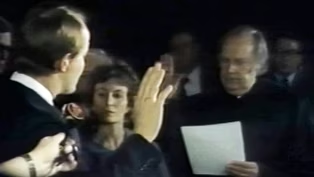
The Governor Who Took Office Three Days Early
Video has Closed Captions
Clip: S4 Ep6 | 2m 9s | This story recounts the extraordinary 1979 transition of power in Tennessee. (2m 9s)
The Best Lesson from Every President
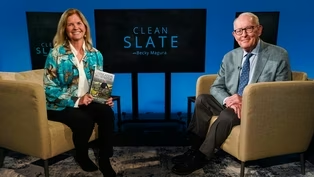
Video has Closed Captions
Clip: S4 Ep6 | 4m 43s | Lamar Alexander reflects on the lessons he learned from working with 10 U.S. presidents. (4m 43s)
Providing Support for PBS.org
Learn Moreabout PBS online sponsorship












Support for PBS provided by:
Clean Slate with Becky Magura is a local public television program presented by WNPT