Pioneer Specials
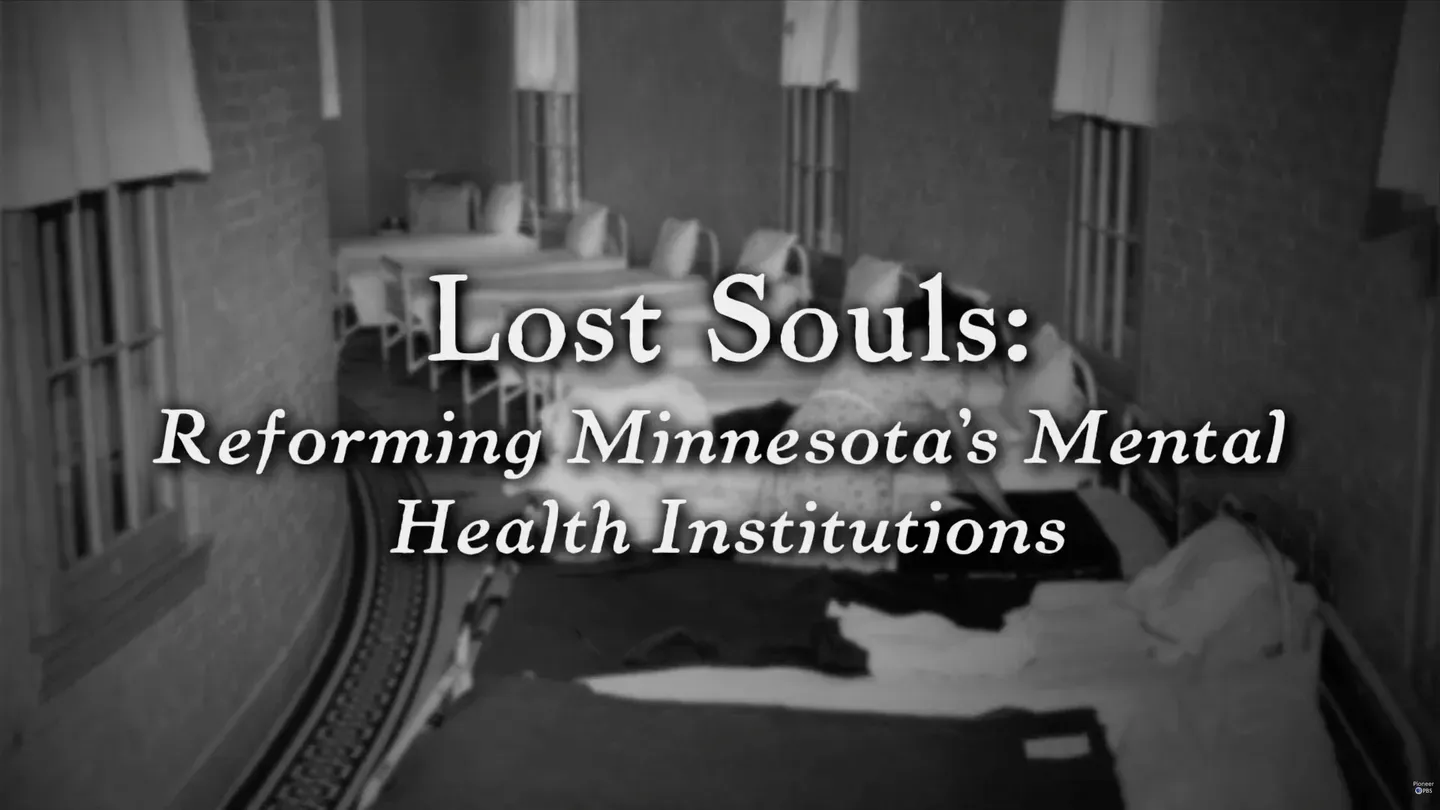
Lost Souls: Reforming Minnesota’s Mental Health Institutions
Special | 26m 51sVideo has Closed Captions
Explore the troubled history of Minnesota’s state hospitals.
Explore the troubled history of Minnesota’s state hospitals, the patients who endured neglect and abuse, and those who fought for more humane treatment.
Problems playing video? | Closed Captioning Feedback
Problems playing video? | Closed Captioning Feedback
Pioneer Specials is a local public television program presented by Pioneer PBS
Pioneer Specials
Lost Souls: Reforming Minnesota’s Mental Health Institutions
Special | 26m 51sVideo has Closed Captions
Explore the troubled history of Minnesota’s state hospitals, the patients who endured neglect and abuse, and those who fought for more humane treatment.
Problems playing video? | Closed Captioning Feedback
Where to Watch Pioneer Specials
Pioneer Specials is available to stream on pbs.org and the PBS app.
(pensive dramatic music) - [Chris] There's endless fascination with the state hospital.
Some people are drawn to the morbidity of the treatments, but there's also a mystique to it.
People with mental health issues literally by the thousands in a facility.
(pensive music continues) - There was just so much pain in families when a loved one got sent away and so much shame.
And in many cases, the families didn't want to send them away, but couldn't care for them.
- And so how did it work?
What did they do to them?
How were they treated?
How did the hospital operate?
And so it creates this kind of sense of mystery that people are endlessly fascinated with.
(pensive music fading) (people chattering) (light gentle music) - I was helping my son clean out his closet, and I was reaching up, and a bag, grocery bag of papers, fell down into my arms.
And I looked inside, and they were papers that described this whole issue of mental health that had taken place 50 years before.
Arthur Foote had been my fatherin and these were his papers that he had saved all those years.
There were photographs from the institutions.
There were speeches typed on an old manual typewriter, on onion skin.
I met a woman who was there.
She was working.
It started me on this odyssey of discovery.
- Operation which is even more so.
- Right, right.
(gentle music) - Minnesota became a territory in 1849 and became a state in 1858.
Minnesota itself was booming.
You had thousands of people moving here.
A lot of those folks didn't have stablished well family networks.
There was a lot of economic rolls of the dice in terms of people coming here with very little and hoping to make more.
So kind of a precarious spot.
And then when things didn't go right or things didn't go as planned, or issues came about through mental illness or alcoholism or other issues that were lumped in with mental illness at the time, there was nowhere to go.
- People with mental health problems were housed by the counties in their poor houses, or sometimes they were called alms houses.
But by the 1860s, the state felt like it had patients that weren't appropriately housed in those places.
And so the state allocated money and bought land in St.
Peter for a state asylum for the insane, which opened in 1866.
And then by the 1870s, St.
Peter was overcrowded, and so Rochester was opened in about 1878.
- You can see in the historical record that there was a real desire to help, and there was a real hope that this system would care for patients, would cure individuals, would make their lives better.
(light dramatic music) - [Jennifer] So there are hospitals for people with tuberculosis.
There are mental asylums.
There are schools for the deaf and the blind and the so called feeble-minded called feeble-minded - For probably an overwhelming majority of those patients, it was a lifelong diagnosis, and they were institutionalized for the remainder of their lives.
You look at a very young state making the commitment to create these hospitals in communities and spend hundreds of thousands of dollars, in 1860 terms, and that was a significant public investment.
I think what happened was that despite all of those efforts and ideals, the state did not sustain that level of funding for operation.
- [Chris] And by the late 19th century, conditions were overcrowded, sanitation was poor, conditions were not good.
(dramatic music) When the Fergus Falls State Hospital was built, it was really intended to be a model institution.
- [Ben] Thomas Kirkbride was head of the American Psychiatric Association and published a book in 1854 detailing 19 rules for asylum construction and operation.
- It was about providing light, providing ventilation, providing good diet, entertainment, occupation, and a sense of the beauty of the surroundings, both in terms of outdoor landscapes and in little details inside the hospital, that they hoped would provide sort of moral and spiritual uplift for the patients suffering in their minds.
- [Ben] There were over 70 quote/unquote "Kirkbride institutions" built around the country, and we had three in Minnesota.
- [Jennifer] And Fergus Falls is considered the last Kirkbride hospital built on that model in the United States, and it is enormous.
- So when the hospital first opened in July 1890, they hired as Superintendent Alonzo Williamson.
And he said, "The entire theory of this hospital "is the fact that patients are sick, brain sick, "and that can be cured."
So they established a farm immediately where they were growing vegetables, and they were growing a lot of their own food.
But they also had a well equipped workshop They did food service activity.
They helped with every aspect at the state hospital.
Members of the community would come and help patients with sewing and knitting and what other activities they had.
A lot of students would and do one act plays and Christmas programs.
- [Ben] So it was the largest employer in town and really was part of the community.
- [Chris] They wanted people to leave, to become functioning citizens in society, and to leave the state hospital.
- [Ben] In 1890, $7 per patient went towards their medical care.
By 1906, that funding had fallen to 57 cents.
So you have a situation where patients are really receiving no medical treatment, at least not in terms of a capital expense.
- They didn't have the resources, you know.
Like during the Depression and during World War II, there were never enough resources to care for all the people that they had.
So they had fewer attendants, higher population.
(gentle music) (people chattering) - Engla's nephew remembers coming here.
It all started with Engla Schey, an attendant in the hospitals.
I wanted to know more about this woman.
(somber music) And I got a call from the greatniece of Engla, who said, "I have her papers and her diaries."
She wanted to be a writer.
She wrote stories about her childhood, about her father, and some of the trials and tribulations of her childhood.
They lived in a town in far Northern Minnesota named Newfolden, and they were Norwegian immigrants.
It was a very troubled family.
The hardships were many.
The poverty was significant.
The challenges were great.
And Engla's father, Anders, was a free thinker.
He was shunned by the churches that were so strongly conservative and very intolerant of deviation if you didn't worship in exactly the right way.
His wife was very hostile.
In one of the documents, Engla reports that the mother used to open the wood stove with the fire burning and say, "That's where your father's going to end up, "in a lake of fire."
Something happened that caused them to lose the farm.
Anders was depressed, and that's when he, without telling anybody, got on a train and came down from Newfolden to Fergus Falls.
(train wheels creaking) He checked himself into Fergus Falls For The Insane.
That was what it was called.
- So this is what it would've looked like when Anders Schey came here in 1929.
- Right.
- He would've walked.
Come through these doors.
- Right.
He was there for nine months, was discharged as cured, but he went home.
And home life was so horrible for him, and he went back.
Engla, who was working in the Salvation Army at the time, went back to see him to persuade him to come home, and he would not come home.
And in a beautiful autobiographical story, she writes about visiting him at Fergus, and he was in bed and his face to the wall, and he didn't want to talk to her.
(somber music) As she writes in her story, "It came to me in a flash "what we used to say in grammar school.
"Do something worth living for.
"Do something worth dying for.
"Do something to show "you have a mind, heart, "and soul within you."
(somber music continues) She said, "I decided to go work in mental hospitals "to care for the people who are there."
But right off the bat, she was appalled by the conditions that she saw.
(light melancholic music) - [Engla] Dr.
Rogers advised, "There are two ways to handle these patients.
"One, reason and persuasion, or two, fear."
The first method takes insight into mental illness and training.
Very few nurses and attendants have training in psychiatry, so they must handle them the only way they know how.
They must make them do as they say through fear and punishment.
- And in her diaries, she writes pretty graphically about patients chained like dogs.
And she talks about how we had to change their, they called them camisoles, the straitjackets, and lacing them in and out of the straitjackets, and toileting them and getting ready for bed.
She said, "We treated them like cattle, "and it wasn't all our fault "because we had to do it within the time allowed."
She wrote little vignettes of patients, why they were there, things that were happening inside.
- [Engla] At noon, I fed R. She was strapped to her bed like some frightened animal.
She said, "I don't know what I did "just before I was tied down.
"I know I screamed and hollered.
"I wouldn't have done it if I could have helped it."
Lucille's parents had her committed because of her out of wedlock pregnancy After her baby boy arrived, the welfare agency took her child.
"They can't do this to me," she howled.
"It's my baby.
I'm its mother.
"I gave birth to it."
She was restrained for months before they gave her a prefrontal lobotomy.
She was the only Colored lady here and seemed so lonely.
One day I found her crouched in a corner near the dining room, shivering with fear and humiliation.
She spoke of the discrimination she suffered from both patients and employees.
I asked the charge nurse why she was on the most assaultive ward?
She said, "I guess some of the White women here "don't like Colored folks.
"If they were White, "they could keep them on better wards."
- One thing that's so fabulous about Engla's diary is that so rarely do we have a way to hear patient voices and to understand the culture, which is that intersection of people who essentially are living and working together in an institution, the workers and the patients.
(gentle music) - [Engla] I met a new attendant, Mrs.
A. She was sick about the overcrowded conditions, lack of adequate help, and the sordid environment that patients had to live in.
She'd been unable to sleep and had been so emotionally upset about the whole business that she thought she would quit.
- Engla always spoke up if she saw injustice.
She was told, "If you don't like it, you can go."
She wanted to get more training, so that she could rise up in the ranks and so that she could actually run a cottage and have more control over how to make it better.
And they denied her that opportunity, so she felt very frustrated.
- The conditions in these large state institutions were so bad by the 1940s, despite repeated investigations and attempts at reform.
(gentle dramatic music) - In 1946, there was a Life Magazine expose of the conditions, and the expose had been initiated by these conscientious objectors who didn't go to war, and they were assigned probably, more as a punishment than anything, to work in these institutions.
- [Jennifer] And they'd sneak cameras in.
They'd take pictures.
They sent the pictures to Eleanor Roosevelt.
It is truly the warehousing of people.
- And this hit like a bombshell.
So Engla wrote to these guys and became sort of the contact in Minnesota.
She was a onewoman crusader, and you got to remember at this time, women had to really be very intentional and clever to find ways to get respect.
She also knew that in order to get change, she couldn't do it alone.
She identified churches, unions, and writers as potential sources to get the story out.
One of the churches was the First Unitarian Society.
The pastor told her that there was going to be a conference of Unitarians.
Engla had to take time off, and she hitchhiked her way up.
(dramatic music) This is when the Arthur Foote information began to parallel, because his report said an attendant in one of the mental hospitals was present, and she made some quote "pretty graphic disclosures."
(dramatic music continues) - What the Unitarians did was really interesting in that they said, "Okay, first we need to gather information.
"We need to make sure that we know "what's happening in the state hospitals.
"We need to be sure that we know "what the dollar amounts are "and how many people are being served."
And then they said, "And, you know, we need to go talk to people.
"We need to talk to family members.
"We need to talk to people who've left the institutions.
"We need to talk to people who work there, "and then we bring forward the recommendations "in a collaborative effort."
So it isn't like there was one person saying, "You know what, I know what to do, "and here's what we need to do."
- She worried though that they would be snookered by the powers that be, and I found in the history center some letters she wrote to one of the women who was one of the leaders: "Don't be fooled.
"Don't be fooled.
"This is what they'll do.
"They'll tour you in the nice places of the hospitals.
"They won't let you see what's really going on."
And Arthur Foote contacted Geri Hoffner, who was a young reporter, and made arrangements for her and a photographer to go into the institutions and write an exposé.
(dramatic music continues) Luther Youngdahl, who had just been elected governor, he was worried that this would be something he'd be blamed for.
He said to her, "If you do that story, "I will have your job."
She was 22 years old, fresh out of the university, wanted to be a reporter.
Well, then the editor went back, and said, "You got to let her do the story."
(tense dramatic music) - [Geri] Minnesota's mental hospitals have been going downhill too many years to be changed completely for the better overnight, but a beginning must be made as soon as possible.
The governor has predicted that necessary improvements will take millions and millions of dollars, but there is no choice.
In the words of the superintendents, "These hospitals belong to the people of the state."
- Arthur gave a speech to this business club in Minneapolis and described the situation.
(tense dramatic music continues) - [Arthur] We lock patients away out of sight and out of mind.
Ignorance, plus indifference, and a false view of mental illness have led to a veritable conspiracy of silence.
I wish I could tell you that after a year's investigation, our Unitarian Committee has found that the article was false and ungrounded, but I cannot.
Such conditions as are here portrayed do exist right now and right here in Minnesota and probably in every other state in the Union.
- It was in the paper.
Luther Youngdahl read it, and he called this young minister in to dress him down.
And Arthur Foote said to him the words that changed him completely.
He said, "It is only political dynamite "in hands other than your own."
In other words, you can own it.
"his can be your issue," and Luther Youngdahl got it.
(light piano music) - [Sue] It raised awareness, and I think it created the pathway for change.
We saw local committees gathering in counties who then frankly called their legislators about pushing forward both the appropriations and the policy bill.
(people chattering) - So Governor Luther Youngdahl wanted to reform the mental health landscape in Minnesota.
So there's a famous photograph of him burning straitjackets at the Anoka State Hospital.
- [Luther] It is just a little more than 250 years ago since mentally ill and other citizens were burned at the stake at Salem as witches.
Tonight, we employ the stake and fire for another purpose, to destroy the straitjackets, shackles, and manacles, which were our heritage from the Salem days.
- And he was determined to appropriate more money to the state and then to improve conditions at our state hospitals.
And he did.
- [Susan] It was the first mental health reform movement in the country, and they shed light on the issue so that the stigma and the pain had an outlet.
- It got better after more funding became available, and they were able to pay attendants, and they were at a state wage with benefits and so forth, and this was largely the 1950s and beyond.
That was probably the golden age of the state hospital.
They instituted new programs.
They instituted an adolescent ward.
They did group therapy, art therapy, just everything improved.
(dramatic music fades) (people chatting) - As public health progressed in Minnesota, and one of the reasons that many of these institutions have closed is that medication and the prescribing of medication meant that a lot of patients who were thought to need total 24 hour care and live in an institution could become outpatients and could live productive lives while undergoing medical treatment.
(sweeping piano music) - Dr.
Patterson writes.
You know, when I do my tours, I end with the story of a gentleman who was a diagnosed schizophrenic, but he was released from the state hospital in the early 1980s and into the community.
He survived on, you know, his medication.
He had Social Security disability and food assistance.
But he became a figure around town.
Every day he would walk downtown.
He would salute the buildings, and he just kind of, you know, wandered every day till he went back to his apartment.
And people knew who he was, but they largely ignored him, and it really became apparent he led an extremely lonely life.
He had no family.
He had no visitors.
You know, a social worker would come and see him, but that's it.
(engine whooshing) When he finally passed away, there wasn't even an obituary or a death notice in the paper.
It's kind of like he never even existed.
- I think most of us realized that what started out as a well intentioned reform movement to deinstitutionalize mental patients and to remove people from segregation and to integrate them into communities that that was a great idea and a logical response to what people saw in these large state institutions.
The problem was is that the funding to build the necessary infrastructure for community mental health was never developed and never put together.
And so instead, we are today looking at homelessness and prisons as the new sort of mental institutions.
(light piano music) - Our system isn't broken.
It was never built.
We have the components now, and all we need to do is fund them.
(wind blows softly) - We are just north of the Fergus Falls State Hospital, and this is the State Hospital Cemetery.
The cemetery contains over 3200 burials of patients who died at the State Hospital.
(birds chirping) This is a place of remembrance that needs to be preserved and kept in peace, because these people had lives, they had names.
And so what we've tried to do over the years is give people identity, to give them some dignity, to show that despite whatever circumstances brought them here, they still have lives.
History is not black and white, but many shades of gray.
(gentle music) There's good parts to the state hospital history.
There are bad parts to the state hospital history, and everything in between, and we need to learn from this.
(people chattering) - [Susan] We still haven't figured out as much as we now know compared to the time we're talking about in terms of the brain, and various forms, you know, of medication.
- You know, it kind of took three things.
I mean, one, it took people who could see firsthand what was going on, so Engla certainly had a huge role to play.
So it took a lot of courage for someone who frankly was on the bottom rung of that ladder in terms of, you know, her role at the state hospitals.
But it also took her compassion to really care about people, to care about what had happened to her father.
She planted that seed of change.
And then it took people like faith communities and some of the other organizations, psychiatrists and the social workers and things like that.
And then it took the media.
It was a community coming together.
It was people impacted coming together.
And I think that that's really important when you talk about the substantive change that we need in the future, that we need to continue that approach.
(gentle instrumental music) - [Announcer] This program is brought to you by the Minnesota Arts and Cultural Heritage Fund and the Press Forward Minnesota's Save the Signal Fund.














Support for PBS provided by:
Pioneer Specials is a local public television program presented by Pioneer PBS