
Open Spaces
5/6/2026 | 52m 23sVideo has Closed Captions
From Kenya to Mexico, sharing space with wildlife on our grasslands comes with surprising benefits.
Though grasslands account for half of the total land area on the planet, most of these landscapes have been converted for human use. But there are some places where people are reaping the rewards of sharing this land with wildlife.
Problems playing video? | Closed Captioning Feedback
Problems playing video? | Closed Captioning Feedback
Open Spaces
5/6/2026 | 52m 23sVideo has Closed Captions
Though grasslands account for half of the total land area on the planet, most of these landscapes have been converted for human use. But there are some places where people are reaping the rewards of sharing this land with wildlife.
Problems playing video? | Closed Captioning Feedback
How to Watch Shared Planet
Shared Planet is available to stream on pbs.org and the free PBS App, available on iPhone, Apple TV, Android TV, Android smartphones, Amazon Fire TV, Amazon Fire Tablet, Roku, Samsung Smart TV, LG TV, and Vizio.
Providing Support for PBS.org
Learn Moreabout PBS online sponsorship♪ [Different animal sounds] Narrator: This is the Maasai Mara in Kenya.
The heart of the African savanna.
♪ And one of the last strongholds of the African lion.
♪ This mother lion faces a big challenge in raising these young cubs.
[Soft roar] Because life on the savanna is getting much harder for lions.
♪ They are surrounded by more and more people and livestock.
[Mooing] And it's creating major conflict.
♪ Lions killing cows for an easy meal can lead to lethal retaliation.
In the last 50 years, lion numbers have dropped by nearly 70% across Africa.
People are impacted too.
Losing cattle means losing their livelihood.
Can there be a future where people and lions are both able to thrive?
♪ Open spaces make up half the total land area of the planet.
And are home to a huge diversity of wildlife.
♪ But most of the world's original grasslands are gone.
[Engines whirring] Now, on this rapidly changing planet, people are finding new ways to live alongside nature.
Allowing humans and wildlife to thrive together.
[Laughs] [Chirping] Medellín: ¿Qué encontraste?
Y ahorita va a ver cómo va a comer.
♪ Narrator: The Kenyan savanna has long been the home of the Maasai people.
[Man speaking off-screen] Narrator: Every evening, Michael Sumare and his family bring their cows back to the safety of their pen, called a "boma."
[Mooing] [Indistinct conversation] But, as night falls... Michael's wild neighbors begin to stir.
[Grunting] ♪ Including the biggest predator of them all.
♪ [Dog whining] [Sumare speaking off-screen] [Mooing] ♪ [Grunting] Narrator: Michael has seen lions kill as many as 22 cows in just one night.
[Sumare speaking off-screen] ♪ [Birds chirping] Narrator: The Maasai have traditionally viewed lions as adversaries.
[Sumare speaking off-screen] Narrator: But Michael saw that the savanna was changing.
With so few lions, he felt it was time for a new approach.
[Sumare speaking off-screen] Narrator: Michael understands the huge benefits that lions provide, maintaining a balanced ecosystem by keeping grazing animals in check and creating tourism revenue.
[Sumare speaking off-screen] Narrator: So Michael jumped at the chance to take on a new job in the community.
As a lion ambassador.
♪ Every day, he patrols a big territory looking for signs of lions.
♪ Each observation and animal sighting is logged into an app on Michael's smartphone.
[Sumare speaking off-screen] Narrator: Based on all this data, he can anticipate where conflict could happen and try to prevent it.
Talking with his neighbors and passing on intel to them is the critical next step.
[Men speaking Maasai] [Sumare speaking in English] Narrator: Michael is one of 20 lion ambassadors who work full time in the Mara trying to mend the rift between lions and humans.
♪ So when Michael gets word of an attack in a nearby village, he needs to act fast.
[Men speaking Maasai] Narrator: Lucas, the village elder, describes how lions broke into the boma.
[Men speaking Maasai] [Sumare speaking off-screen] Narrator: If they don't come up with a solution, it could lead to deadly conflict.
[Mooing] [Birds chirping] [Grunting] Nearby, the mother lion with the three young cubs has her own problem to solve.
[Soft roar] ♪ It's been several days since she and her sisters have made a kill.
♪ The cubs are okay subsiding on milk for now, but she needs to eat soon.
♪ Most hunting is done at night.
♪ But today, luck has brought a herd of zebras moving closer and closer under the midday sun.
♪ Unaware of the danger, they decide it's the perfect time for a dust bath.
[Snorting] It's an opportunity the mother can't ignore.
[Flies buzzing] ♪ So close, but now she's burned up valuable energy.
The mother will go hungry for another day.
And might soon be tempted to try her luck elsewhere.
[Mooing] [Bleating] Michael returns to help install a new boma for Lucas, with support from his employer, the Kenya Wildlife Trust.
[Men speaking Maasai] [Sumare speaking off-screen] [Man speaking Maasai] Narrator: Flashing lights will hopefully scare the lions away.
[Whistling] [Mooing and bleating] A lot hinges on this first night for both humans and lions.
[Mooing and bleating] ♪ Lions do most of their hunting under cover of darkness.
But tonight, a bright full moon will make sneaking up on prey a lot harder.
With the cubs tucked away, the mother lion and her sisters join the pride to hunt.
♪ And buffalo are not an easy target.
♪ [Grunting and roaring] ♪ The pride has met their match.
♪ And now their hunger pushes them to try something risky.
♪ [Mooing] ♪ The flashing lights mimic torchlight from people.
♪ The ploy works.
A deadly clash has been avoided.
♪ Dawn brings good news for the lion mom and her cubs.
She finally made a kill in the early hours, so it's warthog for breakfast.
The flashing lights worked, deterring the pride and moving them back to hunting for wild prey.
[Panting] In just five years, lion ambassadors in the Mara have saved hundreds of cows from lion attacks.
And stopped 17 retaliatory lion killings.
[Engine whirring] For Michael, it's rewarding to see a better future emerging for lions and people.
[Sumare speaking Maasai] Today, he is taking Sankale, his son, lion viewing for the first time.
[Sankale speaking Maasai] [Sumare speaking off-screen] [Both speaking Maasai] Narrator: Michael is teaching his son how valuable lions are to people.
[Sumare speaking off-screen] Narrator: Sankale will grow up seeing lions as allies instead of enemies.
And Michael has found a new way to define the role of the warrior in his community.
[Sumare speaking off-screen] ♪ Narrator: Lion numbers in Kenya are up 25% in the last decade, showing how a grassroots community approach could be used wherever people and predators coexist.
[Soft growling] Another struggle for balance is playing out on an even bigger savanna in South America.
♪ The tropical savanna of central Brazil.
♪ Home to the rare giant anteater.
This young female is out looking for lunch.
Very slowly.
♪ Finally, she arrives at her favorite termite mound.
♪ And her super-sized sticky tongue is perfect for reaching termites deep inside.
♪ She's clever enough not to destroy the nest.
♪ She wants food to come back to next week.
This young anteater's home is a very special place.
It's part of central Brazil, known as the Cerrado.
And it's the largest tropical savanna in the world.
Roughly four times the size of France.
♪ It's also a wildlife hotspot.
♪ But this extraordinary place is in serious danger.
♪ Over 50% of the Cerrado has been cleared.
[Engines whirring] Mostly for crops to feed livestock.
It takes 100 times more land to produce a calorie of meat than a calorie of plants.
♪ And clearing the land for monoculture is making the region hotter and drier.
♪ And it's crowding out animals.
But some in the Cerrado see a new path forward.
Beth Guimaraes was born here into a farming family.
But left for the city when she was young.
She made a good life for herself, but seeing the damage being done to the Cerrado moved her to take action.
[Beth speaking in Portuguese off-screen] Narrator: Beth put her life savings to work.
[Beth speaking in Portuguese off-screen] [People speaking Portuguese] Narrator: Beth leads a collective of farmers who are finding ways to grow food while also preserving the Cerrado.
Instead of clear-cutting the land, they plant their crops beneath the existing native trees.
[Beth speaking in Portuguese off-screen] Narrator: But, by preserving nature, the farm is able to thrive.
The native trees offer shade, shelter and nitrogen for Beth's crops.
Spiders and insects provide natural pest control.
♪ The healthier landscape is yielding a lot of food.
[People speaking Portuguese] Narrator: Every week, Beth sells to hundreds of customers at a busy market in the city.
♪ It's not big, multinational food companies that feed this country.
Small family farms like Beth's provide a remarkable 70% of all food consumed in Brazil.
♪ And those same small farms maintain more habitat for wildlife.
♪ Beth has created space for incredible number of animals on her farm.
♪ [Beth speaking in Portuguese off-screen] Narrator: Even large animals like the anteater have found a home here.
[Beth speaking in Portuguese off-screen] Narrator: Beth's farm, and many others like it across Brazil, are showing it is possible to grow large amounts of the best quality food while still preserving wildlife.
♪ The key to sharing space with wildlife often lies in changing mindsets.
Like in Mexico.
Here in the country's southern jungles, something extraordinary is about to emerge.
♪ Three million bats.
[Squeaking and fluttering] [Medellín speaking] Dr.
Rodrigo Medellín is one of the world's top bat experts.
Medellín: I've been into bats for 50 years, five-zero.
Every time I see them, it's an incredible injection of positive energy.
♪ Narrator: But bats have a famously bad reputation.
Medellín: COVID-19 made things even worse.
From day one, people tried to blame it on bats.
There were many countries that started destroying bats.
Narrator: These misguided perceptions couldn't be further from the truth.
Medellín: The fate of humans and bats is very deeply intertwined.
Narrator: Bats eat billions of bugs every night that would otherwise decimate our crops.
They also pollinate over 700 kinds of plants, including mango, guava, banana and agave.
Medellín: They touch our days in many different ways, with our food, with our clothing, with our drinks.
Narrator: Rodrigo began a quest to rehabilitate the image of his night-flying friends.
And he knew exactly where to start.
[Fluttering] With Mexico's most famous exports, tequila and mezcal.
Both made from the agave plant.
Agaves can take decades to grow big enough to harvest and weigh up to 400 pounds.
Don Emigdio Jarquín Ramírez has been making mezcal for 40 years.
Ramírez: Yo aprendí de chamaco con mi papá.
De los 14 años en adelante, ya empecé a hacer todo el proceso.
Narrator: The agaves are roasted on an open fire, crushed under a massive stone wheel to release the juice, and finally, heated and distilled into a clear, smoky-tasting liquor.
Ramírez: Pero lo más difícil es la formulación.
Ahí es la clave perfecta para sacar un buen mezcal.
Narrator: But this entire industry is under threat because of how agaves are cultivated.
And amazingly, bats could be the key to the solution.
Mature agaves send out roots that grow into small plants.
Genetic copies of the original plant.
These clones are then used to plant new fields.
The problem is, because all the agaves are genetically identical, they are all identically vulnerable to the same diseases.
Any single sickness can wipe out an entire field.
Ramírez: Crecen muy chulas las primeras plantas, pero después, como siempre, de raíz a raíz, se van degenerando.
Medellín: Muchísimo gusto, don Emigdio.
Ramírez: Está muy bien.
Narrator: This is where Rodrigo and the bats have stepped in to try and help.
Nos puede enseñar su campo.
Sí, vamos a ver lo que es.
Narrator: Agave pollen is released at night, so bats are their main pollinators.
Pensábamos que las abejas eran las que polinizaban la flor, pero usted dice que no, que es el murciélago.
Narrator: Most producers don't let their agaves flower, because it drains all the sugars in the plant that are needed to make mezcal.
But letting some of the agaves flower and be pollinated by bats is the only way to get genetic diversity back.
Medellín: Tráete un poste.
Narrator: Rodrigo and his team are going to check to see if any bats visit tonight.
Medellín: Me llevo una cuerda.
Sácale un segmento, ¿no?
Narrator: If he proves a field is pollinated by bats, then every bottle made there gets a special label certifying it as bat-friendly.
Medellín: When people see the emblem of a bat-friendly program on the label, they get excited, and then the word continues to spread that way.
Narrator: If Emigdio is lucky, his brand, Mezcal Vago, could be one of the first to earn this special label.
Va p'arriba, va p'arriba, va p'arriba.
Narrator: The question is, will the bats manage to find Emigdio's agaves?
As night falls, tens of thousands of bats are just waking up.
[Squeaking] ♪ They will fly up to 60 miles in a single night, looking for flowers to feed on.
♪ They've found Emigdio's field.
♪ To reach the sweet nectar, their tongues extend to nearly the same length as their bodies.
♪ The bats carry pollen from wild agaves they fed on earlier in the night.
♪ This wild pollen fertilizes Emigdio's agaves, producing genetically diverse seeds he can plant to rejuvenate his crop.
Medellín: Este es el chiquitito.
Este tiene mucho polen.
Y mira la lengua, ahí tiene una "lenguota" larga, larga.
Y ahorita va a ver cómo va a comer.
Man: ¡Ah, sí!
Narrator: It's a great opportunity for Emigdio and his family to get to know the bats.
Medellín: I have seen many times the change in the eyes of people.
When you give them the facts about why we need bats, they get it in a flash.
I've turned bat-haters into bat-defenders in the course of 10 or 15 minutes.
[Laughs] Ramírez: Ya cuando nos mostró, pues, pensé que, pues, que... que son muy, este... muy bonitos, muy atractivos.
Son, este... Pues son, este... compañeros de trabajo.
Nuestros aliados.
Narrator: Rodrigo and his students must take samples of the pollen on the bats to confirm that pollination has occurred.
This is a critical step to certify that the mezcal produced from this field is bat-friendly.
Una, dos y tres.
[Laughs] ♪ Narrator: Emigdio can harvest the seeds from the agaves pollinated by the bats and use them to plant a new crop.
This is what all the hard work of pollination leads to.
Increasing the genetic diversity of his agaves.
Ramírez: Me gustaría seguir participando, continuar con el programa.
Ahora ya sí, ya aprendimos a... los murciélagos nos apoyan en una parte.
Les damos también a ellos, comen de la flor.
♪ Narrator: Everyone gathers at Emigdio's place to raise a glass to the bats.
Both Emigdio and Rodrigo have reason to celebrate.
The successful pollination by bats makes Emigdio's business more sustainable, and it's a big boost for Rodrigo's PR campaign, the bat-friendly label.
Medellín: The word is out, and the image is changing.
The public image of bats is improving.
Narrator: The relationship between bats and mezcal illustrates the fine web of connections that bind our daily lives to nature.
♪ And in South Africa, this delicate balance has been revealed on an epic scale.
The plateaus of the Western Cape.
A harsh, dry landscape.
Yet there are more plant species here per square yard than anywhere else on Earth.
Most of them, a type of plant called fynbos.
There are close to 10,000 different species in the Western Cape.
And their abundance helps sustain some of the region's locals.
Like these chacma baboons, who go crazy for the nectar-rich blossoms.
[Soft grunting] But how can these plants thrive here when it only rains a few months of the year?
They have a very special ability.
Even in the middle of the dry summer, moisture rises off the Indian Ocean and collects in the mountains as clouds.
♪ The plants gather fine droplets of this moisture.
On some type of fynbos, the moisture flows down the stem into the soil.
And on others, it's absorbed directly through the leaves.
♪ These drought-resistant plants need extremely little water to survive.
[River running] So most of the moisture they do collect goes straight into the rivers, providing plenty of fresh drinking water for those downstream.
[Water flowing] But a surprising enemy is overtaking the fynbos.
Trees, mostly pine, acacia, and eucalyptus.
These thirsty, invasive species soak up 14 billion gallons of water every year.
Initially planted as a source of timber, they have spread widely across the country, contributing to a massive problem.
Man: Cape Town's main reservoir is a dust bowl, exposed by a drought so severe they struggle to find precedent.
Narrator: A catastrophic drought rocked South Africa in 2018.
Man: Cape Town is about to find out whether a city can survive when the water runs out.
Narrator: Total disaster was averted when rainfall returned just in time and topped up the reservoirs.
The invasive trees were a major part of what made this drought so devastating.
But some people are fighting back.
[Indistinct conversation] Lusanda Bofola has dedicated her life to protecting the fynbos.
She lives most of the year in a wilderness camp with 60 other workers.
[Chainsaw revs] They are part of an ambitious 30-year project to cut down the invasive trees across this entire region.
[Chainsaw revs] [Bofola speaking native language] [In English] We are here to make sure that we control the invasive species.
We're cutting the trees to save water and lives.
Narrator: Even a single tree could seed countless new ones.
So they must cut down all of them, no matter where they are growing.
Including on the most treacherous parts of the mountain.
♪ Lusanda and the team use ropes to rappel down the cliffs and cut the trees.
[People speaking native language] Bofola: The team work is very important to make sure of each other's safety.
Narrator: This is Lusanda's first day doing this hazardous work.
Bofola: Since I know that I must do this, I need to be strong.
[People speaking native language] Narrator: The trees must be cut by hand.
Using a chainsaw near the ropes is simply too dangerous.
♪ It's hours of incredibly hard work.
♪ Woo!
[Laughs] [Woman speaking native language] Narrator: Toward the end of the day, Lusanda is faced with her toughest task yet.
Cutting a large tree on the edge of an abyss.
Bofola: Actually, down there, I'm always a bit nervous.
[Bofola speaking native language] It was my first time cutting those big trees.
It was a challenge.
But I'm like, "I will do this, I can do this."
[Bofola speaking native language] ♪ [Screaming and cheering] [Laughing] Narrator: Another water-sucking tree bites the dust.
[Women cheering] Narrator: By the end of the day, the crew has removed hundreds of trees.
[People speaking native language] ♪ Narrator: Little by little, as trees are cleared, an incredible diversity of native fynbos is returning.
Restoring the landscape is great news for all the wildlife that depend on these special plants.
And it's great for people, too.
The work done so far has restored four billion gallons of water a year to Cape Town.
[Water flowing] Bofola: When I see all the dams overflowing with water and the waterfalls all around the mountain, I feel like, "Oh, I'm doing a great job."
By staying here up the mountains, conserving the water, we are saving many lives.
♪ Narrator: Lusanda and her crew are creating the critical space for fynbos to grow and do their magic.
♪ It's thanks to healthy natural ecosystems, supported by plants like the fynbos, that we have water flowing in our taps in South Africa and around the world.
The way that landscapes are managed can be key to sustainability for both people and wildlife.
And a perfect example of this can be found in southeastern Australia.
♪ Most of the animals on this island continent don't exist anywhere else on the planet.
Like the echidna.
♪ This female echidna spends most of her waking hours digging for ants.
Her sharp claws can shovel a surprising amount of dirt with each scoop, leaving behind deep little pits wherever she goes.
But her sloppy table manners are actually great for nature.
Echidna foraging pits create fertile pockets where plants can thrive.
Six times more seeds collect and grow in these pits than on the bare soil.
But there's another animal here that has been rapidly stripping the ground bare.
Australia is home to close to 80 million sheep.
Large-scale land clearing to create sheep pastures, followed by intensive grazing, has turned the land to dust in many places, leading to apocalyptic dust storms.
Woman: Oh, my God.
We are about to get hammered.
[Indistinct conversation] ♪ [Wind blowing] Narrator: These storms damage the environment, making life harder for wildlife.
[Man whistling and shouting] [Hissing] Just close the gate, please, mate.
Narrator: Charles Massy is a fifth-generation sheep farmer.
Massy: Come on, girls.
Narrator: And he's seen his share of tough times on this land.
Massy: All right, they're all in now.
Narrator: Forty years ago, Charles came close to losing everything.
Massy: I look back on my history of farming with some shame.
Narrator: It all started when a severe drought struck in the 1980s.
Massy: I had it in my mind I had to fight, and that meant buying industrial grain to feed animals and causing damage to the whole environment.
Narrator: Charles kept running high numbers of sheep on the land, making conditions go from bad to worse.
Massy: The landscape got further and further degraded, and we had dust storms.
[Wind blowing] Narrator: In addition to the drought came another disaster.
Massy: Wingless grasshoppers would just clear the country.
They were so bad that my mother had a table cloth hanging on the clothesline with flower patterns in it and green leaves in it.
The hoppers even ate all the green leaves.
They ate the green paint off the veranda posts.
Narrator: Charles almost lost the family farm he loved so much.
Massy: We ended up with a very big debt and ended up having to sell some land.
That really made me realize we had to do something better.
Narrator: It started Charles on a 30-year journey of trying to farm in harmony with nature.
And the results have been incredible.
Bare ground is now covered in vegetation, and dry earth is now a lake.
[Bleating] Charles found a way to restore the resilience of the natural grassland by managing his sheep in a new way, with the help of his grandson Hamish and daughter Tanya.
Massy: [Whistles] Tanya.
Narrator: Together they recreate a form of grazing that mimics the way wild herbivores in Africa graze.
[Bleating] Massy: We're moving those larger mobs in smaller paddocks every two or three days.
Narrator: The grass is eaten only a little bit, before the sheep are moved again.
Massy: And they don't come back for at least three months or even longer.
Narrator: Like a wild herd, constantly on the move.
Massy: So we're replicating that African savanna model.
It doesn't matter where the grassland is.
If you graze the landscape properly, you're getting regeneration.
♪ Narrator: While it's definitely a more hands-on approach, farming this way has allowed the natural grassland to recover and flourish.
Then, in 2017, drought struck again.
This time, Charles's farm was ready.
His grassland survived the devastating conditions.
In stark contrast to his neighbors.
♪ Kangaroos and other animals flock to Charles's farm to graze on the only grass left in the region.
There's plenty to go around.
♪ Massy: One of the positive spin-offs is that we are seeing species return that we haven't seen before.
♪ Narrator: Charles's farm has become an oasis for wildlife.
♪ A staggering 140 species of birds have been recorded on the farm.
And a thriving spider population helps keep the winged grasshoppers under control.
Massy: We haven't had a grasshopper attack, but we know it's still occurring not far away.
Narrator: Echidnas are thriving here too.
Their numbers are on the rise.
Massy: We've got plenty of echidnas around doing their job.
They're ecosystem engineers.
They're sort of renovating the soil.
This one looks pretty elite, really.
Narrator: Charles is also seeing his bottom line improve.
His sheep are producing some of the finest wool in Australia.
Massy: Very floppy.
Yeah, this one's opening up at the back nicely.
Massy: You end up with a really beautiful round fiber and it absorbs dyes superbly.
[Bleating] We have next to no costs because of the way we graze.
They're not picking up the diseases that you do in traditional grazing.
We don't use fertilizers because the landscape is regenerating through proper grazing.
We're letting nature do the fertilizing and regeneration.
It's a lot cheaper.
Your inputs are way down.
Narrator: Research shows regenerative farms can be 78% more profitable over time than conventional farms.
Thanks to higher value products and lower input costs.
[Bleating] ♪ And it's also greatly improved the quality of life for the Massys.
Massy: Psychologically for a family, it's a lot more positivity.
You're not fighting the problems as much.
If you can work with nature instead of against her, I think it adds so much more meaning to life.
♪ Narrator: Charles's journey shows us that nature is resilient.
And all around the world, people are enjoying the amazing benefits of sharing open spaces with nature.
[Laughs] Narrator: To keep water flowing, grow food sustainably and make a brighter future for both ourselves and wildlife.
A shared planet is a better home for all of us.
♪ ♪

- Science and Nature

Explore scientific discoveries on television's most acclaimed science documentary series.
- Science and Nature

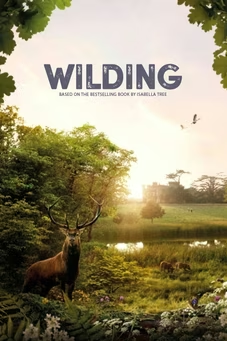
"Wilding" tells the story of a couple who bet on nature for the future of their English estate.












Support for PBS provided by: