Pressing Matters
Pressing Matters 101
Season 1 Episode 1 | 28m 40sVideo has Closed Captions
Water Quality, Microplastics, and AI in the classroom.
Water Quality, Microplastics, and AI in the classroom.
Problems playing video? | Closed Captioning Feedback
Problems playing video? | Closed Captioning Feedback
Pressing Matters is a local public television program presented by WCMU
Pressing Matters
Pressing Matters 101
Season 1 Episode 1 | 28m 40sVideo has Closed Captions
Water Quality, Microplastics, and AI in the classroom.
Problems playing video? | Closed Captioning Feedback
How to Watch Pressing Matters
Pressing Matters is available to stream on pbs.org and the free PBS App, available on iPhone, Apple TV, Android TV, Android smartphones, Amazon Fire TV, Amazon Fire Tablet, Roku, Samsung Smart TV, and Vizio.
Providing Support for PBS.org
Learn Moreabout PBS online sponsorship- Coming up on this episode of, "Pressing Matters," what's lurking in the water?
How new and old contaminants are putting lives at risk, and what's being done about them.
From the air we breathe to what we eat and drink, microplastics are everywhere.
Their impact on us and our environment just ahead.
Plus empowering teachers about using AI in their classrooms.
Those stories next on, "Pressing Matters."
(inspirational music) Hi, I am Stefanie Mills.
Welcome to "Pressing Matters," on WCMU Public Media.
With our beautiful great lakes surrounding us, thousands of inland lakes and numerous rivers meandering throughout here in Michigan, we have an abundance of freshwater, but in recent years, concerns over contaminants flowing in and their impact on our health and environment has forced leaders to take action.
Those contaminants include the manmade forever chemicals, PFAS and DDT.
While we're still learning more about them and their impact on our wellbeing, studies have linked them to conditions like kidney failure and reproductive issues.
Right now, Michigan is one of a few states that's taking an active role of testing for these chemicals.
It's not easy or cheap, but protecting this natural resource is critical, especially when our lives and livelihoods are on the line.
- PFAS is a surfactant, it's an anthropogenic surfactant, meaning human made soap sort of thing.
So it's a degreaser.
It's coming off your clothing, it's coming off your rain gear, your carpets, you name it.
These chemicals are really good at what they were designed to do.
The problem is they get into the environment.
If we test that water right there, it'll have some concentration of PFAS in there.
- [Stefanie] You can't see them or even really feel them.
They're tasteless, but they're in the food we eat, the water we drink, and in the air we breathe.
These toxic chemicals, including per and polyol substances, also known as PFAS, make their way into our water and soil through products like insecticides and are used in industrial and consumer items like non-stick dishes and things like waterproofing sprays.
While they've been around since the 1950s, it wasn't until early two thousands that concerns rose when PFAS began showing up in people's blood work.
- Yeah, I mean, that's quite recent.
It's still happening right now.
That's kind of the more concerning part is that what we don't know about that, and we're learning and we're trying to learn as quickly as we can.
At this point, it's brand new.
Mercury is huge, of course, DDT, PCBs and PFAS and PFOS up and coming, and those are kind of more concerning because we really don't know what they do.
- Good morning.
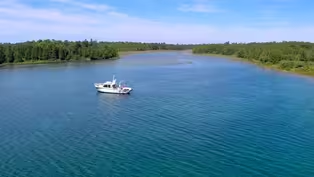
- [Stefanie] Don Uzarski is the director of Central Michigan University's Institute for Great Lakes Research and Biological Station on Beaver Island.
He leads the Great Lakes Coastal Wetland Monitoring Program for the US Environmental Protection Agency.
- We're basically sampling every coastal wetland in the base, and it's about 10 acres size and has a surface water connection to the Great Lakes.
So part of that study, it, you know, the expense is getting there and having the people on hand, but we could do other projects.
So we're doing this PFAS project where we're collecting zebra and quagga mussels.
And because each one of 'em, you know, these tiny little things filter a liter of water per day, there're really good indication of what is in that water.
So then we can take the tissue of those zebra and quagga mussels and measure PFAS in those.
And we're seeing a relationship with agriculture, of all things.
So the percent agriculture adjacent to the wetland is a good indicator of how much PFAS we'll find out.
But be careful, don't think cause and effect don't, you know, a correlation is not causation.
It is basically a relationship.
So we don't quite understand what that relation, why that is at this point.
But what we're doing is we're using that as a tracer of anthropogenic disturbance or human disturbance, human impacts to the ecosystem.
Because if we know it can only come from humans, it's manmade, right?
So when we detect that, we know that there are other contaminants there as well.
And it's just a sort of an indicator of all the disturbances that take place.
- [Stefanie] Identifying contaminated bodies of water in land sites requires a multi-agency effort.
In recent years, the state has seen a significant increase of these areas.
It's an issue not unique to Michigan, but one the state says it's taking very seriously.
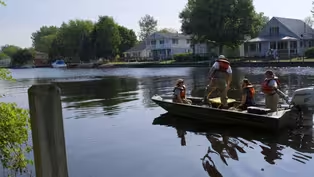
- We're out here collecting fish for the fish Contaminant monitoring Program, FCMP.
The site here is the Pine River.
We're gonna be collecting bottom feeding species like carp and suckers 'cause this is a DDT impacted site.
DDT was a pesticide that was banned several decades ago.
It still shows up in fish.
So we're just out here looking at trends.
And then we're also going to be collecting fish for the Michigan Department of Health and Human Services, MDHHS's Eat Safe Fish Program.
Everything we collect today will be tested for chemicals that build up to high levels in fish tissue.
So things like mercury, PCBs, DDT and PFOS, and as well as other PFAS.
- [Stefanie] This is the Pine River in St. Louis, home of one of the worst chemical poisonings in US history.
50 years ago, a distribution mixup here, sent flame retardant into the state food supply.
Eating fish from here is not allowed.
Crews with Michigan's Department of Environment, Great Lakes and Energy, or EGLE monitor water quality here, along with many bodies of water throughout the state.
They do so by testing the fish.
In order to catch them, the boat sends an electrical current into the water temporarily shocking the fish so they can be netted and carried on board.
- There's two goals for the FCMP Fish Contaminant Monitoring Program.
The first is to collect data that can be used by the Health department to issue those advisories.
So when we collect fish for that to meet that goal, we're only looking at the filet, the edible portion, just the portion of the fish that people are eating.
The second goal is to look at trends of contaminants over time and across the state.
So for those, for that program, we look at whole fish.
It's important to note that when we do test an entire fish, that data will not be used by the Health Department to issue those advisories.
- [Stefanie] Based on findings The Department of Health and Human Services can issue warnings, closures in advisories.
Now, it's important to reiterate that all parts of the fish are tested, including the filet.
Also, not all chemicals and contaminants build up equally in different types of fish.
- PFAS is a big thing with the state.
We do have a surface water monitoring program for PFAS.
That program's run by one of our toxicologists here at EGLE and they get to about four to five watersheds across the state every year.
So if they get a hit for PFOS, that's exceeds our water quality value, we would like to follow up the following year with, you know, fish contaminant monitoring.
10 years ago, we really didn't have a good grasp on, you know, how these chemicals were building up in fish tissue.
And so prior to us understanding, you know, we were looking at things like mercury that build up at higher concentrations in the, you know, higher trophic level fish, fish that are eating at the top of the food chain.
Things like walleye, lake trout.
- [Stefanie] Testing for specific contaminants requires specific testing conditions.
While CMU collects various water samples for certain contaminants in their labs, chemicals in the PFAS categories are sent to a dedicated lab out of state to be tested.
Understanding the contaminates polluting our waterways is critically important, especially because the Great Lakes are the largest fresh water system in the world.
- We're surrounded by water, we have wealth of water, and other states and countries don't.
And it's easy to take that for granted.
The more you have of a natural resource, the more you, you know, don't watch it.
But I think Michigan's really good at doing it, saying, no, wait a minute, we're gonna take care of this.
And that's what you're seeing.
And that's why we detect it everywhere, because we're looking and we're paying attention to it.
And when we do see a hot spot, we're trying to clean it up.
And we're trying to get those levels down to, you know, it's I hate to say acceptable concentrations of toxicants because there is no acceptable, but we reduce the danger and we set those limits at this is a low danger.
But you're gonna find the toxicants everywhere.
- Under the State's Safe Drinking Water Act, it lists what it considers safe limits for various contaminants.
According to WCMU, public radio guidelines for PFAS levels are reviewed routinely by the Department of Health and Human Services.
But because these forever chemicals are so new, there really are no known safe limits as researchers are still learning about them and their impact on people and the environment.
(calm music) Another threat to our health and waterways are microplastics.
These tiny particles are a growing concern because they're being found everywhere in our water, soil, and even in the air that we breathe.
So what exactly are they and why should we care?
Research on microplastics is still pretty new, but here's what we know.
They're small, less than five millimeters in size.
They can come from a variety of sources, including the breakdown of larger plastic items.
They can also be used in some personal care products.
And there's synthetic fibers that are released when we wash our clothes.
They're so small that they can be ingested by animals and can potentially enter the food chain.
To learn more about microplastics today, here is Dr. Amanda Suchy researcher with CMU's Institute for Great Lakes Research.
Amanda, thank you for being here today.
- Thank you.
- Amanda, you've spent a lot of time studying microplastics.
There's something that people have been aware of since the, I believe, the 1960s, but why is there such a sense of urgency now to understand them better?
- I think that there's a sense of urgency now because we're really realizing how prevalent they are and widespread.
I mean, we're finding them in places that we would consider untouched by people, right?
Bottoms of the oceans, tops of mountains.
And a lot of research previously had been done in oceans and in the past 10 years or so, there's been much more focus on fresh water.
And so we're realizing, oh, they're in the Great Lakes as well, and they're there in pretty reasonably large quantities or quantities that we make need to be concerned about.
- Right?
Right, so how do they get there?
How do they get into our ecosystems?
- Yeah, they can get there through a variety of different pathways.
So one common one, and this is how they get to places like mountaintops, is it's in the dust, right?
And so it moves in the air and can travel really far distances and then get deposited in places that might be far from the sources of those microplastics.
Another way that they can get into ecosystems, in particular aquatic ones like the Great Lakes is runoff during storms.
And so you have water coming down, flushing stuff into rivers, and that water carries things and it can carry microplastics into the rivers and ultimately end up in the Great Lakes.
Roadways and tire fragmentation are a source.
And then of course, as you mentioned, fibers from our clothing, washing machines ending up in our treatment plants that can discharge into the waterways as well, a lot of different ways.
- [Stefanie] That's something that I never would've even considered, right?
- I didn't until I was started researching this, as well.
Yeah, so.
- Absolutely.
Well, according to EGLE which is Michigan's Department of Environment, Great Lakes and Energy, there was a national study that found that the highest concentration of microplastics was found at the Apostle Islands National Lakeshore, in Wisconsin.
I'm pretty sure that's a very remote location, but why do you think that is?
- You know, I'm not really sure.
We don't really know, but I can say that we do see that trend beyond the Apostle Islands.
That Lake Superior compared to Lake Michigan and Lake Huron do seem to have more microplastics.
It's not completely clear why yet, and this is the case in terms of the sediments, what we find in the wetlands, and it doesn't matter how remote they are.
My most remote sites were in Lake Superior and had some of our highest concentrations.
- [Stefanie] Really?
- Yeah.
So it's definitely something that needs more work and better understanding.
- Absolutely.
So do we know what the impact of microplastics is on water quality and the life in the Great Lakes?
And of course, how does this affect us as people and our ecosystems?
- Yeah, so that's a big question and one that we don't have a very clear answer to yet.
As you've mentioned, the work on microplastics has really exploded in the past five years.
And despite that explosion, there's still so many unknowns.
And what people are trying to work towards is what is that threshold of effect, right?
When do microplastics become a problem?
But that can depend on the type of microplastic.
Is it a fiber or fragment?
How big is it?
Because if it's a big piece, an animal can ingest it and expel it, but if it's super, super small, it could be ingested and then translocate into different tissues in their body.
So move around.
And so the size matters and so we're talking about various types of effects that can be on, that microplastics can have on organisms.
One that's a bit more clear is we know that it can cause what we call food dilution, or they ingest microplastics along with food.
Their stomachs feel full, but they're not getting the same amount of nutrition that they would if that stomach was full of food and not partial microplastics.
Some were looking at the threshold of effect at that in aquatic systems that we have reached that.
And so we do have risk of food dilution occurring in aquatic organisms.
In terms of that movement of microplastics in throughout our bodies or toxicity that is still really, really unknown in terms of what that level of toxicity is.
- Sure.
- Yeah.
- But it's pretty safe to assume that a lot of people probably have a level of, or are consuming maybe unintentionally of course a level of microplastics, right?
- Absolutely.
Yeah.
And in terms of human effects, that is also very unknown.
Yeah.
And so the amounts that we are likely consuming on a day-to-day basis, as of now, we're not seeing much evidence that that's harm, but we still just know so very little, you know, general inflammation responses and such that could be caused by these types of things that are very hard to pin down.
- So what kind of research is there available right now about the impact on our long-term health?
Is it something that we're still studying?
- Yes, it's very much something that we're still studying and trying to understand.
- We did reach out to EGLE and they're also studying and monitoring microplastics, of course, but it comes with challenge.
So I'm gonna read a little bit from a statement that they sent us, they said that EGLE staff are continuing to follow current scientific literature on the topic of microplastics and nano-plastics in the Great Lakes.
Internally, they're considering appropriate methods for monitoring microplastics in the water.
And this is challenging when it compares to other pollutants.
So my question for you, after reading that is how do microplastics compare to other pollutants in the Great Lakes.
- Right now, I would say that other pollutants such as PFAS, and even when we talk about nutrient pollution like nitrogen, a phosphorus that cause those algal blooms.
One, we know a bit more about those, and I say that they're a bit more of an immediate concern, right?
They have those algal blooms are detrimental.
We know what causes them.
PFAS we know is very harmful and as in concentrations that we know can be harmful in the lakes, the microplastics is still an emerging concern and its concentrations may not be quite as high or of that level yet, which means we have a good opportunity to prevent that from happening.
You know, so another aspect with microplastics and other pollutants is how they might interact with each other.
So microplastics are sticky and so they can absorb or absorb these other pollutants onto them and potentially transport them elsewhere.
And so that's another thing that people are looking into is like, okay, is that a, an additional risk from microplastics if they're interacting with other pollutants like PFAS?
- So as we are trying to find a way to get a handle on this, do you think, you know, do you think legislation is something that can help manage this?
- Yeah, I think legislation could offer some help.
I mean, one of the primary ways that fibers get into the system is through the washing of our clothes and discharging of that into our treatment plants.
Simple filters on our washing machines could filter out a good majority of those particles.
So it's a really easy way to stop at the point source of that pollution discharge into the environment.
Whether that's legislation or people choosing to add those onto their washing machines and the reduction of single use plastics are always beneficial.
Anything that would prevent those from getting into the environment would reduce microplastics in the environment as well.
- Yeah, you're hitting the nail on the head here for my final question.
I was gonna ask, you know, what can we as people do now to try and reduce the amount of microplastics entering our environment?
Reducing single use, what else?
- Yeah, reducing single use plastics, using as much reusable items as you can.
Plastic has changed our world and will not go away and should not go away, but if we are able to change some of the items that we use, whether it's more cardboard in place of plastics where we can or make that choice use more reusable items, and if we're able to adapt our washing machines, those are the most immediate ways that we can start to reduce inputs into the environment.
- Well, microplastics are not going away anytime soon, but we can all do our part to reduce the amount that is circulating in our environment.
Dr. Amanda Suchy, thank you so much for being here today.
- Thank you.
(upbeat music) - [Troy] How are we gonna do it in a creative way that might actually encourage students to use AI, not as a crutch, but as a kind of collaborator.
- It used to be the stuff science fiction movies were made of, but artificial intelligence has now made its way into school classrooms, raising concerns, but also creating opportunities for educators and students.
By now, you've probably heard of sites and apps like ChatGPT, but it's not the only source that's changing the way we learn work and live.
K through 12 educators are beginning to be more open towards AI as a tool to enhance learning.
Still, it's not without challenges.
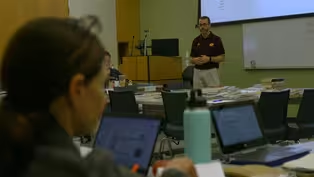
It's the middle of summer.
But inside this classroom at Central Michigan University are K through 12 teachers here to learn and share concerns about how artificial intelligence is transforming the world of education.
- We are just gonna clear the air, we are gonna get the gripes out, we're gonna make sure that we're acknowledging these concerns that you might have about AI and writing.
I don't want to overgeneralize or sound dramatic here, but you saw in the workshop, many of the teachers come into it, even if they feel like there might be some things I could use here, they're worried because they're learning about the tool.
They don't fully understand how the tool works.
Rather than just jumping right into the tool, let's think about what the writing process is, how we go about it, how do we connect it to teaching strategies that we already know and might be familiar with, and then show where we can plug in those AI tools to help kids elaborate or expand.
- [Stefanie] Much like how calculators changed mathematics, the age of artificial intelligence or AI is impacting everything we do say and learn.
Sites like ChatGPT took the world by storm in late 2022 with its ability to write things like full essays, reports, scripts, you name it.
The reaction from teachers and parents was immediate.
Fears of cheating, lack of creativity and loss of personal connections are just a few of the concerns dominating the dawning of this new digital landscape.
But for professors like Troy Hicks with Central Michigan University, instead of feeling negative, he's focused on possibilities.
- Are there concerns about cheating students using these tools in inappropriate ways?
Or the tools themselves either being biased or otherwise producing misinformation?
Yep, absolutely.
Unfortunately, students have always cheated and our technologies have always been biased and produce misinformation.
That is not going to change either.
So much like we teach students how to do critical website evaluation or to learn the next iteration of Google Docs, we're not gonna have to teach them about artificial intelligence.
And so I think by just putting that slight pivot on the conversation saying, I hear you, I understand that you've got some concerns about this, and yet at the same time you're using artificial intelligence, every time you ask your voice assistant, or every time you auto complete an email, these tools are here and they're only gonna become more embedded in word processors and the tools that our students are using.
How are we gonna do this in a productive way?
How are we gonna do it in a responsible way?
- ChatGPT, Sudowrite, Jasper, Writer, those are just some of the few writing tools available online now, you tell them what you want written and AI works by making statistical predictions branching off each word, depending on how specific you want to be or what you're hoping to learn, the AI can customize the results in a certain tone or voice.
Think of children's voice versus adult or specific grade level.
- We're thinking about ChatGPT, and we looked at some of the other ones, like Writer and Sudowrite and Perplexity.
And rather than just seeing them as tools that students might use for cheating, we were really trying to explore how teachers could intentionally, creatively use these tools to encourage students through the writing process.
From brainstorming, through drafting to revising and editing, and even potentially asking these tools to provide feedback on their writing.
- [Stefanie] Every second of the day the AI industry is rapidly enhancing the way it works.
Staying on top of those changes and finding ways to implement them is imperative for students and teachers.
- My thoughts, in fact, when ChatGPT first came out in December, I just said to my students right away, have you guys seen this thing?
Like, I wasn't hiding it.
Have you seen ChatGPT?
And some hadn't.
Some hadn't.
And so, what do you think we can do with this?
And they're like, I don't know.
What can we do?
So we played around with it.
So I like to have some, I like to take risks in the classroom a little bit, and then look at what in this case AI is doing or what we can do with it and listen to what students might want, think about it, and how it impacts their learning, how it impacts teaching.
So we kind of went that direction.
We played around with it in a lot of different sort of ways, but I think there can be a knee-jerk reaction to worry about maybe cheating and stuff.
But I also think too, that cheating has been around since forever, like stone and chisel maybe, right?
So it just changes over time.
And working with teenagers specifically, or really anybody, if you're open about it, they know that you already know about it.
So it kind of diffuses that ability or necessarily that idea to cheat.
- For teachers, like the example I was shown at the end, I think you just have to have a clear policy.
Say it early, say it often.
Here's what I believe about AI, here's how we're gonna use AI.
I'm going to model for you ways to use AI that I think are appropriate and useful.
- [Stefanie] As AI evolves and finds its place in education, it's clear that teachers and administrators must strike a balance between embracing new technologies and preserving the human element of education.
- In some ways, I don't think it's gonna change it too much.
I think it's another tool.
We like to think how original we are in all of our writing, however, writers use models all the time.
We look at something and gain inspiration from it.
If you look at any researched book, any of Troy's books, any of my books, they're not created in isolation.
Just look at the reference pages, right?
- We still want students to be thinking and writing and discovering, putting words into sentences, sentences into paragraphs, into poems and essays and stories.
That creative process is really energizing for many of us as writers and as teachers.
At the same time, we also want to have this conversation that says, our ideas don't just come completely randomly out of the blue, right?
Like, I didn't just suddenly think of the idea of a dragon and a wizard, or I didn't just suddenly think of the idea of magma and lava and igneous rock.
I had to read something.
I had to watch something.
Somebody told me something about this.
I've read lots of stories, watched lots of TV shows.
My ideas got sparked from something.
Now then what you do with it, how do you ask deeper questions?
Where do you get more research?
Who do you talk to?
How can you use these tools to continue your own inquiry and become more curious, more intelligent, more thoughtful about your own understanding of these concepts or your own work as a creative writer.
- AI is not 100% accurate.
When it generates something that's not true, it's called the Hallucination.
As far as concerns of plagiarism, there are companies who say they can detect it, but Professor Hicks says it's still questionable how well that works.
Regulation of AI in the US is still in the early stages, but there are existing laws that include aspects like privacy and security.
Well, this concludes tonight's presentation of "Pressing Matters," here on WCMU Public Media.
The stories and interviews you watched will be available online and our website.
We'll be back soon with another edition of "Pressing Matters."
Good night.
(calm music)
Artificial Intelligence in the Classroom
Video has Closed Captions
Clip: S1 Ep1 | 6m 55s | Artificial Intelligence in the Classroom (6m 55s)
Video has Closed Captions
Clip: S1 Ep1 | 9m 20s | Exploring microplastics in our water (9m 20s)
Video has Closed Captions
Clip: S1 Ep1 | 8m 41s | Water Quality and PFAS in Michigan's water ways. (8m 41s)
Providing Support for PBS.org
Learn Moreabout PBS online sponsorship
- News and Public Affairs

Top journalists deliver compelling original analysis of the hour's headlines.

- News and Public Affairs

FRONTLINE is investigative journalism that questions, explains and changes our world.












Support for PBS provided by:
Pressing Matters is a local public television program presented by WCMU