Washington Grown
Resilience in Bloom
Season 13 Episode 1307 | 26m 46sVideo has Closed Captions
We visit the Wenatchee and Leavenworth region—where mountain beauty meets orchard bounty.
We visit Bountiful Orchard to see how Washington’s famous pears are grown with care and innovation, and learn from the Cascadia Conservation District how fuels reduction and wildfire resilience are protecting farms and forests alike. At Rail & Station, we cook up an amazing salmon orchard dish, then stop by McGlinn’s Public House to try their unique blueberry pizza.
Problems playing video? | Closed Captioning Feedback
Problems playing video? | Closed Captioning Feedback
Washington Grown is a local public television program presented by KSPS PBS
Washington Grown
Resilience in Bloom
Season 13 Episode 1307 | 26m 46sVideo has Closed Captions
We visit Bountiful Orchard to see how Washington’s famous pears are grown with care and innovation, and learn from the Cascadia Conservation District how fuels reduction and wildfire resilience are protecting farms and forests alike. At Rail & Station, we cook up an amazing salmon orchard dish, then stop by McGlinn’s Public House to try their unique blueberry pizza.
Problems playing video? | Closed Captioning Feedback
How to Watch Washington Grown
Washington Grown is available to stream on pbs.org and the free PBS App, available on iPhone, Apple TV, Android TV, Android smartphones, Amazon Fire TV, Amazon Fire Tablet, Roku, Samsung Smart TV, and Vizio.
Providing Support for PBS.org
Learn Moreabout PBS online sponsorship- "Washington Grown" is made possible by funding from the Washington State Department of Agriculture and the USDA Specialty Crop Block Grant program, and by the Potato Farmers of Washington.
Learn why Washington is home to the world's most productive potato fields and farmers by visiting potatoes.com.
- Hi everyone, I'm Kristi Gorenson and welcome to "Washington Grown" North central Washington is known for its world-class pears, but in recent years, this same area has faced some challenges with wildfires.
In this episode, we're gonna look at how innovation and wildfire resilience are protecting farms and forests alike.
Val's thinning pears at Bountiful Orchards.
- You can start this week if you want.
[both laughing] - And I'm making orchard salmon at Rail Station & Ale House in Wenatchee.
- My kitchen manager left me a special knife just for you to cut this pear.
So, there you go.
- Ah!
[Kristi laughing] - We're gonna have you go ahead and just slice that up nice and thin with that.
- Right, no problemo.
Then Val's learning how a conservation district is protecting forests from fires.
- We need to learn how to live with fire in these parts of the country.
- All this and more today on "Washington Grown".
[upbeat music] Cooking with Kristi.
Sweet Pete.
- Jiminy gee willickers.
- Watch my bangs.
Go big or go home.
- Ah, right in my eyes.
You made me a believer.
Oh, I'm making a mess.
- Oh, Val, I love you.
- Heaven on a plate.
That's yummy.
- We're gonna get a to-go cut for these.
- Yeah.
- You keep talking, I'll keep eating.
Here in Wenatchee, one historic building is returning to its roots.
Back when it was built in 1906, this building was a fruit warehouse, and today, they're bringing Wenatchee's bounty to the people as Rail Station & Ale House.
Delicious and unique flavors are delighting guests, but you don't have to take my word for it.
- The menu's huge.
So, I mean, there's something on the menu for everybody.
- Something about the flavor, the consistency to the whole plate, the presentation, and there's always enough leftover for later.
- It's delicious.
- We do a little bit of everything I guess you'd say.
- Owner and chef Todd Mill knows that people love a good pizza or a steak, but he also likes to create more unique and interesting dishes to scratch that creative itch.
- Most of my best dishes happen in the middle of the night.
I got it.
I have to wake my wife up and she goes, "That sounds disgusting.
You'll have to prove it to me."
- Okay.
- But it's just weird things that click in my mind all the time trying to put strange flavors together and do different stuff.
- I love coming here.
I've been coming here for years.
- Kind of a family-oriented place.
People having a good time, some live music, maybe some things going on behind the bars.
- You need to get your [beep] down here.
- I was, you know, 09:00 to 05:00 chef with a tie, you know, and a folded over thing and not really cooking much except in the test kitchen.
We decided, you know, let's go back to basics where I can do stupid crazy things that I come up with in the middle of the night and- - Give 'em a try.
- maybe you win 20 bucks if it sells.
- There you go.
That's awesome.
Don't miss later in the show when Chef Todd and I make Rail Station's orchard salmon.
Watch my bangs burn.
- Fire in the hole.
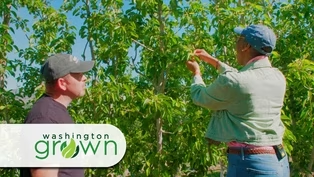
[Kristi laughing] [upbeat music] - Out here in Monitor, Washington in the springtime, the trees are barely showing signs of fruit, but you don't name a place Bountiful Orchards for nothing.
Pretty soon these trees will be bursting with pears.
Today, orchardist Blaine Smith is showing me how he's changing things up to help his trees produce fruit quicker.
- So, there's that phrase, pears for your heirs.
And typically, it takes like 12 years to get into full production with a pear tree.
These trees here are about two years old and you can see that some of 'em have hit the top wire here, which is what we're hoping to do.
That's really critical, because we'd like to have fruit at three years.
One of the things that we're using is the strings to hold the branch still to let it grow.
If you move this thing, it's very weak, because it's not using a lot of energy to hold the branch still.
It's using most of its energy to grow.
We're used to these big trees that have, you know, limbs that are quite large.
- Right, real stocky.
- On these, we can kind of help control the bugs in here a lot easier with way less chemicals.
The biggest thing we farm is light.
So, we're trying to keep a really good amount of light interception in here.
- Okay.
- That helps develop the buds, helps grow the fruit.
So, there's a lot of different things we're trying to balance.
And one thing that's interesting with trees is they have hormones just like we do, and the hormones want to go to the the highest point.
So, if I bent this thing over- - Bent over.
- it would start growing wherever the highest point is.
- Here, okay.
- Because that hormone will flow to the highest point.
- Highest point.
I just love these little tiny baby pears.
They're just cute.
[both laughing] Now, Blaine is taking me to a five-year-old block of his orchard.
- So, we're getting to that point where we're starting to reach a full crop.
And so, we're gonna start using the fruit to slow the tree down.
So, this fruit will get heavy and throughout the summer it'll start to pull down.
- Okay.
- And that hormone response of the branch changes and it'll start to develop more buds back here.
And that'll help the tree slow down.
And help us create more fruit in the future.
- Okay.
- I'm just trying to change what we always have thought we could, you know, do to reach better quality fruit with better yields that are more sustainable, less chemicals, less water.
It's fun trying new things, you know, it's a challenging industry, but this actually makes me very excited.
- Well, I say you're doing a really good job, 'cause I see the growth and the evidence.
Now, I know what to look for in a pear orchard.
At this time of year, Blaine and his crew are doing something called thinning.
That means breaking off some of the buds.
so the trees put energy into making bigger pears.
- You think it's wasteful, but you actually get a bigger, more beautiful piece of fruit.
- Okay, okay.
- And you actually, get better yields.
- I love that perspective.
- Yeah.
Consumers like a beautiful, perfect piece of fruit.
And that's what we're trying to give 'em.
For thinning, like I said, we just wanna separate the space between the pears a little bit, that gives them enough leaf to help grow the fruit.
Our guys come through and kind of try to select the biggest pear to save.
- So this would be the saver, correct?
- Yep, that'd be a good one.
- All right.
- And then you can just use your thumb and kind of just push off the ones that you don't want down at the base there.
Just kind of snap 'em off down here at the base.
Just push 'em.
- I'm gonna get rid of that one.
- Yep.
- Ooh, bye-bye, baby.
And I'm sure once you get the hang of this, it's bang, bang, bang, but I don't have the hang of it.
- Yep, perfect, amazing.
- A lot of pressure.
- You can start this week, if you want.
[both laughing] [upbeat music] - Hey, everybody.
Anna-Lucia and I are here in the Cascade Mountains right in the middle of blustery October.
It is gorgeous up here in the fall.
And you know, just because you're around hiking in the woods doesn't mean that you still can't have a lunch with good Washington-grown ingredients.
Isn't that right?
- Yeah, I'm hungry.
- Okay, well, me too.
So, we packed ourselves a sack lunch full of Washington goodies.
So, let's see what we got.
Okay, Anna-Lucia, so here are our sack lunches full of Washington-grown ingredients.
So, what do we got here?
- We have some Tim's Cascade-style chip.
- That's right.
And Tim's was based out of Auburn.
So, those are local guys right there.
You've got jalapeño I see.
- Yeah.
- I went with original.
All right, what else we got?
- My favorite apple juice.
- Oh yes, we got Tree Top apple juice right out of Selah.
So, there's a good friend of ours.
- Some Beecher's cheese sticks.
- Oh yes, indeed.
Beecher's one of our favorite cheeses, and they do make individual cheese sticks, so we can't go without one of those guys.
- We have some sandwiches.
- We got some sandwich, some turkey sandwiches with some Shepherd's Grain bread right there.
- We've got some baby carrots.
- Yeah, these guys are actual from Herschel Heritage Farms located close by to where we live, so that's pretty cool.
And then, of course, we got a beautiful D'Anjou pear right out of the Yakima Valley.
Well, we're gonna fuel up, get our bodies nice and nourished and then we're gonna get back on the trail, because there's incredible sites around here during the fall and we can't wait to see 'em all, right?
- Yep.
- All right.
We will see you guys next time.
[gentle upbeat music] - Washington and Oregon are major pear-growing regions in the US.
What percentage of pears do we grow here?
I'll have the answer for you right after the break.
- Coming up, I'm making orchard salmon at Rail Station & Ale House in Wenatchee.
- My kitchen manager left me a special knife just for you to cut this pear.
So, there you go.
- Ah!
[Kristi laughing] - We're gonna have you go ahead and just slice that up nice and thin with that.
- Right, no problemo.
Then Tomás is trying a blueberry prosciutto pizza at McGlinn's Public House.
- I did not think this was gonna work, but it is working.
- It is.
- It's perfect.
[gentle upbeat music] - Washington and Oregon grow close to 90% of the fresh pear crop here in the US.
[upbeat music] - We're back in Wenatchee at Rail Station & Ale House.
Live music, a unique historic setting, and amazing food all come together to create a night to remember whether you're on a date or just hanging with some friends.
- It's a great vibe.
- It's one of those places where you wanna have a good experience and then you come back.
- With the fireplace, the live music, the lights of the bar kind of feels like you're kind of home.
- You know I like to come to work.
I get to see smiles, I get to see people thank me.
- Owner and chef Todd Mill enjoys seeing happy customers.
And when the food is made with such incredible local ingredients, there's no way anyone's going home without a smile.
- At the end of the day, I'm just a service guy.
It gives me pleasure, it fills me to feed people to be honest.
- You know, you get more asparagus in the winter, you got potatoes less than 30 minutes away.
Like, it's just great to have a lot of local produce and be able to support the local farmers.
- Just pay attention to what we have right here.
The northwest has a bounty of beautiful things.
And we spend too much time talking about what we don't have when we have so much that other people want.
Apple capital of the world, right, Wenatchee?
- So you and I get to cook today.
What are we gonna make?
- We are going to make what I call orchard salmon.
It's a fresh king Chinook salmon from Washington state that we got in yesterday.
And we're gonna pair that with some of our local fruit and some other fun flavors.
I think you're gonna enjoy it.
- Sounds delicious.
Okay, I can't wait.
Cheers.
- Cheers.
Let's get cooking.
- Look forward to it.
We have a very special guest today.
- It's the king.
- It's the king - Chinook salmon.
- Okay.
- It's so forgiving, because it's got such high fat content that, I mean, really it is the favorite for the home cook.
- Ooh, and you're so lucky to be surrounded by all of this.
- Yeah, yeah, you tend to forget about it, but every now and then you realize how lucky you are.
- Yeah, okay.
Well, thank you for all that you've done for us.
- The king.
- We're going to eat you a little bit later.
- These are local D'Anjou pears from Pirus Orchards, who's through Blue Star Growers.
- Perfect.
I'm gonna do it my way.
You do it your way.
- I won't judge.
- You do it you're fancy schmancy.
- There's no fancy way I don't think.
My kitchen manager left me a special knife just for you to cut this pear.
So there you go.
- Ah!
[Kristi laughing] - We're gonna have you go ahead and just slice that up nice and thin with that.
- Right, no problemo.
- Just kidding.
- I need to be a little bit taller.
- I wish I was a little bit taller.
- I wish I was a real brick.
- I wish I was a baller.
- We season the salmon with some salt and pepper.
Then it's time to put them in the oven.
- Yeah, this is a Himalayan salt block.
Some people say that they get the salt flavor in it.
I've never really noticed it, to be honest with you, but I like cooking on it.
- But you like cooking on it, and it just sizzles away.
Next, we coat the pears in some balsamic vinegar and honey.
Then they go in the oven to roast.
This next step looks like fun.
What are we gonna make?
- We are gonna make the apple fennel butter.
- Apple fennel butter.
- These are Sugar Bee apples from Chelan Fresh.
Got a nice sugar content in the skin that caramelizes well for us.
- A butt load of butter.
- Butter.
- A lot of butter.
- You wanna cook this thing?
- Yeah, let's do it.
- Let's do it.
- I'm always impressed with the pros knife skills and how these are just so... - That took probably 18 hours for me to do.
- Perfect and tiny.
- Yeah, and I realized when I was doing it, 'cause I was doing it mindlessly that it's going into a food processor afterwards.
I could've literally smashed it with a mallet, stuck it in there.
- Oh well, they look beautiful.
- Yeah.
- We brown the butter with some fennel and about half the apples.
Then time for a secret ingredient.
- Secret ingredient.
- Secret ingredient.
- Just to give us that extra caramel touch.
- Watch my bangs.
- Fire in the hole.
- That was awesome.
- Like I did that just for you.
- We put the rest of the butter and the cooked apples into the food processor and blend it up.
Then we add some chopped fennel frond and some of the uncooked apples.
Very good, I can't wait.
I'm getting hungry.
Are you getting hungry?
- Sure, actually I'm hungry.
Yeah, I meant really not for the show.
I'm actually getting hungry.
[gentle upbeat music] So, what do you say, Kristi, you ready to try it?
- Oh yeah.
- Let's do it.
- I've been ready.
I've been ready since you brought out all of the- - Ever since we started.
- all of the raw ingredients, yeah.
[upbeat music] Delicious.
I'm doing the happy dance.
Super rich salmon flavor, but then I get the sweet from the balsamic.
- Yeah.
- A little crunchy from the pear and the richness of the butter.
- But it just finishes off, right?
- It does.
- Yeah, it opens up in your mouth and you get that little bit of anise is what you can't place.
To me, it's just good.
- Just good.
- We're not wine tasting here.
I'm not getting a little bit of black currant in the back of my throat.
It's got a jammy.
- Washington grown, local.
- Everything's better with butter.
- Everything's better with butter.
And I'm gonna keep eating, because that was a really good bite.
- Cheers.
- Cheers.
- My son always does that.
- For this and other recipes for the home chef, visit us at wagrown.com.
Coming up, Val's learning how one conservation district is protecting Wenatchee forests from forest fires.
- We need to learn how to live with fire in these parts of the country.
[upbeat music] - If you're looking to freshen up that tired old pizza order, then McGlinn's Public House in Wenatchee might have just what you need.
Using locally-sourced ingredients, manager Ashley Watson and her team are creating unique and flavorful blends between meats, cheeses, and even blueberries.
- You come into McGlinn's, it's super colorful, super playful, like I wouldn't necessarily say we're like a hippie style, but we kind of are.
I mean, people, we got farm to table food here.
I mean, we make everything here almost from scratch.
- So, what was the inspiration behind the blueberry prosciutto?
I mean, you know, you hear pineapple and pepperoni, that's, you know, so salty and sweet.
So, I guess, is that kind of a take on that?
- Yeah, I mean, Jaime is the kitchen manager and he's like, "Honestly, I just kind of wanted a twist."
He had thought about it and he was like, "Well, let's just try it out."
- I hopped into the kitchen with Caden see what all goes into this unusual pizza.
We start with hand-tossed dough.
- Hopefully, I don't drop it.
- On my face.
- It happens.
- Lay down a pesto base, some mozzarella, and then add some fresh dandelion greens tossed in a balsamic reduction.
Ashley said that this wasn't a hippie place, but it kind of is, right?
- You know, I've heard both ways.
- We add prosciutto, caramelized fig and onion then top it with even more cheese before this special creation goes in the oven.
When that comes out, that's when we hit it with the secret weapon.
- Yeah, the blueberries.
- Okay.
- The important part.
- All right, Ashley, check it out.
Look what Caden and I just made.
Well, Caden made it, I watch him.
I love it when we can look at something that we would deem non-traditional, you know, because when I think of blueberries, I'm not thinking about pizza.
I do not think this was gonna work.
- I know.
- It is working.
- It is.
- It's perfect.
- One of my, I mean, and that's why this is one of my favorite pizzas, because everything about it just somehow you get a great bite no matter where you're at.
- I love how savory it is.
I love how sweet it is.
- Yeah.
- And that crust in that wood fire grill, that's perfect.
- Perfect.
- But what do the locals think about this unique and flavorful pizza?
- The prosciutto you kind of expect, right?
The blueberries have this sweet thing going on.
- Yeah, - that you don't expect.
- It actually really good.
- Okay.
- Got the cheese, blueberry.
- You weren't expecting it.
- Yeah, I thought it was gonna be really weird.
- Yeah, it's kind of a delightful thing.
I'd have it again on purpose.
[gentle upbeat music] - Near Leavenworth, gorgeous acres of forest blanket the landscape.
But as the summer heats up, everyone worries about one thing, fire.
But keeping a forest safe from fires is a complicated task and landowners can't do it by themselves.
Luckily, there's a network of professionals that can help.
- Our mission is to provide technical and financial resources to private landowners to help them steward their natural resources.
- Patrick Haggerty works with Cascadia Conservation District.
He explained contrary to popular belief fire is not a bad thing for a forest.
It just can't be too severe.
- These forests are really fire-dependent forests, naturally.
So, these ecosystems have evolved over thousands and thousands of years to really depend on fire coming through these landscapes.
This is an example right here of a fire-scarred ponderosa pine.
We can see that this tree that was born back in 1809, it had a fire coming through every 10 to 15 years.
Now, for a lot of reasons over the last 100 years, our forests have really changed.
A lot of 'em look a lot more dense.
Historically, when we had these kind of low severity wildfires, they were moving through the understory of well spaced out forests in eastern Washington.
There was a lot of benefits to that fire to the soil.
And so, there's natural nutrient cycling that occurred.
More and more we're seeing fires that are larger scale.
- And we always joke that the, you know, the Forest Service is in the Department of Agriculture, so it's just really big carrots.
- Yeah.
Andrew Home is the director of operations at the Tierra Learning Center, which is where we are today.
As a public charity focused on empowering people with disabilities, it's important for them that their land remains safe for the people who live and work on it.
That's why they've partnered up with the Cascadia Conservation District.
- It's an education.
You look and you're like, "Oh, that's just how the forest is, right?
- Right.
- Gosh, what's that gonna look like in another 50 years?
Then it's gonna be really dense and that's not gonna be healthy.
- And you can imagine, if fire was running through that area, it would be likely that it might get up into the trees, into the crowns, and have a crown fire.
And over here where they've done some thinning work with the help of Cascadia Conservation District, it's likely that the fire could stay on the ground and not come up into the crowns of the trees.
- You think about this forest stand, that's too thickly stocked, right?
It's like your carrot patch.
It's got too many seedlings, right?
You always want to throw more down, because you just want all come up.
- And then you have to pick 'em all up, so it's the same idea as pulling trees out.
The trees that are left are able to become more vigorous, right?
They've got more moisture, they've got more nutrients, therefore they become healthier trees.
- Conservation districts can be a great resource for landowners after a fire.
We've worked with a lot of grazing producers, for example, to help replace fence after, a that's been lost to a fire.
We work with a lot of private landowners to do like seeding projects or erosion control projects after a fire, particularly in critical areas.
These are fire-adapted ecosystems.
We're always gonna have fire.
Fire prevention's important.
Most fires are started by humans, but we need to learn how to live with fire in these parts of the country.
[upbeat music] - Washington's history has been defined by how it manages water.
Visionary infrastructure, forward thinking laws, and cooperation have made Washington's farmland some of the best in the world.
The roots of water management in Washington trace back to a time when water use was largely unregulated and based on informal claims.
In the late 1800s, settlers in the Wenatchee Valley began diverting river water through ditches and canals, transforming arid land into orchards.
By the early 1900s, canal companies expanded irrigation across thousands of acres and mid-century investments modernized those systems with pipelines and improved efficiencies.
Today, irrigation in the valley is managed through a mix of public and private entities, including irrigation districts and the Chelan County PUD, which works to balance agriculture, residential, and ecological water needs.
The region's longstanding investment in irrigation has enabled it to remain one of the nation's premier fruit-producing areas.
Similar efforts unfolded across central Washington connecting local canal systems with large federally-backed irrigation networks.
One of the state's most monumental is the Columbia Basin Project.
The Columbia Basin Project, authorized in 1943, diverts water from the Columbia River through a vast canal network that irrigates over 670,000 acres of farmland.
- This project is in an area that is really a desert, 10 inches of rainfall or less.
So, if you went to places in the west where you saw that type of rainfall, you'd see a desert.
Well, in our case, we've been able to add the magic ingredient, which is water from the Columbia River.
And this is a large river.
The Columbia Basin Project uses less than 2% of the flow of the Columbia River, and it's made the landscape bloom.
And so, with the very fertile soils that were available with the water, we've been able to turn the region into an oasis.
We grow a lot of crops in the state of Washington that we couldn't grow for the lack of irrigation.
And on the Columbia Basin Project, well over 200 crops are produced on an annual basis, some with very large acreages, some with very small acreages, but the ability to have water resources, the soil resources, and the climate resources, the very long days that we have here in the Northern Hemisphere create a perfect environment for tremendously diverse agricultural production.
- Its network includes over 300 miles of major canals, around 2,000 miles of laterals, and 3,500 miles of drains and wasteways.
Though massive, the project remains only partially complete.
More than 300,000 acres still lie eligible for development.
- There's still work to be done, and the folks in the area recognize that water supplies from the Columbia Basin Project are something they can bank on.
There's good certainty surrounding them from now and on into the future.
- Farmers are also adopting advanced technology to use every drop more efficiently.
- Over 90% of the farmland in the Columbia Basin Project is irrigated through some sort of advanced irrigation technology.
What you see a lot are the center pivots that deliver water.
Farmers can be very precise with their water deliveries with that kind of technology.
- In south central Washington, the Yakima Valley stands as one of the state's oldest and most complex irrigation systems.
Launched in the early 1900s, the Yakima Project transformed a dry river basin into one of the nation's most productive farming regions.
A series of reservoirs high in the Cascades feed hundreds of miles of canals that deliver water across the valley's orchards, hop fields, and vineyards.
More than a century later, the project still sustains nearly half a million acres of farmland, along with the towns and communities that grew around it, but it also faces new challenges, aging infrastructure, changing snow pack, and growing competition for water between farms, fish, and cities.
Today, a broad coalition known as the Yakima Basin Integrated Plan is working to balance those needs to secure the future of water in the valley.
Today, Washington continues adapting to climate change, population growth, and conservation needs.
Modernization efforts from investments to collaboration reflect a legacy of innovation that will guide the future of water in the state.
- Farmers and conservationists in north central Washington are working together to keep farms and forests thriving for generations to come.
That'll do it for this episode of "Washington Grown" We'll see you next time.
 New
NewReslilience in Bloom | Preview
Video has Closed Captions
Preview: S13 Ep1307 | 30s | We visit the Wenatchee and Leavenworth region—where mountain beauty meets orchard bounty. (30s)
Providing Support for PBS.org
Learn Moreabout PBS online sponsorship

- Food
Christopher Kimball’s Milk Street Television
Transform home cooking with the editors of Christopher Kimball’s Milk Street Magazine.








Support for PBS provided by:
Washington Grown is a local public television program presented by KSPS PBS