
Saving Tangier Island
Season 23 Episode 7 | 55m 15sVideo has Closed Captions
Scientists race to save the historic island on the Chesapeake Bay from rising sea levels.
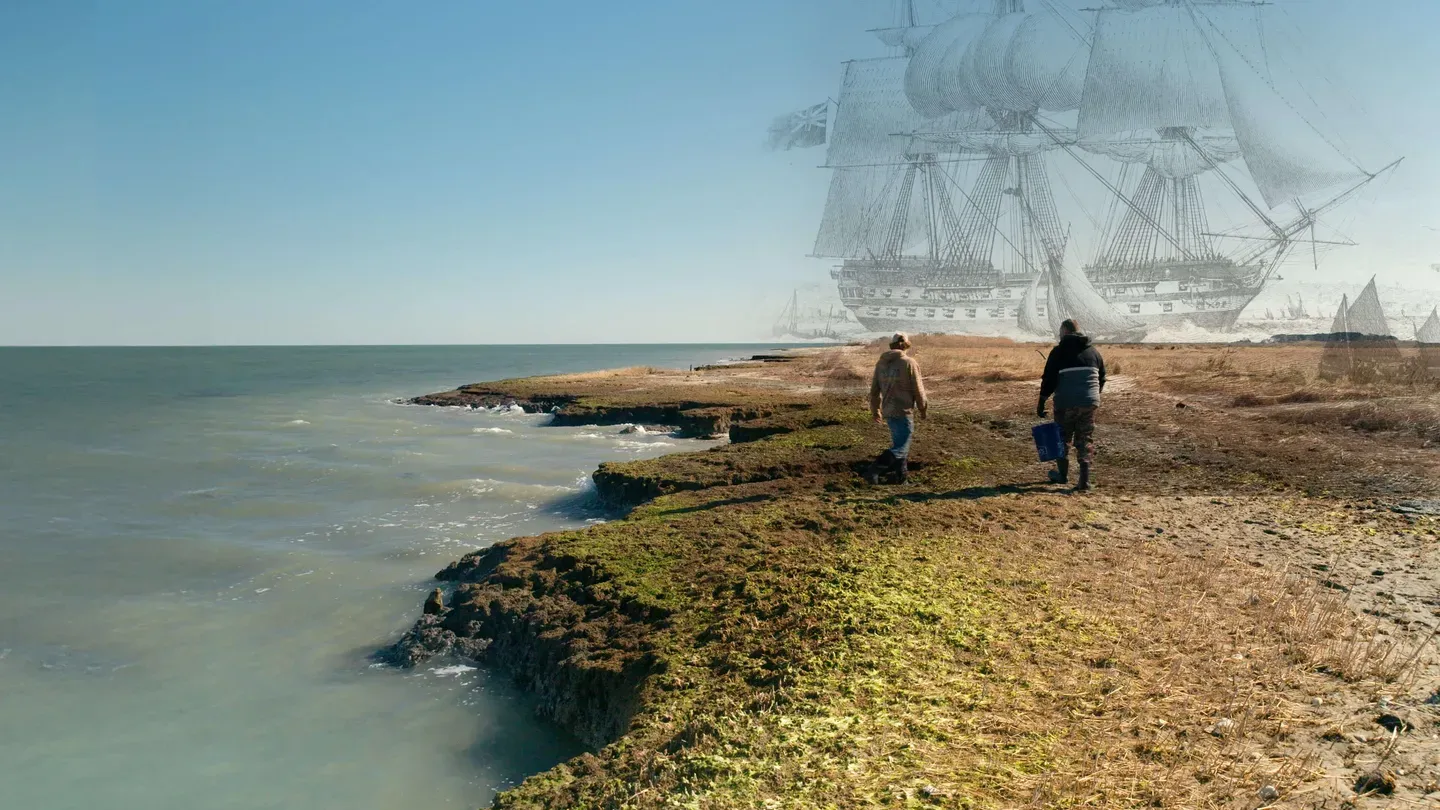
Welcome to tiny Tangier Island in the Chesapeake Bay. Pivotal in the War of 1812, it's where Francis Scott Key was inspired to write "The Star-Spangled Banner" and where hundreds of self-emancipated men joined the British to take up arms against their former masters. Now, rising sea levels threaten the island, and the race is on to ensure Tangier will remain a witness to American history.
Problems playing video? | Closed Captioning Feedback
Problems playing video? | Closed Captioning Feedback
SECRETS OF THE DEAD is made possible, in part, by public television viewers.
Saving Tangier Island
Season 23 Episode 7 | 55m 15sVideo has Closed Captions
Welcome to tiny Tangier Island in the Chesapeake Bay. Pivotal in the War of 1812, it's where Francis Scott Key was inspired to write "The Star-Spangled Banner" and where hundreds of self-emancipated men joined the British to take up arms against their former masters. Now, rising sea levels threaten the island, and the race is on to ensure Tangier will remain a witness to American history.
Problems playing video? | Closed Captioning Feedback
Where to Watch Secrets of the Dead
Secrets of the Dead is available to stream on pbs.org and the PBS app.
Buy Now
Providing Support for PBS.org
Learn Moreabout PBS online sponsorship♪♪ -Tangier Island, 12 miles off the coast of Virginia, is sinking.
-What if someone said to you that where you've lived for 200 years, your family, it's no longer going to exist?
-That's 4 feet of land loss right there in this last storm.
-Rising sea levels are swallowing the island and threatening to erase a centuries-old way of life.
-It's already concerning.
I mean, we've lost five or six other communities north of here.
I doubt they could imagine that, one day, their community would be underwater.
-This very well could be, you know, a human bone.
-Along with the island's unique culture, an untold chapter of history is slipping away.
-A lot of the slaves were granted their freedom on Tangier Island long before the Civil War.
I'm very proud of that part of our history.
-In 1812, the United States declared war on the British Empire.
African-Americans escaped from American slavery and joined the British forces.
-Freedom would be available to any black people who fought for the cause.
-The strange thing about it is that not that many people know about it.
That's what is so sad.
-So everything is underwater.
-As Tangier washes away, so does a little-known moment in black history.
-It is like a metaphor for what has happened to the black story.
The island itself, so much of it has disappeared into the ocean.
So has the story just disappeared into the ether.
You'll see there are 10 enslaved people living... -Here.
-...here.
-Now descendants of Tangier's black soldiers are stepping forward to reclaim their past.
-That's very significant to me to know this.
My heart is full of joy.
-We're related to a legend, and that's incredible.
-Whoa-ho!
-Wow!
-A race is under way to save the island and its disappearing history.
-You could do extensive reef restoration.
We could simultaneously protect the past and the present so that the people here have a future.
-Our black brothers and sisters are buried there.
-To lose Tangier Island would be a final erasure.
-Tangier is sacred ground because of the individuals who sacrificed so that they could be free.
♪♪ ♪♪ -Lying in the middle of Chesapeake Bay, Tangier Island is small -- less than 1 1/2 square miles.
And it's isolated, accessible only by boat.
The majority of the island's 300 inhabitants can trace their roots back for generations.
-My name is James Wyatt Eskridge, but I go by the nickname "Ooker."
I used to have a pet rooster when I was 3 or 4 years old, and I tried to crow like the rooster, and that's sort of how it came out.
Come on, Bella.
Come on!
Born and raised here.
Been here 67 years.
Also the mayor of Tangier Island.
It's a two-year term, but after this term, I'll be in for 20 years.
See this guy here?
It's a pet.
Summertime is his name.
He's been coming for nine years now.
Hangs out on the boat out here, and he's soon going to head for Florida.
I feed him all the summer, and he leaves.
He's going to get that one.
There he goes.
-Most people on Tangier, like Mayor Ooker, make their living on the water.
-My father was a crabber, grandfather, great-grandfather.
My older son's a crabber.
Yeah, it's all about the seafood.
That's what keeps the ball rolling out here.
Bella, stop eating our bait!
Stop it!
You're gonna eat all of our bait.
Myself and the community living out here, we love what we do.
All in all, it's a wonderful life.
♪♪ -This is a tight-knit community, and they're fiercely protective of their way of life.
-What a blessing, Lord, that you have bestowed on us to be able to come together in fellowship.
-It's a good place.
There's some good people here.
I mean, everybody look out for everybody.
All the kids can run around and go all over the island.
-Yeah, we have a lot to be thankful for.
-I feel very proud of being a Tangierman, as we call it.
-I do, too.
-On Tangier, the dead remain close to the living.
Loved ones are buried alongside people's homes, most of them aboveground, due to the threat of flooding.
-A lot of people just likes to bury 'em right close.
There's both of my parents buried right there.
-That whole place there is all our family.
-Tangier Island's storied past stretches back hundreds of years.
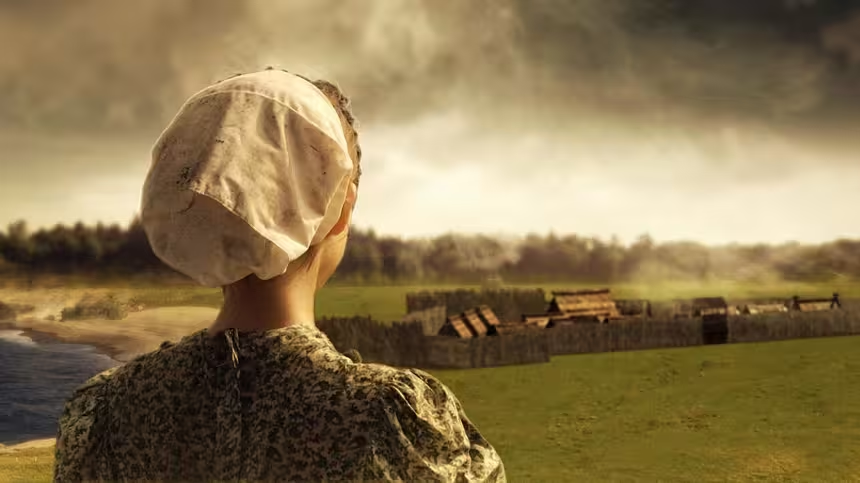
Surrounded by the warm waters of the Chesapeake, Tangier sits perfectly between the eastern shore of Virginia and the western coast of Maryland... a prime location for a long line of people who have lived off the ocean, from the indigenous inhabitants who thrived here before the 17th century, to the first European settlers, who arrived in the 18th century.
Now this unique way of life is in jeopardy.
-Tangier Island and all its culture and history are on the verge of being lost due to being washed away and essentially drowned.
The sea level has been rising.
And over the last, say, 150 to 200 years, there has been an acceleration of that process.
-Marine ecologist Dr.
Russell Burke is in a race to protect what's left of Tangier Island.
-What if someone said to you that where you've lived for 200 years, your family, not only do you have to move, but it's no longer going to exist?
And this is our chance to show what we're really made of.
Is this worth saving?
Are they worth saving?
-♪ Thank you, Lord, for saving my soul ♪ ♪ Thank you, Lord, for making me whole ♪ -Good morning.
-Morning.
-Good to see you, Captain.
-You, too.
You ready to go out?
-Oh, yeah.
-Dr.
Burke is determined to help save this village... and meets up with local environmentalist and activist Cameron Evans to see the remains of a community already lost to rising sea levels.
-So, right where we're at in the boat now, you know, used to be land.
I'd say not quite this far, but close to it, I remember land.
I remember it used to be hunting lodges here after, -I guess, in the '80s, '90s.
-Yeah?
-And I remember three trailers here, riding lawnmowers.
The whole cemetery was intact.
And I've watched it all wash away just in my short lifetime.
I'm only 25.
-Right.
-All of these shorelines had trees.
See, here's part of sediment that's broke away.
That's 4 feet of land lost right there in this last storm.
-Yeah, in one shot.
-Here's one of the bricks from one of the foundations.
That was a part of one of the houses that was here in the early 1900s into the 1800s.
-Wow.
-Cemetery should be up here.
You know what that is?
-No.
-This very well could be, you know, a human bone.
I've found a lot of bones a lot bigger than this one.
And I found a grave unearthed, washed out, and I was standing right by it.
Didn't even realize it was until I saw the whole -- you know, whole skeleton and the outline of the casket.
Back when these people were probably buried here, you know, the community was still thriving then and didn't have any indication that they were going to be moving away.
-Wow.
Look at this.
I mean, is that marble?
-Yeah.
Yeah.
It shows just how close we are to becoming, you know, exactly this.
People finding our remnants here 150 years later.
-Well, that is my concern for Tangier.
It really puts it into perspective.
You know, you see it, touch it, feel it.
It's very real.
Seeing parts of the island that have already been washed away really makes you understand why you need a good game plan, but also shows you how quickly history can be drowned away and lost.
-The arrival of a fleet of British warships more than 200 years ago was a pivotal moment in Tangier Island's past.
-So, this is where the British would have come in, right in here, right where my crab shanty is.
There's a path that would go up to the island.
My father and grandfather used to -- they used to talk to the people and just said, you know, fishermen were out here, and these ships showed up and anchored out here and said they noticed they had the British flag on the ship, and, yeah, quite intimidating.
-The British ships brought the War of 1812 to the shores of Tangier Island.
-So, when the British arrived in the Chesapeake Bay, they brought with them two battalions of Royal Marines.
-By day, Dr.
Matthew Taylor manages correspondence at Britain's House of Lords, but his real passion lies two centuries in the past.
A leading expert on the War of 1812, he lectures in full period dress.
And he wrote the definitive account of the conflict's Colonial Marines, or "Black Redcoats."
-The War of 1812 was very poorly named, as it lasted from 1812 to 1815.
It was very much a war that should not have happened.
At the beginning of the War of 1812, the United States and Great Britain were in an ongoing diplomatic spat, which was itself a kind of reverberation of the much greater Napoleonic War going on between the French Empire and the British Empire at the time.
The United States decided that the best way to make the British Empire change a maritime policy of impressment and duties and taxes on international trade was by invading what was to become Canada, seemingly intending to use occupation as a bargaining chip -- the idea that "We're here in Canada and we will leave if you give us what we want, politically."
Unfortunately for the United States, it turns out that when you invade a territory, the people in that territory tend to fight back.
[ Gunshots, explosions ] -The British Empire counters, seizing American land along the border.
And in a major escalation, the British Navy attacks Delaware.
They set their sights on a highly strategic location further south for their fort.
Naval forces descend on Tangier, in hopes of capturing and occupying this small fishing community.
From here, they will launch attacks throughout the Chesapeake region and eventually into the heart of America.
-As a strategy that was taken on by the British to take away resources from the American enemies, they encouraged black people to come join the British.
-The man in charge of the operation -- Vice Admiral Alexander Cochrane.
-Admiral Cochrane presented a proclamation to tell slaves that they could be free, they could serve as Colonial Marines here, to be trained here.
They were also promised land in the British colonies -- Nova Scotia, Trinidad.
-Cochrane's Proclamation significantly said that you would not only gain freedom, be taken away to British territory, but you would also receive tools and supplies necessary to build yourself a new life.
The news of this proclamation made the American newspapers, and in so doing, they unwittingly transferred knowledge of the proclamation even more widely than the British could have themselves.
-So those who can read will tell those who can't, because they have all of these networks, and these things will get back to more rural areas.
-Dr.
Deirdre McCorkindale is a leading historian of black history at the University of Guelph, whose research explores the lives and legacies of black communities in Canada.
-Then there's a lot of inter-plantation networks.
People who could move between plantations, people who could go on the water, people who could go to the markets, who were trusted to do those things were usually the message carriers.
-Word of the proclamation spreads, and enslaved men risk everything to escape and accept the British offer of freedom.
-As a slave trying to emancipate yourself, it was not easy to walk away from friends and others to go with the British and not look back.
You had to find a way to dress so that you could not be identified as a slave.
You had to find a way to plot moving from place to place, usually by water, knowing the waterways, the inlets, the bay.
-Slavery in the United States, at this point, predates the United States by about a century.
So the overwhelming majority of the enslaved population there are born into slavery in the United States.
Cochrane's Proclamation is a kind of incredible blank check offered to an enslaved population.
-Admiral Cochrane, though -- he did not have entirely clean hands.
He was himself a slave owner, owning several hundred people in the British colony of Trinidad.
-With a deep hypocrisy, he knew that the ultimate thing you can offer to an enslaved person in any situation is freedom from enslavement and having the opportunity to be armed, uniformed as part of an adversary of your former enslavers.
-It is believed that the uprising involved approximately 6,000 individuals.
-Tangier Island becomes a thriving military camp.
Alongside the newly emancipated soldiers, formerly enslaved civilians arrive to support the troops and gain their own freedom.
-Tangier is sacred ground.
It is sacred ground because of the individuals who sacrificed so that they could be free.
But the strange thing about it is that not that many people know about it.
That's what is so sad.
-Mayor Ooker has asked Graham Nickerson to search for any evidence of the Colonial Marines, as the black soldiers were known.
For Nickerson, this is personal.
He can trace his ancestry back to the island and is on a mission to recover the history that disappeared after the Canadian border was crossed.
-The way that history is appreciated, if there isn't a narrative that's been written by an old white guy from the past, people dismiss it.
Our oral histories are dismissed.
And so when we have this tangible evidence of our presence and the stories of our past, they're almost impossible to refute.
-Well, welcome to the island.
-Thank you.
So, I see there's lots of golf carts here.
-Yeah, that's the main mode of transportation here, golf carts.
So, this building right here is the Methodist Parsonage.
Building is probably about 120 years old.
-Oh, it's beautiful.
Well, I notice it's pretty flat.
-Oh, yeah.
Yeah.
So, our high ground here is about 4 foot above sea level.
-Okay.
Yeah.
-The island is about 3 miles long, maybe a mile wide.
-The island is so different from anywhere else.
-Yeah.
-So, my family is a mixture of black people who fought for the British, mostly from Virginia... -Okay.
-...who came to Nova Scotia, but we know so little about them.
We don't learn about them much in school.
They're just these communities of black people who we know came from here.
-Nickerson is one of many descendants whose family stories vanished at the border.
Black Canadians with roots in the South left their pasts behind the moment they crossed into Canada.
-It's almost like the boundary between Canada and the U.S.
is an iron curtain in which history just dies when it reaches the border.
And, so, like, I'm here where this story really unfolds.
This is a sort of beacon, a central location that holds all of this history.
-Nickerson is searching for the centerpiece of the Colonial Marines' history -- the original British fort built here centuries ago.
-So, down here to the south of the island, this is where the fort would have been.
So, the actual site is offshore now, underwater.
It'd be interesting if it could be located -- like, the exact site -- in hopes that we could determine where the fort was.
-Fort Albion stood on the southern tip of Tangier Island, a massive military installation, complete with barracks, training grounds, a hospital, even a church.
It housed hundreds of soldiers and hundreds more support staff.
-Somewhere in the region of maybe 1 out of every 7 or 1 out of every 8 served as a Colonial Marine.
-The other civilians were here to support the newly enlisted soldiers -- cooking meals, stitching uniforms, and handling necessary domestic tasks.
-Well, alongside the primarily young men who became Colonial Marines, hundreds or potentially thousands of others, both men, women, and children, took upon other roles that aided the British cause.
-We have so much modern convenience now that we take for granted.
Laundry used to take a lot of time to do.
Cooking also takes a lot of time.
Formerly enslaved people who are smart, they're resilient, they're very, very good with, like, farming and building and all of those things.
These are all very, very important skills that enslaved people had.
But at the same time, the British wanted to capitalize on taking that labor away from the Americans.
They see value in the work.
They know how valuable it is to the people that they're trying to destroy.
[ Gunshot, horse neighs ] -Black soldiers fight side by side with their British brothers-in-arms, but are segregated into their own unit -- the Corps of Colonial Marines.
-Let's get into these.
-What do you got for me?
-I got you some maps.
-Nickerson and Dr.
Burke study a map to better understand what the soldiers would have experienced.
-So, we're on this little island, and if we were standing here in 1814 and we were looking out across the channel here and out to sea, we would have seen, like, the most powerful navy in the world basically patrolling this area and dominating the Chesapeake.
-With the valuable manpower the Colonial Marines brought to the fight, the British launch raid after raid from Fort Albion across the Chesapeake.
-The Colonial Marines are local, so they're more likely to have a better feel for the ground and, therefore, guide the British Army more effectively.
Any encounters with civilian Americans shows that the British force is amenable and friendly to the enslaved, but not to the slave owners.
-In August 1814, the Colonial Marines advance with the British forces, first to Bladensburg, Maryland, and then straight on to Washington, D.C.
-And most famously, of course, the British Army burned down the White House.
It's impossible to imagine that operation taking place without formerly enslaved African-Americans.
-For an enslaved person to be part of an effort burning down the White House, to burn down the symbol that represents their continued lack of legal rights is pretty symbolic for a lot of black people.
-And, you know, all of this stuff is happening out of this little island where we are right now.
And, like, all of that evidence is -- it's missing.
-It's missing because, as you can see on this map, there is a red and a green indicator.
And the red is what Tangier Island was about 10 years ago.
The green is what it was in 1850.
So what you're noting here is a loss of almost 67% of the total landmass... -Holy smokes!
-...since 1850.
One other thing I really wanted to point out is that our attention is in this part of the island, in particular Fort Albion.
-So everything is underwater.
Yeah, that's -- I mean, there's nothing there.
-Yes.
Given that the fort was burned down before the British left, all we really think we will be able to find is the foundation and maybe some of the timbers.
-It is like a metaphor for what has happened to the black story.
The island itself, so much of it has disappeared into the ocean.
And, essentially, so has the story just disappeared into the ether.
-Clues to what might remain of Fort Albion come from an original British plan discovered in the Cochrane Archives at The National Library of Scotland.
-Okay, so, let's take a look at what was here.
-Officer's barracks.
-Officer's -- -And now we've got the -- -The regular barracks.
-Regular barracks, right.
-What else do we have there?
-Are these graveyards?
Or burial -- They're burial grounds.
-Number 13, burial grounds.
-Burial grounds.
-So, I mean, that really changes the -- I mean, this is not just a place where black people lived and then left.
Our black brothers and sisters are buried there.
And it would be great to commemorate not only their presence in the ground, but their contribution to the freedoms that we all enjoy today.
The presence of the cemetery at Fort Albion demonstrates to us that freedom has a cost and that even once people reached Tangier Island, the story and the risks weren't over.
It goes beyond like, "The British gave these people freedom."
These people freed themselves.
They earned their freedom by fighting for the British.
And that came with risks.
In that time, medicine was not as advanced.
Those people who suffered wounds got carried back to the fort.
Sometimes, they survive.
Other times, they perish from their wounds and their bodies are left in the graveyard on Tangier Island.
-To lose Tangier Island to the forces of nature would probably be a kind of final erasure of what Tangier Island should probably always have meant in American history.
-Nickerson and Dr.
Burke's next task?
Determining if the waters around the sunken fort are safe for underwater exploration.
-Hey, you think this wind's gonna let up?
-I hope it does.
It's gonna make it bumpy out there.
-[ Laughs ] -They head out on the same waters the British Navy once commanded more than two centuries ago.
-Somewhere hidden away, there is this piece of history that ties to me.
It's literally being swallowed up by the sea.
If we don't do the work now, the site is going to disappear.
And then, with the site disappearing, the story disappears.
Black people who essentially rode out to this island from the mainland... [ Thunder crashes ] ...not only the Colonial Marines or the recruits, but their families also came out.
And so these boats were loaded down with -- You can imagine, like, a whaler or even canoes with 10, 12 people stuffed on them.
I think about the freedom struggle all the time.
These black people -- they knew what they wanted.
They were willing to brave the challenges.
-We've got 25-, 30-mile winds from the west, northwest, so it's gonna be pretty rough, pretty sloppy.
-It makes you appreciate just how much they were driven to be free.
Being here now and looking back at the land, you can imagine having a fortified position here.
You have the Royal Navy supporting you, so you're safe from seaborne attack.
But you also have all of the island.
They were secure pretty much from land and from sea.
-That's a good wave right there.
Yeah, this is just the bay.
Imagine the ocean.
-We are encountering seemingly further-roughening conditions.
It gives you a sense of what it must have been like to have been moving from the mainland to Tangier in a rowboat.
-And here we go.
-I'm just glad that I'm not over the side, throwing up.
Wow!
Wow!
-Whoa-ho!
-We must really want to see this place.
-Rough seas bring the search to a halt.
So Nickerson shifts his focus from the fort to a deeper mystery -- uncovering the names of those who lived and fought on Tangier Island.
-So much history has been lost that we must do everything we can within our power to preserve it.
-He and historian Dr.
Clara Small head to the island's museum.
-Dr.
Small has a detailed knowledge of specifically the black people who lived in the Chesapeake.
And so I'm hoping to learn from her immense wealth of knowledge individuals who might have actually served in the Colonial Marines and been at Fort Albion here on Tangier Island.
So, in Nova Scotia, we really don't know much about the history here.
-Oh, my gosh!
-How well-known is it for the black community on the Chesapeake?
-Not very many people know it, because in the beginning, many slaves or free blacks were -- according to the law, were prevented from writing their history, from even learning to read and write.
And so a lot of it is oral history.
As a slave, you receive little or no protection whatsoever from your owner, not even from the law, because you were property, the same as your shoes.
When someone came and offered to you the right to be free, to have liberty, justice and equality, as a slave, you took that opportunity, because you might not ever get it again.
This history -- I hope that they're preserving a lot of it here.
My gosh.
It's amazing.
-Oh, look, War of 1812.
There's a whole display dedicated to it.
-Yes.
Oh, imagine -- Look, the cannon.
32-pound cannon, solid iron shot.
Imagine seeing one of those coming towards you.
Once you have become free from your master's plantation, you had to learn how to fight with guns and ammunition, because the laws had been passed in Virginia and Maryland that prevented a slave to have guns and ammunition.
-So, I know, like, the general history of this area.
Do you know, like, intimate details of people who may have participated in the war?
-Some details of some individuals.
Maybe the most famous individual, or the one we know a lot about, was a man by the name of William Dare -- but we know of him as William Deer -- and his wife, Nancy.
[ Insects chirping, owl hooting ] -William escaped his plantation in Maryland and joined the British Army.
Once enlisted, he famously risked his life, returning to the plantation to rescue his wife, Nancy.
-And after the war, ended up in Nova Scotia, raised a family, and also established an inn -- became very, very prosperous.
The inn was the Stag Inn.
-I know of the Stag Inn.
It's in Preston, Nova Scotia.
There's still a black refugee community in the Preston area.
-Oh, my gosh!
-So it's amazing.
-William and Nancy Deer were among the thousands who claimed land, promised by the British, in Nova Scotia -- more than 600 miles north of Tangier Island.
[ Thunder rumbles ] -It's very hard to truly grasp the kind of emotional state that people like William and Nancy must have been in.
Because they'd left a known state of horror for an uncertain state of freedom.
The British offer of encouragement primarily took the form of land grants, and the authorities they are now under -- the British authorities and soon to be the Nova Scotian authorities -- might be as indifferent or neglectful as anyone else in looking after them.
It's very much their own show from now on.
-Like so many others, the story of William and Nancy's escape to freedom disappears at the Canadian border.
Back in Nova Scotia, Nickerson knows how rarely black stories make it into the history books.
At his alma mater, St.
Mary's University in Halifax, he searches for any trace of William and Nancy Deer.
Against the odds, he finds two -- "Acadia; or, A Month with the Blue Noses," featuring an interview with Nancy, and "Traditional Lifetime Stories," containing recollections from a Deer family descendant.
-I found an interview with George Brooks, who is a descendant of the William and Nancy.
And, so, it talks about them coming here and starting the Stag Hotel in Preston, which is -- I didn't know this -- is the first hotel to be run by a black person in the area.
And there's a quote here about William, and it says, "He came here, I guess, as a slave from the south and lived here for years."
-I'm glad you found something.
I had no idea about all this history, so it's quite fascinating stuff.
-Between 1835 and 1840, William and Nancy Deer established the Stag Inn, which became well-known and was featured in the travelogue "Acadia."
-I was looking in another one of our books.
This is on "Acadia," but there's a whole section here which talks about the Deer family in Chapter 3.
I think it's the same folks you're looking at.
-There's a question in here, "'In which place do you like the best, this or Maryland?'
'Well,' said Mrs.
Deer, 'I like Nova Scotia best.'"
-[ Laughs ] I think that's the right answer.
That's amazing.
What a discovery.
Oh, that's great.
-Yeah, it's fascinating.
-Armed with determination, William and Nancy turned their plot of land into a thriving home for a growing family.
But the story of their bravery and where they came from remains a mystery to their descendants.
-I'm Nicole Brooks.
I'm African-Nova Scotian.
Nova Scotia means "New Scotland" in Latin.
The province itself is sort of painted as the land of seafarers and Scotsmen and Irishmen who came to the province and, you know, established its roots here, and that's the legacy.
What is often forgotten in the legacy is the many other people who existed before, how African-Nova Scotians -- how we arrived here and how we made a lasting mark on the province's history.
It's not something that's inherent in a lot of the history teachings of Nova Scotia.
-Nicole Brooks and her father, Herman, are direct descendants of the Deers.
Two centuries after William and Nancy settled in Canada, Nicole and Herman wait for word about their family's past.
-So nice to meet you, and I'm glad that you agreed to talk to me about your family and what you know of the Deer family.
So, in this book, George Brooks... -Granddad.
-Yep.
-Yeah.
-...is interviewed.
And, so, he talks about what he knew about William.
And, so, the interview sort of chronicles, like, he is a descendant of William and Nancy.
They run the Stags Inn Hotel, which is, like, the first hotel to be run by a black person in this area, and it's a very popular landmark for the community.
-When I was a kid growing up, the place was there, but no one lived in it at that time.
I used to run in and out it when I was a kid.
I didn't realize who this Deer person was.
-We didn't know any of the significance.
We didn't realize it was the only black-owned inn of that time, ever, period.
And, like, that's huge.
I mean, it's monumental.
-I've been wondering for years, "Where did I come from?"
You know?
-Yep.
-And now that these -- tracing these roots back, gosh, we've come a long ways.
Look where we were at, and, all of a sudden, we're over here now.
-Yeah.
-You know?
-We're still here.
-Yeah.
-So, this is a great entry point to this book, which you're... -Okay.
-...really going to like.
-Okay.
-Which is a first edition.
It was written in 1859.
-Okay.
I'm nervous.
-And he's asking Nancy, "Did you prefer Nova Scotia or Maryland?"
-"'Why, I never had so much work to do at home as I have to do here, grubbin' up old stumps and stones; it isn't women's work.
When I was home, I had only to wait on misses, and work was light and easy.'
'But which place do you like best?'
'I like Nova Scotia best.'
'Why...do you prefer Nova Scotia to Maryland?'
'The difference is, when I work here, I work for myself, and when I was working at home, I was working for other people.'"
-William, here, is a soldier.
You know, they're on Tangier Island in a fort called Fort Albion.
And they're part of the Royal Marines -- this endeavor that the British were taking.
-They're part of, like, this British war machine, essentially.
-Yes.
A crucial part.
-Yeah.
-They basically have roughshod all over the Chesapeake for a year.
And they go and burn the White House.
And then they end up going to Nova Scotia.
-That's very significant to me to know this.
-We're related to a legend.
And that's incredible.
-My forefathers were great people.
They persevered through slavery.
My heart is full of joy.
-Oh.
-I'm very proud.
-Yeah.
-Yeah.
Very proud.
-The property remains in the Brooks family.
And they agree to an excavation, in hopes of uncovering physical evidence of the life William and Nancy built here.
-These large stones that we're seeing here are part of the actual foundation, the back wall of the building.
-There you go.
-Look at that.
What is that?
-Now, that's a very interesting piece.
-It's pink!
-It's pink.
It's a very early use of the color red.
-Because I was gonna say, you see, like, a lot of old dishes, and, usually, it's a lot of blue.
-Yes.
Yeah, yeah.
That was a color that they mastered earlier.
-Okay.
-By about 1830, they're experimenting with other colors, including red.
Now, the family is here, operating the inn in that era.
-Like, I'm thinking about the symbolism of having, like, the brand-new colors on your brand-new plates and what that means.
Like, obviously, the inn is doing well.
That's so meaningful to me that, you know, Nancy picked out those dishes especially for her business and for her home and what that would have been like as a free woman in your own business, your own space.
That's amazing.
-The Brookses are invited to the Museum of Natural History in Halifax to see an important artifact from the Stag Inn that's been hidden away for years.
-Hello again.
-Hi.
-Hi.
-Hi.
-How are you?
-Welcome.
So, here, we have the sign from the Stag Inn.
-It looks really good for an old sign.
-It's amazing, isn't it?
-Yeah.
-Like, it looks like it's in excellent shape for being almost 200 years old.
-"Brandy, whiskey, hop, spruce, ginger beer, clean beds, and food for horses here.
To suit the public's taste is clear.
Bill Deer will labour.
So will his dearest dear."
Nancy?
-Nancy.
Yes, Nancy.
-Nancy being mentioned on the sign of the Stag Inn -- it seems very much so that they were a team.
When we're talking about the running of an inn, that's running a house.
I think she probably knew more about how to do that than he did.
And he gave her the recognition.
-While Nancy and William tend to their guests, their son Bill helps out, picking up visitors like Frederic Cozzens, who interviewed the Deers for the travelogue "Acadia."
-"The pony under the hands of Bill is still cheerful despite the long travel up and down hills.
A savoury odour of fried bacon and eggs stole forth from the door as we sat in the calm summer air upon the stone fence.
'Mrs.
Deer,' said I, 'is that your husband's portrait on the back of the sign?'
'Why,' replied Mrs.
Deer, 'he doesn't look quite good to brag on, but I don't think he looks quite like a beast either.'"
I think that's a fitting description after years of marriage and trials.
Then, yeah, not to mention war, you know?
We know that she was strong and that she was very, very competent and not afraid to speak her mind.
And many of those characteristics are the characteristics of so many black women whose names we don't know.
They were smart.
They were resourceful.
They were brave.
Knowing those things can be very, very helpful, especially to black families, who often -- due to the way that our history has been suppressed, often don't know very much about who our ancestors were and the things that they did.
-Determined to learn more about their ancestors, Nicole and Herman travel more than 600 miles south to Tangier Island.
-Are you ready?
-Yes, I'm ready.
-Alright, let's do it.
-Let's go.
-It's been such an exciting experience learning more about where we came from and our family story.
But now, to have the experience to go up to Tangier Island and figure out who our ancestors were and walk in their shoes and find out what their lived experience was leading up to that, I can't wait.
-Back on Tangier Island, Dr.
Burke discovers a troubling sign in the island's interior.
-Everyone notices the erosion on the outside, but it's not just shorelines -- it's people's properties, right?
Where their houses are, where the grasses are turning from regular grass to wetland grasses.
♪♪ Right now, I am standing in the marsh.
If you look around, it doesn't look like it's the marsh.
It looks like it's someone's lawn.
It once was.
Now it is wetland.
And this conversion from upland to wetland is the silent killer of this island, because this is what's happening in people's backyards, even in the interior of the island.
-Dr.
Burke is using nature itself -- newly built oyster reefs -- to fight erosion.
-I started with oyster restoration, so when I see -- -All the oysters all over.
-Yeah, I just can't help but to get excited.
-Gets you excited.
-It does.
I want to jump out.
So, this definitely helps for the erosion.
I'm looking at this flat over here, and you could do extensive reef restoration, and that would provide a lot of protection for what's back there.
And that's really what we're hoping to do right up past that last crab house.
Oysters grow in clusters and clumps and eventually form oyster rock.
They rely on something to settle on.
So they float around in their larval state, looking for a good place to land.
This reef, we call it an "X" reef.
We make sure we have nooks and crannies, because when they're really small, they'll settle in there.
And you won't see them for a while, but, eventually, they're going to grow out and emerge like a flower blooms and comes out.
So, a reef, when we first put it out there, provides a certain amount of protection, but when it's a full, living, growing reef, it does even more.
The parallels between trying to save a history that's been lost, and maybe would have been lost forever, at the same moment that we're trying to save a living community that could also be lost to history if we don't act?
So we could simultaneously protect the past and the present so that the people here have a future.
And that really is what is giving me goose bumps right now, just talking about it.
-Nickerson joins the Brookses as they set out to learn more about their ancestors.
First stop, Benedict, Maryland, 60 miles north of Tangier Island.
He has something deeply meaningful to show them.
-I have no idea where we're going.
I have no idea what Graham has in store, but it's time for an adventure.
But what's so weird is that, like, in the year of our Lord 2026, it still says Williams Wharf Plantation on, like, the signs to these communities, which, like, ick.
It doesn't feel like it's warm enough here to grow cotton... -No, I don't think so.
-...but what do I know?
Which is, like, what a privilege to say, right?
I don't know how cotton is grown.
And I love that for me.
May I never find out.
-[ Laughs ] Don't want to pick it either.
-Oh!
Exactly.
It's a big house.
-It is.
-Hi!
-Hello!
How are you today?
This is the location where William and Nancy would have been enslaved.
-Oh, okay.
Okay.
-Oh, my.
Okay.
-And at one point, in the census of 1810... -Right.
-...they are -- well, they didn't list black people by name at the time.
So, you'll see there are 10 enslaved people living... -Here.
-...here, on this property.
-And 10 people, including William and Nancy?
-William and Nancy.
-Wow.
-Never mentioned their names, but mentioned by number.
-Yes.
-Yeah.
-Yeah, because they... they didn't really consider them to be people at the time.
-The Brookses explore the grounds, imagining how their ancestors might have escaped.
-It's a long way to go, hey?
-Yes.
There's the river, and -- -That's the river.
-It's a long walk.
What would probably happen would be the British would show up.
The militia would set something on fire or whatever and cause distractions.
And so you have all this chaos, and in that chaos, the British would send a whaleboat in.
-Gotcha.
-And they would hop on, and... -It was opportunity.
-Opportunity and planning.
[ Thunder rumbles, crashes ] -William distinguishes himself on the battlefield.
Then, during the Battle of Bladensburg, an eyewitness account describes him asking permission to return to Maryland and face a different kind of danger -- saving his wife from slavery.
[ Dogs barking ] -It's clear that he must have been held in some kind of high regard, that he, as a Colonial Marine, had been released from his duties in order to go and attempt to rescue his wife, Nancy, who remained in enslavement.
To be trusted not just to leave the ranks, but leave the ranks on quite a dangerous kind of solo mission and be expected to return.
-William and Nancy Deer self-emancipated, but their freedom came at a price.
When the Treaty of Ghent is signed, ending the war, Britain agrees to pay the Deers' former enslavers for the loss of "property."
William and Nancy are reduced to line items, their lives stripped down to a number and a price.
-One of the big stipulations is for the American enslavers to be compensated for the people that joined the British.
-Okay.
It says, "Indemnities due under the award of the Emperor of Russia, for slaves and other private property carried away by the British forces."
"Private property."
And their average value?
$280.
-Oh, okay.
$280 was my worth, according to them.
-That's correct.
-Wow.
-The thing that I have come to do when I am in a place where the ancestors live... -Okay.
-...is I give libation for what the ancestors sacrificed for us to be here.
It gives some closure.
-It does.
-Yeah.
Much appreciated.
-No problem.
♪♪ -The Brookses cross the Chesapeake Bay to Tangier Island, retracing the journey William and Nancy made in their quest for freedom.
-I cannot imagine leaving, getting across this huge body of water in a rowboat to freedom.
I cannot even imagine what William or Nancy must have been thinking.
They are so brave.
♪♪ -To pay tribute to the sacrifices William made on behalf of the British, a Royal Marine is sent to meet the Brookses on Tangier Island and honor the Corps of Colonial Marines.
-It's a real honor and a privilege to be here today, I think probably more than 200 years since any previous Royal Marine has stood on Tangier Island, to commemorate fallen Royal Naval, Royal Marines, and, of course, the Corps of Colonial Marines who lived and died on this incredible island.
I'm personally very delighted that the Royal Marines recognize this incredible part of their history.
This is not a story about Britain coming into the United States and rescuing people from slavery.
British forces were present and provided the means, but the people who caught their own freedom were the enslaved people themselves, who took the incredibly courageous risk of fleeing from slavery to try and find freedom.
-As Lieutenant Colonel James Smith prepares the plaque, Nickerson makes another attempt at locating Fort Albion.
-Alright, Graham, you want to direct our divers?
-Sure.
Okay.
The site itself is much more elaborate than what we thought originally, so... -It looks extensive.
-Yeah.
There's lots of potential artifacts you could come across.
-Okay.
-So, what are we expecting the divers to see?
-It's hard to know.
We know that the British burned it once it was abandoned.
It was an extensive wooden structure, so we should find, hopefully, remnants of preserved wood.
-Okay.
-There were thousands of people there.
They were building lives there.
There were gardens.
There were markets.
And the other thing is that there's a pretty substantial graveyard.
-Wow.
-And so we might find grave markers, human bone, or -- it's really difficult to know.
-Oh, it's such a shame that it's all underwater now.
I... That's... -Well, the thing about it being underwater is that it means that it's been preserved, hard to get to, so it might still be there.
-Okay.
-Diver in the water!
♪♪ ♪♪ -Buried beneath the sands of the Chesapeake Bay, divers uncover what could be remnants of Fort Albion.
-Looks like we found a little bit of a debris field down there.
It looked like flecks of either old wood or stuff like that.
-Wow.
So you actually found wood down there.
Do you think it was part of the fort?
-It very well could have been.
It was almost like petrified wood, which very well could have been part of the fort.
Mother Nature takes its toll over 200 years, but it very well could have been something that, you know, was part of the history of this fort that was here.
-This petrified wood may be the only remaining evidence that the Colonial Marines stood here... but their story is no longer buried.
Islanders, descendants, and Royal Marines now come together to honor their legacy.
-Good afternoon, Tangier Island.
It is a real honor and a privilege to be here today to remember and to commemorate the Corps of Colonial Marines.
The motto of my first Royal Marines company, the unit that I first joined, is "Slave to no man."
And the Colonial Marines personified this ethos.
The Colonial Marines braved impossible odds, a hostile shore, 16 miles of merciless sea to reach this place... to claim their freedom... and to fight as free men.
And it is a real honor to be here today with a number of descendants of the Colonial Marines.
Thank you for being here.
It's been wonderful to meet you and to understand your story.
We have a saying in the Royal Marines... "Once a Marine, always a Marine."
And that is a promise that transcends not just continents, but also generations.
So it's my pleasure to welcome you to the Royal Marines family.
You're in it whether you want to be or not, right?
You've got no choice.
You're in the family.
I'm sorry.
[ Laughter ] -Greetings, my brother.
-It's a pretty good way to join the Marines, I'd say.
-Thank you.
-Thank you.
Thank you so much.
-The wreath, please.
♪♪ Thank you.
♪♪ -I am so grateful that everybody came to the ceremony today.
Thank you so much.
I'm just reflecting and looking at this beautiful medallion -- "Once a Marine, always a Marine" -- and James' words, "Slave to no man."
May none of us be slaves to any man again.
Thank you.
-It's such a privilege to be here and to... to share this moment with you all.
I've been thinking to myself, God has put me here for this particular time and place.
I'm so pleased to see you all honor those who fought in the Royal Marine.
My heart will be ever grateful to you all.
-The ceremony was really the sort of -- the punching home of what we're trying to do, is we want everyone who's involved and the descendants of the Royal Marines -- and the black refugees in general -- to feel this emotional connection to Tangier, to Fort Albion, to own their place in history as what the story of the War of 1812 actually was.
-I hope they're so proud of how far we've come.
It pushes me to want to go further and make sure their story is heard and that their contributions are understood and heard.
-♪ Thank you, Lord, for giving to me ♪ ♪ Thy great salvation, so rich and free ♪
Preview | Saving Tangier Island
Video has Closed Captions
Preview: S23 Ep7 | 30s | Scientists race to save the historic island on the Chesapeake Bay from rising sea levels. (30s)
 New
Uncovering Fort Albion's Forgotten Black Heroes
Video has Closed Captions
Clip: S23 Ep7 | 3m 18s | The search for a sunken fort uncovers a powerful freedom story. (3m 18s)
Providing Support for PBS.org
Learn Moreabout PBS online sponsorship










Support for PBS provided by:
SECRETS OF THE DEAD is made possible, in part, by public television viewers.