
Sensational Finds
Season 30 Episode 23 | 52m 45sVideo has Closed Captions
ROADSHOW spotlights high drama, dire straits, and scandals with these sensational finds!
Get your popcorn ready as ROADSHOW reveals high drama, dire straits, and scandals keeping us on the edge of our seats, including a U.S. Secret Service archive, ca. 1900, and a 1965 Noah Purifoy Watts riots sculpture. One is a $200,000 treasure!
Problems playing video? | Closed Captioning Feedback
Problems playing video? | Closed Captioning Feedback
Funding for ANTIQUES ROADSHOW is provided by American Cruise Lines and Ancestry. Additional funding is provided by public television viewers.
Support provided by:


Sensational Finds
Season 30 Episode 23 | 52m 45sVideo has Closed Captions
Get your popcorn ready as ROADSHOW reveals high drama, dire straits, and scandals keeping us on the edge of our seats, including a U.S. Secret Service archive, ca. 1900, and a 1965 Noah Purifoy Watts riots sculpture. One is a $200,000 treasure!
Problems playing video? | Closed Captioning Feedback
Where to Watch Antiques Roadshow
Antiques Roadshow is available to stream on pbs.org and the PBS app.
Buy Now

ANTIQUES ROADSHOW's 2026 Production Tour
Enter now for a chance to win a pair of free tickets to one of the three stops on ANTIQUES ROADSHOW's 2026 Tour. Sweepstakes entry deadline is April 6.Providing Support for PBS.org
Learn Moreabout PBS online sponsorship♪ ♪ CORAL PEÑA: Wait till you hear the stories behind these treasures.
My grandmother was a floozy.
(laughs) We have no idea where she got 'em.
She was advertised as a vampire.
Because they... A vampire!
PEÑA: It's "Antiques Roadshow: Sensational Finds."
♪ ♪ PEÑA: Every treasure has a story, but some treasures have stories that make you gasp... GUEST: This is Beatrice.
Beatrice and her stepmother were abused by her father.
They murdered him, and ultimately, they were both beheaded.
Yeah.
PEÑA: ...and shake your head in near-disbelief that something so outrageous ever happened.
APPRAISER: So we just discovered, just now... Yes.
...that he stole these items... Stole those-- yeah.
...from Clara Bow.
From Clara Bow.
PEÑA: The tales behind the objects in this special episode will keep you on the edge of your seat, starting with one so scandalous, it inspired artists for centuries.
GUEST: It's a micromosaic.
We don't know if it's from Italy or Russia.
It's by the artist Moglia, but there's a father and a son.
So that's one of the things I'd like to find out.
My grandmother was an antique dealer.
Uh-huh.
And it used to be in her home.
And I always loved it.
I was amazed that something made from stone or ceramic could actually look like a painting.
Well, as you said, it is a micromosaic.
The term "micromosaic" was given in the 20th century to denote this type of artwork, which is literally the introduction or the placement of these tiny little what we call tesserae... Mm-hmm.
...into a ground.
So the tesserae, actually, you mentioned ceramic or stone, I mean... Are these stone or are they ceramic?
Mosaics are stone, are stone often.
These are neither c, ceramic or stone.
Okay.
These are actually glass.
Ah!
Up to 15,000 different colors in glass would have been made to create micromosaic artworks.
The technique really sort of came into its own in the 18th century, and into the 19th century, as increasing numbers of Grand Tourists visited Italy... Mm-hmm.
...and purchased these.
They depicted some of the antiquities that they found there, some of the archaeological sites, the Forum, St.
Peter's, and great Old Master paintings... Mm-hmm.
...such as this.
Tell me a little bit about the subject itself.
Well, this is Beatrice.
Beatrice and her stepmother were abused by her father.
They murdered him.
They were convicted of murder, and ultimately, they were both beheaded.
Yeah.
Partly because she's so beautiful, partly because she stood up for her rights, she was both a heroine, as well as a murderer.
She's a tragic hero, absolutely, yeah.
Okay.
Some people say that Guido Reni, the artist of the original painting... Mm-hmm.
...on which this is based... Right.
...visited her the night before she was beheaded.
But it's one of the stories, unsubstantiated... Good story.
...about how this painting was created.
She was executed in 1599.
Guido Reni painted the original painting on which this is copied... Right.
...in 1600.
And the painting itself, because it captured her at such a tragic moment... Mm-hmm.
...the night before she was going to be killed, it inspired so many people-- especially in the 19th century-- authors, poets, and so forth.
This was made in the 19th century.
Right.
Probably somewhere between 1850 and 1875.
Okay.
It was almost certainly done in Italy.
Because the son went to the Russian court, was my understanding.
There were, there was more than two Moglias.
Okay.
There were three of them-- Luigi, Augusta.
There was, uh, Domenico.
They all flourished in the 19th century, when they were making these wonderful works of art.
I don't know for certain... Mm-hmm.
...but I think it's by Luigi.
The family of Moglia, who created this, are considered some of the best.
The Moglia family exhibited in 1851 at the Great Exhibition.
Mm-hmm.
To huge acclaim.
They created artworks in mosaic, paintings after Old Masters, such as this.
The art of micromosaic, on this sort of scale, which is actually very, very large for a mosaic, is incredibly rare and incredibly exciting to find on "Antiques Roadshow."
I would think an insurance valuation of $85,000.
Cool.
It's an absolutely splendid work of art.
GUEST: I brought my stepfather's Rolex watch... APPRAISER: Okay.
...that I found with a bunch of medals and everything.
He was a P.O.W.
in World War II in Stalag Luft III.
Okay.
And that's the one that this book was written... Mm-hmm.
...and that the movie was based on.
And your stepfather, he was the real... Cooler King.
He wrote his own book, "Sage."
Okay.
Okay.
But this one, Paul Brickhill was one of the P.O.Ws., and he wrote about 'em.
Okay.
Yeah.
And if we open the book to this page, he is... Upper left.
This was a friend of his that did a sketch and then a painting, you know, with the supplies they had.
He really was in the O.S.S.-- he was a spy.
Okay, wow.
And if they knew he was a spy, they would execute him.
Right.
So he posed as a pilot, he... When he was getting captured... Mm-hmm.
...he got rid of all his O.S.S.
stuff.
But he did survive.
He did survive.
He es, he escaped.
He was in charge of getting rid of the sand while they were digging the tunnels.
But he was not one of the 75 that escaped that night.
The movie was based on these experiences, and they got a lot of the stories and information from him.
They did, they did.
The watch does date to the end of World War II.
It is 1940s.
Oh!
It is a Rolex.
Uh-huh.
It is a chronograph watch.
It has two buttons that operate chronograph functions on the face, which are the side dials and the sub dial.
Uh-huh.
It's a stainless steel case, typical of what they would've worn during the war or during that period.
Now, what makes this watch special is that it has an original black dial, which is very rare.
We do not see it on watches of this time period.
Oh.
So, that adds quite a bit of the value and quite a bit of interest to it.
It makes it more unusual and highly sought after.
So, now... Yes?
I see-- I know you're waiting.
(laughs) This watch, today, I feel this will sell very easily at auction between $40,000 to $50,000.
Oh, my gosh.
Don't fall out of the chair on me now.
Oh, I, I started to say... (laughing) Okay?
(laughing): Yeah, okay.
I did, I did say $40,000 to $50,000.
$50,000?
It is an exceptional watch, it's a rare watch, the story is wonderful.
Mercy.
(laughing) Thank you.
You're welcome.
That is-- oh, my goodness.
I love this show.
(laughs) GUEST: They belonged to my grandmother.
She gave 'em to me.
APPRAISER: Great.
And do you know where your grandmother might have gotten them from?
I have no idea.
My grandmother was a floozy.
(laughs) We have no idea where she got 'em.
All right, well, it sounds like your grandmother might have had the personality to wear these wonderful brooches.
So what we have here are rhodium, enamel, and gemstone-set Duette brooches.
A Duette brooch are a pair of brooches that are meant to be worn either separately or together.
They are made by Coro, who is arguably our country's largest and most prolific costume jewelry manufacturer from the 20th century.
They were founded in 1901, but not branded as Coro until 1943.
And it was the Coro company that trademarked the Duette name.
Mm.
In this example here, we have the Coro signature towards the tail of one of the seahorses.
It's very faint, but it's a very characteristic C-O-R-O... Mm-hmm.
...the name of the company.
On the tail of the other seahorse, we have the patent number.
You can see they have dress clip fixtures, or they would've been worn like this with an apparatus to connect them to each other.
That's no longer with the brooch.
Mm.
So, it's kind of unfortunate... Aw.
...it's not a part of them anymore, but they could still be worn together like this.
Mm-hmm.
Duette brooches in this fashion went out of style in about the 1950s, when lighter knits came into fashion and you couldn't wear these heavy brooches anymore.
Mm-hmm.
So that really helps us date them to the 1940s period.
Mm-hmm.
At auction today, I would value these between $800 and $1,000.
(chuckles): Oh, my goodness.
Cool!
Tammy, you brought along two of these plaques.
Uh-huh.
Jamie, you brought along one of these plaques.
Yes.
And you've come in independently, never met before.
No.
What an extraordinary coincidence.
They're the same marble, the same sort of frames, but you know that they are fakes.
GUEST: I paid $3,000 for this, uh, about, uh, four years ago.
APPRAISER: This image was done by John Webber, who was an artist who actually went with Cook on his third voyage, which was 1776 to 1780.
And of course, Cook was killed in Hawaii, and this is the scene of that.
The event happened because of a stolen boat.
Trying to get it back, things got out of hand, and there was a battle, and he was killed.
When Webber came back, he himself published this print to make his name.
And it's a very, very rare print.
I would say today, we'd probably have about $6,500 to $7,000 on it.
These are three posters and a banner from a movie made in 1911 called "The Mystery of the Maine."
The battleship Maine was destroyed in Havana Harbor in 1898.
And it was used as a pretext to start the Spanish-American War.
In 1910, the government paid for a project to refloat the Maine and then towed it further out into the harbor and re-sunk it with full military honors.
So this is a two-reel patriotic entertainment documentary, I guess you might say.
The sinking of the Maine was a national event that really gripped the consciousness of America.
And by many accounts, it was something that was manipulated by the yellow press.
Yellow journalism was a phrase coined for "The Yellow Kid," a comic that ran in William Randolph Hearst papers.
I think yellow journalism refers to the fact that they played fairly fast and loose with the facts.
It was more about creating a certain feeling than it was about presenting the truth.
Mm-hmm.
How were you able to acquire these pieces of history?
Well, it was just a piece of luck.
Late 1970s, I was living in Orange County, saw this stuff coming out for the yard sale.
And I was a poor college student at the time and I only had about $20 in my pocket.
And I said, "How much of this stuff can you give me for $20?"
And these are the pieces I got.
This, plus one other of this poster, which I have framed in my house.
We basically have three different posters for the movie and one banner that was involved in the publicity.
Two of the three are clearly marked as having been printed by the Courier Company, a great American lithography company in Buffalo.
The larger one is not marked with the Courier imprint, but we have to believe that it was done by the same people, because it's of the same quality with many of the same images.
We can start with the one-sheet, which shows the Maine half-sunk in the harbor.
It's got the most spectacular and awe-inspiring motion pictures slogan on top.
It's trying to get people to come and see the film.
But in order to promote a film back in those days, production companies made posters of many different sizes.
So, in addition to the one sheet, we also have the three-sheet, which is right here.
So we see her in 1898, after she was sunk, and we see her in 1911, after she's been raised.
And of course, very cinematographically, we also see the ship itself blowing up.
But I think the real graphic pièce de résistance is the largest, six-sheet version.
Talking about history on pieces of paper, here you have the entire story of the ship, from its glory days in 1898 to the explosion, when it sank in Havana Harbor, to the years it spent underwater, to the time when it was brought to the surface prior to its being re-sunk with full military honors.
You have the American flags, you have the bunting.
I mean, this really, I think, would have compelled a lot of people to come and see the film.
By our estimation, the one-sheet version, we feel that at auction would sell between $2,000 and $3,000.
Wow, really?
The three-sheet version we feel would sell between $3,000 and $4,000.
And this really monumental six-sheet we think would be between $4,000 and $6,000.
And I'll also add that you have the banner.
And the banner we think is worth about $500.
Mm-hmm.
So, the auction estimate of the four pieces we have here is between $9,500 and $13,500.
That's wonderful.
It's $20 well spent.
All, all... (chuckling): I think so, as well.
All this and an education, too.
GUEST: Before I existed, my dad was in prison for a forgery and worked for this priest, and was also in prison at the same time that two men kidnapped Frank Sinatra, Jr.
And on behalf of those two men, the priest wrote a letter to Frank Sinatra asking forgiveness.
And this was the six-page rebuttal that was written back to the priest.
And somehow it ended up with my dad.
And that is your dad in that photo.
Yes, ma'am.
When did he get out?
I think he was in there 11 months.
So he happened to be there right when this letter's written about a really historic event that occurred.
Yes.
In December of 1963, a couple of drug-addled 23-year-olds in California had this get-rich-quick scheme that they were going to kidnap Frank Sinatra, Jr.
And so in December of '63, they hatch this plot.
They take him at gunpoint, they kidnap him, and they ask for $240,000 in ransom.
Yes.
I think it is the best Frank Sinatra letter I have ever seen because, not only is it lengthy, it's also about a deeply personal subject.
Very much so.
And unlike many of the other letters that are really famous from Frank Sinatra, which he has full of barbs and, and has a lot of grit to it... Mm-hmm.
...it's not quite as bombastic, 'cause sometimes he was writing those knowing that they were going to be made public.
And he got in some good jabs at the people he wrote to.
But because this is such a deeply personal subject, he's forceful, he's strong, he takes offense to what the chaplain is saying to him.
More than anything else, and this is what I thought was really fascinating about this letter, you have these two young men who have kidnapped his son, taken him at gunpoint, put him through this crazy ordeal, and he's not so much upset about the fact that they kidnapped him.
Most of the letter actually deals with the fact that he's more upset about the fact that their defense in this... Exactly.
...was that Frank Sinatra, Jr., was in on it and that it was a hoax.
The people we're talking about are Barry Keenan and Joe Amsler.
Yes.
Joe Amsler is no longer with us, Keenan is still alive.
He has given interviews since Frank Sinatra, Jr., passed away... Mm-hmm.
...and expressed deep regret that he was never able to set the record straight.
Correct.
Because this story that Frank Sinatra, Jr., hatched this plot to become kidnapped to get headlines to try and help sell his first record, 'cause he was actually at a, a casino performing, and it was-- he was 19 years old.
Exactly.
Just beginning his career.
And that story dogged the family and dogged Frank Sinatra, Jr., for the rest of his life.
Exactly.
There was a stigma.
People still believe that he had something to do with it, and he didn't.
Keenan claims that it was their defense lawyers who put that defense on.
The family really didn't comment publicly about this, and this is probably one of the most significantly emotional events in their lives.
And my favorite part here is at the end... Mm-hmm.
...where he says, "Up to this time, I have remained silent "on the subject of the manner in which the trial was conducted "and the harm done to my son by the claim of 'hoax', "but your letter, written in the name of God, has caused me to break that silence."
And that is... Very strong.
...a strong-worded... (chuckling): Yeah, that... Very strong.
That is a f, a Papa Bear father really defending his son and his family's reputation.
And he basically tells him nicely to go pound sand, in my words.
(laughs) Have you ever had the letter appraised?
In person, no.
I have written and I've sent copies.
Did you receive a value at the time?
Estimating, uh, between $8,000 and $12,000... Yeah.
...is the last one.
And that's only been in the last, maybe, six months.
I would be really, really confident, at auction, an estimate of $20,000 to $30,000.
And I really would not be surprised if it definitely exceeded that.
I know, we always like to set relatively conservative estimates at auction.
Correct.
Who knows what would happen on the day, as we like to say.
GUEST: Bought her at a local auction.
She was advertised as a vampire, because they... APPRAISER: A vampire!
A vampire.
(laughing): Okay.
They said when they tried to put her photo on the auction brochure, she kept double-exposing.
So they just said, "Okay, we're selling a vampire picture today."
(laughs) Well, what did you pay for the vampire?
Paid $65 for her.
$65.
And what did you think about it when you bought it?
To me, she just looked like a very demure nude.
I just thought she was, she was pretty.
Well, this is a story of not what it is, but what it is not.
(laughs): Okay.
This photograph has a recent history of auction records of almost $3,000.
Neat!
But that auction value of almost $3,000 is based on a misattribution.
This photograph, as you can see, is entitled "Kaloma."
This much of Kaloma, from about here up, was illustrated on the dust jacket of a book called "I Married Wyatt Earp" by Josephine Marcus Earp.
Hmm.
And most people have assumed, for the past 15 years, that this is actually a picture of Josie Earp... Okay.
...Wyatt Earp's, the famous gunfighter's, wife.
Mm-hmm.
The author of the book did nothing to quell that rumor that this is Josephine Marcus Earp.
But in fact, it probably isn't Josie Earp.
If you look down here... Mm-hmm.
...it says "P.N.
Company."
And then it, there's a copyright date of 1914.
That stands for the Pastime Novelty Company of New York City.
The Pastime Novelty Company made photographs like this of, you know, suggestive poses of young women and used them just as sort of inexpensive photographs to sell.
Hm.
There's no evidence we know who this person is, but she almost certainly is not Josie Earp.
I've been guilty of selling this photograph in my auctions as Josie Earp, and so have a whole other group of auctioneers.
One of the reason we know it's not Josie is that Josie Earp was born in 1861.
And you'll see that there is a copyright date here, again, of 1914.
That would make Josie, in this picture, 53 years old.
Do you think she's 53?
Lucky for her if she is.
(both laugh) Yeah, if she's 53, I want whatever she was eating, right?
(laughing): Right, right.
So, it's a great picture.
In my book, it's about a $150 photograph.
So, you still did all right.
Thank you.
Well, thanks for bringing it in.
It's a great story.
Hang her right back on the wall.
GUEST: We were working in Beijing... APPRAISER: Mm-hmm.
...about 2000.
Outside the Forbidden City, we saw an antique shop and then I, uh, really loved this bowl.
The dealer in there said, "Well, this is really authentic."
Mm-hmm.
It looked a little shiny, but I said, "I really love the bowl."
And then he turned it over and he said, "Well, this red mark "is from the Communist government, and it definitely guarantees it."
He fooled you a little bit.
(laughing): I'm afraid.
Uh, probably.
What he sold you was a 20th-century copy of an earlier type of bowl.
Ah.
The seal mark here, which is a red wax seal mark, was put on a lot of porcelains.
It's an export mark.
It was one of my grandfather's objects that he had.
He was a serious collector of all types of art.
And it was at their house in Chicago for as long as I can remember.
Okay, and have you ever had it appraised before?
I took it one place once and got a little bit of information about it, but not very much.
Do you recall how much it was valued for at the time?
I believe between 20 and 25.
Okay.
So, what we have here is a sculpture by Frederick William MacMonnies, and it is the "Bacchante and Faun."
And it's a 15-and-a-half-inch model of this sculpture.
The original full-size model was exhibited in 1894 at the Paris Salon.
And then after the Paris Salon, it was gifted to a friend of MacMonnies called Charles McKim, who was an architect in Boston, who in turn donated to the Boston Public Library.
Wow.
And in 1896, it went on display, at the time with great acclaim.
But shortly after it went on display, the Women's Christian Temperance Union had great issue with it, because of her perceived drunken indecency.
And after a short period of display, it was taken down.
Really?
So the gift was withdrawn and it was donated to the Metropolitan Museum of Art, where it sits today.
Because of all of this uproar in 1896, MacMonnies was able to recast many smaller editions.
It became extremely popular.
MacMonnies, from 1896 onwards, for about the next ten years, cast these in two sizes, in a 32-inch and just over a 15-inch model.
We have the signature right here, which is "F. MacMonnies," and then the date of 1896.
Mm-hmm.
And then you have the bronze foundry mark, as well.
And it was cast in Paris.
You had talked about the value, and now when you say 20-25, is that thousand?
Mm-hmm.
Okay.
Now, whether or not that was correct, I have no idea.
When I was researching it and looking for comparable sales results, I found that the price that you had been given was the price for the bigger model.
I see.
We were able to find examples in the 15-and-a-half-inch model.
When they come up for auction, the auction estimates are $3,000 to $5,000.
That doesn't bother me.
I had no intentions of taking her out of the family.
I was just curious to learn more about her.
GUEST: My parents attended a baseball game in Sendai in 1934.
The team came from New York.
And these are the players, all of their signatures.
They weren't really baseball fans, but they were American fans in a foreign country.
And the big memory that I read in one of their writings was, the Japanese behind them brought a huge jug of sake.
(laughs) They broke the jug and sake was all over everybody.
And they left in 1939-- why did they leave?
Things were happening already around the world.
War things.
And because I was an infant, they left.
Did they ever go back to Japan?
They never went back, but I want to.
(chuckles) And here are your parents in the stands right here.
There's your dad and there's your mom in this photo.
So that's their story, and getting their signatures from the baseball players, they must have had a great opportunity to get them at the game.
My father had a lot of personality.
Right into the pit he went.
(laughs) Tensions with the United States were very high.
Baseball teams, all-star teams, had gone over ever since 1908.
But in 1934, they made a huge push to bring over their best players as sort of seeking peace between the two countries.
Right.
So they brought Babe Ruth, one of the greatest Hall of Famers, if not the greatest of all time, who was adored by them.
500,000 people showed up... Right.
...to greet the team, and they're all yelling, "Banzai, Babe Ruth!"
Babe Ruth brought over 20 pieces of luggage, including one case just for tobacco.
And then you had Lou Gehrig, you had Jimmie Foxx, you had Charlie Gehringer.
You had a whole team of all-stars that went over.
But the undercurrent-- for instance, you have Moe Berg here.
Yes.
Now, Moe Berg was a second-string catcher, essentially.
He was not of the same caliber as the rest of this team.
But he brought over his camera, and later on, it was found out he was filming Japanese military installations.
That I'd heard.
So he had done some spying.
Again, there were the, all these military undertones.
Yes.
The players had their bags gone through and they were shadowed on the streets.
You look at these and they're just signatures on a page.
But when you find out the history, they mean so much more.
Yes.
I would probably put an auction estimate on the group of $10,000 to $15,000.
And I could think they could sell possibly as high as $15,000 or $20,000, depending on the auction.
If you were going to insure them, I would then put $30,000 on them.
Okay.
To protect yourself.
Thank you-- I had nowhere... I had no idea where to begin.
So, if you were gonna sell them, what would you do with the money?
Go to Japan.
(both laugh) This is a book that was given to me and my wife by my sister-in-law who passed away five years ago.
About 20 years ago, she purchased those books from an antique book seller in Los Angeles.
The book is by Radclyffe Hall, a British author, which originally was written in 1928 and is the story of two ladies, is a lesbian novel.
It's a landmark book in gay and lesbian modern literature of the 20th century.
Yes.
It was a sensation at the time, and still today, it's read and discussed.
It's an important part of the canon, we say... Yes.
...of gay and lesbian literature.
Yes.
It has a really interesting publishing history.
The author, Radclyffe Hall, was already a famous novelist when she decided to write this book.
Yes.
And she took it to her British publisher.
Yes.
And he thought that the subject matter probably would be controversial.
But he decided he was going to go ahead and publish it anyway.
He brought it out in a very small limitation.
It had a reasonably positive response.
But there was one newspaper publisher who just really took a dislike to the book, who thought it was obscene, who mounted a really strong negative campaign and really kind of demanded that it be declared obscene and be censored.
And the British courts declared that it was obscene and that it was removed from circulation in the U.K.
Wow.
What do you think happened when American publishers heard that?
Of course.
There was a bidding war.
A bidding war, yeah.
(laughs): For the publishing rights.
So it came to America, where it was less likely to be the subject of an obscenity trial, but nonetheless, because of the subject matter, because it's about lesbian relationships, it did go to trial.
The U.S.
courts did not declare it as obscene.
They declared that it was, in fact, fine literature.
It was adult subject matter, but it was nothing that needed to be removed from circulation.
That was good news for the publisher... Yes.
...the American publisher, which is a company called Covici-Friede.
And to celebrate, they produced this, what they called the Victory Edition.
It's in two volumes instead of one.
Yes.
It comes in a slipcase.
Yes.
It is signed by the author.
And I'll show you the title page, which has a portrait of the author.
Yes.
And she was sort of famous for her style.
She wore her hair very short... It's wonderful, yes.
...and often wore suits and ties.
Here's the New York, the 1929 publication page.
The next page is the author's signature, and the very next page is the limitation page, and you have copy number 43 of the 225.
Wow.
And your slipcase also has the number 43 handwritten on the, on the spine.
It says on there, yes.
I always tell people that it's very important to collect the edition that's in the country of origin.
Yes.
So for an English author, you want the English edition.
But in this instance, the U.K.
edition is a collectible book, but the book itself is very plain-- it has a very plain dust wrapper.
And this is a much more deluxe edition.
It has a beauty to it that the earlier one doesn't have, and, and it's rarer.
Amazing.
So of the two, this is actually the more desirable and more valuable edition.
The 1928 U.K.
one sells at auction for between $200 and $400.
Yes.
This one sells at auction for $1,000 to $1,500.
Wow.
That's wonderful.
Do you have any idea how much your sister paid for the book?
Yes, I think she paid $700 to $800, yes.
What you have is probably the most famous fakes ever to walk through the doors here at the... Really?
...at the, uh, "Antiques Roadshow."
This is a faux something by an artist known as the Spanish Forger.
We don't know his real dates, but we know he's painting around 1900 to about 1930.
And he was producing these manuscript illuminations on the backs of old antiphonals, or old, old, um, songbooks.
And I can show you the back of that.
You can see here, what we have is this old, um, musical notation, but it doesn't match up what's on the front, so he has old paper, paper from the period he wants to, but he's doing it in the 1900s.
But the funny thing about it is, they're actually worth about $4,000.
Oh, my God.
Yeah, even, even as a fake.
Wow, that's great.
(laughs) Well, thanks for bringing it in.
Well, thanks a lot.
I've had them periodically displayed, but, uh, they've been hidden for about 15 years because my kids were embarrassed to see them.
(laughing) So the bronzes are by, uh, sculptor Allan Clark, who was from the West Coast, but he traveled through Asia from, in the 1920s, right before these were done.
And you can really see the Asian influence on the Art Deco designs.
For auction, for the pair, you're probably looking at between $8,000 and $12,000.
Very good.
GUEST: It was purchased by my great-grandmother in Paris back in the early 1900s.
It's a painting by Jehan Georges Vibert.
Right.
Who's a French painter, and it's called "The Sacrilegious Monkey."
Mm-hmm.
His paintings, I guess, were always kind of making a little bit of fun at the Catholic Church.
Exactly.
The painting is an original oil on what's called cradled panel.
There's a cradling on the back, which would assist in making sure that the painting remains flat.
Signed J.G.
Vibert.
And these cardinal paintings reflect a larger theme, if you will, that was going on in society at the time in Europe, where there was more of a, not so much necessarily a repudiation of the church, but a different view of the church.
The church was not held in the same sort of high esteem.
Right.
What I love about Vibert is the wonderful use of color.
He was somebody who was a real innovator.
He studied for six years at the École des Beaux-Arts and really mastered his craft.
But an innovator in the sense that he was also a very accomplished watercolorist.
He is said to have been involved in the invention of certain kinds of brushes and varnishes.
And this particular color of red became known as the Vibert red, which he used to depict cardinals.
Really a great attention to high realism, and the whole scene is really humorous.
Not all of Vibert's paintings are titled.
Not all of Vibert's paintings are dated.
I would probably date this work circa 1875, give or take, maybe a little bit later.
These kinds of humorous pictures were immensely popular.
Amongst the patrons, you had captains of industry, such as John Jacob Astor, who were paying vast sums of money, along with William Vanderbilt.
A painting called "The Missionary's Story" sold for $25,000 during Vibert's lifetime, which was a fortune.
What I like about it is, it's fresh to the market.
You said it was acquired by your great-grandmother.
Right.
In what, in the early 1900s?
Early 1900s, yes.
So Vibert died in 1902.
Given how important he was as an artist, how popular he was, and how much his paintings were commanding, one wonders, do we know how much she may have paid for it?
I have no idea.
One assumes it may have been a pretty penny.
Has the painting been appraised?
When my grandmother passed away, it was appraised at that time.
We paid $30,000 for it... Right.
...when, when we purchased it... Right.
...from her estate.
My feeling, or my concern, maybe, is that paintings of this genre, uh, in today's market, maybe, aren't so well-liked or, or sought-after.
Mm-hmm.
Maybe the price has gone down, but... I... Doesn't really matter, because it's a family heirloom.
It's not going anywhere, so to speak.
Sure, sure.
But it's always, curious to know.
The price that you paid, in my estimation, for auction purposes, is very close, in fact, almost spot-on, to what, in 2021, I would state as a value for the painting.
Okay.
I think at auction today, conservatively, I would price the painting at $25,000 to $40,000.
Okay.
I would probably want to insure the painting for about $75,000.
That's exactly where it is.
Hi, Rachel.
Hi.
You've brought in some very interesting items today.
Items owned by the silent screen star Clara Bow.
Uh-huh.
An original flapper girl.
How did you get these items?
Well, I went to a garage sale with my granddaughter, okay?
And we bought a whole box of jewelry and some other stuff.
Uh-huh.
And, um, I paid... Approximately when did you do that?
About two, three months ago.
Okay, and what did you pay?
$26 for the whole box of stuff.
That's not everything that we're seeing here, right?
No, no, there was a lot of other stuff in there.
We're only just seeing the things that you decided to bring in.
We did, yeah, uh-huh.
Okay, well, let's kind of cover what you've got here.
First of all, you've got a Cartier Ermeto purse watch.
Uh-huh.
All handmade in Art Deco style, in enamel.
It opens and closes, and on the back, it's got Clara Bow's... Yeah.
...name on it.
Uh-huh.
Down at the bottom, it's very hard to see... Yeah.
...but you've got the original Cartier registration numbers.
Uh-huh.
It's a really excellent piece.
You also have an anklet... Mm-hmm.
...that was given to Clara Bow by a lover of hers, Warren Burke, okay?
Yeah, right.
So, it's Clara Bow, initials on the cover.
On the cover, and Burke on... And Warren Burke on the back.
Uh-huh-- I got the watch, and I couldn't figure out what was wrong with it.
I thought maybe it was broken or something, okay?
And I saw the little note in there and I pulled it out.
(laughing): And I couldn't believe that little note was in that little watch, stuck inside it there.
Let, let, let's see how you, you pulled it out.
Okay.
You went to the back.
Yeah, back there, and it was... And inside of this.
This right there.
This little note was crumbled up into the watch.
So we just started, you and I, to... Right.
...to read this note... Right.
...because it's very small and hard to read.
Mm-hmm, right.
Okay, it says... Okay.
..."Daniel Freeman to Clara Bow "on her 22nd birthday, 29th of July, 1928.
"And I take it as a souvenir from her on February 10, 1929.
"They said it was gone and it was in the bureau.
"On the 13th of February, I left 512 Bedford Drive, "my little dream girl's home.
"God likes her.
"She is a girl to feel loving for, and she broke my heart, the little darling."
(laughs) So we just discovered... Yes.
...just now that he stole these items... Stole those, yeah.
...from Clara Bow.
From Clara Bow.
Well, I think its historical and movie value is substantial.
Uh-huh.
The watch is wonderful.
Uh-huh.
The note's fantastic.
I would say in the neighborhood of $3,000 to $4,000 for the whole series.
Wh... Wow!
(laughs) Whoa!
(laughs) I think it's really wonderful.
I brought a collection of the papers and effects of John E. Wilkie, who was the head of the Secret Service from 1898 until approximately 1913.
A friend of mine called me up.
He said, "I know you collect things.
I have a bunch of old papers."
He says, "If you want 'em, you can have 'em.
Otherwise, I'm throwing 'em away."
And so, uh, being a collector, knowing I have too much stuff to begin with, I, I hesitated.
But I went over and I first came across this steel engraving signed by Teddy Roosevelt.
And I said, of course, "I'll take it."
(laughs) And you took the whole batch of the things.
Yes.
And there's boxes, believe me.
This is John Wilkie-- explain who he was.
He was a newspaper man back in the 1880s, and he was actually made the chief of the Secret Service by President William McKinley.
This is his Secret Service badge, and it has the star, and then you open it up, and you have "John E. Wilkie," "Secret Service."
Now, one of the things that he was doing is, he was in charge of protecting the president, McKinley.
That's correct.
Uh, obviously, there were problems with that protection, and the assassination happened under his watch.
As I mentioned to you, I have volumes of papers.
But the most significant to me, anyway, are the papers that represent the statements by the Secret Service agents who were in attendance at the assassination of William McKinley at the Temple of Music at the Pan-American Exposition in Buffalo in September 1901.
Here's one of 'em: "I was stationed "about ten feet to the right of the president, "and standing in front of the president, close to him, "was a young fellow with a handkerchief in his hand "concealing a revolver from which he had shot the president.
"The president stood erect and seemingly did not realize he had been shot."
You have a group of papers here from each of the Secret Service agents who were on the spot giving their detailed account.
I mean, it's, it's incredible history.
And these are the official documents.
And then he then was sending this report on to the secretary of treasury, who was his boss, and then they had to sort it all out.
But also, later in his career-- and these were just in the same group of pages?
Yes.
This is addressed to P, "Roosevelt, Washington, D.C."
"Your life is in danger.
The plot to, is to destroy the opera house."
So you have the threats to Theodore Roosevelt.
It's an amazing archive.
Now, there are a few things that I would be a little bit careful of.
Anytime I hear about somebody getting papers that were essentially going to be thrown away, I always want to check the provenance.
Where did that person get the papers?
How did they get them?
There are laws called replevin, where, if they're actual government documents, they can get 'em back.
I don't think that applies in this.
It's something to look into.
Well, now let's talk about the value.
First of all, more straightforward is, you have a signed picture of the president with a nice handwritten statement to Wilkie.
That's worth $1,500, $2,000 just on its own.
But the other is a little bit harder to evaluate, because there are people who collect everything they can get on assassinations.
And I would say that this archive of the, uh, letters, the Roosevelt letters, are worth at least, in the retail market, $5,000 to $10,000.
It's a wonderful collection-- it's great.
Thank you very much, I appreciate it.
We have two portrait plates here.
We have two signatures.
And it says "Georget of Sèvres."
Whoever did the decoration would have taken it, obscured this mark, put the Sèvres mark here, signed it with, unfortunately, a fictitious name.
Oh, okay.
And then put the title on here.
Now, there was a Jean Georget who painted for the, for Sèvres.
But this is just a made-up name.
It's sort of a made-up scene trying to be old, but it's not really old.
It's really what we would consider to be a piece of fake Sèvres.
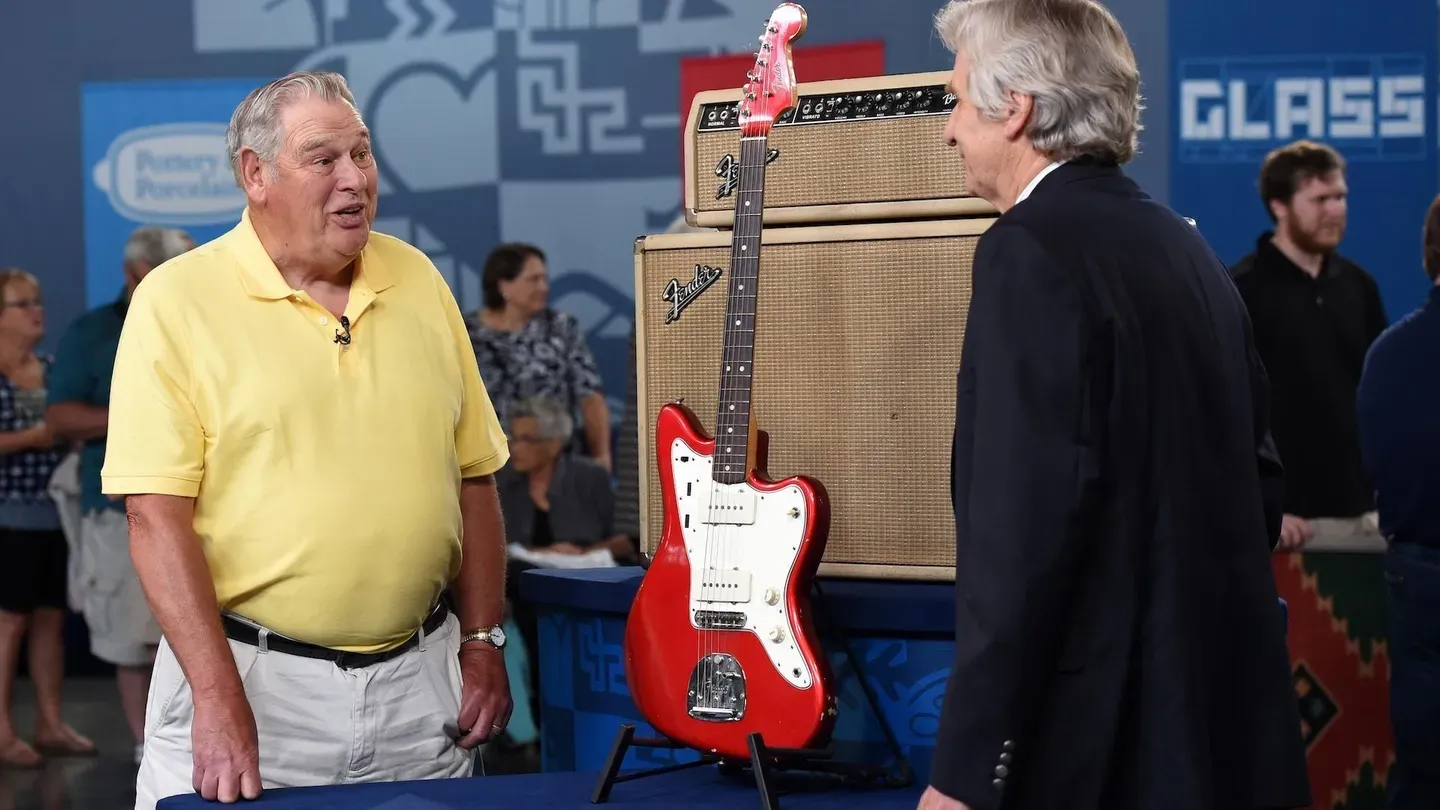
GUEST: Well, I bought it in '64.
And played in different bars and stuff with it.
I, uh, had a little experience with it.
My son took it to his place where he was living with some other kids, and I found it was missing.
So I called him and said, "You get that guitar and get it home."
And the next day, he called his mother and said, "Mom," he said, "that guitar has been stolen."
And so I took a picture of me playing it... Mm-hmm.
...in to this guy and asked him if he could appraise it.
And he looked at me kind of funny a couple times.
And finally he said, "You know, I think I had your guitar in here a couple weeks ago."
He said, "I bought it out of a hock shop in Coeur d'Alene."
And he said, "I shipped it back east and I traded it for two Dobros."
Mm.
And I said, "Well, do you know the guy's name?"
And he said, "Yeah, I've got his name and phone number."
Mm.
And so I went to the police station and talked to them.
And the policeman told me, he said, "He will send that back."
Mm-hmm.
And he said, "He's dealing in stolen goods."
And so the guy finally called me and he said, "Well, if you pay the shipping and handling on the shipping it over here and shipping it back," he said, "I'll send it back to you."
And I said, "Okay."
Well, I knew the kid through checking with the hock shops and stuff.
So I went and talked to him and his dad.
And I told his dad, I said, "If you pay "for the shipping and the handling, I won't press charges on your son."
And he said, "Okay," so he did.
It cost him $1,300 shipping and handling on that guitar, both directions.
Wow.
So when I got it back, it did have some chips in it and stuff.
I was pretty sick about the chips and the strap-- it had the regular Fender strap on it.
Right.
And it was missing.
The serial number is on the, on the neck plate on the back of the guitar.
And that, that coincides with what you've said about when you got it.
So it's a 1964, and it's a Jazzmaster.
And they were starting to do custom colors then.
And they would also do a matching headstock.
The earlier custom color Fenders would just have the custom color on the body, but the, but the headstock would be the blond maple.
Oh.
And of course, it's that candy apple red, right out of the DuPont hot rod paint catalogue.
Yeah.
(laughs) Despite the, the chips on the edge of the body, the guitar still shows really well.
The paint on the front is in, is in good shape.
When you got this back in '64, how much did you have to pay for it?
I think it was $300.
The guitar alone in today's market, in a vintage guitar shop, something like that, would probably sell for about $6,500.
And the amplifier would sell for enough, you could, we could almost get the total combination up to ten grand for the two of 'em, or get, get fairly close.
So the amplifier is probably easier at the $3,000, $3,500, something like that, so... It's a good thing you managed to get it back.
Oh, yeah, I, I was tickled to death, I... Of course, I wouldn't sell it anyway, I... It's got a lot of memories.
The artist is Noah Purifoy.
He was an African American who passed away a few years ago in a house fire in the high desert, but in 1965, there were the Watts riots in Los Angeles.
It was a terrible, terrible time, and Noah lived and worked in Watts.
Mm-hmm.
Well, he was so distressed, he went and he gathered up the debris.
And this debris, it consists of blood, metal, neon, and glass, and it's all fused together.
And he made these sculptures, whatever you want to call them.
Mm-hmm.
He gave this one to my late husband, who at that time was the assistant director of the California Arts Commission.
We got it in 1966, so I've had it now 50 years.
Well, you mentioned the artist's name, and it is Noah Purifoy.
He was an African American artist who was actually born in 1917 in Alabama.
And he got a bachelor's degree from the Alabama State Teachers College... Mm-hmm.
...before going on to get a graduate degree from Atlanta University.
Mm.
But then what's more interesting, I believe, about his education is that he was the first African American full-time student at the Chouinard Institute, which is now called CalArts... Oh, for heaven's sakes.
...here in California.
Yes.
But his artistic career is really begun during those 1965 Watts riots.
Right.
And the first large body of sculpture that Purifoy produced came from this found debris that he gathered.
Mm-hmm.
And his quote was, "While it was still smoldering."
Mm-hmm.
Purifoy had been on the Watts Towers Arts Council and was really involved in art in Watts.
Mm-hmm.
Right.
And so this really shook him and affected him deeply.
And he took this debris and expressed his frustrations dealing with the bias and the violence.
And I think what we have here is an incredibly powerful depiction of the, the strife and the angst and the violence... Yes.
...that, that came about during the Watts riots.
This really is a, a sculpture to be viewed from every angle.
Yes.
Because at every single angle, you see the different charred places where the fire was more intense.
And it was said that you could still smell the burnt wood and metal smell on his sculpture.
To put Purifoy in the context of importance in African American art... Mm-hmm.
...the Los Angeles County Museum of Art dedicated a solo show to him... Mm.
...last summer, in 2015.
Oh, my.
And it was so popular, it got extended.
My goodness.
The, the attendance was massive.
Very little of his work has ever appeared on the open market.
Right.
I would advise insuring this for $125,000.
(gasps) (gasping) You're kidding me!
Really?
Really?
Oh, my goodness.
Oh, my goodness.
It's that important.
I don't have a stick of, of fine art insurance on this.
Not one, not one dollar.
PEÑA: Coming up... These spurs were passed down in my family from my great-grandfather.
Your great-grandfather and his friends look fairly armed and dangerous in this photograph.
Well, actually, that's a family photo, so... (laughs) Okay.
But yes, that's my family.
(laughs) PEÑA: Right after this.
GUEST: These spurs were passed down in my family from my great-grandfather.
He got land from the land run, didn't like it, moved to Indian Territory.
While he was there, a gentleman moved into Indian Territory that was from Ireland.
The story goes that he got into some trouble in Ireland, killed a man.
His family sent him to Texas.
He killed a man in Texas.
So he moved up into the Kiamichi Mountains in Indian Territory, which is now Oklahoma.
He was able to hide out there from the Texas Rangers for a while.
But he was plowing his field.
Uh, the Texas Rangers came for him.
He went for his gun and the Texas Rangers went for him.
Nobody really knew anything about him in the community, so they auctioned off his belongings to pay for his burial.
So my great-grandfather, which is the guy in the black here, bought the spurs from the auction.
They were later passed down to my grandfather, who is actually the far guy here, in the white, and then passed to my father, and then to me.
And this auction took place when?
It was in 1915-- the gentleman from Ireland was able to hide out until a little bit after statehood.
1907 was statehood, so... Yes.
Your great-grandfather and his friends look fairly armed and dangerous in this photograph.
Well, actually, that's a family photo.
(laughs): Okay.
So, so those are all of his children.
And his wife and a few others mixed in there.
But yes, that's my family.
(laughs) Well, let me, let me tell you about these spurs.
Okay.
It all fits.
The spurs are McChesney, John Robert McChesney.
He made his first pair of spurs in Indian Territory, which is the eastern part of Oklahoma, in 1887.
Okay.
And he decided he was gonna be a major force in the spur world.
So he moved to Gainesville, Texas, about 1890.
Okay.
Well, he realized he wasn't quite the major force he thought he was, and he moved back to Pauls Valley, Oklahoma, in 1910.
So those spurs could have been made anytime during that period.
All right.
They're called gal-leg or lady-leg spurs.
In this case, they're called double-mounted double gal-legs.
Most gal-legs, especially McChesney's, only had the gal-leg on the shank, which is this part back here.
These have 'em on the shank and going around the boot heel.
Mm-hmm.
And they're on both sides.
Right.
A lot of gal-legs were only on one side.
Right.
So these are double doubles.
Okay.
Plus, they've got the heart button and the brass overlay on the shoe.
They've also got something that John Robert McChesney is said to have patented.
It's called the locking rowel, and most rowels, when you hit them, they spin.
Mm-hmm.
This one locks down.
Okay.
It's got that slot cut in it with a bar.
So when you dig into a horse, that rowel locks down and it just stops.
This is full silver overlay on both sides.
If you went to put 'em on the market, they're gonna bring $2,500 to $3,500 easily, especially in this condition.
But it's hard to beat a story like that.
That's great-- thank you very much.
PEÑA: Thanks for watching this special episode of "Antiques Roadshow."
Follow @RoadshowPBS on social, stream full episodes and sign up for our newsletter at pbs.org/antiques.
See you next time on "Antiques Roadshow."
 New
Appraisal: Coro Duette Seahorse Brooch, ca. 1945
Video has Closed Captions
Clip: S30 Ep23 | 2m 7s | Appraisal: Coro Duette Seahorse Brooch, ca. 1945 (2m 7s)
Video has Closed Captions
Preview: S30 Ep23 | 30s | ROADSHOW spotlights high drama, dire straits, and scandals with these sensational finds! (30s)
Providing Support for PBS.org
Learn Moreabout PBS online sponsorship New Episode

- Home and How To

Hit the road in a classic car for a tour through Great Britain with two antiques experts.
 New Episode
 New Episode








Support for PBS provided by:
Funding for ANTIQUES ROADSHOW is provided by American Cruise Lines and Ancestry. Additional funding is provided by public television viewers.