
Stoneville Ep. 5
Season 6 Episode 605 | 28m 20sVideo has Closed Captions
A Navajo rug, an onyx signet ring, and a tour of an appraiser’s New Orleans gallery.
Our guests bring a Navajo rug with a controversial symbol, an onyx signet ring, a German music box, a Boss Tweed piggy bank, and a vibrant Hector Gonzalez painting. We learn more about the history of Leland, and visit appraiser Adam Lambert’s gallery in New Orleans.
Problems playing video? | Closed Captioning Feedback
Problems playing video? | Closed Captioning Feedback
Mississippi Antique Showcase is a local public television program presented by MPB
Stoneville Ep. 5
Season 6 Episode 605 | 28m 20sVideo has Closed Captions
Our guests bring a Navajo rug with a controversial symbol, an onyx signet ring, a German music box, a Boss Tweed piggy bank, and a vibrant Hector Gonzalez painting. We learn more about the history of Leland, and visit appraiser Adam Lambert’s gallery in New Orleans.
Problems playing video? | Closed Captioning Feedback
Where to Watch Mississippi Antique Showcase
Mississippi Antique Showcase is available to stream on pbs.org and the PBS app.
Providing Support for PBS.org
Learn Moreabout PBS online sponsorshipWelcome to the Mississippi Antique Showcase, where our expert appraisers take a closer look at your rare finds, family heirlooms and quirky collectibles.
We'll uncover the stories behind these unique treasures and of course, find out what they might be worth.
Hey, we're here with Lydia Chassaniol, one of our state senators, and she's also one of the hosts of Southern Dishes.
Oh, Southern Dish.
It's just one dish.
One dish, we like a lot of dishes.
A lot of dishes.
But she is here today and we're excited because she's actually come to the showcase to bring an awesome piece for us to appraise.
So that being said, tell us about this awesome piece that we have here.
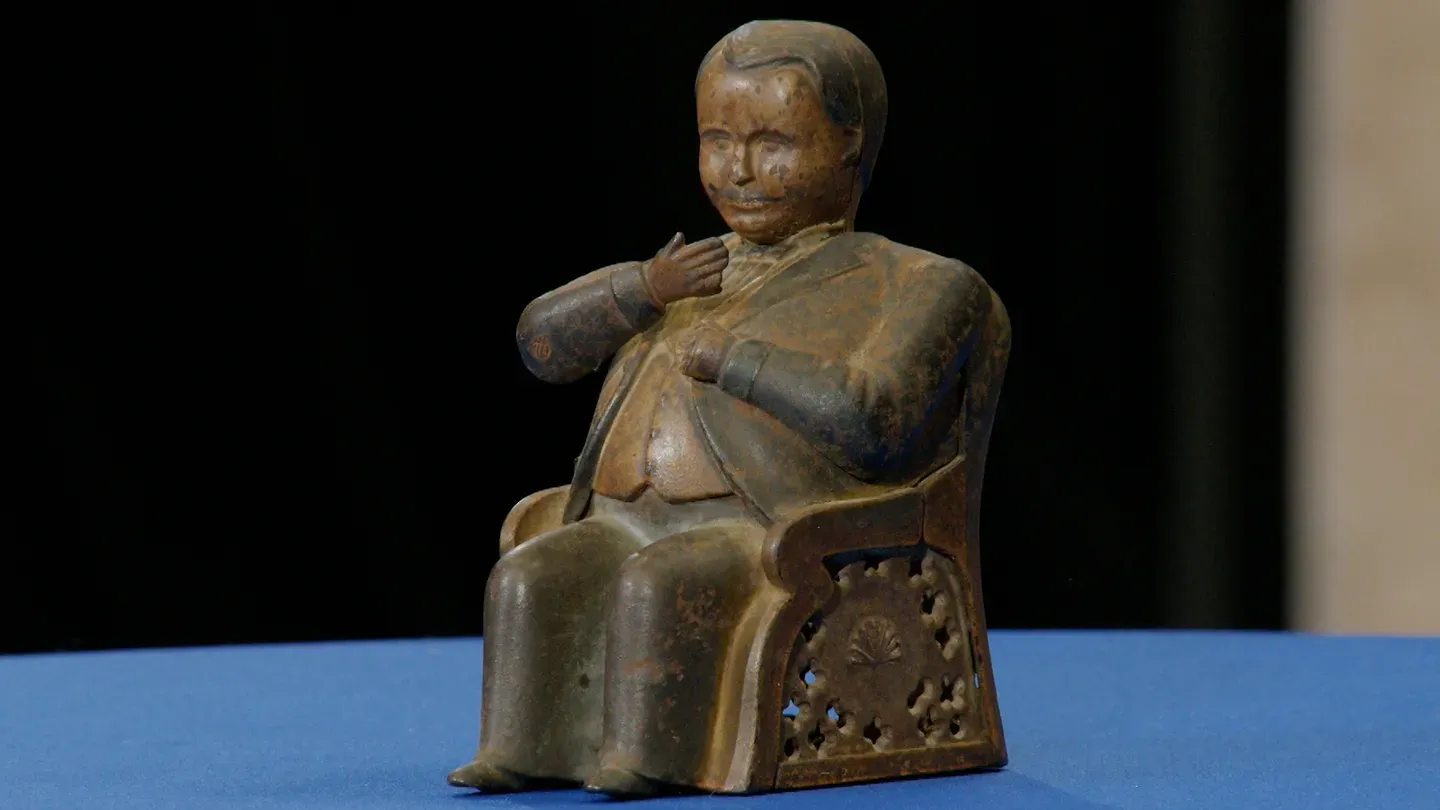
This is a Boss Tweed Bank and the way I came to have it was it belonged to my mother.
And when she was a small child in the 1920s, her Sunday school class, the children in the first grade would put their coins into Boss Tweed's and he nodded his head.
So they were like, "Uh-huh," you know, which I thought was sort of funny because Boss Tweed was so notorious.
But this little bank is from 1872, and I was digging around and found in my mother's handwriting This little piece of paper that says Boss Tweed Bank, 1872.
So he's over 100 years old.
Well, another thing about William Boss Tweed, we found out that he embezzled a little bit of money.
A lot.
A little bit of money.
So it's kind of funny how he's shaking his head and putting the money in the bank.
They say anywhere from $30 up to $200 million that he embezzled, supposedly.
Well, we did some math earlier.
Uh-huh.
Well, that money would be $8.7 billion in today's money that he would embezzle.
So, I... He's used to having the pennies put in.
I would say that he's very much used to... He used to have the pennies put in.
Let's see if we can get him to nod his head.
Oh, now he don't want... There it is.
There it is.
Well, like I said, so it's a very unique piece.
I think it's very interesting that both of us serve in the legislature.
Me being a representative, you being a senator.
And here we are appraising... Bank that's actually has some political backstory to it here.
I mean, you know, some that are in great shape, have a lot of color and paint and all that are in great shape.
You know, they're somewhere in that two, three hundred dollar range.
This one we looked at it's probably in that hundred to a hundred and fifty range.
Doesn't matter.
But it is an awesome piece and it's just an awesome piece and it's just awesome to know that we're here together and the fact that, look, I want you to tell while we're standing here, tell me a little more about the Southern Dish while we're standing here.
- Oh yeah, well, and look, we want everybody to watch Southern Dish.
This was something that MPB encouraged me to help them with.
I thought up the idea that we needed to promote our restaurants.
- That's right, yes.
- And this is my own saying, 100% of tourists eat.
So everybody that comes here, even the folks that come here for something like Antiques Showcase, They're going to eat while they're here.
We had a great lunch, by the way.
But we're going into the restaurants, and the chefs let me in the kitchen with them, which is pretty brave, and we cook.
And then people that watch the show get a chance to learn about the chefs.
So many of these young people, and we've mostly done young chefs, their grandmothers or grandfathers inspired them.
They have close ties to the land and to Mississippi.
Many of them are very, very particular about using locally sourced seafood, crops that are grown.
Some people are using rice that's grown here in the Delta up at Minter City.
So they're very particular about what they cook and so much love goes into it.
So we're having a lot of fun with it.
That is awesome.
It's a great show, I hope.
Well, I think it's great.
I think the one thing I love about MPB is that they're promoting Mississippi.
That's what we want to do is promote Mississippi.
And we don't want to see anybody embezzling money like this guy by no means.
But it is awesome to see that people are doing great things for Mississippi.
But going back to the item, it's a great item.
I think it's a cool item.
It's an item that I would never get rid of if I were you.
I'm just so glad you were here on the show and glad we could be on here together since we already serve together.
Isn't that right?
That's right.
We serve in the Capitol together.
The House and the Senate do get along.
We do get along.
They just need to listen to folks like us.
That's true.
They should listen to us.
There wouldn't be any disagreements over there.
That's right.
That's right.
So we're just glad you're here and thank you for being here on the show.
Oh, thank you so much.
Thank you all so much.
Appreciate it.
Well, this is certainly an interesting rug you brought us.
Why don't you tell the viewers a little bit about it, what you know about it and how you got it?
How I got this rug, okay, I was traveling to see my mom in Paris, Tennessee, and I veered off to go to Nashville because I loved flea market and antique and thrift.
And I went in a Goodwill and I walked to the back of the store and this rug spoke to me and I pulled it out and I saw it and I thought, this has some historical importance here.
I need to take this home with me.
So I did.
And I've had it.
And I took some photos and I sent it to Dr.
Mark Sublette out in Santa Fe, New Mexico.
And he told me that he thought it may be circa 1900, a Navajo Chief's blanket.
And that was eight years ago.
And now I'm here.
That's a great story of how you came to acquire it.
Let me just start off and clear the air for a lot of our viewers.
This image may be startling to a lot of our viewers because they only associate it as a swastika used and adopted by Nazi Germany in World War II.
But you know different than that as to what this is.
Why don't you tell the viewers and we'll kind of talk about that too.
My research tells me that the Navajo used this as a whirling log, as symbol for peace and harmony.
That's correct.
Mainly because this is more of a Southwestern Navajo style rug.
Yes, it was common used in Navajo productions in hand woven rugs and even reproductions to symbol or commercial productions to symbol motion as a whirling log.
So of course, after 1940 when it became adopted in World War II, they stopped producing these and now what we know is the swastika.
But this is more attributed to a whirling log and/or to signal luck and motion.
So I wanted to give that out of the way of the viewers because there is some historic significance in Native American history as well.
So a couple of things besides that, you have really bold colors on this rug in the striped form, you know, mainly black and brown and then you've got the red beading along the side as well.
But these are typical shapes and patterns that are associated with Navajo rugs.
And so really what indicates a key indicator in whether we can attribute this as an actual more period Navajo rug versus maybe a later kind of reproduction or commercial made is we have to look at the pile and the weave in the actual rug.
Okay.
And so I kind of looked at the backing, I've looked at the front, I've kind of given it a once-over and what I've noticed is it's a little heavier and signifies more commercial reproduction.
Okay.
So not as tight the weave and pile, as you would see, on more of a hand-woven Navajo rug.
I think you can also tell by the vibrant graphic colors and how this is laid out that, I mean, there are periods of Navajo rugs we've had on the show before and we've kind of laid out.
I still think a combination of all those things is kind of giving me the spidey senses that you're looking at, yes, a 20th century rug.
I would kind of put it in the Navajo style or the Southwestern style rug.
Value now, knowing everything I've said, you have any idea what it's worth?
I do not.
I have no idea.
Even if it's not an actual official traditional Navajo rug, I still think you're looking at $300 to $600 in value and that's a lot of things because it is 20th century so it's not, it's pre-1940, they still use some of this, these graphics and so I think you still have a good rug.
It was just not maybe as early and or traditional in the phases of the model.
That sounds great to me.
Just don't always associate that with what it is.
I won't, I won't.
Yeah, but thank you so much for bringing in.
Would you like to know how much I paid for it?
Oh, I would love to.
I can't believe I didn't ask.
Eight dollars.
Eight dollars.
Well, okay, I've always said this coming in, your return on investment is pretty good.
Yeah, absolutely.
Even if you have some condition issues, I still think, I mean, people, a three to six hundred dollar valuation is a good estimate.
I'm tickled.
So, yeah, eight to three hundred.
Look at what you found out today.
That's a great return on investment.
It really is, but thank you so much for bringing it in.
Thank you.
One of my favorite parts of Antiques Showcase Intel is getting to bring something different, something that we might not see every day.
And so today, what I brought was a Nkisi Mambai.
Very unusual, very rare.
This is from the People's Republic of the Congo.
And this is a medicine man's healing device, So a medicine man's ball in the tribe.
And what we see here, this is a monkey skull, and then woven baskets around it.
But what they did is they would mix in earth and they would mix in other minerals and things for healing powers of the basket.
Most people will see something like this in a museum with African artifacts.
Rarely do I ever get to see one of these.
This might have been the first one that I've touched.
Now this is coming up at auction at Crescent City Auction Gallery and we have an estimate of $1500 to $2500.
Some of these things can bring thousands and thousands of dollars.
Very rare again.
Nkisi Mumbai.
Let's head over to the Big Easy and chat with Adam Lambert for a bit.
Hey, I'm Adam Wolf Lambert and we're here today at Crescent City Auction Gallery.
Welcome to the lobby of Crescent City Auction Gallery.
You're going to find the wildest things.
I'm going to start on this side, if you will.
Look at this.
This is a life-size, we think, transformer from the estate of a famous real estate developer.
This was in his office.
the set over the conference table.
Also from the same estate, we've got Elvis and a Chevy hanging out.
Two cool, cool collectibles.
But come this way, let me show you a little more.
This is a very rare walnut buffet a de corps from the Ursuline convent in the French So one of the very first pieces in the convent and this would have been probably in a kitchen or one of the serving areas, but this is something that you just don't see.
Ursuline convent furniture just doesn't show up that often.
So to get something like this, to get something like this is just fantastic.
You know, again, we don't see stuff like this every day.
Very rare.
Betty Boop?
We cycle through roughly 25 to 45,000 items a year.
We also have sister companies.
One of them is the Bellflower, which I'll take you guys to today.
And another one is called Consign Consign, which is a consignment store.
But that's enough for Crescent City.
Come see our new project called Bellflower, right across the street.
All right, y'all.
Welcome to the Bellflower.
Come on in.
Follow me.
So what this is, is dealers all over New Orleans and the South, Mississippi, Alabama, have one collective place to come and display their items.
So we've got Newcomb College Pottery.
We have French antiques here, miniature portraits.
These are all separate dealers that are showing their items here at the Bellflower.
But look at the quality and the selection of this stuff.
You can't find something like this where you have so many high-end dealers in the South right now.
New Orleans is the Mecca for the antique market.
I've said that before over and over again.
People for hundreds of years have come here to buy their items and to buy their antiques.
And here they are.
They come back.
So some of this stuff is from Europe.
Some of it is local.
And then follow me over to this booth right here.
Look at this booth.
These are all Louisiana artists.
There's nowhere else in the city where you can go to find Louisiana artists all under one roof anymore with early Louisiana paintings.
So I've been a licensed auctioneer in Louisiana since I was 18.
When I was in college, I decided to get my auction license.
And so I went through the process.
I apprenticed under my father.
And so I've been a licensed auctioneer since 1998.
I was born into it and I've seen it all.
And so that is the best part.
And that is the best way to be involved.
As president of Crescent City Auction Gallery, I can tell you the best way and the worst way to do things.
Because I've done it.
The spirit of auction, the spirit of New Orleans and the auction process is what really makes this a fun place to do this.
Thanks, Adam.
Let's get back to the showcase.
Alright, Patti, tell me about this.
Okay, my son-in-law's father got this, we think in Germany.
He was in the Air Force and he flew a lot of places and every time he went to another country he brought his wife home something.
and he brought her, Alinda, home this.
We were told that it is for lipstick, and that it's a music box, of course, and that this is where a woman could put her lipstick.
I think you described it exactly.
And it is German.
It has an Italian look, too, you know, capo di monte, It's on the bottom, it says made in Germany, so we're going to go with that.
And the little ballerina is while the music's playing, she's moving around.
And so we have sold, in the past, we've sold some of these that are very elaborate.
you know, moves and does all kinds of stuff and plays all kinds of music, but does everything.
And when you just close it up, it stops all the racket.
So normally when we're selling these at auction, They bring five to seven hundred.
Okay.
And so, but this one doesn't have any damage and it's working.
A working model.
It's something that I'm sure you want to hold on to.
Sure, yeah.
We weren't planning to sell it.
Just kind of curious to know more about it.
Yeah, well that's what it is and it is exactly as you described.
And we thank you so much for bringing it back.
Well, thank you.
I appreciate it.
That's good.
Thank you.
I'm here today with Dr.
Nause from Greenwood, Mississippi, who brought us something super cool down to Mississippi Antiques Showcase.
Dr.
Nause, thank you for coming down, number one.
You're welcome.
What'd you bring us?
I brought a ring that was in my father's chest ever since I was a little boy.
So I've had this ring probably, well, 70 years now.
No one in our family has ever worn the ring, but the history behind the ring is that it belonged to my great-great-grandfather.
It was an onyx stone in there that was broken, and the end on the signet ring was chipped as well.
And a jeweler just recently fixed it and we don't know any of the history behind it other than my great great grandfather brought it from Austria when he came to the United States.
So we know a little bit of the history just from the story.
So it sounds like it's European or it came from Austria or at least that region.
And then you said it was your great great grandfather?
Great great grandfather.
So what time period would that be for great great grandfather?
It was prior to World War II.
Prior to World War II, okay, so turn of the century, somewhere in there, somewhere between, we'll say 1910 to 1930, somewhere in there.
And based on what I know about these, I think that that's right on.
Now, I was looking at some of this off camera, and the ring is not marked.
And you said something about the condition.
Walk me through that.
What happened to the ring?
Recently had it repaired.
I've got a relative that's in the jewelry business and she had the onyx replaced and had the end fixed and it's in preparation to give it to my oldest son.
Okay and then what do you know about the initial?
Well it's a family name.
Okay.
It's N, that's all I can tell you.
Right.
Our last name.
Right, same last Okay, so let me tell you what we know about this having seen these before.
So a signet ring was very common for men to wear around the turn of the century, even into the 19th century.
So they would wear them with initials, a lot of times family crests.
So you can see the family crests.
As a matter of fact, my family has one with a crest on it that my mother still wears that's from the 1800s.
So they have shown up throughout time, throughout history.
This one being an initial makes us think that your dates are spot on.
Onyx itself, the stone is for strength.
And so it was common for people to have these set in onyx, it's strength.
And it was actually the first stone mentioned in the Bible.
and so it's in the Bible, there's a verse on onyx in there as well.
We don't know what gold this is, what karat gold it is.
It could be 22 karat, which is going to be a little softer.
There are no marks on it whatsoever as far as the gold is concerned.
And so that could have been polished off, but it could have been that it wasn't marked at the time, or if it was marked in Europe, it would have been an obscure mark that somebody cleaned off.
They just simply didn't know what it meant.
But it's a guessing game as far as that's concerned.
Now, I know you said you weren't that interested in the value, but have you looked into the value at all?
I have not.
No, so no idea?
These sell at auction from this age range anywhere from a couple hundred dollars, say, $250 to $450 all the way up into the thousands, $3,000 to $5,000.
Now the higher end of that range are some of the earlier signet rings with the shields on them and the crests, the family crests.
You get into some of the European family crests that can get traced back to more important figures in history and those can hit 3,000, 4,000, 5,000 and up.
This one with the age, with the condition of the stone, and then with the gold, I think easily we're looking at an auction estimate of somewhere between a thousand and two thousand dollars.
Okay.
So anyway, this is a fantastic piece.
Keep it in the family because it's got great history.
Thank you so much for bringing it down at Antiques Showcase.
And you know, we appreciate it.
Thank you.
Thank you very much.
We're here at Mississippi Antiques Showcase in Stoneville, Mississippi, Just hanging out with the appraisers and I've got a couple questions.
We've been talking about stuff.
We've been looking at awesome items all day.
What inspired you to become an appraiser?
I think my introduction to antiques was like a lot of people are collecting and so the more I collected the more I studied and then when the opportunity arose to be involved with Mississippi Public Broadcasting I really couldn't turn it down because now you can actually put all the knowledge that you've somewhat acquired and you're constantly learning.
You can actually put that to good use, not just in your workplace, but actually doing it volunteering like we do for people all over the state of Mississippi.
So I really think it's sharing kind of the knowledge and the value with people all over Mississippi.
So, Dwight, you might have been appraising longer than anyone else in this room.
What inspired you when you started?
Well, I've been doing appraisals for years.
I've been in the business starting on my 46th year.
And I've been asked by insurance companies and everything for years to do it.
And then Chase's mother, she put the pressure on me and told me she needed me to come and help her start this show.
So I was glad to.
She's a delightful lady and I just couldn't turn her down.
So it's been fun and we meet all kinds of great people at this.
We meet some of the nicest people in the world.
And we see some things that we don't normally see, you know, at auction.
People drag them in here and they don't know what they have.
And then we tell them, you know, you may have bought this thing at a yard sale, but it's worth $8,000.
And they turn a flip and then they jump and holler and they scream all the way out of the building.
It's the knowledge I think that we have gained in the industry that allows us to look at You know, I think we can learn something pretty quickly.
Lance, can you look at something and just decide right away if it needs more research, less research?
Oh yeah, absolutely.
Like I said, I think, you know, with me, you know, I kind of accidentally got into the auction world.
So, you know, in 2013, just because I bought out some property that had two old houses, a bunch of antiques in it, and just trying to figure it out, that's when I started doing You know, we were trying to sell on Craigslist and different things that were popular at the time.
And that's kind of unfolded and started auction 18. since 2013, I become an appraiser and didn't even know it right accidentally, accidentally yeah, it's uh, but it's a I've got, uh, you know, s me, you know, from some judges that call me they need somebody appraise different items or different things you just kind of kind of unfolds and you become an appraiser without even knowing you're an appraiser.
We are here with Mary Boteler from Leland, Mississippi.
Welcome, Mary, to the Mississippi Antique Showcase.
Thank you.
I'm glad to be here.
Well, your reputation precedes you.
Before I even met you, I talked to several people who said, Mary Boteler is the perfect person to talk about the history of Leland.
So tell me some of the highlights of this lovely town.
You know, the whole Delta didn't really develop.
I mean, it was late developing in relation to the state history because this was a swamp in the 1800s and it had to be cleared.
But the people that first came here, came here to buy land so that they could farm because they realized the rich soil that was coming because of the floods.
Our town is a small, I'd say, turn of the century railroad town.
The buildings are still here, but for years we couldn't get anybody to really restore We have a lot of our downtown buildings, but they hadn't been completely destroyed yet.
Right now, our town is booming with restoration.
And it's a good thing because we have a Historic Preservation Commission through the Department of Archives and History.
And our Historic District has been here, has been established since the year 2000.
And the early beginnings of Leland were not very pretty.
The town was filled with liquor and gambling and all kind of things.
And in the early days, the creek was very ugly and they raised pigs, hogs and cows and chickens and everything down the creek.
And it was just awful looking.
So that's when the women, they got together and they said, look, we're gonna clean this We don't like living like this.
So they got, I'm sure farm labor came in and cleaned those banks up and now it is a beauty spot.
And it's, it's, we have people come from everywhere just because of this sweet little town.
But the big houses along the creek were first built as small houses.
And in 1920, they were paid a dollar a pound for their cotton.
And around here we call it dollar cotton.
And they thought they were all getting rich.
All of those houses that are now two-story, three-story, bricked and gorgeous were redone in the 1920s.
Now the 1930s hit them pretty hard, but they didn't tear the houses down.
And there's still generations of those families living in those houses.
Well, Mary, thank you so much for sharing this history of Leland with us.
I appreciate your being here.
We're thrilled.
Leland is really happy to have you all.
Well, enjoy the showcase.
Thank you so much.
We have Mike Zikmund with us today.
And Mike's brought in... It's a heck of a painting.
There's paintings and then there's paintings.
Where did you find this one, Mike?
Well, interesting story.
We found it at an estate sale here in the Delta.
Oh, really?
And we didn't know anything about it.
My wife and I had been living in New Orleans for a long time, and we saw the New Orleans theme and we were immediately taken aback by it.
We said, "We have to have that."
So we bought it at the estate sale.
And how much did you pay for it at the estate sale?
$100.
$100?
Yes.
Well, that's $100 well spent.
This is Hector Gonzalez.
Hector has a gallery in New Orleans.
He kind of does an abstract of New Orleans.
A lot of his scenes are streets and different things in New Orleans.
But I love the texture.
This is so thick, the way, I guess this is probably supposed to be Spanish moss maybe.
Up there.
Hector seems to be doing very well these days.
Some of his pieces, the commission pieces, are probably between $10,000 and $20,000.
But most of his pieces are more of a square than a rectangle, which this one is.
And a piece like this in today's market, I think, would probably be somewhere in the $4,000 to $6,000 range.
Oh, wow.
That's great.
Well, we love the painting.
I mean, that's, you know, first and foremost, as we were just, you know, immediately taken aback.
We love New Orleans and we love the painting.
But to have it be worth that much money is a great bonus.
Well, it's a great piece and we appreciate you bringing it in.
Well, thank you very much.
Join us next time on the Mississippi Antique Showcase.
Find out if you've got a hidden treasure tucked away in your closet.
♪♪













Support for PBS provided by:
Mississippi Antique Showcase is a local public television program presented by MPB