
The Frozen Heart
Episode 1 | 54m 20sVideo has Closed Captions
Venture into Earth’s most extreme ice fields to unlock the hidden history of our climate.
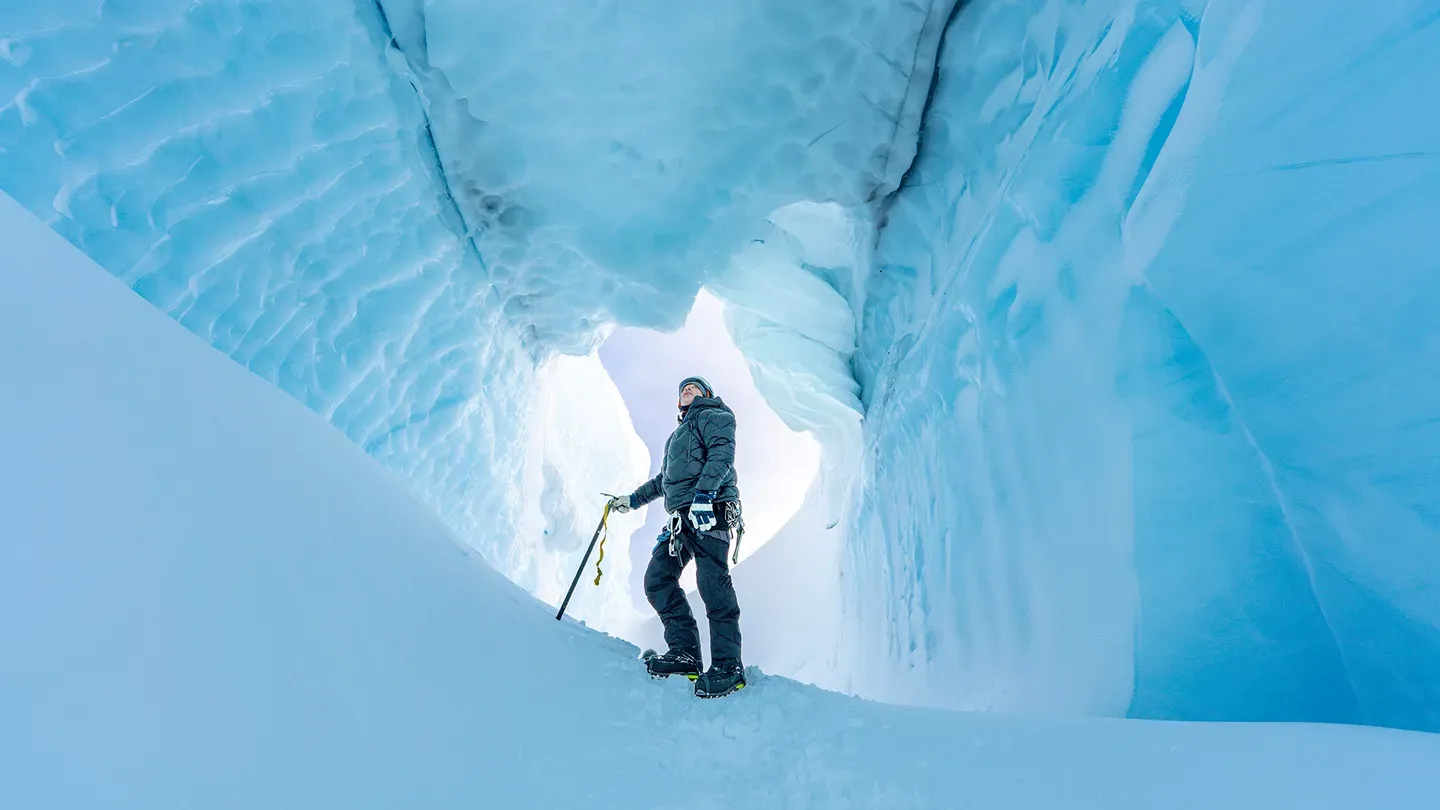
Venture into our planet’s most extreme ice fields alongside scientists uncovering the history of our climate. From scaling jagged peaks to descending deep into the ice sheet, track how the polar world is transforming.
Problems playing video? | Closed Captioning Feedback
Problems playing video? | Closed Captioning Feedback
The Frozen Heart
Episode 1 | 54m 20sVideo has Closed Captions
Venture into our planet’s most extreme ice fields alongside scientists uncovering the history of our climate. From scaling jagged peaks to descending deep into the ice sheet, track how the polar world is transforming.
Problems playing video? | Closed Captioning Feedback
Where to Watch Ages of Ice
Ages of Ice is available to stream on pbs.org and the PBS app.
MALE NARRATOR: If you want to understand how the world is changing, you start here at the very edge of the Earth.
It's crazy.
[laughs] I've got my hard hat on, health and safety.
Oh, that's quite a big boy.
[laughs] NARRATOR: The clearest signs of change unfold here at breathtaking speed.
[splash] NARRATOR: From Antarctica to the Arctic.
[splash] Spray coming over here, be careful!
NARRATOR: Scientists are pushing the boundaries of exploration and endurance.
Three, two, one.
ADRIAN MCCALLUM: You do need to like to suffer a little bit or at least be prepared to suffer because you will suffer.
[grunts] And you need to have something pulling you through that to do your work beyond the harshness of the environment.
[grunting] NARRATOR: Research is revealing how the polar regions sustain our wildlife.
WOMAN: Oh!
We've got a seal!
NARRATOR: Our oceans... Our future.
VICKIE SIEGEL: How can we explore here on Earth and learn more about climate change, learn more about extreme biology?
Right now, we are at 73 meters.
NARRATOR: At the frontier of discovery... Oh, my goodness!
NARRATOR: We follow polar scientists to places no human has ever reached.
[music swells] ULYANA PEÑA: Nature is powerful.
Nature is still boss.
NARRATOR: What they're finding is reshaping our understanding of Earth.
MCCALLUM: The polar regions, if changes occur there, there's implications for us all.
KEVIN ROZMIAREK: We need to study it while the Earth is changing so rapidly.
NARRATOR: This is their quest.
These are the ages of ice.
[dramatic music swells] NARRATOR: The story of an ice sheet begins with a single snowflake.
One flake becomes a layer, a layer, a season, and over time, snow turns to ice.
Antarctica and Greenland hold the two great ice sheets of our world.
Powerful systems that reflect heat, store water, and help keep the climate in balance.
- You good?
- ALAN HUBBARD: I'm cold!
[Joel chuckles] NARRATOR: Professor Alun Hubbard has spent three decades studying Greenland's icy interior.
HUBBARD: We're just coming out of a very frigid dark winter.
It's about minus 20-25 today.
And days like today, I just wish I'd done tropical reefs, not glaciers.
[laughs] You can see, well, actually, it's not a flat ice sheet.
What we've got behind us is a pretty impressive canyon, which carried a big, big melt river during the summer.
NARRATOR: A crack in the ice is where most turn back.
But to understand what's happening to the ice sheet, you have to step inside.
[suspenseful music building] [whimsical music] HUBBARD: It's just such a sort of weird, surreal, creamy whip kind of icescape.
You couldn't dream this up.
NARRATOR: Greenland's ice sheet has endured for millions of years.
But canyons like this reveal how quickly it's changing.
HUBBARD: It's really lovely to get up close to the ice and see all the amazing detail and then start to think "Well, why is that looking like that?
Why is that doing that?"
And this really does, to me, show the absolute power of water in sculpting this ice and the effect and the impact it has on that ice.
In a couple of months, there's no way you'd be here.
This'll be topped off full of an absolute torrent of meltwater with huge amounts of energy, huge amounts of power.
NARRATOR: A little like this.
[chuckles] NARRATOR: Each summer, the Greenland ice sheet sheds more than 250 billion tons of ice.
In just three decades, the rate of ice loss has increased around five times over.
HUBBARD: Ah... [laughs] You're committed.
Ah, you cheat!
Too much for my little Welsh legs.
NARRATOR: Something more than rising temperatures is driving this change.
Alun wants to find out what that is.
HUBBARD: The ice sheet has always melted.
If it didn't, it would take over the whole planet.
But this ice sheet, which holds over 7 meters of global sea level rise, that's been taking a real hammering in the last two decades.
NARRATOR: Meltwater rivers wind their way across the ice only to disappear down deep shafts, known as "moulins," draining into the depths below which for most people, is a good reason to keep your distance.
For Alun, it's yet another invitation.
The adventurous side of me just wants to go in there and have a look and see what the hell's happening.
NARRATOR: Alun believes these sinkholes may unlock new clues as to why there's accelerating change.
The idea here is, we're going to put in a methane sensor to see what methane may be expelling out of the ice and from the bed.
It's only a hunch but you have to try.
Alright he says.
I'm very confident.
A bit nervous now, actually.
Been thinking about it too much.
Hopefully I won't be doing a Darwin award today.
We need to clean up a little bit here.
Joel, do you want to go down?
JOEL: Sure.
Piece of cake.
- HUBBARD: Piece of cake.
- [chuckles] [suspenseful music] [Hubbard laughs] The gates of Hades!
You can feel the thundering and vibration of the water going down there, the whole thing's shaking.
Joel!
NARRATOR: But there is method in Alun's madness.
HUBBARD: So we sense that what's under this bit of ice below us is a fossilized ancient Arctic forest.
As the base of the ice sheet thaws and more meltwater accesses it, it's starting to break down that organic matter and it's starting to leak methane.
Amazingly, at the moulin there, I got quite an elevated methane signal.
That's a first, right?
So, that's interesting, that is something new.
- Nice!
- JOEL: Everything good?
HUBBARD: Interestingly, I got actually quite a high methane reading.
- Really?
- HUBBARD: Yeah.
It's actually emissions coming out of this moulin from the bed of the ice sheet or from stuff that's trapped in the ice sheets.
Either that, or it was the Moroccan lentil curry I had last night.
NARRATOR: Methane is a powerful accelerator in the climate system.
And ice sheets may be hiding more of it than we realize.
HUBBARD: It's one of those things we've speculated about.
But I don't think anyone else has ever measured methane out of a moulin before.
So that's quite cool.
I went quite a way in, so I was definitely in the updraft of what's coming out of there.
So quite good to be able to sense it.
NARRATOR: Current climate models don't account for methane leaking from ice sheets.
Only by standing here, face to face with change, can we begin to see what's emerging.
NARRATOR: Somewhere that also feels like nowhere on the Greenland ice sheet, a team of adventurers and scientists set out on a data collecting journey of almost 370 miles.
MCCALLUM: The Greenland ice sheet is traversed occasionally by perhaps 10 to a dozen parties every year.
All of those typically are adventurous parties.
Very rarely, very, very rarely do we get scientific traverse expeditions that actually will travel across the Greenland ice sheet gathering data as they go.
My name is Adrian McCallum and I am scientist and engineer from the University of the Sunshine Coast in Australia.
The icy parts of the planet where I like to work, to some extent can give us the pulse of the planet.
What is happening?
How is it faring?
It's covering ice.
And then of course, we can project what implications that might have to sea level rise.
That's it, that's it!
Okay, team.
Woo hoo!
NARRATOR: For the next 30 days, Adrian and the team will attempt to cross the entire Greenland ice sheet, each pulling a 220-pound sled across one of the most hostile environments on Earth.
Out here, exhaustion, storms and extreme cold can end an expedition fast.
But their goal is to map the hidden world below with radar, and measure how much snow the ice sheet has gained over winter.
MCCALLUM: We are collecting ground-penetrating radar data where I'm dragging a radar behind my sled.
It projects energy into the ice sheet, which bounces off reflections within the ice sheet, comes back to the surface.
And we can then work out how deep particular snow-ice interfaces are.
NIKLAS: Everything is working?
Yeah, we got data!
NIKLAS: Yes.
25 meg of radar data at -30... NIKLAS: Oh, nice.
Hasn't been collected here before, so so far, so good.
NARRATOR: The routine is relentless: ski 12 miles, then build a home on the ice.
Every.
Single.
Day.
MCCALLUM: We're five people from five different countries.
We never met until we met in Kangalussuaq in Greenland twelve days ago.
Life in Greenland, huh?
It's not too bad!
MCCALLUM: We've got Niklas from Germany.
Laura, from Greenland.
She's Danish.
Jan, our expedition coordinator.
He's from Copenhagen.
And we've got Jens, our surgeon from Sweden.
NIKLAS: What's for dinner tonight?
Turkish falafel.
I haven't tried it before.
NARRATOR: For the next month, home will be under canvas, with all five squeezed in together.
[snoring] [match strikes] JENS: It's probably the coldest morning so far.
It's like... Oh, it's only minus 14 in the tent now.
MCCALLUM: It's noticeably harder.
NARRATOR: Each day, Adrian measures the depth and density of the snow... Ten, so there.
Above the ice.
NARRATOR: ...revealing how much water is stored here and how quickly it's compacting into ice.
170.
NARRATOR: However, the team needs to keep moving.
MCCALLUM: It says it's receiving radar data.
It says the internal GPS is okay.
ELECTRONIC VOICE: No GPS present.
- That's all okay.
- VOICE: No GPS present.
So it looks like we are good to go.
- So... - VOICE: No GPS present.
As you can hear, there's no external GPS.
We're using the GPS on the phone, which is fine.
So we'll take the radar for a bit of a drag and see what we can find.
ELECTRONIC VOICE: No GPS present.
No GPS present.
NARRATOR: But Adrian and the team aren't the only ones with a keen interest in Arctic snow.
On the Norwegian archipelago of Svalbard, snow density is changing, as more rain is falling in place of snow.
For the Arctic's most iconic hunter, the ground is quite literally shifting beneath its paws.
Most bears sleep through the depths of winter.
Polar bears do not.
As the cold tightens its grip, they move out onto the sea ice to hunt.
But when a female is expecting, her priorities change.
She'll search for a place with the perfect mix of snow.
Neither too soft, nor too hard, but just right, much like Goldilocks!
Only then will she dig her den.
[groaning] NARRATOR: How arctic warming affects the snow mix and the bears is of particular interest to one polar scientist.
LOUISE ARCHER: I'm Dr.
Louise Archer and I'm a research fellow with Polar Bears International, where I'm studying the denning behavior of polar bears here in Svalbard.
This really is polar bear territory right here.
[screeching] ARCHER: We base ourselves here out of Longyearbyen.
Right now, a lotta the snow has melted.
But in February, March... it's totally snow covered.
That snow is what provides the habitat and the insulation for the dens for females.
[indistinct conversation] NARRATOR: To find bears in their lairs, scientists must venture further across the archipelago, to areas only accessible by helicopter.
ARCHER: The chopper will drop us off about a kilometer away from the den site.
And then we'll actually go by ski or on foot because we know the bears are sensitive to disturbance.
NARRATOR: Faint radio signals guide them to where a mother bear sleeps under the snow.
ARCHER: We're trying to capture those first few moments in those first weeks when they're in and around the den site.
So the cameras, we set them up time-lapse and continuously recording And then we leave the cameras in place, for several months, to hopefully capture all this footage remotely.
[bright music] NARRATOR: It's springtime in Longyearbyen.
With the camera cards recovered from the field, now Louise begins the search.
Sifting through weeks of footage for any sign of a bear.
Let's see.
I hope that we see something.
We're looking for that initial nose poke as usually the first thing we see.
Oh, hello!
We have a mother.
So right here, you've got mom, has just popped her head out from the den.
It's her first sniff of clean air.
We know she's been in there months on end without eating, all to give her cubs the best chance at survival.
Oh, and I think I've just seen the first sight of the cub.
Yeah, there we go.
So there's the cub just coming out!
Oh, there's two.
And they look extremely round and fat, which is nice to see.
Polar bear cubs are definitely something else, and at this size, they're little balls of fluff.
I mean they do look like marshmallows!
The cubs are tiny when they're born.
They're pretty much hairless and they're blind, totally dependent on their mother, and critically the heat of the den.
It's quite an emotional thing to get to see these first few moments of mom and cubs coming out of the den.
Knowing that they're kind of going out into this profoundly changing environment.
Svalbard is actually warming between six to seven times faster than the global average and we're also seeing more rain rather than snow.
NARRATOR: A mother's den is only as strong as the snow that holds it.
If the snow is washed away or thaws too soon, the family will be forced out before the cubs are ready, making survival that much harder.
ARCHER: We know the timing when they emerge from the den has a knock-on influence on the survival of cubs later in life.
Less than 50% of cubs will actually make it to reproduce themselves, so it is really important that cubs are protected in the den to give them the best chance at survival.
NARRATOR: Fortunately for this family, the den has done its job.
ARCHER: Getting to see polar bears still reproducing, still giving birth is pretty, pretty special.
It all comes back to that snow providing the conditions that allow these bears to thrive.
NARRATOR: At the other end of the Earth, the frozen realm belongs not to polar bears, but to penguins, who have adapted to this environment almost perfectly.
Antarctica holds around 90% of the world's frozen freshwater, locked up in ice.
As the world warms, what happens here will reshape the planet.
So the race is on to understand the forces now unfolding.
IAN KELLY: Where we are right now is a particularly remote region and we're camping by this glacier for the next two weeks.
My name's Ian Kelly, and I'm a PHD student at the University of Tasmania, and I study Antarctic geophysics.
NARRATOR: Welcome to the coldest neighborhood on Earth: the high plateaus of East Antarctica.
The ice here is thick.
Over a mile on average.
And in some places, more than double... [indistinct chatter] which is precisely why scientists are searching here, in the planet's most stable ice, for the faintest signals of change.
Because if this ice begins to shift, it changes everything.
KELLY: The Antarctic ice sheet holds about 60 meters of global sea level rise.
This part of East Antarctica is relatively poorly studied and it's largely believed to be stable.
But that's all based on satellite data.
Being on the ground here, we can uncover whether that's really the case.
If this glacier is changing faster than we expect, then it poses a bigger question.
Let's go.
[sighs] NARRATOR: When working on a glacier 37 miles long, the morning commute can last half a day.
Twelve hours on foot, across a landscape that has never known footsteps at all.
KELLY: We look all around us, and it's just an endless horizon of ice.
You realize it goes on for thousands of kilometers more.
NARRATOR: Beneath their feet lies a hidden landscape of peaks and valleys, one that controls how the ice above flows.
KELLY: All those mountains, you see, they dip down and they're all hidden beneath this glacier.
This all affects how the ice slides towards the ocean and eventually gets melted.
NARRATOR: On the surface, the glacier has the stillness of stone.
But appearances are deceiving.
KELLY: We actually don't know what we're going to find underneath this glacier.
There's the possibility of meltwater coming from the interior of the ice sheet that's flowing underneath the glacier.
That would be a huge discovery, actually.
If that's the case, that would spell a big warning sign.
LEVAN: I'm going to be on two separate ropes here, okay?
KELLY: Yeah, sounds good.
So we want to get a parallel line in between those two points.
Yes.
NARRATOR: So how do you find a river under a mile of ice?
KELLY: Yeah, great.
NARRATOR: You stop looking, and start listening.
Ah, perfect.
KELLY: So the way that we listen to the glacier is we put sensors on the surface of the ice.
- CREW: Okay.
- Next one.
KELLY: And they record minute ground vibrations.
We have to try and pick that apart and see what it's telling us.
[sparse cracking] NARRATOR: As sunlight warms the surface, the ice creaks and shifts under thermal stress.
[soft cracking] NARRATOR: Listen carefully, and you can hear sudden snaps, crackles and pops... [soft sizzling] NARRATOR: Sizzles... and deep groans.
[grinding] NARRATOR: The ice is not still.
It's alive with motion.
[creaking] [crackling] [dramatic music] NARRATOR: For the next two weeks, these sensors will listen to the natural sounds of the glacier.
Just to keep things interesting, Ian will be adding a few vibrations of his own.
[clang] [metallic reverberation] NARRATOR: It's a bit like giving a glacier an ultrasound.
As the echo ricochets off the bedrock, a picture of the ice's interior begins to emerge.
[metallic reverberation] I'm feeling it right now.
[laughs] NARRATOR: So far, data from this region has revealed a thermal patchwork.
In some places, the cold locks the ice in place, holding it fast, anchored to the earth.
In others, a quiet warmth rises from below, melting, softening, setting the ice in motion.
KELLY: Understanding and mapping the bed underneath Antarctic glaciers is a major answer to how they will melt and contribute to sea level rise.
NARRATOR: By the end of this century, sea level is projected to rise by up to 3 feet.
But that number hides a deeper uncertainty.
Around the margins of West Antarctica, the ice sheet rests on bedrock below sea level, where warm ocean water thaws the ice from beneath.
This undercutting will accelerate the flow of ice from the interior.
As Antarctica's edges begin to unravel, the ocean could rise faster and far higher.
NARRATOR: While the greatest ice loss in Antarctica is happening out of sight, in Greenland, it's laid bare across the surface [grunts] NARRATOR: And Professor Alun Hubbard suspects what begins as surface melt may be driving a hidden transformation within the ice.
HUBBARD: What I'm really interested in is the way that the ice sheet flow is affected by the heat that's going in.
How about using that bamboo for now?
Yeah.
NARRATOR: To test this theory, he'll feed a fibre-optic cable into the rushing meltwater to be swept, hopefully, down into the "moulin."
Give it a go!
NARRATOR: "Give it a go" is a perfectly respectable step in the scientific method.
I'm glad I brought my gloves.
Yeah, me too.
There's quite a drag.
NARRATOR: This is no ordinary cable.
It can feel the tiniest shift in temperature down to a fraction of a degree.
HUBBARD: It's kind of testing this hypothesis that this water is releasing heat into the ice fabric that's reducing its strength and making it more vulnerable to flow and climate change.
It really goes for it!
Nobody's done it before, so what I'm hoping, if the gods are willing, it'll tells us the temperature and the amount that cable is straining.
Are you able to stop it?
CLAUS: Just a second.
I'm not sure I can.
F### me.
[chuckles] - Well, hold it now.
- Yep.
Hold it.
Don't let it go.
Wow there's a lot of pressure on it.
[chuckles] HUBBARD: Hopefully it works, I mean, it's glaciology, for Christ's sake.
It's experimental!
Okay, that's brilliant.
NARRATOR: The concern is if water is forcing heat deep inside the ice sheet, even its oldest, most stable layers may no longer hold.
HUBBARD: Can you redeploy that about 50 meters back?
CLAUS: Okay.
There's a lot of tension in that.
That's why I've got gloves.
Yeah.
- Okay?
- Yeah.
Are you ready?
Yeah.
Be quite quick please!
- So, a new hole?
- Yeah, yeah.
CLAUS: So put it here.
HUBBARD: I can't hold it for much longer!
CLAUS: We are working on it.
NARRATOR: With the cable now inside the moulin, the river grips it with crushing force.
Its immense drag threatening to tear the experiment apart before it even begins.
I can't hold this for much f###ing longer!
CLAUS: Yep, we are here.
- You are right?
- CLAUS: Yeah!
Thank you.
Real jeopardy.
[laughs] Wouldn't be the first time a scientist has f###ed up.
Thank you, Claus.
I needed your help there.
[laughter] HUBBARD: We're gonna leave it in there now.
And my hope is that it gets totally frozen in to the end glacial ice fabric.
[suspenseful music] NARRATOR: What's happening here in the Arctic is just one piece of a much bigger story.
From the poles to the world's glaciers, the same signals are starting to appear.
DR.
ULYANA PEÑA: Throughout Earth's time, there have been multiple ice ages, and were called these interglacial warm periods.
And where we are right now is an interglacial.
So the melting is normal.
But what's different is in the stage we are in orbit around our sun, we should actually be entering a phase of cooling.
And it's not.
[dramatic music] NARRATOR: In the foothills of New Zealand's Mount Aoraki, glaciologist Ulyana Horodyskyj Peña, has come to study the Tasman Glacier.
[music swells] Walking the valley floor, she traces where the ice once rested.
Over the last half century, the Tasman Glacier has retreated 3.7 miles, in step with a global pattern of glacier decline.
PEÑA: You see just this incredible landscape.
But you also see vulnerability.
And for me here in New Zealand, it's important to be creating baselines and contributing to this global database.
NARRATOR: Temperature rise is driving glaciers into retreat.
But Ulyana is searching for a hidden accomplice.
We finally had a weather window open up here.
So really excited to take off and get on to the ice here shortly.
[dramatic music] PEÑA: This is just unbelievable terrain.
You can just really see the structure of the glacier.
It's really steep peaks.
Look at it, how vertical it is, just right beside us here.
Oftentimes, the terrain is just going to look pristine and reflective and white.
But then when you get down to the level, we're actually like physically looking at that snow and sampling it, then that's when secrets start to reveal themselves.
[radio chatter] PEÑA: Just looking around from where we landed, there's crevasses everywhere.
You have to be super careful around here.
NARRATOR: From this point forward, the team must tread carefully.
The glacier is full of trapdoors.
The trick is finding them before they find you.
GUIDE: Just straight across a little crevasse here.
PEÑA: Yep.
GUIDE: And a big one.
PEÑA: Yep.
PEÑA: Yeah, that one goes deep.
I can't see the bottom!
The snow and ice is incredibly important for regulating and maintaining that nice temperature range that we enjoy as a species surviving on this planet.
It's not just about snow being cold, it's also about how it reflects that solar radiation back into space.
- Right here.
- GUIDE: Yep.
PEÑA: The Inuit have so many names for the snow forms and scientists do as well.
So you have all sorts of different crystal sizes and shapes that all interact with that light differently, that translates into or what kind of potential melting that can cause.
So this is definitely different from Antarctica.
It's definitely much more metamorphosed, meaning it's melting a lot more.
It's not surprising seeing the condition of the glacier and they're much bigger grain sizes and all that's pretty bad for letting solar radiation go through the snowpack more and actually causing more melting.
NARRATOR: Amongst the snowflakes, there are signs of something new.
Black carbon, the residue of fossil fuels burned far beyond these mountains, carried here on the wind.
PEÑA: Black carbon is a really good absorber.
And so, when it's on a pristine snowpack, it's going to absorb more of that solar radiation and cause it to heat that snowpack, which is going to cause melting.
NARRATOR: Even at just a few parts per billion, black carbon can dim the snow's natural brilliance, tipping the balance toward warming.
Once you start to add in this black carbon onto that snowpack and you start to drop that reflectivity, just a few percentage, then you start to see the effects of that more solar radiation gets absorbed and reflected.
That's going to cause the areas to warm up, cause more melting.
You can almost think of this like a trigger.
Okay.
That'll do.
NARRATOR: Even here in the remote mountains of New Zealand, the atmosphere carries the traces of an industrial world.
Lifted high, black carbon rides great rivers of air, swept around the globe by jet streams for days, even weeks, before falling back to Earth.
PEÑA: It's impacting every corner of the planet.
Even places that are completely remote and untouched by people.
NARRATOR: As ice loss accelerates, every process that speeds it up matters.
PEÑA: The main drivers of climate change are carbon dioxide and other greenhouse gases increasing in the atmosphere, as well as the associated temperature rise.
Never in geologic history have we seen such a rise in such a short amount of time.
We've seen higher amounts of carbon dioxide.
We've seen it lead to mass extinctions.
But we're talking about thousands of years to adapt and change versus what we're doing now on a scale of just a few hundred years.
And that's the difference.
It's that rate of change.
But then you have this component of black carbon that's becoming more and more of a driver of climate change as well.
There hasn't been a time where humans have lived where it's been ice free.
And that's the experiment.
Is that even possible?
[waves lapping] [grunting] NARRATOR: Adrian McCallum's team are halfway across the Greenland ice sheet with almost 200 miles of ice, wind, and exhaustion behind them.
MCCALLUM: We're really surviving first, traveling second, and then thirdly, gathering data in remote environments where others just won't go.
When you're skiing for 12 to 13 hours a day, you're doing the same thing over and over and over again.
Worst day ever.
Wait until tomorrow, man!
MCCALLUM: Every day is like the previous day, and it's mentally challenging to keep on going.
[intense upbeat music] I worked out I will be doing about a million steps across the ice sheet.
The thing that keeps me going is the fact that, well, we are getting data that no one else probably would get in environments that are largely inaccessible.
There's much data that we need to gather to try and assess, what's the density of the snow?
How deep is the ice?
How much is the ice moving?
The questions that we need to answer in the polar environments are almost endless.
[intense upbeat music continues] Oh, yeah, and I can smell it already.
Yeah.
Even though we change socks like every week.
- Every week?
- Yeah!
[laughs] [intense dramatic music] NARRATOR: Sunny days blur into blizzards, as sudden violent katabatic windstorms can strike with little notice.
Despite the brutal cold, there is no turning back.
With two more weeks of punishing slog ahead, the team pushes on.
MCCALLUM: There's a romance about the trip before you go, I think.
Once you're on the trip, it's a hard slog.
I've written in my diary numerous times, "What am I doing here?"
[grunts] NIKLAS: Oh, buddy.
All good?
NIKLAS: Yeah, sure.
NARRATOR: As temperatures dip below minus 40, the forecast calls for "character building."
MCCALLUM: You do need to like to suffer a little bit or at least be prepared to suffer because you will suffer.
You'll get cold toes and feet, you'll get hungry, you'll get thirsty.
You will be inherently cold all the time.
And you need to have something that's pulling you through that, that's driving you to gather information and do your work beyond the harshness of the environment that you place yourself in.
[dramatic music intensifies] NARRATOR: And yet by morning, it's as if the blizzard never happened The next storm, however, is already on its way.
And then Monday plus two and rain.
Oh, wow.
Tuesday, plus two, and rain.
- [Laura laughs] - JENS: That's it.
That could kill us And then it's Wednesday and then we run out of food.
NARRATOR: To make it out before conditions turn deadly, the team must complete the final 30 miles in just two days.
So the bottom line is we have to move as much as we can tomorrow.
[wind blusters] PILOT: We should be getting close now.
PILOT: Yep.
NARRATOR: After a season of snow, Alun is back in Greenland, hunting for the instruments he left behind in the summer.
Snow has filled the moulin, buried the river.
The whereabouts of the fiber optic cable is... anyone's guess.
HUBBARD: The problem is we've got a position where it was last summer, but of course, the ice sheet has moved about 75 meters since then.
Okay, I can see a, um... NICHOLAS: Something sticking up.
- HUBBARD: At 12 o'clock, yeah.
- PILOT: Yep.
Okay, don't go much further forward.
[wind blowing] Cool!
We're in business!
Good news, eh?
We've got a fiber optic cable so we're game on.
Always good to give them the right coordinate to come to.
NARRATOR: Base camp is set up so the data can be downloaded.
HUBBARD: Oi, Kapoika.
NARRATOR: Just as the katabatic winds hit with a vengeance.
HUBBARD: Jeez, quite a wind chill.
Okay, power, lights, action.
Possibly a moment of truth.
So we know the thermal profile of this part of the ice sheet pretty well and the particular thing that I'm looking at is, we call it cryohydraulic warming... [laughs] I feel like a snowman in one of those little snowstorm things.
Anyway, to cut to the chase.
Here we are eight months later from last August, plugged it in, and one of the channels worked, and it's given us cool data.
NARRATOR: The fiber optic cable, swept into the moulin, has captured temperature changes from the surface to deep within the ice.
The bulk of the volume of the Greenland ice sheet was deposited as snow during the last ice age, over 20,000O years ago.
And the world was much colder at that point, and that ice has a very, very cold signature so it's, here, minus 18, minus 20, so that's what it should be, and what I'm seeing here is it's minus 4.
So that's a 15-degree warming and difference.
I mean, this is really, really warm for the ice sheet and ice flows orders of magnitude faster with that increase in temperature.
I'm excited about the result.
But actually in terms of the future of the ice sheet, it's not good news.
Basically, the ice sheets responding faster than forecast means we're looking at possibly a meter of sea level rise by the end of the century.
I've been working for almost thirty years now.
Even in the short period of time that I've been here, I've seen some really dramatic changes.
People may think there's no point.
But every ton of CO2 that we can stop from going into the atmosphere if we can really focus on getting to carbon neutral within 10, 20 years, we really do avoid a major catastrophe.
[dramatic music swells] NARRATOR: On their final push across the Greenland ice sheet, the team must ski up to 13 hours a day to reach the coast before another storm hits.
But for Adrian, completing their data-collecting mission will be just as significant.
MCCALLUM: It's very important for us to understand the mass of the Greenland ice sheet because changes in the Arctic won't just affect the Arctic, they will affect all parts of the world.
It's a long way away from home.
But if the Greenland ice sheet melts in the future, then it's not Greenland that will be affected.
NARRATOR: Right now, Greenland's ice sheet actually pulls seawater towards it.
But as it loses ice and mass, that gravitational pull weakens.
Sea level will rise across the planet, but especially on the coast of large landmasses.
MCCALLUM: It will be other places, like Australia, like Europe, like the United States, where their mass as a continent hasn't changed and they may attract more seawater to them, therefore, sea level will rise.
So areas of the world that are not in the Arctic need to understand that the polar regions, both the Arctic and Antarctica, if changes occur there, well, there's implications for us all.
[cheering] NIKLAS: Group hug.
Come to my arms, guys.
- Well done, team!
- [cheering] MCCALLUM: Good job.
NARRATOR: There's a saying, often repeated by climate scientists: "What happens in the Arctic doesn't stay in the Arctic."
Accelerated melting of the Greenland ice sheet is already in motion.
Now it's up to us to heed the warning.
Because rising seas won't just reshape coastlines, they'll reshape how and where we live on our changing planet.
FEMALE VO: Ages of Ice is available with PBS Passport and on Amazon Prime Video.
Video has Closed Captions
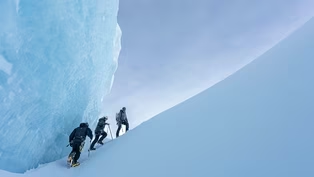
Clip: Ep1 | 4m 58s | Professor Alun Hubbard is studying the cause of meltwater on the Greenland ice sheet. (4m 58s)
Video has Closed Captions
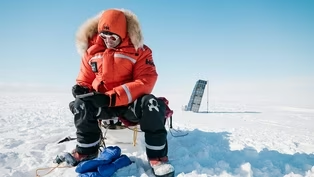
Clip: Ep1 | 4m 48s | Dr. Adrian McCallum and his team traverse the Greenland ice sheet on a 350 mile journey. (4m 48s)
Providing Support for PBS.org
Learn Moreabout PBS online sponsorship

- Science and Nature

Explore scientific discoveries on television's most acclaimed science documentary series.

 New Episode


 New Episode




Support for PBS provided by: