
The Pulse of Change
4/1/2026 | 47m 27sVideo has Closed Captions
Four people across continents face environmental change and seek coexistence with wildlife.
Four people on four continents face environmental change driven by climate change. As resources grow scarce, they witness shifts in wildlife behavior. Each actively seeks solutions to adapt and prevent conflict between humans and wildlife.
Problems playing video? | Closed Captioning Feedback
Problems playing video? | Closed Captioning Feedback
The Pulse of Change
4/1/2026 | 47m 27sVideo has Closed Captions
Four people on four continents face environmental change driven by climate change. As resources grow scarce, they witness shifts in wildlife behavior. Each actively seeks solutions to adapt and prevent conflict between humans and wildlife.
Problems playing video? | Closed Captioning Feedback
How to Watch Our New World
Our New World is available to stream on pbs.org and the free PBS App, available on iPhone, Apple TV, Android TV, Android smartphones, Amazon Fire TV, Amazon Fire Tablet, Roku, Samsung Smart TV, and Vizio.
Chris Morgan: This is the Mont Blanc Massif in the French Alps in 1870.
Using CGI, we can now visualize how it has evolved over the last 150 years.
The glacier has retreated, the ice has been replaced by prairie, and forests have climbed the slopes... ♪ and this is a Canadian tundra landscape.
It, too, has evolved in the last century.
♪ It gradually transformed into a boreal forest.
[Geese honking] ♪ It's not just the tundra or Mont Blanc.
Everywhere, rising temperatures are transforming the planet.
♪ Some regions are becoming inhospitable.
♪ [Thunder] Others are transformed into enchanting places.
♪ [Birds chirping] [Rumbling] What world will we live in tomorrow?
♪ Men and women are at the heart of this upheaval.
♪ They tell us how their world is changing.
♪ How nature is adapting to these new conditions.
♪ So this is a journey around our planet to discover a new world, our new world.
♪ There is a place on Earth where the impact of climate change has already been dramatic.
♪ Southeast Alaska.
Here's what happened over the last 250 years.
♪ Gigantic glaciers have melted at great speed, carving mountains and deep valleys, a new home for forests and freshwater ecosystems.
♪ The sea has entered the land, creating fjords, estuaries, and marine ecosystems.
This is Glacier Bay National Park.
My name is Chris Morgan, and I'm an ecologist who studies the workings of natural systems.
Right here?
I'm fascinated by the science that has emerged from this special location.
This area is undergoing a tremendous transformation.
♪ Is it a land of hope?
I've heard that bears are coming back to this area, and if they are here, it means that this is an ecosystem that is beginning to really flourish.
It's hard to imagine because this was covered in a mile of ice at one point.
♪ Just 250 years ago, the glacier was here.
Now the ice has retreated 60 miles north.
♪ What happened here?
How has nature given birth to such an abundant ecosystem so fast?
[Gulls crying] [Bald eagle cries] It's just amazing to see all this life, you know, islands covered in life and the smell and the sounds.
It feels thick.
♪ I've been coming to Alaska for over 30 years.
As a bear expert, I want to know if these animals can adapt to a warmer climate.
♪ In many places around the world, life has become more difficult for wildlife.
What's happening here seems to be the contrary.
Ray was born in this region.
He's witnessed the transformation of this frozen land, so he's the perfect companion for my journey.
♪ It all starts here.
♪ Two miles wide, 600 feet high.
This glacier is a cracking monster.
[Rumbling] [Ice cracking] ♪ Whoa!
Wow!
♪ [Cracking and rumbling continues] ♪ [Boom] ♪ This ice is retreating fast, 70 feet per day.
It was here just a year ago.
It uncovered this landscape of sand and rock, a dead planet.
[Distant rumble] Mosses.
♪ Brought here by the wind or on the feathers of a wandering bird.
[Glacier cracks] And lichen.
They get nutrients from the air and rain.
They secrete acid, which dissolves the rock, creating soil.
Their presence allows the next plants to come here, like dryas... ♪ and the fabulous fireweed.
This is the beginning of life here, so it's a bit of a moonscape and a place where it looks impossible for life to take hold, but it happens thanks to the beginnings from the lichen.
With Ray, we will go back in time, traveling to places from where the glacier has gradually retreated year after year, and by doing so, we will document the return of life to this formerly inhospitable landscape.
♪ On the other side of the planet lies another ecosystem that is undergoing a tremendous transformation in Australia.
Man: Shhwp, shhwp, shhwp, shhwp, shhwp.
Hey, guys.
You remember me?
Shhwp, shhwp, shwwp.
Morgan: If it hadn't been for John Creighton, these wombats would no longer be alive.
John: Look at you.
You've been growing big and strong ever since we've met.
You are this little, little pinkies.
You little guys, you've grown so, so much.
I'm proud of you, and you're becoming big wombats.
Hmm.
Morgan: John is a naturalist.
He has dedicated his life to protecting these marsupials.
Their incredible story began in early 2020.
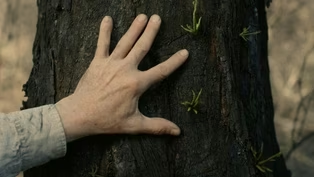
After months of intense drought, the forests burst into flames... ♪ the greatest fires in Australia's history.
♪ [Sirens] [Helicopter flying] In a few weeks, an area larger than England is burnt to ashes.
[Whoosh] ♪ Among the trapped animals, there are those that managed to escape... ♪ and the others.
♪ Fires are part of the natural cycle of the dry forests of Australia, but these fires, intensified by global warming, were exceedingly brutal, on such a scale that their smoke was visible from space.
♪ They brought on disaster to the animal world.
♪ John: It was the moments after the fires, my thoughts went to the animals, and, um... That was very sad time, very sad thinking in that what you see out there, their home, their environment, their safe place, that was gone, absolutely gone.
So like a soldier with a mission, I put it together, and I kept focused, and I just put the idea that we're gonna bring some help out there.
♪ [Wind blowing] ♪ And my hope is those Wombats that have found safety in that area are still there and have survived this fire.
This is definitely wombat bones.
That's a hip bone.
All right.
So this wombat would have been caught outside of its burrow, and I would say intense heat, died instantly, and the temperatures that bring a bone to this nature would have been crematorium temperatures.
Shocking.
It's really just shocking.
This poor little guy.
Shhwp, shhwp.
Shhwp, shhwp.
Shhwp, shhwp, shhwp, shhwp, shhwp, shhwp.
Shhwp, shhwp, shhwp.
The noise I'm making is a greeting sound for the wombat, and if she trusts me, she'll come out.
Shhwp, shhwp, shhwp.
Shhwp, shhwp.
[Wombat responding] Some of those burrows, they're 4, 10, 15, 20 meters long.
So just by staying in their burrows, they would have made it through.
Some of the other animals would have run into those burrows.
I think the echidna and the goanna.
I don't think the wombat was actually shepherding them and saying, "Come on in please," but the animals know where to go to get safe.
Now the ones that did come out of their burrows and survive, they were left with a world with no food, no water.
It wouldn't have made much sense to them, and they would have eventually just walked, looking, trying to find new food.
The other ones that didn't or couldn't would have died of thirst or starvation.
♪ Life is out there, life is being rescued.
If only we got to take the time to do it and more people were stepping up and going out there and checking pouches and looking for the wounded, and there were many, many out there.
♪ Some little wombats had lost their moms, but they were staying around mom's body, and they were feeling scared, and they would wait and wait and wait until help came, and many times, we were there.
♪ Through that time, there has been many miracles.
♪ Oh, Andrew, let's show our students off today.
Thank you, guys.
I love you, Bundanoon.
Our Bundanoon students, you guys are gonna be plowing the way forward in wombat care, hey?
It's really important that you see this and you know what to do.
OK?
So now remember, mama's been dead, OK, but the joey's not.
You saw that little foot?
See the baby?
So this is her pouch, just like a kangaroo's pouch, right, and the little joey's in here.
Mama's gone, so we're gonna have to open this up a little bit to get the joey out.
Look at the little joey here, see?
OK.
So this is what we call a pinky.
Hey sweetheart.
You're gonna get love, OK?
And I'm gonna get us straight to the carer right now, OK?
So we took out that little wombat and saved him.
[Joey squealing and grunting] After a few weeks, he became strong.
And we gathered all the orphans together.
Good morning, everybody.
It's milky milk time.
With those little ones and with each and every one of them, we promised ourselves that we're gonna someday get them back into the forest, get them back into the bush where they belong.
♪ Since those fires, we came back many times to the forest.
♪ It looked like the trees were dead.
♪ Would life ever come back?
♪ And then, suddenly... ♪ [Bird chirping] Where'd these animals come from?
How did they survive all of this?
♪ Slowly, slowly, nature began to heal herself.
♪ [Birds chirping] ♪ Leaves were growing back on trees.
Seeds were growing from eucalypts that had dropped into the ashes.
♪ Little bit by little bit, this was a new start for nature.
♪ That was an astounding time to witness... ♪ but our biggest concern was would nature be able to pull back all that she's lost in this horrible time?
[Birds chirping] You turn your back on it, and look what it's become.
It's a magic.
All now you see is green, green, and sometimes, it's just like walking through a jungle.
[Chattering] Life is everywhere.
I hear it, I see it.
[Birds chirping and squawking] [Chirping] Morgan: Thanks to this wonderful rebirth, John was able to keep his promise.
John: This little wombat has marked its territory by dropping its cubic scat.
This area is now so dense that I cannot find the burrows that I used to know, but I know they're here, and that's a very, very good feeling.
♪ Just 4 years ago this place was like a desert, black and burnt... ♪ and now look at it-- spectacular.
All this regrowth, but it makes me wonder is this fuel for a future fire?
♪ Have we learned enough about this black summer?
♪ I got to say out of those fires, out of all that negativity looking at it now, there's positive lights and so many positive things.
People are more aware of the wildlife around them, and they value it more.
There's something has been taken from us in many ways, and to have it coming back slowly, people are seeing that, and they care.
[Birds chattering] ♪ Morgan: How can life regenerate so quickly after such a disaster?
♪ Thanks to natural sanctuaries... ♪ deep valleys escaped the fires... ♪ so the animals that lived in them survived.
From these havens, they gradually repopulated the burnt forests.
♪ Thanks to these sanctuaries, nature can regain its balance after chaos.
The recovery of wildlife will take years or even decades, but it is well underway.
This is the Indian Ocean, realm of the most powerful cyclones in the world.
The ocean's warming multiplies their energy.
At the bottom of the Bay of Bengal, the Sundarbans region lives under the threat of these monsters.
[Birds chirping] [Thunder] Set on the ocean's edge, this sprawling mangrove forest is home to wondrous biodiversity.
It is Anil Mistry's world, and he is its protector.
[Thunder] [Thunder] [Chattering] [Growls] The Bengal tiger is the jungle's other guardian.
Its presence deters humans from entering and prevents its destruction.
Mangroves are tailored to weather cyclones but not to withstand their new devastating power.
[Thunder] [Wind blowing] ♪ When the cyclone hits, it engulfs the mangrove.
♪ Animals must flee.
♪ They seek new territories... ♪ but their forest is surrounded by villages... ♪ so they are forced to move closer to humans.
♪ This morning, Anil was called by the villagers.
When there's a problem with a tiger, it's up to him to intervene.
He's the warden of the balance between humans and animals.
[Speaking local language] [Camera beeps and clicks] [Beep, click] ♪ ♪ [Man speaking local language] [Shouting] [Growls] [Dart gun fires] [Clamoring] ♪ ♪ [Growls] ♪ ♪ Morgan: Anil knows the tiger is hiding in the jungle around the village.
[Chattering] Tigers kill dozens of people every year in the Sundarbans.
Anil must find her as quickly as possible.
♪ Mangrove trees are adapted to the tides between fresh and saltwater... ♪ but during the last decades, due to sea level rise, the water has become too salty.
♪ The excess salt threatens the trees' health.
♪ It is also said to make tigers more aggressive.
Mm-hmm.
Morgan: This changes everything.
[Firework explodes] ♪ [Bang] Capturing a mother and her cub at the same time is mission impossible.
Anil has decided to scare them off... [Bang] to drive them as far away as possible.
[Indistinct chatter] [Bang] ♪ [Bang] [Bang] ♪ [Bang] [Bang, bang] ♪ [Bang, bang] ♪ ♪ [Bell ringing] [Speaking local language] Morgan: Anil wants to believe this, but the future of tigers is quite unsure.
In 50 years, rising sea levels have already swallowed up a third of their territory.
♪ Morgan: There is more good news.
To face rising waters, mangroves have an effective strategy--motion.
Mangrove seeds are great travelers.
They are carried by the tide and can take root hundreds of miles away.
♪ The mangrove thus spreads along the coasts of the Bay of Bengal.
♪ In our new world, global warming is disrupting the water cycle.
Some regions are drowning in torrential rain, while others are drying up.
In the Horn of Africa, the lack of water has provoked a major conflict with elephants.
♪ Mpayon Loibotong'u is a woman of the Samburu people.
She lives in northern Kenya.
From 2020 to 2023, she experienced the worst drought in the region's history.
♪ [Speaking local language] [Flies buzzing] [Elephants trumpeting] [Grunting] [Cowbells ringing] [Goats bleating] ♪ Morgan: Guided by their matriarch, they searched for water across a vast territory.
♪ All the springs and waterholes known to the female elephants were dry.
[Elephant trumpets] ♪ When a resource as crucial as water disappears from an entire region, the strategy of motion is stretched to its limits.
[Wind blowing] ♪ [Monkeys grunting] ♪ [Trumpets] ♪ [Mpayon speaking local language] [Trumpeting] [Roaring] [Woman screams] [Elephant roaring] [People shouting] ♪ [Metal clattering] ♪ ♪ [Shouting] [Indistinct chatter] [Indistinct chatter] ♪ [Grunting] ♪ ♪ [Calf trumpets] ♪ [Calf grunting] [Groans] [Speaking local language] [Herdsmen singing in local language] ♪ Morgan: Every evening, the shepherds left them water, and the elephants came at night to drink.
♪ The Samburu even dug wells with gentle slopes to help access and prevent drowning.
♪ [Thunder] [Elephants trumpeting] [Zebras calling] ♪ [People singing in local language] ♪ ♪ [Squeaks] Morgan: What Mpayon shows us is that wars for water are not inevitable.
♪ In her hotter, more arid world, she chose another path-- solidarity.
The more difficult the conditions, the more vital cooperation becomes.
♪ ♪
Video has Closed Captions
After the 2019 - 2020 wildfires, CGI timelapse reveals a forest’s rebirth in Australia. (2m 11s)
Providing Support for PBS.org
Learn Moreabout PBS online sponsorship
- Science and Nature

Explore scientific discoveries on television's most acclaimed science documentary series.

- Science and Nature

Capturing the splendor of the natural world, from the African plains to the Antarctic ice.











Support for PBS provided by: