Vermont Public Specials
Vermont Public's 2026 Democratic primary debate for lieutenant governor
Season 2026 Episode 12 | 56mVideo has Closed Captions
The Democratic candidates running for lieutenant governor in Vermont met for a live debate.
Molly Gray of Burlington, Ryan McLaren of Essex Junction, and Esther Charlestin of South Burlington met Jul. 21 for a live debate at Vermont Public’s Colchester studio. While the three candidates differ in their professional backgrounds and have varying degrees of experience in state and local government, primary voters might be hard pressed to differentiate between their policy priorities.
Problems playing video? | Closed Captioning Feedback
Problems playing video? | Closed Captioning Feedback
Vermont Public Specials is a local public television program presented by Vermont Public
Vermont Public Specials
Vermont Public's 2026 Democratic primary debate for lieutenant governor
Season 2026 Episode 12 | 56mVideo has Closed Captions
Molly Gray of Burlington, Ryan McLaren of Essex Junction, and Esther Charlestin of South Burlington met Jul. 21 for a live debate at Vermont Public’s Colchester studio. While the three candidates differ in their professional backgrounds and have varying degrees of experience in state and local government, primary voters might be hard pressed to differentiate between their policy priorities.
Problems playing video? | Closed Captioning Feedback
Where to Watch Vermont Public Specials
Vermont Public Specials is available to stream on pbs.org and the PBS app.
Providing Support for PBS.org
Learn Moreabout PBS online sponsorshipMore from This Collection
Special episodes from our daily radio show.
 New
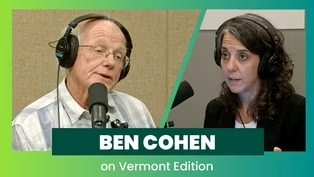
NewThe uncertain future of the Ben & Jerry's Foundation
Co-founder Ben Cohen discusses the foundation's origins, the company's social justice mission. (17m 58s)
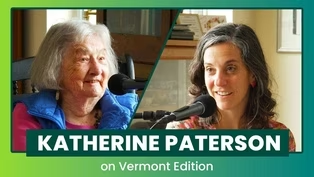
Katherine Paterson on a Lifetime of Moving, Writing, and Starting Over
Video has Closed Captions
Katherine Paterson is the award-winning author of Bridge to Terabithia and over 40 other books. (52m 41s)
Providing Support for PBS.org
Learn Moreabout PBS online sponsorshipWelcome to the Vermont Public 2026 Primary election debates.
I'm Mikaela Lefrak, the host of Vermont Edition.
This show is part of a series of Canada interviews and debates ahead of Vermont's August 11th primary.
Today, the Democratic candidates for lieutenant governor here with me in the Vermont public studio are Esther Charlestin of South Burlington.
She owns a consulting firm, and she's a former Middlebury Select board member.
In 2024, she was Vermont's Democratic nominee for governor.
Esther, welcome.
Happy to be here.
Thank you.
We also have Molly Gray of Burlington with us.
Molly served as lieutenant governor from 2021 to 2023.
Her other previous roles include assistant attorney general and executive director of the Vermont Afghan Alliance.
Molly, good to see you.
Thank you for having me.
And Ryan McLaren of Essex Junction, who's a longtime aide to senior.
Excuse me, longtime senior aide to Vermont Senator Peter Welch.
Good to see you, Ryan.
Good to see you, Mikaela.
Thanks.
And throughout today's debate, you're going to hear some questions submitted by you, our audience.
If you want to submit a question for candidates in other races, you can email that to Vermont Edition at Vermont Public with the subject line debate question.
All right.
Here is the format for today's debate.
In the first segment, I will ask common questions to all the candidates fill each have 60s to answer.
I'll also likely ask short follow up questions.
The order in which the candidate's answer was randomly selected before the program.
In the second segment, the candidates will ask one another questions.
They'll have 30s to ask a question and 60s to answer.
We'll start our third segment with more questions for all the candidates.
Then there's a lightning round.
My favorite part questions with very brief answers.
And we'll conclude with one minute closing statements from each candidate.
All right.
Let's begin.
We're going to start with questions for all three of you.
And again please limit your answers to 60s.
So the lieutenant governor position holds both a lot and a little bit of power.
You don't vote on bills unless the legislature needs a tie breaking vote.
You don't serve on legislative committees, but you do play a major role in handing out committee assignments.
And of course, your first in line to succeed the governor.
So considering the unique parameters of the job, why are you seeking this role?
And Molly Gray?
We're going to start with you.
Thank you.
Thank you for having me.
And thanks to everyone tuning in today.
Esther Ryan, really good to be with you.
Listen, for me, running for lieutenant governor isn't theoretical.
I know what the office can be.
I believe I know what Vermonters deserve, especially in this moment and beyond the the constitutional roles presiding over the Senate, casting a tie breaking vote.
And we saw lieutenant governor this year cast a tie breaking vote to send a Trump U.S.
attorney to the Vermont Supreme Court, someone who was here in our state trying to exercise their free speech rights.
But more than anything, this office has a voice at the bare minimum to ensure Vermonters know what is right, what is wrong, what is lawful, what is not, to advocate fiercely for things like health care and housing, and to build the statewide support to be able to do that.
Working with the legislature and other statewide elected leaders.
And for me, that's everything.
That's why I'm running.
Trying to help us get through this really hard time and deliver on these really key priorities for the state.
So what you spoken about why you're running for this position in past forums, you've cited the cruelty of the Trump administration, your quote, as a motivation for seeking the position.
And you said that the lieutenant governor can hold the line against unlawful federal action.
How exactly can you do that, considering the limitations of this position?
It's a very fair question.
And just by way of background, I've spent the last three years helping to grow and lead a statewide organization, the Vermont Afghan Alliance, helping more than 650 Afghans working with community partners to find housing, jobs and other supports.
And time and again, I've asked myself, where is John Rogers when the Trump administration tries to take away Snap benefits or there's unlawful Ice detention detention happening in the state?
The lieutenant governor has a voice, and they can help Vermonters understand what's right.
What's wrong?
Work with Charity.
Clark, Mike.
Peach, Sarah.
Copeland, Hans.
Other statewide elected leaders who are every day showing up and trying to protect the state.
And sometimes that's communication.
Sometimes it's galvanizing expertise around the state and the way that I did when snap wrongfully ended here in Vermont for Afghan allies and other refugees and immigrants.
But this isn't a ceremonial office, and that's why we need a different lieutenant governor right now.
Thank you.
Esther Charlestin, same question to you.
Why are you seeking this specific role, considering both its powers and its limitations?
Absolutely, as it was already named.
So, yes, you preside over the Senate.
You have the tie breaking vote.
You also get to influence by putting senators on committees.
But the part I really want to hone in on is the opportunity to convene, to bring people together, to build trust across community.
All 14 counties.
As I traveled the state, I hear this the distrust communities really feeling like, hey, you remember me during election, but will you remember me after?
And that is what I want to fight against bringing people together who talk past each other, but really help them to talk to each other, learn from each other.
Because the gold is within us already.
And I've seen what we can do and I know we can do better.
So you are the Democratic nominee for governor in 2024.
You lost to fill Scott in the general.
This lieutenant governor race also includes a Republican incumbent, John Rogers, who's been endorsed by Governor Scott.
What would you say to your fellow Democrats who want to be sure that they are voting for the person most likely to beat that Republican candidate?
The good news is, is this is his first time being an incumbent, so his seat is not secure.
And according to polling, all three of us would do better.
And so for me, it's about the values of who is going to fight for Vermonters every day, day in and day out.
And I've had 15 years experience across higher education, public schools and as a small business owner, a consultant, really having hard conversations and bringing communities together.
And that's the work I intend to continue to do on this platform and be an advocate.
And briefly, are you citing the University of New Hampshire polling on this race?
Great question, Ryan McLaren, it is your turn.
Why are you seeking this position specifically?
I'm seeking this position because it's a it's a continuation of my 15 plus career in public service that hasn't always been in positions of immense institutional power, but where I've been able to bring people together, connect them with their government in ways that can make a meaningful impact in Vermonters lives.
And so, I think, you know, the limitations of this role are in some ways a self-fulfilling prophecy.
And people are desperate for leadership in Montpelier in ways that can change the tide of what's going on in Vermont.
Today, I'm running on three things housing, health care, and hope.
All three are in short supply here in Vermont.
And people are desperate, hungry for something to change, to make them believe that they could afford a home, that they could afford to raise a family here, and that they can have hope that their kids, my kids, will have a better future than they have here in Vermont.
This is an opportunity to lead, and I've been doing that work for the last 15 years.
Yeah.
Tell us a little bit more about that professional experience.
Because you don't have experience in state government and this is your first statewide race.
So what about that past experience makes you feel ready to take on this role?
Sure, sure.
I have I do have experience in state government.
I spent five years in the Shimla administration.
I was the number two at the Department of Motor Motor Vehicles.
I helped lead an agency and want to be elected state office.
Yes of course.
Yeah, but one of the things I'm most proud of is in that role, we helped pass and implement the first law in Vermont that allowed our migrant neighbors to get driver's licenses, because we believed it was wrong that anyone would get deported just for driving their kids to school, or the doctor's office or the grocery store.
And then I spent ten years working for Senator Peter Welch here in Vermont as a senior advisor, just doing the work, connecting people with his office and with federal resources in a way that can make an impact here on the ground.
I'm really proud of that work.
And Senator Welch endorsed my campaign because he has seen me just do the work like I am running for this office to do something, not to have a title or to be someone.
And I can use this role to actually get things done in a way that I think people are desperate for.
Let's move on.
A word you might have heard once or twice on the campaign trail.
Affordability is a topic of our next question.
A recent poll from the University of New Hampshire found that about 4 in 10 Vermonters say they're likely to move out of the state within the next five years.
More than half of the people who say they plan to leave point to cheaper housing, or the high cost of living as their reasons.
What would you do in the role of lieutenant governor?
To address affordability with a particular eye to that five year time frame?
Esther Charlestin, we'll start with you this time.
Affordability is top of mind for folks.
And as I travel the state, I've talked to different families who are feeling the squeeze, people who are working several jobs to make it work, and those who graduate from our schools and say, I'm not coming back because it's not worth it.
I don't have the supports in place.
And so for me, housing is the biggest piece where we can move the needle.
And so I think about the Home Act that was passed in 2023, where we are able to build in our downtown area downtowns and village centers, right, bringing together builders towns and conservation groups, having them talk to each other instead of past each other, and having the hard conversations of some of our downtowns are in flood plains.
Do we build there?
I don't think so.
But what does it look like to expand, to really make sure that folks are able to stay here and thrive here?
And so the biggest way to do that is housing.
During a recent candidate forum, you said that you when you were on the Middlebury Selectboard, you were the only renter and you shifted the conversation during your tenure.
Did that conversation shift that you were referring to a apply to affordability specifically in the Middlebury area, and if so, how?
Yeah.
When?
At the time there was everybody owned a home.
And so that was the perspective that was brought up a lot.
And so when I was able to speak up and really talk through, like, who else is in our community, what are other folks dealing with?
I was able to speak to that gap of like, there's not a lot of available space for rent.
Actually, one of the reasons why I had to leave the Middlebury Select Board is because I couldn't find housing, I couldn't find rent.
And so it's a problem that still exists.
I know folks in the community who are moving out because they're either priced out or not able to find housing.
And so it's an issue that has been here for years and will continue.
So my work is to help move it forward.
Ryan McLaren, this question to you, how would you address affordability with a particular eye to people who are thinking about moving in the next five years?
Yeah.
So I proposed the yes in my backyard tax credit, which is designed to do exactly this, to start using money that the state is already spending to artificially by down property taxes, taxes year over year, to finally start building more homes.
And so what my MB tax credit says is for every unit of housing that a community permits, the taxpayers in that community get $25,000 a property tax relief.
And so it would finally do connect the two things that people are desperately asking for more homes so they can find a place to live that they can afford, and property tax relief so they can afford to stay in the homes they already have.
And so I would do that on day one, whether I'm lieutenant governor or not.
I have confidence that it's a good enough idea that people are going to carry it forward.
And I'm really excited about that.
And then the other thing I would do tomorrow if I could is a Pieta tear tax.
People in own ski.
Shelley's in Stowe should never be paying a lower property tax rate than the family down the street that just wants to send their kid to a local school.
It's happening now and we could change it tomorrow.
Since you've worked for a Democratic senator for many years now, formerly a Democratic representative to Congress, I wanted to ask you about something involving our current lieutenant governor, who switched his party affiliation from Democrat to Republican because of what he sees as the Democrats abandonment of the working class.
So as somebody who who's boss is so deeply embedded in the Democratic Party, and as a longtime Democrat yourself, do you think any of the lieutenant governor's frustrations with the party are warranted?
I think absolutely.
And it's not a Partizan thing, actually.
It's not a Republican Party Democratic Party thing.
It's a politics thing.
Politics has abandoned working people.
It has been captured by money, by elites, and it is detached from the day to day reality of people like my parents, who did not go to college but managed to raise three kids in a 900 square foot house in Essex Junction.
My life was never guaranteed, but it was possible.
30 years ago my parents could buy a house.
They could send me to a great public school.
I had health care from the government that supported my family, and we had food assistance, and we needed all of these things, that infrastructure of opportunity.
It added up to make my life possible.
And I'm running.
I feel this sense of urgency that I think people feel out in the community, that that's no longer possible for people here and for working people, regular people, and they just want to do something more than just struggle to get by.
And can we build a system in our politics that says, yes, you can hope to do more than just struggle?
Molly Gray, same question to you.
How would you address affordability in the role of lieutenant governor?
With an eye to that five year time span in which many people say they want to move out of state?
Yeah, it's very, very serious.
And as lieutenant governor, I was a huge champion for paid family and medical leave child care.
Now Vermont, we do have the nation's leading child care bill, which has been huge.
I can say, even as a new mom, a three year old, that's been huge for me personally.
But it's an it's an interconnected issue.
It's housing.
And we've talked a little bit about that already and hope we can get into it.
But also health care.
Health care costs are the largest driver of education spending in Vermont and the largest driver of property taxes.
We know next year there isn't going to be excess money to buy down property taxes.
So what I am hugely focused on is addressing health care and making sure that in the state, we have a comprehensive health care strategy.
I'm a huge supporter of universal primary care to help get emergency care, folks go into the emergency room for basic preventative care out of our emergency rooms.
Re incentivizing health care as a human right, not profiting off of illness, and trying to really bring down health care costs.
We have meaningful property tax relief for Vermonters.
I think a lot of people in Vermont right now are rightfully are not playing the blame game and looking back at previous legislators or elected officials and saying, you're the ones that got us here.
What the heck?
You're the former lieutenant governor just cited some of the ways in which you bolstered policies that you say contribute to making the place more affordable.
I wonder if you can hone in on that a little bit, especially for the runners who might be saying what?
Yeah.
And I right now the blame game is not helpful.
It doesn't work like we can't use our very limited energy and resources at a time where the Trump administration is coming at us for everything, right?
They want to take away health care subsidies.
They want to attack our newest neighbors.
They don't want Vermont to succeed.
So we need a lieutenant governor who is going to work every single day with the legislature, with other statewide elected leaders to help address our big health care and housing affordability challenges, which are interconnected.
And not only did I fight for child care as lieutenant governor, but I've spent the last three years helping to grow our workforce.
I've always fought for addressing our Democrat graphic crisis through really strategic investments that create this landing pad for the generation that wants to stay here, the generation that wants to come back, and a new generation that wants to bring their skills and talents to the state.
And that's what I'll be deeply focused on continuously as lieutenant governor.
Well, let's move on to a topic that Molly you just set up for us, which is healthcare.
Jacob in Essex Junction is the one that submitted this question to us.
Jacob asks, what is one concrete thing you would do as lieutenant governor to lower healthcare costs?
And on Jacob's behalf, I would just emphasize that he they are asking for one thing.
I know there's a tendency to try to squish as much as possible into these one minute answers.
Ryan McLaren, we'll start with you.
I'm going to squish as much as possible, but I try.
It's a great question, Jacob.
I really appreciate it.
I mean, the first thing I would do is the first thing I did in this campaign, which is support universal primary care.
I think it's the bite of the apple that Vermont can do on its own that drives down costs because it pushes health care to the place we know it creates the best outcomes close to home and is the cheapest.
Like, we can't be giving primary care in hospitals, in an emergency rooms.
And it would help us invest in rural health care, to help us invest in Planned Parenthood clinics that have closed all over the state.
But that is a step for me.
And what is the ultimate solution here?
National single payer health care.
And the day I was paralyzed in a skiing accident nine years ago.
The day I got hurt, I went from an ambulance at River Glen to Central Vermont Medical Center, where they put me in a helicopter to take me to UVM.
They put me in another ambulance to take into the air to fix my spine.
Everyone is a separate bill, and I got a $10,000 bill for a critical care ambulance ride from a helipad at UVM rescue across the street to the E.R.
it's totally dysfunctional and it's inhumane.
It's totally broken.
When any of you guys bring up universal primary care, I'm going to ask you, how do you pay for it, Ryan?
Yeah, we pay for it by bringing down health care costs.
We have enough money in the system right now.
It's about how we organize that money.
A ton of the money comes from Medicare.
Ten of the money comes from Medicaid.
If we just expanded our coverage in Medicaid to to 200% of the poverty line, we could add a huge number of senior citizens to what is essentially free primary care, where they're not paying co-pays and they're not paying premiums.
Now, it's tweaking the system that we have that is delivering a lot of money into a health care system to produce this outcome, which is universal, guaranteed primary care.
Esther Charlestin, what is one concrete thing you would do as lieutenant governor to lower the cost of health care?
As I travel the state, I learned and heard from different families.
One family in particular, all three of their children are on Doctor Dinosaur and parents don't have health insurance.
I wish that was there, the only family with that story, but I know there's several others with that story.
And so as I think about what we need, they usually the parents go to the emergency room really to get primary care.
Is that okay?
No.
And it's not sustainable.
So in my travels, I had the opportunity to visit the People's Clinic in Barre and that was incredible.
They are open three days a week and people can come in and get their needs met at no cost.
What if we invested more in the People's Clinic?
We have a few here in our state and opened it up so that they're open more days, because right now that is the safety net that folks, that's where they're going when they don't have health insurance or if they can't afford the copay.
And so I would continue to support that initiative.
So you would have state dollars invested in programs like the clinic you're describing in Barre.
Where does that money come from?
That money can come from second homes.
I think about Massachusetts, how they really created a tax for those who have more people who were are millionaires in the state, and how much money that brought into the state millions of dollars invested in infrastructure, education.
And we could also use that money to invest in programs that I support and that really serve people and our people centered like people's Clinic in Barry.
Thank you.
And Molly Gray, what's one concrete thing that you would do as lieutenant governor to lower health care costs?
I've already talked about universal primary care, and I'm glad to have a little more time to get into it.
It's so important, as I said earlier, because it helps bring people out of emergency rooms where costs are extremely high.
We see hospital costs go up.
That's really what drives health insurance premiums.
I think there's a pathway to pay for it in a really sustainable way.
Esther already mentioned increasing the tax or having a tax on second homeowners in Vermont right now, primary residence across the state pay less in taxes than second homeowners.
And we now know 40% of the homes in Vermont are second homes.
And we're not talking about hunting camps or worker housing, for example.
We're talking about, you know, these year long, like homes that are vacation homes.
The other piece that I think sets me apart is that we've seen in Vermont, a number of folks receive a Trump tax cut under the one big beautiful bill.
And what I would propose is that that money be directly invested as part of a health care surcharge into universal primary care, to make sure we're building out the system that's really sustainable and truly provides meaningful property tax and affordability relief for our communities while delivering on a human right.
So you've all brought up taxes on second homes.
So, Molly, just to clarification on on that policy proposal from you, would the money from a second home tax, are you imagining it would be directly funneled towards universal primary care.
Or would that be divided amongst many other different programs.
Yeah.
So there's a couple of things that happen have to happen immediately.
One, we have to define what a second home is.
And I've been very clear that deer camps and worker housing like that's not what we're talking about.
We're talking about the luxury homes across the state that are largely vacant.
And in Ludlow and Stowe, sometimes 80% of the housing that's available.
The other piece is then what's the tax rate?
And then how are we defining universal primary care, what's accessible in communities, what's not.
But it really relies on a statewide health care strategy, which we haven't had.
And I'm hoping with our governor, whomever she may be, will get that.
And also a statewide housing strategy.
And I really hope we can talk more about some of the concrete changes we need to make to our housing system to make housing more affordable and available to Vermonters at every stage of their housing journey in the state.
Well, for now, let's turn to education, because this is a topic we've gotten a lot of listener comments about, including from one person named Janice in Putney, who wonders about education reform.
It's been a major topic of debate these past two legislative sessions.
But while lawmakers appear to have given up on forced district consolidation, they say they do plan to move forward with a new financing system for schools, a foundation formula.
And this would essentially give Montpelier the power to dictate how much school districts can spend instead of local voters.
My question is simple.
Do you think this is a good idea?
And Molly Gray, it is your turn to kick us off.
Yeah.
When we talk about education, especially rural education, I'm thinking about Jansen.
Putney.
I'm thinking about where I grew up in Newbury.
You know, for me, it's very personal.
I grew up in rural Vermont.
I went to Newbury Elementary School.
We closed Newbury.
There's a big question about what is left of the town.
And so I strongly believe that we have to very much use our resources and energy and focus right now on this voluntary merger process and see how that shakes out.
And we and it has to succeed because we know we've lost 40,000 students in the last 40 years.
So consolidation will happen.
And making sure it's a thoughtful, grassroots, bottom up effort with towns and school districts involved.
And then we can consider the foundation formula and what that looks like.
But to put the foundation formula on top of a voluntary merger process that's still underway.
I think can be very, very challenging because we don't really know yet what everything's going to look like.
So to clarify, you would say to wait on the foundation formula until there are more school mergers underway.
Yes.
Okay.
And Ryan McLaren, you are up next.
Yeah.
I think conceptually the foundation formula makes sense.
It ties voters to their decision making.
It helps them have more power.
Actually, I think in a lot of ways, because they understand it's if there's a direct relationship between your budget and what you're voting on and what your tax rate is.
And I think that's really important to making solid decisions about what your community can invest and will invest, wants to invest.
And but I think there's some challenges in the implementation that that if we set a floor instead of a ceiling for what we are able to pay to school districts, I think people can make smart decisions about that, and it can help incentivize some of the voluntary conversations around what our educational delivery system looks like in the end.
But what frustrates me about the conversation education is we talk a lot about spending.
We talk a lot about school buildings.
We spend very little time talking about student outcomes and how we are prioritizing for those.
And so in any of these conversations, funding buildings, we have to put student outcomes at the center.
And Esther Charlestin, you're next.
Then I have a follow up education question for all three of you.
So our current formula isn't working and people are feeling it.
Those who own homes and so light.
Now, I believe what's important about the formula it has to center student needs and make sure that teachers are at the table and that they so they don't burn out and we don't lose them, but we keep them, we keep the ones we have, and we make sure students are getting what they need to succeed, especially for a world that they're nobody knows what the outcome will be.
But we want to make sure our students have everything they need and a core sense of who they are to tackle the challenges we've made for them and the challenges that are that we don't know yet that are coming.
So just to clarify, do you believe that the foundation formula is a good idea to implement?
Now?
It is a start.
It's not the finish.
And I believe making sure that we're bringing communities along with us as we're going through the process is the most important piece.
And where the lieutenant governor can do great work.
A follow up question for all three of you.
I'll give you each 30s to answer this one.
So Vermont has 118 school districts, 51 supervisory unions, and declining public school enrollment.
Total K-12 students last year was 70,000 kids.
20 years ago it was more than 90,000.
Now I know the the district consolidation.
It's kind of tabled right now.
It's a little Berkey.
But is this sustainable?
And what what do you do?
Day one is lieutenant governor to address this, go see a border.
Yeah, sure.
Well, right now across the state, there is a very rapid, very aggressive and urgent process happening with the 20 different groupings of the state where schools, communities are coming together to try to figure out where mergers can happen, maybe starting with high schools and middle schools.
Nobody wants this to happen, but we can't avoid this reality any longer.
I think by focusing on health care and housing in this landing pad to welcome people to the state, we're going to continue to grow our workforce.
But we also need to have a health care system that really is focused on outcomes and making sure no Vermont student is not getting the education that they deserve, regardless of whether they're in up in Canaan or down in Pownal or Newbury or anywhere in between.
Ryan.
Yeah, 118 school districts isn't rational given our population and student size.
Neither is five.
So the answer is somewhere in between.
Right, right, exactly.
And the summers, the answer is somewhere right in between.
And I'm encouraged that there's some real urgency around coordination, cooperation to make sure we're delivering better outcomes for kids.
And in doing that, we might save money.
And that's a good thing.
But the status quo is schools are closing right now and kids aren't getting the education they deserve.
So we have to have around fixing a delivery system that is not giving kids what they need.
I'm the product of public education.
I graduated from public high school in Vermont and my life is possible because of public education.
Kids deserve what I got 30 years ago.
Thank you.
And Esther Charlestin.
Yes.
So I believe it's important that we make sure students needs are at the center.
I think about the students.
I think about special education.
I think about 504 plans.
I think about the mental health that has gone up since 2020 that is still there.
And so making sure that student needs are at the center of any formula is important.
And that again, we don't leave teachers behind or communities behind and we support the trades.
I'm going to do a shout out for the trades.
That is incredible programs we have across our state.
Thank you.
Well, that concludes the first segment of Vermont public's Democratic primary debate for lieutenant governor.
We're going to pause here for a short break, but there's lots more to come.
When we come back, the candidates are going to have an opportunity to ask each other questions directly.
I'm Mikaela Lefrak.
Stay with us.
This is Vermont public's Democratic primary debate for lieutenant governor.
I'm Mikayla Lefrak in the studio with our three candidates.
Ryan McLaren of Essex Junction, Esther Charlestin of South Burlington and Molly Gray of Burlington.
The candidates are now going to have an opportunity to ask each other questions.
The question should be no longer than 30s and responses are limited to 60s.
And there could be space for brief follow ups.
But I get to decide that.
All right, Ryan McLaren, you are up first.
Oh, great.
Yep.
Well thanks, Mikayla.
Molly.
Esther, thanks so much for doing this with me.
And I just admire you both genuinely and for putting yourself out there for what you've done for Vermont now and in the past.
And I say a lot that I don't consider any person in this race.
My opponent, my opponent in this race is nihilism, the sense of hopelessness that we can't get anything done, that politics doesn't matter.
And so my question is, is there anything that I have said or done in this race that has impacted you positively and that if you do win, if you are the next lieutenant governor, that you'll take with you into that office.
And we do have time if you want to ask this to both.
Both?
Yeah, both of you.
Let's do it.
Esther, we'll start with you.
Thank you for your question.
Thank you for the work that you've done in Peter Welch's office.
And as I think about what I'll take with me, I think I will.
Take with me that we are running a race and.
And it's important for our democracy that several of us continue to engage and continue to run.
So what I would say to our listeners is run, if you're thinking about running for office, yes, it's hard, but it's so important when we all do it and when there's more than one in the race.
So that's what I would continue to take with me.
Molly Gray Ryan, that's a really thoughtful question.
And I you know, I've gotten to know you and Esther so much through this debate, not just this debate, but like the dozens of debates that we've done.
And I learned something new about your strength and your tenacity and what you've overcome with your accident.
I'm inspired by your leadership.
I'm inspired by your deep dedication to the state.
And I know that regardless, like whomever wins, we're all going to find ways to work together and achieve the things, right?
Like.
And I'm, like, so excited to nerd out over the tax credit with you at some point when this is all over.
So thank you.
Thanks for that question and thanks for all you do.
Thanks.
All right.
Esther Charlestin, you are up next.
Who would you like to ask a question to?
I have a question for Molly.
Right.
Hey, hey.
Molly, you've said you're ready to get off the sidelines, but plenty of Vermonters have been in the game the whole time at the select board meetings, the food shelf, the school budget first that never make the news.
You were in office less than a year before you left to run for Congress.
What do you say to the people who were counting on you to finish the work you started?
Thanks, Esther.
Yeah, it's a fair question.
Listen, in 2022, when I was serving as lieutenant governor, we unexpectedly had an open congressional seat.
And as you know, we were the first state in the in the nation or the only state in the nation never to have sent a woman to Washington.
And it was this moment where so many amazing women stepped up to run, including Becca Ballard, who is exactly where she needs to be.
And.
I think about every minute of that time.
The time is lieutenant governor.
And even taking the very last weeks that I had in the office to help organize and host a summit on childcare and paid leave.
And then when my term ended, I was absolutely devastated, but also found ways to do what I can over the last several years, growing and growing a statewide organization.
Excuse me, working with a lot of national partners to support Afghan veterans and allies.
And I come to this race with a lot of perspective and humility and a lot of deep, deep care, as I know you and Ryan have for our state for what we think we need to do.
And as a mom, you know, and there's nothing that makes things clear, I think, and more like humble and real than the fear you have for your child.
And like the world, you want to leave for them.
So that gets me out of bed every day and really ready to do the work that I'm doing.
Thank you.
And lastly, Molly Gray, what is the question you want to ask to one of your.
Yeah, yeah.
Here.
You know, as I said earlier, it's been so incredible sharing a debate stage.
And I, I know in my heart of hearts that we're also deeply, deeply committed to Vermont.
I think we all bring different things to the race.
But, Esther, my question for you is you've been the chair of the Vermont Commission on Women.
Yes.
And you're a mom.
And I'm curious, like, what's the one thing that you would do as lieutenant governor to help address the needs of women in the state?
Paid leave coalition.
Come on.
We are part of it.
In the Vermont Commission on Women.
We've been a part of that group just really fighting for it.
And it is work that we still are fighting for.
We're not there yet.
And so it reminds me that this work is long.
It's hard.
It doesn't happen overnight.
And it's important that we continue to fight regardless of whether we are in seat or not, but continue this work so we can build the Vermont where our children are able to thrive here and our families are able to thrive here.
So that's the Vermont I'm going to continue to fight for it.
That's the Vermont I've been fighting for, and I'm looking forward to doing that even more so as we move forward.
Well, I'd like to get all three of your thoughts on on paid leave while we're on it for Esther, since you're talking about this already, what exactly is your proposal here for the Paid Leave Coalition?
What do you want to see?
So the dream is just to really make sure that folks are able to take time off after they have children.
That's the dream.
And it expands funding for paid.
Yes.
So I think about my story when I was, when I first had I have two children, 11 and eight right now, and his birthday's next month, and I could not stay with my child for too long because I couldn't afford to.
And so many parents, as I traveled the state, are really juggling that.
If you're if both parents are working full time, what do we do?
And what if the child.
Oh, thank you so much for the bell.
And I'm done.
Thank you all.
Okay.
Thank you for clarifying that.
Ryan McLaren, what do you think of this paid leave proposal?
I couldn't support universal paid family medical leave more.
I'm the father of two daughters.
There's six and three.
And I was the beneficiary, having worked for the federal government, who passed a law that guaranteed paid leave to every one of its employees, a paid leave.
And then when I broke my back, I spent two months in a hospital.
And I only was able to do that because I had an employer that was guaranteed me paid leave.
So we can do it.
And this is the opportunity cost, frankly, to get back to my tax credit, we are buying down property taxes year over year to the tunes of $300 million over the last four years.
It means we don't have money to invest in things like paid leave and Molly.
It's universal.
Paid family and medical leave is deeply personal to me.
It always has been.
I've helped care for my mom who battles multiple sclerosis.
And then you have a kid and you're thinking about the caregiving that happens on both sides or the sandwich generation.
So I support a universal, which means every Vermonter 12 week plan that is state funded.
And what I can say is when I was executive director of the Vermont Alliance, I got our board to approve a 12 week pay policy for organization, and we had staff use it, and it meant that I retained staff, retained employees like it works, and I will continue advocating for it if elected.
Thank you.
All right.
Well, that is it for the second segment of our program.
This is the Democratic primary debate for lieutenant governor on Vermont public.
When we come back, the candidates will answer more questions, take part in a lightning round and share their closing statements.
Stay with us.
This is Vermont public's democratic primary debate for lieutenant governor.
I'm Mikayla Lefrak in the studio with our three candidates, Molly Gray of Burlington, Ryan McLaren of Essex Junction and Esther Charlestin of South Burlington.
We're now going to return to questions for all three of our candidates.
Again, please limit your answers to 60s.
We're going to start with the relationship that the lieutenant governor will have with the governor, whoever that might end up being.
Republican Governor Phil Scott is, of course, running for a sixth term.
In an interview with WAMC earlier this year.
Lieutenant Governor John Rogers said he meets with the governor at least once a week and he said, quote, I think the governor appreciates having somebody that he can actually work with.
What do you see as the ideal working relationship between the governor and the lieutenant governor, whoever the next 1st May be?
Molly Gray, we will start with you.
Sure.
I worked very closely with Phil Scott when I served as a tenant governor.
We had a standing meeting, and for me at the time, it was all hands on deck and helping us get through Covid.
And we found different things to work on together.
Workforce development, for example.
But this is a different time.
And as I said earlier, I will work with the governor, whomever she may be.
And there's some amazing women running for governor right now.
What I think is unique about this moment is that we see the Trump administration coming for the state, often on all sorts of fronts, from voting rights to attacking our new neighbors to taking our health insurance.
And I'm uniquely place as a human rights lawyer and advocate, former assistant attorney general, someone who's been working with our new neighbors refugees for the last three years in a very close and deep way, to be able to be a point of reference, a point of expertise for the governor, and figuring out how the office can be used to help protect the fundamental rights of every single Vermonter, every single day.
Thank you, Ryan McLaren.
You're up next.
Yeah.
I think the ideal working relationship with the governor, the current governor, a future governor, anyone who might be in that role is the same.
It's it is to focus on outcomes and not ideologies.
And, you know, my theory is to agree when I agree to disagree, when I disagree, to do so in good faith, and to always be honest and transparent with people about what I believe.
And I think that's the Vermont way we do things.
That's how it was when Senator Welch was in the Senate.
And and I think that works.
I have spent ten years of my life working for Senator Welch and trying to serve Vermonters.
That means working directly with the state of Vermont.
The governor has been the governor of that entire time, and we have worked closely on things like flood recovery, on things like immigration reform, on things like getting our veterans.
V.A.
coverage for cancers caused by their service overseas.
Like all of those things are not Partizan anyone that called our office.
We weren't asking who you voted for, who you supported for governor.
We were just trying to get things done.
And I just I won't do that with anyone who's in that office.
Thank you.
And Esther Charlestin, once you're elected, especially statewide, you represent everybody.
And so for me, I would walk in and make sure that I have an open door policy that we're meeting, that we're in communication, that I amplify when constituents are communicating things with me that are an issue and that I don't agree with, but also highlighting what I do agree with.
And that work is what I've been doing for the last 15 years, again, as a in higher education dean and as a small business owner consultant, really helping people who believe different things really talk through and get to the other side.
I think about a client that I had who walked in with a Trump shirt on, really clear about where he stood and what he believed, and we were able to sit for hours and talk through what he needed and what would be best for the family, and we were able to do that, putting aside differences to really get the job done.
And that's how I would approach this work real quick.
Yes or no question for all three of you.
Since we're talking governor and lieutenant governor, do you think Vermont should lengthen its two year terms for those positions?
No.
Yes.
We shouldn't be campaigning constantly.
It's not good for our democracy.
That's true.
Yes.
All right, let's move on.
We got this question from a rising high school sophomore named Savannah.
They have a question about the Defend the Guard Act.
This bill was introduced last year.
It didn't become law.
It would, among other things, prohibit the Vermont National Guard from deploying into overseas combat without an official congressional declaration of war.
And Savannah wants to know, do you support this?
And we will start this time with Esther Charlestin.
Yes, I do support it.
I love that Congress gets to have the final say, and that's how it's supposed to be.
And so our National Guard is here to be with us, to protect us, to help in any crisis situation.
And that's what we want.
Sending folks overseas without Congress is not something that I would support, so I would support this 100%.
Thank you.
And Molly Gray, the Defend the Guard Act was started by Iraq and Afghanistan war veterans who were deeply impacted by 21, 22 year long war.
My brother served in Iraq.
I get it.
And why I think this is so important is that essentially says that if there's not a declaration of war by Congress or really an F, that Vermont's going to protect our guards, members, guardsmen and guards, women from being deployed sort of off the books, frankly.
What's and that's what's happened right now.
We don't know where they are.
We don't know how long they're going to be gone.
I think at a bare minimum, this bill that was introduced this year needs to be reintroduced.
And there has to be a real congressional, real, excuse me, legislative hearings and understanding of what's possible.
But our priority has to be protecting the fundamental constitutional rights of every single Vermonter.
Thank you.
And Ryan McLaren.
Yeah, I agree that should be our priority.
And I think this war overseas is unconscionable.
We see the recent deaths of folks as a result of it.
And but at the same time, I've not heard from a single member of the Air National Guard to date supporting this bill.
It's not there on their priority list.
What is on their priority list is making this place a place they could raise kids and afford to live.
They could buy a house, they could live out their dreams.
And I'm so proud of the Vermont National Guard, the people that helped us recover from flooding, the people I've worked closely with to make sure that when they were overseas in Iraq and Afghanistan, accumulating cancers caused by burn pits, that we actually addressed the thing that they needed most health care.
And so that's where I take my cues from them.
I'm here to to act on their behalf in a leadership capacity when they tell me what they need.
And I haven't heard that from them yet.
Thank you.
We now have time for a lightning round.
Please keep your answers as short as possible, 10s or less.
And I'm just going to go and same order.
Keep it simple.
So Esther will start with you.
Should Vermont raise taxes on people who make more than five $500,000 a year?
Yes, again, I've seen it happen in Massachusetts and how we're able to make a difference.
And I want that for us.
To Molly Gray, we should recoup the Trump tax cuts.
Yes.
And invest them in universal primary care to lower costs in the state.
I wouldn't start there.
I would start by taxing people like Alex Karp, the billionaire founder of Palantir, who owns property in Vermont and pays a lower property tax rate than residents who just want to live here.
Thank you.
If you had to move to any other state besides Vermont, where would you go?
Esther, Colorado.
The mountains.
This is so unfair.
Montana.
Montreal, Quebec.
You know it's not a state.
But you want me to pick a state?
Rhode Island in-laws are there.
It's beautiful.
Is sports betting a net positive or net negative for the state of Vermont?
Esther.
Net negative.
I'd say it's a net neutral.
It's not something I would advocate for.
Right.
It's here.
It happens.
The addiction is net negative.
And we have to treat the addiction, which is a real problem.
And the companies profiting off that addiction.
When is the last time you consciously used AI?
Dinner plans for the week?
How about that?
Molly.
We recently had an AI poster made for an event so the kids could do a Molly for Vermont coloring set, which was really fun and kind of cool.
Ryan, I'm not aware of a time, honestly.
I mean, googling you passively through search engines, but it's not in my daily practice.
Let's say.
Lastly, ten years from now, what job do you hope to have?
Serving Vermonters?
One that allows me to keep fighting for human rights and that could be housing.
That could be health care.
And hopefully we have a different administration at that point.
Dad, I'm a dad now, and my whole mission is to make sure 12 years from now, my kid graduates from high school that she can live a life for dreams.
And that's what's most important to me.
Well, thank you all for playing along with my lightning round.
Time now for closing statements from each candidate.
The order for these statements was determined randomly before the show.
And Ryan McLaren, you are going to start us off.
Oh, Mikaela, thank you so much.
And it this I'm having the time of my life on the campaign.
And I view this as a love letter to Vermont, to the place that made my life possible.
I like I said, I grew up in a 900 square foot house just down the street from here in Essex Junction.
My parents worked their butts off, and they had a community that invested in me and our potential to send me to great public schools to make sure I had health care, and my life was never guaranteed.
But it was possible because my parents could buy a house, because I had health care, because politics made it possible.
And then I broke my back and I walked in that door because of this place, because I came back to a community that was still invested in my potential.
I worked my butt off to get here, and every day I'm just trying to repay the community that gave me so much.
And I've been doing it my entire career, 15 years in public service.
I think I can do it in this role.
It's my highest and best use right now and I'm really excited to do it.
So thank you for letting me be here.
Thank you.
Molly Gray thank you, Mikaela and Ryan.
Esther.
And thank you to everyone tuning in today.
Listen, the last few years have been a time of big change and even bigger perspective.
I became a mom.
I've been helping to care for my mom who has M.S.. I helped grow and lead a statewide organization and helped more than 650 Afghans working with community partners resettle across the state.
I've seen the deep, deep cruelty and inhumanity of the Trump administration up close, and these moments where we as a state haven't held the line, we've coordinated or capitulated.
So I'm running for lieutenant governor because I want to help address the extreme issues facing working families, to help protect the fundamental rights of every single Vermonter, and to investments that actually lower costs across the state.
I know this office, I know Vermont, I know how high the stakes are.
And today I'm asking for your vote to serve as Vermont's lieutenant governor.
Thank you for tuning in.
Thank you.
And Esther Charlestin, thank you again for having for hosting.
I am Esther Charlestin.
I am a wife, a mother, a small business owner and have had the privilege of living being in Vermont, raising a family.
And I come from a Haitian immigrant parents who came here, started the dream of making a better life for their children.
And I can honestly say, all five of us have that better life that they dreamed of.
And I want to be a part of that generation that also gives my children and Vermonters, all Vermont children, a better life here, too.
And that's being engaged.
So over the past few years, serving on my select board, then the Vermont Commission on Women Running Statewide learning and listening.
And what I've learned is that folks want to feel heard, want to folks to know that they're here, that they come back even after the election.
And my work is to run one where I am the community grounded leader, where I won't forget you.
And that's who I'll be as your lieutenant governor.
Thank you.
Thank you.
Esther Charlestin.
That concludes the Democratic primary debate for lieutenant governor on Vermont public.
Many, many thanks to the three candidates for being part of the program today.
Esther Charlestin of South Burlington.
Thank you.
Wonderful.
Thank you.
We also had Molly Gray of Burlington with us.
Thank you Molly.
Thank you.
And Ryan McLaren of Essex Junction.
Thank you.
Thanks, Ryan.
Join us this Thursday for the Democratic primary debate for governor with candidates Ali Richards and Amanda Janu.
You can still submit a question for them by emailing Vermont Edition at Vermont Public with the subject line debate question.
And as you heard today, questions from you, our audience really help make these debates much, much stronger.
So thank you.
We are also going to be airing interviews with candidates for the Republican primary for Congress very soon.
And you can find our interviews with the candidates for the Democratic candidates for state auditor up on Vermont public.
The Vermont Public Debate series is produced by Holt, Albee and Daniella Fierro, with key production support from a whole host of people including Frank Olin, Kyle Ambuscade, Rick Barrett, Phil Adverse, John Ahrens, Mary Angus, Andrea Lauren, Joey Palumbo, Dave Rice and Bryan Stevenson.
I'm Mikaela Lefrak.
Thank you so much for listening and we will catch up again soon.















Support for PBS provided by:
Vermont Public Specials is a local public television program presented by Vermont Public