
Washington Week with The Atlantic full episode, 7/17/26
7/17/2026 | 26m 46sVideo has Closed Captions
Full Washington Week with the Atlantic broadcast from July 17, 2026.
Full Washington Week with the Atlantic broadcast from July 17, 2026.
Problems playing video? | Closed Captioning Feedback
Problems playing video? | Closed Captioning Feedback
Major funding for “Washington Week with The Atlantic” is provided by Consumer Cellular, Otsuka, Kaiser Permanente, the Yuen Foundation, and the Corporation for Public Broadcasting.
Washington Week with The Atlantic full episode, 7/17/26
7/17/2026 | 26m 46sVideo has Closed Captions
Full Washington Week with the Atlantic broadcast from July 17, 2026.
Problems playing video? | Closed Captioning Feedback
Where to Watch Washington Week with The Atlantic
Washington Week with The Atlantic is available to stream on pbs.org and the PBS app.
Buy Now
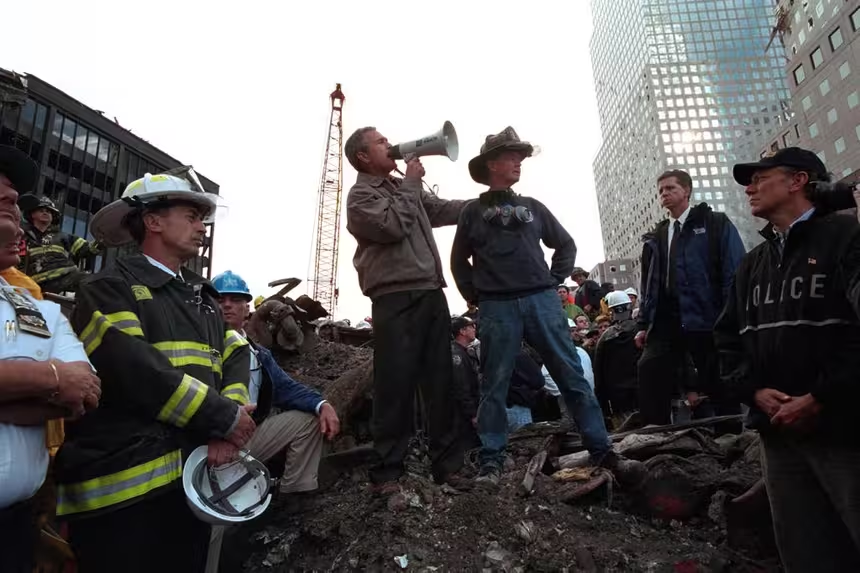
10 big stories Washington Week covered
Washington Week came on the air February 23, 1967. In the 50 years that followed, we covered a lot of history-making events. Read up on 10 of the biggest stories Washington Week covered in its first 50 years.Providing Support for PBS.org
Learn Moreabout PBS online sponsorshipJeffrey Goldberg: The midterm elections are just a few months away, but why talk about the future when you could sow confusion about an election held six years ago?
And why work to encourage broad participation in our democracy when you could manufacture unsupported doubt about the integrity of American election systems?
Tonight, we ask the question, when is hindsight not 20/20, next.
Good evening and welcome to Washington Week.
I want to start by giving you a sense of what it's like to live in the Washington reality distortion field these days.
Among the issues facing Americans and their leaders this summer are matters of enormous domestic and international importance, including the Iran war, the Russian war against Ukraine, the future of NATO, energy prices, massive wildfires, the coming A.I.
jobs crisis, and really, really malignant lettuce.
But what are we talking about in Washington, and what are we going to talk about tonight?
Our president's obsession with alleged election corruption.
On Thursday, he spoke to the nation and claimed, without providing evidence, that our election system is in terrible danger.
He has brought the country's intelligence agencies into this campaign, and released declassified documents that he says proves his point, but don't prove it at all.
Why is he doing this, and why now?
For answers, I'll ask our panel tonight.
Anne Applebaum is a staff writer at The Atlantic, Laura Barron-Lopez is a White House reporter for MS NOW, Stephen Hayes is the editor and CEO of The Dispatch, and Carl Hulse is the chief Washington correspondent for The New York Times.
Okay.
No lettuce jokes.
That was my one lettuce joke for the night.
I'm sorry.
And I know it's a very serious issue, so I won't talk about it anymore.
Laura, you get to start.
We're going to get to motive in a minute, but explain the message that President Trump was trying to transmit to the country last night.
Laura Barron-Lopez, White House Reporter, MS NOW: Well, one, President Trump, for him, this was about personal vindication.
This was about him trying to, again, just convince the public that his lie about the 2020 election being stolen is true.
That was him.
He is fixated on 2020.
Sources close to the White House have told me it's what keeps him up at night.
He wants to be talking about this.
That's one.
But the other main message is he was trying to show, with this release of declassified documents, the likes of which many, you know, intel experts and former analysts say they've never seen any release like this in their careers, the big message was, look, our elections are so insecure that, essentially, he needs to gain more control over it.
And so this is part of his larger campaign to gain as much control over American elections as possible, and he has had his agencies doing many things along the way to try to take control from states, which they have the constitutional authority to control elections to take control away from them ahead of the midterms.
Jeffrey Goldberg: Right.
Anne, what evidence is there actually that our elections are in danger from foreign interference or from other nefarious players that Donald Trump believes exist out there?
Anne Applebaum, Staff Writer, The Atlantic: So, there's no evidence that any foreign nation has ever interfered an election in the sense that they've changed votes or affected voting machines or altered the outcome of an election.
There's no evidence at all, and actually, he didn't produce any.
I mean, there are foreign countries who try to shape the narrative, who try to intervene in our social media and try and support one candidate or another.
And, ironically, the one country that has done this rather successfully and at great length over many years wasn't mentioned by Donald Trump, and that's, of course, Russia, who went out of their way to support him.
So, you know, there's no other -- and he didn't mention them, and other than that, there isn't any evidence.
There have been, in our system, there is a series of institutions that have been created going back decades actually, that are designed to prevent foreign interference and other interference.
And, actually, the Trump administration has pretty systematically dismantled them starting with the Cyber Defense Agency, which had an election monitoring ability, and they've shut that down.
There's something called the Election Electronic Registration Information Center, a kind of non-profit that helped states manage their electoral rolls.
There's an electoral -- Election Assistance Commission, another bipartisan commission.
I mean, I could go on and on.
There are multiple things have been created to make the system safe, and, actually, the Trump administration has pulled them apart one by one.
Jeffrey Goldberg: Steve, what was the purpose of the speech casting forward?
Stephen Hayes, Editor, The Dispatch: Yes.
Well, I think you framed it the right way.
I think the speech was all about looking forward.
The speech itself wasn't the main thing last night.
It wasn't -- it was about 2020, but it wasn't really about 2020.
It was about the security of elections in the past, but it wasn't really about that.
I think it was all about what's to come, and I think it sets up what we could see from this president going forward.
If you look back at the way that President Trump has tried to intervene in elections in ways that are both, you know, uncommon, illegal, unethical, sometimes legal, he's very concerned about the outcomes in 2026.
He doesn't want to be impeached.
He believes that if Democrats take the House, they will move to impeach him quickly.
So, he's done a number of things in his past that suggest he's very open to interfering in the elections in the months to come.
Jeffrey Goldberg: People have talked about this as the opening shot in a campaign to regularize or normalize the idea that the Trump administration, even in the midterms, will come in and meddle in untoward ways with local elections.
Stephen Hayes: Yes.
Jeffrey Goldberg: Elections of Congress.
Is that something that's worth worrying about, in your mind?
Stephen Hayes: Yes, look, I mean, at this point, if you look back on what the president has done, this stuff is not hypothetical.
It's not speculative.
You look at the fact that he, you know, has tried to seize voting machines in 2020, that he threatened his own vice president, that he called the Georgia secretary of state and asked him to find votes so that he could win in Georgia, that he summoned a riot on January 6th to try to stop certification.
These are things the president has done.
They're extreme.
At this point if you think it's alarmist to worry that he's going to do something, you're wrong.
It's naive to worry to not be concerned that he won't.
Laura Barron-Lopez: And all those things are also more things he did during his first term.
This, I wouldn't call it an opening salvo because since the start of the second term, he has been doing things.
The Justice Department has been threatening local elected officials with prosecution if they feel like, oh, you allowed a non-citizen voter to stay on your voter rolls.
The DHS just followed that up with more threats today.
Jeffrey Goldberg: Yes.
Laura Barron-Lopez: So all along the way, also Tulsi Gabbard going to Fulton County alongside FBI agents this term to seize ballots, yes, they were about 2020, but it's all about laying the groundwork for actions they may take ahead of the midterms.
Jeffrey Goldberg: Carl, I want to talk to you about what's going on the Hill, but you're right.
It's just interesting.
It just strikes me, listening to you and listening to what you just said about Tulsi Gabbard.
The idea that the director of National Intelligence has dispatched herself to a local voting jurisdiction in Georgia is quite extraordinary, and sometimes we lose -- well, novel and unprecedented, and we lose the -- Carl Hulse, Chief Washington Correspondent, The New York Times: And that's why it came up in the hearing this week for her successor.
Jeffrey Goldberg: Yes.
No, I want to ask you about that hearing.
I also want to ask you, at the end of the speech, Carl, he called for Republicans to pass the SAVE America Act, what he's calling the SAVE America Act.
It doesn't seem likely that he's going to get his SAVE America Act.
A, what is it, and, B, what is the general tenor of the conversations you're hearing among Republicans on the Hill about this, this hard pivot to talking about 2020 and forward?
Carl Hulse: Well, the Save America Act has become a big priority of the president.
It would change some election rules, probably make it harder for people to register to vote and vote, require I.D., citizenship, really crack down on vote by mail, which, of course, is a huge thing in a lot of states.
Jeffrey Goldberg: Well, when you say citizenship, only citizens can vote?
Carl Hulse: You would have to prove your citizenship to register to vote.
Laura Barron-Lopez: And it can make it harder for married women whose names are different on their birth certificate.
Carl Hulse: But how that -- and how that would be sort of enforced.
Jeffrey Goldberg: Right.
Carl Hulse: So, the -- and it's stuck in the Senate because the Democrats don't want anything to do with this and the Republicans, despite the president's regular urging them to get rid of the filibuster, John Thune does not want to get rid of the filibuster.
Jeffrey Goldberg: Over this?
Carl Hulse: Yes.
Certain -- or at all, but certainly not over this.
So, there's a lot going on.
So, today, talking to Republicans, you know, they wish the president would move on from this, right?
It's not going to happen.
It's just causing them a lot of grief.
But they were also -- really interesting to me, you know, we all know these big presidential set pieces usually come with a big, coordinated effort with the Hill, and everybody talks, and the statements to bolster.
Well, the silence was deafening except for the people who said, I talked to Lisa Murkowski.
She's like, I'm underwhelmed by this.
It was nothing new.
John Cornyn at an event said, this is all old stuff.
They weren't moved by this at all.
Jeffrey Goldberg: Right.
Carl Hulse: So, you know, Republicans traditionally want states to run the elections.
They don't want the federal government to run the elections.
So -- and then lastly on kind of what you were talking about, so Markwayne Mullin followed up the speech today with a briefing -- Jeffrey Goldberg: The new secretary -- Carl Hulse: Homeland Security.
And we had been hearing a lot before the speech that the president was going to say more than he said last night, because you're right, he didn't say they have changed votes.
Markwayne Mullin kind of picked up where Trump left off last night today saying, we know countries have the ability to change votes, even though I'm not sure that's true, and that, you know, we might go out and arrest state elections officials who don't cooperate with us.
So, I mean, obviously -- Jeffrey Goldberg: Well, that's taking it to another level entirely.
Carl Hulse: Right, he did say it.
Now, on the other hand, Democrats are really preparing for this, because they think this is coming.
They're all organized.
They have a lot going on to get ready for this.
Jeffrey Goldberg: I want to talk about the non-political part of that, the organization that you're talking about, but I also want to ask you about the politics of it.
Watch this for a moment.
This is some Democrats talking about what's going on.
Sen.
Mark Warner (D-VA): Do you deny that Joe Biden won the 2020 election?
Sen.
Angus King (I-ME): Who won the 2020 election?
Sen.
Kirsten Gillibrand (D-NY): The 2020 election.
Sen.
Mark Kelly (D-AZ): The 2020 election.
Sen.
Jon Ossoff (D-GA): Who won the 2020 election?
Jeffrey Goldberg: The point being the Democrats seem to think that there's a way to capitalize on this obsession.
Carl Hulse: Yes.
Jeffrey Goldberg: And my question to you is how much are they going to jujitsu this in a kind of way and take that obsession and turn it against -- Carl Hulse: Jon Ossoff, who you saw there at the end from Georgia, kind of expected to be a target of the speech last night and wasn't.
But he has turned this into a blockbuster for him, really kind of elevating his presence out there.
Yes, so I think they see this as a rallying cry.
You know, the more that they see the -- they can tell voters the administration's trying to take away your vote, your ability to vote, it rallies people, they think.
So, in some ways, they think it's a benefit.
But they're all -- they're seriously concerned about what might happen after the election with seating members and there's a lot.
Anne Applebaum: Because I think it's really important to think, understand that this is not just about what happens before the election.
Carl Hulse: Correct.
Anne Applebaum: Yes.
It's about creating a narrative about what will happen after.
And so the reason they're talking about non-citizens voting, even though study after study after study shows that almost no non-citizens ever vote, including Heritage Foundation studies.
The reason they're doing that is that when they get a result they don't like, they will say non-citizens voted, like we said they were going to.
So, it's a preparation.
Laura Barron-Lopez: And just to me, more important than the Democrats asking was Clayton's non-answer, was Clayton not -- was essentially refusing to say that Joe Biden won the election.
And, again, we are talking about DNI, director of National Intelligence, that's the position he would be in.
The current acting one, Bill Pulte, just like Tulsi Gabbard, he was the reason that the president went forward with releasing all of these declassified documents.
That acting director of National Intelligence, all of the sources told us at MS NOW, was one of the biggest advocates constantly in the president's ear, bringing diagrams in, telling him, we need to release these documents.
And, again, yes, it's not about 2020, ultimately.
It's about justifying any actions they may take right around November, after November, all around the election.
Jeffrey Goldberg: Let's just watch with me for a minute Senator Gillibrand in the hearing for Clayton this week.
Kristen Gillibrand: You can understand why this committee is concerned that you won't say Biden won the election, because it just reeks of this insecurity by the Trump administration about election security.
So, when you say election security is important to you, I want to make sure that you understand the ODNI has a responsibility towards cybersecurity, towards election security, that's not about voter fraud but about the influence of foreign countries on our election security.
Do you understand that?
Jay Clayton, Director of National Intelligence Nominee: Absolutely.
Jeffrey Goldberg: Stay on Clayton for a minute.
He's not a well-known figure.
You can introduce him a little bit in your answer.
But what does this tell you, this general atmosphere and this specific hearing, about his ability to be a neutral arbiter and analyst of the facts related to foreign interference?
Laura Barron-Lopez: Right.
Well, he has no intelligence experience.
Not that stops the president from nominating anyone for positions that have no experience for what they ultimately -- Jeffrey Goldberg: I have no television experience, so here we go.
Laura Barron-Lopez: Right.
I know.
We can all tell.
Jeffrey Goldberg: Yes.
I know.
I appreciate that.
Laura Barron-Lopez: No.
But he -- I think that it doesn't bode well for independence because we have seen that, again, with his answers to the committee, he was not willing to give a direct answer.
Also, he was behind the subpoenas of The New York Times reporter.
Jeffrey Goldberg: Right.
Laura Barron-Lopez: So, I think that he is showing that he is willing to do the president's bidding, and, you know, they're talking to an audience of one.
Jeffrey Goldberg: So, Steve, this is a really fascinating question.
Now we're getting into the psychology of this.
Let's go to previous presidencies.
There are certain issues, let's say, that were no-go issues.
If you didn't agree with the president on X, you couldn't work for him.
You could not be opposed to the free market and go to work for Ronald Reagan, just a random example.
It seems now, and it has seemed for a while, that if you don't play along with the delusion -- the either earnestly felt delusion on the president's part or the manufactured delusion that he won 2020, you can't work in this administration.
Stephen Hayes: Yes.
Jeffrey Goldberg: This is what might be called a novel situation in American democracy.
Stephen Hayes: I mean, novel is probably the nicest way to put it.
Look, I think it's very worrisome.
Jay Clayton is somebody who's widely respected among Republicans, Republicans not just in the MAGA world, but Republicans who are skeptical -- Jeffrey Goldberg: Serious guy, serious lawyer.
Stephen Hayes: Yes, even Democrats.
He has -- Jeffrey Goldberg: He had -- yes.
Stephen Hayes: He has a history.
He has a history.
They're never-Trump Republicans, think very highly of him.
And to watch him, you know, unwilling to answer this very simple question in a straightforward manner, that is what you need to.
Jeffrey Goldberg: Pure speculation I'm asking for, but what are the chances in your mind that Jay Clayton, someone you've studied, believes that Joe Biden didn't win?
Stephen Hayes: I mean, no, zero.
Jeffrey Goldberg: Zero, right?
Stephen Hayes: Nobody serious believes that anymore.
Look, remember, it's important to remember the president's own campaign hands didn't believe that he won the 2020 election.
They were the ones who were telling him.
His White House counsel was telling him.
His attorney general was telling him.
Nobody serious believes this.
And to watch somebody like Jay Clayton, who's going to be taking the position that you mentioned, not being willing to state the obvious, I think, is really problematic.
It's also the case, we should point out that in interviews, not just the high level, not just in Senate hearings, but in interviews of lower-level employees being hired by the administration, they too are asked usually as the first question, did Donald Trump win the 2020 election?
They have to say yes.
Jeffrey Goldberg: Well, that's what I mean.
It's become the equivalent in 1942 of saying to somebody who wants to work in the administration, you do support our war effort against Japan and Germany.
I mean, it's a baseline -- Laura Barron-Lopez: And people are being regularly polygraphed.
Jeffrey Goldberg: Right.
Anne Applebaum: It's an authoritarian test.
Jeffrey Goldberg: Well, this is what I wanted to ask, Anne.
You go into this because you have broad experience covering elections and threats to democracy in other countries, including other countries that have experienced authoritarianism.
What are you seeing here that's novel, and what are you seeing here that's not novel?
Anne Applebaum: So, it's not at all novel that there is a kind of myth or a lie that everybody has to pay lip service to in order to demonstrate their loyalty.
So, Trump also, at some level, knows it's a lie, or he -- and he -- but he's making people go along with the lie because that proves they'll be loyal to him no matter what, and that they won't -- they're not bothered by reality, by law, by anything else.
Carl Hulse: Well, and this went all the way to all the judicial nominees have been caught in the same trap, they have to say it.
Now, the thing about Mr.
Clayton, Democrats wanted to support him and move him along quickly because they want to replace the acting director in there.
But this -- that hurt him.
That hearing hurt him with Democrats.
And he's not going to get the Democratic votes that he would've before.
Jeffrey Goldberg: One last question on this, Steve.
Does it mean anything that the president didn't outright say last night on Thursday, on his -- in his speech, that the 2020 election was stolen?
I mean, he didn't do the usual -- Laura Barron-Lopez: He used the words rigged and stolen.
Jeffrey Goldberg: -- full Monty -- no, but it wasn't -- but he didn't go -- and you're right, he didn't go as far.
Stephen Hayes: He didn't go into detail, and he didn't spin the crazy conspiracies.
He didn't get into Venezuela, some of the things that we were led to believe he might.
Jeffrey Goldberg: Yes.
Stephen Hayes: I think it's very interesting.
Jeffrey Goldberg: He stuck to a script that had been written with him, but -- Stephen Hayes: Well, and it comes after the administration has gone to great lengths.
I mean, we talked about Tulsi Gabbard going to Georgia to seize ballots, to do deep investigations of what had happened in 2020.
And the fact that they've been focused on this, that this is what keeps the president up at night, that they've spent time and attention on this, and that in this moment, the president didn't make that case, I think, is pretty telling.
Jeffrey Goldberg: Right.
Although, I will say, in one of my encounters with the president, I asked him, you know, why can't you drop this?
You're already the most successful American politician of the 21st century.
You've won two elections.
And he said, three.
And I said, exactly.
Why do you have to?
And he said, it was very interesting, I thought this was interesting psychologically, he said, I don't want to keep bringing this up, but I believe in the truth so deeply that I feel that I can't let people lie about who won in 2020.
It was -- and to go to your point, we don't know if he believes it or if he believes that he believes it or some kind of -- it's too -- it's a very complicated thing.
But the point of the fact is that it is the central preoccupation.
Carl Hulse: And it's influencing a lot of events.
Jeffrey Goldberg: And it's going to influence the midterm.
Laura Barron-Lopez: But if I could just add one more thing, because a source close to the White House who used to work in the White House told me that there are more people like Clayton maybe who don't believe it around him, including in the White House right now.
But they will not stick their heads out because they know that this is the one thing that he wants, that he believes.
Jeffrey Goldberg: This is the red line.
Laura Barron-Lopez: So, even if they don't want Pulte in the Oval talking to the president, convincing him to declassify all these documents, they are not willing to fight on it.
Jeffrey Goldberg: Right.
Carl, I want to turn to the death of Senator Lindsey Graham, the untimely death of Senator Lindsey Graham, one of the most influential members of the Senate, one of the most influential allies of Donald Trump.
Talk about his legacy for a minute.
Carl Hulse: Well, I mean, definitely a big character in the Senate that has fewer of them these days.
You know, he was -- he filled a lot of roles.
He was a dealmaker, but he was also a hard right on foreign policy, very, you know, pro-U.S.
intervention.
He obviously learned at the knee of John McCain and Joe Lieberman traveling the world, trying to insert themselves into all these foreign policy disputes.
The Senate was rocked by this.
I mean, people were really kind of stunned.
John Thune relied on Lindsey Graham as a conduit to the White House.
So, you know, the question about Lindsey Graham is also, what happened to Lindsey Graham, right?
Someone who had criticized the president so harshly, ran against him, sort of acted like after January 6th that he was going to break with the president and didn't break with him.
Lindsey Graham, as I said in the story, and a lot of people have also noted, he was in search of relevance.
Lindsey Graham wanted to be in the middle of everything on Capitol Hill, and he kind of did what he had to do -- Jeffrey Goldberg: Succeeded at that.
Carl Hulse: -- to stay in the middle of it.
Jeffrey Goldberg: Yes.
Carl Hulse: And part of that was you know, appeasing the president and having a relationship with him.
Now, members on both sides give him credit for keeping President Trump and the administration behind Ukraine when there was a lot of pressure, on the outside, not.
Jeffrey Goldberg: Anne, you've thought about this, last word to you on this.
A lot of us met Lindsey Graham when he was the sidekick, wing man, Sancho Panza, to John McCain, a man who loathed Donald Trump and everything that Donald Trump stood for.
You've written a lot about this new age of politics.
How do you interpret Lindsey Graham's legacy?
Anne Applebaum: I think Lindsey Graham will be remembered for only one thing in the end, and it won't be Ukraine, and it won't be Iran.
Jeffrey Goldberg: His support for Ukraine?
Anne Applebaum: Yes, it won't be about any or anything to do with foreign policy.
It will be his decision to abandon the ideals that he held for so long.
He was very loyal to the military.
He had an idea of, you know, propriety in politics.
He had an idea of America playing a role as a leading democracy in the world.
He abandoned all of those things in exchange for having power and influence and helping to legitimate Donald Trump.
And I really think in the long run of history, that's how he'll be remembered.
Jeffrey Goldberg: One last question to you on the Ukraine piece.
This is a blow to the Ukraine cause on the Hill.
Is that fair to say?
Anne Applebaum: It's not clear to me that he made that much difference.
You know, he had this sanctions bill.
Almost everything in the sanctions bill that would put sanctions on Russia can be done without the bill.
So, it was more of a symbolic game rather than real influence as far as I could see.
Jeffrey Goldberg: Carl, you're definitely right that he was larger than life in a Senate.
That seems to be getting smaller.
Carl Hulse: Yes, the characters aren't quite there the way they used to be.
Jeffrey Goldberg: No?
Carl Hulse: And, you know, and he was actually -- love him or hate him, he was a very funny person, right?
And there was a lot of humor with him.
And now his sister is serving in his stead, and we'll see what happens there.
Jeffrey Goldberg: Right.
We are going to have to leave it there.
I'm sorry to cut the conversation off, but I want to thank our guests for joining me, and thank you at home for watching us.
You can read Anne's story on Lindsey Graham's legacy at theatlantic.com.
I'm Jeffrey Goldberg.
Good night from Washington.
 New
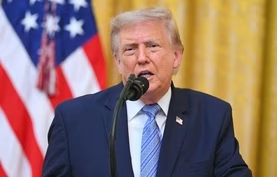
NewThe president’s obsession with alleged election corruption
Video has Closed Captions
The president’s obsession with alleged election corruption (12m 50s)
 New
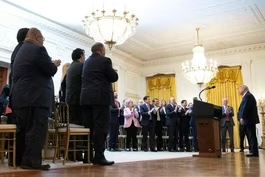
NewTrump’s election claims become loyalty test for officials
Video has Closed Captions
Loyalty to Trump’s election claims becomes requirement for administration members (10m 52s)
Providing Support for PBS.org
Learn Moreabout PBS online sponsorship New Episode
- News and Public Affairs

Top journalists deliver compelling original analysis of the hour's headlines.

- News and Public Affairs

FRONTLINE is investigative journalism that questions, explains and changes our world.
 New Episode
 New Episode
 New Episode
 New Episode
 New Episode
 New Episode

 New Episode
 New Episode
Support for PBS provided by:
Major funding for “Washington Week with The Atlantic” is provided by Consumer Cellular, Otsuka, Kaiser Permanente, the Yuen Foundation, and the Corporation for Public Broadcasting.