
Who are We?
Episode 1 | 54m 19sVideo has Audio Description
After young Thoreau fails at a career in writing, he retreats to a cabin in the woods.
Henry David Thoreau’s early life unfolds as a changing nation struggles to live up to its ideals, while industry threatens the landscape. After attending Harvard College, he was inspired by Ralph Waldo Emerson to become a writer. Then, a family tragedy deepens his bond with nature, and, disillusioned with society, he builds a cabin in the woods to live simply, deliberately, quietly — and write.
From
Problems playing video? | Closed Captioning Feedback
Problems playing video? | Closed Captioning Feedback
Episodes presented in 4K UHD on supported devices. Major funding for HENRY DAVID THOREAU was provided by The Better Angels Society and its members: The Keith Campbell Foundation for the...
Who are We?
Episode 1 | 54m 19sVideo has Audio Description
Henry David Thoreau’s early life unfolds as a changing nation struggles to live up to its ideals, while industry threatens the landscape. After attending Harvard College, he was inspired by Ralph Waldo Emerson to become a writer. Then, a family tragedy deepens his bond with nature, and, disillusioned with society, he builds a cabin in the woods to live simply, deliberately, quietly — and write.
From
Problems playing video? | Closed Captioning Feedback
How to Watch Henry David Thoreau
Henry David Thoreau is available to stream on pbs.org and the free PBS App, available on iPhone, Apple TV, Android TV, Android smartphones, Amazon Fire TV, Amazon Fire Tablet, Roku, Samsung Smart TV, and Vizio.
Share Meditative Moments from the Film
Explore the PBS Giphy collection for Henry David Thoreau.Announcer: Major funding for "Henry David Thoreau" was provided by... The Better Angels Society, Jeff Skoll, the Mansueto Foundation, Tyson Foods, and The Arthur Vining Davis Foundations.
Funding was also provided by the Tyson Family Foundation, The Neil and Anna Rasmussen Foundation, and by The Better Angels Society members: The Keith Campbell Foundation for the Environment and Mark A. Tracy.
Additional funding was provided by Roxanne Quimby Foundation, Jim and Mona Mylen through The HeartSpace Fund, and Elizabeth Kenny.
[Clock ticking] ♪ ♪ Michael Pollan: Every now and then, a sentence, a paragraph, an essay continues to speak to people and has some value in the present.
Kristen Case: There is something incredibly powerful about taking someone else's words inside yourself, and your body is involved in those words, in making those words real.
Sandra Harbert Petrulionis: Words start wars.
They save people, and they convert us from thinking one way to realizing that we're wrong in what we think.
Rebecca Solnit: The stories we tell, the ways we think about the world have huge consequences, and so do our actions.
Ideas shape reality, and they can change the world.
Narrator: His life was a relentless search for truth.
His words have inspired revolutions, social movements, and environmental actions all around the world for more than 150 years.
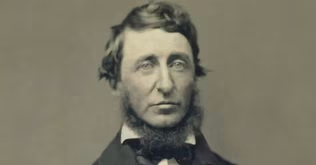
His name was Henry David Thoreau.
♪ [Birds chirping] ♪ [Crow cawing] Henry David Thoreau: I wanted to live deep and suck out all the marrow of life, to live so sturdily and Spartan-like as to put to rout all that was not life, to drive life into a corner and reduce it to its lowest terms, and, if it proved to be mean, why then to get the whole and genuine meanness of it and publish its meanness to the world; or if it were sublime, to know it by experience, and be able to give a true account of it in my next excursion.
♪ Clay Jenkinson: Most people today would say, "Why am I not happy?"
They realize that the path that they took to happiness has not precisely worked out for them.
Thoreau was trying to make sense of life.
He lived exactly the way he wanted to live, and there was an enormous freedom for him that most people just don't get.
The things he's getting at were mostly ignored then, and they're mostly ignored now, but Thoreau understood that language matters.
♪ [Steam whistle blows] Narrator: Henry David Thoreau wrote about the impact of industrialization on nature and society, the hypocrisy of slavery in a country that declared all men equal, and the mindless pursuit of wealth, which he said led to lives of quiet desperation.
So much of what we spend our lives and our days doing we don't truly care about, and yet, somehow we've found ourselves in the middle of a life with obligations.
[Indistinct chatter] Rebecca Kneale Gould: People don't know where to find meaning, and they don't take the time to try to find it, which Thoreau says is essential.
You can't even ask the deep questions if you don't stop to figure out what the deep questions are.
Michael Pollan: Our lives are overcomplicated.
It's so easy to lose sight of what matters.
His big project as a writer is to wake us up.
Narrator: He spent his time observing, contemplating, and experimenting, including two years in a small house he built near a pond, where he tried to live a simple, spiritual, and intentional existence.
He never stopped asking questions and never settled for easy answers.
"Rather than love, than money, than fame," he wrote, "give me truth."
Clay Jenkinson: The program of his life is to seek other ways of being and of connecting.
It involves distancing yourself from norms until you begin to see things that you could never have seen in any other way, things that most people can't see.
Narrator: Thoreau was a lecturer, philosopher, pencil-maker, and surveyor, a teacher, scientist, and an abolitionist, but above all, he was a prolific writer.
His journal alone was more than 2 million words.
He wrote two timeless manifestos, one on discovering spiritual truths in nature and the other on a citizen's obligation to stand up against injustice, two seemingly different doctrines that Thoreau would prove are profoundly interconnected.
Pico Iyer: I think if 20 people read Thoreau, each one of us will get something different, and yet what they're getting from Thoreau, I think, is very much the same-- a sense of possibility, a new dawn, a reminder to think about the essential facts of life.
There's so many ways in which his work and his life and his ideas and his creativity and his passion and his vulnerability shape our world today.
Narrator: His life was rife with contradictions.
He yearned for solitude but became a public figure.
He believed in the preservation of wild nature, yet knowingly contributed to its destruction.
He was committed to freedom and equality for one race of people but often failed to take action against the inhumane treatment of another.
Ultimately, his life would be reduced to legend and his complex prose to one-liners, and while he rarely traveled far from his hometown of Concord, Massachusetts, he became a man of the world.
Rebecca Solnit: Life can always be endless adventure and discovery, even if you've only traveled widely in Concord, and Thoreau is a genius at packing a thousand miles into a single step in how he writes.
♪ Henry David Thoreau: Man thinks faster and freer than ever before.
He, moreover, moves faster and freer.
He is more restless because he's more independent than ever.
The winds and the waves are not enough for him.
He must ransack the bowels of the earth, that he may make for himself a highway of iron over its surface.
[Clattering, bells ringing] [Birds chirping] Think of our life in nature-- daily to be shown matter, to come in contact with it-- rocks, trees, wind on our cheeks, the solid earth!
the actual world!
The common sense!
Contact!
Contact!
Who are we?
Where are we?
♪ Kristen Case: And he never let those questions settle, and I think that makes him relevant always, in every time, but particularly in a time like ours, where we are really thinking about what it means to be a human being on this planet.
Clay Jenkinson: But you have to open the book, and Thoreau says, "All right.
I've got your attention now.
Keep reading, and I'll help you sort this out."
[Water rippling] [Birds chirping and squawking] ♪ [Rooster crowing, dog barking] Narrator: Henry David Thoreau was born July 12, 1817, on his grandmother's farm in Concord, Massachusetts, a town some 18 miles northwest of Boston.
Man: Fire!
[Musket fire] The United States of America had won its independence from England only 34 years earlier.
Sandra Harbert Petrulionis: The early 1800s were a very introspective and also a very outward time for America.
It was growing.
It was trying to figure out what it meant to be a democratic republic and how to improve this democratic republic.
Narrator: Henry was the third of 4 children of John Thoreau and Cynthia Dunbar.
He had an older sister, Helen, and a younger one, Sophia.
His older brother, John Jr., was his closest friend.
After two years of dwindling harvests and the failure of a dry goods store, according to legend, Henry's father John was forced to sell his wedding ring to make ends meet.
The family shared a love of the outdoors and took day-long walks in the Concord countryside.
Cynthia encouraged the children to pay close attention to nature's sights and sounds.
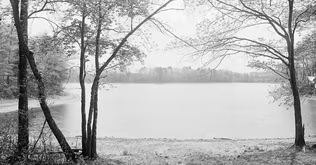
When Henry was 5 years old, she took him to nearby Walden Pond.
He would later say, "That woodland vision for a long time made the drapery of my dreams."
[Loon calling] Beth Witherell: Thoreau's interest in what was beyond what he could see started very early.
His mother came up one night and said, "Henry, why aren't you asleep?"
And he said he was looking at the stars, trying to see God behind them.
Cristie Ellis: He once said, "This is a world where there are flowers," and you can feel his wonder at that fact.
Imagine how many different worlds there could be on how many different planets, and we are the lucky idiots who landed on the world with flowers.
Narrator: As a boy, Henry was aloof, introspective, and intensely curious.
His brother John was athletic, charismatic, a jokester, and an instigator of rough and rambunctious games.
Henry usually watched from the sidelines, but he and John were always together, swinging on the branches of a birch tree, climbing nearby Fairhaven Hill to see the sunrise, or down at the Concord River, fishing, swimming, and exploring.
At times, they would also participate in what they called Indian play.
♪ [Drum beating] Henry David Thoreau: John and I had been searching for Indian relics when, with our heads full of the past and its remains, I broke forth into an extravagant eulogy on those savage times.
"There on Nawshawtuct," said I, "was their lodge, the rendezvous of the tribe."
"Here," I exclaimed, "stood Tahatawan."
How often have they stood on this very spot at this very hour?
Lois Brown: He's always keenly aware and curious about where he is.
When he finds an arrowhead, he recognizes it has significance, even when he's a young boy and doesn't yet know fully the history attached to such an item.
John J. Kucich: He's so deeply fascinated by Native people and yet really doesn't understand America's long colonial dispossession.
The Musketaquid people have been living in the Concord area for thousands of years, but the Native people Thoreau knew in Concord were ones he knew, really, by their relics.
Narrator: Henry and John had begun their education by attending a one-room public schoolhouse on the town common.
Then they enrolled in a new private school for promising children called the Concord Academy.
Sandra Harbert Petrulionis: As much as he was busy reading at school, he was in the woods and the local hills.
He had spent so much time in the hills and on the river that he nearly squandered his chance to be a college student.
Narrator: On August 30, 1833, Henry David Thoreau entered Harvard College in Cambridge.
He was 16 years old.
Thoreau was a voracious reader and spent hours in the library, where he began a lifelong habit of copying passages from books for later reference, but his mind was often elsewhere.
Henry David Thoreau: Though bodily I have been a member of Harvard University, heart and soul I have been far away among the scenes of my boyhood, scouring the woods and exploring the lakes and streams of my native village.
Narrator: In his junior year to defray the cost of his tuition, Henry left for a term to earn money as a visiting schoolmaster in the nearby town of Canton.
He boarded with Unitarian minister Orestes Brownson, who believed that social justice was a critical component of America's democratic experiment.
♪ Laura Dassow Walls: And so here he is, and he's still just a kid, walking into the household of this ferociously brilliant firebrand intellectual, and instantly this man starts to talk to him, and they're up until midnight.
This fury that Brownson had that ideas will make you free was something that really struck deep for Thoreau.
Thoreau speaks of it as "the day when my mind was born," and he came back to Harvard a different person-- bold, sassy.
He talked back to his professors.
Can you imagine?
Narrator: After suffering what may have been a sign of tuberculosis, Henry had to take another 5 months off.
[Bells tolling] Thoreau graduated from Harvard College on August 30, 1837.
It was a time of significant change.
♪ Political issues, particularly slavery, were dividing states, communities, and even families.
The Industrial Revolution and the westward expansion of the country were reshaping the lives of many Americans.
Those in the younger generation often had to choose between settling further west, where farmland was more plentiful, or moving into the cities to work in factories.
Robert A. Gross: This is a generation for whom there's no single clear path to follow.
There's not enough land in Concord anymore for most farmers to set up their kids.
Bill McKibben: Mills going up everywhere up and down Massachusetts and New Hampshire, people streaming off the farm to work in those factories, being forced into worlds that they did not understand and were not suited for them.
Thoreau understood what it would mean to the human spirit.
♪ Narrator: In his senior year, Henry had read a book called "Nature" written by a 34-year-old philosopher and fellow citizen of Concord named Ralph Waldo Emerson.
In it, he spelled out an entirely new and radical approach to life.
♪ Ralph Waldo Emerson: The foregoing generations beheld God and nature face to face.
Why should not we also enjoy an original relation to the universe?
Why should not we have a poetry and philosophy of insight and not of tradition, and a religion by revelation to us, and not the history of theirs?
There are new lands, new men, new thoughts.
Let us demand our own works and laws and worship.
Narrator: Emerson had graduated from Harvard Divinity School and later served as a minister in Boston.
He then left the church for a new kind of ministry, an electrifying, spiritual, philosophical, and social movement that was attracting reformers and intellectuals dissatisfied with society's values.
It was called transcendentalism.
Lawrence Buell: Transcendentalism is the first youth movement in American history.
It was a reform movement to incinerate orthodoxies and rebuild from the idea that the individual genius trumped received wisdom.
That was music to Thoreau's ears.
Laura Dassow Walls: Transcendentalism boils down to one very simple but very powerful idea-- that there is a spark of divinity within absolutely every single human being.
[Birds chirping] That means every person who is enslaved, you are enslaving part and particle of God.
Every woman who doesn't have full human rights, every child that you're depriving of an education, you're depriving that spark from developing.
Rochelle L. Johnson: They're questioning religion, education, politics.
They're asking questions about labor and freedom and enslavement.
They're questioning the entire grounds of society.
That's pretty radical.
Narrator: Emerson's book "Nature" had established him as the leader of this new movement.
Henry, now 20 years old, became his protege.
"I delight much in my young friend," Emerson wrote, "who seems to have as free and erect a mind as any I've ever met."
Ralph Waldo Emerson: Brave Henry is content to live now and feels no shame in not studying any profession, for he does not postpone his life, but lives already, and pours contempt on these crybabies of routine and Boston.
Narrator: Emerson saw Thoreau's potential as a writer and encouraged him, asking, "What are you doing now?
Do you keep a journal?"
On October 22, 1837, Thoreau wrote, "I make my first entry today."
Laura Dassow Walls: His journal was meant to catch the flow of thoughts, of observations, and take that little emergent flame of whatever little spark is there and just explore it.
[Indistinct chatter] Narrator: Henry was now living with his family in Concord in a rented house on Main Street, where his mother Cynthia ran a boarding house.
There, she and her daughters, Helen and Sophia, began having informal meetings with a group of abolitionist neighbors, 61 women in all, including Emerson's wife Lidian, the new organization's leader Mary Merrick Brooks, and the one Black founding member Susan Garrison.
They called themselves the Concord Female Anti-Slavery Society.
It is always astonishing to me to look at this point when the abolition of slavery in the United States is really being led by these little marginal groups-- a lot of women dissenters, Quakers, ex-slaves.
They are not nearly recognized enough.
Women get work done.
They move the nation forward.
Henry David Thoreau is living in a household with women who are determined to do something.
The women of Concord to a person will outdo the men of Concord when it comes to actually thinking about justice, and you can imagine that hive of activity.
That defines the Thoreau home.
Henry David Thoreau: October 1837.
To be alone I find it necessary to escape the present.
I seek a garret.
♪ Narrator: Thoreau retreated to a small east-facing room in the attic, where he could write in his journal in relative peace and quiet while gazing out at the forest and hills in the distance.
Henry David Thoreau: I yet lack discernment to distinguish the whole lesson of today, but it is not lost-- it will come to me at last.
My desire is to know what I have lived, that I may know how to live henceforth.
Cristie Ellis: He says, "I feel ripe for something, "yet do nothing.
I feel fertile merely."
He recognizes that you don't know where this is going, but you have to trust that because you love it, it will produce something.
Laura Dassow Walls: And pretty soon, the whole world is reflected in that journal.
It literally becomes the anchor of his entire life, and it is epic.
All the universe is in it.
[Bells tolling] Narrator: Henry's first job after college was teaching at his old grammar school, but after only two weeks, he abruptly quit when a supervisor told him he must strike his students to make them behave.
"I would make education a pleasant thing," Henry said, for both the teacher and the scholar.
Then, with his brother John, he started his own school.
Now no student was physically punished.
They were encouraged to speak up.
Instead of following a static writing curriculum, they kept journals, and to break up long days in the classroom, Henry and John took them outdoors to explore the local woods and fields.
Henry also began working at his father's business making pencils, which later focused on selling its refined graphite.
He would continue working there on and off his whole life.
The business would prosper.
[Horse neighing] Back in 1828, the citizens of Concord had become one of the first towns in the country to establish a lyceum, a program of regular lectures and debates on a variety of topics and open to the general public.
Rochelle L. Johnson: In Henry's time, there are two ways really to get one's thoughts and writings out to the world.
One is publication, and the other is lecturing.
Robert A. Gross: The Lyceum is an agent of progress.
It was common for Lyceum lecturers to challenge the ways people have done things and to say, "No.
The new way to do it is this," and Thoreau is part of this.
♪ Narrator: On April 11, 1838, Thoreau, now 20 years old, delivered his first Lyceum lecture, entitled "Society."
Henry David Thoreau: The mass never comes up to the standard of its best member, but on the contrary, degrades itself to a level with the lowest.
Hence the mass is only... Narrator: In the years to come, Thoreau would speak in towns all over New England.
Henry David Thoreau: I take it for granted... Lidian Emerson: Henry's lecture pleased me much, and I have reason to believe others liked it.
A few Lyceum fees would satisfy his moderate wants, to say nothing of the improvement and happiness it would give both him and his fellow creatures, if he could utter what is most within him and be heard.
Lidian Emerson.
[Thoreau's voice continues indistinctly] [Insects chirping, geese honking] Henry David Thoreau: Saturday, the last day of August, we two, brothers and natives of Concord, weighed anchor and dropped silently down the stream.
[Loon calling] [Water lapping] Narrator: In the late summer of 1839, John and Henry set off on an adventure on the Concord and Merrimack Rivers in a boat they had built together and christened Musketaquid, in honor of the name given to the river lowlands by Indigenous people.
♪ The brothers planned to row, pole, and pull their boat down the slow-moving Concord River and then head up the mighty Merrimack to Hooksett, New Hampshire, where they would continue on land to visit the White Mountains.
Rochelle L. Johnson: This was a camping and hiking adventure to take in the history and signs of community and society along the way.
There's these kind of wonderful stories about them spending hours and hours together playing in the woods.
You can kind of sense this on the Concord and Merrimack Rivers.
Their relationship revolved around being together in the natural world.
[Steam whistle blowing] Rochelle L. Johnson: At times, their adventure was hijacked by what they saw.
♪ Laura Dassow Walls: Traveling up the river was really traveling up a kind of highway for the Industrial Revolution that was going to completely change the New England that Thoreau knew so well and loved so much and change the river forever.
[Water flowing] Narrator: At Billerica, Massachusetts, they came upon a woolen mill powered by a dam that blocked the spawning of fish.
Henry David Thoreau: Who hears the fishes when they cry?
I, for one, am with thee, and who knows what may avail a crowbar against that Billerica dam?
Robert Thorson: When they built the Billerica dam, it stopped the migrations of fish, and what he wanted to do was take a crowbar and take down the dam and let the fishes run free.
[Steam whistle blowing] Narrator: As they made their way up the Merrimack River to Lowell and then to Manchester, New Hampshire, they witnessed a booming textile industry, where young women and children earned only $3.00 a week for working 6 12-hour days.
Henry David Thoreau: I cannot believe that our factory system is the best mode by which men may get their clothing.
As far as I've heard or observed, the principal object is not that mankind may be well and honestly clad, but unquestionably that corporations may be enriched.
Rebecca Kneale Gould: Are nice clothes all about enriching corporations?
Is that why we have these dams?
Is that why we have these factories?
He names it the critique of consumption.
♪ Narrator: Henry and John's journey lasted two weeks, ending with such a strong wind at their backs, they were able to travel the last 50 miles home in a single day.
Henry David Thoreau: Thus we sailed, not being able to fly, making a long furrow in the fields of the Merrimack toward our home, with our wings spread, but never lifting our heel from the watery trench, gracefully plowing homeward with our brisk and willing team, wind and stream pulling together.
Margaret Fuller: We do not wish to say pretty or curious things, or to reiterate a few propositions in varied forms.
The pages of this journal will be filled by contributors who possess little in common but the love of intellectual freedom and the hope of social progress.
Margaret Fuller.
Narrator: In May of 1840, Ralph Waldo Emerson and a small group of transcendentalists started a new quarterly journal to help spread their radical ideas.
It was called "The Dial: a Magazine for Literature, Philosophy, and Religion."
Sarah Margaret Fuller, a highly respected intellectual, became its editor.
Thoreau was determined to write for "The Dial."
Laura Dassow Walls: Which meant that if he was going to be published, he would have to go through the formidable Margaret Fuller, and she was hard on him.
Margaret Fuller: The thoughts seemed to me so out of their natural order that I cannot read it through without pain.
It is true, as Mr.
Emerson says, that essays not to be compared with this have found their way into "The Dial," But yours is so rugged that it ought to be commanding.
Yet I hope you will give it me again.
Narrator: When the first issue came out on July 1, 1840, it included one of his poems and an essay.
Rochelle L. Johnson: We don't see his early writings as fantastic art.
He's writing like a young writer who's working his way to being a great writer.
♪ Narrator: Fuller would become Thoreau's colleague and friend, but she would also remain one of the fiercest critics of his writing.
Meanwhile, after a year of teaching at the new school, Henry's brother John became ill and no longer had the strength to continue.
They closed the school on April 1, 1841.
That same month, Lidian and Ralph Waldo Emerson asked Henry to come live with their family in exchange for doing chores, tutoring their young son Waldo, and serving as Emerson's assistant.
Henry moved in, simply noting in his journal "At R.W.E.'s."
♪ Ralph Waldo Emerson: My good Henry Thoreau made this else solitary afternoon sunny with his simplicity and clear perception.
How comic is simplicity in this double dealing, quacking world?
Everything that boy says makes merry with society, though nothing can be graver than his meaning.
Laura Dassow Walls: Henry was funny and loved to pull people's legs, but underneath all that, Emerson also saw a kind of rebelliousness against convention and against the kind of immorality that he thought was all too common around him, and that was the kind of thing that Emerson looked for.
Narrator: Emerson was pleased with the arrangement, telling a friend that Thoreau was "a writer "you may one day be proud of, a noble youth full of melodies and inventions."
Ralph Waldo Emerson: My dear Henry, will you not come up to the cliff this p.m.
at any hour convenient to you, where our ladies will be greatly gratified to see you?
And the more they say, if you will, bring your flute.
♪ Henry David Thoreau: I am living with Mr.
Emerson in very dangerous prosperity.
Laura Dassow Walls: "Very dangerous prosperity."
Well, a big house with servants, good food, leisure.
I think there was a little bit of resentment there.
He knew very well that his family wasn't living in that kind of luxury.
Creature comforts have a way of allowing us to forget the friction with reality that is at the heart.
I see Thoreau as needing friction.
[Birds chirping] Henry David Thoreau: I seem to see somewhat more of my own kith and kin in the lichens on the rocks than in any books.
Meet me on that ground, and you will find me strong.
[Fire crackling] Narrator: On Christmas Eve, Henry confided to his journal one of his innermost wishes.
♪ Henry David Thoreau: December 24, 1841.
I want to go soon and live away by the pond, where I shall hear only the wind whispering among the reeds.
It will be success if I shall have left myself behind.
[Bird chirping] Narrator: On New Year's Day, John Jr.
cut his ring finger while shaving.
Sandra Harbert Petrulionis: They wrapped it up with a bandage, thinking absolutely nothing of it, and by the time it was looked at by a physician, he pronounced it tetanus, which they called lockjaw at the time, and said there was absolutely nothing anyone could do.
[Wind blowing] Narrator: Henry rushed home.
Laura Dassow Walls: Henry stayed with John right through to the end.
Henry David Thoreau: He was perfectly calm, ever pleasant while reason lasted, and gleams of the same serenity and playfulness shone through his delirium to the last.
Narrator: On January 11, 1842, John Thoreau died in his brother's arms.
He was just 27 years old.
♪ Laura Dassow Walls: They were the closest of friends, the closest of brothers.
For Henry, I think with John's death, half of him died, too.
Then Thoreau collapsed.
Kristen Case: He contracts what looks like also lockjaw, and this turns out to be a kind of sympathetic response of his nervous system.
He was so devastated that he, in fact, died a kind of death himself.
Narrator: Another tragedy struck shortly thereafter.
The Emersons' young son Waldo died suddenly of scarlet fever.
♪ A month later, Thoreau wrote a condolence note, hoping that the slow lifting of his own grief would give Emerson some solace.
Henry David Thoreau: March 11.
Dear Friend, The sun has just burst through the fog, and I hear bluebirds, song-sparrows, larks, and robins down in the meadow.
[Birds chirping] The wind still roars in the wood as if nothing had happened out of the course of nature.
Every blade in the field-- every leaf in the forest-- lays down its life in its season as beautifully as it was taken up.
So is it with the human plant.
♪ Laura Dassow Walls: Henry writes how he hears and feels John's presence everywhere in the woods and fields that they used to travel.
Nature starts to speak to him in a way that it really hadn't, I think, quite before, and he starts to listen, and he is reborn.
After John's death, he writes his first great nature essay, "The Natural History of Massachusetts."
♪ Henry David Thoreau: We must look a long time before we can see.
I walk in nature with a sense of greater space and freedom.
Nature will bear the closest inspection.
She invites us to lay our eye level with the smallest leaf, and take an insect view of its plane.
I explore, too, with pleasure the sounds which crowd the summer noon, and which seem the very grain and stuff of which eternity is made.
To him who contemplates a trait of natural beauty no harm nor disappointment can come.
Surely joy is the condition of life.
Laura Dassow Walls: From then on, he has a mission to spend as much of his writing time as possible to express what he sees and hears and feels outdoors, and I think this is really the birth of the Henry that we know.
♪ Narrator: After returning to live with the Emersons, Thoreau spent as much time as he could reading, writing, and going for long, solitary walks around Concord.
Douglas Brinkley: Emerson mentored him, gave him books to read.
There was this whole other realm of great world literature that Emerson put Thoreau onto.
Narrator: Emerson was now the editor of "The Dial."
He asked Thoreau to work on a new column called "Ethnical Scriptures," introducing readers to Eastern religious traditions like Hinduism and Buddhism.
♪ Clay Jenkinson: Every society faces the fundamental questions of life.
What are we called upon to do in our life?
What happens when we die?
And for most of the history of Western civilization, we have simply accepted the Bible.
What about Islam?
What about Judaism?
What about Hinduism?
What about Confucianism?
David McCullough: I often think about where you could put a lens down on the map of the United States and take what you would get in that lens to reflect the substance and the cast of characters and the importance of and the nature of the history of our country.
Concord, Massachusetts, is to me a good choice.
You not only have the start of the Revolution, with the battles of Concord and Lexington, but you have the creative residences and workplaces of people like Ralph Waldo Emerson and Hawthorne and Louisa May Alcott and Henry David Thoreau.
How these clusters of brilliant people can emerge and flourish and change how we view the world, is one of the mysteries of history.
Mary Merrick Brooks: Years ago, the ladies used to be admonished to leave off meddling with what did not belong to them and stay at home and mend stockings.
I always replied that I would be very happy to do so when the men would fulfill their obligations.
Mary Merrick Brooks, president, Concord Female Anti-Slavery Society.
Sandra Harbert Petrulionis: Women weren't accepted as public speakers at this time, so they directed their efforts to bring in the most fervent speakers.
Frederick Douglass became an important speaker in the area, and Mary Merrick Brooks insisted that he visit Concord.
Narrator: Douglass' impassioned and inspiring speeches would make him one of the country's most renowned abolitionists.
He and Helen Thoreau would become close friends and allies in the fight against slavery.
Sandra Harbert Petrulionis: Presumably, he boarded with the Thoreaus in their home.
It must have been very fulfilling for Thoreau and inspiring.
Kerri Greenidge: One of the things that can be taken from Thoreau's time is to look at ways in which you read and interact with writers and authors and thinkers that you might not traditionally engage with and then listen to them, and then when you think you've listened enough, keep your mouth closed and listen some more, right?
Just opening and appreciating a different lens and appreciating how complex it is because it's better to struggle with that complexity than to imagine that it doesn't exist.
[People shouting] [Hoofbeats, horse neighing] Narrator: On August 1, 1844, the Concord Female Anti-Slavery Society held a rally to celebrate the anniversary of the emancipation of slaves in the British West Indies.
The society convinced Ralph Waldo Emerson to give the keynote address.
[Indistinct chatter] The women had hoped to hold the event at the Unitarian Meeting House, but church officials refused.
Sandra Harbert Petrulionis: The abolitionists by this time, the mid-1840s, in Concord were anathema.
The preachers didn't want them.
The institutional buildings didn't want them.
Narrator: When the event was moved to the courthouse, no one dared ring the bell used for major announcements.
Sandra Harbert Petrulionis: Henry decides, "Well, that's ridiculous," and starts tolling the bell himself.
[Bell tolling] He made it clear that the talk you're about to hear deserves the attention of ringing the bell the same way that we would for a fire or a community emergency.
I like to think of it as symbolically beginning what will be a turn in his own anti-slavery thinking.
♪ Narrator: Then Emerson addressed the crowd.
Ralph Waldo Emerson: If we saw the whip applied to old men, to tender women; and, undeniably, though I shrink to say so-- pregnant women... if we saw men's backs flayed with cowhides-- if we saw the runaways hunted with bloodhounds into swamps and hills-- if we saw these things with eyes, we too should wince.
They're not pleasant sights.
The blood is moral: the blood is anti-slavery: it runs cold in the veins: the stomach rises with disgust, and curses slavery.
Lois Brown: Ralph Waldo Emerson's grandfather enslaved folks, so he's taking accountability for the damage it did and the profit it made, and he inspires others to do more.
[Indistinct chatter] Narrator: Afterwards, Henry arranged to have copies of Emerson's speech printed and distributed, now openly identifying himself as an agent for the Concord Female Anti-Slavery Society.
Clay Jenkinson: He's trying to figure out, "What am I called upon to do?
Is a Lyceum lecture enough?"
And the answer is no, that this situation calls upon us to rise to an unprecedented level of personal moral courage and integrity.
Narrator: Henry was 27 years old and caught up in a myriad of social, political, and personal crises.
As the United States moved westward, the question of the expansion of slavery ripped at the union of the country, dividing states and communities.
Industry and innovation were transforming the landscape.
Train tracks had recently been laid across Concord.
Telegraph lines would soon follow.
Thoreau's writing career had stalled.
He felt himself a failure, and the memory of his brother's death still weighed heavily on his heart.
♪ Henrik Otterberg: In our time, crisis is strenuously to be avoided at all costs, whereas in the older sense, it signified a juncture where a decision should be made.
It's a defining moment.
It's one where one's character, one's mettle, one's courage will be tested, and that is often when he felt himself most fully.
Kristen Case: He was at that point that I think many people have experienced and many people continue to experience, particularly in their 20s, deciding what to do and how to live.
That was daunting for him as it is daunting for people today.
Bill McKibben: It was very easy to just be dragged along by the currents of the world around you, and I think Thoreau was questioning all of that and saying, "I want to figure out for myself "what I actually want to do.
I want to live deliberately."
[Insects chirping] Narrator: It was time for Henry to make real that woodland vision of his childhood, to find a place where he could quiet himself and write at the pond he had visited so many times since he was a boy.
His friends encouraged him.
Ellery Channing: My dear Thoreau, I see nothing for you on this earth but that field which I once christened "Briars;" go out upon that, build yourself a hut, and there begin the process of devouring yourself alive.
Eat yourself up.
Concord is just as good a place as any other.
Ellery Channing.
Margaret Fuller: Dearest Henry, do not say constantly of nature She is mine; for She is not yours until you have been more hers.
Seek the lotus, and take a draft of rapture.
Let me know whether you go to the lonely hut.
Margaret Fuller.
Henry David Thoreau: What I began by reading I must finish by acting.
[Loon calling] ♪ ♪ ♪ ♪ ♪ ♪ Announcer: Next time on "Henry David Thoreau"... Henry David Thoreau: I went to the woods because I wished to live deliberately.
Announcer: an experiment in living... Michael Pollan: I think he went to Walden not to escape human society but to criticize it.
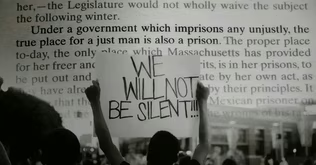
Announcer: a night in jail... Henry David Thoreau: I did not pay a tax to...the state, which buys and sells men, women and children.
Announcer: and a daring expedition... Henry David Thoreau: Not till we have lost the world, do we begin to find ourselves.
Announcer: when "Henry David Thoreau" continues.
Announcer: Scan this QR code with your smart device to watch the whole series and learn more about Henry David Thoreau.
Announcer: The "Henry David Thoreau" DVD is available online and in stores.
The series is also available with PBS Passport and on Amazon Prime Video.
The digital companion soundtrack is also available online.
♪ ♪ ♪ ♪ ♪ Announcer: Major funding for "Henry David Thoreau" was provided by... The Better Angels Society, Jeff Skoll, the Mansueto Foundation, Tyson Foods, and The Arthur Vining Davis Foundations.
Funding was also provided by the Tyson Family Foundation, The Neil and Anna Rasmussen Foundation, and by The Better Angels Society members: The Keith Campbell Foundation for the Environment and Mark A. Tracy.
Additional funding was provided by Roxanne Quimby Foundation, Jim and Mona Mylen through The HeartSpace Fund, and Elizabeth Kenny.
 New
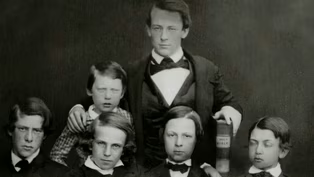
NewHenry David Thoreau and Transcendentalism
Video has Closed Captions
Clip: Ep1 | 5m 9s | Thoreau is introduced to Ralph Waldo Emerson and the radical ideas of transcendentalism. (5m 9s)
 New
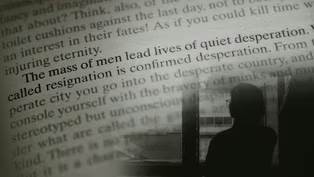
NewAn Introduction to the Words and Life of Henry David Thoreau
Video has Closed Captions
Clip: Ep1 | 8m 20s | Henry David Thoreau spent his life experimenting and contemplating on how to live a good life. (8m 20s)
 New
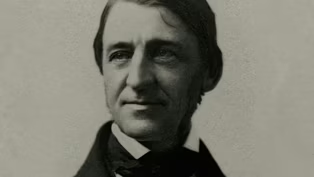
NewRalph Waldo Emerson's Mentorship of Henry David Thoreau
Video has Closed Captions
Clip: Ep1 | 9m 9s | Thoreau moves in with Ralph Waldo Emerson's family, but personal tragedy strikes both families. (9m 9s)
Providing Support for PBS.org
Learn Moreabout PBS online sponsorship












Support for PBS provided by:
Episodes presented in 4K UHD on supported devices. Major funding for HENRY DAVID THOREAU was provided by The Better Angels Society and its members: The Keith Campbell Foundation for the...