
Wilding
4/22/2026 | 1h 12m 35sVideo has Closed Captions
"Wilding" tells the story of a couple who bet on nature for the future of their English estate.
"Wilding" tells the story of a young couple that bets on nature for the future of their 400-year-old estate. The young couple battles entrenched tradition, and dares to place the fate of their farm in the hands of nature.
Problems playing video? | Closed Captioning Feedback
Problems playing video? | Closed Captioning Feedback
Wilding
4/22/2026 | 1h 12m 35sVideo has Closed Captions
"Wilding" tells the story of a young couple that bets on nature for the future of their 400-year-old estate. The young couple battles entrenched tradition, and dares to place the fate of their farm in the hands of nature.
Problems playing video? | Closed Captioning Feedback
How to Watch Wilding
Wilding is available to stream on pbs.org and the free PBS App, available on iPhone, Apple TV, Android TV, Android smartphones, Amazon Fire TV, Amazon Fire Tablet, Roku, Samsung Smart TV, and Vizio.
[Woodpecker drilling] ♪ [Birds chirping and singing] [Birds chirping and singing] ♪ Isabella (VO): It was really just an experiment.
This unloved piece of land was becoming a haven.
♪ ♪ Isabella: They'll be coming in from that very hostile landscape out there, honing in on Knepp.
♪ ♪ Isabella (VO): It's the stuff of fairytales, in a way.
♪ Isabella (VO): The earth coming to life behind them.
[Horse whinnying] ♪ [Chorus of birds calling] Isn't that amazing, that noise?
[Chorus of birds calling] ♪ We hadn't understood any of that when we were farming.
We hadn't seen the magic.
But it happened here.
[Birds chirping] Isabella (VO): It really starts a long time ago.
Charlie and I were very young, in our 20s... and we'd come down, driving through this wonderful traditional farm country landscape.
It was the idyllic picture postcard of England.
["Life's a Gas" by T-Rex playing] ♪ Isabella (VO): Which we now know is something very different.
A landscape of loss.
♪ Life's a gas ♪ Isabella (VO): We were blissfully ignorant of this creeping change that was happening.
♪ I could have burned your fate in the sand ♪ Isabella (VO): That, since we'd been born, in the 1960s, we'd lost millions of birds from the sky.
Our native mammals are heading for extinction.
We're one of the most depleted countries in the world.
♪ Life's a gas ♪ Isabella (VO): For us then, it was normal.
♪ I hope it's gonna last ♪ ♪ [Footsteps clicking] Isabella (VO): Knepp Castle was built in 1812, and it sits in a farming estate of about five square miles in southeast England.
[Weather report in background] Isabella: Charlie was trained as a farmer, and he was ready to take on the family estate.
He was told, literally, you know, when he was 14, that it was going to skip a generation and go straight to him.
♪ Isabella: Such privilege, and yet there was something bubbling up under the surface that we hadn't grappled with.
The estate was under the plough.
Field upon field of crops drenched in chemicals, fertilizer, fungicides, herbicides.
And this is marginal land.
It's famously difficult soil.
It's just not suitable for industrial agriculture.
♪ [Cows mooing] [Cows mooing] It was all intensive farming, all the way down to the lake there, all the way around the house.
All of it was ploughed, sprayed, fertilized.
The only thing keeping us going was subsidies.
And I guess the same with everyone around us.
♪ Isabella (VO): These subsidies were what we farmers depended on, which, amongst everything else, helped pay for all the tons of fertilizer and pesticides.
Charlie: There's you.
Isabella: Oh, yeah.
[Chuckles] In a maize crop.
God, look at the 80's hair.
♪ Isabella (VO): But ultimately, it's not sustainable, and it destroys the very soil, the thing that you depend on.
Charlie: And actually, not having a plan, knowing where the hell we were gonna go, but knowing that I couldn't-- we couldn't continue what we were doing.
It was so depressing.
I mean, you know, the sleepless nights.
Was there no one talking about the soil?
We weren't smelling it.
We weren't going, "Ooh, look at the organic matter in this."
None of that.
But maybe that was just me being hopeless, but... [Chuckles] ♪ Isabella: Our story really is all about the soil.
It's that veneer that covers the planet, that we completely depend on for everything, and we were trashing it.
[Crow cawing] Isabella (VO): There is a sort of disconnect somewhere that you feel in your bones that something isn't right.
[Cows mooing] [Cows mooing] Isabella: It was only as we began to realize how broken the system was that we were able to listen.
And I think the person who really began to make us see the land in a completely different way was Ted Green.
The authority on ancient oak trees.
He grew up very feral as a child.
It's almost like he's symbiotically connected with trees.
He's a mycorrhizal fungi in himself!
In fact, he doesn't wash, because he feels that, you know, that's a terrible thing to do.
That we're all moving bacteria and fungi spores.
And he thinks totally differently.
Ted came to advise us on our oak trees at Knepp.
There was just something not right about them.
And what he saw there really appalled him.
[Distant conversation] Ted: Everywhere I look was a sea of wheat, and I thought, "Ah!
"They're killing them.
They're going to die."
He said, "You know, the roots of these trees "extend 10, 15 meters out beyond the canopy."
Ted: ...beyond the canopy.
Every oak you can see in the landscape, they're all connected by these microscopic filaments.
Mycorrhizal fungi, going through the soil, collecting the minerals and nutrients.
These are very, very fine strands, like cotton wool.
Isabella (VO): What he described was this fizzing chemical circuit board underneath your feet.
The life support system that sustains pretty much all plants on the planet.
♪ ♪ Isabella (VO): Plants and trees can actually talk to each other, communicate about disease, about attack from pests and insects, or about being browsed by animals.
♪ Isabella: And some people say that mycorrhizal fungi can extend over continents.
I mean, they extend for hundreds and hundreds of miles in a system that hasn't been disturbed.
♪ [Farm machine whirring] Isabella (VO): And so, we were chopping through that every year.
And spraying the soil and mycorrhizal fungi with fungicides.
It was us destroying the whole survival system that trees depend on.
The soil eventually becomes dirt, empty of organic life.
[Low rumbling] [Rumbling grows louder] Isabella (VO): And then it requires artificial fertilizer in order to grow anything in it at all.
Ted: A young couple, two children.
Farmers, big acreage.
And to come out here with them and show them trees like this and watch them see the tree differently.
And they got it in one.
And I walked away-- when I went home, I thought, "They're gonna do something.
"Something will happen."
[Birds chirping] Isabella (VO): In a way, we could never look at the land the same way again.
[Birds chirping] Isabella (VO): People like Ted were telling us how connections can ignite a whole chain of events that can fire up the circuit again.
♪ [Birds chirping] Isabella (VO): Creating a landscape that we've been missing for hundreds of years.
♪ Isabella (VO): Ted told Charlie that if he really wanted to understand how a landscape should look, he needed to go to see a radical experiment in Holland called Oostvaardersplassen.
[Animals grumbling] Isabella (VO): Here an ecologist, Frans Vera, had a completely radical idea about how animals integrated with the landscape way before humans began to transform it.
Frans: Science believed that everywhere in Europe was like this, covered with trees.
And I'm saying that's wrong.
Not many people believed my ideas about what the natural landscape would be.
My theory was that a natural landscape is driven by big herds of large animals.
[Animals grunting] Isabella (VO): So, Frans started this extraordinary experiment.
He introduced Konik ponies, a herd of ancient horses, and Heck cattle, a wild breed of cattle.
[Cattle mooing] Isabella (VO): The herds were mimicking the ancient animals that once roamed all over Europe.
Big animals would hold back the trees, turn over the soil and change the land, showing us what Europe might have looked like in the past.
Frans: A landscape which we don't have in our minds anymore.
[Bull grunting] Frans: Even the scientists think you must be almost crazy to adopt such an idea.
"It doesn't make sense.
It will not work."
♪ ♪ Frans: Only when you see it you can believe it.
♪ [Horses whinnying] ♪ Isabella (VO): The trees didn't take over the land.
Instead, a patchwork of different habitats evolved, supporting giant numbers of animals where so few had survived before.
[Stag bellowing] Frans: Charlie came; I didn't know him.
He looked to the wild cattle, the wild horses, and the wild deer.
I didn't expect anything would come from it.
Why would some crazy Englishman adopt such an idea?
He liked it, but I knew from experience you would have had a lot of opposition if you would adopt such an idea.
[Horses exhaling] [Birds calling] ♪ ♪ Charlie (VO): For me, it was rather than battle against nature all the time, what about using this idea on Knepp?
If we come back with this idea, there's a huge change that's going to have to happen.
It's never been done before, and there's a whole lot of government laws and legislation that stops you even thinking like this.
Isabella (VO): If you're a farmer, and particularly if generations have been farming that land, the moment when you decide to stop is kind of weighted with so much guilt and pride.
[Thunder rumbling] [Cows mooing] -[Distant voices] -[Bell ringing] Isabella (VO): The Burrells had been farming this land for over 200 years, for Heaven's sake.
-[Bell ringing] -[Indistinct voices] Auctioneer: Good morning, ladies and gentlemen.
Welcome to Knepp Castle Farm on a very wet September morning.
Selling all their arable and livestock equipment.
For those that haven't been to an auction before we sell by numbers... Isabella (VO): There is all your effort, all your hopes, all your dreams... that you're admitting to the world that it'd all been for nothing.
It's incredibly painful to see.
Auctioneer: Down on my right.
Sold and gone at 25.
Isabella (VO): Charlie just couldn't bear to look at it.
I think he was in his office; he just didn't want to look.
It was all too raw, still.
[Auctioneer continues in distance] ♪ ♪ ♪ Isabella (VO): One way or another, the message from Frans was clear: we were going to tear down the fences, rip it all up, and let the animals run free.
♪ ♪ [Horses whinnying] ♪ [Laughter] Isabella (VO): It was unbelievably exciting when we got the Exmoors.
They just came out bucking, jumping, leaping.
They've got that real Ice Age hefty look about them.
They've just got a wildness about them that... the domesticated animals just don't have.
♪ ♪ ♪ [Cows mooing] Isabella (VO): What we were looking for were ancient breeds.
Cattle that are as close to their ancient ancestor, the aurochs, as we could possibly get.
Instead of wild boar, Tamworth pigs.
Isabella: Here you are.
Off you go, off you go.
[Pigs oinking] ♪ Isabella (VO): For all these animals, this was the start of a journey from tame to wild.
Hello!
Isabella (VO): I remember the pigs more than any of the others.
They seemed so incredibly docile.
♪ [Pig sniffing] ♪ Isabella (VO): Is it possible for these animals, these huge, domesticated creatures, to survive out here at all?
[Pig grunting] [Birds calling and chirping] Isabella (VO): That first winter it was touch and go.
Were these animals really going to survive out there all winter long?
Farm animals, obviously, get fed through the winter.
But ours were going to have to fend for themselves.
[Cows mooing] ♪ ♪ ♪ ♪ ♪ ♪ ♪ Isabella (VO): After all the doubt and worry, it was a complete joy to meet a sow coming along an old hedgerow with a line of little piglets behind her.
[Piglets squealing] ♪ ♪ [Pig grunts] Isabella (VO): As the day began to draw to a close, she very carefully sort of guided them in to the shelter of a sallow grove.
In the leaf litter on the floor of the wood, she started scraping out this little nest for them.
Completely reverting to... to sort of natural behavior.
♪ ♪ ♪ Isabella (VO): They find a little hollow to keep them warm because they're tiny and quite sort of-- quite skinny when they're born.
[Piglets squealing] ♪ ♪ Isabella (VO): But that's not the end of it.
She comes back with mouthfuls of leaves and moss to sort of tuck them in, to cover them up with the duvet at night.
♪ ♪ ♪ ♪ [Piglets grunting] ♪ [Birds chirping] ♪ ♪ [Birds chirping] [Stag grunting] Isabella (VO): And at this time of year, the pregnant cows go off and find somewhere really secluded where they can give birth.
[Birds chirping] [Birds chirping] Isabella (VO): After generations of captivity, this calf is born one step closer to wildness.
[Flies buzzing] [Birds chirping] [Flies buzzing] Isabella (VO): After she's given birth, she needs to replenish her iron, so she'll go straight for nettles.
She won't eat those any other time of the year.
And when the time is right, the cow introduces her young calf to the rest of the herd.
And that is a really moving experience, when you see all the cows, beginning with the matriarch, welcoming it in, and it becomes part of the tribe.
Part of the collective consciousness.
Isabella (VO): These sort of instincts, you realize, are completely unavailable in the farm situation.
[Cows mooing] [Cows mooing] Isabella (VO): Charlie doesn't really like to talk about the past.
He likes to think that we're creating a new landscape for the future.
But we are certainly trying to wake up ancient relationships.
[Horses whinnying] Isabella (VO): Our animals may look like domesticated ponies and shaggy cows, but right from the start, those animals were becoming something completely different.
Isabella (VO): But that's not to say that there weren't a few challenges on this journey from tame to wild.
Not least of all with the rather complicated Duncan.
[Horse exhaling] Isabella (VO): Duncan had absolutely no fear of humans, and he would dung on this pile outside the estate office door.
And they do that as a sort of territorial marker.
One day he actually broke into the office and went straight into reception!
Scared... [Laughs] scared our secretary witless.
Secretary: Go on, out!
Isabella (VO): But he was a problem because he didn't know if he was wild or tame.
He was in this really weird twilight zone.
Isabella (VO): It wasn't just Duncan who was proving too tame.
In those days, we raised money by hosting events like fairs and polo matches.
Commentator: Gotta find a way through here... Isabella (VO): And the pigs started associating marquees with food, obviously.
They would just make a beeline for that tent.
Mingle with the guests... [Laughs] and... and partake of canapes.
[Plates clattering and crashing] [People reacting] Commentator: ...once again picks it up now.
Looking for a passage of play up the field... Isabella (VO): They broke into a catering tent and hoovered up boxes of Mr.
Whippy's powdered ice cream.
Commentator: ...out the front now, taking the ball on, takes attack, controls it, playing towards the goal... Isabella (VO): And then Duncan got involved.
♪ [Commentator speaking indistinctly] Commentator: Oh, looks like we've got a bit of a pitch invasion, a wild Exmoor pony.
Can we just keep calm?
Isabella (VO): These incredibly valuable polo ponies, you know, Duncan was right in there charging in and ready for a fight.
Commentator: We could be in trouble here, ladies and gentleman, but the play is still on play.
Please, ladies and gentlemen, just keep calm.
Isabella (VO): It was always complete chaos.
Commentator: Oh, no.
Oh, no, no, no!
It's making his way over to the marquee!
Oh, he's making his way out, he's making his way out.
Oh, he's taken the table with him!
The lemon drizzle cake's had it!
He makes his way back across the field of play... He's definitely not a polo pony!
♪ Commentator: Looking for a way forward towards the goal.
The ponies all over the pitch.
Isabella (VO): It's funny in hindsight, but this kind of behavior could easily turn public opinion against us.
If they did that, the government could withdraw their support.
The clock was ticking.
Would this motley collection of animals transform the land in the way that people like Ted and Frans were saying they would?
[Stag groaning] Isabella (VO): The first real signs of how these animals could change this little piece of England came from the pigs.
[Pigs oinking] Isabella: The first thing the pigs did was plough down the verges of all the drives.
Just these strips down either side of the drive.
And the reason was because those strips had never been ploughed.
They were the only part of the land that we had never ploughed, never sprayed with chemicals, that were still full of life, that still had the earthworms, the invertebrates, the rhizomes they were after.
It was like showing us what we'd done to the soil.
The only bits that we hadn't farmed were the bits that the pigs made a beeline for.
Suddenly, Charlie was having this awakening.
It was what was happening to the soil that would tell us if this project was going to be successful, if life was indeed coming back.
There's a kind of circle, an ornamental circle, in front of the front door with the stone dog in the middle of it.
Obviously that never had been ploughed.
And they went straight for that and ploughed that up too.
Rootling on the lawn was a bridge too far, I think.
[Laughs] Even Charlie, when he was really trying to get his mind around how to let go, couldn't let go of that grass circle.
He has a stock whip and it's always in with the umbrellas.
I mean, it's quite difficult to turn around a massive sow that is hell bent on rootling up that bit of grass.
[Sow grunting] [Sow grunting] ♪ ♪ Isabella: He only had to do it a few times, though, because they are incredibly intelligent and they remember, and they'll tell their piglets basically, "Don't go there."
You know, "You won't be hassled anywhere else, "but just not that circle."
The pigs rootling up the front lawn really pissed me off.
-They're fast!
-Charlie: They are fast.
You've gotta be on a bike to be able to catch them.
Picture Indiana Jones, um, but on a bicycle.
[Charlie laughs] Right, another... [Mumbling] Oh, one's flown away.
Ned: Weird things do happen.
There was a dead owl in the freezer for about six months next to the ice cream, and... there's a whole load of crap in there.
[Both laughing] I've been storing all this stuff in the freezer.
What we were trying to do is trying to create a database, a beginning of the story, a beginning of where we had started from, so a baseline survey.
You know, what we were seeing in the early stages was absolutely no sign of anything.
And that was a real, wow, what are we... what had we been doing before?
What... You know, what were we thinking, sort of thing.
That sort of feeling of guilt, and... and you, you know-- and we're all, I guess, collectively thinking that now.
We have presided over a period of real destruction, and we need to think again.
We need to-- well, we are, we are beginning to think again.
Isabella (VO): The farmer I married had become a bug collector.
He'd be crawling on his hands and knees up to any cowpat to see what he could find in there.
And this was all really important stuff because from having nothing at all in those cowpats in the days that we were farming, we were now beginning to see them as these new universes of life.
♪ ♪ Charlie: Even in those early stages of what was happening, we were seeing life pouring back in to what was arable fields.
♪ ♪ Charlie: You can feel the relief from the soil as it starts to puff up, and it's all these little creatures that are actually doing it.
And that life that then comes back into those dead soils from after 100 years of ploughing is amazing to watch.
♪ ♪ ♪ ♪ ♪ Isabella (VO): We were doing something that had no goals, no targets, that was just going to basically put all our trust in nature and see what happens.
♪ Isabella (VO): This was all challenging 200 years of agricultural progress, so-called.
And that really needed some careful communication with our farming neighbors.
[Indistinct chatter] Charlie (Actor): Hi, there.
Isabella (VO): Charlie got up and he talked about free roaming animals and soil restoration, and he explained that farming subsidies are going to change.
He showed some images of Knepp and some images of what we expected Knepp to look like in ten years' time.
And so, we thought that there'd be this real buzz of excitement in the room... and there was just stone-cold silence.
Isabella (VO): And then a few of them began to speak up.
-It doesn't feed the nation... -Which is why we're in the problem we're in... Isabella (VO): They said that it was a disgrace.
-It's pretty much worthless.
It's just crazy.
Isabella (VO): Us being irresponsible.
-You can't have wild boar running across the M25.
Isabella (VO): Weeds everywhere.
-Ragwort seeds blowing everywhere.
Isabella (VO): And worst of all, ragwort.
Farmer: Ragwort, it will kill cattle, it will kill horses, there's no doubt about it, and it's supposed to be managed by the landowners.
Isabella (VO): The outrage it caused when they saw swathes of it covering our former arable fields.
This journey was not going to be as simple as perhaps we'd thought it was going to be.
We were trying to bring up two very small children, we were trying to build our lives, and I guess we did feel very beleaguered.
I've felt an outsider in some way for much of my life.
I'm adopted, and I think you always have that kind of distance and that sort of, um, slight feeling of not belonging, perhaps, or not being, you know, born down a conventional path.
I think that helps you, perhaps, when you're thinking it's all going wrong.
My father always said that I was looking for the hole in the fence.
And, in a way, that's what we're doing.
We are looking for a way out of this way of thinking that has confined us for so long.
We needed to see some signs that we weren't headed on a road to nowhere.
We needed to see that something really was going to happen out of all of this.
[Wind blowing] [Night animals calling] [Birds chirping and singing] Isabella (VO): And that's when we would go out at dawn and suddenly you were completely overwhelmed by this sound of birdsong.
[Birds singing] [Birds singing] [Deer snorts] Isabella (VO): It took you back to your childhood.
[Chicks peeping] Isabella (VO): We'd already had nightingale numbers coming back, and their numbers were beginning to break records.
But then... something extraordinary.
[Turtle dove cooing] Isabella (VO): That lovely "turr-turr."
We'd never had a record of turtle dove here at all.
To have one of the most endangered birds in Britain to have found us.
This is Chaucer, Shakespeare.
It's what we sing about at Christmas, you know, "My true love gave to me."
And we are about to lose this species.
They are the next likely bird to go extinct.
Suddenly, there's a place in the south of England where turtle dove numbers are actually rising.
It's completely bucking the trend.
♪ Isabella (VO): Nobody had expected it.
Something absolutely extraordinary is happening here.
♪ ♪ Isabella (VO): This ugly, thorny, unloved piece of land, was becoming a haven.
♪ Isabella (VO): Other rare animals were finding us too, the little animals, the animals that many of us had forgotten about.
And I just love this idea of the harvest mouse.
Isabella: We had no sightings of this mammal before the rewilding project, and somehow they've found us.
So, I mean, I kind of, you know, I love to think of them somehow instinctively honing in on us now there is habitat for them.
Isabella (VO): You can imagine them, in that very hostile landscape out there... adventuring... hoping to find somewhere that's better.
♪ [Farm machine whirring] ♪ ♪ ♪ [Birds chirping] ♪ ♪ ♪ Isabella (VO): They'll be coming in under culverts, under roads.
♪ ♪ ♪ Isabella: And ending up in places like this where the reeds are absolutely perfect for making their nests.
And they make these incredible, beautiful little nests.
I mean, how they balance!
They weave them onto these very delicate long, long stems and then they line them with thistledown.
So, they look like these lovely, sort of incredibly cozy, luxurious nests.
[Horse whinnying in distance] [Mice squeaking] Isabella (VO): Every day, we wonder what we might find.
What animals are on their way to find us.
[Wings flapping] Isabella (VO): We never know what small interplay will make the difference.
That sort of butterfly wing effect that can spark a transformation.
["Immunity" (Asleep Version) by Jon Hopkins playing] ♪ ♪ You've answered my prayer ♪ ♪ For a worthless diamond... ♪ Isabella (VO): Everywhere you look, the animals and the plants are rediscovering connections long since lost in the modern countryside.
Where a cow leaves a footprint, even that depression in the soil can become a whole universe of incredible creatures.
A place where you can find water beetles, and snails, and we even found a tiny fly that's new to Britain.
And then these creatures feed frogs and bats and birds.
All because of the casual action of those cows walking across the land.
♪ ♪ [Birds chirping] ♪ ♪ [Cows mooing] Isabella (VO): Even oak trees have these complicated relationships.
They have to have open areas in which to grow.
And it's the large grazing animals that provide those open areas... and a bit of help from the Jay.
♪ ♪ ♪ Isabella (VO): This is how an oak grows in the wild.
♪ ♪ Isabella (VO): Starting its life under the thorny bushes, a sapling is protected from nibbling mouths... until it's strong enough to cope on its own.
♪ ♪ ♪ Isabella (VO): Just like the Oostvaardersplassen, changes were happening to the landscape under the influence of animals.
In Holland, the project was eventually controlled because of public opinion.
People thought natural die-offs caused unnecessary suffering.
Here at Knepp, we manage our herds.
[Stag calling out] Isabella (VO): But we've got our own problems with public opinion.
Isabella: One letter said to Charlie that, you know, his grandparents would be rolling in their graves.
You know, they'd be appalled by what he was doing.
That we were unpatriotic.
One woman said, quite simply, you know, "What you were doing hurt my sensibilities."
It was an affront, I think, to people who saw the British countryside as something controlled and managed and had an aesthetic of what beauty is.
And we were turning something beautiful into something very ugly.
[Horse snorts] Charlie (VO): It really did push us close to the breaking point at times.
It's sort of personal and hurtful, and also that feeling of you're not part of the club anymore.
You're moved away from the society.
You've been ostracized.
We were under such siege, and the criticism was growing.
News: ...thousand acres here has been left to nature, but there are questions about how wild this is.
Charlie (VO): TV broadcasts.
News: Last summer, ragwort was particularly prolific, and there were reports of ragwort-infested fields.
Charlie (VO): Angry letters to ministers.
News: Ghastly, pernicious weed... News: I'm disgusted with the conditions.
Charlie (VO): Radio pieces.
News: ...do this because you're in a position of huge privilege.
Charlie (VO): We could've stopped at any point and just gone, "Well, okay, we'll give up."
But no, we did stick at it, because all the time you were seeing this life just coming back.
[Birds chirping] Charlie (VO): Because I had spent all my life looking down and looking for insects, I could see there was something happening.
[Night bird calling] Charlie (VO): That migration of worms moving into the fields, that the scientists said might take a hundred years, it happened in ten.
We now have 19 species of earthworms.
♪ ♪ Charlie (VO): All this material is being ripped down from the surface, down into these little holes creating soil.
It's the building block of all life.
♪ ♪ ♪ [Night bird calling] Charlie (VO): All those millions of little earthworms, bringing back life, bringing back organic matter, feeding the hundreds of small, little insects, feeding Ted's network of mycorrhizal fungi.
That's what's so astonishing.
♪ Charlie (VO): The rejuvenation of that soil, that's what Knepp's transformation is all about.
♪ ♪ ♪ [Birds chirping] Isabella (VO): Encouraged by the changes in the soil, Charlie was taking his obsession with landscape change to another level.
[Engine whirring] [Indistinct conversation] Isabella: He now wanted to rewild the River Adur, which runs across our land and had been pushed into a kind of straight channel.
And he wanted to return it to its old meanders, these wonderful curves that you can still see like a sort of ghost of the past across the flood plains.
But that, of course, needed a huge amount of equipment; it needed investment, ten years of environmental impact studies with the Environment Agency.
You name it.
It was a mega project.
Then Derek Gow turned up.
And so, we showed Derek, and Derek just kind of rolled his eyes and said, "A pair of beavers would have done this in six months, "and it would have cost you nothing, "and they'd have done it better."
[Laughs] I remember quite clearly just saying to Charlie, "Look, y'know, this is something beavers have been doing "for hundreds of thousands or millions of years.
"They're much, much more capable of re-engineering wetlands "than we are ever going to be."
[Birds chirping] Isabella (VO): Derek has created a sanctuary to hold European beavers on his farm in Devon.
He's the beaver specialist in the UK.
He invited us over to meet the beavers that he hoped to release into the wild one day.
[Quietly] So, where you can see the water ending and you don't see a lot of visible sticks, when they're raw structures, they, um, they're very visibly made from sticks or wood or rocks or whatever else.
Derek (VO): This creature is going to change the landscape.
You can see the water that the beavers are holding breaking the forest, and the forest opening in response.
[Water sloshing softly] Derek (VO): And the whole thing just becoming this great big watery hanging garden full of life.
For a landscape that's ill, they help make it better.
In this cataclysmic relationship we have with water whereby it comes straight off drain fields, straight down a main channel, down to the first village and goes, "Dumf!"
And floods primary schools and housing estates, and knocks people's cars out, and you've people weeping through the sewage, that starts to finish.
Isabella: So, as soon as Charlie met Derek, he knew that one of the key things we need back in our landscape is beavers.
And they've been missing for over 400 years.
If we were ever going to release beavers, we were going to need the government's permission to do it.
It's just an utterly ludicrous situation.
It's a license for you to keep two beavers in a pen.
Derek: You know, you're looking at an animal that can help alleviate flooding, purer water, restore biodiversity.
What is the issue here?
I mean, the things are not nuclear reactive.
And, you know, it's not an Allosaurus that we're, you know, releasing into the wider environment which is gonna knock over tourist buses in downtown London.
It's just an animal that does considerable good.
Isabella: So, there were some beavers living in England already, but they'd been released illegally by the sort of rewilding black ops, as it were.
Um... I mean, as sympathetic as we were to that approach, it was something that we could never do.
I'm not gonna talk about the black ops team!
No, no, no, I can't tell you any of that stuff.
Interviewer: What is it?
No.
Zip.
There's lots of ways of getting beavers into a landscape.
[Laughs] We're doing it with a license.
Yeah.
Isabella (VO): We would have to wait eight years for that license to come through.
On Hammer Pond, we may not have beavers yet, but the pigs are showing us something completely new.
A behavior we never thought would happen.
[Pig snuffles] [Water sloshing gently] Isabella (VO): Swimming.
Or rather, diving.
[Water burbling] Isabella (VO): They can hold their breath.
I mean, that's quite unique, I think.
I don't think a cow can hold its breath underwater, but a pig can hold its breath underwater.
And they come up with huge swan mussels in their mouths.
[Mussel shell crunching] [Mussel shell crunching] [Water burbling] [Birds chirping] Isabella (VO): With each passing year, we were seeing how one species can ignite a whole chain of events that we could never have imagined.
♪ ♪ [Birds chirping and singing] Isabella (VO): Like the willow seed that drifts like fluff in May, those seeds have to find damp, bare soil.
If they don't, they die.
It's the pigs' rootling that provides these patches of open soil for the willow seeds to grow.
♪ ♪ Isabella (VO): So, now we have all these groves of willow where the pigs have been rootling.
And willow is the food of the larvae of the purple emperor, one of our rarest species of butterfly.
They now appear in their hundreds around Knepp.
We now have the largest population in the country.
So, one of the rarest of butterflies thrives here because of the humble pig.
♪ ♪ Isabella (VO): There are so many of these chains of connections that stretch out, making the landscape more and more complex.
And there's a new complexity coming out in their lives too.
[Horses jostling and whinnying] Isabella (VO): You see these personalities coming out.
You see this full range of expression, of interaction, of interest.
And you suddenly realize how farm animals are just a shadow of themselves because of the context we put them into.
[Horse whinnying] ♪ Isabella (VO): Seeing our animals simply express themselves, it's really emotional to watch.
♪ ♪ ♪ Isabella (VO): I remember one particular moment when one of our fillies took the herd right up to the boundary of Knepp and this beautiful thoroughbred horse was looking in from the human world beyond.
♪ ♪ ♪ [Fence rattling gently] ♪ Isabella (VO): It's easy to become quite romantic about everything you see, but I couldn't help but think that she must have been looking wistfully on, perhaps with some kind of equine version of envy.
♪ [Horse snorts] Isabella (VO): It was not just the horses that were looking on.
It felt like the whole world was watching as a new threat to our credibility started spreading across the farm.
[Indistinct conversation] Isabella (VO): We had released a monster from the earth.
A plant that farmers have always dreaded and battled against: it's called creeping thistle.
Its underground roots spread like wildfire, cloning itself and forming huge colonies.
Only powerful herbicides can touch it.
Even in this country, where it's native, there are government rules to control its spread onto farmland.
After all this time, this was not the new landscape we were expecting.
I think Charlie was really beginning to lose his nerve and he was thinking, maybe we should get out there with the herbicide and just get rid of it.
There was too much at stake.
♪ [Determined footsteps] ♪ ♪ Isabella (VO): We were sure there'd be a civil servant coming up the drive any day to close the project down.
[Birds chirping] Isabella (VO): Incredibly, unknown to us, our rescue is mobilizing across the landscapes of North Africa.
[Muslim call to prayer] Isabella (VO): In 2009, for the first time in over ten years, a boom migration of painted lady butterflies is setting out across Europe.
♪ Isabella (VO): They're coming in on a high-pressure weather system funneling across the channel in these ever-increasing numbers.
By the morning of the 25th of May, a radar station in Hampshire is tracking a migration that will total 11 million butterflies heading for Britain.
[Butterflies fluttering] ♪ ♪ ♪ Isabella: How they find us at Knepp, I just don't know.
They were just descending and going past the front door towards the creeping thistle.
Tens of thousands of butterflies.
So, if you closed your eyes, you could hear the sounds, almost like a distant waterfall or something.
It's astonishing.
You can actually feel their presence.
They laid their eggs on the creeping thistle... The caterpillars started eating the leaves.
Just got these kind of little skeletal stems sticking up in shreds, complete tatters.
We had been saved for now by a cloud of a million butterflies.
Still, people talk about it.
It was that amazing year, 2009.
The next spring, nothing came back.
No creeping thistle came back.
Not one.
[Birds chirping] ♪ Isabella (VO): We were finally being shown a glimpse of how nature works.
A gathering of species that connects to reveal an English landscape that no one has seen for hundreds of years.
♪ ♪ Charlie (VO): It's just magical.
It's sort of... it's a surreal landscape.
These towering, thorny, bright white flowers, and with all this birdsong surrounding you.
Highest densities of breeding songbirds in Britain.
["Immunity" (Asleep Version) by Jon Hopkins playing] ♪ ♪ Isabella (VO): Paths opening up the scrub, crisscrossing like the fungal networks below.
And it creates this amazing, complex, dense, deep vegetation structure that is rocket fuel for wildlife.
♪ And you said you'd never stop... ♪ Charlie (VO): These feelings that you're getting, some of those things are welling up in your mind.
You know, you're moving back in time.
It feels like you're in a really very different place.
♪ Charlie: And just think how this little, tiny microcosm that Knepp is creates something much greater than the sum of its parts.
And that feeling that, you know, that you've achieved that just by letting go.
♪ ♪ Isabella (VO): Those years of watching this happen have changed us too.
Making us more and more aware of the loss that was continuing to happen all around us.
40 million birds had disappeared from our skies.
We've lost 97% of all our wildflower meadows.
We've ploughed up 75,000 miles of hedgerows.
We've lost tens of thousands of ancient woodlands.
A quarter of all mammals in Britain are on the verge of extinction.
We are one of the most depleted countries in the world.
♪ ♪ Isabella (VO): Fifteen years after we'd first heard our turtle doves at Knepp, I found a turtle dove dead on the ground.
Whether it had died of old age or had some stress on its migration, this can happen.
And it coincided with a scientific report showing that many of these species are doomed to extinction.
Knepp on its own could never stop the extinction of turtle doves in Britain.
[Turtle dove cooing] ♪ Isabella (VO): It highlighted how tiny the project was.
Knepp is a bubble.
It's a drop in the ocean compared to the whole-scale transformation this planet needs to see.
♪ ♪ Isabella (VO): This experiment was showing us solutions, how to connect a new wilded landscape.
But 15 years into the project, our message of recovery wasn't really taking off.
It has to reach out beyond these boundaries, beyond the fortress of Knepp.
It's got to reach other people.
But a new animal was going to ramp up our profile like no cow or pig could ever do.
This next chapter at Knepp was, in a way, going to be the most important of all.
Hello... Head first... Isabella: Hello!
Isabella (VO): Sixteen years after we started the project, we were about to introduce an animal that had not been recorded breeding in the UK since 1416.
[Water sloshing gently] Isabella (VO): You know, it conjures up a sense of magic.
You know, the whole thing with storks bringing babies in their beaks.
They're still considered good luck and rebirth and new beginnings.
There's this wonderful moment when the birds take flight from the holding pen.
♪ Isabella (VO): And then they find their wings.
And, in moments, they're circling above you, looking down on this new world.
♪ ♪ Isabella (VO): The big question for us... Will our birds even manage to build a nest when no stork has bred here for centuries?
Watching them pick up sticks, all I can think is, "Crikey, will they even know how to make a nest?"
♪ ♪ ♪ ♪ ♪ ♪ Isabella (VO): Next, they have this even more awkward process of trying to get it together on a rather uncomfortable looking bed of twigs.
[Bill clattering] ♪ Isabella (VO): And to crown it all, one early morning I started to hear bill clattering coming down my chimney.
[Bill clattering] Isabella (VO): It was beyond my wildest dreams that they could have the confidence to nest on our roof like this.
♪ ♪ Isabella (VO): Now we must wait to see if they're actually going to hatch some chicks and be the first wild storks born in Britain for 600 years.
♪ Isabella (VO): And after 10 years of waiting for our permit... finally, beavers.
♪ ♪ ♪ ♪ ♪ Isabella (VO): An animal that had been extinct in Britain, that we had hunted to extinction, is back on British soil.
They had a legal right to remain.
It was really thrilling.
♪ ♪ Isabella (VO): Beavers are these amazing engineers.
They create complex watercourses that soak up storms and prevent flooding.
It's incredible how the action of an animal cannot just heal the land, it can change people's lives far beyond the boundaries of Knepp.
[Water sloshing gently] [Birds chirping] [Water sloshing gently] ♪ ♪ Isabella (VO): Amazingly, we now have two fledgling storks, and they're ready to make their first maiden flight.
Inspired by this extraordinary story, people are arriving.
♪ ♪ [Cows mooing] [Indistinct voices] Isabella (VO): It's awakened something in the public mood, that people now know what they're missing from the rest of the countryside.
[Distant child calling out] [Wings flapping] [Indistinct conversations] [Indistinct conversations] [Wings flapping] Isabella (VO): On a summer's evening in June, the first chick hatched in the wild in Britain for 600 years took flight, took proper flight from the nest and just flew.
♪ ♪ ♪ Isabella (VO): I'm left with this huge pile of sticks on the top of my study chimney.
Any excuse for Charlie to climb the battlements.
Isabella: So, is it sitting on all three chimneys, or just two of them?
I don't think he's listening.
Nothing unusual there.
Isabella: So, Charlie?
Charlie: Yeah?
What's it look like, actually?
There's a hoary ragwort plant growing up here.
No!
[Laughs] Isabella (VO): It may feel like the end of our story, but, of course, Charlie has new ambitions, dreaming about a future way beyond the boundaries of Knepp.
Charlie: And so, from here I can see the pathway through the Downs, following the Adur River.
The cattle and the pigs and the deer and the ponies, all making their journey to the sea.
♪ Charlie (VO): Just think how corridors could lace through, like veins in a body, through the whole of Britain, creating landscape change running throughout our whole country, our whole world, our planet.
♪ Isabella (VO): There is something magical about this great transformation on this piece of degraded land.
And most of our planet is degraded land.
It's wonderful to imagine these large herbivores on the move, spreading their wilding effect as they go.
["Immunity" (Asleep Version) by Jon Hopkins playing] ♪ ...the dead of night ♪ ♪ You said forever was unkind ♪ ♪ ♪ ♪ [Waves lapping] Isabella (VO): It really is possible that our pigs will be reaching all the way to the beach and rootling amongst kelp and transferring nutrients from coastal areas all the way up to the mountain tops.
[Seagulls calling] [Waves lapping] ♪ Isabella (VO): For so long, it was lonely, I guess.
["Unstoppable" by Santigold playing] Isabella: In one of the darkest moments, a friend sent us this video clip of a man doing this mad, mad crazy dance.
And everyone is sitting down and thinks that he's a lunatic.
♪ You don't lie... ♪ Isabella: And then, slowly, one or two brave people start dancing too.
♪ I got to be unstoppable ♪ ♪ Ey-ey-ey-ey, you don't lie... ♪ Isabella: And then everyone begins to join in.
♪ 007 Mission and it's just one day ♪ ♪ I marked my position, then I ran away ♪ Isabella: And suddenly, it's a movement.
[People cheering] Isabella: And there's a few people still sitting down who are looking really awkward.
They're not part of it.
We're no longer the lonely lunatics dancing like crazy, trying to attract attention.
We are part of a big movement of people who get it.
♪ ♪ Isabella (VO): If we are to save the systems on which all life depends, we've got to change the way we look at the land.
And Knepp has shown us how we can do that.
♪ ♪ Isabella (VO): It's showing us that we can bring back life where there was no life before.
[Piglets chewing] [Birds chirping] Isabella (VO): We know how to do it.
We know how to let nature back into our lives again.
♪ ♪
Video has Closed Captions
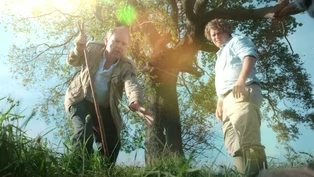
An expert on trees changes the couple's perspective on what is possible on their estate. (3m 39s)
Video has Closed Captions
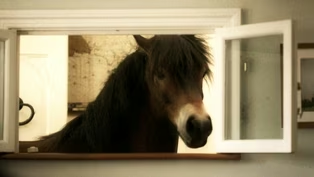
Charlie and Isabella face many challenges with their Wilding Project. (3m 34s)

Video has Closed Captions
"Wilding" tells the story of a couple who bet on nature for the future of their English estate. (30s)
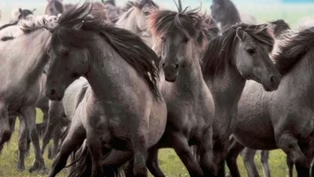
You Must be Crazy to Adopt Such an Idea
Video has Closed Captions
An ecologist's radical idea on natural landscape provides a plan for a couple's estate. (2m 55s)
Providing Support for PBS.org
Learn Moreabout PBS online sponsorship
- Science and Nature

Explore scientific discoveries on television's most acclaimed science documentary series.

- Science and Nature

Capturing the splendor of the natural world, from the African plains to the Antarctic ice.








Support for PBS provided by: