NOTE: If you are short on time, watch the video and complete this See, Think, Wonder activity: What did you notice? What did the story make you think? What would you want to learn more about?
SUMMARY
NPR’s Tamara Keith and Amy Walter of the Cook Political Report with Amy Walter join Amna Nawaz to discuss the latest political news, including President Trump's push for the Senate to pass the SAVE Act, what's at stake with primaries for the midterm elections underway and the impact of the war in Iran.
View the transcript of the story.
News alternative: Check out recent segments from the NewsHour, and choose the story you’re most interested in watching. You can make a Google doc copy of discussion questions that work for any of the stories here.
Key Terms
primary elections — Elections held by political parties to select their candidates. Primary elections are used to select candidates for local, state and national elections.
SAVE Act (Safeguard American Voter Eligibility Act) — a law proposed by Republican legislators that would require voters to provide documented proof of citizenship, such as passports or birth certificates.
WARM-UP QUESTIONS
- What is the SAVE Act?
- Why is the SAVE Act important to President Trump, according to Tamara Keith?
- How might failing to pass the SAVE Act de-motivate Republican voters, according to Amy Walter?
- What is the divide in philosophy among Democratic candidates, according to Amy Walter?
- How has President Trump's actions against Iran impacted his approval rating?
ESSENTIAL QUESTIONS
- What do you think is the most critical step that the federal government can take to make sure elections are fair and accessible to all who qualify to vote?
- In what ways do you think the 2026 elections might be different than past midterm elections (midterm elections are the federal elections held two years before/after presidential elections)?
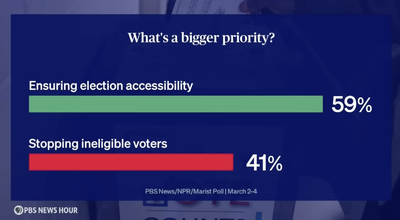
Media literacy: The producers of this segment included the following graphic as Walter and Keith discussed the SAVE Act. What does this poll tell you about voter priorities? What other questions would you want to see polling on to understand public opinion about our elections?
WHAT STUDENTS CAN DO
- You can learn more about the SAVE Act using this resource from the National Conference of State Legislatures. After reading the 9 points mentioned in the post, discuss as a class —
- What change do you think would have the biggest impact on national elections? How?
- What change do you think would be most difficult for states to implement?
- Follow the latest in midterm news here.
- You might also want to watch Trump's response to a reporter question on seizing control of elections. Read this article to find out more about presidential power over national elections.
NEWS: THEN & NOW
The News: Then & Now section of the Daily News Lessons allows students to see connections between current and past news events. The activity provides historical context using primary sources from the Library of Congress.
See PBS News Hour Classroom's Journalism in Action website for interactive examples of how journalists covered key events in U.S. history while honing your primary source, civics and digital news literacy skills.
Then
This News: Then & Now takes a look at the the history of voting rights in the U.S. and how different groups including women, Black people, Native Americans and youth had to fight to gain the right to vote and then had to fight to protect their right to vote.
Directions:
Take a look at the primary sources below and then answer the discussion questions.
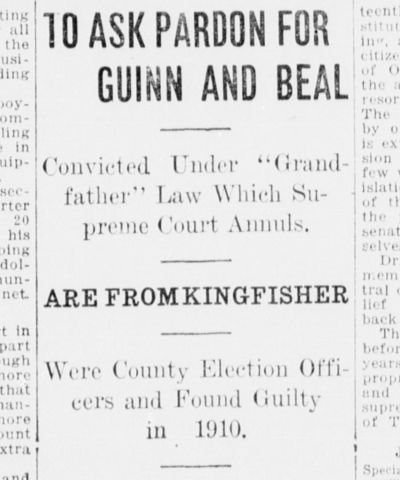
Library of Congress: "Despite the new [14th and 15th] amendments, when Reconstruction ended in 1877, states across the South and elsewhere in the U.S. implemented various laws to restrict the voting rights of Black citizens.'Grandfather clauses' were one tool that states used. For example, Oklahoma passed a constitutional amendment in 1910 that stated only citizens whose grandfathers had voted in 1865 could vote. This disqualified the descendants of formerly enslaved people."
The NAACP (National Association for the Advancement of Colored People) persuaded the U.S. attorney general to challenge the “grandfather clause” in the Oklahoma constitution, arguing it was a violation of the 15th Amendment. The first president of the NAACP, Moorfield Storey, filed an amicus brief supporting the federal government’s position that the Oklahoma law was unconstitutional. In 1915, the state of Oklahoma appealed to the Supreme Court in Guinn v. United States and lost. State legislatures in the South found other ways to disenfranchise Black voters.
This article was written after the Supreme Court’s ruling in the Tulsa Daily World newspaper.
Tulsa Daily World. (Tulsa, OK), Jun. 27 1915. https://www.loc.gov/item/sn85042344/1915-06-27/ed-1/.
Now
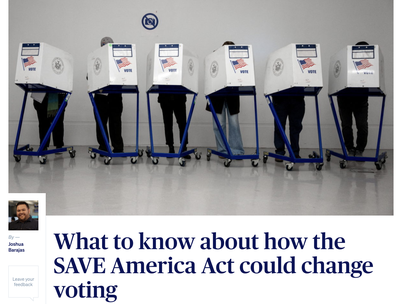
Read What to know about how the SAVE America Act could change voting by News Hour's Joshua Barajas. The article is broken down into the following categories:
- What does the SAVE America Act do?
- What voters think
- Who would be most affected if the SAVE America Act is passed
- Which other states have attempted proof of citizenship?
Credit: PBS News Hour screenshot
Discussion questions:
- Why did some Oklahomans push for pardoning Guinn and Beale (note: Guinn vs. United States is the name of the 1915 Supreme Court case)?
- Why do you think there been such a long history of disenfranchisement (not allowing someone to vote) in American history?
- Historically, most states did not require any form of ID at the polls; 4 states required ID in 2012, now 36 do. Do you think voters should have to show proof of citizenship like a passport or birth certificate when registering to vote in a federal election or photo ID for state elections? Why or why not?
Additional resources
The SAVE Act faces long odds in the Senate. GOP-led states are picking up the cause (NPR)
How Trump's SAVE America Act would reshape voting and why critics are concerned (PBS News Hour video)
Sign up to receive our weekly newsletter with Daily News Lessons and community events.
To provide feedback on News Hour Classroom's resources, including this lesson, click here.