
9 Tips to Help Your Child Wear a Mask


The night before his first day of preschool, Julien felt excited about seeing his friends and teachers again. As his dad read their final bedtime story, Julien glanced over at the clothes for his first day of school. Julien could not keep his eyes off his mask. When he put his mask on, he felt as though he had superpowers — superpowers that could help people stay safe. On this particular night, however, Julien was feeling nervous about going back to school and wearing his mask. Sometimes it felt itchy. Sometimes he felt afraid when he saw other people in masks. His dad talked with him about these feelings and together they brainstormed strategies Julien could use when he had these feelings at school.
Dad: Do you remember why you have to wear a mask at school?
Julien: Uh huh. Because of coronavirus so I don’t get sick and my friends don’t get sick.
Dad: That’s right. We want to keep your teachers healthy, too. Your mask is one way to be a helper - just like a superhero!
Julien: I like being a superhero!
Dad: Being a superhero is hard work. Even superheroes feel scared or worried sometimes. Do you have any of those feelings?
Julien: Sometimes.
Dad: That’s okay. Everyone has those feelings-I do too. Is there anything we could do right now to help you feel less worried or afraid?
Julien: I don’t know.
Dad: Do you remember what we practiced earlier?
Julien: Oh yeah. I can say, “My mask is my superpower. When I wear it, I’m a superhero!”
Even though he was finding ways to help Julien manage his worries, Julien’s dad had worries, too. He knew that preschool was an important time for developing social skills. Like many four-year-olds, Julien struggled to read other children’s emotions and he was learning how to express and manage his own feelings. Julien’s dad worried that wearing a mask would make it even harder for Julien to build these skills this year.
Research shows that preschool is an important time to develop social and emotional skills — skills that lay the foundation for social and academic success. Learning to read and respond to others’ feelings may be especially challenging when wearing a mask because many facial cues are hidden.
Try these ideas at home to support your child’s social and emotional growth while being a mask-wearing superhero.
- Talk with your child about being a mask-wearing superhero! Wearing a mask is one way your child can help keep your family, friends, and the people in your community healthy. Talk with your child about the coronavirus in a way they can understand. Even though sharing is usually something we encourage children to practice, sharing germs is not. Let your child know this is one time when being a helper means keeping their germs (and their mask) to themselves.
- Recognize the many different feelings your child might have about masks. Your child might feel excited about wearing a mask while also feeling scared or even annoyed. Let your child know that these feelings are okay and brainstorm together what to do when they feel this way. What can you do when your mask feels uncomfortable? What can you do when someone else’s mask makes you feel afraid? Model wearing your own mask and share the strategies you use out loud with your child.
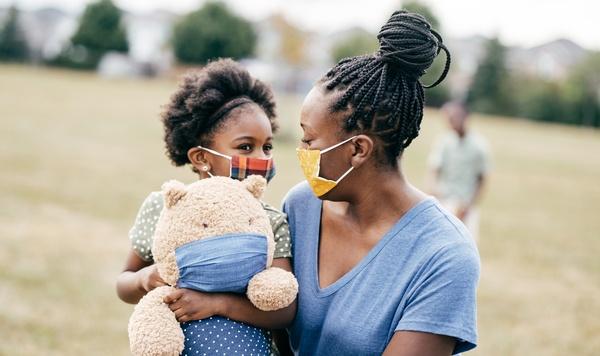
- Use masks while playing pretend. Children learn through play. Putting masks on stuffed animals or toys can help your child gain comfort putting on and taking off their mask. Pretend together that some characters like their masks and some do not. Through play, your child can practice explaining why wearing a mask is important and help their toy friends come up with ideas for working through challenging feelings.
- Get comfortable with masks through arts and crafts. Create paper masks to decorate. Draw the shape of a mask on a piece of paper. Together, color, paint, or add stickers to personalize them. Cut out miniature masks to add to storybooks as you read together.
- Look for emotions behind the mask. Talk about feelings throughout the day (your feelings, your child’s feelings, the feelings of characters in storybooks). These conversations can help your child practice the vocabulary they need to express their feelings. Using words to share feelings is especially important when wearing a mask because others can't see your full face. Together, play “Guess the feeling.” Take turns making different faces (such as happy, sad, excited, scared, angry). Try to guess the feeling the other is showing based on their eyes and eyebrows.
- Bring your smile out from behind your mask. With your child, make a pin or a name tag your child could wear to school with pictures of them showing different feelings (such as happy, sad, or angry). Have your child practice using these pictures to point out how they feel in the moment.
- Play a fun activity for your child to practice seeing themself in a mask. Take and print a photo of your child. Add velcro to the sides of their cheeks. Add the other side of the velcro to a paper or cloth mask. Have your child take the mask on and off of the photo so that they can see what they look like with the mask on and get used to the idea.
- Have a video call with anyone you will be seeing with a mask for the first time. For example, before visiting your grandparents house, have a video call where your child sees their grandparents wearing and not wearing masks so it's not frightening to see grandparents in masks.
- Practice mindful breathing while wearing masks. The way you breathe can impact the way you feel (quick fast breaths can lead to anxious feelings, slow deep breaths promote calm). With your child, practice taking slow deep breaths (try belly breathing) while wearing your masks and talk about using calm breaths at school.
Like Julien and his dad, many parents and caregivers with young children are preparing for a school year that will look like no other. Using these strategies at home can help prepare your child for managing the many feelings they have as they navigate their social world with a mask.
 Author: