
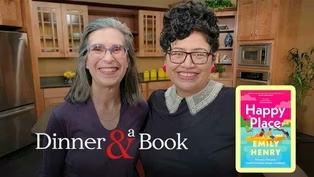
Happy Place
Season 23 Episode 17 | 26m 46sVideo has Closed Captions
No description
No description
Problems playing video? | Closed Captioning Feedback
Problems playing video? | Closed Captioning Feedback
Dinner & A Book is a local public television program presented by PBS Michiana
Happy Place
Season 23 Episode 17 | 26m 46sVideo has Closed Captions
No description
Problems playing video? | Closed Captioning Feedback
How to Watch Dinner & A Book
Dinner & A Book is available to stream on pbs.org and the free PBS App, available on iPhone, Apple TV, Android TV, Android smartphones, Amazon Fire TV, Amazon Fire Tablet, Roku, Samsung Smart TV, and Vizio.
Providing Support for PBS.org
Learn Moreabout PBS online sponsorshipDinner and a book is supported by the Rex and Alice, A. Martin Foundation of Elkhart, celebrating the spirit of Alice Martin and her love of good food and good friends.
Emily Henry's novel, Happy Place, introduces us to Harriet and Wynne and their cluster of friends at their annual reunions at a summer cottage in Maine.
The cottage is their happy place that anchors their friendship and their lives until changes threaten to cast all of them adrift.
I'm April Lidinsky, filling in this week for Gail Martin.
And joining me today is Diana Palomo, co-owner of the ceramics shop The Pigeon and the Hen Pottery.
Thank you for saying yes to this invitation to you.
For trusting me and cooking for you.
Total trust.
So thanks for recommending this book as well.
So tell us just a little bit about the book and then we'll talk about what we're making.
Well, the book is lovely because the book just talks about these three friends who have been friends since college for literally ten years.
And they go to Maine and they go to this beautiful, happy place in a little cottage, but it's not really a cottage It's a mansion.
Yes, it is.
Let's be honest.
It's a mansion.
And so it's and also all their trials and tribulations over the last ten years.
Yeah.
So a lot about growth, friendship and.
How to keep it going.
Absolutely.
Nicely put.
So with that in mind, we have a menu here of foods that put us in our happy places.
So I put a little oil in the pan and I'm going to be starting some Tell me more Taps.
So there's about four different pork chops there that I've cut very thinly sliced, and I put them in oil.
The pan should be nice and warm and toasty.
Okay.
Yeah.
And then we're just going to mix it up.
April's a vegetarian, so please.
Thank you for being so nice and doing this.
You're very welcome.
So I'm going to do this because you are making something very special.
Making like flour tortillas or tortillas.
And so I just learned this recipe a couple of weeks ago.
So it's my mom's recipe coming from a family of five.
I was the lazy one.
I was the youngest of five, so I didn't really pay attention.
So now I'm paying attention.
So the first thing you do is three cups of flour.
Then you have three tablespoons of baking powder, not soda.
I learned that the hard way.
That so many of us have.
A half a teaspoon of salt and then we have this oil here.
It's just regular vegetable oil.
And then we're going to use like I think it's like a teaspoon and a half of vegetable oil.
But before we do that, we mix the dry ingredients first.
I was going to do a huge faux pas.
You mix this up really well with your hand and you want to do like a little action like this where you just go up and down and make sure all those ingredients are completely mixed in.
You don't want any clumps, April.
Clumps are bad.
All right.
And you're using you use just one hand to do all of the mixing.
You do one hand because this other hand you'll see this hand gets very, very sticky in this hand is used to, you know, make some things.
Get other things that you need ready.
Okay.
And so here I'm just going to cut in and just very quickly say, well, Diana is making this and there's some nice process to talk about.
I'm going to put together popovers.
So part of the book, you know, as we said, takes place in Maine or several different locations.
But popovers feature and they are a specialty of the Jordan Pond house in Acadia National Park, where I worked for a summer.
And I ate popovers in that same spot.
And that really is one of my happy places.
So I'm going to put these together and it's such a simple it's just milk and eggs, a little bit of salt, flour and some butter.
It comes together very quickly, a very thin batter, and we'll use a popover pan.
But you could use a muffin tin and well, I'll say a little bit more as we're as we're as I'm putting these together.
But what's what's after the dry ingredients.
There, we put vegetable oil and you mix that in and then you mix it really well.
You make sure it gets over everything then, and you just try to get rid of all those clumps.
You have fine little pebbles in there.
And after you do that, it's all about feel.
I'm learning that, you know, it's all about feel and it's about, you know, how well you really mix this at this point in time because this says a lot about your dough later on.
Well, and as a ceramicist, we'll get to that later.
But ceramics plays a role in the book, and I'm sure there's some similarities in some of this is, as you said, this is not a recipe that's written down.
No, it's it's all my down.
And you got to you got to learn what it feels like.
My mom would say, poquito, no mas, poquito.
Want to see the little words that, you know, mean a lot to me?
Okay, so now you make a little hole right in the center, and then you pour a little bit at a time, and then you start mixing it, and then you pour a little bit more.
See, as you can see, you start using the dry hand, the clean hand.
Sorry, I have a cough drop in my mouth.
We're doing great.
And then as you can see, you start seeing some formation going on.
And so I usually pour the dry ingredient, the wet ingredient, into that dry area until you start seeing everything, start mixing together to look like a nice little ball of dough.
And I'm noticing there's some similarities here.
Almost every culture has comfort, carbs.
Therefore most of us put us in our happy place.
So there's a lot of similarities between what you're making here, which is sort of a fried dough and a popover, which has butter at the base.
And also, as you know, very few ingredients cooked in a cooked in a different way.
I'm really excited about your.
Well.
So I've never had one so.
Well, you will never had one of my tortillas.
No, they're not.
I'm excited about those.
90% of the population, not even my family.
And can you tell us a little bit about the what you're going to be cooking them on?
So this is a comal, My dad worked in the steel factory in that steel warehouse for about 25 years.
And so he made this for all of his daughters.
He has four daughters, so we were all lucky enough to get one.
And so all it is is just forged steel.
Made by your.
Dad and made in by my lovely dad, you know?
wonderful.
He's the nicest.
He's the nicest man in the April the.
thank you.
Yes, chef.
These need to get a little darker.
Yes, yes, yes.
All right.
Thank you.
Maybe we need to add a little bit of salt.
Okay.
Just a little bit of sprinkle and then stir it again.
All right.
And as you can see, look at my dough.
It's starting to come together in a really nice way.
And so the goal is to not stick anymore on your hand.
I see that.
Yeah.
So you have to really know.
Yeah.
So that probably is affected by putting some melted butter in at the very end by the humidity in the air.
And sometimes flour has more or less humidity itself.
And I'm and I'm really proud that it's actually turning out.
I think.
Gosh, I believe in you.
Okay.
And so I usually just scrape up the sides here to get more of that dry component back into it.
And as you can see, my hand looks pretty good.
I made a good batch.
I there's not a lot on my hand anymore.
And I still.
Have a a clean hand.
I'm going to be in the opposite situation because I'm buttering my pop over tin.
But again, you can use just regular old like a muffin tin to make this work.
Look at that.
There you go.
Ceramicist at work.
So we get to eat it this time.
Yum.
And so now what I'm going to do is I'm going to grab this piece of fabric and then I'm going to wrap it up and let it rest for about 5 minutes.
Okay?
And then try to clean up a little bit of my area, because in the next 5 minutes I'm going to start making little balls of dough.
And I was going to say, Clay, because that's my pocketbook.
Yes, absolutely.
But that's a. Similarity.
Yeah.
A lot of slim similarities.
And then do you put any oil on the comal before?
No, there's no oil.
So basically, let me wipe my hands a little bit.
So I made one earlier today.
I rolled it out already.
So all you're going to do is you're going to grab your tortilla, you're going to put it on there and you're going to heat up your mouth for about 5 minutes.
Or you can.
Also look at it go.
just a regular nonstick pan that also works at home.
And so you're just going to let it just flatten out.
And then the key is just see it to start bubbling.
You'll start seeing little air pockets in there.
And while we're doing that, we should talk about the novel a little bit here.
Yes, you can stir stir the pork.
So the the novel takes place over sort of moves around in time.
You mentioned already that the friend traces friendships, particularly Harriet, as the protagonist who has ties to Indianapolis.
Yes.
Yes.
She has ties to southern Indiana.
And and also, I mean, she really doesn't specify where she's from.
She just says, I'm from southern Indiana.
Yeah.
And now we're.
Outside.
Yeah.
Yeah.
I thought Carmel, maybe.
Maybe.
And then the way that she talks about, you know, her her experience, her childhood is kind of like we don't talk very much.
We don't do very much.
It's a family that has a lot of silences.
Not yeah, not a terrible family, but lots of silences.
Yeah.
And the only reason to elevate your with like, your voice is to yell at someone.
Not for laughing, not for, like, crying because it's so funny, but mostly because they're yelling at.
They're older.
She's they're yelling out the older sister mentions.
Yes.
And that.
So I'm going to put these in the oven right now at 450 and in order so that these work by steam heat.
So there's no other leavening besides the eggs and a super hot oven.
So for 50 for 20 minutes and then we'll finish them a little bit cooler than that, I usually put a put them on the bottom of the oven and put another pan on the top level to keep them from browning too much.
So Right, I'll set a timer there and this is going to Brown just a little bit and I don't know, can we flip.
And then we can flip in and look in your beautiful air pockets developing.
That's when you know it's going to it's ready to bless.
Already it's smelling good.
And even the smells good even to a vegetarian.
So.
So we're going to take a little break before before we come back and you'll get a chance to look at some of the beautiful places, the happy places where this book is set.
So we'll be right back.
All right.
The popovers have just come out of the oven.
They smell fantastic.
The steam did its work.
This puts me in my happy place here.
I think the book really invites us to think about our own happy places.
So what would you describe as your happy place?
My happy place is my apartment with my two cats.
my goodness.
And a Frida Kahlo.
Yeah, well, they're named after one of my favorite artists.
Why?
It's my happy place.
Because I work a lot being a business owner.
And for the first five years of our business, I worked, like, 60, 70 hours a week.
So I rarely got to be in my happy place.
And now, since we're going on year 11, I actually spend a lot more time in my happy place.
At the Pigeon and The Hen.
Yeah, yeah, the Pigeon and The Hen.
good connection to the novel.
Harriet has been studying to be a brain surgeon, literally a brain surgeon, and finally admits to herself that she doesn't love the work and discovers that her happy place might be being an artist.
So I'm just very quickly say what I'm doing, and then we've got to find out what you're doing.
Okay?
Your artistry.
So I'm making one of the specialties that they eat in the in the novel and a specialty of Maine, which is a lobster roll.
One of those things that you eat once a year, a little bit of an adult indulgence in the starts just by warming.
Some already cooked lobster and a little bit of butter.
And then you make a you know, if you've ever made tuna salad or egg salad, a very similar sort of concoction with lemon and some fresh herbs.
So I'm going to be working on that and tell us what you're doing here and maybe the connection to the ceramics and the artistry part of of the novel.
So I've been doing ceramics for about 25 years, so I love doing pottery.
And so the past couple of months I've discovered how much I need to learn all of these fun recipes that my mom and dad just passed down to my family.
So when April said, Hey, Diana, go on this.
Show, say that, Yeah.
It's like, come on this show.
So I'm like, okay, I can do this.
So I chose Happy Place because it had a lot of similarities to my life.
I one of my happy places, of course, is my apartment.
But during the summers, two summers in a row, I would go to upstate New York and it was truly one of my happy places.
And so going up to New York and then we would spend a couple of days in Vermont and Lord, it was beautiful.
It was.
So that is one of the setting and a a private college in.
Mattingly College.
Yes.
And I can see why it's so romanticized.
If you haven't read this book, please read it, because the book's really good at describing the places and like describing feelings, smells, emotions.
And in this book, you really like dull time right now and January, February, March, whatever day, whatever the month it is, it's just a really nice to go to a a nice, beautiful place.
It is it is full of those descriptions.
And just as Harriet starts to discover herself through artistry, you tell us about the art of her.
So is that you're.
Making this is tortillas de harinna There are flour tortillas and so I've rolled out I'm rolling out the tortillas.
And so before you roll them out, you actually put them in a little bolitas That's a little balls of a little clay.
I was going to say clay, a little flour and just as much.
Yeah.
So kids would love doing this, don't you think?
Yeah.
And it but you start sweating because you have to roll so many outs.
And so right now I wrote about five.
And then right here we have a comal And so what I'm going to do is you grab what you try to remember which one you did first.
And when you're making tortillas, April, there is a wet side and a dry side.
you can touch it.
You feel the other side.
interesting.
Yeah.
So you want to put it on the dry side and then mine?
I can already tell they're a little thick.
Really?
Because.
Yeah, they're supposed to be really, really thin.
And then while you're warming these up, you're going to start making this lovely Juanita's white gravey Those really did get brown.
Yeah.
So this is your mom's specialty My mom's okay.
During my lovely birthday, my mom would make this meal only for my.
On my birthday.
So another special.
And that's why it's my happy place, my Happy Meal.
And so she never really wrote this down.
So me and my sister Blanca, we were trying to figure out this recipe, so we just finally figured it out two weeks ago.
It's great.
And now you're revealing the secret here.
It's a secret.
Okay, So we have four pieces of, you know, pork chops already cooked, so we only see them with a little bit of salt.
So right now we're going to put just a little bit of like garlic.
Okay.
Garlic powder, garlic powder.
And then we're going to put a little bit of salt.
The recipe is going to be online and then we let that mix a little bit.
well, together.
And then and then the hard part is you put about a half a cup of flour and then you just mix that, right?
And once again you get more carbs.
But such as, you know, I think every culture has a sort of it's like a roux based around the meat and probably gets all of its flavor from the drippings.
Yes.
Yes.
And that's the goal.
You're getting as many flavors as possible in here.
And then you're mixing the garlic, the salt and also the pork chop, lovely sirup that it makes.
And so you mix it really well.
And then this is kind of the hard part where you just it's this is five cups of water and then you and then after before you do that, you have to turn this up to a nice high heat.
Then you add roughly a cup at a time.
To make a gravy.
yeah.
Is another high wire act, isn't it.
yeah.
And so.
I. but it's instantly.
Ground.
Up.
Yes.
And thickening.
Yes, thickening.
And then you have to look for those clumps.
Clumps are bad in gravy and then you add more another cup.
So you want to have some, some faith in this.
What I'm doing here, the lobster.
You sort of warm up a little bit and some butter drain it a little bit and then you don't want to chop it to fine because you want to know you're eating lobster.
So just pulling this apart a little bit so that that will fit in the buns.
And what would a delicious split top bun be without toasting the sides in butter?
So we'll look at this.
So part of this is, as with yours, the texture as well as and so these need to just have a little ways to go.
They're from Maine, baby.
So pretty fancy.
Yes.
But you could use just regular.
We've got to watch this.
Too.
look at that.
You've got a lot going on at once.
So we have to warm this up a little bit more.
A little bit more.
Okay.
Some low, but you want to keep it on a high heat.
So it gives you what the goal is to start seeing it bubble.
right.
I'm doing a lot of things.
You are.
You're doing great.
Yeah.
So Harriet in the novel has to really realize that that medical school is not her thing.
You're doing great.
Now.
I'm just spilling it everywhere.
I'm leaving my mark out.
Sell bread.
It's coming this way.
good.
So what does she learn by doing by doing ceramics?
A lot of it is trial and error, and she's not upset when something falls apart.
And why is that?
This is, I.
Think because ceramics is very much Zen.
It's very much yoga.
You're in your own meditative state when you're when you're doing it, you're doing pottery.
And it sounds like her, you know, surgery's kind of extremely stressful.
It doesn't bring her any type of joy whatsoever.
Right?
So even though she's a very competitive person and she wanted to please people, so that I think is one of the other if there are lessons from this book, it's not preachy, but you've got to live your life for yourself, not for other people.
She doesn't want to make anyone unhappy, right?
Not even Wyn.
her parents, her friends.
So you know, when and Harriet, they're not together, you know, and they're not throughout.
They're adorable.
They are.
And they are.
We're like, what's going on?
Because they go back and forth.
They go back and forth.
Her happy place is the past.
Her present is present day.
And it's in It sounds like she's miserable, except when she goes to lovely Maine.
So and then she gets to relive basically her life and her memories through these friendships.
And so one of the crises in the novel is that the the happy place, the cottage is being sold.
Look at you, asbestos fingers.
That's awesome.
High wire act here.
So now no Diana's were harmed in the making.
Hopeful look and this is beautifully thickening and we've got our buns toasting here.
I'm going to just mix together a little something for the popovers, which you can you can have them just with strawberry jam or a little bit of butter sweetened with some maple sirup product of Maine and a little bit of salt.
So.
So why is this you're happy?
Why?
Why are you making.
Well, because of Maine.
And the summer that I spent in Maine is definitely one of the things that I think of The novel actually opens with her saying that to picture my happy place.
Yes.
Just as my therapist said.
And certainly Maine is one of those places.
So this looks absolutely gorgeous.
This is thickening.
We're going to take a little break before we plate all of this up and you'll see some of the images of covers of other books written by Emily Henry.
We'll be right back.
Welcome back.
Diana and I have been hard at work on foods that put us in our happy place.
I have some popovers here, just like they serve at the Jordan Pond house in Acadia National Park.
You just sort of tear them open and put a little jam in there and eat them as quickly as you can.
So.
Diana and I've got a lobster roll here, and you've got to have those with potato chips.
So this is a carb heavy meal.
And tell us about your dish here.
And this is, you know, flour tortillas that I made.
And then you also eat this.
So you cut the little tortilla off and then right over here you have Juanita's white gravy and then you scoop it up like that, and that's how you would eat it.
Delicious comfort.
Food.
And you said made only on your birthday?
Yes, only on my birthday.
Super sweet.
I can continue making it on my birthday.
So this book is about happy places, but it really is also about the things that make us happy.
And it's not really the location so much as it is relationships, long term friendships and and our sense of ourselves.
So why would you recommend this book to somebody?
This book is surprisingly good.
I picked it up just because I'm like, I love happy places.
I need to read something happy and the friendships and it talks about the locations and most importantly, just the friendships.
So between friends.
Because, you know, when you get older in your thirties and forties, it's really hard to keep those friendships going on.
So because you have families, you have work and so forth, and then this teaches you how even through difficulties you can still, you know, keep those friendships going.
Yeah.
Everybody grows.
Yes.
Changes.
Yeah.
But the relationships can stay strong.
Yeah.
Beautifully put.
Thank you.
Thank you so much for recommending this book and for saying yes to this invitation to come on the show.
You were awesome.
thank you so much to Gail Martin for allowing me to co-host.
Thank you to guest host and thank you to you for joining us.
We hope that you find foods, people and places that put you in your happy place.
And we'll see you next time on dinner and a book.
Let's have a toast to you.
Too.
You.
This WNIT local production has been made possible in part by viewers like you.
Thank you.
Dinner and a book is supported by the Rex and the Alice A. Martin Foundation of Elkhart.
Celebrating the spirit of Alice Martin and her love of good food and good friends.
Providing Support for PBS.org
Learn Moreabout PBS online sponsorship















Support for PBS provided by:
Dinner & A Book is a local public television program presented by PBS Michiana