One-on-One
Dr. Christopher A. Capuano; Craig Drinkard; Abi Ishola-Ayode
Season 2022 Episode 2553 | 26m 17sVideo has Closed Captions
Dr. Christopher A. Capuano; Craig Drinkard; Abi Ishola-Ayodej
Steve Adubato sits down with Dr. Christopher Capuano, President, Fairleigh Dickinson University, to discuss lowering tuition; Craig Drinkard, Executive Director, Victoria Foundation, examines some of Newark’s most pressing issues, including affordable housing; Abi Ishola-Ayodej, author, Patience Is a Subtle Thief, and producer for the Caucus Educational Corporation, discusses her debut novel.
Problems playing video? | Closed Captioning Feedback
Problems playing video? | Closed Captioning Feedback
One-on-One is a local public television program presented by NJ PBS
One-on-One
Dr. Christopher A. Capuano; Craig Drinkard; Abi Ishola-Ayode
Season 2022 Episode 2553 | 26m 17sVideo has Closed Captions
Steve Adubato sits down with Dr. Christopher Capuano, President, Fairleigh Dickinson University, to discuss lowering tuition; Craig Drinkard, Executive Director, Victoria Foundation, examines some of Newark’s most pressing issues, including affordable housing; Abi Ishola-Ayodej, author, Patience Is a Subtle Thief, and producer for the Caucus Educational Corporation, discusses her debut novel.
Problems playing video? | Closed Captioning Feedback
How to Watch One-on-One
One-on-One is available to stream on pbs.org and the free PBS App, available on iPhone, Apple TV, Android TV, Android smartphones, Amazon Fire TV, Amazon Fire Tablet, Roku, Samsung Smart TV, and Vizio.
Providing Support for PBS.org
Learn Moreabout PBS online sponsorship- [Narrator] Funding for this edition of One-On-One with Steve Adubato has been provided by Holy Name.
This place is different.
Delta Dental of New Jersey.
Everyone deserves a healthy smile.
Prudential Financial.
Community FoodBank of New Jersey.
NJM Insurance Group.
Serving New Jersey'’s drivers, homeowners and business owners for more than 100 years.
Operating Engineers, local 825.
New Jersey'’s Clean Energy program.
Lighting the way to a clean energy future.
NJ Best, New Jersey'’s five-two-nine college savings plan.
And by The New Jersey Education Association.
Promotional support provided by Meadowlands Chamber.
Building connections, driving business growth.
And by NJBIZ.
Providing business news for New Jersey for more than 30 years, online, in print, and in person.
- This is One-On-One.
- I'm an equal American just like you are.
- The way we change presidents in this country is by voting.
- I'’m hopeful that this is the beginning to accountability.
- Life without dance is boring.
- I don't care how good you are or how good you think you are, there is always something to learn.
- I did do the finale, and guess where my trailer was?
A block away from my apartment, it couldn'’t have been better!
- People call me 'cause they feel nobody's paying attention.
-_ It'’s not all about memorizing and getting information, it'’s what you do with that information.
- (slowly) Start talking right now.
- That's a good question, high five.
(upbeat music) - Hi, I'm Steve Adubato.
We kick off the show with Dr. Christopher Capuano, President of Fairleigh Dickinson University.
Good to see you, Mr. President.
- Very nice to see you, Steve.
Nice to be with you.
- For those who do not know FDU, describe what it is, where it is.
- So, FDU is a major private university in Northern New Jersey.
We have two campuses, one in Teaneck and Hackensack, New Jersey in Bergen county which is named the Metropolitan Campus because of its proximity to the New York City Metro area.
And we have another in Florham Park in Madison, New Jersey, which we call the Florham Campus because it's a former Vanderbilt estate which back then was called the Florham Estate, so today we refer to it as the Florham Campus.
We also have two international campuses, one in England which we've owned and operated since 1965.
Actually, we purchased it in 1963 and opened it in 1965.
And more recently we opened a second international campus in British Columbia, Canada in Vancouver where we enroll about a thousand students.
- Doctor, let me ask you this.
Higher education is more expensive than ever.
There are more and more people questioning the value of higher education.
I do not with our kids, others, we're blessed to be able to do that, send them to college but you and your colleagues at FDU have decided to quote lower tuition.
Explain how the heck that works in these incredibly difficult economic times.
How does that math add up?
(Steve chuckles lightly) - So, I'll tell you how it adds up.
So, what we did in the fall of 2020 at the height of the pandemic is we announced that beginning in fall of 2021, which was this past fall, that we were gonna lower our tuition which was about 45, $46,000 on each of our two New Jersey campuses to $32,000.
And we did it simply because we're very focused, as we have been for a long time, on improving access and affordability to more students and promoting for more students upward social mobility.
So, we know that a basic principle of consumerism is cost.
If something is perceived to cost too much many people will look at it and say, can't do it - Not worth it.
- Yeah, or not worth it.
Absolutely.
So, that was the primary, those were the primary reasons and ideals for why we lowered the tuition to 32,000.
Knowing that more people would consider a private university education if the beginning point, the sticker price were lower.
And you know, this past year, we didn't get a full sense because of the pandemic of what the effect of that might be.
But this year now we're seeing that applications actually in a difficult environment are up and more students are, in fact, considering FDU as a first choice, which is very nice to see.
- Doctor, what do you say to those students and parents of those students who honestly, genuinely do question the value of higher education, and whether you really need in this day and age a college education, a college degree to be successful.
To have a decent quality of life in this country.
- Well, what I would say to them, Steve, and I say this to everyone that asks me that question, and certainly we tell all our students who we're educating, to look at the data.
The data are pretty clear.
They have been for a very long time and they continue to be.
When you look at unemployment rates and those unemployment rates actually have grown for those who don't have a college education and they remain far lower for those that have a college education.
So, that's one very important piece of data that people should consider.
And when you look at wage earnings, people that have a college education on average make more money, significantly so, than people who don't have a college education.
And in fact, it's been reported many times that over an individual's lifetime, that someone that has a college degree, and I'm not talking about a doctoral degree like you and I have Steve, I'm talking about just a bachelor's degree, that on average you will likely make a million dollars more in lifetime earnings.
- A million.
- And you would- A million dollars more over the course of your life, perhaps 40 years of work with a college degree than if you don't have a college degree.
So, those data I think are very compelling.
The gaps on unemployment rates and on wage earnings have actually grown larger during the pandemic.
One might think that they've grown smaller but in fact, they've grown larger.
Those gaps, the wage earnings gap is probably at an all time high rate now.
- Quick follow up on that.
You have decided, you and your colleagues from the academic perspective at FDU have decided to specialize in a few areas of study.
Just very quickly.
What are those areas and why specialize?
- Yes.
So, what we're doing Steve in our planning right now is we have offered for a long time about a hundred, actually more than a hundred undergraduate and graduate degree programs.
I don't expect that to change very much, but what will change is we're gonna better focus what we're doing at each of our campuses.
So for example, at the Metro Campus, which I talked to you about earlier, the focus will become a greater focus on offering professional programs, both undergraduate and professional programs.
- Such as?
- Programs in business, which we've done for a very long time.
Programs in health sciences, in STEM areas more broadly like engineering, computer science, cybersecurity.
Programs in hospitality, sports and tourism management, which is a big area of focus at FDU, has been historically.
And also the arts, all of which will be grounded firmly in the liberal arts, but not as many liberal arts majors per se.
And the other campus where we'll also offer some professional programs will have a stronger focus on liberal arts majors for students who might be interested in those majors.
But what we're trying to do actually is differentiate, make our campuses more distinctive in what each is offering.
So, it's not that we're gonna become more specialized per se in terms of our offerings, we're gonna become more focused or better differentiated when it comes to what each of our campuses is doing.
- Before I let you go.
I've taught at several universities, I do seminars in-person and remotely.
In-person makes all the difference but remote teaching can work.
30 seconds or less.
Will remote learning, a hybrid, whatever, be part of higher education for the foreseeable future?
- I think hybrid certainly will.
Remote for most 18 to 20 year olds, 18 to 22 year olds, I think is not an ideal learning modality.
I think there has to be a strong element of in-person learning to connect with many of these students.
So, that's where I see the future going.
But certainly we need to do more hybrid.
- Dr. Chris Capuano, President of Fairleigh Dickinson University, I wanna thank you so much for joining us.
We really appreciate it.
- My pleasure.
Nice to see you.
- You got it.
I'm Steve Adubato.
That is President Capuano.
We'll be right back.
- [Narrator] To watch more One on One with Steve Adubato find us online and follow us on Social media.
- We're now joined by Craig Drinkard, who is Executive Director of the Victoria Foundation.
Good to see you, Craig.
- Good to see you, Steve.
- Now I know, everybody in the world of media philanthropy not-for-profits knows, the Victoria Foundation.
But for those who do not know, please share with them.
- Sure, Victoria Foundation, we've been around for about a hundred years, Steve, and for the last 60 plus years we've been focusing on the city of Newark.
And recently we just went through a new strategic framework and we have a new mission, which now calls for us to partner with Black and Brown residents and other marginalized communities in Newark, and other non-profit organizations to champion bold strategies that strengthen community power, foster economic justice, promote youth self-determination, and respond to pressing needs.
- Hmm, well said.
You know, again, for those of us who head up not-for-profits, we spend at least half of our time, in my case, it's a lot more than that, raising money, You know?
The old expression, "no money, no mission," right?
So people come to the Victoria Foundation, they go to other foundations, and they're asking for money, sometimes we beg, you know, it's part of the job.
However, the model you're talking about, Craig, at the Victoria Foundation, isn't simply "we'll decide who should get what, based on a proposal."
It's more engaged with the community.
Give us a concrete example of that.
- Sure, well, first let me explain that, you know, most organizations, when they go through a process like this, they end up with a strategic plan.
They're going to, they know exactly what they're going to do.
What we opted for is to do a strategic framework where we have some ideas, but we wanna go out and work with our partners who include the non-profit organizations you mentioned, community residents and other local stakeholders, like the city government, county government, and other quasi-governmental agencies who are all working to address the needs particularly in the city of Newark.
So we wanna go out and hear from them, and not for us as a foundation, to tell them what we want them to do, but to hear from those on what we should be doing in partnership with them.
- What are they saying?
What are you hearing back, Craig, as the most quote "pressing issues," particularly in the city of Newark?
- Well, you know, Steve, you know, that runs wide and deep.
You know, you have issues such as what is really affordable housing?
That's a big issue.
Public safety, access to not just any job, or a living wage job, but, you know, I heard someone mention this concept about having a job that has a thriving wage, right?
So those are some of the key issues, you know, the wellbeing of families right now, you know given the pandemic and the other challenges that we see in society.
How's the mental health of our families?
That's also has risen up over the last couple of years.
- So, you know, people talk about poverty in a lot of different ways.
Somebody's experiencing poverty, but, the quote unquote "root causes" of poverty are much deeper.
Please talk about that, Craig.
- Well, the root causes of poverty, you know, Steve, we've gotta just name it.
It ties back into systemic racism and, based in, going back to days of slavery.
When you look at the city of Newark, when you have just 23% of the homes owned by black people in the city of Newark, compared to almost 76% in the state of New Jersey.
That has a big impact on poverty.
It has a big impact on intergenerational wealth, or creating intergenerational wealth.
And one of the things Victoria Foundation wants to do through some of its, you know, one of its strategies, as far as the economic justice, how do we close the racial wealth gap in the city of Newark?
- Mm.
You know, Craig, you're born and raised as I'm, you know, born and raised in Newark.
- Yeah.
- As you well know.
- Mhm.
- And I always try to explain to people, well, sometimes explaining it, doesn't get done.
I often say to people that growing up in Newark, being born and raised in Newark, growing up in Newark, (clears throat) it imbues you with lots of things, good, bad, indifferent.
But it's hard to explain to someone unless you grew up in Newark.
And not that my experience is yours or yours is mine, but I've gotta believe that your experience growing up in the city of Newark has influenced your view of philanthropy.
- Yeah.
You know, for me to sit in this role, sitting at an organization that, right now, we have somewhere close to $300 million in our corpus.
And we end up investing about, I use the word investing, about $13 million a year in grants throughout the city of Newark.
It's really amazing for me to be in this role to go back into those same neighborhoods that I grew up in and now work with say, right now, we're working on a project with the city of Newark, the Urban League, Invest Newark, and Greater Newark LISC, where we're working to identify residents that living in the Newark public housing with the Housing Authority who are Section Eight renters, how we can convert those Section Eight vouchers into home ownership vouchers.
So people won't... - I'm sorry for interrupting, Craig.
Section Eight, often people don't know Section Eight of a Federal Housing Law - Right.
- that's about affordable housing.
- That's correct.
Right, so - Please, go ahead.
- The government, right.
So, the city has this unique opportunity, this unique program, where it's taken city-owned properties, hiring local developers to completely rehab these properties, identifying Newarkers who've been long-time, Section Eight renters and converting those vouchers into home ownership vouchers.
And within 15 years, these renters will now be homeowners.
Now we're really talking about addressing both, you know, generational poverty, creating wealth for these families, as well as creating jobs and promoting small business development in the city of Newark.
And that's something that, really proud of the foundation as being a part of.
- It's partly personal for you, isn't it?
- Yeah.
Yeah.
You know, I'm born and raised here.
Steve, I'll be honest with you.
I could think about three or four different instances in my life growing up, if they went a little differently, I wouldn't be sitting in this seat.
So I'm very humbled by this opportunity, and I understand the joy that the city of Newark has bestowed upon me in this role to come and really help deliver on what I can from this from this perch.
- Where'd you, this is getting really inside.
What part of the city did you grow up in?
- Ha, great question.
I've lived most of my life in the west and the central ward, Steve.
We moved around a lot, again, because of poverty and because of poor housing conditions.
By the time I was, I think 13, we lived in six different apartments.
But that allowed me to create some great friends across the city of Newark and a lot of great relationships.
- Yeah, and a PS, I wanna give a shout out to Irene Cooper-Bosch who spent more than a few years leading the Victoria Foundation, stepped down recently, you were in a co- situation and now you are the Executive Director.
She has done really important work.
And just wanted to acknowledge that.
Hey Craig, thank you so much for joining us.
Victoria Foundation, a great organization.
(both simultaneously) - Thank you, Steve.
- Thank you, Craig.
All right, have a great one.
- We'll right back after this.
- [Narrator] To watch more One on One with Steve Adubato find us online and follow us on Social media.
- Hey folks.
It isn't often that we have one of our great producers who writes a terrific book.
But Abi Ishola is in the house, she's the author of a new book called "Patience is a Subtle Thief".
And she's one of our terrific contributing producers.
Abi, how proud are you of this?
- I'm so proud.
I'm in awe when I look at it I could barely open it sometimes, 'cause I'm just like, "I can't believe this thing is out in the world".
(chuckles) - How long it take you to write it?
- Oh, my God, the story's been with me for over a decade.
I would say it took, seriously me writing, probably about seven years.
And you know, over the course of that, having children, taking breaks, it's been a ride.
- It's a novel and it is a book set in the early 90s in Nigeria when the country's political system is really at a boiling point.
Describe that major theme in this novel, please.
- Sure.
So basically, what happened was, the people of Nigeria were promised democracy year after year by the military dictatorship.
So when that time came there was a wealthy businessman named M.K.
Olawale Abiola who ran for the presidency.
But by the time the election happened, it was a free and fair election, but the military annulled the election in the end.
So that's where the title comes in, because I think people were very patient for this change to happen, only for it to be stolen from them.
So that's the backdrop of the story.
- Did you come up with that title?
- I did.
I did.
- I'm curious.
You're a terrific journalist, broadcaster, and you've been on the air as well, and producer.
The only writing I've done is non-fiction, because I have no ability to do the other kind of writing.
Where does your gift of writing fiction come from?
- Well, I would say that I was blessed to have a father who was a great orator and he used to tell us so many stories, a lot of like folk tales from Nigeria.
And I would just hang on his every word.
So storytelling, for me, started from that point, listening to stories that my dad would share.
And then obviously reading books.
I love books, and I love writers like Toni Morrison.
And of course, she's one of the best, so to aspire to be like her is aiming pretty high.
But I just love the art of storytelling.
Even through journalism, I like the writing aspect of things, so this was something I wanted to tackle for myself - Share with folks, and by the way, the book, you see Abi's good on the branding end too, she's got it over her shoulder, but this is the book, "Patience is a Subtle Thief".
Describe your growing up.
What was it like?
- I was born and raised in Miami, Florida.
My parents are Nigerian immigrants.
They came in the late 70s, and raised my sister and I in Nigeria.
But there was one year, when I was 12, that my parents decided, "You guys are moving to Nigeria to," you know, "get in touch with your roots."
So we moved there, my sister and I, and we lived with my uncle.
And it was such a transformative experience.
I learned so much, and I soaked up everything.
And I think that experience stayed with me, and it's what inspired me to write this story.
I was there when that election happened.
And then obviously, meeting a lot of Nigerian people here is what inspired a lot of the characters in the novel - Biggest message in the novel?
- The biggest message, I would say, is having resilience, staying on course.
My main character, Patience, she is looking for her mother, she hasn't seen her mother in over a decade.
So her father's not very nice, so she has to look for answers herself.
She does get into some shady dealings when she realizes that she has to gather money to get to America, but she stays resilient, and she realizes that her dreams actually matter.
And then obviously, my other characters are dealing with, you know, the democratic issues there the political issues there, I should say, and how that affect their personal lives.
So I would say, staying resilient, and also staying on course.
- Let me push you a little bit into an area that I'm sure you weren't thinking I would go in, but you've been with us long enough to know that I can do that sometimes, good, bad, or indifferent.
So I'm listening to you talk about the experience in Nigeria, that election, the view of democracy, or not.
To what degree do you believe, Abi, that your view of democracy, and democratic with a small D, government has been influenced by your parent's experience and the Nigerian experience?
- Well, there are some folks who only know this form of democracy - Yes.
- And you were born in Miami, but you've heard enough, right?
- Yes.
- You're connected enough.
Your parents connected.
Do you believe you see our struggles to maintain "Democracy at a Crossroads" is a long time series that you know we've been doing.
- Yeah.
- Do you believe you see that any differently than those of us who just know this?
- Well, I think that, you know, in Nigeria at the time, it's interesting, because I don't think people understood what democracy was though they wanted it so badly.
And I think, you know, people look to America and that's also a part of the theme in the book, she's obsessed with America, because she knows her mother is there- - Patience is obsessed with America?
Yeah.
- Yes.
And also that's the culture there, people look to America for everything.
So I think when people in Nigeria at that time thought of democracy, they thought that, you know, the country can be on its way to being like America.
So I don't think America realizes the kind of influence that it has on the world, whether that be good or not great.
But the influence is very deep, and it's very vast.
So for me, as you said, I grew up here.
So, but going back to Nigeria and living there for a year, showed me another world, and another way that people think, and another way that people behave, so.
- Real quick, before I let you go, your family's reaction to the book?
- My mom, I keep saying she's selling more books than Barnes & Noble.
(Steve laughs) She's calling everybody, and she's like, "I'll buy it.
'I'll pay for it.
"And you just pay me back."
(laughs) - Oh, that is crazy.
- She read it in two days.
So that alone is enough for me, knowing that my mom is proud of me, so yeah.
- That's pretty much all it takes.
Hey, listen, I lied, I got one more quick one.
Why journalism for you?
- Again, I love storytelling.
I connect with people in a really, you know, deep way.
I always ask myself when things happen, I always say, "Well, why did that happen?
"Why did that person do that?"
So I think that being very interested in the human experience is why I wanted to be a journalist.
Like I love autobiographies.
I love people's stories.
- Yeah.
Hey, Abi, first of all, congratulations.
- Thank you.
- "Patience is a Subtle Thief".
This is Abi's first novel.
I have a feeling it may not be her last.
But also, thank you for being part of our team, you add so much.
Thank you so much.
- Thank you for having me, you're amazing.
- Well, I don't know about that.
And also, Elvin, our director, who brought us to you, thank you Elvin as well.
Abi, all the best.
- Thank you.
- Sell books.
It's good, hopefully, we just helped.
This is Steve Adubato.
That is Abi Ishola, one of our terrific producers who's a great author.
Check the book out.
See you next time.
- [Narrator] One-On-One with Steve Adubato has been a production of the Caucus Educational Corporation.
Funding has been provided by Holy Name.
Delta Dental of New Jersey.
Prudential Financial.
Community FoodBank of New Jersey.
NJM Insurance Group.
Operating Engineers, local 825.
New Jersey'’s Clean Energy program.
NJ Best, New Jersey'’s five-two-nine college savings plan.
And by The New Jersey Education Association.
Promotional support provided by Meadowlands Chamber.
And by NJBIZ.
- Are you looking to be a part of a dynamic, forward-thinking business service organization?
At Meadowlands Chamber, every day we connect, collaborate and innovate, helping to drive business and economic growth in the greater Meadowlands and New Jersey.
I invite you to visit our Meadowlands Chamber headquarters, an open office facility with access to resources for our members' businesses and networking needs.
Together, we will build the chamber of the future, and the next generation of leaders.
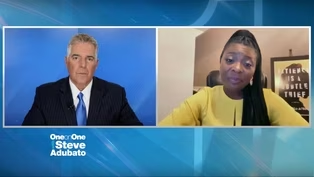
CEC Producer Recounts the Inspiration Behind her Debut Novel
Video has Closed Captions
Clip: S2022 Ep2553 | 9m | CEC Producer Recounts the Inspiration Behind her Debut Novel (9m)
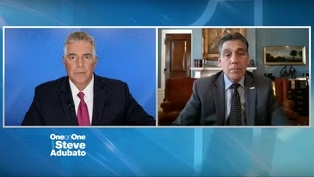
Fairleigh Dickinson President Announces Lower Tuition
Video has Closed Captions
Clip: S2022 Ep2553 | 9m 10s | Fairleigh Dickinson President Announces Lower Tuition (9m 10s)
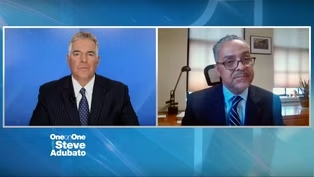
How We Can Help Resolve Newark's Most Pressing Issues
Video has Closed Captions
Clip: S2022 Ep2553 | 8m 30s | How We Can Help Resolve Newark's Most Pressing Issues (8m 30s)
Providing Support for PBS.org
Learn Moreabout PBS online sponsorship
- News and Public Affairs

Top journalists deliver compelling original analysis of the hour's headlines.

- News and Public Affairs

FRONTLINE is investigative journalism that questions, explains and changes our world.












Support for PBS provided by:
One-on-One is a local public television program presented by NJ PBS