WEDU Arts Plus
Episode 1022
Season 10 Episode 22 | 26m 45sVideo has Closed Captions
Chip Weiner, Elginia McCrary, Art Belongs Here, The Colour of Music Festival
Food photographer Chip Weiner shares tips for getting the perfect shot of delectable meals. Virginia artist Elginia McCrary uses an elongated style in her images to embrace moments in time. An initiative in Reno, Nevada, aims to bring more art into public spaces. Learn about The Colour of Music Festival, which celebrates the contributions of people of African ancestry to the classical music genre.
Problems playing video? | Closed Captioning Feedback
Problems playing video? | Closed Captioning Feedback
WEDU Arts Plus is a local public television program presented by WEDU
Major funding for WEDU Arts Plus is provided through the generosity of Charles Rosenblum, The State of Florida and Division of Arts and Culture and the National Endowment for the Arts, and the Hillsborough County Board of County Commissioners.
WEDU Arts Plus
Episode 1022
Season 10 Episode 22 | 26m 45sVideo has Closed Captions
Food photographer Chip Weiner shares tips for getting the perfect shot of delectable meals. Virginia artist Elginia McCrary uses an elongated style in her images to embrace moments in time. An initiative in Reno, Nevada, aims to bring more art into public spaces. Learn about The Colour of Music Festival, which celebrates the contributions of people of African ancestry to the classical music genre.
Problems playing video? | Closed Captioning Feedback
How to Watch WEDU Arts Plus
WEDU Arts Plus is available to stream on pbs.org and the free PBS App, available on iPhone, Apple TV, Android TV, Android smartphones, Amazon Fire TV, Amazon Fire Tablet, Roku, Samsung Smart TV, and Vizio.
Providing Support for PBS.org
Learn Moreabout PBS online sponsorship- [Announcer] This is a production of WEDU PBS, Tampa, St. Petersburg, Sarasota.
Major funding for "WEDU Arts Plus" is provided through the Greater Cincinnati Foundation by an arts loving donor who encourages others to support your PBS station, WEDU, and by the Pinellas Community Foundation, giving humanity a hand since 1969.
- [Dalia] In this edition of "WEDU Arts Plus," a local food photographer shares tips for getting the perfect shot.
- Never shoot on a red plate.
Red does not render well in digital photography, unless there's an absolute reason to do it and you know what you're doing.
- [Dalia] Art that reflects the human form.
- [Artist] Even though they're black silhouette images, it doesn't limit itself because most people can relate to what is taking place.
- [Dalia] Public art collaborations bringing communities together.
- [Woman] The idea behind it is to get people in neighborhoods to work with artists and collaborate with each other.
- [Dalia] And a festival that celebrates diversity in the classical music world.
- When I walk out on stage, I'm thinking that there probably will be someone in the audience who's never seen anyone look like me that is doing what I'm doing.
So I need to always put my best foot forward.
- It's all coming up next on "WEDU Arts Plus."
(upbeat music) Hello, I'm Dalia Colon, and this is "WEDU Arts Plus."
if you eat an amazing meal, but you don't post a pic on Instagram, did it even happen?
In this first segment, we'll learn hacks for taking better food photos from south Tampa based photographer Chip Weiner.
(upbeat music) - My name is Chip Weiner.
I am a photographer here in Tampa.
I have been a photo journalist and a food photographer, photographer in general, probably for 30 years.
So way back in the days of film is when I started.
I think I was given a film camera for high school graduation.
It's such a typical story, and a lot of photographers, older photographers will tell you this, that they've taken some pictures and then they go in a dark room.
This photograph appears on this piece of paper, and fell in love like that, which eventually led into shooting for Creative Loafing newspaper here in Tampa for the last 12 years, doing everything from photo journalism to food photography for them.
They had a food critic who would go in and eat and then they would send me in to take food photos of what he ate.
There's kind of a share generation now, that people are around and they want others to experience what they have experienced.
That is relatively new, especially with the advent of Instagram.
Some tips as far as taking some better photos.
First thing is put a little extra effort into it.
Pay attention to what you're seeing through the camera.
Desserts tend to photograph the best, because restaurants put a lot of time and effort into making them just look awesome.
If you're going to shoot in a restaurant, don't be afraid to ask for a table next to a window.
If you don't have a large light source, so if you don't have that large window, there are other ways.
Listen, I've seen people light food photography with their phone.
A lot of the photography that I do at least on social media is I call it run and gun, no special consideration from the kitchen, no special consideration from the restaurant.
I want to show in my photography and I want to experience, if you go into a restaurant and you sit down and eat this dish, what does it look like?
- The cool thing about Chip is that he doesn't let you know he's coming.
Now that's a good thing 'cause then you're not running around, you know, pulling out gold lobster tails out of the freezer and making it happen.
You know, he's a customer just like anybody else, but it's very impactful.
- What we're looking at is these are some of the photos that I've seen on Yelp.
I looked at an egg sandwich at a restaurant recently, and what I like to do first is sometimes go online to see what they're serving, which is what I did.
And there, I saw some photos and I went oh, okay, it's shot in a styrofoam box.
It's a good looking food, but it gives it no context.
So as I went in there, I'm looking around, how can we set this up so that you get a feel of the place?
'Cause it's sort of a nostalgic place.
And I went in and reshot the egg sandwich and it looks very different from what I originally saw on Yelp, not criticizing Yelp.
They have a lot of good food photos on there, but there are some on there that could certainly be improved.
So what I wanted to do with the egg sandwich is I wanted to show what the context of the place was.
Again, it's a nostalgic restaurant.
It's been around for a long time and they had a lot of nostalgia around.
So I put items on the table.
One of the things that I encourage in food photography is give food a presence.
Instead of shooting it from above, shoot it from the side.
If something is tall, let it be tall in your photograph.
Then show what's in the background.
So this was at a brand new restaurant in town.
Believe it or not, that's grouper.
Brown food, by the way, is really difficult to photograph.
So what I did with that same dish was I put it on a plate, I put something in the background.
I lit it a little different.
I added some color and some candlelight, and it's same dish just with a very different view.
So that is a meat dish served right here at Factory 4914, which can be a beautiful photograph.
Unfortunately, that one, there's just not a lot of lighting or composition consideration.
So I saw that and I came in and again, wanted to add some color, wanted to add some background, wanted to show this is what it's like to sit in this restaurant and eat this dish.
It's got some candlelight, it's got a nice drink in the background.
I typically will put some flatware in so that you get some scale.
Everyone knows the size of a fork.
They don't always know like the size of a scallop, which can be small or large.
And I think the last one that we'll see there really speaks to color.
How do you use color?
And you can go on any retail website online and buy a color wheel for a couple of bucks.
Learn what complimentary color is and use that.
Even if you're in a restaurant, if you've got something blue, a lot of times something brown will go with that.
If you've got red, a lot of times something green will go with that.
So here's some tips for people at home, because one of the cool things about cooking at home is you control the whole place.
You're not waiting for someone else to deliver food.
Go to a secondhand store and find some different kinds of dishes.
If you spend $10, you're spending too much.
One tip that I will use strongly is never shoot on a red plate.
Red does not render well in digital photography unless there's an absolute reason to do it and you know what you're doing.
White, light blue plates tend to work well.
Darker plates are a little tougher to render.
Put those muffins, stack them up or cut them.
I love cutting food and seeing the inside of it.
- Food only stays for maybe a couple of minutes, if not maybe an hour, but when you get a fantastic photo, that's a memory, that's something that you can share and project to other people that can last a lifetime.
- One of the things that I like putting food on Facebook, for example, is to encourage people.
If you're out taking photos, make it better.
Take a little extra time to really make that shot delicious and make people want to eat it and try it.
And when you're ready, look online and learn about two things, aperture and shutter speed.
Those two things interact on most cameras, and if you learn how to adjust those, your food photography is going to improve significantly.
(relaxed music) - For information on Chip Weiner's photography classes, check out chipshotz.com.
Art imitates life in the work of Chesapeake, Virginia native Elginia McCrary.
See how the artist's elongated, stylized images embrace moments in time.
- You can learn from watching and listing to other people.
It comes out in my work, so it's not just my experiences.
It is the experiences of other people.
(upbeat music) (crowd chattering) - [Customer] You did these paintings?
- [Elginia] Yes I did.
- [Customer] Wow, beautiful.
- Thank you.
When I started doing the elongated silhouette images, this was one of the first ones that I started with.
Even though they're black silhouette images, it doesn't limit itself, because most people can relate to what is taking place in the pictures.
- Do you have the original, or what'd you do?
- No, the original is gone.
- [Customer] I love her.
- I wanted to do something that identified me.
You know, everybody kind of has to find their niche.
I started out with images.
The first one I did really was a group of dancers.
They had on no clothes, but I try to distort to fit their bodies some.
And after I did that, I said, hmm, I could put clothing on them and put them in settings and tell stories.
(relaxed music) I like the latest one on the front with the couple of walking away.
And I love it because it's called "The Golden Years."
It's wonderful to see people whose relationships last through the years and who still have that close bond as they get older.
And I get that.
(upbeat music) - Love it, love it.
- You know what that one is called?
- No, tell me about it.
- It's called "Morning Joe."
I'm a coffee drinker.
Are you a coffee drinker?
- I am too, yes I am.
I love it.
- There's your coffee.
(upbeat music) I like that piece because it makes me think in terms of just people in general, that people can aspire to do many things.
And it's like, the world was their oyster.
They can accomplish much.
And when I look at that, I think a good location for it, to me would be in a school or in a children's hospital.
- I like almost all of her work because all of her work symbolizes to me, family, love, relationships, and music.
(relaxed music) I remember when she started drawing, and this was when we were very young in elementary school, she would sit at the kitchen table.
And if she had a pad or anything that she could write on, she would doodle, she would doodle all day if she could.
- Well, I do mixed media and different other types of drawings, and I think that's a reflection of me teaching and giving students projects, I give myself projects.
I like doing different things, working with different mediums.
It kind of rolls over into the different types of artwork that I do, so everything I do has painting in it, but it varies because with the mixed media, it has painting, but then I go in and I add other materials.
The mask came from my own head.
I was thinking about doing masks, but I wanted to do something that was a little different.
So all my masks, I said, well, to identify them as my personal work, I would always put the mouth at the very bottom of each mask.
So there's no chin or anything like that.
It's just the lips.
So that would identify all my masks.
(upbeat music) - [Son] How are you coming along over there, Ma?
- I'm doing pretty good, how about yourself?
- I'm proud of everything my mother does, to be honest.
I have to draw a little bit, but I've never had to take a art class because of my mother.
Okay, I'm stuck now, Ma.
- Because he got this shoulder, let's just put his shoulder and stuff in.
You got his shoulder here, that's gonna go here.
His shoulder's gonna come down like this.
Don't make it so narrow.
- One of my earliest memories, I think I was about three, three or four years old.
I was on punishment.
I was in my bedroom coloring, and my mother came and took my coloring book and colored all the people purple and their hair was orange.
I'll never forget that, it really made me upset.
And then she told me that when you do art, there's no boundaries.
Just use your imagination.
You can make people look like however you want them to look.
- It's so vibrant and it's so rich and full of color.
And I just love it.
I love it, how she makes things pop.
- I like to use colors that compliment each other.
And I like to use contrast, where you have lights against darks.
That kind of really helped, to me, make a piece pop or stand out.
- She went to art school in California, and so when she moved back to the east coast, which has been pretty much my entire life, she's been doing art.
So she's one of my favorite artists, and actually inspired me to do art.
And now I'm an artist too.
She inspired me just with her ability to capture the simple vibrancy of simple everyday life of African-Americans.
And I think that each piece, it speaks volumes.
(relaxed music) - That's an oil painting.
That's called "Uncle Joe."
Everybody has an Uncle Joe.
He might be a little strange, very vocal, maybe a little silly at times, but I did that piece, and when I did it, I was, I was laughing the whole time.
It made me feel good.
It's a funny piece to me.
It's a take off when you look at it, of cubism, Picasso's work.
And I wanted to kind of show that in this piece and that's what I did, I like it.
I hope other people like it when they see it.
I hope that when people look at my work, it touches.
I wanted to touch the hearts of all people and all ages.
- See more of her work at elginiamccrary.com.
Public art is remarkable for its ability to rejuvenate environments and bring people together.
Up next, check out an initiative in Reno, Nevada that promotes collaboration and brings art to the public space.
(upbeat music) - The Art Belongs Here grants initiative is a neighborhood creative place-making project for public art.
The idea behind it is to get people in neighborhoods to work with artists and collaborate with each other to create art projects that exist outdoors in public space, in their neighborhood, projects that reflect community identity, heritage, the personality or character of a place.
One of the projects that got approved is a sculpture titled "Good Luck Horseshoe."
That's happening at the Reno rodeo.
So the Reno rodeo partnered with artist Michael Gray to bring the sculpture to Reno and permanently locate it.
- [Michael] You had to use the chipping hammer to bust out the concrete so that it would sit flat.
And then we drilled holes on the outsides for concrete anchors.
- [Deb] And then we put the banner on the top for stability.
- Keeps the horseshoe from separating, because you know people are going to climb all over it.
- The good luck horseshoe to me is a real piece of inspiration I think that Mike had to take something out to the Black Rock Desert that sort of symbolized the horses of our area, the Western culture and things like that, and be able to provide it to the people that were at Burning Man.
And it's just completely appropriate that it ends up full circle back here.
Mike was able to source the materials like the horseshoes that are in the "Good Luck Horseshoe" are all repurposed horseshoes that he collected from different farriers and different people with horses in the area.
But a lot of those folks that are our neighbors, they have horses that are in the drill team and things like that, so the likelihood that those horseshoes have been in the actual Rena rodeo grounds are probably pretty good.
- [Megan] There's a project happening along Fourth Street, the artist that's working on that is actually doing bike benches.
So he's taking bike parts and making them into these really cool benches.
- I'm involved with the Reno bike project and the brewery arts district from Fourth Street.
We're putting out a series of artistic bike benches that are also bike racks.
It provides somewhere for cyclists to park on Fourth Street and produces some art for the community and promotes cycling in the area.
Today I'm assembling the first finished version of our latest prototype.
While working on this project, a lot of things have affected our overall design.
We've had to take into account ADA regulations as well as sidewalk regulations, and developing a bench that will conform to the codes as well as be a piece of art and be functional as far as parking a bike and noticeable that it is a bike rack and a bench and for cyclists.
(upbeat music) - [Megan] Another project that's happening is on Rita Cannan Road at the 395 overpass, and that is a community mural project.
It's Be The Change project working with artist Asa Kennedy.
- The mural is going to be a Day of the Dead themed piece.
The wall behind us is just, it's ugly, and it's always been ugly and it gets tagged and it gets painted over to gray, and then it gets tagged again, and that can easily be changed.
And as we talked to the community and kind of got some feedback, people were really positive about the idea.
We just went with it after that.
- About a week or two ago, we went to the elementary school, kind of ran through the concept with them about what it was going to be and went through some small exercises, asking them what images, what elements and ideas do you kids think represent this cultural festival?
And from then we went from the answers being provided to them drawing.
Part of their actual more direct inclusion is going to be structuring some of the panels and the work for students' own original work, where my job as the lead artist is to come in and weave all that together.
- Part of it is incorporating their own designs and bringing their ideas right to the wall itself.
So that at the end of the day when the mural's done and they're walking past it to go to school, they can say, you know, I did that.
- We see public art as being an integral part of city life.
- A lot of times, while I'm working on public art, people when they see it, they get so excited and they really do feel like a sense of ownership over some of the art.
- It's good for the people.
It's good for the town.
It's good for the city itself.
I mean, art makes people happy.
- And when people come here that haven't, that aren't from here and they're traveling and visiting, they see it and it's character, it's our city.
(upbeat music) - Learn more about the arts in Reno, Nevada at reno.gov.
The Color of Music Festival celebrates contributions that people of African ancestry have made to the classical music genre.
From vocalists and musicians to composers, the festival gives artists a stage to perform and values inclusion, diversity, and accessibility.
(relaxed piano music) - Why do I sing?
(singing in foreign language) I sing because I know that I have something to say, and I know that it's important.
There's a challenge involved in singing classical music.
It's the memorization component.
It's the style component.
It's the component of actually communicating what the composer has asked of you to communicate.
One is constantly thinking about your focus.
At this moment, what is the character thinking?
At this moment, how would the character sit?
At this moment, how would the character look into the eyes of someone that she loves?
And so when you have those things running in your mind, the music lends itself to be sung.
(singing in foreign language) I'm involved with the Color of Music Festival because I think it's a fantastic premise.
The idea is quite amazing.
- The Color of Music exists to showcase the extraordinary talents people of African ancestry have contributed to the classical genre.
We are truly the largest Black classically-presenting organization.
The talent of the musicians that perform in the Color of Music Festival is truly global.
From the natural voice, having Miss Laquita Mitchell, who's a phenomenal soprano, to conservatory trained musicians that come from the Curtis Institute, Oberlin, Julliard, Manhattan School of Music, the Royal Conservatory, I can go on and on and on.
- I think something like this can thrive because the importance of inclusion and diversity is needed.
And with classical music, I think there's, it's like 0.01% of orchestras have people of color.
- So like many Black institutions that start, it's out of necessity.
We have to create our own institutions when they're not giving us access.
The classical music world is a very complicated, expensive world.
That's where it started, by aristocrats who used to pay very poor composers to do things that they could show off their wealth.
So it still carries all of those standards of what classical music should be and how it should be presented.
These people of African ancestry, many of whom can't get the coveted spots, and there's limited spots in orchestras around the world.
This is an opportunity for them to present these huge works.
(singing in foreign language) - Ms. Jessye Norman is probably one of the most celebrated African-American sopranos of our time.
She has sung in every major opera house there is in the world.
So at the age of 14, I was able to meet Jessye Norman and then I was able to see her onstage.
I'm a kid from Brooklyn.
I had no idea that that was actually a possibility for me.
So the importance of diversity on stage, it's paramount, it must happen.
It's really, really important that young people understand that there is a possibility.
When I walk out on stage, I'm thinking that there probably will be someone in the audience who's never seen anyone look like me that is doing what I'm doing.
So I need to always put my best foot forward when I'm performing.
(singing in foreign language) (audience applauds) - Discover more about the festival at colorofmusic.org.
And that wraps it up for this edition of "WEDU Arts Plus."
For more arts and culture, visit wedu.org/artsplus.
Until next time I'm Dalia Colon.
Thanks for watching.
(upbeat music) - [Announcer] Major funding for "WEDU Arts Plus" is provided through the Greater Cincinnati Foundation by an arts loving donor who encourages others to support your PBS station WEDU, and by the Pinellas Community Foundation, giving humanity a hand since 1969.
(dramatic music)
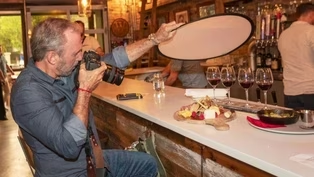
Video has Closed Captions
Clip: S10 Ep22 | 6m 53s | South Tampa photographer Chip Weiner specializes in taking photos of food. (6m 53s)
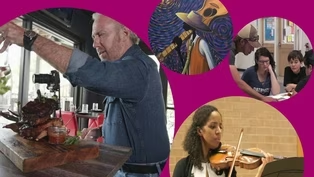
Preview: S10 Ep22 | 29s | Chip Weiner, Elginia McCrary, Art Belongs Here, The Colour of Music Festival (29s)
Providing Support for PBS.org
Learn Moreabout PBS online sponsorship

- Arts and Music
The Best of the Joy of Painting with Bob Ross
A pop icon, Bob Ross offers soothing words of wisdom as he paints captivating landscapes.











Support for PBS provided by:
WEDU Arts Plus is a local public television program presented by WEDU
Major funding for WEDU Arts Plus is provided through the generosity of Charles Rosenblum, The State of Florida and Division of Arts and Culture and the National Endowment for the Arts, and the Hillsborough County Board of County Commissioners.