
Henry Ford, Black developers, Regina Carter, Audra Kubat
Season 7 Episode 44 | 26m 46sVideo has Closed Captions
Henry Ford College, Black developers, Regina Carter, Audra Kubat and One Detroit Weekend.
Henry Ford College and Wayne State University create a new transfer pathway to help students earn a four-year degree. The state of Black real estate Development in Detroit. Violinist Regina Carters talks about receiving the 2023 NEA Jazz Masters Award. Plus, Dave Wagner shares what’s ahead on “One Detroit Weekend,” and Audra Kubat kicks off “Detroit Performs: Live from Marygrove” season 12.
Problems playing video? | Closed Captioning Feedback
Problems playing video? | Closed Captioning Feedback
One Detroit is a local public television program presented by Detroit PBS
Henry Ford, Black developers, Regina Carter, Audra Kubat
Season 7 Episode 44 | 26m 46sVideo has Closed Captions
Henry Ford College and Wayne State University create a new transfer pathway to help students earn a four-year degree. The state of Black real estate Development in Detroit. Violinist Regina Carters talks about receiving the 2023 NEA Jazz Masters Award. Plus, Dave Wagner shares what’s ahead on “One Detroit Weekend,” and Audra Kubat kicks off “Detroit Performs: Live from Marygrove” season 12.
Problems playing video? | Closed Captioning Feedback
How to Watch One Detroit
One Detroit is available to stream on pbs.org and the free PBS App, available on iPhone, Apple TV, Android TV, Android smartphones, Amazon Fire TV, Amazon Fire Tablet, Roku, Samsung Smart TV, and Vizio.
Providing Support for PBS.org
Learn Moreabout PBS online sponsorship- [Speaker] Just ahead on One Detroit, Henry Ford College and Wayne State University team up to help clear up some of the hurdles for students seeking a four year degree.
Plus African American real estate developers in Detroit, talk about the challenges they face as minorities in the industry.
Also ahead, jazz violinist Regina Carter, who is raised in Detroit, talks about her newest national award.
Plus, we'll have some great ideas on things you can do around Metro Detroit this weekend and beyond.
And we'll close with a performance by Audra Kubot, Emily Rose and the Detroit Women's Chorus.
It's all coming up next on one Detroit - [Speaker] From Delta faucets to Behr Paint.
Masco Corporation is proud to deliver products that enhance the way consumers all over the world experience and enjoy their living spaces.
Masco serving Michigan communities since 1929.
Support for this program has provided by the Cynthia Edsel Ford Fund for Journalism at Detroit Public tv.
The Kresge Foundation.
- [Speaker] The DTE Foundation, is a proud sponsor of Detroit Public TV.
Among the state's largest foundations committed to Michigan focused giving.
We support organizations that are doing exceptional work in our state.
Visit DTEfoundation.com to learn more.
- [Speaker] Nissan Foundation and viewers like you (intro music) - [Speaker] Just ahead on this week's, One Detroit.
A frank conversation on the state of black real estate development in Detroit, examines the obstacles to success for minority developers.
Plus jazz violinist from Detroit, Regina Carter racks up another prestigious musical honor.
Also coming up, Dave Wagner.
of 90.9 WRCJ offers some suggestions on what you might wanna do this weekend, in Metro Detroit.
And a performance from the season opener of Detroit performs, live from Marygrove.
But first up, our future of work series, looks at the education of the future workforce.
Henry Ford College has announced a new initiative that will help more Michigan residents earn a four year degree.
The college has partnered with Wayne State University to guarantee admission and full credit transfer to the university for HFC students.
I spoke with Henry Ford College President Russ Kavalhuna, about the impact of the program on the future of education and work in Michigan.
(bright music) - [Speaker] Let's just start with the, the very basics.
What is it?
What is the overall goal of the program?
- The overall goal of the program, is Michigan needs to get more competitive in many respects, but one respect is those citizens who have a four year degree.
And that's because across the country states are starting to count how many heads they have in their state, as a percentage, with four year degrees.
Now, Michigan happened to start this race behind we were in the bottom third.
Now we're making up ground.
But the truth is, at least on this metric, Michigan has now decided across bipartisan divides that we need to have more four year degrees.
Now, the role we play in that, is to help a lot of people who are contemplating whether they should or can attend college.
We are an open access institution that has very few barriers.
We're in your neighborhood, our cost is low our programs are wide, and when you get to our college you get your way through at least two years of college.
And then if we're going to start making ground on this race against other states for four year degrees, we have to see our students onto the four year degree institutions.
And so, we lie at that intersection between four year degree institutions and ours.
And there were barriers there.
So we went about trying to attack those barriers and we're pretty excited that this almost eliminates every barrier that a student at HFC would see as they move to Wayne State University or other four year degree institutions.
- Why does it feel like it's taken so long for institutions to get to this point where you guys are, where you're trying to make this a streamlined process?
Is it the, the motivating factor of what the state needs what the, the economy and employers here need?
- I, I can't speak to why it hasn't happened before.
I can speak to how it has started to happen and it's become the focus that we have on students.
Historically, higher education has not been as focused on what helps the students.
And right now that is the future of higher education.
So we've spent a lot of time trying to understand the hurdles that students face that stops them from getting to that college credential that we need to have a higher percentage of our citizens having.
And one of 'em is the things you just mentioned.
Our students will work hard, work well in the classroom, work at home, taking care of family.
A lot of our students work really hard to get these 60 credits in their associate degree.
And then they face more hurdles to move to the four year degree, degree institutions.
And some of those hurdles were how many credits will I take with me?
I spent a lot of time and money on those credits.
Well, I have to ask for permission.
And what if they say no, because a lot of my students are first generation either Americans or college students like my dad was.
And it's a serious question, will they say no?
And no one wants to be told no.
So we went right at those two hurdles after hearing our students say these are the hurdles that we have moving from Henry Ford College to Wayne State University and with this agreement, if they get through Henry Ford College and show academic success, they don't have to worry about being told no when they ask for admission at Wayne State.
And if they collect 60 credits, they don't have to worry about whether those 60 credits travel with them.
And that is, that is really focusing on students.
And that is where we're gonna make up ground on this 60 by 30, getting 60% of a Michigander population to a post-secondary credential.
(cars passing by) - [Will] Do you think that that's going to be the case?
Because sometimes it, it, it seems like an obvious solution, but I'm sure there are other considerations that other higher institutions might have when it comes to maybe the quality of education from one institution to another, whether or not they're accepting students that might not be able to fit or make it or, or actually graduate.
Do you think that what you guys are doing is going to catch on?
- Let me just be blunt, I talk to students a lot, both at universities and community colleges, and there is historically an idea that community colleges were for a lesser student, and that couldn't be further from the truth.
That's my experience here that it's not the truth and the experience of my parents who are community college graduates.
Community college students have an opportunity to be just as good as anyone else but they're using the access portal that we have which has a low barrier for cost and a low barrier for geographic distance from your home.
And I know that because when I talked to President Wilson I said, look at the students that we bring you.
They perform as well or better than the students that started with you at the beginning of the university.
And President Wilson, like any other very sharp leader knew that to be true, checked it to be true.
But still, we said, we don't have any interest to send you students who are going to come to your institution having left Henry Ford College and then not be successful with you.
That won't.
And so, you tell us partner at Wayne State University and any other institution that we would gain this kind of agreement with you, tell us what we can do to show that these students are ready for your institution.
And Wayne State decided to say, we want you to grad bring us students with a 2.5 grade point average at Henry Ford College.
Now, it was helpful to show Wayne State the data that when we bring students, because we do 300 to 400 a year when those students come over to them with 2.5 or higher they are successful and in many instances more than the students who started at Wayne State University.
So that was a quick way for both partners to feel like it was going to be successful.
And that makes me believe, to answer your ultimate question, that this can catch on.
- Is there anything that you would like to share with people that would be particularly useful or how they might get in touch and get put into this pipeline and and how they can get a pathway forward for themselves?
- If you or anyone in your sphere is contemplating whether college is for them reach out to me.
I have publicly committed, anyone who contacts me via email will get a personal response.
It is statistically proven that if you invest in yourself in higher education, you'll be healthier, you'll be wealthier and you'll be happier.
(bright music) - [Will] And you can see more of my conversation with Russ Kavaluhna at onedetroitpbs.org.
Let's turn now to real estate development.
It's a difficult field for minorities to break into and build wealth.
A national study shows black and brown developers together make up less than 1% of the industry.
American Black Journal and Bridge Detroit held a virtual town hall hosted by Steven Henderson to explore the barriers faced by developers of color and the growing efforts to level the playing field.
Here's a portion of that discussion.
- [Speaker] Every development is, has tons of risk, tons of struggle, a lot of moving pieces.
A and and particularly when you're redeveloping a a, a city then, then you're kind of overcoming barriers that have made prior people not, not, you know go after a certain project.
So you have all that and then you have this sense of and and sometimes it can be pretty nebulous, right?
It's uh where it's mmmm, what's going on here.
You know, it's, you know, it's a big part of of development, is the confidence that people have in the developer.
And, and that's where bias can be particularly introduced.
The sense of are you able to do it?
You know, even once they believe that it can be done, which was a struggle for Detroit for years, then it's can you do it?
- So talk about your journey as a developer in the city and again, talk about it in the context of these kind of dual barriers that you face.
It's tough for African Americans and other people of color to be developers, successful developers, also tough for women.
How did you get started and then get us to where you are with Developed Detroit - I actually spent a number of years working on Wall Street and, and came back to Detroit about 10 years ago for what I thought was a temporary consulting job.
And not having been in Detroit for a while, I really fell in love with the energy here and what was going on.
And there just were so many people who were moving here, moving back here, who were just trying to figure out like how do we move Detroit to a better place?
And, and I I, I did have a finance background.
I did have a, a Wall Street banking background had a little bit of a land use background, but really I just wanted to be a part of what was going on here.
And so I work with a group of people to launch what has now become Developed Detroit back in 2015.
And, you know, it's a really tough business.
I, I suppose you could say being a woman doesn't make it easier.
I, I have to admit, I've spent most of my career in male dominated industries, and so I, I think I maybe just have a really thick skin kind of around the ways in which gender intersect with work.
- Jeff, I wanna have you talk about Capital Impact Partners and I think you're kind of uniquely situated among our guests today to talk about more of a national picture with, with this issue but also how that national picture relates to Detroit because I know you guys do do work here as well.
- We're Capital Impact Partners.
We're a national CDFI, Capital Community Development Financial Institution.
And while we are a national entity working with what we call underestimated communities nationwide, we've actually just celebrated our 10th anniversary of working in Detroit, the Highland Park communities.
We are committed to Detroit.
And what you've heard in terms of the challenges of developers rising in this space, is a national theme as well.
So while it's not specific to the the Detroit market or region it definitely plays out certainly, but differently in, in in ways as well.
As a capital provider, we're a lender, but we're also a capital provider in other ways.
Talking about the growth of developers, there's the access to capital, there's the access to resources there's the access to networks that you've heard about.
We as, what we like to tell the story of our work in Detroit is that we've realized that we've been a lender in many important impactful projects in Detroit.
But we realized back mid twenties that by and large we weren't making to the developers of color the black and brown developers, and credit to my colleagues who, who run our local programming, they actually created our equitable development initiative.
So it, it started in Detroit.
So we're, we're very thankful and proud of that story.
And just to say what that is the Equitable Development Initiative is really a holistic way to support the growth of black and brown developers in this space.
- [Will] You can watch the entire building black development virtual townhall at onedetroitPBS.org.
Now, let's continue our recognition of women in music.
during Women's History month, violinist extraordinaire Regina Carter, who was raised in Detroit, is a recipient of this year's National Endowment for the Arts Jazz Masters Fellowship.
The honorees will be celebrated at a concert in Washington DC on Saturday, April 1st.
Linda Yawn of 90.9 WRCJ caught up with Carter to talk about this latest honor (intro music) (jazz music) - [Speaker] To kick off jazz appreciation Month 2023 at the Kennedy Center in Washington DC, You, Kenny Garrett and and Louis Hayes will be featured in concert to receive your NEA Jazz Master Awards.
This is a banner day for jazz in general.
And for Detroit Jazz specifically - I'm over the moon as the old people would say, I'm still in disbelief, you know, I, you know, I know it's happening.
I do these interviews and I I I'm in touch, you know, making all the arrangements.
And then I say, really, this is really happening?
And I, and I'm really excited, I'm so honored.
And the fact that it's three Detroiters, I couldn't be more proud of my city.
It's amazing on one hand that the three of us are from Detroit but it's not amazing, you know, it's just the city.
Detroit is extremely unique and special.
- It sure is.
And, but see, the thing is is that this is not your first rodeo.
This is not your first major award.
I mean, you are a MacArthur genius grantee.
So what does the, what is the difference between, say the NEA Jazz Master Award and some of the many other awards and accolades all deserved I might add, that have come your way?
- You know, every award is very special.
It's, they're like green lights, if you will.
I call them to say you're on the right path.
And everyone has their own path, their own journey.
And so sometimes it feels like when you're out here doing this, doing this, doing music, being self-employed, sometimes it's like what am what am I doing?
And I think that's probably everyone.
At certain points in our lives we question what we're doing.
But any award that I've received I feel like it's a green light.
Like, yes, keep going, you're on the right track.
And of course, winning the MacArthur was probably that was so huge for me in my, in my life.
And then being a Doris Duke artist as well after that.
And then on top of it, this, it's, I'm blown away.
(jazz music) I know that the music comes through me, not from me.
And just having life experiences and allowing those experiences to help guide me and to guide my music.
And I've had some opportunities that I never even thought about early on in my, in my career or in my life.
There's so many ways in which to use music and the the longer I live, you know, I can, I can serve I love playing for audiences and touring but I can also play for people in nursing homes, hospitals, I do hospice work and end of life work.
And so all of that feeds feeds my soul and helps and yeah it just helps me to stay humble.
- Other aspect of Regina Carter, that's just super important is the variety in your recordings.
Of course, we, I go back all the way to the straight ahead days, but then when you started out and you were doing your own sessions, you decided or I don't know if, if you decided it, but someone decided that there should be variety in the presentations.
- Well, you know, it's interesting.
I I was, I recorded with Atlantic two solo records and those records were considered smooth jazz whatever that means.
So, and when I, when I signed with Verb they wanted more of a straight ahead.
And I remember turning in my first record and the A&R Artist and repertoire person assigned to me said, well, your, your music is all over the place.
People won't know how to, how to categorize you or what.
And I said, I'm, I'm not gonna pick one thing.
I love all of this music.
It's just music.
And growing up in Detroit and listening to the radio stations, we heard such a wide variety of music under that umbrella of jazz.
On the stations there was Motown and then of course you drive anywhere in the city you might hear, if you go to Greektown you'd hear some Greek classical music, or Mexican Village you'd hear authentic Mexican folk music Mariachi you might hear you go, there was the the Chaldean section of town.
So there was all of this music from all these different ethnic groups that were living in and around Detroit.
So all of those sounds were in my head.
And when the A&R Guy said, well, you have to pick one.
I said, I can't, you know, all these sounds are there.
So I, I have, I need to be able to express music.
(jazz music) - [Will] The live webcast of the NEA Jazz Master's tribute concert, can be viewed at arts.gov on April 1st at 7:30PM.
Plus, it can be heard on 90.9 WRCJ.
There are also a lot of events you can check out in person this weekend and beyond in metro Detroit.
Dave Wagner of 90.9 WRCJ has some suggestions in today's One Detroit Weekend.
- Well, the weekend is nearly here and there's so much going on in and around the city that you can check out.
On Friday and Saturday, you can experience a night at the Esterhazy Palace with a Valencia Baritone project.
They're performing in Bloomfield Hills and Ann Arbor this weekend.
The group was formed with a vision of performing the nearly 160 works written by Franz Joseph Hyden for this ancient instrument called the Baritone.
And now through Saturday at the Detroit Symphony Orchestra, Maestro Jader Bignamini conducts Stravinsky's Firebird Suite with violinist Ana Kiko Myers.
She's going to join the orchestra in the Fandango, by Arturo Marquez.
And by the way, that concert is going to be broadcast on WRCJ Friday morning.
Now, more on the classical front, on Sunday, April 2nd organist James Kibbie continues his performances of the complete Oregon works of Johan Sabastian Bach on the campus of the University of Michigan.
And we've got jazz coming up, Saturday, April 1st pianist and guitarist Damon Terrell is performing at the Dirty Dog Jazz Cafe.
Two shows.
6:30 and 9:00PM.
And for those of you that love the blues Saturday night, you wanna be at the Fox Theater because we've got the 2023 Motor City Blues Festival.
This is the 15th annual concert this year presenting King George Calvin Richardson, Ronnie Bell other legendary blues performers.
So there you have it, jazz, classical, the blues.
There's so much metro Detroit has to offer.
I'm Dave Wagner with WRCJ.
Here's more of what's happening ahead.
Hope you have a great weekend.
(intro music) - That will do it for this week's one, Detroit.
Thanks for watching.
We're gonna leave you now with a performance from the season premiere of Detroit Performs, live from Marygrove airing on Wednesday April 5th at 7:30PM.
Here's singer, songwriter producer and educator, Audra Kuba, along with Emily Rose and the Detroit Women's Chorus Singing, Oh Mother - We stand in Your shadow but must sit by your side to hear your song in the winds blowing wild.
- [Both] And I trust in the world you have given to us.
And we'll fight with my bones and my fists if I must.
To shatter the wall they put up with fear.
I will break all the rules - Just to keep her here.
Oh, mother Mountains, mother of fire.
I climb the highest ridges and I light the pire.
To burn down the kingdoms created by greed.
We'll dance on their ashes watch their power recede.
- [Both] And I trust in the world you have given to us.
I will fight with my heart and my mind if I must.
To tear down the fences and take down the flags.
And undraw the lines that divide us in half.
Oh Mother of freedom, mother of hope.
I'll pull back the blinders and I'll cut all the rope.
Smash all the windows, give away all my clothes.
Now walk through your belly.
Get your mud on my toes.
Cuz I trust in the world you have given to us And I'll fight with my fingers, tooth nail if I must.
And I'll spare your body, All that I am, I will work for the change.
- [Speaker] From Delta faucets to Behr Paint.
Masco Corporation is proud to deliver products that enhance the way consumers all over the world experience and enjoy their living spaces.
Masco serving Michigan communities since 1929.
Support for this program is provided by the Cynthia & Edsel Ford Fund for journalism at Detroit Public TV.
The Kresge Foundation - [Speaker] The D T E Foundation is a proud sponsor of Detroit Public TV.
Among the state's largest foundations committed to Michigan focused giving.
We support organizations that are doing exceptional work in our state.
Visit dtefoundation.com to learn more.
- [Speaker] Nissan Foundation and viewers like you.
(outro music)
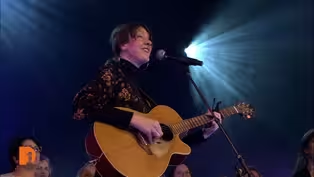
Audra Kubat performs ‘Oh Mother’ | Detroit Performs
Video has Closed Captions
Clip: S7 Ep44 | 1m 39s | Audra Kubat performs her song “Oh Mother” on “Detroit Performs: Live from Marygrove.” (1m 39s)
Henry Ford, WSU create transfer pathway to 4-year degree
Video has Closed Captions
Clip: S7 Ep44 | 6m 15s | Henry Ford College and Wayne State create a transfer pathway for four-year degrees. (6m 15s)
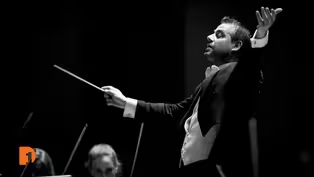
One Detroit Weekend: March 31, 2023
Video has Closed Captions
Clip: S7 Ep44 | 2m 1s | Dave Wagner of 90.9 WRCJ shares what’s happening around the Detroit area this weekend. (2m 1s)
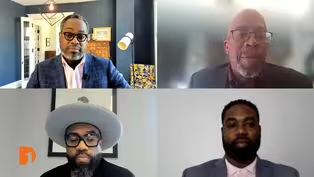
The state of Black real estate development in Detroit
Video has Closed Captions
Clip: S7 Ep44 | 4m 53s | Black and Hispanic real estate developers combined make up less than 1% of the industry. (4m 53s)
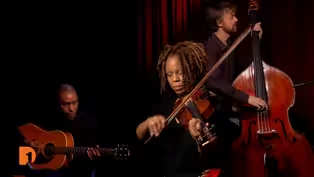
Violinist Regina Carter receives NEA Jazz Masters Award
Video has Closed Captions
Clip: S7 Ep44 | 6m 16s | Violinist Regina Carter on receiving the NEA Jazz Masters Fellowship Award. (6m 16s)
Providing Support for PBS.org
Learn Moreabout PBS online sponsorship
- News and Public Affairs

Top journalists deliver compelling original analysis of the hour's headlines.

- News and Public Affairs

FRONTLINE is investigative journalism that questions, explains and changes our world.












Support for PBS provided by:
One Detroit is a local public television program presented by Detroit PBS