
Made with Love
Season 3 Episode 4 | 26m 15sVideo has Closed Captions
Meet the Movers and Makers celebrating love in all its forms.
Gaffney Fabrics supports a diverse and dedicated community of clothing designers, photographer Ken McFarlane captures the tender relationships between Black fathers and their children, and Éclat Chocolate collaborates with Longwood Gardens to craft three hyper-local chocolate bars. Plus, Elba Hevia y Vaca’s journey to embracing her indigenous roots through flamenco.
Problems playing video? | Closed Captioning Feedback
Problems playing video? | Closed Captioning Feedback
Movers & Makers is a local public television program presented by WHYY
Made with Love
Season 3 Episode 4 | 26m 15sVideo has Closed Captions
Gaffney Fabrics supports a diverse and dedicated community of clothing designers, photographer Ken McFarlane captures the tender relationships between Black fathers and their children, and Éclat Chocolate collaborates with Longwood Gardens to craft three hyper-local chocolate bars. Plus, Elba Hevia y Vaca’s journey to embracing her indigenous roots through flamenco.
Problems playing video? | Closed Captioning Feedback
How to Watch Movers & Makers
Movers & Makers is available to stream on pbs.org and the free PBS App, available on iPhone, Apple TV, Android TV, Android smartphones, Amazon Fire TV, Amazon Fire Tablet, Roku, Samsung Smart TV, and Vizio.
Providing Support for PBS.org
Learn Moreabout PBS online sponsorship- [Announcer] On this episode of Movers & Makers, a family owned fabric store with a devoted Clientele.
- Lovely, lovely, lovely.
- [Announcer] A photographers love letter to his community, a match made in chocolate heaven and the dance of passion and self-discovery.
(upbeat music) - Welcome to today's show.
I'm your host Andrew Erace.
In the heart of Center City sits Love Park home to the iconic statue known around the world.
But did that our city boasts a second replica here on University of Pennsylvania's Campus.
Artists, Robert Indiana gave the statue to Philadelphia for the 1976 Bicentennial and since then it's become a top destination for tourists, a popular meetup spot for locals, and one of the most photographed pieces of art in the entire city.
Over the course of half a century, what began as one individual's deeply personal self-expression has become a universal symbol.
And like the love statue today's show celebrates love in all its forms.
Right here in a city of brotherly love and sisterly affection.
(upbeat music) ♪ If a custom tailored vet ♪ ♪ Asked me out for something wet ♪ ♪ When the vet begins to pet, I cry hurray ♪ ♪ But I'm always true to you darling in my fashion ♪ ♪ Yes I'm always true to you darling in my way ♪ ♪ Because tomorrows brutal curt wants to ♪ - Good morning.
- It will hold a zipper.
It'll stretch.
Well a little bit... - Not, I don't need it to be perfect.
I just wanted to have a little gift - [Cashier] One 16, one 19.
- All ready?
- People do not realize how much they deal with fabric all the time.
I'm Kate Gaffney Lange and I'm the heir apparent of Gaffney Fabric, a retail store here in the Germantown section of Philadelphia.
(sewing machine rolling fabric) I call it the most democratic place to shop in Philadelphia.
You can be standing with a designer or a mom with a baby or a Muslim sister or a Mennonite who's visiting from Lancaster, there's a woman who comes up from Baltimore weekly to see what we've got new.
It's not just a fashion store and it's not just a quilting store and it's not just an upholstery store it's all of those things.
That's what makes us different from everybody else.
We might not have every piece of high-end fabric, I will send them down to Fourth Street.
We know who we are and we don't try to be anybody else, that is not as durable.
I am Velma Lee and I am a clothing designer.
So I just had something for the Grammys.
Yup.
I had something on the Tony's, It was wonderful, and right now I have a patent pending for something.
So I would like Kate and her staff to help me find the right fabric so that I can take it to the factory and make prototype.
Maybe, can we look at the graph just to see?
- Yeah.
- We can do B, C. I couldn't find anybody to make things the way I wanted them.
When I decided to cover, I like to be popping.
I have a boutique.
My boutique is close to Britain Somerville, it's called The Boutique.
Everything that I make come straight from the heart to make sure that you feel great covered modestly.
- You know, the girls don't like a lot of glitter that comes off because it gets on their client.
I'm Eve Freeman, and I make exotic dance wear.
Lovely, lovely, lovely.
I have to have it.
I come to Gaffney's maybe about twice a week.
Hi.
How are you?
- I'm good, aren't they fine?
- They basically know what I'm looking for.
Sometimes they put things away for me.
I've seen a trend of different types of fabrics and some of them want feathers, they want all the bling that you can possibly find and that's about it.
- Do you guys need help?
- Hey, these are the coffee guys, how are you?
You need vinyl.
Yes.
- I mean you tell us.
- Yeah.
- My favorite part of my job is solving the customer's problems.
Is this is for upstairs or where are the chairs... - [Coffee Guys] Down stairs, Where they were upstairs.
- Our customers have to get in their car.
They have to drive here.
They come through the door, they have a problem and you have to figure out what it is.
That is for me, a great challenge.
(door banging) (wind wavering) That's a good one.
I feel like there are two routes that consumers are taking.
One is faster, faster, faster, Amazon, get it in here today or tomorrow, or there's the, I want to connect to my community.
And I feel like we stand strongly on the ladder.
Buying fabric online is not the same as touching and feeling and being comfortable with what you're buying.
(soft piano music) What year is this?
- 19.
- Over here 73.
- 1973.
- And here at khakis, chinos, Gabs at a dollar 99.
That's still the price.
- Right.
- We wouldn't be around if it hadn't been for the hard work of my parents.
(soft piano music) We've given it 50 years.
That is a long time.
- When you own, your own business, you cannot fool yourself.
You know when it's good and you know when it's bad.
I am Joe Gaffney.
I am the owner of Gaffney Fabric.
- I'm Lenore Gaffney.
And I was Head Notions Buyer of Gaffney fabrics.
- My name is Julia Lange and I'm the granddaughter of the people who run Gaffney Fabric.
- I was young, I was energetic.
It was just a product.
I enjoyed the handling of the goods, I enjoyed the people, I enjoyed servicing, I just enjoy everything about retail and It just happened to be fabric.
It could have been... - Nuts and bolts.
- It could have been a hardware store.
- It takes soo long to grow the business.
And the fact that Kate is so capable and willing to keep it going is very satisfying.
- The question has been asked before, where else would we be in the city?
And I can't think of another neighborhood as supportive of this business as Germantown has been.
- One, two.
- And I would say thank you to all the employees, you've ever come through Gaffney's and all the customers who've ever come through, Gaffney's.
You make it worth us being here and being part of this community.
(soft piano music) - This has been one of my favorite images of my son, Marcus.
He loves basketball, West Philadelphia, born and raised, on the Playgrounds.
So he spent most of his days in all of that and he just speaks so, we work out a lot, we used to work out before COVID, we used to work out a lot.
But yeah, I just love this image of him.
My name is Ken McFarlane, I'm a artists and activists based in West Philadelphia.
(bus engine roaring) The Root to the Fruit: Portraits of Black Fathers and Their Children is a project that I started working on, about five years ago.
I saw a young man walking with his daughter as I was driving and it spoke to me in a way that made me park my car and run over to him and ask for a portrait.
There was a conversation that came out of that interaction that sparked a need to create a larger body of work.
There's a common notion, but, from I leave my house in the morning time until I come back in the evening, I see fathers interacting on different levels with their children.
So there's a narrative, but I knew of a counter narrative and he was proofing evidence of that counter narrative.
(trumpet buzzing) I have in my work, at the Barnes was a wonderful experience and I can take very little credit for that.
The community carried me there.
It's probably the sweetest thing that I've ever experienced as an artist.
Because it wasn't me trying to push the work, it was the community demanding that the work be seen and the conversation be held.
♪ I know is heaven, where is Jamaica ♪ ♪ True is no dance sending down the river ♪ - My father was a photographer many, many years ago in Jamaica.
I grew up hearing people telling me that my father made the first picture that they ever had of themselves.
And I certainly didn't understand that as a child.
I certainly didn't attach a great value to it.
But over time, when I looked back, I realized those were the seeds that were planted early and they took time to bloom.
♪ Take home ♪ ♪ Country home ♪ - Being community based and community driven.
All of these photographs, I have a responsibility to how they are presented.
And I'm in the community so if I do something that they don't like, I'm going to hear about it over and over again.
And for the most part, my name is good in the streets.
(upbeat music) All Of my projects begin quite organically.
So 52nd Street has a historical record in Philadelphia.
It was once called The Golden Strip.
A collection of black businesses from the North to the South as a great history that many of the elders know, but a lot of the younger people don't know.
One time I was photographing a person by a bus stop, a crowd gathered, and I could feel someone's eyes on me, when I turned around to meet the eyes, someone said, "Who are you?
What are you taking pictures for?
Who are you taking pictures for?"
And it was a barrage of questions, but I just took the last one, which was who you taking pictures for?
And I said, "Brother, I'm taking pictures for you."
He say, "What are you talking about?
You don't know me."
I said, "Brother, do you remember what 52nd Street was 10 years ago?
15 years ago.
Yeah."
I said, "Do you remember when the elders talk about The Golden Strip when they were black businesses from one side of 52nd Street to the other side."
He was like, yeah.
And I said to him, I said, "Well, you mess around and your children or your grandchildren might not believe that black people ever lived on 52nd Street."
And he took it in.
And then he asked me to make his picture.
I understand that I am part of a continuum of black image makers taking control of our own image.
I understand that photography became popular in 1839 with the daguerreotype.
And I know that black photographers were making images from 1840.
And I also know that from the beginning of the medium, the black image was devalued.
(upbeat music) The time old tale of the Hunter and a Lion.
When the hunter tells a story, it doesn't sound like how it sounds when the lion tells a story.
So we all lions and we're gonna tell our story and we're gonna tell our truth, and we're not waiting for anyone to lift us up and tell our own stories because we can do it ourselves.
♪ My mama, mama, mama ♪ ♪ what a day to go home ♪ ♪ Country home ♪ (upbeat music) - We have a real diversity of material here.
So I think we could pick and choose from some different herbs that might work really well.
- 'Cause we talked about the Arcadia.
We talked about the Rosemary.
We talked about even some of the other plants that we haven't used in a culinary direction, that might be really fascinating to use.
- Long gardens is located here in Kennett Square, Pennsylvania.
We are close to the beautiful location of West Chester, where Eclat is from.
Chris with Eclat is just magnificent in what he does, he really is an artist in the chocolate world.
And he has been coming to Longwood for a very long time and when you come here, you get the beautiful smells, the beautiful sights, the textures, and for him to bring another sense to life on the sense of taste really helps to bring Longwood to life in a new way.
- Chocolate has three ingredients let's say, in it.
So how do you change, how do you write a whole story with only three words?
Basically is what we're trying to do.
We start from correct beans, how it's roasted, how it's fermented, every one of those steps, all those little things we can sort of steer nature to have those flavors come out the way we want it.
After that, it's then more of a technical side of how do you control the parameters of tempering and flavor profile.
And then, if you're adding flavors to it, we always want the chocolate to come forward.
If you really love mint and you want a mint chocolate, then you should eat mint.
We want the chocolate to be in front of the palette, not the other way around.
One of the things that we're really excited about is how do we make a mint fresh truffle in winter?
How do we do a Rosemary truffle?
Pennsylvania is a cold state.
- And that's one of the beauties of having greenhouses to produce the plants in.
- We cut it here and we have it in my kitchen in 10 minutes down the road.
We've always done a dry Carmel method, which we actually start out with a copper kettle like this.
And we actually start with a little bit of sugar to begin with, we melt that and we add a little bit more, melt that you're building more flavors upon flavors, just those little simple things that make a world of difference.
So basically the experience of Eclat, when you come into Eclat Chocolate, we have Caramel Sauces that we make now we have these Hot Chocolate Sticks that are actually in the shape of a cacao bean, so it reminds people that actually this is the fruitiness, it's not chocolate appears from anywhere.
Philadelphia is one of the biggest cocoa bean ports in the country.
Everything pretty much goes through here and clearing some of the organic beans out to California, there's this great resources here, we have up to 25 varieties of filled chocolates from either Belgium, Swiss or German style chocolates.
Also, we do a lot of hand piping work, we do a cage heart with two little hearts inside, we're sort of melding two worlds of techniques, modern versus Latino.
- I know when you first approach us about the collaboration, we were so excited 'cause we certainly knew about Eclat.
It was really exciting for us to bring our world-class horticulture to your world-class chocolate and it works great.
- And it's a very simple concept.
Actually, you just heat up the cocoa butter and we have some dried lavender here.
You can add it in there.
Actually the trip here is just to keep it in a very low temperature, so that it releases more of the floral oils and so it doesn't get any bitterness in it.
- I can smell it already.
- It's amazing.
Isn't it?
And basically now we'll just saved us out and put it into temper chocolate and put it into a bar mold and your product will be ready.
It seems to trend now, especially with the better cacao beans and sourcing out trucks with the farmers that we're enjoying much more higher percentage of cacao mass.
They're also describing the antioxidants are good for you.
You know a lot of the farmers that we've talked to with proof, they have extremely rare beans and some of them are all white pure national, the only ones in the world and they see that that is their market.
So instead of cutting those down and putting up hybrids, which would perceived as a better business move, they watch, we've make better money, sustainable money with the higher breads and they text, you take pride in what they're doing.
It's nice to see that these health benefits plus the environmental plus direct sourcing and improving the lifestyles of where we're buying the beans is helping everyone involved, it seems.
(upbeat music) - I have had to look at my relationship to my art form continuously as I've aged because it has to be relevant.
So when I turned 60, there was this shift that happened, whether it was psychological body shift, I don't know.
All I know is I was aware of how much slower the energy leveled.
(feet stamping) The most important part of flamenco is the compas, the rhythm that's our North South East and West.
The rhythm is what binds us, what we have to adhere to and in flamenco you're about precision.
I have such high respect for flamenco precision, is precision, you're in compas, you're not.
(feet stamping) I decided to start pursuing the art at 2000.
I need to have a way to empower women.
I realized how much it empowered me.
Just the stamps alone, you're immediately and added to those to your steps believing this.
So I wanted to have a company that was all about women for women, our own protagonists of our own story.
Women who are with each other, in a community, helping each other, supporting each other and making work for women and about women.
There was nothing like that at the time.
Historically, the dance forum was very divided between men and women and for women you got really sexualized and the men were the macho, that powerful ones.
So men and women, right now, we can deal with this exact same thing, the arms, they will work a group dance exactly the same way, female, male, exciting.
Flamenco history is Very complex and there are a lot of theories.
The one we all know is flamenco was born out of angst.
For over 800 years the Arabs were in central Southern part of Spain.
Lots of cultures lived cohesively together.
Sephardic Jews, Arabs Romani, Northern African, Fernanda Isabella came in like 1400 said, Catholicism or else.
And that's when all these people either fled or they converted.
And these people that fled had nothing in common except their sadness.
They were homeless and flamenco was born out of that.
(drum beats) The history of flamenco starts with cante, the voice, cante came about in the 16 hundreds.
Then in the 18 hundreds came the guitar and dance that's what Flamenco is about.
The feet, the guitar, the percussive component of flamenco, most flamencologist theorize comes from the Kotak tradition, the Indian tradition.
So I think what happened is you have people who lived in small homes who were hiding constantly hiding.
The percussive part was very important, The cathartic component of flamenco, how do we release some of this energy?
How do we feel?
In flamenco we dance to emotions, each rhythm family is an emotion.
So the percussive component has to be about releasing energy through.
I was born in La Paz Bolivia and I started dancing, Spanish classical dance in that conservatory at five years of age.
I was supposedly born in the Spanish family.
So that's what we practiced being Spanish.
At age 12, I was introduced to Flamenco.
There was a gypsy dancer that came through La Paz and I knew that was the way in how I wanted to move.
It spoke to me.
It allowed me to feel things that I couldn't feel outside of that environment.
I was living in a very, very confusing environment at the time.
And now that I look back and I understand what it was confusing.
We're not Spanish.
We're indigenous.
Thank you very much.
Growing up in La Paz Bolivia, in this pretend Spanish family and highly, highly, highly segregated indigenous population at the time there were slaves and I saw it and I felt the impact of that.
And that's why I gravitated to flamenco unconsciously.
Thankfully, I came here for college purposes, remove myself from that world and started my own world.
And then I had to do a DNA test, I discovered that I'm 48% Indian ancestry.
So that impacted me heavily.
I understood now why I was so confused about it all.
The sad part is I told my family this, they don't believe me.
They think it's wrong.
It's not, they still are in their world.
And I've always been the outsider in my family, now even more.
I dance now when I want to, as opposed to, as to like, okay, this is a show and you just have to look at that.
What is it that still feeds me?
Performance at one time was something that I really enjoyed.
It was never really the huge component for me.
It was always about the politics, the feminism, and now racism.
Now that I'm 62 with a lot more knowledge about me.
I've integrated lots of parts of me and I can share that.
So my relation to flamenco is about teaching young women bodies.
I'm very much about teaching, making people understand the power of Flamenco, especially women.
I've always been interested in love to choreography.
I'm doing much more choreography now.
In flamenco it's a lifelong journey.
So I had to look at myself and say at age 60, what is it that I love about you flamenco?
And I fell in love with it all over again.
(soft violin music) - To commemorate the Pope's historic visit in 2015, Robert Indiana gifted Philadelphia, the Spanish version of his famous statue.
This fitting tribute to the diversity of our city is permanently on display here at Sister Cities Park on the Ben Franklin Parkway.
We hope you enjoy today's show and wish everyone much love this Valentine's day.
I'm your host, Andrew Eraci and I'll see you next time for more Movers & Makers.
(upbeat music)
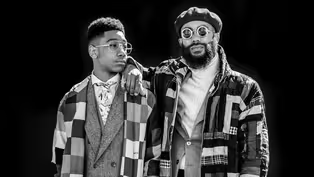
Preview: S3 Ep4 | 30s | Meet the Movers and Makers celebrating love in all its forms. (30s)
Providing Support for PBS.org
Learn Moreabout PBS online sponsorship

- Arts and Music
The Best of the Joy of Painting with Bob Ross
A pop icon, Bob Ross offers soothing words of wisdom as he paints captivating landscapes.












Support for PBS provided by:
Movers & Makers is a local public television program presented by WHYY