VPM News Focal Point
Medical Challenges & Triumphs | September 28, 2023
Season 2 Episode 14 | 26m 46sVideo has Closed Captions
Bringing health care directly to Appalachians; we also highlight medical breakthroughs.
What are the primary health challenges facing Virginians? Doctors and dentists on wheels are bringing health and dental care directly to rural Appalachians. We also highlight recent breakthroughs in medical treatments and disease prevention.
Problems playing video? | Closed Captioning Feedback
Problems playing video? | Closed Captioning Feedback
VPM News Focal Point is a local public television program presented by VPM
VPM News Focal Point
Medical Challenges & Triumphs | September 28, 2023
Season 2 Episode 14 | 26m 46sVideo has Closed Captions
What are the primary health challenges facing Virginians? Doctors and dentists on wheels are bringing health and dental care directly to rural Appalachians. We also highlight recent breakthroughs in medical treatments and disease prevention.
Problems playing video? | Closed Captioning Feedback
How to Watch VPM News Focal Point
VPM News Focal Point is available to stream on pbs.org and the free PBS App, available on iPhone, Apple TV, Android TV, Android smartphones, Amazon Fire TV, Amazon Fire Tablet, Roku, Samsung Smart TV, and Vizio.
Providing Support for PBS.org
Learn Moreabout PBS online sponsorshipBILLY SHIELDS: Our health impacts every aspect of our lives, and a severe illness can be devastating.
This week, we're looking at medical challenges and triumphs.
Care providers in Appalachia say oral health is about more than just a smile, and we examine new ways to help people struggling with food allergies.
We also highlight a solution for those who have a hard time accessing medical care.
You're watching VPM News Focal Point.
Production funding for VPM News Focal Point is provided by The estate of Mrs. Ann Lee Saunders Brown.
And by... ♪ ♪ BILLY SHIELDS: Welcome to VPM News Focal Point.
I'm Billy Shields, in for Angie Miles.
Today, we're talking about human struggles and the hope of scientific advancements connected to medical care.
Health experts have called the global rise in diabetes alarming.
More than 10% of adult Virginians have been diagnosed with the illness.
News producer Adrienne McGibbon tells us about a new treatment that aims to delay that diagnosis.
ADRIENNE McGIBBON: The Troutmans have two children with two different stories.
Their youngest child, Jenna, was diagnosed with Type 1 diabetes when she was 11.
AMANDA TROUTMAN: For our daughter, everything she eats and all of her activity, her glucose blood sugar is measured 24 hours a day, so it's never ending.
ADRIENNE McGIBBON: William has not been diagnosed with diabetes, but because of his sister's diagnosis, he's at a higher risk.
So his parents decided to put the 17-year-old on a drug recently approved by the FDA called Tzield.
AMANDA TROUTMAN: We knew what it meant to have a child with Type 1 diabetes and the relentless nature of it.
So we definitely wanted any portion of extension, 'cause that's what Tzield is supposed to do is extend the life of the beta cells that produce insulin, so we were thrilled.
ADRIENNE McGIBBON: Early studies of Tzield show it delays the onset of diabetes by two to eight years for adults and children.
Dr. Bryce Nelson is the Chief of Pediatric Endocrinology at the Children's Hospital of Richmond at VCU and oversees William's care.
DR. BRYCE NELSON: Think about the impact of that two years could be in a child in middle school and not having to go to the school nurse, not being singled out in a way that makes them feel different.
ADRIENNE McGIBBON: Dr. Nelson says this medicine is revolutionizing how he treats diabetes.
DR. BRYCE NELSON: Prior to that medication, even if I knew someone was in this particular stage, all I could do was wait until they needed to go on insulin, wait and watch.
Now there's something I could potentially do.
ADRIENNE McGIBBON: By delaying the onset, Dr. Nelson says the treatment decreases the long-term effects diabetes has on major organs, like the heart, kidneys, nerves, and blood vessels.
Some side effects from Tzield include fever, fatigue, nausea, and headache.
Amanda Troutman says she hopes the drug will buy her son some more time.
AMANDA TROUTMAN: Our hope is that while in the waiting, something else will come out and you know, just getting back some of what diabetes can steal.
BILLY SHIELDS: Dr. Nelson says those whose family members have Type 1 diabetes are at higher risk and may be eligible for Tzield.
Other warning signs to look for are increased thirst and urination and unexplained weight loss.
BILLY SHIELDS: When we invited people of Virginia to share their perception of the public's overall health, most said not good.
And when we followed up by asking what the biggest challenges are to good health in our state, here is what they told us.
JOANNE DIXON: Long waits to see doctors because there aren't enough physicians.
The overcrowding of our ERs for primary care issues is a big problem, and patients are just waiting until they get so sick and then they end up admitted and having surgeries that could have all been prevented if they had good preventive health care.
AVA ALFRED: The wait times to seeing health professionals, like, by the time I get to the appointment, I'm already dead.
(laughs) That's what it feels like, you know?
Or by the time I get to see the therapist, I've already, you know, been admitted to the psych ward.
Like, the wait times are insane.
SHAVONNE HARDY: Just came off of a three-day conference that focused on individuals with disabilities and their access to health care is problematic and the disparities there.
ALEXANDRA MARRERO: Affordability regarding insulin or just other very basic, necessary life medications that people require to be healthy.
And I met a lot of people who couldn't meet their insurance copay for their insulin, even though it might've been only $30.
So I would say access to affordable health care.
BILLY SHIELDS: Many people living in the far corners of Virginia face immense challenges accessing dental care, but a free annual event helps to bridge the barriers, ensuring that smiles shine brighter.
Multimedia journalist Keyris Manzanares has more.
KEYRIS MANZANARES: People from all over Southwest Virginia travel to Wise County for the annual Mission of Mercy free dental clinic.
TRICIA COUNTS: It's important to us because we don't have dental care.
KEYRIS MANZANARES: Tricia Counts, who lives near Haysi, traveled an hour to get her teeth cleaned.
TRICIA COUNTS: Just recently I got an estimate from a dentist local in the area, and they wanted $300 just to clean.
And I wouldn't pay that.
I couldn't pay that.
KEYRIS MANZANARES: Besides money, Count says another challenge is the shortage of dentist options in the area.
TRICIA COUNTS: We had a very good dentist right in Haysi, but he retired.
So I just haven't been able to find a dentist I like since him.
KEYRIS MANZANARES: For the past 24 years, the Virginia Dental Association Foundation has been hosting the Mission of Mercy event.
The goal is to bring dental care into parts of Virginia that lack enough practitioners to serve the underserved and uninsured in Virginia, or those who rely on Medicaid and Medicare.
TARA QUINN: So we're in our 24th year this year.
KEYRIS MANZANARES: For Tara Quinn, executive director of VDAF, the mission is personal.
TARA QUINN: To see the extent of the suffering that comes from not being able to have oral health care, the pain, the impact on overall health, the impact on being able to apply for a job or keep a job, to be able to focus in school for children that are in pain.
I mean, it's so far reaching and I feel very grateful to be able to be a little tiny part of the solution.
KEYRIS MANZANARES: This year, Missions of Mercy has crossed a monumental threshold in providing $50 million of free dental care to the people of Virginia who need it the most.
To treat patients, VDAF partners with Virginia Commonwealth University School of Dentistry students and faculty, as well as other dentists from the state who volunteer their time to help the people of Appalachia.
ELIZABETH REYNOLDS: We know that oral health impacts every aspect of our lives.
It impacts heart health.
It impacts diabetes and diabetes impacts it.
It impacts low birth weight babies.
Our periodontal health is so important, and we forget that.
People who can't live with healthy oral health don't have healthy overall health.
KEYRIS MANZANARES: Dr. Elizabeth Reynolds traveled to the first Mission of Mercy event 24 years ago.
Now, she runs the triage, the first stop at the clinic.
ELIZABETH REYNOLDS: They come in and we do an oral cancer screening, which is of utmost importance.
And then we do an overall screening of head and neck, and then we do a screening of their teeth.
And sometimes people want their front tooth filled, but they may have abscesses in their back teeth that don't hurt right now.
So it's our job to educate patients and help them understand what is going to best serve them long-term.
People judge you without your teeth.
And so if you can take these folks, give them the confidence they need and help restore their smile, you can change their lives.
And we do that every day.
We do it here.
And I'll be honest, I think dentists do it every day in their own offices.
KEYRIS MANZANARES: Reporting for VPM News, I'm Keyris Manzanares.
BILLY SHIELDS: The Virginia Dental Association Foundation says the project's mission will always be to help create lasting solutions for dental care access.
But for now, they will continue to seek opportunities to provide care in communities throughout Virginia.
For a list of free upcoming Mission of Mercy events, head to vpm.org/focalpoint.
ANGIE MILES: VPM News Focal Point is interested in the points of view of Virginians.
To hear more from your Virginia neighbors, and to share your own thoughts and story ideas, find us online at vpm.org/focalpoint.
BILLY SHIELDS: It's become somewhat of a modern medical mystery.
An estimated 8% of American children and 11% of American adults have some sort of food allergy.
Over the past 20 years, peanut allergies in the United States have more than tripled.
And it's not just peanuts; tree nuts, shellfish, wheat, soy, gluten, dairy, eggs, all of these are harmful or even deadly for an increasing number of Americans.
And adult-onset allergies are becoming more common as well.
Scientists are unsure what's causing the increase, but for researchers and those who have to manage this challenge, the goal is to find answers, as living with food allergies can be life-altering and life threatening.
Focal Point anchor Angie Miles brings us this story.
PATRICK OSBORNE: When I looked down, and my whole body was covered in hives.
And I guess my mom had told my older brother to put calamine lotion.
But all I remember was just being covered in this pink lotion from head to toe.
ANGIE MILES: Patrick Osborne had his first allergic reaction to food around the age of 4.
Initially, fish sticks, then salmon, then tuna.
PATRICK OSBORNE: That's when I just decided, 'Hey, I'm going to stay away from any kind of fish.'
Mom would cook the fish in the house.
I would just leave, you know, go play outside or something like that.
ANGIE MILES: Now, married with a family, food allergies pose a challenge for the entire Osborne household.
KRISTIN OSBORNE: I have three sons who have multiple life-threatening food allergies.
PATRICK OSBORNE: David, he's about 1.
What is he, 2?
Something like that.
And she said that he wasn't breathing right and he was drooling.
So I put him in the car seat, wanted to take him to the doctor.
KRISTIN OSBORNE: They tested him for dairy, egg, and wheat.
And I remember getting the phone call from the nurse thinking, 'Oh, it's just one of the three.'
And she said, "No, it's all three."
And I remember thinking, 'What do I feed him?'
ANGIE MILES: Kristin, the only family member without any known food allergies, has a passion for making sure her family enjoys healthy meals that are safe for them to eat.
KRISTIN OSBORNE: So today, we're making gluten-free meatballs with a gluten-free spaghetti pasta and a delicious salad with a vegan feta crumbles and gluten-free baguettes.
All the spices and all the ingredients have to be checked.
I have to read the ingredient label to make sure there aren't any allergens that we're allergic to.
ANGIE MILES: Kristin coaches her boys to understand that staying safe from allergens should not detract from a sense of joy and adventure at mealtime.
BENJAMIN OSBORNE: When I discover something new that I can eat and it's really good, I like it because it's a new addition to the other foods that we've had.
DAVID OSBORNE: There have been some surprising ingredients in some of my favorite foods, and I'm like, 'Really?
There's beet root in this, but it tastes so good.'
KRISTIN M. OSBORNE: Through the years of advocating on behalf of my children, I realized there were other parents who really needed someone to kind of hold their hand through the process.
ANGIE MILES: Kristin is founder of Virginia Food Allergy Advocates and has worked closely with schools, places where food allergen safety has become a prominent issue.
HEIDI SOWALA: There are about 3,000 students in Virginia Beach City Public Schools that we have identified with life-threatening allergy, the peanuts to the other nuts to milk now, sometimes to some perfumes to some odors.
We're seeing just different life-threatening allergies.
ANGIE MILES: Schools are required by law to stock life-saving epinephrine.
But what happens if a child is between school and home when an allergic reaction occurs?
KRISTIN M. OSBORNE: So I was approached by a parent almost a decade ago about helping her student safely ride the bus, and needed accommodations for epinephrine.
And after working with the school system, we arrived at changing the guidelines so that bus drivers would be able to recognize anaphylaxis, but also administer epinephrine to the students who are allowed to self-carry their epinephrine in their backpack.
ANGIE MILES: And Virginia Beach schools made the change to prepare all school bus drivers just in case.
JEFF BOZARTH: When we're initially hired, we go through training and we're taught how to use the EpiPen.
Really helps our confidence when we're out with the actual children on the bus that if something were to happen, we would know how to handle the situation and help that child.
ANGIE MILES: Five-year-old Isaiah is just beginning his school career, something that adds a little worry for his mom.
CAITIE MAHARG: It's somewhat nerve wracking because I think sometimes people think, "Oh, gluten-free, that's just a trend."
And for so many people, it's not a trend, it's a matter of life or death.
And for our son, if I know at school they're going to have something, they'd let me know what they're going to have and I create something for Isaiah, so he doesn't feel left out.
ANGIE MILES: Isaiah's mom advocates for him and others in an entrepreneurial way.
CAITIE MAHARG: You're very welcome.
We have our cinnamon roll.
Is this all together?
Okay.
There you go.
CUSTOMER: Thank you.
CAITIE MAHARG: You're very welcome.
ANGIE MILES: Maharg is a professional chef, who experiments with recipes at home and who founded a company so that those with food allergies can experience the joy of special treats, safely.
CAITIE MAHARG: The more I thought about it, I was like, 'You know what?
Isaiah's never had a donut' and nowhere we went made donuts that were safe for him.
And I was like, 'I'm going to tweak around with some of these recipes and see what I can come up with.'
The donuts that I make are gluten-free, dairy-free, egg-free, nut-free, everything-free.
(laughing) And it's a good product and I put my heart into it.
And Isaiah is probably our biggest fan.
Anytime I think of new flavors or anything, he is my, the first one that gets to try it for me.
ANGIE MILES: Isaiah receives care for his specific food allergy issues at the University of Virginia.
Pediatric Allergy Specialist, Dr. Jonathan Hemler, works with patients to try to expand the list of foods they can eat safely.
We asked him why food allergies are on the rise in America.
DR. JONATHAN HEMLER: The most common theories are something like, "The Hygiene Hypothesis," where we are using our hand sanitizers and soaps and detergents and we're just very clean.
And our bodies aren't exposed to the microbes that they should be exposed to in order to keep your GI tract functioning properly.
There's some very recent research looking at detergents.
They are designed to break things down.
And there's, at least in the lab, has been shown that those things can actually break apart the linings of your GI tract and specifically, in your esophagus and in your lower gut.
And that is what may be the catalyst for allowing food to get in there that shouldn't get in there.
And that's why, potentially, food allergies develop.
ANGIE MILES: While research into the “why ” continues, in earnest, at places like UVA, experts and families living with food allergy challenges say the more important issue is making it possible for people to live well, despite the specter of food allergies.
At UVA, that might mean research into immunotherapies to help people tolerate their known allergens.
For the general public, it can mean advice on how to avoid food allergies altogether.
DR. JONATHAN HEMLER: I think the most important thing for many people to know, especially new parents, is that the earlier you introduce allergenic foods, especially like it's been studied mostly with peanuts, but also milk, egg, tree nuts, those other things, the thought is that you'll be able to go on to prevent future food allergies.
CAITIE MAHARG: Our story begins on the first day of school.
"No peanuts," said Eppie.
“She knew.
” ANGIE MILES: Avoiding food allergies or avoiding the dangers of having them, these are motivators for researchers and parents as they manage the pitfalls of food allergies and look for silver linings as well.
KRISTIN M. OSBORNE: And that silver lining is that my kids love to be in the kitchen.
They fully understand the food that we eat, but we do our best to make sure that the kids feel included and they can create some of these delicious foods on their own when they leave the house.
BILLY SHIELDS: The University of Virginia has been named a Discovery Center of Distinction by FARE, Food Allergy Research and Education.
It's a major education and advocacy group based in Virginia.
UVA is the only Virginia hospital to earn the designation.
To learn more about the university's food allergy research and recommendations, find those links on our website.
BILLY SHIELDS: The cost of prescription drugs is so high that a CDC report found more than 9 million Americans said they've had to skip doses or take less medicine than prescribed.
But in Virginia, there's a new project underway meant to help lower drug costs.
Joining us today is Dr. Frank Gupton, CEO of VCU's Medicines for All Institute.
He's also co-founder of a Richmond-based pharmaceutical company called Phlow.
BILLY SHIELDS: What are some of the causes for those high prescription drug costs?
DR. FRANK GUPTON: If you look at the generic drugs which is what we're focused on right now where approximately 80% of all the drugs consumed in the United States are generic drugs, sometimes you get into a situation where you get into a single supplier situation and then the price skyrockets because you don't have a competitive marketplace to be able to produce to sell the materials into.
So that's for generic drugs that's probably one of the most common scenarios.
BILLY SHIELDS: What effect did the pandemic have on drug manufacturing?
In order to be able to sell the product you have to have the product to sell.
And so the shortage created this situation where there weren't drugs available at any cost.
And it was an end-to-end problem because it wasn't just the formulated product or the, even the active ingredient was even the starting materials to make the drugs.
All of these things are required in order to be able to have a robust supply chain.
And we weren't able to sustain that because some of those starting materials were made in China some of 'em were made in India, some of the active ingredients were produced in other parts of the world, and then the finished dosage parts of the product could be also produced anywhere.
So you can see that when you start limiting the ability to transfer materials across countries due to the pandemic, you could have a shortage that would occur as a result of any of these individual components to the supply chain being unavailable.
BILLY SHIELDS: Okay, so explain what Phlow is.
DR. FRANK GUPTON: Phlow is a company that was started with the idea of being able to provide access to these essential drugs that were needed during the pandemic, but also to provide a platform for new technology so that we could actually produce these drugs more cost effectively in the United States.
BILLY SHIELDS: Could you also offer an overview of the project that you're working on in the region?
The overall project.
DR. FRANK GUPTON: Weve actually been working for the last 15 years or so with the Gates Foundation, trying to figure out how we can apply these same principles to HIV, malaria and tuberculosis drugs and COVID drugs.
So we've been very successful in that space but we recognize that this is an area of research that most academic institutions and even other research groups are not working on in the United States.
So what we're hoping is that as a result of the successes that we've been able to develop in this region, that this will become like an epicenter for advanced pharmaceutical manufacturing in the United States here in Central Virginia.
ANGIE MILES: You can watch the full interview on our website.
BILLY SHIELDS: The Health Wagon, a mobile medical RV that brings health care to rural Wise County, recently held its annual free event at the local fairgrounds.
The program brings in hundreds of medical volunteers in an effort to treat thousands in Appalachia, and I traveled there for this report.
(truck engine rumbling) (bird trilling) TERESA OWENS TYSON: We have four mobile clinics that go around to the area.
We are the oldest mobile free clinic in the nation.
We do have a lot of black lung here, coal miners' pneumoconiosis in the region.
As well, we have high rates of smoking, unfortunately, in the region.
So we are actually going out and finding a great burden of, unfortunately, lung cancer in the region.
The Health Wagon was started, it was founded by a Catholic nun, Sister Bernie Kenny.
She came from Massachusetts at the request of the Richmond Diocese because of the inherent poverty here.
And she literally started dispensing health care out of the back of a Volkswagen Beetle, hence the name of the Health Wagon.
PAULA HILL-COLLINS: We take no insurance and underinsured.
A lot of patients are underinsured, and those are the patients that we see.
Anymore, most people have catastrophic insurance only.
A $1,000 deductible is a low deductible anymore.
So patients needing their medication, I have a school teacher, her husband has diabetes.
His insulin is $3,000 a month.
He has to meet his deductible for his insulin before his insurance will pay for it.
These are who we're seeing.
OPTOMETRIST: We've got some letters in red and letters in green there.
DEBBI GIERAT: I don't have insurance, so it's incredibly helpful and they're very gracious to give their time.
And I'm very thankful.
I cry every year.
I've had X-ray services today, CT services today, optical services, and a mammogram.
DR. JAMES NEWBY: It's a health care gap in this vicinity, so a lot of people can't get the health care that's required.
So this is sort of a stop gap for them to come in, get things taken care of.
PAULA HILL-COLLINS: 30 miles here is not like 30 miles on the interstate.
You're talking about an hour and a half drive, probably, and with very treacherous roads, actually.
And they can't always come and have labs drawn.
We can draw labs, we can connect them to the University of Virginia Telehealth.
We can see them.
DONALD PURDIE: This is a SpaceX Starlink mobile dish.
The purpose, of course, is to be able to get connectivity anywhere.
So in this instance, with the Health Wagon, the idea is to be able to get into the areas where internet is not available and then be able to work with patients to have a better health outcome.
PAULA HILL-COLLINS: Medications go here, and then if we brought you on back here, we actually have an exam room where Teresa and myself do pap smears.
OPTOMETRIST: 5 better?
PATIENT: That one's better.
TERESA OWENS TYSON: Keeping the money coming in, that is the most difficult part of this.
There's a lot of foundations.
Although we give care that's free, it's not free to give that care.
It is expensive to give that care.
Our budget is in excess of $6 million annually.
NONA MCDANIEL: It's hard for us, and I know it's hard for people that's not got anything to have health care.
And it's truly a blessing for this to be up here.
DEBBI GIERAT: To get through to the system when you don't have insurance, oftentimes, you're getting charged just to make the appointment and then they make you the next appointment before they can get you to the next appointment and you haven't had any services.
So, here, given what I've had done today thus far in the limited hours that I've had, I would've been back and forth or elsewhere, maybe Morristown, maybe Knoxville, maybe elsewhere.
And it would be there and back for each test multiple times.
Sure.
Wow, you are quick!
Sure.
Wow, you are quick!
OPTOMETRIST 2: Go ahead and take them out and try them on.
OPTOMETRIST 2: Go ahead and take them out and try them on.
BILLY SHIELDS: From prevention to diagnosis to treatment, we've explored how Virginians are addressing medical challenges and triumphs.
For more coverage, including the full discussion with Dr. Frank Gupton, visit our website at vpm.org/focalpoint.
Thank you for joining us.
We'll see you next time.
Production funding for VPM News Focal Point is provided by The estate of Mrs. Ann Lee Saunders Brown.
And by... ♪ ♪
Can Virginia solve the affordable drug crisis?
Video has Closed Captions
Clip: S2 Ep14 | 6m 6s | Central Virginia to be “epicenter” of affordable drug manufacturing (6m 6s)
Video has Closed Captions
Clip: S2 Ep14 | 2m 20s | Can a new drug change diabetes treatment? (2m 20s)

Video has Closed Captions
Clip: S2 Ep14 | 7m 44s | Learn about research, advocacy and risks related to those living with food allergies. (7m 44s)
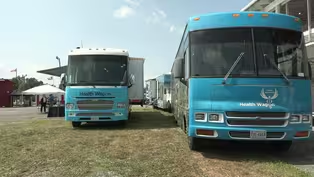
Health Wagon Returns to Wise County
Video has Closed Captions
Clip: S2 Ep14 | 3m 35s | For the first time since the pandemic, the Health Wagon held its annual volunteer drive. (3m 35s)
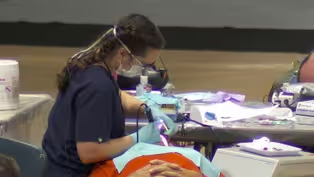
Oral health disparities in Appalachia
Video has Closed Captions
Clip: S2 Ep14 | 3m 29s | Mission of Mercy helps address oral health disparities in Virginia’s Appalachia region. (3m 29s)
Providing Support for PBS.org
Learn Moreabout PBS online sponsorship
- News and Public Affairs

Top journalists deliver compelling original analysis of the hour's headlines.

- News and Public Affairs

FRONTLINE is investigative journalism that questions, explains and changes our world.












Support for PBS provided by:
VPM News Focal Point is a local public television program presented by VPM