
MetroFocus: June 6, 2023
6/6/2023 | 28mVideo has Closed Captions
SUNNY HOSTIN ON THE ISSUES FACING NEW YORK CITY; BROADWAY WEEK: “NEW YORK, NEW YORK"
Emmy Award-winning legal journalist and co-host of The View Sunny Hostin joins us to talk about some of the most pressing issues facing New York City, as well as her new book, "Summer in Sag Harbor." Then, joining us to discuss the musical, "New York, New York" are Colton Ryan, who plays Jimmy Doyle; Anna Uzele, who plays Francine Evans; and Emily Skinner, who plays Madame Veltri.
Problems playing video? | Closed Captioning Feedback
Problems playing video? | Closed Captioning Feedback
MetroFocus is a local public television program presented by THIRTEEN PBS
MetroFocus: June 6, 2023
6/6/2023 | 28mVideo has Closed Captions
Emmy Award-winning legal journalist and co-host of The View Sunny Hostin joins us to talk about some of the most pressing issues facing New York City, as well as her new book, "Summer in Sag Harbor." Then, joining us to discuss the musical, "New York, New York" are Colton Ryan, who plays Jimmy Doyle; Anna Uzele, who plays Francine Evans; and Emily Skinner, who plays Madame Veltri.
Problems playing video? | Closed Captioning Feedback
How to Watch MetroFocus
MetroFocus is available to stream on pbs.org and the free PBS App, available on iPhone, Apple TV, Android TV, Android smartphones, Amazon Fire TV, Amazon Fire Tablet, Roku, Samsung Smart TV, and Vizio.
Providing Support for PBS.org
Learn Moreabout PBS online sponsorshipJenna: Tonight, Sunny Hostin weighs in on the hot topics New Yorkers are talking about.
What the former prosecutor and Bronx native is saying about immigration, gentrification, and the mental health crisis.
Start spreading the news, the stars of New York, New York making a brand-new start of it.
They join us as Broadway Week on "Metro Focus" continues, starting right now.
♪ Announcer: This is "MetroFocus", with Rafael Pi Roman, Jack Ford, and Jenna Flanagan.
"MetroFocus" is made possible by Sue and Edgar Wachenheim III, Filomen M. D'Agostino Foundation, The Peter G. Peterson and Joan Ganz Cooney Fund, Bernard and Denise Schwartz, Barbara Hope Zuckerberg.
And by Jody and John Arnhold, Dr. Robert C. and Tina Sohn Foundation, the Ambrose Monell Foundation, Estate of Roland Karlen.
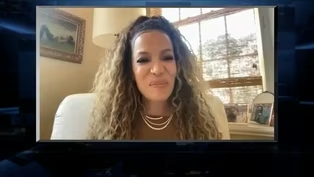
Jenna: High, I am Jenna Flanagan.
As one of the hosts of "The View", Sunny Hostin does not hold back.
We don't often get to hear Bronx natives thoughts on the issues impacting New York City.
She growth and the housing project in the South Bronx with her Puerto Rican mother and African-American father, and experience she chronicled in her best-selling memoir.
It launched a national conversation on race, identity and social justice.
The former federal prosecutor turned journalist is a lot to say about what goes on in the city.
From immigration to the mental health crisis and homelessness, to gentrification.
She is also a New York Times best-selling author once again, finding local inspiration for her reading novel, summer on Sag Harbor, set on a historically black beach community on Long Island.
She joins me right now.
Sunny: Thank you so much for having me.
Jenna: First I want to get into the book that you have written before, and talking just about diving in to those complex narratives of intersectionality, a word that we use regularly.
What that process was like writing it, and unpacking those different parts of your identity.
Sunny: The memory was tough.
I/O is thought fiction would be more difficult, that is not true, I know from experience.
As a journalist, when you make yourself the subject, it is already uncomfortable.
When you are writing a memoir about identity, people have a lot of views on it.
Including my own mother, who snuck an advanced copy and was with upset about how I remember things.
I found it to be difficult to broach a lot of the topics.
I did it to start conversations that I think we need to have.
Conversations that we have every day on "The View", but our country remains uncomfortable about.
What is identity?
How do you assign value to yourself?
You get to determine who you are, no one else gets to do that.
I will say, it was difficult to write.
I will not write anymore members, I don't think.
[LAUGHTER] I wrote it in both English and Spanish, I am happy that I did it, but I prefer fiction.
Jenna: Definitely a one and done situation.
Sunny: I think so.
[LAUGHTER] It was a bestseller and it was great that so many people read in, and it did start honest conversations about identity and social justice, and about poverty.
Jenna: Speaking of that part of your childhood identity, your journey of growing up poor and living in housing projects, I am wondering if you could take us to how QC the city's current housing crisis.
There are so many challenges that working-class New Yorkers are facing in just being able to stay in the city that they love, that they have made so fibrin, and that they also work in.
Sunny: It is really terrible what is happening.
I understand gentrification, I think that can actually be a good thing.
But what I do not agree with is displacement.
I think unfortunately that is what we are seeing, especially in New York, but also around the country.
You have communities, like the African-American community that built up New York.
You had the great Gratian and Black folks that came to New York to build families, to grow in communities like Harlem.
Now you are seeing gentrification, you are seeing displacement.
I don't read over the statistic, but in the past couple of years, you have had an exodus of black families.
The flavor is different when you walk around.
I was surprised to visit Harlem recently, and it has changed.
I'm not sure that that robust community is there.
I visited the South Bronx often, I see the same thing.
People that made the community what it is have been displaced.
That is problematic.
Jenna: Of course.
Displacement unfortunately can add to not necessarily in every situation, it can add to people finding themselves house lists or without a steady place to live read we know that the homeless crisis is growing exponentially in New York City.
I am wondering, from your perspective, how you see that being addressed?
Is this an ongoing problem that will always be part of New York?
Or is it something that, if we band together, we could make a difference?
Sunny: There is no question that we could make a difference.
We have other states sending migrants to New York, and 50% of the hotels are filled with migrant families.
They are looking for work, they are getting services.
New York is a very welcoming place.
But unbeknownst to some people, I will also say that, we don't do enough.
We don't do enough for those that find themselves without homes, for families that find themselves without homes.
For people that are suffering from until health.
There are no services for those folks.
If we can spend $5 billion per year on policing in New York, I don't understand why we can't spend a commensurate amount on housing, for those that find themselves without, why we can't spend money on mental health services, which are sorely needed in the city.
Why we can't spend more money on education and arts programs in our public schools.
It seems to me that rather than policing, we should be helping these communities thrive and grow.
I am saddened by the lack of resources that are funneled into those buckets.
Jenna: One of the interesting things that always seems to come up is that whatever there is a crisis, especially when it comes to an outburst of violence or perceived violence, the subject of middle health comes up.
At the same time, does not seem clear as to exactly who is supposed to be responsible, even from my perspective as a local journalist.
It seems there is a lot of political hot potato, it's not the city's job, it is the state's job, it's not the state's job, it is the federal job.
Who do you see as being responsible?
Who needs to step in and make sure we can provide something as critical as mental health services?
Sunny: A couple ways to approach this.
We know that when it comes to violence, that those who are mentally ill are generally the folks that are the recipients of violence, rather than committing violence.
This is a statistic.
I am always concerned when I hear people in this country blame mental illness for violence.
That is not the case.
With the case we saw on the subway system recently, the gentleman that was mentally ill, that was telling his fellow citizens, I am hungry, I am thirsty, I don't feel a reason to live.
That is someone who is asking for help.
However, he was met with violence.
And murdered, in my view.
I think it is a multipronged issue.
I think everyone needs to help.
I thing we can do more federally, in terms of medical care.
We have the affordable care act, what it seems to me that whenever the government has a shot at it, they don't fund mental health services.
It is terribly misunderstood.
New York State has to do a much better job.
Of providing programs for those that are homeless and mentally ill.
I think the city has to do a much better job.
We have interviewed the mayor, and I know that he would disagree.
Some of the money that is funneled to policing in the city needs to be funneled to mental health services.
When I was a federal prosecutor, the local Metropolitan police department in D.C., emotionally disturbed persons.
They did not want to respond to situations involving EDPs, they wanted to concentrate on crime and felony level crimes.
They were called often to deal with family issues dealing with mental health.
Why can't we address that issue?
The cops don't want to sponsor to those issues, nor are they trained to.
Why don't we have a mental health response team that responds to a situation like the one on the train?
There have been states like in Ohio and Cleveland that have specialized units that are filled with mental health professionals, that go to the scenes and have made a difference in terms of the outcome for the citizens and in terms of middle health care.
I don't understand why a city that has so many resources, so much money, it doesn't know how to take care of this.
Jenna: That is such an important conversation to have.
I want to thank you for even a robust and thoughtful answer.
I want to pivot, we have two minutes left.
You have a new book out, called "Summer on Sag Harbor", tell us a little bit about what makes this book stand out monks other summer creeds.
Sunny: It is based in history.
It is historical fiction, something that I love very much.
I love a good each read, I like an elevated beach read.
I realize there were places in the country of black excellence that we do not focus on.
I think you can also start discussions about difficult issues if you place them in a beautiful place.
[LAUGHTER] For me, I wanted to center stories on Black and brown folks, around women, older women as well, which is a demographic we forget even exists sometimes.
I wanted to center those stories and relationships.
I wanted to place them in a historically black beach community.
HBBCs, these places are federally recognized as historically Black beach communities.
Sag Harbor is close to my heart, black people have been summering there since the 1940's.
You have a group of civil servants, doctors and lawyers that pulled money together to buy beachfront property.
At the time it was not desirable because it was on the bay.
It is a beautiful community with generational wealth.
Which is something that I talk about often.
People do not know about it.
I found out about it 20 years ago because Barbara Smith invited me to Sag Harbor.
It was quite the invite.
She was like the black Martha Stewart.
I was amazed at this incredible community that I discovered.
I have been summering there ever since.
Jenna: Why does it take place?
Sunny: It takes place in the current day.
I was writing during the pandemic.
I felt like wow, I can't ignore what New Yorkers are going through.
I wanted to relive, not only the pain that we went through, I lost many family members from Covid.
But also the gelling of so many communities, people were looking after each other.
I couldn't ignore that.
It is not all sad, it is actually very joyful in many respects.
I am proud of it.
I was surprised, because sequels rarely hit the New York Times bestseller list.
But this one did.
I am thrilled that the first book did and this one did.
I am happy at the reception that the book has received.
Jenna: I think that is a beautiful note to leave it on.
And a beautiful setting that I am thinking of right now.
I want to thank you so much for joining us on "Metro Focus".
Sunny: Thank you so much for having me.
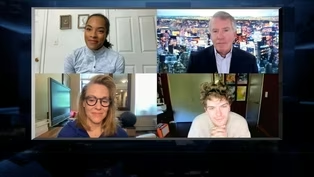
♪ Jack: What better title for a new Broadway musical than New York, New York.
Inspired by the iconic song by composers John Cantor from the 1977 Martin Scorsese film of the same name, this new musical with 9 nominations brings together two generations of Broadway legends.
It features a score and additional lyrics by Lin-Manuel Miranda.
♪ >> Fortune cookie?
>> No, my daddy.
>> Oh, smart daddy.
♪ [Applause] ♪ >> Don't bet against New York.
[Applause] Jack: Joining us now to talk about this marvelous musical are the stars.
Welcome to all of you, so glad to have you with us.
>> Thank you for having us.
Jack: We were talking before we started, my wife and I saw the show, it was spectacular.
You were also good.
I mentioned nine Tony nominations, all well deserved.
This is a project based very loosely on the 1977 film New York, New York.
Robert Scorsese, Robert De Niro, Liza Minnelli.
As an actor, when someone presents you with a new project, and they say this is all new, but it is kind of connected to something that was out there and got a lot of attention.
Is that a daunting prospect for you in any way?
We will work our way through the boxes here.
>> Surprisingly not, it is only daunting if there is an expectation to fill the shoes.
With this project there was not.
I would be missing out if I did not experience the magic that Liza brought us.
I went to the movie to see what she did and gave.
But she was fully herself, and she allowed me to be that as well.
There has been no expectation for me to be her or inhabit her shoes in any capacity.
But only to bring myself to the project.
It only helped, I think.
Jack: How about you?
Robert De Niro, the legendary character.
Your first thought about it?
>> It is not bad company to be included with.
It is the best case scenario.
We are talking about people who have the bona fides.
Proving that time and time again.
And yet they had their own point of entry.
They had inspiration with this piece that we had carte blanche range over what we wanted to accomplish with it.
If the starting point is De Niro...and the rest is open campus, it is a good situation to be in.
>> I knew that Susan Stroman was going to be smart enough not to try the stick the movie onstage stage.
She was going to reimagine the kernel of the movie and theatricalize from there.
Her plan was to expand and make the story more about New York then just to central characters.
Jack: How about the idea, being a part of a project that has a legendary names.
Emily, you brought me to my other question, which is Susan Stroman directing and choreographing.
How about that idea of walking onto a stage and saying this is who I am working with.
>> I grew up in Delaware, in the same hometown.
We grew up looking to her as the legend that came from Wilmington, Delaware in the hope that one day you might be able to meet her.
It was a fun reunion for two Delaware girls to get together.
It is easy, because you trust her, you trust her wholeheartedly.
Her vision is one you can't help but get on board with.
>> Colton, what do you think?
>> I love her.
She is a Titan of this industry.
You already have your own pretense when you come in, thinking, "I know what she is going to do."
She is... our tour of stage.
She has her own vernacular, her own signature.
You think, I think I know how I slot into that.
The beautiful thing about getting to know her was the long leash that she gave us.
I think it is one of the beautiful deft hands of directing where you can make your signature happen and allow your actors to find their own signature within it.
She is supreme, she is top of the list.
Jack: As someone who has never been an actor, what you just described, would be the ideal scenario for you to find.
Emily, the idea of making the show about New York.
I saw in one of the reviews, they described it as a love letter to New York City and all of its possibilities.
Talk about that notion of making this a love letter to New York.
>> I would say that is a very accurate statement.
It is sort of centering on the idea of people coming to New York with an agenda, with a dream, and even if you are from New York, you are living here with a purpose.
Our show feels so much about people who hold our hands out to each other.
In particular, it is set in 1946, at the end of World War II.
When the city was putting itself back together.
And we are living that right now, post-pandemic.
I think the show is resonating on multiple levels for people when they see it because of that.
And the fact that, the world that we put it in is a small town.
It is a big city, but it is also a small town.
It is about people holding their hands out to each other.
Jack: You didn't get that small town feel.
It is interesting you mention that.
The stories are so intricately interwoven, with the backdrop of New York City as a small town.
But I have to ask you about two things, the first is the sets.
Somebody jump in, give a description.
It is hard for me, people deed to go to the theater to see the show.
One is to see the set design.
>> It is its own standing achievement, this set.
I will put it this way, it somehow hits every single major landmark in the city and sometimes it does so within the same number.
It is a very cinematic, very sweeping set.
It is very artful.
Jack: I saw it described as a travel log.
Is that accurate?
>> Yeah, and the first number we have a handful of hand-painted drops within 30 seconds that all fall an outfit or the other.
You are taken through the entire city.
It is a visual smorgasbord.
Jack: If you are someone who is fascinated by old photo grass of New York City, and there is an iconic one of ironworkers building a high-rise.
They are sitting there having their lunch on the steel beams.
And Emily, I know you are not dancing in the scene, but I will let you describe it.
That scene shows up in this show.
>> That scene turns into a musical number in our show.
Jack: Who would have thought that would lend itself to a musical number?
The music we talked about, this stage we talked about, the dancing is fabulous.
Why would you expect anything less than that from Susan Stroman?
Talk a little bit about the dancing and how it is so significant in this show.
>> When I got the call that I was going to be a part of New York, New York, I asked how much I was going to dance.
She said, don't worry, you will do a twirl here and there.
Her choreography is so rooted in storytelling and truth, that someone who is daunted by dancing, I watched these answers every night.
I tell them every night, I want to sing better from watching you.
Thank you for what you bring.
It is tremendous what she has brought and what she can tell the story through bodies.
Jack: We could talk for hours about this.
We are up against the time.
Once again, New York, New York, a magnificent show.
Talk about nine Tony nominations , including Best Musical.
Great theater is supposed to entertain us and make us think.
That is what this dozen a lot of ways.
Congratulations to all of you for the work that you have done and looking for to seeing this run for a long, long time.
Thank you so much for joining us.
To all take care now.
>> Thank you.
♪ Jack: Thanks for tuning in to "MetroFocus".
You can take our award winning program with you go with "MetroFocus" the podcast.
Listen and subscribe wherever you get your podcasts so you never miss and episode.
Or simply ask your smart speaker to play "MetroFocus" the podcast.
Also available at metrofocus.org, wliw.org/radio, and the NPROne app.
♪ Announcer: "MetroFocus" is made possible by Sue and Edgar Wachenheim III, Filomen M. D'Agostino Foundation, The Peter G. Peterson and Joan Ganz Cooney Fund, Bernard and Denise Schwartz, Barbara Hope Zuckerberg.
And by Jody and John Arnhold, Dr. Robert C. and Tina Sohn Foundation, the Ambrose Monell Foundation, Estate of Roland Karlen.
♪
BROADWAY WEEK: “NEW YORK, NEW YORK”
Video has Closed Captions
Clip: 6/6/2023 | 11m 21s | BROADWAY WEEK: “NEW YORK, NEW YORK” (11m 21s)
SUNNY HOSTIN WEIGHS IN ON THE ISSUES FACING NEW YORK CITY
Video has Closed Captions
Clip: 6/6/2023 | 14m 5s | THE VIEW’S SUNNY HOSTIN WEIGHS IN ON THE ISSUES FACING NEW YORK CITY (14m 5s)
Providing Support for PBS.org
Learn Moreabout PBS online sponsorship
- News and Public Affairs

Top journalists deliver compelling original analysis of the hour's headlines.

- News and Public Affairs

FRONTLINE is investigative journalism that questions, explains and changes our world.












Support for PBS provided by:
MetroFocus is a local public television program presented by THIRTEEN PBS