Keystone Edition
NEPA and the Chesapeake Bay
3/4/2024 | 27mVideo has Closed Captions
How does what we do here affect the watershed and what can be done to improve its quality?
The Chesapeake Bay Watershed encompasses parts of 6 states and covers over 64,000 square miles, including Pennsylvania. The Susquehanna River, which runs through our region empties into the Chesapeake Bay. However, excess nutrient pollution, polluted storm runoff, climate change and more are causing serious problems in some areas in parts of the watershed, which includes NEPA.
Problems playing video? | Closed Captioning Feedback
Problems playing video? | Closed Captioning Feedback
Keystone Edition is a local public television program presented by WVIA
Keystone Edition
NEPA and the Chesapeake Bay
3/4/2024 | 27mVideo has Closed Captions
The Chesapeake Bay Watershed encompasses parts of 6 states and covers over 64,000 square miles, including Pennsylvania. The Susquehanna River, which runs through our region empties into the Chesapeake Bay. However, excess nutrient pollution, polluted storm runoff, climate change and more are causing serious problems in some areas in parts of the watershed, which includes NEPA.
Problems playing video? | Closed Captioning Feedback
How to Watch Keystone Edition
Keystone Edition is available to stream on pbs.org and the free PBS App, available on iPhone, Apple TV, Android TV, Android smartphones, Amazon Fire TV, Amazon Fire Tablet, Roku, Samsung Smart TV, and Vizio.
Providing Support for PBS.org
Learn Moreabout PBS online sponsorship(upbeat music) - [Announcer] Live from your public media studios, WVIA presents: Keystone Edition Reports, a public affairs program that goes beyond the headlines to address issues in northeastern and central Pennsylvania.
This is Keystone Edition Reports.
And now, moderator Larry Vojtko.
- Hello, I'm Larry Vojtko.
When you think of a body of water in our area, your mind might immediately go to the Susquehanna River, and understandably so.
It's 444 miles long, and has been a critical part of local history long before the birth of our nation.
Our connection with the Susquehanna River goes deep.
What you may not know is that the Susquehanna River is part of the Chesapeake Bay watershed.
The watershed encompasses parts of six states, and Washington DC.
It is the largest estuary in the United States, and the third largest in the world.
Naturally, what we deposit into the Susquehanna River in our region empties into the Chesapeake Bay.
This includes the west branch of the Susquehanna River, which runs for about 120 miles across the state, where it meets up with the north branch of the river.
Also, consider the thousands of smaller streams that comprise the watershed in our region.
Pollutants emptied into those smaller streams, such as sediments, excess nutrients for plants, pavement runoff, and more, ultimately end up in the bay.
Everything is connected.
40 years ago, the Chesapeake Bay program was established to restore and protect this valuable natural resource.
In this program, we'll learn how far we've come, and what work remains to be done to secure this vital watershed for future generations.
Keystone Edition Reports Sarah Scinto tells us more.
(logo whooshing) (bright music) - [Sarah] The Chesapeake Bay lies about six hours south of northeastern Pennsylvania, and is known for seafood, recreation, and tourism.
Despite the distance, it can impact several aspects of life in our region, and we have our own effects on the watershed.
18 million people live in the Chesapeake Bay watershed, and 55% of the fresh water flowing into the bay comes from the Susquehanna River.
What we put in the water here not only affects the health of the Chesapeake, but also the ecosystems and waterways closer to home.
Pollutants have a trickle down effect on the overall health of the bay.
According to the Chesapeake Bay program, agricultural practices upstream, such as over-irrigating, over-tilling soil, and over-applying pesticides and fertilizers are the number one source of nitrogen pollution entering the Chesapeake.
Farmers are working with the Chesapeake Bay program to curb some of this runoff by using newer conservation practices, like implementing forest buffers, introducing stream-side fencing to keep livestock from waterways, and better manure and poultry waste management.
The Chesapeake Bay Foundation says more farmers making the move to this regenerative agriculture could also protect a farm's economic stability and resiliency.
For Keystone Edition Reports, I'm Sarah Scinto, WVIA News.
- Thanks so much, Sarah.
Let's welcome our guests, who are here to share their expertise on this topic.
And joining us here in the studio is Ben Hayes, the Program Director for Watershed Sciences and Engineering at Bucknell University in Lewisburg.
Teddi Stark, the Watershed Forestry Program Manager of the Pennsylvania DCNR, the Department of Conservation and Natural Resources.
Bernie McGurl, Senior Project Manager at Lackawanna River Conservation Association.
Well, thank you so much for joining us here for this important conversation on a topic that is, you know, we think of water, we almost take it for granted in a lot of ways, and we don't often realize that our actions here have great consequences for so many, particularly as it relates to a flowing body of water that is coming from where we are, moving hundreds of miles downstream.
But, Bernie, let's start with you, your lifelong work with the restoration of the Lackawanna River.
How can conditions of the Lackawanna River here be consequential to the health of a body of water hundreds of miles away that's about 4,500 square miles in surface area?
- Yeah, well, Larry, every part of the Chesapeake Bay watershed, where you have a piece of land that rainwater falls on it, and spring water comes out of the ground, and carries itself downstream into a creek, or into the river, and then into the Susquehanna, that all eventually gets into the Chesapeake.
And I like to say that water's a carrier of messages, it tells everybody downstream from us, you know, how well we understand and care for our own part of the watershed.
So that's been the mantra for the work that we've been doing up here with our fellow citizens across northeast Pennsylvania, but particularly in the Lackawanna, which comes down into the Susquehanna at Pittston.
So the area around Scranton, and Carbondale, and Clark Summit, and all of those old abandoned mine lands, and urban areas with vast parking lots and highways, all of that affects the Chesapeake Bay.
- So we have the Lackawanna River that feeds into the Susquehanna River, then there are the various creeks and streams in our areas, Scranton, Wilkes-Barre area, people would be familiar with Solomon's Creek, Abraham's Creek, Toby's Creek, things of that sort.
Ben, can you give us an idea of how big the Susquehanna Basin is?
- Well, it's huge.
It covers over 60 counties, most of Pennsylvania is included in that, and its interconnections, I like that term that you've been emphasizing here, are both upstream to downstream, like we've talked about, but it's also upstream to downstream, I mean, downstream to upstream, meaning that many of the floods that we experience up in our area come through sweeping up the east coast, up the Chesapeake, and into our area of the watershed.
So we have that connection, both longitudinally, upstream and downstream, and also laterally, the water that's in the river is connected to our homes right here in Pittston, and Wilkes-Barre, and Scranton, and the groundwater, and the levees, and the floodplains adjacent to it.
So we also have the vertical connection there too.
So this watershed affects millions of people, not only for the water supply, but also the health that is so connected to the water quality.
- The Chesapeake Bay is actually, technically, part of the Susquehanna River, is that correct?
- It is.
During the ice ages that occurred most recently in the past million years, there were several ice periods, and so these large ice sheets came down from Canada, they sculpted the beautiful Wyoming Valley, and left behind the sediment that filled up the valley that forms our floodplains.
But while those ice sheets were at their maximum, sea level was much lower, so, in fact, the Susquehanna River really flowed out to the shoreline, which was quite a distance from where it is now.
So the Chesapeake Bay is really, in fact, a drowned portion of the river.
- And so those of us who consider us, you know, residents of this Susquehanna River, that we have this connection to this waterway in so many different ways, you know, we can have a mindset that, well, the Chesapeake Bay is part of what we are too.
It is part of our, you know, our identity.
- Yes.
- Now, since the Susquehanna provides more than half of the freshwater going into the Chesapeake Bay, it follows that the practices of businesses, and companies, and residents, has an enormous impact on that bay, Ben, right?
- It does, not only in, we mentioned thus far the nutrients, which are predominantly nitrogen and phosphorus, but also the sediment loads that produce it, but we also are contributing other emerging contaminants that we are concerned.
Things like microplastics, things like hormones, things like herbicides and pesticides.
And some of these things degrade into compounds that we call endocrine disruptors.
In other words, they disrupt the development of our endocrine systems.
And we see that already in the disruption in the small levels of the ecosystems in the river, and naturally, it concerns us for humans as well, especially embryos and young.
- And this is part of what you're doing in the program at Bucknell University, is tracking all of this?
- Yes, we're active in, I have the distinct pleasure of working with faculty in chemistry, and biology, and geology, and we collect samples, we analyze 'em in our labs.
And we also have instruments that sit in the river at multiple places, and every 15 minutes, they collect data and stream it back.
- So WVI's Tom Reese went down to spend a day there with Ben, so let's find out a bit more about what Ben and his team do at Bucknell University.
Rivers are often referred to as arteries, and it's easy to consider our waterways as kind of the circulatory system of the land we inhabit, and Ben expands on that medical analogy.
(logo whooshing) - Bucknell's a river school, we're one of a handful of schools that literally lives on the banks of a major river, and we consider the Susquehanna perhaps one of the greatest teaching and research laboratories offered us.
(cars roaring by) - Part of the story of the Susquehanna River in the Chesapeake Bay is the importance for scientists and state and regulatory agencies to come up with ways that we can monitor and understand the health of the river.
So, just as a physician will monitor your heart rate, take blood samples to monitor the health of your organs, we too install things like this.
This is a sonde, you can see it has multiple different instruments that go into a computer into this.
And this will measure things like dissolved oxygen, chlorophyll, pH, temperature, water depth, and turbidity.
And we share this data with the U.S. Geological Survey and the Susquehanna River Basin Commission.
At any one given time, there may be 50 to 60 of these sondes all throughout the Susquehanna River, and this is really shedding a lot of light on, number one, its health, its metabolism, how does it respire, how does it produce oxygen that the fish need, and the plants need.
And this information is vital for the Chesapeake groups that are trying to model and to try to analyze the health of the Bay.
(logo whooshing) - We're discussing the health of our natural waterways, and how what goes in the water near our homes affects millions of people and countless animals as far away as the Chesapeake Bay.
And so far, we've learned about contributions by a community organization and a university, and now we meet Teddi Stark, Pennsylvania's DCNR.
Teddi, tell us about your task, and how that connects in, in what you do, to keeping these waterways clean.
- Of course, what we do in my program at DCNR is we are working on implementing riparian forest buffers, those are the trees and shrubs along streams, to help catch pollutants before they get into our waterways, as well as converting areas that are currently mowed grass to either lawn, or from lawn to either meadow or forest.
And by doing that, by replacing those kind of landscapes with something that's more natural, we are allowing storm water to filter back into the ground, recharge aquifers, and we keep those pollutants out of the water, to keep them on the land, where they can do good, and from polluting our water here, and then from polluting the Chesapeake Bay - There is the benefit of having, the need to have clean water is actually embedded in the Pennsylvania Constitution, is it not?
- Yes, it is.
- Yeah, (laughs) it actually states that we are, you know, entitled to clean water.
A lot of the efforts that we've been discussing so far help achieve goals that were set up by the Chesapeake Bay Program way back in 1983.
Can you provide a brief overview of that program, Teddi?
- Sure, the Chesapeake Bay program is a partnership between the federal government, state governments, that are connected to the Chesapeake Bay watershed, local governments, and also non-governmental organizations that have a mission to help clean up the Chesapeake Bay and local waterways.
And they all work together to try to figure out how it is we can keep the pollution out of the bay, and out of our streams and rivers.
- Now, you said that your task is to build up these, the greenery around the banks.
How do you persuade say, a farmer, to do that?
They have to take away some of their acreage to do that, correct?
- They do.
And you know, we don't require farmers to do that here right now, but we try to think about the benefits that they can have as well.
So, it's sometimes taking away acreage, they could have a pasture or a crop field, but it also can provide recreational opportunities for them and their family.
If they enjoy fishing, it's going to help make that a more productive fishery.
If they enjoy boating or swimming, it's gonna be a healthier place.
It also can really help improve herd health if they have some kind of livestock, keeping them out of the waterway, and keeping them fenced in, and planting those trees, often will improve the health of their animals, and it can also provide privacy screens from neighbors.
So there are a lot of benefits to these things that we maybe don't think about right away, so we talk about how they benefit individual people.
And a lot of farmers are very willing to sign up.
- [Larry] And I'm sure you use the same sort of points when you're talking to other businesses.
- [Teddi] Absolutely.
- [Larry] Probably facilities along the rivers and the streams that are commercial enterprises, warehousing, things of that sort.
So you work with all those businesses as well.
- [Teddi] Any landowner type that has stream frontage we can plant a riparian forest buffer on.
They're not just for farmers.
And in fact, if everyone that owned stream frontage planted trees there, it would take some of the pressure off the farmers, that they are facing, to do all kinds of improvements on their farm.
Everybody contributes to the pollution in the bay and to our water waste.
- Now, say somebody, maybe there's a private landowner watching this that has a significant amount of land, how would they go about contacting you or getting involved in that program?
- There is a contact form on DCNR's website.
It's under the Buffer My Stream section, they can fill out why they're interested, and we can reach out to them.
We have regional watershed forestry specialists that serve all of Pennsylvania, as well as service foresters that serve each county, and somebody can come out and assess what the right practice is for their property, and help connect them to even funding opportunities so they don't have to foot the bill to plant those trees themselves.
- Well, we've so far been talking a lot about the environmental side of caring for the Chesapeake Bay and the Susquehanna River, and that care is funded in part by a local storm water fee in some parts of our area, which some have dubbed "the rain tax."
We recently spoke with Jeff Colella, a stormwater Division Manager at the Wyoming Valley Sanitary Authority, about the stormwater fee, what it does, and how it contributes to the health of our area waterways.
(logo whooshing) - The fee supports the MS4 requirements that are brought to us by the federal government and as part of the Chesapeake Bay Agreement, which is a compact between seven states and the federal government to help clean up the waters of the Chesapeake Bay.
The requirements of the permits, they require us to help clean the water prior to getting into streams and bodies of water that feed the Chesapeake Bay.
So, obviously in our area, concentrating on the Susquehanna River, and all the tributaries of the Susquehanna River, it's not just about the Chesapeake Bay waters that we're talking about, we also have to realize it's about local impairments.
It's about local issues that we have, non-attaining streams, streams that have sedimentation.
Over the long term, there's going to be, you know, studies done that show that the impact of this, over the long term, is, you know, an improvement in the water quality for the streams, not just of the Chesapeake, but of the Wyoming Valley.
If we have sedimentation from here, or from above us, what happens there affects, you know, our waters directly, and what we do affects other regions of the United States, not just the Wyoming Valley.
- To learn more about the Chesapeake Bay agreement, go to chesapeakebay.net.
In 2010, to settle a lawsuit, the EPA agreed to a 15-year plan to clean up the Chesapeake, it's called the Chesapeake Clean Water Blueprint, and you can find out more about that at the Chesapeake Bay Foundation website, cbf.org.
In that agreement, the EPA conceded that urban storm water runoff was a major source of pollution, so the efforts managed by the Wyoming Valley Sanitary Authority and the storm water fee are no doubt directly related to this agreement.
It's important that you understand that this is a requirement that has been agreed upon by all the partners in this Chesapeake Bay program.
The goals of the Chesapeake Clean Water Blueprint have to be met by next year, right, 2025.
We have to do that by 2025.
So, how are we doing, Teddi, (laughs) in meeting that?
- We're making progress.
We could be making progress a lot faster, and certainly we need to continue to amplify the amount of progress that we're making.
But we have seen a lot of good things happen recently.
2022 is the most recent year we have data for, and for that year, we planted over 4,000 acres of riparian forest buffer in Pennsylvania.
That's more than any other jurisdiction, and that's more than any year in recent years.
So we're getting there, but we have a long way to go yet.
- And Ben, do you have any data that can substantiate that claim that we're doing okay, that we might be able to make it?
- In many ways, we're doing well, especially in sediment reduction, a lot of the conservation and the restoration practices that have been put into place in the last decade are seeing measurable results in the amount of sediment.
We're seeing also on-target are projections, each were now what's called the Watershed Implementation Plans, or the WIP programs, we're in Phase 3 of that now.
And the projections, based on the models of how we'll perform by next year, show that we may be able to make it on target for nitrogen and phosphorus.
But we see some lags, in the response of the systems, for example, and it just, they reflect a number of different factors.
It's a complex system, like our health is complex, it's always a little hard to pinpoint what's causing it.
But right now, the projections are favorable.
- So let's just backtrack a little bit and try to do a little bullet point about what the major pollutants of the basin are.
- Well, nitrogen and phosphorus, which you mentioned earlier, we call nutrients, because they feed the plant growth and whatnot.
- So, for those of us who are gardeners, we see that all the time in our Miracle Gro.
You know, (laughs) you just look at that, and you're looking for those aspects.
But you know, too much of a good thing is sort of a idea.
So, we have those nutrients, what else?
- Well, the living resources, the plants and the organisms in the Chesapeake Bay have three criteria that the Chesapeake Bay Program wanted, it wanted to make sure that it limited the amount of Chlorophyll a, or algae production, which is harmful about the plants, and it's a nuisance for us as well swimming.
And the water clarity, to make sure light could penetrate down and then dissolve oxygen so that fish had, and other plants, other animals, had enough to breathe.
And nitrogen and phosphorus are critical in balancing and reducing those loads.
We just had too much of it.
- And also on top of that, we heard about urban, or suburban runoff from pavement.
Even air pollution has some impact.
Teddi, do you have any information, or Bernie, on that?
- Sure.
Larry, everybody's got a car, everybody drives on a road, everybody parks their car in a parking lot.
And all the time, your car is running, you're producing air pollution, and that air pollution, you don't see it, but some of it is falling out of the atmosphere, molecule by molecule.
Nitrogen oxide, sulfur dioxides, all those molecules are landing on the pavement in front of your house, and on the roadways, and on Interstate 81, and all the parking lots.
When it rains, that just turns into an urban stormwater tea.
(Larry laughing) - [Larry] Yes.
- And it all flows down into the Susquehanna River.
So everything we do as a society in the 21st century is generating some type of pollution, maybe little bits and pieces, molecules here and there, but with thousands, and thousands, and millions of us, that adds up pretty quick.
So when we have local capacities, like the Wyoming Valley Stormwater Authority, that kind of work locally, they can maximize out the available money from the federal and state agencies to start to do better work along our local streams.
And that's why these local stormwater agencies are so important, and we're advocating for more of them to be created with our local municipalities.
- So we have been enumerating the activities of the 21st century right now, how we affect that.
- [Bernie] Yeah.
- But activity that happened a long time ago is still affecting us, and we add into that the mine - - You got all of the abandoned mine land.
So, you know, a suburban area in Harrisburg, or in Lancaster, it it might have agriculture, it might have a little bit of forestry.
We've got agriculture, forestry, we've got urban, and we've got coal mining.
So all of the thousands of acres of Luzerne and Lackawanna County that were just dug up, and thrown up, and take the coal out, and dump everything down, and all that mine drainage, as the water flows through that, it turns into acid and acidic mine drainage that flows into the Susquehanna and Lackawanna Rivers.
We've got the old forage borehole on the Lackawanna, we believe it's the largest single point source of abandoned mine drainage on the whole continent of North America.
So we're looking at the opportunities that are in the Infrastructure Act, and combining that with creating more capacity at the local level through the stormwater agencies, to start to deal with, take advantage of those mine reclamation dollars that are coming into the area, and really start to fix up our local creeks and address the water quality issues from the anthracite industry for 150 years it's been.
There really hasn't been an opportunity till now, we have the opportunity now.
- Now we've been talking about meeting the mandates and requirements of the agreement, and making sure that we keep that clean.
But there are other advantages, there are economic advantages.
One peer-reviewed economic report I read estimated that keeping the Chesapeake Bay clean could present an economic benefit of something like $22 billion annually.
But Teddi, aside from those potential economic benefits, are there other advantages to keeping our waterways clean?
- There are so many advantages, especially when it comes to recreation around waterways.
People love to boat, and fish, and hunt, and having clean water benefits all of that.
And that, of course, can play into economics as well.
And just enjoyment, and physical health, and mental health, of having people be able to go outside and enjoy the natural resources around them.
- And, Bernie, people can attest to that around the Lackawanna River over the years that you've worked, you've been there since the mid 80s.
- [Bernie] Yeah.
- And we've seen such an improvement.
And people love to use the Lackawanna River.
- We've got a great trout fishery on the Lackawanna.
We have a canoe and kayak paddle event every year.
And so we're looking at, clean water attracts people, they wanna recreate in it.
And, Larry, I think it also, we have a long legacy of flood problems in northeast Pennsylvania.
The more work we can do in and along our streams, replanting our urban, repairing forests, all of that can help build resilience and help with our flood control issues and our floodplain management issues as well.
- And, Ben, are you optimistic about the future of the Susquehanna River and the Chesapeake Watershed?
- I'm optimistic about the ability for humans to come together as communities up and down the river to do what's necessary.
I think the question that we need, and I asked my young students at school, it's not so much what do you want to be when you grow up, but what kind of person do you want to be?
Do you want to come together and do the kind of work that these two wonderful individuals had devoted themselves to?
To take up the hard work?
And I say, it's gonna be hard, it's not an easy pushover, but you'll do it, and I'll help you.
- Well, that's it.
We've run out of time.
And I'd like to thank you for participating in the conversation.
And thank you for joining us.
For more information, (bright music) if you'd like more information, please visit wvia.org/keystonereports.
And remember, you can rewatch this episode on demand anytime online, or on the WVIA app.
For Keystone Edition Reports, I'm Larry Vojtko.
Thank you for watching.
(bright music continues)
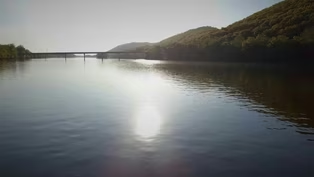
NEPA and the Chesapeake Bay - Preview
Preview: 3/4/2024 | 30s | Watch Monday, March 4th at 7pm on WVIA TV (30s)
Providing Support for PBS.org
Learn Moreabout PBS online sponsorship
- News and Public Affairs

Top journalists deliver compelling original analysis of the hour's headlines.

- News and Public Affairs

FRONTLINE is investigative journalism that questions, explains and changes our world.












Support for PBS provided by:
Keystone Edition is a local public television program presented by WVIA