
October 21, 2024 - PBS News Hour full episode
10/21/2024 | 57m 46sVideo has Closed Captions
October 21, 2024 - PBS News Hour full episode
October 21, 2024 - PBS News Hour full episode
Problems playing video? | Closed Captioning Feedback
Problems playing video? | Closed Captioning Feedback
Major corporate funding for the PBS News Hour is provided by BDO, BNSF, Consumer Cellular, American Cruise Lines, and Raymond James. Funding for the PBS NewsHour Weekend is provided by...
October 21, 2024 - PBS News Hour full episode
10/21/2024 | 57m 46sVideo has Closed Captions
October 21, 2024 - PBS News Hour full episode
Problems playing video? | Closed Captioning Feedback
How to Watch PBS News Hour
PBS News Hour is available to stream on pbs.org and the free PBS App, available on iPhone, Apple TV, Android TV, Android smartphones, Amazon Fire TV, Amazon Fire Tablet, Roku, Samsung Smart TV, and Vizio.
Providing Support for PBS.org
Learn Moreabout PBS online sponsorshipGEOFF BENNETT: Good evening.
I'm Geoff Bennett.
Amna Nawaz is on assignment.
On the "News Hour" tonight: Kamala Harris hits the campaign trail with Republican Liz Cheney, while Donald Trump uses increasingly crass rhetoric during his political events.
Israel targets banks linked to Hezbollah.
How the strikes could hurt the militia group, but also civilians trying to weather Lebanon's financial crisis.
And an academic initiative works to revive liberal arts as a key part of the college experience.
MELINDA ZOOK, College of Liberal Arts, Purdue University: I'm not trying to get students away from engineering or business degrees.
I'm trying to give them just a much more complete education.
GEOFF BENNETT: Welcome to the "News Hour."
As we near the two-week mark to Election Day, former President Donald Trump traveled to North Carolina to see the aftermath of Hurricane Helene, while Vice President Kamala Harris toured swing states alongside former Republican Congresswoman Liz Cheney.
Laura Barron-Lopez has this report.
LAURA BARRON-LOPEZ: The Democratic nominee for president campaigned with unlikely company today, Republicans.
KAMALA HARRIS, Vice President of the United States (D) and U.S. Presidential Candidate: This election is presenting for the first time probably in certainly recent history a very clear choice and difference between the two nominees.
And I think that is what, as much as anything, is bringing us as Americans together.
LAURA BARRON-LOPEZ: Vice President Kamala Harris spent the day in moderated conversations with former Republican Congresswoman Liz Cheney, starting in Pennsylvania.
FMR.
REP. LIZ CHENEY (R-WY): I have spent time working in countries where people aren't free and where people are struggling for their freedom.
And I know how quickly democracies can unravel.
But I tell you again as someone who has seen firsthand how quickly it can happen that that is what's on the ballot.
LAURA BARRON-LOPEZ: It's the latest in a string of unprecedented events Harris has held with Republican figures like Cheney.
The pair then made their way to Michigan for another event.
KAMALA HARRIS: What is at stake in this election is so fundamental that it really does cross partisan lines.
LAURA BARRON-LOPEZ: Meanwhile, Harris' running mate, Governor Tim Walz, spent the morning with the hosts of "The View."
GOV.
TIM WALZ (D-MN), Vice Presidential Candidate: Nothing Donald Trump is proposing does anything about the middle class.
And every economist, Moody's themselves, talked about what it would do to drive up inflation, potentially leading us to recession.
So there's more work to be done.
We acknowledge that.
I think the vice president's proposals are real.
LAURA BARRON-LOPEZ: Former President Donald Trump was in Swannanoa, NOAA, North Carolina to tour storm damage from the recent hurricane.
DONALD TRUMP, Former President of the United States (R) and Current U.S. Presidential Candidate: But it's vital that we not let this hurricane that has taken so much also take your voice.
You must get out and vote.
LAURA BARRON-LOPEZ: Trump repeated baseless claims about the federal government's response to the disaster.
DONALD TRUMP: Certainly, you have all heard the same stories that we all hear, that FEMA has done a very poor job.
They were not supposed to be spending the money on taking in illegal migrants, maybe so they could vote in the election, because that's a lot of people are saying that's why they're doing it.
LAURA BARRON-LOPEZ: Later, the former president again deployed dark and anti-immigrant rhetoric in Greenville, North Carolina.
DONALD TRUMP: Under the Trump administration we are going to take back what is ours.
(CHEERING) DONALD TRUMP: We will end the looting, ransacking, raping and pillaging of North Carolina and, frankly, every other state in the union.
LAURA BARRON-LOPEZ: On Sunday, Trump scooped french fries and served fast-food to staged customers at a Pennsylvania McDonald's.
The political stunt comes as Trump has accused Harris, without any evidence, of lying about her college job at a McDonald's.
On the same day, in an interview with FOX News, Trump again described Democrats like Adam Schiff and Nancy Pelosi as enemies from within.
HOWARD KURTZ, FOX News Anchor: You talk about the enemy within.
There's enemies, America's enemies, outside.
DONALD TRUMP: Yes.
HOWARD KURTZ: The enemy within is a pretty ominous phrase, if you're talking about other Americans.
DONALD TRUMP: I think it's accurate.
I mean, I think it's accurate.
But when you look at "Shifty" Schiff and some of the others, yes, they are, to me, the enemy from within.
And I think Nancy Pelosi is an enemy from within.
She lied.
LAURA BARRON-LOPEZ: It's rhetoric Trump used against fellow Americans on a podcast days earlier.
DONALD TRUMP: They were saying, he said the enemy from within.
Of course.
It's Adam Schiff.
These are bad people.
These are sick people and bad people.
LAURA BARRON-LOPEZ: Speaker of the House Mike Johnson deflected when asked on CNN this weekend if Trump's vows to use the National Guard against political enemies was OK. REP. MIKE JOHNSON (R-LA): What President Trump is talking about is that they have been attacking and maligning him from the day he came down that golden escalator.
Everybody knows that's true.
LAURA BARRON-LOPEZ: At a rally on Saturday in Latrobe, Pennsylvania, hometown of the golf legend Arnold Palmer, the former president started talking about the late golfer's genitalia.
DONALD TRUMP: Arnold Palmer was all man.
And I say that in all due respect to women.
And I love women.
He took showers with the other pros.
They came out of there and they said, oh, my God.
LAURA BARRON-LOPEZ: At the same rally, Trump used an expletive when talking about Vice President Harris.
DONALD TRUMP: We can't stand you.
You're a (EXPLETIVE DELETED) vice president.
(CHEERING) LAURA BARRON-LOPEZ: In an MSNBC interview with Al Sharpton on Sunday, Harris said the American people deserve better.
KAMALA HARRIS: And what you see in my opponent, a former president of the United States, really is -- it demeans the office.
And I have said, and I'm very clear about this, Donald Trump should never again stand behind the seal of the president of the United States.
He has not earned the right.
LAURA BARRON-LOPEZ: For the "PBS News Hour," I'm Laura Barron-Lopez.
GEOFF BENNETT: Turning now to the Middle East, Israel has launched new attacks in Beirut, despite U.S. requests to limit strikes in the Lebanese capital.
The target was a financial organization that Israel and the U.S. call Hezbollah's bank, but the bank also provides loans to Lebanese civilians.
And human rights groups worry the strikes only worsen the country's financial and humanitarian crises.
That's as the U.S. is looking into a leaked document revealing Israel's preparations for attacking Iran.
Nick Schifrin reports.
NICK SCHIFRIN: Overnight, right outside the Beirut Airport's gates, an Israeli airstrike.
Israel ordered the area evacuated before massive airstrikes that destroyed entire buildings and burned storefronts in Hezbollah's stronghold in Southern Beirut.
By day, those buildings lay crumpled next to apartment complexes whose sides are now blown out.
The strikes hit from Northern Lebanon in the hills of the Beqaa Valley to Zahrani in the south.
AHMED, Lebanon Resident (through translator): Our store and our livelihood are gone.
This neighborhood is all civilian.
Our store is right there, and everything is gone.
NICK SCHIFRIN: Across the country, the targets were Al-Qard al-Hasan that Israel and the U.S. Treasury say Hezbollah uses to manage the group's finances.
Herzi Halevi is Israel's top general on a visit today to Southern Lebanon.
LT. GEN. HERZI HALEVI, Chief of Staff, Israeli Defense Forces (through translator): We struck close to 30 targets across Lebanon, Hezbollah's financial system, Al-Qard al-Hasan, which receives funds from Iran, provides loans, and ultimately finances Hezbollah's terrorism.
MATTHEW LEVITT, Washington Institute for Near East Policy: One of the things that's unique about Al-Qard al-Hasan is that it is primarily involved in cash and in gold.
And so it is possible, by destroying the right brick-and-mortar Al-Qard al-Hasan entities to destroy a lot of their U.S. dollars.
NICK SCHIFRIN: Matt Levitt directs the Washington Institute's Counterterrorism and Intelligence Program and is the former deputy assistant secretary for intelligence at Treasury.
MATTHEW LEVITT: What the Israelis do want to do is make sure that Hezbollah can't finance its militia terrorist activity and will have difficulty rebuilding itself once the dust settles.
NICK SCHIFRIN: But the airstrikes have sparked a humanitarian crisis and driven a quarter of the country to flee their homes.
DAMIEN MARQUET, International Rescue Committee: There is no safe place and they just don't know how to cope because they're just fearful of life.
NICK SCHIFRIN: Damien Marquet is the Lebanon emergency team leader for the International Rescue Committee, which says 90 percent of the population is not able to meet its basic needs.
DAMIEN MARQUET: People in the streets will say, we just need a roof.
People who had a roof will say, like, we need shelter, we need a blanket, we need a mattress, we need water, we need food.
LLOYD AUSTIN, U.S. Secretary of Defense: The numbers of casualties have been -- civilian casualties have been far too high.
NICK SCHIFRIN: Even before today, U.S. officials objected to the extent of Israeli airstrikes in Beirut.
Today, top presidential envoy Amos Hochstein blamed Hezbollah and acknowledged the destruction the war had wrought.
AMOS HOCHSTEIN, White House Special Envoy to Lebanon: A resolution was possible, but it was rejected.
And the situation has escalated out of control, out of control, as we feared that it could.
NICK SCHIFRIN: Israelis today remain focused on Hezbollah rockets and drones, more than 170 intercepted today, including above the heads of mourners who took cover at a cemetery as they buried a man killed this past weekend by a Hezbollah strike nearby in Northern Israel.
And Israel is preparing to strike Iran for its unprecedented attack of 180 ballistic missiles on October 1.
An Israeli official tells "PBS News Hour" the Israeli Cabinet has not yet approved the response.
But a document posted online last week reveals the U.S. spy satellites picked up Israel preparing long-range air-launched ballistic missiles, covert drone operations, and conducting a second large military exercise, but no indication that Israel intends to use a nuclear weapon.
U.S. officials said today they do not expect additional similar documents to go public, as Secretary of State Antony Blinken left today for his 11th trip to Israel since the October 7 attacks.
For the "PBS News Hour," I'm Nick Schifrin.
GEOFF BENNETT: And we start today's other headlines in New Mexico, where water levels are starting to recede after record rainfall left at least two people dead.
National Guard officials say more than 300 people have been rescued since Saturday, with dozens brought to nearby hospitals with injuries.
The National Weather Service says nearly six inches of rain fell on Roswell on Saturday, breaking a record setback in 1901.
That sent water gushing down streets, trapping vehicles, and leaving entire homes submerged.
Tropical storm Oscar battered eastern Cuba today as the entire island deals with an electrical grid failure that has left millions without power.
Oscar made landfall as a Category 1 hurricane in the Guantanamo province late yesterday with winds of 70 miles per hour.
It unleashed up to 20 inches of rain in some areas, raising concerns about flooding and mudslides.
On the other side of the island, protesters in Havana banked pots and pans amid ongoing blackouts following Friday's nationwide power outage.
There are concerns that Oscar could hurt efforts to get the power back on.
The White House has proposed a new rule that would require health insurers to cover over-the-counter contraception and birth control at no cost to patients.
That's on top of prescribed contraception, which is already covered.
The rule would include emergency contraception, as well as the new over-the-counter birth control Opill.
The proposed rule would not affect those on Medicaid.
And it has a 60-day public comment period before it would be finalized.
The White House today called birth control a fundamental right.
KARINE JEAN-PIERRE, White House Press Secretary: We have women out there who don't have the protections that they need on their own health care because Roe v. Wade, which was law of the land for almost -- a constitutional right for almost 50 years, was stripped away.
And we have made that commitment from this administration, the Biden/Harris administration, to protect women, to do everything that we can.
GEOFF BENNETT: The White House says if approved, the new rule would increase coverage of contraception for 52 million women of reproductive age who have private health insurance.
A bipartisan congressional task force says that stunning security failures contributed to the July assassination attempt on former President Trump.
The House panel drew on documents, interviews and briefings to investigate how a gunman managed to open fire on Mr. Trump from a rooftop near his rally in Butler, Pennsylvania.
One attendee was killed and two others were wounded in the shooting.
The initial report largely blames the Secret Service, saying -- quote -- "The tragic and shocking events of July 13 were preventable and should not have happened."
A final report is due in December.
Secretary of Defense Lloyd Austin promised to get Ukraine -- quote -- "what it needs" during an unannounced visit to the country.
Meeting with President Volodymyr Zelenskyy in the capital, Kyiv, today, Austin backed that up with another $400 million in U.S. military assistance.
But Austin didn't address Ukraine's request to use Western-supplied weapons to strike deeper into Russia.
And he offered no hints on whether the U.S. would support Zelenskyy's so-called victory plan.
Instead, Austin urged all parties to stay the course.
LLOYD AUSTIN, U.S. Secretary of Defense: There is no civil bullet.
No single capability will turn the tide.
What matters is the way that Ukraine fights back.
What matters is the combined effects of your military capabilities.
And what matters is staying focused on what works.
GEOFF BENNETT: Separately, voters in Moldova narrowly approved a referendum to move forward with European Union membership amid accusations that Russia tried to interfere with the vote.
Moldova applied to join the E.U.
shortly after Russia's invasion of neighboring Ukraine in 2022.
Russia has denied any wrongdoing.
The men once known as the Central Park 5 are suing Donald Trump for allegedly making defamatory remarks during last month's presidential debate.
In their federal complaint, the men write that Trump -- quote -- "falsely stated that plaintiffs killed an individual and pled guilty to the crime.
These statements are demonstrably false."
The five were accused of the 1989 rape and beating of a white female jogger in New York's Central Park.
They said that their confessions at the time were made under duress and their convictions were vacated in 2002.
A Trump spokesman called the lawsuit frivolous.
On Wall Street today, stocks ended mixed, following last week's strong gains.
The Dow Jones industrial average snapped a three-session winning streak, giving back nearly 350 points.
The Nasdaq managed a gain of about 50 points to start the week.
And the S&P shed about 10 points, so just a small loss there.
And President Biden presented the latest National Medals of Arts at a private ceremony at the White House today.
It's the government's highest award for artists and arts patrons.
Those being honored include Missy Elliott, Idina Menzel, Queen Latifah, Spike Lee, Steven Spielberg, and Ken Burns.
After the event, Mr. Biden hosted the reception for those winners, plus the recipients of the National Humanities Medals, which were also presented today to 19 writers, historians, educators, and filmmakers.
Still to come on the "News Hour" billionaire Elon Musk's massive effort to elect Donald Trump and gain influence over the government agencies that regulate his companies; Tamara Keith and Amy Walter break down the latest political headlines; and the widow of Russian dissident Alexei Navalny discusses his posthumous memoir.
The world's richest man, Elon Musk, is now a powerful megadonor for Donald Trump.
Musk is using his vast resources to campaign for him in Pennsylvania and taking aggressive measures for Mr. Trump in other key battleground states.
Some of those moves are raising major legal and ethical concerns as well.
Billionaire entrepreneur Elon Musk unveiling a new tactic to boost Donald Trump's campaign, pledging to randomly award $1 million to registered swing state voters daily through Election Day.
The catch, sign a petition for his pro-Trump political action committee.
The petition is in support of the First and Second Amendments.
ELON MUSK, OWNER, X: It's very straightforward.
You don't even have to vote.
You don't have to vote.
You just have to sign a petition saying you believe in the Constitution.
GEOFF BENNETT: Musk's political action committee known as America PAC has already committed $75 million to the Trump campaign.
Some election experts say Musk's latest effort could be illegal.
That's because federal law prohibits offering, paying or accepting payment in exchange for voter registration or voting.
But Musk and his allies argue there's an important distinction.
Payments and voter status aren't directly linked.
They say voter registration is merely a prerequisite to sign the petition.
Democratic Pennsylvania Governor Josh Shapiro, a supporter of Vice President Kamala Harris, on Sunday called it deeply concerning.
GOV.
JOSH SHAPIRO (D-PA): Musk obviously has a right to be able to express his views.
I don't deny him that right.
But when you start flowing this kind of money into politics, I think it raises serious questions that folks may want to take a look at.
QUESTION: So you think it might not be legal, yes or no?
GOV.
JOSH SHAPIRO: I think it's something that law enforcement could take a look at.
GEOFF BENNETT: It's not clear whether federal officials are looking into the payments.
In campaign appearances and online, Musk has spread unfounded claims about widespread voter fraud and made incendiary statements about immigration.
Donald Trump has already offered him a key appointment if he's reelected.
DONALD TRUMP, Former President of the United States (R) and Current U.S. Presidential Candidate: At the suggestion of Elon Musk, I will create a government efficiency commission task with conducting a complete financial and performance audit of the entire federal government and making recommendations for drastic reforms.
And Elon, because he's not very busy, has agreed to head that task force.
GEOFF BENNETT: Let's bring in New York Times investigative reporter David Fahrenthold, who's been closely following Elon Musk, his connections with Donald Trump, and his business contracts with the federal government.
He joins us now.
Thanks for being with us.
DAVID FAHRENTHOLD, The New York Times: Hey.
It's great to be here.
GEOFF BENNETT: So before we delve into Elon Musk's political leanings, help us understand the degree to which his sprawling tech empire is entangled with the federal government.
DAVID FAHRENTHOLD: Enormously entangled.
It's hard to overstate how entangled Elon Musk is with the federal government.
And there's two dimensions to that.
One is his -- the federal government is a customer of his, a huge customer of his.
NASA and the Defense Department pay billions of dollars a year to SpaceX to launch their satellites, to launch their people, launch their rockets.
There's 300 contracts within the federal government and Elon Musk's companies this year alone.
The other dimension of that relationship is that he fights with the federal government all the time.
Regulators from different agencies are limiting what his companies can do, checking on his companies, making sure they live up to their promises.
He doesn't like that.
He's often complaining about these different regulators.
So there's a good side and there's a bad side, but there's a huge breadth of entanglements between Elon and the federal government.
GEOFF BENNETT: Meantime, Elon Musk is pouring millions of dollars into Donald Trump's reelection effort.
What's the connection between Elon Musk's business interests and Donald Trump's electoral success come Election Day?
What's in it for Elon Musk, as he sees it?
DAVID FAHRENTHOLD: Well, what he's done is, he sort of prodded Trump to say that, if Trump is elected, he will name Elon Musk to be the head of a government efficiency commission, basically a commission that has the responsibility or the power to recommend huge cuts in the spending and the regulation the federal government does.
Now, why does that matter for Elon?
Well, it matters a lot because now the people that oversee him, the agencies that oversee him, Elon's going to flip that relationship.
Now he oversees them.
He's the one who could decide, OK, how much is your budget going to be?
How much cuts am I going to recommend?
So now you're in a situation where the people who are supposed to be keeping tabs on Elon Musk and his companies, making sure that they're safe for the public, he's going to have a position of power over them.
So the question is, what will -- how will he use that power?
And even if he doesn't use it explicitly, how will that sort of chill and scare the regulators who are supposed to be keeping tabs on his businesses?
GEOFF BENNETT: You and your colleagues report that two of Elon Musk's companies, SpaceX and Tesla, account for at least $15.4 billion in government contracts over the past decade.
How did the federal government become so dependent on Elon Musk's companies over the years?
DAVID FAHRENTHOLD: Most of that is a story about SpaceX.
SpaceX is really good at what it does.
It shoots rockets up in the air much more often, much more safely, much more effectively than any of its rivals.
And so SpaceX, through some lobbying, but mostly just through its own sheer skill, has managed to take over the space launch business in the U.S.
So, that means that for NASA, NASA basically -- SpaceX dictates to NASA when NASA can shoot up its biggest payloads, not the other way around.
The Defense Department is enormously indebted to SpaceX, is a huge customer of SpaceX, because SpaceX shoots up their spy satellites and other satellites, and because SpaceX's Starlink satellite communication service provides this incredible satellite service all over the world for communication.
So those two agencies alone, NASA and the Defense Department, account for a huge chunk of that spending because they want to be in space, and Mr. Musk's companies are the very best at getting you there.
GEOFF BENNETT: So it sounds like, even if there were federal officials and lawmakers who view Elon Musk as an unreliable or problematic partner, that, even if there was a will to roll back some of that dependence, there really isn't a way to do it, at least not yet.
DAVID FAHRENTHOLD: That's right.
Elon Musk has said, oh, if Kamala Harris is elected, I'm going to jail or something like that, I'm going to lose my contracts.
That's not going to happen.
NASA and the Defense Department, which have huge budgets, are hugely dependent on SpaceX.
And as we have seen from Boeing, Boeing's failed attempts to rescue its own astronauts from outer space.
There's nobody out there who could even give those contracts to.
So even if Kamala Harris gets elected and burns with hatred in her heart for Elon Musk, there's really nothing she could do, because the government is so dependent on his companies.
GEOFF BENNETT: Lastly, there's lots of attention around the legality of these cash incentives that Elon Musk is offering to swing state voters who sign this petition of his.
We have not seen anything like this before.
What questions does it raise for you as you do your reporting on Elon Musk and these perceived conflicts of interest?
DAVID FAHRENTHOLD: Well, the question for me is whether this is effectively buying a vote.
Is he paying you to vote for Donald Trump?
Is he paying you to vote at all if he knows you're a supporter of Donald Trump?
Legally, what he says he's doing is just paying you to sign this petition, to sign up for this -- to get e-mails from this PAC.
That probably as far as it goes is legal.
But if it becomes a way to pay you for voting for Donald Trump or pay you to incentivize you to vote for Donald Trump, that becomes illegal.
However, that said, the enforcement mechanisms for U.S. election law are so weak that, if it's just a borderline case, I doubt anything happens to him here.
GEOFF BENNETT: David Fahrenthold of The New York Times, thanks for being with us.
DAVID FAHRENTHOLD: Thank you.
GEOFF BENNETT: Elon Musk's efforts are just one high-profile effort by Trump allies to win over voters in key battleground states.
On that and what else to watch for with just two weeks remaining before Election Day, I'm joined now by our Politics Monday duo.
That's Amy Walter of The Cook Political Report With Amy Walter and Tamara Keith of NPR.
Hello to you both.
TAMARA KEITH, National Public Radio: Hello.
GEOFF BENNETT: So, the Trump campaign, Tam, has outsourced some of its get-out-the-vote effort to these third-party super PACs, including Elon Musk's.
The hitch there seems to be this reporting by Reuters that the PAC, the Elon Musk PAC, is having trouble hitting door-knocking goals and that some canvassers, according to this reporting, have lied about the numbers of voters that they actually contacted.
On a race that hinges on turnout, that seems like this could be problematic for the Trump campaign to have these outside groups doing this crucial work.
TAMARA KEITH: Right.
Another outside group that's involved is Turning Point USA, run by Charlie Kirk.
A lot of these people are very good at getting attention.
What we don't know is whether they're very good at a ground game.
And the one case study that we have of a campaign saying, all right, I'm going to farm it out, we're going to have this super PAC do it, we're going to focus on the things that we can focus on, like ads and putting the candidate where the candidate should be, that was Ron DeSantis.
And it was a disaster.
It was not a good case study in what you want to do.
And so there is a very open question about whether these efforts will work or whether Elon Musk is proving himself very good at burning millions of dollars.
And we won't really know until the election, though the other thing that I would say, the sort of counterbalance to this is that there are a lot of people who believe, including Democrats, that Donald Trump doesn't need a ground game, because he is his own ground game.
His voters are so motivated that they will crawl over glass to vote for him, and you don't need a big door-knocking effort to get to them.
GEOFF BENNETT: And that's the lesson of 2016, that Donald Trump can win even with a decentralized or disorganized, as was the case back then, campaign.
AMY WALTER, The Cook Political Report: Right.
And even 2020, the polling certainly suggested that he was not going to hit the numbers he ultimately came up with.
But the reason that we're paying so much attention to this ground game isn't just because the race is so close, but the kinds of voters that Trump does best with are the kinds of people who don't show up traditionally to vote.
And those people are harder to know not just who they are, but how to motivate them to get out to vote.
So, traditional door-knocking or sending, putting pieces of mail, that's not -- they don't necessarily respond to the same messages that your voter who turns out in every single election is going to respond to.
That takes a level of sophisticated targeting and messaging that you just don't put together on the fly.
But, ultimately, do I think that, if Donald Trump loses, it's because he outsourced his ground game?
No, I don't.
GEOFF BENNETT: Meantime, the Harris campaign is going all in trying to reach out to those dissatisfied, disaffected Republicans.
Unpack your reporter's notebook for us.
What are you seeing on the ground and what does it suggest about their strategy?
TAMARA KEITH: So what I have seen -- and I was traveling with Harris all weekend -- she is making a concerted effort to speak to what you would say are Nikki Haley Republicans.
And this is an ongoing effort that includes today stops in all three of the blue wall states, doing events in suburbs specifically targeted at college-educated voters, Republicans, people who would have been Republicans if it wasn't Trump, and trying to convince them to sort of get over whatever discomfort they have and support her.
And the reason that the campaign is putting so much effort into this, which, in theory, like in a normal year would feel kind of like a long shot or an afterthought, is that Vice President Harris, they are concerned that she may not do as well with Black voters, particularly Black men, that she may not do as well with Latino voters, that Trump is making some inroads into the traditional Democratic base, also working-class white voters.
And so what they're trying to do is run up the numbers in the suburbs, where Trump has clearly struggled, where there are tens of thousands of people who voted for Nikki Haley after she dropped out.
AMY WALTER: Yes, and this is a perfect example.
In Chester County, which is where the campaign was today with Liz Cheney this morning, this is a place where after the Haley campaign was over, she had dropped out of the race, there was still a primary in Pennsylvania.
She got about 10,000 votes in Chester County from -- and, remember, Republicans can - - Pennsylvania has a closed primary, so only Republicans could vote in that primary.
So, theoretically, there's 10,000 votes for somebody, obviously the Harris campaign hoping it's them, to pick up.
And in a state that's been decided by 60,000 votes, 80,000 votes, yes, 10,000's nothing to sneeze at.
GEOFF BENNETT: Well, look, while I have you all here, can we look at a latest poll?
AMY WALTER: Why not?
TAMARA KEITH: Sure.
GEOFF BENNETT: Let's delve in.
So this is the Washington -- this is a Washington Post poll of likely voters in battleground states.
Doing my quick electoral math, this shows a slight Harris lead.
Tam, how is the campaign feeling about a poll like this?
TAMARA KEITH: Well, I think they feel about this poll like they feel about all polls, which is the way Harris said it this weekend is, and the way she's been saying it for a while, but it sounds like she really means it now, they -- this race is close.
They acknowledge it's close.
It's going to take a lot of work to make it better than close for them.
And she has said that they are running like underdogs.
She has said repeatedly that either you are running scared or you are running stupid, and they would rather run scared.
Now, would they love to have better poll numbers?
Yes, of course they would.
But this race has been incredibly stable.
We are talking about all of these movements are within the margin of error.
All of these movements are statistically not even that significant.
GEOFF BENNETT: Amy, when you dig deep into these numbers and other polls that I'm sure you have access to that we mere mortals do not... (CROSSTALK) AMY WALTER: I would share with you guys.
GEOFF BENNETT: What do you see?
What do you see 15 days out, a little more than two weeks away.
AMY WALTER: Yes, it is a question.
I think there are two questions.
One, who are these undecided voters?
Overwhelmingly, they are younger.
It's a more diverse group of voters.
They tend to be more heavily female.
And, on paper, those would look like Democrats, except that they are also -- they also tend to be more economically sensitive and very, very worried about the economy, which is why when you see the Harris ad that is running the most, it is talking about the economy and middle-class economy and calling out Trump for being for billionaires and not being for regular people.
It's an interesting -- she obviously has a lot of different messages to a lot of different groups.
But if you're talking about who are those last bastions of swing voters, those undecided voters, the economy and being able to sell her on the economy, or at least lessen Trump's advantage on that, they believe is really the key.
GEOFF BENNETT: And, Tam, you were just with the Harris campaign in Nebraska's Second Congressional District, just, again, to reiterate how closely and how hard-fought this election is.
TAMARA KEITH: Yes, so this is known as the blue dot or the purple dot that could be the blue dot this time.
And if Harris -- of these swing states that we're talking about, if Harris were to only win the blue wall of Michigan, Pennsylvania and Wisconsin, she would be at 269 electoral votes, one shy of what is needed to win the presidency.
And that is where Omaha comes in.
And just to give a sense of the Harris campaign ground game, they have three campaign offices there.
Now they're combined campaign offices.
There's also a competitive House race there.
But they have volunteers.
I was watching them phone bank.
They were chasing ballots.
And there's also this kind of quirky grassroots effort that has sprung up with people putting blue dots in their yards.
More than 10,000 signs have been made, many of them with blue spray paint that's all over their hands, and then Republicans responding with some red Pac-Man things to eat the blue dot and also a big red state of Nebraska.
It is fun to see a place where they believe that their vote matters and they are incredibly politically engaged and it's not super toxic.
GEOFF BENNETT: Tamara Keith and Amy Walter, thank you both so much.
TAMARA KEITH: You're welcome.
Online on TikTok, our Lisa Desjardins and Deema Zein have been counting down to Election Day, giving us a fun and insightful fact each day.
Here's what they have for us today.
DEEMA ZEIN: Only 15 people have become president after being vice president.
GEOFF BENNETT: Well, call it the death of the humanities.
That's been a leading story about colleges over the last decade or so, and numbers bear it out.
Majors in English and history are down by a third.
Humanities enrollment overall is down by almost a fifth.
But there's also another story to be told.
Jeffrey Brown traveled to Purdue University to take a look for our higher education series Rethinking College.
BRIAN KOGELMANN, College of Liberal Arts, Purdue University: Most people would lie to you if given the opportunity so there is nothing wrong with you lying to them first.
JEFFREY BROWN: Welcome to the Machiavelli School of Management.
Today's prompt, passages from "The Prince," published in 1532.
BRIAN KOGELMANN: "Because men are wretched creatures who would not keep their word to you, you need not keep your word to them."
JEFFREY BROWN: A classic text, small discussion groups, back-and-forth debate about ethics in today's world.
BRIAN KOGELMANN: Does it work?
Good argument, bad argument?
MAN: I think it's a bad argument.
BRIAN KOGELMANN: Why?
MAN: Because it's basically saying that you have to expect that you're going to be the sucker.
JEFFREY BROWN: A philosophy professor, Brian Kogelmann, working with freshman business and marketing majors like 18-year-old Savannah Espinola.
SAVANNAH ESPINOLA, College Student: He really pushes us.
He says, OK, why?
Why do you believe that?
And he makes us come up with clear arguments and defend our reasoning.
And he makes sure we're clear about it.
JEFFREY BROWN: The course is part of Cornerstone, a general education program that injects the liberal arts into all realms of the freshman academic experience.
MELINDA ZOOK, College of Liberal Arts, Purdue University: It's about understanding your humanity, cultivating your inner life, and understanding the world and having empathy for other people.
JEFFREY BROWN: History Professor Melinda Zook runs Cornerstone.
MELINDA ZOOK: I define it as giving students that are not liberal arts majors a more holistic education that includes courses that will have them reading classic texts, have them experience the arts.
JEFFREY BROWN: Purdue is one of the country's leading universities for engineering and other STEM fields, proud to showcase its more than two dozen astronaut graduates, including Neil Armstrong.
It was also experiencing its version of a national trend that saw the number of humanities graduates fall by nearly a third in the decade before the pandemic.
DAVID REINGOLD, College of Liberal Arts Dean, Purdue University: Between 2010, 2011 and 2015, this college of liberal arts had lost about 20 percent of its credit hours, 40 percent of its majors.
I mean, it felt like a ball rolling off a table.
JEFFREY BROWN: David Reingold took over as dean of Purdue's College of Liberal Arts in 2015.
DAVID REINGOLD: I could show you some projections which would show, by 2024, there would be no students left in this college.
JEFFREY BROWN: The reasons why are complex and debated, the shock of the 2008 financial crisis, the higher costs of college, a shift away from social sciences to technology, seen as better for job prospects, and a devaluing of the very idea of a canon of great books.
For Reingold, it added up to a reality that struck at the very heart of what colleges are for.
DAVID REINGOLD: Once you get to a point where some of the domains which gave rise to the modern research university are either withered or nonexistent, I think we have sort of lost what it means to actually have a university.
WOMAN: I was trying to demonstrate, yes.
MELINDA ZOOK: OK, good.
JEFFREY BROWN: The answer here, Cornerstone, which begins with a two semester slate of classes that replaced written and oral communication requirements for freshmen.
The strategy, to integrate the liberal arts into the overall curriculum, rather than standing or falling apart.
MELINDA ZOOK: If you think you're just going to build a program and they will come, you're wrong.
You have to take over requirements, and that's what we did.
And we do it through great books, which we call transformative texts.
JEFFREY BROWN: Homer, Huxley, and Shakespeare, but also Rumi, N. Scott Momaday, and August Wilson.
MELINDA ZOOK: Here's Octavia Butler.
JEFFREY BROWN: Zook and the more than 100 liberal arts professors teaching these courses choose from an ever-evolving list of more than 200 authors, spanning the ancient world to modern day, across continents, genders and races.
Students attend theater and music performances and take classes with actors, and also act out some of their own work, based on texts they're reading.
WOMAN: I call this court to order.
JEFFREY BROWN: Including a trial of Victor Frankenstein from Mary Shelley's novel, a fine way into debating A.I.
and other monsters of today.
In 2017, the pilot program comprised 100 students.
Now there are more than 5,000 taking Cornerstone classes.
NATHANIEL DIXON JR., College Student: It's so different from what I thought it was going to be.
JEFFREY BROWN: Students like freshman Nathaniel Dixon Jr., who's studying neurobiology, but finds here something different in terms of class size and approach.
NATHANIEL DIXON JR.: I was really worried at first, being a STEM major, but being here now, it is so great.
We have been doing a lot of Plato readings, Kant, Burke.
And it's one of the first times that I found a lot of joy in my reading.
JEFFREY BROWN: Really?
I mean, in what way, joy in what sense?
NATHANIEL DIXON JR.: My professor, she really pushes the idea that what we're reading can be applied to us.
And the point of the class isn't to find the correct answer, but find how what's in the reading can be applied to you in the grand scheme of the thing.
JEFFREY BROWN: Other schools are paying attention, and Cornerstone-based programs have spread to more than 70 colleges across the country with help from foundation and other funding.
That includes community colleges, home to more than 40 percent of all undergraduates.
TED HADZI-ANTICH JR., Austin Community College: Historically, there's not been a lot of thought about what that experience in general education at community colleges should really be.
JEFFREY BROWN: And so government and humanities Professor Ted Hadzi-Antich Jr. set out to change that at Austin Community College in Texas with a seminar called The Great Questions, a general education requirement-level class.
And he sees a benefit that goes beyond the individual students.
TED HADZI-ANTICH JR.: You have people from all different places in life.
You have got younger people, you have got older people, people that want nothing to do with politics and people that won't shut up about it, and they're in the same classroom and you're asking them to talk about Homer.
And it's the only time they're ever going to get that experience.
And if they don't get that experience at community colleges, they're increasingly not going to get it at other places.
JEFFREY BROWN: You're making an implicit argument that they need that or that does benefit them.
TED HADZI-ANTICH JR.: I think it not only benefits them.
I think it benefits us, representative democracy, which is - - has at its core the requirement that we're able to talk to each other across differences that actually matter.
JEFFREY BROWN: But all this raises a further question.
While Cornerstone might be good for the stem students, does it ultimately foster and preserve the liberal arts disciplines themselves?
At Purdue, the hope is that students exposed to transformative texts as a requirement will want more.
And the university now offers a Cornerstone certificate, a kind of minor.
And the success of Cornerstone has already allowed Purdue to hire more than 100 new liberal arts faculty, bucking trends elsewhere, though these new hires are required to teach at least half their courses in the Cornerstone program.
DAVID REINGOLD: In fact, now we have more philosophers than we had 10 years ago.
Now, there's conflict in that, because, obviously, the Philosophy Department does not want to sort of see the teaching commitments of their faculty pulled away from their core discipline.
But we're trying to find a middle ground, where we can have a robust philosophy department who's engaged in serious philosophical scholarship, as well as working to serve the broader student population here.
JEFFREY BROWN: And what does serving students mean to Melinda Zook?
MELINDA ZOOK: I'm not trying to get students away from engineering or business degrees.
I'm trying to give them just a much more complete education while they're here at Purdue.
I often look at my students and I think, your life is going to be filled with crucial choices.
Will you make the right ones?
And if you don't know anything, right, if you don't know anything about the world or yourself or others, how can you?
JEFFREY BROWN: As the famous ancient Greek inscription at the Temple of Apollo at Delphi put it, gnothi sauton, know thyself.
For the "PBS News Hour," I'm Jeffrey Brown at Purdue University in West Lafayette, Indiana.
GEOFF BENNETT: In February of this year, Alexei Navalny died in a Russian prison camp three years after he returned to his homeland.
Navalny was Vladimir Putin's most prominent critic, an anti-corruption crusader who evolved into a political threat to Putin's near-quarter-century rule.
He survived a nerve agent poisoning by Russian operatives in the summer of 2020, but insisted on returning to continue his fight to change his nation.
Navalny's memoir is being published tomorrow posthumously shepherded by his wife, Yulia, who has taken on his mantle of political leadership.
Navalny wrote while recovering from the poisoning and later surreptitiously in prison.
Yulia Navalnaya met Amna Nawaz yesterday in New York to discuss her husband's life and his work for this memoir, "Patriot."
AMNA NAWAZ: Yulia, thank you for being here.
Welcome to the "News Hour."
YULIA NAVALNAYA, Widow of Alexei Navalny: Hello.
Thank you so much for having me.
AMNA NAWAZ: So as we sit here and speak now, it's been eight months since your husband died.
How are you doing?
YULIA NAVALNAYA: Everything has changed in my life.
This work on book and all this meeting with politicians, conferences, they give me a power, but very much different than eight months ago.
AMNA NAWAZ: It gives you a power, you said.
What do you mean by that?
YULIA NAVALNAYA: To continue Alexei's fight, to continue to do things to keep his legacy, to continue to keep memory about him in people's minds.
Everything of this is very important for me.
AMNA NAWAZ: There was one moment that really stood out to millions of people.
That was when you and Alexei returned to Russia in January of 2021, after he had been recovering in Germany, after nearly dying from being poisoned by Russian agents.
And you and he walked through the terminal after he landed.
And then he was immediately arrested in customs and imprisoned, never to be free again.
Did you know at that moment that that may be the last time you were together?
YULIA NAVALNAYA: I didn't think about that at that moment.
I knew that we are going at our homeland.
We wanted to go there.
I knew that it was very important for my husband to come back to Russia to show that he's not afraid, to show and to encourage all his supporters not to be afraid.
I knew that it's very important for him, and I knew that it could be dangerous, but I knew that he would never do it in another way.
AMNA NAWAZ: He began writing this as he recovered in that German hospital, but he continued to write during his time in prison this last time.
Why was it so important, do you think, to him to continue to write in this way, to make sure that these words got out?
YULIA NAVALNAYA: You're right.
He started to write in Germany and he continued to write in prison.
He wasn't allowed to have a notebook and a pen more than for one an hour a day.
AMNA NAWAZ: He wrote this in one-hour increments?
YULIA NAVALNAYA: Yes, and even -- last month even less.
But, still, we are very lucky to got some of his prison diaries.
Nobody knows how many of them are lost, because, after his death, we got nothing from prison.
Like, no personal belongings were given to us back.
AMNA NAWAZ: So you think there could be more of his words, more of his writing?
YULIA NAVALNAYA: I don't think that -- I know in what conditions he was.
Everything was taken by police and FSB, so I'm sure that we will never get anything from his personal belongings.
AMNA NAWAZ: He was known to the entire world as Vladimir Putin's fiercest, most prominent critic and a political opponent, as sort of an unflinching voice against the forces of corruption.
But I was really struck in reading this by just how funny he was, by his sense of humor.
Is that something that stood out to you?
Was that always there?
YULIA NAVALNAYA: It's one of the parts of him which I liked a lot.
He was really very funny.
And I'm happy that book is written so.
And, even in English, you can feel how funny he was.
It's the main thing why people loved him so much, why people supported him so much, why he became a leader of opposition, because he was a very ordinary man.
AMNA NAWAZ: You made each other laugh?
YULIA NAVALNAYA: A lot.
(LAUGHTER) AMNA NAWAZ: There's a real love story in these pages too.
And there's this moment he shares about the very first time he saw you when you two lock eyes.
He writes in the book that he says to himself at that moment: "This is the one.
This is the girl I will marry."
Do you remember that moment differently when you read it or do you remember it the same way he did?
YULIA NAVALNAYA: I remember it differently.
AMNA NAWAZ: Do you?
(LAUGHTER) AMNA NAWAZ: What's your memory of that?
YULIA NAVALNAYA: I liked him a lot.
He was very funny from the first day.
He was very clever.
But, of course, I didn't have such thoughts like he will be my husband one day now.
AMNA NAWAZ: No?
When did you realize?
YULIA NAVALNAYA: When he proposed to me.
(LAUGHTER) AMNA NAWAZ: Not before then?
YULIA NAVALNAYA: That's what I remember.
(LAUGHTER) AMNA NAWAZ: He didn't arrive at his political views on an impulse.
And he goes into great detail and really great historical detail in the book about why he came to believe what he did, why he came to distrust the system and to challenge the system.
And this surprised me.
He offers the Chernobyl nuclear plant disaster as an example from his youth.
Why do you think that was such a formative experience for him?
YULIA NAVALNAYA: Part of his family lived in Chernobyl.
And it was very obvious for him that parents discussed one thing at home, and then, when he switched on and watched TV, there are other news.
AMNA NAWAZ: This idea of officials who lie to their people, he comes back to this again and again in the book.
Was that really the source of his inspiration, of his dedication to his work?
YULIA NAVALNAYA: I don't think it's about lies, the biggest part of this, but, still, it's about corruption, about that these people, they are not serving their country.
They are not serving their people.
They're serving their own interests.
AMNA NAWAZ: I guess the question, if it's so deeply entrenched, can it ever be changed?
YULIA NAVALNAYA: Of course it can be changed one day.
It's a difficult process when you're living under tyranny and there's dictatorship in Russia.
AMNA NAWAZ: There is the obvious question in all of this, Yulia, which is, especially as you're raising your kids and you're considering your lives ahead.
A lot of people will wonder, why did you go back and why did you stay?
Did you ever think, we just shouldn't go back?
YULIA NAVALNAYA: I knew that, if we would stay in exile, he wouldn't be happy.
AMNA NAWAZ: But he may have been safe.
YULIA NAVALNAYA: That's true.
AMNA NAWAZ: It was worth it to you?
Even after he nearly lost his life after being poisoned by Russian agents, knowing the target on his back, you still felt it was worth it to go back to Russia?
YULIA NAVALNAYA: Now it's a difficult question, but, at that, moment I knew that he wouldn't change his mind, and he will -- he would come back.
AMNA NAWAZ: Knowing what about Vladimir Putin, do you believe he would have your husband poisoned in prison?
YULIA NAVALNAYA: Of course, I'm sure that he did it.
AMNA NAWAZ: What does justice look like for you, if that's the case?
YULIA NAVALNAYA: There are two things which I would love to see, Vladimir Putin in prison, in Russian prison, like my husband was.
And the second is that Russia will become normal democratic country, about which my husband so dreamed.
AMNA NAWAZ: Do you see that happening, knowing where the opposition movement is right now, knowing that your husband is no longer there to lead it?
How do you see that happening now?
YULIA NAVALNAYA: That's very important to believe.
It's very important, like my husband said, not to give up, just to do anything you can do every day.
AMNA NAWAZ: What role do you see for yourself in that?
YULIA NAVALNAYA: It doesn't matter about role.
I would like to come home, to come back home to Russia.
I would love to live in Russia.
I never dreamed to live somewhere else.
AMNA NAWAZ: Yulia, the opposition in Russia suffered an enormous blow with the loss of your husband.
And there's been reports of it being fractured and leaderless.
When you look at the opposition right now in Russia, where do you see signs of hope?
YULIA NAVALNAYA: Everywhere.
I think that we all the time, every day need to keep our hope.
And all these people inside Russia who are against Putin's regime, against war, and I very hope that one day everything will change.
But it's just not hope.
It's belief.
I understand that it could take a long time.
But, still, as I said, we just need to do anything every day.
AMNA NAWAZ: Just visiting your husband's grave is an act of resistance.
What do people do or say when they visit?
What do you hear?
YULIA NAVALNAYA: There are a lot of fresh flowers still after eight months pass.
Somebody said that Alexei has changed their mind.
They believed in politics and in politicians in Russia again.
I hope to come back to Russia one day, and the first thing which I'm going to do, to go to the cemetery.
AMNA NAWAZ: Yulia Navalnaya, thank you so much for sitting and speaking with us today.
We appreciate it.
YULIA NAVALNAYA: Thank you.
GEOFF BENNETT: And there's a lot more online right now, including a look at how the Cherokee Nation is finding solutions for a lack of affordable housing.
That's at PBS.org/NewsHour.
And that is the "News Hour" for tonight.
I'm Geoff Bennett.
For all of us here at the "PBS News Hour," thanks for spending part of your evening with us.
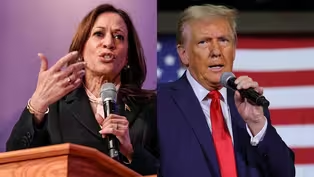
Harris campaigns with Cheney as Trump deploys dark rhetoric
Video has Closed Captions
Clip: 10/21/2024 | 4m 48s | Harris campaigns with Liz Cheney as Trump again deploys dark and anti-immigrant rhetoric (4m 48s)

How strikes on Hezbollah-linked bank could hurt civilians
Video has Closed Captions
Clip: 10/21/2024 | 4m 32s | How Israeli strikes on Hezbollah-linked bank could hurt Lebanese civilians (4m 32s)

Navalny's widow reflects on her husband's legacy
Video has Closed Captions
Clip: 10/21/2024 | 10m 51s | Navalny's widow reflects on her husband's legacy and releasing his memoir, 'Patriot' (10m 51s)
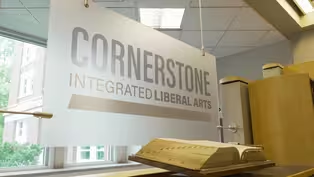
Purdue works to revive liberal arts as key part of college
Video has Closed Captions
Clip: 10/21/2024 | 8m 43s | Purdue program works to revive liberal arts as key part of the college experience (8m 43s)
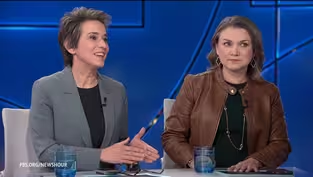
Tamara Keith and Amy Walter on Trump's ground game
Video has Closed Captions
Clip: 10/21/2024 | 9m 10s | Tamara Keith and Amy Walter on Trump's ground game and Harris' outreach to Republicans (9m 10s)
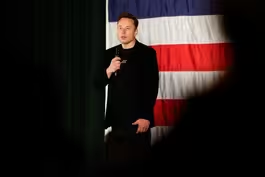
What's behind Elon Musk's massive effort to elect Trump
Video has Closed Captions
Clip: 10/21/2024 | 7m 41s | What's behind Elon Musk's massive effort to elect Trump (7m 41s)
Providing Support for PBS.org
Learn Moreabout PBS online sponsorship
- News and Public Affairs

FRONTLINE is investigative journalism that questions, explains and changes our world.

- News and Public Affairs

Amanpour and Company features conversations with leaders and decision makers.












Support for PBS provided by:
Major corporate funding for the PBS News Hour is provided by BDO, BNSF, Consumer Cellular, American Cruise Lines, and Raymond James. Funding for the PBS NewsHour Weekend is provided by...