
October 23, 2024 - PBS News Hour full episode
10/23/2024 | 57m 46sVideo has Closed Captions
October 23, 2024 - PBS News Hour full episode
October 23, 2024 - PBS News Hour full episode
Problems playing video? | Closed Captioning Feedback
Problems playing video? | Closed Captioning Feedback
Major corporate funding for the PBS News Hour is provided by BDO, BNSF, Consumer Cellular, American Cruise Lines, and Raymond James. Funding for the PBS NewsHour Weekend is provided by...
October 23, 2024 - PBS News Hour full episode
10/23/2024 | 57m 46sVideo has Closed Captions
October 23, 2024 - PBS News Hour full episode
Problems playing video? | Closed Captioning Feedback
How to Watch PBS News Hour
PBS News Hour is available to stream on pbs.org and the free PBS App, available on iPhone, Apple TV, Android TV, Android smartphones, Amazon Fire TV, Amazon Fire Tablet, Roku, Samsung Smart TV, and Vizio.
Providing Support for PBS.org
Learn Moreabout PBS online sponsorshipGEOFF BENNETT: Good evening.
I'm Geoff Bennett.
Amna Nawaz is away.
On the "NewsHour" tonight: Donald Trump's longest-serving chief of staff speaks out about the former president's authoritarian tendencies and praise of Adolf Hitler.
Intelligence officials warn that Russia and Iran could stoke violence after Election Day, all while local election officials try to combat misinformation spread by politicians here in the U.S. And despite advancements in safety for drivers, how the increasing size of cars poses a threat to pedestrians.
JESSICA HART, Mother: Forty thousand people a year dying on our streets and roads across the country, and, still, we just collectively shrug.
GEOFF BENNETT: Welcome to the "News Hour."
With less than two weeks until Election Day, former President Donald Trump is courting voters tonight in the state of Georgia.
But he's also facing blistering new criticism from his longest-serving chief of staff, John Kelly, who's sounding the alarm on Trump's fitness for office, something Vice President Kamala Harris pounced on today.
Here's Lisa Desjardins.
LISA DESJARDINS: In swing state Georgia, south of Atlanta... MAN: President Donald J. Trump.
LISA DESJARDINS: ... former President Donald Trump fielded questions in front of a friendly crowd, a faith town hall of Christians.
DONALD TRUMP, Former President of the United States (R) and Current U.S. Presidential Candidate: When you have faith, when you believe in God, it's a big advantage over people that don't have that.
It's a big advantage.
(CHEERING) LISA DESJARDINS: But, overnight, far harsher words from John Kelly, Trump's longest-serving chief of staff, someone who was at his side for nearly a year-and-a-half.
In scathing comments in audio interviews with The New York Times, Kelly said Trump, behind the scenes, displayed the tendencies of a fascist.
GEN. JOHN KELLY (RET.
), Former White House Chief of Staff: He's certainly an authoritarian, admires people who are dictators.
He has said that.
So he certainly falls into the general definition of fascist, for sure.
LISA DESJARDINS: The retired Marine general says he won't endorse a candidate in the election.
DONALD TRUMP: That's an enemy from within.
That's really -- that is a threat to democracy.
LISA DESJARDINS: But said Trump's recent comments about using the military against domestic political opponents motivated him to speak out.
GEN. JOHN KELLY (RET.
): I think this issue of using the military to go after American citizens is one of those things I think is a very, very bad thing.
Even to say it for local purposes, to get elected, I think it's a very, very bad thing, let alone actually doing it.
LISA DESJARDINS: Kelly, who said Trump would likely try to govern as a dictator if given another term, recalled Trump repeatedly praising Adolf Hitler.
GEN. JOHN KELLY (RET.
): He commented more than once that Hitler did some good things too.
LISA DESJARDINS: The Trump campaign ardently denied Kelly's story, calling it fabricated, and that he -- quote -- "has totally beclowned himself."
Vice President Harris took the rare step of addressing the comments from her official residence.
KAMALA HARRIS, Vice President of the United States (D) and U.S. Presidential Candidate: He wants a military who will be loyal to him personally, one that will obey his orders, even when he tells them to break the law or abandon their oath to the Constitution of the United States.
We know what Donald Trump wants.
He wants unchecked power.
The question in 13 days will be, what do the American people want?
LISA DESJARDINS: Republican vice presidential pick J.D.
Vance kept the focus on immigration as he rallied voters in the swing state of Nevada from inside the Treasure Island Casino in Las Vegas.
SEN. J.D.
VANCE (R-OH), Vice Presidential Candidate: Right now, thanks to border czar Kamala Harris' open border, right now, there are 425,000 criminal illegal aliens in the United States of America.
LISA DESJARDINS: And with a high-five to his son, Gus, a first-time voter, Democratic V.P.
nominee Tim Walz cast his early ballot this morning in St. Paul.
In neighboring Wisconsin, where early in-person voting began yesterday, lines stretched out the door at polling places.
RAYMOND LATHROP, Trump Voter: I didn't vote for him to be the pastor of my church.
I voted for him to be the president of this country.
This country needs to be run like a business, and he's a businessman.
GARY TORRES, Harris Voter: She's got a good head on her shoulders.
She's very intelligent, and she knows the difference between right and wrong.
LISA DESJARDINS: While Harris has largely been off the trail this week, her campaign has amped up some targeted star power.
EMINEM, Musician: President Barack Obama.
LISA DESJARDINS: In his hometown of Detroit, Eminem introduced political star and former President Barack Obama, who performed a few of the rapper's lines.
BARACK OBAMA, Former President of the United States: My palms are sweating.
Knees weak.
Arms are heavy.
(CHEERING) LISA DESJARDINS: Harris' media tour continues tonight.
She's set to face voters in a CNN town hall in battleground Pennsylvania.
For the "PBS News Hour," I'm Lisa Desjardins.
GEOFF BENNETT: And the Harris campaign says tonight that the vice president plans to make a major speech next Tuesday at the Ellipse near the National Mall in Washington, D.C.
It'll be her closing argument on why voters should vote for her over former President Trump, and the location is the site where Trump gave a speech on January 6 in 2021 that preceded the violent attack on the U.S. Capitol.
As we just heard, retired Four-Star General John Kelly, who was one of Donald Trump's White House chiefs of staff, told The New York Times, Donald Trump would rule like a fascist if reelected.
Kelly also spoke to "The Atlantic"'s editor in chief, Jeffrey Goldberg, for a new piece which quotes Donald Trump as once having said: "I need the kind of generals that Hitler had."
Goldberg is also moderator of "Washington Week With The Atlantic" here on PBS and joins us now.
Thanks for being here.
JEFFREY GOLDBERG, Moderator, "Washington Week With The Atlantic": Thank you.
GEOFF BENNETT: So John Kelly confirmed to you that Trump had said he wished military leadership showed him the same kind of deference that Hitler's Nazi generals showed him during World War II, people who were totally loyal to him that followed orders, Trump is quoted as saying.
Walk us through that part of your reporting.
JEFFREY GOLDBERG: Well we have known for several years from other reports, background reports mainly, that Trump, particularly in moments of high tension -- think the 2020 George Floyd unrest - - has expressed frustration that, in a democracy, generals can't just be ordered to do things that they consider to be illegal or immoral.
He had a frustration with obviously the generals he had hired into his Cabinet, Jim Mattis and so on.
But he also had frustrations with the Pentagon itself.
And so these expressions of desire to be more like Hitler and have Hitler's relationship with his generals came out in these moments of tension, and, again, especially around that George Floyd area, where Trump has been cited as saying, "Why can't you just go shoot them, shoot them in the legs?"
is what he said to Mark Esper, the former secretary of defense.
And this is what's so interesting about it.
When John Kelly explained to Donald Trump, among other things, that Hitler's generals repeatedly tried to assassinate him, Donald Trump showed himself to be impervious to that knowledge and said, no, no, no, no, that's not true.
So Kelly grew more and more frustrated with Trump's inability to understand his role or what Hitler did.
GEOFF BENNETT: And John Kelly's comments don't exist in a vacuum because they're the latest in a line of warnings from former Trump Cabinet officials and top aides about how Donald Trump views the presidency and how he would exercise power if reelected.
Did John Kelly express concerns about how Donald Trump would govern in a second term, especially given that there will likely be fewer guardrails in a second term than existed in the first one?
JEFFREY GOLDBERG: Yes, well, that's -- the assumption that we have to make is that the kind of person Donald Trump put in the first term, especially at the beginning, Jim Mattis, Rex Tillerson, John Kelly, he has learned from his -- quote, unquote -- "mistakes" and will get people who are more compliant.
He's looking for obedience.
This is the thing that shocks him about American generals and continues to shock him, is that they swear an oath to the Constitution, not to the president.
That's what he's looking for, personal loyalty.
And we know that from many other discussions we have heard around him.
In terms of what people are expecting in a second term, I think it's fair to say that not just John Kelly, but a wide swathe of people who worked in the national security area, from John Bolton to H.R.
McMaster to many others, have expressed varying degrees of concern that the guardrails will be off next time and that Donald Trump will try to do the things that he wasn't -- quote, unquote - - "allowed to do" in the first go-around.
So, yes, they are.
They're extremely worried about it, which is why I think you hear more and more of this discourse over the last couple of weeks.
GEOFF BENNETT: You also report in this piece that Donald Trump, then-President Trump, in July 2020, he promised to cover the funeral cost of 20-year-old U.S. Army Private Vanessa Guillen, who had been bludgeoned to death by a fellow soldier at Fort Hood, but he reneged months later after inquiring about the cost during an Oval Office meeting.
And you write that Trump became angry -- quote - - "'It doesn't cost 60,000 bucks to bury an effing Mexican.'
He turned to his chief of staff, Mark Meadows, and issued an order: 'Don't pay it.'
Later that day he was still agitated.
'Can you believe it?'
he said, according to a witness, 'effing people trying to rip me off.'"
According to your reporting, how did people in the room respond to that?
JEFFREY GOLDBERG: Well, my sources were in the room and so there were some people who were upset about it, obviously, and I have contemporaneous notes taken in the room that reflect the kind of shock.
Remember, it's shocking, but only to a degree if you worked for him for a while, because there's a lot of, let's say, emotion that coursed through that White House.
Obviously, other people in the room, including Meadows and Kash Patel, who was the chief of staff to the secretary of defense, the acting secretary of defense at the time, because he had just fired Mark Esper, are denying that this happened and issued statements that saying that Donald Trump was very supportive of the family.
The fact remains that he didn't pay.
But there's a split.
Mark Meadows has come out and said that this didn't happen.
But I have great confidence in my sources and in the notes that I have seen.
GEOFF BENNETT: What does this suggest about Donald Trump?
JEFFREY GOLDBERG: He was triggered by this in a couple of ways.
Obviously, we know that the subject of Mexico and Mexicans is a sensitive one to him.
It would go all the way back to 2015, when he was warning the country about Mexican rapists coming across the border.
That's been a through line.
And, obviously, and this is the larger point of the story, he has difficulty expressing admiration in private settings and admiration for soldiers.
He -- when he reads from a teleprompter, he says the right things and he has shown sympathy to certain groups of soldiers in the past.
But his relationship with the military -- this goes back to my reporting that he called World War I veterans who had lost their lives suckers and losers.
He has a very complicated relationship with national service and with the soldiers in a way that we haven't seen in other presidents.
GEOFF BENNETT: Jeffrey Goldberg, thanks so much for being with us.
We appreciate it.
JEFFREY GOLDBERG: Thank you.
GEOFF BENNETT: And we start today's other headlines with the ongoing troubles at Boeing.
The plane maker reported a $6 billion loss for the latest quarter, even as striking union workers vote on a new contract.
The company's CEO, Kelly Ortberg, announced plans today to turn Boeing around by improving company culture and boosting airplane production.
But that can't be done until some 33,000 striking machinists return to work after nearly six weeks on the picket line.
They're voting on a new contract today, with results expected tonight.
Ortberg said today that he's hopeful about the outcome.
KELLY ORTBERG, CEO, Boeing: The vote is important.
It's more important in terms of our long term, getting back to building airplanes, delivering good airplanes.
And so we have worked really hard to find that overlap where we have got a deal that the employees can feel good about, and the company can be successful going forward.
GEOFF BENNETT: The deal offers bonuses and a 35 percent wage increase over four years.
It stops short of restoring a pension plan that was frozen a decade ago.
The U.S. government is finding American Airlines $50 million for the carrier's mistreatment of disabled passengers and their wheelchairs.
The Transportation Department says the company failed to provide assistance to passengers with disabilities and damaged thousands of wheelchairs between 2019 and 2023.
Transportation Secretary Pete Buttigieg said the company's conduct was not just undignified, but unsafe.
Authorities say that American will only need to pay half of the fine because it's getting credit for money spent on improving its handling of wheelchairs and for compensating those affected.
Secretary of State Antony Blinken touched down in Saudi Arabia today, his second stop of his latest visit to the Middle East.
In Riyadh, he met with Crown Prince Mohammed bin Salman for two hours, during which the two discussed their -- quote - - "common efforts" to end the war in Gaza.
Today, the Israeli army says it arrested some 150 suspected Hamas militants in Jabalia in Northern Gaza and forced more than 20,000 Palestinians to evacuate.
Blinken and the crown prince also talked about the fighting in Lebanon, where health officials say 28 people were killed in the past 24 hours.
Israel ordered residents in the port city of Tyre to flee hours before unleashing a new wave of strikes.
WAEL FARRAJ, Lebanon Resident (through translator): We took the children, grabbed what we could and fled.
We came back and looked, and our house had collapsed.
Are there weapons?
There's only a small bed for my son.
What could there possibly be here?
GEOFF BENNETT: The U.N. children's agency says the fighting in Lebanon has forced 1.2 million people out of their homes, including more than 400,000 children.
Here in the U.S., freshman enrollment at college campuses declined this fall for the first time since the start of the pandemic.
A preliminary report out today shows the total number of first-year students nationwide was down by 5 percent.
The drop was even steeper at four-year colleges that serve low-income students, which saw a 10 percent fall.
Despite that dip, overall college enrollment was up 3 percent.
Experts say it's hard to pinpoint a reason for the freshman declines, but they acknowledge that it's the first such report since the troubled rollout of the new Free Application for Federal Student Aid, known as FAFSA.
the Justice Department has reportedly warned billionaire businessman Elon Musk's political action committee that its million-dollar sweepstakes may be illegal.
Last weekend, Musk announced a lottery-style giveaway of a million dollars each day until Election Day and has already given away at least three prizes.
But, to qualify, you have to sign a petition supporting the First and Second Amendments and you have to be a registered voter in one of seven highly contested swing states.
Federal law prohibits paying people to register to vote.
A DOJ official declined to comment to the "News Hour."
On Wall Street today, stocks ended sharply lower on the day.
The Dow Jones industrial average dropped more than 400 points, its biggest loss since early September.
The Nasdaq fell nearly 300 points, or more than 1.5 percent.
The S&P 500 ended lower for a third straight day.
And baseball is mourning the loss of Los Angeles Dodgers great Fernando Valenzuela.
He died last night in Los Angeles.
William Brangham looks back at how Valenzuela's meteoric rise helped elevate America's national pastime.
ANNOUNCER: The youngest Major League opening day starter since Catfish Hunter 15 years ago.
WILLIAM BRANGHAM: In 1981, this 20-year-old Mexican-born lefty sent the city of Los Angeles and the broader baseball world into Fernando mania.
Fernando Valenzuela pitched a shutout that opening day,the first of his eight straight wins, five of them shutouts.
Known for the rare screwball pitch, Valenzuela earned rookie of the year and the Cy Young Award that season, the only pitcher ever to be so honored.
That year, he helped lead a stacked Dodgers team to a World Series championship.
They called him El Toro, The Bull, and he made the All-Star team six years in a row, winning awards for both his fielding and hitting.
Born into a Mexican farming family, the youngest of 12 kids, Valenzuela was especially beloved by California's Latino community, who flocked to see him at Dodger Stadium.
MAN: I love him.
The Dodgers are number one, all right!
WILLIAM BRANGHAM: In 1990, his last year with the team, he left Dodger fans a particularly sweet parting gift.
ANNOUNCER: Fernando Valenzuela has just pitched a no-hitter.
WILLIAM BRANGHAM: After a 17-year big league career, Valenzuela served as color commentator for the Dodgers' Spanish language radio broadcasts.
Last night, after his death, Dodger Stadium's scoreboard was alight with his memory.
Major League Baseball said it will pay tribute to El Toro Friday night in Los Angeles before game one of the World Series between the Dodgers and the New York Yankees.
Fernando Valenzuela was 63 years old.
GEOFF BENNETT: Still to come on the "News Hour": local officials in Arizona combat efforts to undermine confidence in the election; recent food poisoning outbreaks raise questions about safety protocols; and U.S. intelligence confirms the presence of North Korean troops in Russia -- what it could mean for the Ukraine war.
The U.S. intelligence community is warning that Russia and Iran are planning to stoke violence in the U.S. from Election Day through inauguration and that, between now and the election, those countries, plus China, will intensify their efforts to divide Americans and undermine confidence in the election.
The intelligence community said Russia was behind this fake video pushing a salacious lie against Democratic vice presidential nominee Tim Walz.
That is just one of myriad efforts under way to undermine the already fraught election here.
For perspective on all of this, we turn now to Graham Brookie, the Atlantic Council's vice president for technology programs and strategy.
He's also the founding director of the Digital Forensic Research Lab.
Thanks for being with us.
So, Russia, Iran and China have conducted influence operations in this country for years.
How significant is it that the intel community is now warning that Russia and Iran are set to stoke violence between the Election Day and inauguration?
GRAHAM BROOKIE, Digital Forensic Research Lab, Atlantic Council: Well, Geoff, as you have said, the -- all of those state adversaries that you just mentioned have been conducting influence operations and interference operations for years and years and years, including past election cycles.
The intelligence community has done a particularly good job preemptively putting out these assessments at the 90-day period ahead of elections, at the 60-day period before elections, and at the 30-day period.
And we expect to have more updates like this to their assessment.
Now, what is interesting about this assessment is that it is particularly focused on the information environment in the immediate lead-up to Election Day and in the post-election period, as well as the period in between Election Day and when we know the results of the election.
And what we expect from those state actors is potential October surprises, things like crossing that threshold from broad influence operations to try to change the behavior or perception of the American public to interference, which includes that type of mobilization toward potential for mobilization or encouragement to mobilization towards things like political violence or disrupting electoral processes.
GEOFF BENNETT: That fake video targeting Tim Walz, is that the kind of thing that Russia routinely pumps out and tries to promote?
GRAHAM BROOKIE: Yes, we expect that type of content.
I would rate that type of video as not necessarily a sophisticated deepfake.
I would rate it as a cheapfake, because it has just enough amount of granular bits of truth.
The person that is -- the person in the video is purporting to be is a real person, but the narratives themselves are false.
And so it has just enough truth to be believable.
It has just enough truth to be a viable narrative, but it is patently false.
That is something that takes a little bit of research.
It takes a little bit of sophistication.
And it is something that we expect from sophisticated state actors like Russia.
GEOFF BENNETT: Walk us through what Russia, Iran, and China are trying to gain with these influence operations and which candidate each country prefers.
GRAHAM BROOKIE: Well, the U.S. government rates each one of those countries that you just listed as adversarial states, meaning they are against the United States and in what the United States is engaging on across -- around the world.
They are geopolitical adversaries.
Their tactics in information operations or influence operations are a little bit different.
What we're seeing from Russia is persistent activity to -- well, I guess one thing that is common across those actors is that each one of those influence operations or approaches to influence activity is designed to drive Americans further away, as opposed to closer together.
They are intended to prey on divisive issues in the United States and drive up ideological differences.
That's the primary through line across all of those state actors, but the tactics that they take are somewhat different.
Russia is very, very engaged in more granular kind of social understanding of what is going on in the United States.
China typically with influence operations is trying to paint America as a force for bad or for ill in the world, as well as even more specifically China as a force for good in the world.
And Iran, given the geopolitical events in the Middle East in particular, would be seen as more of a spoiler in their influence activities.
They typically as a state actor are more willing to cross that threshold from influence to interference just in terms of their general approach.
GEOFF BENNETT: And in the minute we have left, there's one point I want to underscore, because U.S. officials, as I understand it, say there's no indication that Russia, China or Iran are plotting significant attacks on election infrastructure as a means of changing the potential outcome of the vote.
Is that right?
GRAHAM BROOKIE: That's exactly correct.
And that's an extraordinarily important point.
The voting infrastructure in the United States is safe and secure.
It's very diffuse across many different electorate and basically counties at the state level, at the national level.
So the electoral infrastructure is safe and secure, very trustworthy.
The influence operations are more designed to influence public opinion or interference operations would be more designed to influence people to do an action.
So there are any number of case studies where those state actors have tried to get American people to do something.
They haven't always been successful, which is another really important point about foreign influence.
The specter of foreign influence is sometimes a lot greater than the impact of foreign influence.
GEOFF BENNETT: Graham Brookie, we appreciate your insights.
Thank you.
GRAHAM BROOKIE: Thank you.
GEOFF BENNETT: Meantime, today, the Justice Department announced developments in four cases involving domestic threats to election workers.
Two individuals pleaded guilty or were sentenced to prison time for threatening election officials in Arizona, a state that became a hotbed of conspiracies after former President Donald Trump spread lies about the 2020 election results there.
Now, in 2024, election officials in Maricopa County, Arizona, are preparing for round two.
Our White House correspondent, Laura Barron-Lopez, has this report from Phoenix, Arizona.
STEPHEN RICHER (R), Maricopa County, Arizona, Recorder: Those are the high-speed Dominion tabulators.
LAURA BARRON-LOPEZ: Stephen Richer is ready for this election.
STEPHEN RICHER: The average Maricopa County ballot will have about 80 contests on it.
LAURA BARRON-LOPEZ: The Maricopa County recorder, who runs mail-in voting and maintains voter registration, says he's ready for processing two million absentee ballots and for signature verification.
But he's also ready for the backlash.
STEPHEN RICHER: We're very aware of the fact that Arizona could be one of the, if not the last state waiting to be called.
And if you say it's all coming down to Arizona, then you can bet that whatever emotion was already baked into the equation is going to be increased magnitude.
So this is our main lobby.
LAURA BARRON-LOPEZ: Since 2020, Richer, a Republican himself, has faced an onslaught from his own party, undermining his office and trust in each election.
DONALD TRUMP, Former President of the United States (R) and Current U.S. Presidential Candidate: It is clear in Arizona that they must decertify the election.
You heard the numbers.
(CHEERING) DONALD TRUMP: And those responsible for wrongdoing must be held accountable.
STEPHEN RICHER: We seem to be caught in a bit of a doom loop where politicians feed these lies to voters, and so then it creates a feedback loop to politicians incentivizing them to keep doing it.
PROTESTER: Count the legal votes!
PROTESTERS: Count the legal votes!
LAURA BARRON-LOPEZ: Arizona became ground zero for election denialism in 2020.
MAN: We saw a coup being attempted in America.
LAURA BARRON-LOPEZ: Republicans led by former President Donald Trump spread baseless conspiracies around the accuracy of voting machines and lengthy vote counts.
Election officials faced death threats and intimidation.
Trump allies falsely claimed to be Arizona's electors in an attempt to overturn the 2020 presidential results.
Then, the state's Republican-controlled Senate seized voting equipment in 2021 and ordered a forensic audit of the 2020 election.
But it found no significant discrepancies, reaffirming Joe Biden's victory.
Now Donald Trump's leading conspiracy theory is that Democrats are signing up noncitizens to vote in the election.
DONALD TRUMP: Our elections are bad, and a lot of these illegal immigrants coming in, they're trying to get them to vote.
STEPHEN RICHER: In Arizona, we have a lot of safeguards to ensure that doesn't happen on any sort of significant scale.
We not only require somebody to be a United States citizen, but to vote a full ballot in Arizona, you have to provide documented proof of citizenship.
LAURA BARRON-LOPEZ: In your time as recorder, have you ever found a noncitizen that actually cast a ballot?
STEPHEN RICHER: Actually cast a ballot?
No.
I have found noncitizens who have registered to vote.
I don't know that I have found a single one of a noncitizen who actually voted.
LAURA BARRON-LOPEZ: Given the wealth of disinformation around the 2024 election, Arizona's Democratic Secretary of State Adrian Fontes has spent much of this cycle trying to prepare for the worst.
ADRIAN FONTES (D), Arizona Secretary of State: I'm concerned about any conspiracy theories that are peddled by candidates and elected officials.
It's sort of like Whac-A-Mole for conspiracy theories.
So if it is right now that the mythology of noncitizen voting is going to be the conspiracy theory du jour, then so be it.
We will deal with that.
LAURA BARRON-LOPEZ: Fontes sees his office's slow-rolling civics lesson as a dent in the election conspiracy mill.
ADRIAN FONTES: I think folks now are starting to realize the checks and balances, the security, the accountability and the transparency of our systems can be depended on.
And I think that's why a lot of this election denialism is waning and becoming much less popular than it was in years past.
LAURA BARRON-LOPEZ: But election deniers are back on the ballot this November.
KARI LAKE (R), Arizona Senatorial Candidate: Oh, my goodness, do we love this man?
LAURA BARRON-LOPEZ: Kari Lake, a Trump ally who lost the 2022 gubernatorial race, is running for Arizona's open seat in the U.S. Senate.
Lake repeatedly spread lies that both the 2020 election and her last race were stolen.
KARI LAKE: People cannot take this level of fraud much longer.
LAURA BARRON-LOPEZ: Lake is one of eight election deniers running for Congress, either for reelection or for the first time in Arizona this November.
And throughout the state, a number of influential Republicans are still convinced that the 2020 election was rigged.
Craig Berland is chair of the Maricopa County Republican Committee.
He believes that mail-in ballots are a problem.
CRAIG BERLAND, Chair, Maricopa County, Arizona, Republican Committee: We have to decide whether we want to trade our freedom for convenience or not.
And the mail-in ballots cause a detriment into our freedom.
But we also have the issue now because we're a border state of the illegals crossing the border and being registered to vote and the mail-in ballots.
And it all combines into an issue that just keeps us up at night.
LAURA BARRON-LOPEZ: Berland's basis for his distrust comes from the widely debunked conspiracy that Maricopa County counted 200,000 mail-in ballots with mismatching signatures in the 2020 election.
So do you think that the elections that have happened, all the elections that have happened since 2020, be them the state level, local level, that they are not fair and accurate?
CRAIG BERLAND: Since 2020?
I would have to agree with that.
I don't have evidence that would support not being the case.
I don't see that -- being involved at the level I am, I don't see that anything has changed.
LAURA BARRON-LOPEZ: So do you think that 2024 is being rigged as well?
Because Donald Trump is saying that it is.
CRAIG BERLAND: I don't have any reason to believe it's not.
LAURA BARRON-LOPEZ: But you don't have any evidence that it is.
CRAIG BERLAND: Well, it's -- nothing's changed, right?
We're still doing massive mail-in ballots.
LAURA BARRON-LOPEZ: Berland's claims, including that of noncitizens voting, have been refuted and rebuked by the Republican-led Maricopa Board of Supervisors, who run the county's election.
BILL GATES (R), Chairman, Maricopa County, Arizona, Board of Supervisors: For members of our own party to turn around to question our integrity, to question our commitment not only to the Republican Party, but to this country, it's been incredibly hurtful, and, frankly, it's been traumatic.
LAURA BARRON-LOPEZ: Bill Gates, the board's chairman, had to seek help for PTSD after threats and harassment in 2020, and he spent the last four years trying to systematically disprove many of the allegations of fraud in the county.
BILL GATES: To still be here is incredibly frustrating, but we feel like the more information that we can provide to people, the more access we can give them to our elections facility, the more likely we are that we can change people's hearts and minds.
We know that it's not easy, because we know that, unfortunately, people have been fed lies about our election system now for literally four years.
LAURA BARRON-LOPEZ: For Stephen Richer, this November will be his last as the Maricopa County recorder.
Earlier this year, he lost his primary to Justin Heap, a state representative who has refused to answer whether he believes the 2020 election was stolen, instead calling the Maricopa County's elections a laughingstock on social media.
What do you think that says about the state of the Republican Party in Arizona?
STEPHEN RICHER: One of the cornerstones of being a good member of good standing in Donald Trump's Republican Party is that you give credence to the idea that the 2020 election was stolen.
And so I have always pushed back against that.
That might have been to my disadvantage politically, but it was the right thing to do.
And so I hope that whoever comes next can think about the future, rather than thinking about past presidential elections.
LAURA BARRON-LOPEZ: For the "PBS News Hour," I'm Laura Barron-Lopez in Phoenix, Arizona.
GEOFF BENNETT: Today, for the first time, the U.S. government confirmed that North Korean forces are in Russia to help fight Ukraine.
The U.S. said 3,000 troops have traveled so far, what it called a serious escalation.
It also reveals North Korea is expanding its alliance with Russia to take on the U.S. and its allies.
Nick Schifrin reports.
NICK SCHIFRIN: In Eastern Russia, marching to fight someone else's war.
Russian cell phone video apparently shows North Korean troops deploying to Russia, receiving Russian equipment, the first wave of what Ukraine and South Korea say will be 12,000 North Korean troops.
The U.S. says it's not clear how they will be used.
But they're believed to be special forces known as the Storm Corps, and if they join the battle, they may suffer the consequences, says National Security Council spokesman John Kirby.
JOHN KIRBY, NSC Coordinator For Strategic Communications: If they do deploy to fight against Ukraine, they're fair game.
They're fair targets.
NICK SCHIFRIN: Already, North Korea has shipped Russia more than a million artillery shells and ballistic missiles that Russia uses to strike Ukrainian residential neighborhoods and injure and kill Ukrainian civilians.
But North Korea's willingness to send soldiers who could die on Russia's behalf helps cement their alliance, says the Center for Strategic and International Studies' Victor Cha.
VICTOR CHA, Senior Adviser, Center for Strategic and International Studies: Sending troops is about the biggest symbol of an alliance commitment that one country can make to another.
So it really shows that North Korea is all in with the Russians in terms of this war in Ukraine, this war in Europe.
NICK SCHIFRIN: In June, Russian President Vladimir Putin visited Pyongyang to sign a treaty with the North's leader, Kim Jong-un, that included a mutual defense pact.
Today, the U.S.' largest concern is that Russia will help accelerate North Korea's intercontinental ballistic missile or nuclear programs or improve North Korea's submarines.
VICTOR CHA: So, historically, Russia has been reluctant to provide really high-end military technology to North Korea.
But with this deployment of troops, Kim can exact a higher price for what he's doing for Russia.
And this could take the form of ICBM technology, nuclear submarine technology, things that Kim has said he really needs to round out his modern nuclear weapons force that would pose a direct threat to the U.S. homeland.
NARRATOR: The Reds continue their relentless advance over the rugged country.
NICK SCHIFRIN: It's been 70 years since North Korean soldiers fought in war.
Their deployment to Russia will give them invaluable experience, says the Mansfield Foundation's Frank Jannuzi.
FRANK JANNUZI, President and CEO, Maureen and Mike Mansfield Foundation: Really, the North Korean army lacks realistic combat experience.
So deploying their special forces to Russia and potentially into Ukraine is going to give them invaluable experience in modern warfare, drones, interoperability, combined operations forces.
This is going to be a real game changer for the North Korean military as they try to build a more capable force.
NICK SCHIFRIN: Today's announcement coincides with Kim Jong-un's first ever publicized visit to an ICBM base.
In the past, Kim has threatened force if North Korea is threatened.
But, today, he's trying to create a new strategic axis, willing to use force as a fellow traveler with America's other global adversaries.
FRANK JANNUZI: The June 2024 strategic partnership between North Korea and Russia, we're now seeing Kim Jong-un define that as part of a global struggle against U.S. and U.S. interests by sending combat forces to Russia.
They really seem to be saying to the world, a threat to Russia is a threat to us.
NICK SCHIFRIN: Until then, Ukraine fears North Korean troops will join Russian forces to evict Ukraine from seized Russian territory within days.
For the "PBS News Hour," I'm Nick Schifrin.
GEOFF BENNETT: A deadly E. coli outbreak linked to a popular McDonald's menu item is the latest in a number of cases involving dangerous foodborne illnesses.
It's prompting concerns and questions over the safety of our food supply.
Stephanie Sy has more.
STEPHANIE SY: Geoff, federal officials are investigating a deadly E. coli outbreak linked to McDonald's Quarter Pounder hamburgers.
At least 49 people have gotten sick in 10 states and one person has died.
McDonald's says it serves about one million Quarter Pounders in those combined states every two weeks.
The company believes the food poisoning is tied to sliced onions on the burgers supplied by a single vendor.
McDonald's USA President Joe Erlinger spelled out in a video for customers what the company is now doing.
JOE ERLINGER, President, McDonald's USA: We have taken steps to proactively remove slithered onions, which are used in Quarter Pounders, from restaurants in select states.
We also made the decision to temporarily remove the Quarter Pounder from restaurants in select states.
The decision to do this is not one we take lightly, and it was made in close consultation with the CDC.
STEPHANIE SY: Erlinger also said McDonald's' other meat products are safe and will continue to be sold in those states.
For more on this case and ongoing concerns about food safety, I'm joined by Donald Schaffner, who's focused on this subject at Rutgers University.
Don, thank you so much for joining us.
With this case, many of us will remember the Jack in the Box hamburger outbreak of E. coli that occurred in the early 1990s.
This case with McDonald's doesn't seem to rise to that magnitude.
Still, as somebody who studies these incidents, how surprised are you that this outbreak is occurring at McDonald's, essentially an American institution?
DONALD SCHAFFNER, Rutgers University: Yes, I'm really surprised that it was McDonald's that got hit by this particular problem.
They take food safety very seriously.
They put a lot of pressure on their employees and on their suppliers to make sure that stuff like this doesn't happen.
STEPHANIE SY: We should say that the outbreak appears to be in the past tense, from what we know, occurring between September 27 and October 11.
Don, is it normal to have that lag time between when people start to get sick from a food product and when the public hears about it?
DONALD SCHAFFNER: Yes, so the CDC is working all the time to take isolate, stool isolates, and do whole genome sequencing.
But it takes a while to put together a picture to say, hey, all of these people are all getting sick around the same time and they're all sick from the same organism.
Then they have to go and talk to these people and say, hey, what did you eat however many weeks ago and what do you remember about that?
And then bit by bit, they put the pieces together.
And then, when they're sure, when they're confident or mostly confident, that's when they go public.
And that's what happened recently here.
STEPHANIE SY: And, as you know, Donald, the McDonald's case is just the most recent outbreak of foodborne illness.
Over the summer, we had Boar's Head deli meats contaminated with listeria.
That has been linked to 10 deaths.
Go back and tell us what we know about what happened at Boar's Head and how that contamination occurred and spread.
DONALD SCHAFFNER: Yes, well the Boar's Head situation is very different than the current situation.
first of all, it's a different regulatory agency.
Meat and poultry are regulated by USDA Food Safety Inspection Service.
They have inspectors continuously on site.
It sounds like there were, based on Freedom of Information Act requests, reading the N.R.
notices that were issued to that plant, it sounds like that that particular plant had a systemic and ongoing food safety problem, whereas this just appears to be a temporary blip.
STEPHANIE SY: Well, let's talk a little bit more about that, because there were repeat violations that one of Boar's Head production plants, with reports revealing -- and this is going to grow some folks out, but the reports revealed mold, insects, dripping water and meat and fat residue found on the walls of the facility dating back two years.
Why wasn't that facility shut down?
Did somebody drop the ball at the USDA?
DONALD SCHAFFNER: Well, that's -- why wasn't the plant shut down is a good question to ask USDA.
Now, making meat is a messy business, and you are going to have occasional problems.
But, having said that, having read those N.R.
reports, this does seem like it was an ongoing problem, so, yes, so definitely some questions that USDA needs to answer there.
STEPHANIE SY: There are, of course, victims when companies don't keep food safe, and, of course, there are lawsuits, legal settlements.
We can look at the stock price, McDonald's down 5 percent today.
Are there enough actions being done, though, to prevent foodborne illnesses from occurring and for there to be more accountability?
DONALD SCHAFFNER: Well, I think regulatory agencies and FDA in particular could always use more resources.
Mostly, especially with FDA-regulated products, they really rely on the companies knowing what they're doing and doing a good job.
Now, we still don't know exactly what happened in this particular case, but there may be some implications.
Certainly, if I was somebody who bought onions and who bought sliced onions, I'd be looking carefully at my supplier.
If I was an onion supplier, I'd be looking carefully at where I get my onions from.
We need to figure out where this particular problem came from.
And then, once we know where it came from, then we can begin to put steps in place to prevent it from happening again.
STEPHANIE SY: I'm just thinking through that.
I think, for the average consumer, it might be difficult to know how to know whether a vendor of onions or any particular food is safe.
So I go back to the question of whether these incidents should concern us broadly about food safety and enforcement in this country.
DONALD SCHAFFNER: Well, I think that people are right to be concerned.
But, at the same time, I will say that most everybody eats food most every day and most people don't get sick most of the time, right?
And so -- but, obviously, we're concerned about these situations where stuff goes wrong.
The thing is, we have good rules in place, but we need to make sure that those rules are followed and that we have adequate inspection resources and that companies know what their responsibilities are to make sure that everyone does what they need to do to keep the food supply safe.
STEPHANIE SY: Donald Schaffner with Rutgers University, thanks so much for joining us.
DONALD SCHAFFNER: My pleasure, Stephanie.
Thanks.
GEOFF BENNETT: By many measures, advancements like seat belts and airbags have made vehicles dramatically safer for drivers and passengers.
But as our cars get bigger and bigger, what about the safety of those outside of our vehicles?
Ali Rogin reports on how federal regulators are looking at pedestrian safety now and whether new rules can help curb the rising number of people killed on our streets each year in the U.S. JESSICA HART, Mother: So these are all from her last summer.
ALI ROGIN: Jessica Hart is showing me photos of her daughter, Allison, or Allie, as her friends and family called her.
JESSICA HART: This is totally her, Running through the water, just joyful in her own skin.
ALI ROGIN: I love how so many of these pictures, she's in motion, she's jumping and... JESSICA HART: Yes.
Yes.
She didn't need all the things to just have fun and run around and be happy.
ALI ROGIN: In September of 2021, Allie's life was tragically cut short.
She was killed while riding her bike with her dad near their house in Washington, D.C. Allie was just 5 years old.
JESSICA HART: They were going down the sidewalk, and she went into the intersection of a four-way stop.
She was on the crosswalk in a school zone, and the driver of a van didn't make a full stop and see her and hit her.
And we think she died on impact.
ALI ROGIN: City law enforcement officials didn't file any criminal charges against the van's driver, who remained at the scene.
Allie was one of more than 8,000 pedestrians and cyclists killed that year.
JESSICA HART: It breaks my heart every day.
So her last moments were moments of terror.
And I wasn't there with her, and her dad was there, and it breaks his heart every second that he couldn't save her.
It's just -- it's awful.
ALI ROGIN: Over the past 15 years, pedestrian and cyclist deaths on our roads have increased dramatically.
As of 2022, fatalities and crashes with motor vehicles were up more than 80 percent.
But, in September, the National Highway Traffic Safety Administration, or NHTSA, proposed a new safety standard to better protect pedestrians, mandating that new vehicles be designed to reduce the risk of serious to fatal pedestrian crashes and test what happens when hoods make contact with heads.
ANGIE SCHMITT, Author, "Right of Way: Race, Class, and the Silent Epidemic of Pedestrian Deaths in America": I was really excited to hear about it.
I feel like NHTSA has been really hands-off on this issue, and it's got -- there's been a lot of real-world harm.
ALI ROGIN: Angie Schmitt is an urban planning consultant and the author of "Right of Way: Race, Class, and the Silent Epidemic of Pedestrian Deaths in America."
Should regulators have acted sooner?
ANGIE SCHMITT: Yes, I think so.
And, actually, in Europe and in some parts of Asia, they have required certain features that are designed to protect pedestrians, particularly to the front end of cars, since about 2009.
So we're way behind them.
And these new regulations do not go as far as what they're already doing in Europe.
ALI ROGIN: The Alliance for Automotive Innovation, an auto industry trade group, is still reviewing the proposed rule and said in a statement: "Safety is a top priority.
Automakers have voluntarily developed and introduced many crash-avoidance technologies to help make roads safer for pedestrians and road users."
Part of what makes the U.S. unique is that our cars keep getting bigger.
The average U.S. passenger vehicle has grown four inches wider, 10 inches longer, and eight inches taller over the last 30 years, according to the Insurance Institute for Highway Safety, or IIHS.
JESSICA CICCHINO, Senior Vice President For Research, Insurance Institute for Highway Safety: We do know that larger vehicles like SUVs and pickups are deadlier for pedestrians when they're in crashes with them.
ALI ROGIN: Jessica Cicchino is senior vice president for research at IIHS.
In a paper published last month, she and her co-authors found that taller and blunter front ends were associated with significant increases in pedestrian fatality risk compared with shorter front ends.
JESSICA CICCHINO: When we see those tall, blunt front ends, that's when we see that the pedestrians are especially likely to be thrown forward.
That's the feature that we have really seen has made the most difference in pedestrian injury severity.
ALI ROGIN: While Cicchino thinks NHTSA's proposed rule is a step in the right direction, she also points to another safety feature that can prevent some crashes altogether.
On a covered test track at IIHS' research center in Virginia, we got a firsthand demonstration of pedestrian Automatic Emergency Braking, or AEB, which will be required as a standard feature on all new vehicles by 2029.
MAN: OK, ready here.
ALI ROGIN: As the vehicle cruises at 25 miles per hour, a warning, and then automated braking to prevent contact with a pedestrian who has entered the roadway.
DAVID AYLOR, Vice President for Active Safety Testing, Insurance Institute for Highway Safety: Early on, for pedestrians, the systems didn't perform as well.
ALI ROGIN: David Aylor is vice president for active safety testing at IIHS.
He says that in the group's tests, AEB systems have improved significantly.
DAVID AYLOR: Back then, not all cars were able to avoid.
It was often optional equipment on a lot of luxury vehicles.
Now the technology is pretty much standard, and we're now recognizing other vehicles, as well as pedestrians, motorcycles, other targets.
And so, even in 10 years, we have come a long way.
ALI ROGIN: Automakers have raised concerns about the feasibility of meeting NHTSA's 2029 deadline for pedestrian AEB.
But either way, there will still be a significant lag before researchers expect to see an impact.
JESSICA CICCHINO: It could be up to 30 years before nearly all vehicles in the fleet have it.
And regulation takes a long time.
ALI ROGIN: IIHS' Cicchino says we need an all-of-the-above approach to pedestrian safety and can't just rely on new technology.
JESSICA CICCHINO: So, we're looking at designing roadways that are safer for pedestrians to cross, lowering speeds.
Those are all things that we can get to faster, where we can start trying to chip away at these increases in deaths right now.
ALI ROGIN: Back in Washington, D.C., a study from the city's Department of Transportation identified the intersection where 5-year-old Allie Hart was killed as needing a crosswalk update in 2015.
But the plastic posts, signs, and added visibility only came after Allie's death in 2021.
JESSICA HART: I mean, nothing will bring Allie back for us.
But when you still see drivers day after day slow and roll into the crosswalk and clearly not look for pedestrians, you just know that that's not enough.
MAN: Jessica Hart, I have got you up first.
So let me turn to you for your testimony.
Good afternoon.
ALI ROGIN: Jessica and her husband, Bryan, have become active with Families for Safe Streets, an advocacy group with chapters around the country made up of people whose loved ones were killed or injured in crashes.
JESSICA HART: I hope that by sharing what happened to Allie and our family, it makes people realize, first of all, that it could happen to anybody.
When you think about 40,000 people a year, every year dying on our streets and roads across the country, and, still, we just collectively shrug.
And I can't understand it, and it makes me just furious.
ALI ROGIN: But as new rules come into view, questions remain about whether drivers will stop to notice.
0:54:28.200,1193:02:47.295 For the "PBS News Hour," I'm Ali Rogin in Washington, D.C. GEOFF BENNETT: And that is the "News Hour" for tonight.
I'm Geoff Bennett.
For all of us here at the "PBS News Hour," thanks for spending part of your evening with us.
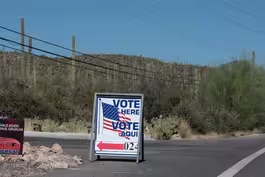
Arizona prepares to combat election conspiracy theories
Video has Closed Captions
Clip: 10/23/2024 | 8m 39s | How Arizona is preparing to combat election denialism and conspiracy theories (8m 39s)

Harris slams Trump after John Kelly sounds alarm
Video has Closed Captions
Clip: 10/23/2024 | 4m 39s | Harris slams Trump after John Kelly sounds alarm on his fitness for office (4m 39s)

Officials warn adversaries want to undermine election trust
Video has Closed Captions
Clip: 10/23/2024 | 5m 59s | Intelligence officials warn foreign adversaries determined to undermine election trust (5m 59s)

Series of outbreaks raises concerns about U.S. food safety
Video has Closed Captions
Clip: 10/23/2024 | 6m 43s | McDonald's E. coli outbreak and other incidents raise concerns about U.S. food safety (6m 43s)

What John Kelly said about Trump's fascist tendencies
Video has Closed Captions
Clip: 10/23/2024 | 6m 37s | What John Kelly said about Trump's praise of Hitler and fascist tendencies (6m 37s)

What Korean troops in Russia could mean for the Ukraine war
Video has Closed Captions
Clip: 10/23/2024 | 4m 20s | What the presence of North Korean troops in Russia could mean for the Ukraine war (4m 20s)

With vehicles safer for drivers, focus now on pedestrians
Video has Closed Captions
Clip: 10/23/2024 | 7m 58s | As vehicles get safer for drivers, advocates demand protection for pedestrians and bikers (7m 58s)
Providing Support for PBS.org
Learn Moreabout PBS online sponsorship
- News and Public Affairs

FRONTLINE is investigative journalism that questions, explains and changes our world.

- News and Public Affairs

Amanpour and Company features conversations with leaders and decision makers.












Support for PBS provided by:
Major corporate funding for the PBS News Hour is provided by BDO, BNSF, Consumer Cellular, American Cruise Lines, and Raymond James. Funding for the PBS NewsHour Weekend is provided by...