Oregon Field Guide
Pig-N-Ford, Green Crab Invasion, Smith Rock Photo Essay
Season 35 Episode 4 | 26m 31sVideo has Closed Captions
Tillamook’s Pig-N-Ford competition; Green Crab invasion; Visual exploration of Smith Rock
Tillamook’s Pig-N-Ford competition has been an Oregon tradition for nearly 100 years; Oregon grapples with an invasion of green crabs along the coast; A visual exploration of Smith Rock State Park.
Problems playing video? | Closed Captioning Feedback
Problems playing video? | Closed Captioning Feedback
Oregon Field Guide is a local public television program presented by OPB
Oregon Field Guide
Pig-N-Ford, Green Crab Invasion, Smith Rock Photo Essay
Season 35 Episode 4 | 26m 31sVideo has Closed Captions
Tillamook’s Pig-N-Ford competition has been an Oregon tradition for nearly 100 years; Oregon grapples with an invasion of green crabs along the coast; A visual exploration of Smith Rock State Park.
Problems playing video? | Closed Captioning Feedback
How to Watch Oregon Field Guide
Oregon Field Guide is available to stream on pbs.org and the free PBS App, available on iPhone, Apple TV, Android TV, Android smartphones, Amazon Fire TV, Amazon Fire Tablet, Roku, Samsung Smart TV, and Vizio.
Providing Support for PBS.org
Learn Moreabout PBS online sponsorshipMajor support for Oregon Field Guide is provided by... [ music playing ] WOMAN: Come on!
There he is, there he is, there he is.
[ exclaims ] Come over here, buddy!
Good boy!
[ laughing ] WOMAN: Whoo, high five!
Yeah!
ED JAHN: Next on Oregon Field Guide: [ starter pistol fires ] [ crowd cheering ] It's a swine time at the races for a century-old tradition in Tillamook County.
Then, grab a moment of peace with a photographic journey through Smith Rock State Park.
But first, these crabs are abundant along the Oregon coast, and that's not a good thing.
WOMAN: Once people can identify green crabs, then we can remove them.
Like to come to the Oregon coast to dig for shellfish, maybe catch a few native Dungeness crab?
Well, enjoy it now, because Jule Gilfillan has been tracking an exotic invasive species that threatens to upend the natural order of things here along our coast.
But if you stay with the story till the end, there are a few things you can do to help.
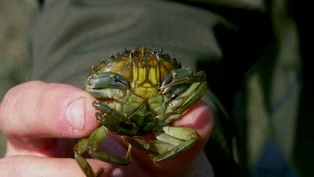
GILFILLAN: On this summer day in 2022, Cat De Rivera and her team from Portland State University are conducting a survey of European green crab in Siletz Bay.
Since their arrival on the West Coast in the 1980s, these little green monsters have established themselves as some of our most successful and destructive invaders.
Green crabs are voracious shellfish eaters.
They'll eat the baby Dungeness crabs as well as clams and oysters.
And green crab densities can get very high, totally depleting the number of clams or oysters in that area.
So that's why we're worried about them.
Looks like we have some green crabs and some Dungeness and sculpin in this trap.
The survey is one of many long-term studies aimed at controlling their numbers and will take the team from the salty oceanside to the fresher, warmer waters of the upper estuary.
We have another male Dungeness.
Green crabs have incredible tolerances for temperature.
They can be much warmer than our native crabs can and thrive.
But they're also pretty successful at cold temperatures.
Similarly, they're very tolerant of different salinities.
So they can be fully marine, they can live at five parts per thousand, which is very fresh.
-Salinity?
-Salinity is 6.3.
-And what about temperature?
-Uh, 23.9.
They're great survivors, and this is why they've managed to invade so many areas around the world and now in Oregon, too.
So we have five juvenile green crabs and one... We first met Cat back in 2006 when she and her colleague Sylvia Yamada from Oregon State University were documenting the early stages of the invasion.
Back in 2006, red rock crabs, which are our native crab we have, will prey on them and they could keep their numbers in check.
So we were keeping our eye on them, but we weren't as worried for Oregon shellfish as we are now.
Much of that worry comes from the enormous impact these crabs are having in Washington State, the U.S.'s largest shellfish producer.
One hotspot is the Lummi Sea Pond near Bellingham, an important aquaculture site for the Lummi Tribe.
Exponential growth in populations there have led to an intensive strategy of year-round trapping.
While Oregon's shellfish industry is orders of magnitude smaller than that of Washington, economics are not the only issues.
Green crabs dig up eelgrass.
Eelgrass is a really important habitat, and they can destroy just the whole ecology of the systems as well.
Spend an afternoon at Netarts Bay on Oregon's north coast and the problem becomes clear.
When green crabs first invaded Oregon, this was one of the sites that they turned up in, you know, moderate numbers.
And now they're really coming up again.
So I'm just going to look under rocks here for them.
All right, here's our first green crab of the day.
It's just stuck in the mud here.
She's a female with a bunch of eggs.
And each of these eggs is just tiny.
That's two eggs on my finger, like right above my fingertip there.
Females will live five years, sometimes six years.
So they can produce potentially hundreds of thousands of eggs in a lifetime each.
So I always feel good about removing females.
One down.
Let's see how many to go.
Oh, and we have another female.
All right, let's see if anyone else is buried in here.
Why, yes, under this same rock we have crab number three, another female.
She's missing both of her claws.
All right, there's one here.
That is so many eggs for her body size.
I see two.
I see three.
Don't pinch me, please.
I'm finding a good number here, for sure.
Along with the wide tolerances for temperature and salinity, European green crabs have a number of special traits that give them advantages for survival.
They have flatter rear legs, which make them pretty good swimmers.
They have a crusher claw that is thicker... And specialized claws that help them crush and slice into clams and mussels.
They're amazing survivors.
So we've got 21 from just under that one rock.
Oh, here's another one!
I got you!
Twenty-two!
[ chuckles ] And more and more.
Today, in a very short time, we have pulled up so many crabs.
And there's no way we would've seen anything like that in 2006.
Another female with eggs.
Just a lot of reproductive capacity.
In all, Cat found 263 crab today.
She has a special permit to take that many.
[ Cat chuckles ] But for the general public, there's a limit of 35 per day per person.
Got the males.
I think there should be no limit on their take, and ODFW has that limit because they're worried that people can't identify them from the natives.
From our perspective, it's essential that the public be able to recognize a European green crab from our native species of crab.
Steve Rumrill is the Shellfish Program Manager for the Oregon Department of Fish and Wildlife.
Green crab can be easily misidentified.
These are just a native shore crab.
So the well-intended person that may go out and try to catch 3- or 400 green crab, there would likely be an unintended by-catch-- 30, 40, 50, 60 native crab-- and we don't want that to happen.
So we're comfortable with holding that limit at 35.
MAN: I think we'll have a few in there today.
WOMAN: Yeah, think so?
So just how hard is it to tell a European green crab from, say, a native Dungeness?
Oh, looks like we got a few in there.
Yeah.
Well, for one thing, they're not always green.
WOMAN: There's a lot of color variation in the European green crab.
See, this one is very orange and red.
Compare that with this one, also a green crab, that's kind of a yellow tan.
They can also be quite green.
So using color, it's impossible to correctly identify them, but there is a really good, easy method you can use to identify green crab.
So European green crab have three bumps in between their eyes and five spines on either side of their eye.
One, two, three, four, five.
Dungeness crab have 10 spines.
So that's a clear way to ID, and it doesn't change with age or color, so it doesn't lead to the same misidentification concerns.
This is a Dungeness.
We can let this guy go back into the-- where we caught him.
Another conundrum is what to do with these invasive crabs if you catch them.
Yeah, it looks like the last one there.
ODFW has a Pottery Barn policy.
That's yours.
You bought it.
That's yours.
So we ask you to take it home with you and dispose of it.
And the best way to do that?
You can eat these just like you would a Dungeness crab or a red rock crab.
You can see they have big, meaty claws, so that holds a lot of meat in there.
And if you aren't going to eat them, ODFW says freeze them.
It slows the whole body process down, and so they essentially go to sleep pretty quickly, and then their body just shuts down and they freeze right up.
After that, wrap them up and put them in the trash can.
Or chunk them up and add them to your garden as fertilizer.
Cover it up nice, give it a little pack.
That works really well.
DE RIVERA: I see more green crabs.
Once people can identify green crabs, then we can remove them, and everybody doing their part removing some green crabs could keep the numbers down.
So just how urgent is the problem?
RUMRILL: On one sense, it's fairly urgent because their numbers have increased.
On the other side, we have not really come to the point of an emergency for Oregon.
One of the problems is, when they're not concerning, they're easier to remove.
And once they're really high numbers, that you have thousands in a small spot, then it's harder to get all of them out.
One thing that both Steve and Cat know is the clock is ticking.
RUMRILL: We are now seeing changing conditions in our global climate that will be favorable to the green crab, so it's really a complex, unfortunate, and alarming problem.
The research, assessment, and planning that go into formulating policy all take time.
One cautionary tale comes from Cat's own experience near California's Bolinas Lagoon.
DE RIVERA: After years of removing them, we had brought that population down from about 100,000 to about 3,000.
And we came back one year, and there were about 300,000.
They just rebounded really quickly, and it's something like that that makes me really worried.
[ music playing ] [ announcer speaking indistinctly over PA ] [ crowd cheering ] The grandstands here at the Tillamook County Fairgrounds used to be wood, now they're aluminum.
That's about one of the biggest changes to happen here in the last hundred years because tradition looms large.
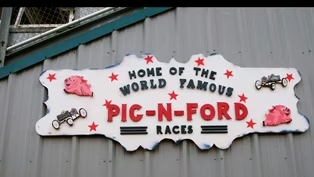
In fact, this is where generations of Oregonians have come year after year to witness one of the most unusual and longstanding traditions in Oregon, and it's called the Pig-N-Ford.
[ announcer speaking indistinctly over PA ] [ crowd cheering ] MAN: These guys are absolutely serious about taking first place.
These guys want it more than anything else you could imagine.
ANNOUNCER: Get ready for it.
MAN: These guys are a ball of nerves.
There's no fair warning of when that shot's gonna be fired.
-[ starter pistol fires ] -ANNOUNCER: And they're off!
[ pigs squealing ] [ announcer continues indistinctly ] [ engines starting ] MAN: Once that shot goes off, they're off to the races and away they go.
McCLUSKEY: This is the annual Pig-N-Ford races.
Like the name suggests, it involves two things: pigs and Model T Fords.
When they come around that first round and they come back to the pig pens, if you watch this, they've already got that car shut off a long ways out.
They're using their foot as an additional brake, right?
And they're coming in kind of hot, and that first-place driver wants to get in close to the pig pens, drop his pig off, grab the next pig, and now he's gotta do the same thing.
If he slips that start, that's gonna be a bad day for him.
-ANNOUNCER: Aw, man!
-WOMAN: It doesn't matter how well you practice or anything.
These cars can be temperamental.
So you really don't know who's going to win.
That's what's exciting.
They can miss their crank, miss the spark, they could do anything, so you never know.
And they could be way ahead, and then something happens.
These T's are pretty-- They make you work for it.
-Yep.
-I would say.
MAN: You're getting the dirt in the face and in your teeth.
You're holding on because you're not getting held in by seat belts, and you've got a squirming pig and you're trying to adjust your spark and read the track and read the other drivers, and so it's really-- it's a raw feeling is how I'd have to explain it.
You know, you feel every element of the race.
[ crowd cheering ] The Pig-N-Ford races happen each summer at the Tillamook County Fair.
Six qualifying heats over four days that culminate in the World Championship.
Generation after generation, they are a crowd favorite.
It's nuts!
[ laughs ] This is the only place in the world you can see it.
That's why we're here!
BENTLEY: Tillamook County Fair is a really small county fair.
We have approximately 25,000 people in our county.
And in four days, there's over 70,000 people that come to the Tillamook County Fair.
[ kids screaming excitedly ] The origins of the Pig-N-Ford races at the county fair go back a century, and the story has been passed down like folklore.
MAN: Way back in the day, there was a couple dudes chasing a pig down the road, grabbed it, and shoved it in their Model T and decided it was a good idea: "We should do this at the county fair."
A guy's pig got loose, and a guy drove by on a Model T, "Jump on," and they went and caught it.
And that's how we started the racing.
[ laughing ] The fair was just looking for some entertainment, and how this ever came in, you know, in 1925 with these guys coming to the fair and saying, "We have an idea."
[ chuckles ] MAN: It used to be just for show years ago, and so anything went, and it was pretty hilarious.
Somebody would jump on somebody else's car, or crank start or shut their car off.
They're staring to go, they'd shut the car off.
They gotta get out, crank it again.
There was just comical things like that.
Parry Hurliman has been involved in the Pig-N-Fords for 40 years.
His dad raced, his uncles raced, he raced, and now his son races.
My dad raised the pigs sometimes, and back in those days, there was no limits on the pigs.
You might have 25-, 35-pounders.
One year, we had 60- to 70-pounders.
And believe me, you could hardly handle those pigs.
So after that time, we started regulating the size.
What'd you say?
[ pig snorts ] [ crowd laughing ] You give the pig a round of applause here!
Ask any Pig-N-Ford participant, and they'll say that the safety of the pigs is first and foremost.
They put designated safety officials at the sidelines, and a racer can be immediately disqualified for any mishandling of a pig.
HURLIMAN: We're giving them a ride.
[ laughs ] They get kind of used to it.
[ engines rumbling ] BEN: We're here to race.
You ask any racer out there on championship day, "Are you here to put on a show?"
No, I'm here to win.
Ben started racing as soon as he got his license at age 16.
At 18, he won his first championship.
He's now been racing for nearly 20 years and is hungry to win another championship, following in the footsteps of his grandfather and his dad, Ken Salo.
Yeah, these pictures here, they go way back.
In the '70s, I would guess, these pictures.
There's Grandpa.
Oh, there's a good one when I was in my prime, racing.
Here's me and my dad.
He was the several times winner of the Pig-N-Ford races, the championship.
And then I was, too.
My dad and I built this Model T. The earliest memories I can remember is this T sitting in here, you know?
It's been a good thing for me and my son.
We've watched our husbands, and now we're watching our sons.
But there's a generation right behind them, biting at the bit, wanting to get on these T's.
Here's your pig.
Start it up!
[ crowd cheering ] After four days of racing, the winners of each heat have qualified for the final race, the World Championship of the Pig-N-Ford.
BENTLEY: Probably the most unique thing with winning the championship is that you don't get paid one red extra cent for winning that championship.
However, you get to keep that trophy all year long at your house, at your residence, and that's what they're prideful of.
So a back-to-back win is just amazing, because they're bringing the trophy back home.
And if you look on that trophy, there are some guys that have won that several years in a row, and there's guys that have traded off and on.
You've won several times, and you've got one under your belt.
So your name's only going to get put on there one way, and one way only, and that's if you're that good.
Those are your best drivers for that week that got there, and whoever wins that, I mean, that's a big day.
Big day in Tillamook County.
Like in the previous heats, the drivers draw ping-pong balls from a jug.
One...
The number they draw determines their starting position.
[ announcer speaking indistinctly over PA ] -ANNOUNCER: You guys excited?
-[ crowd cheers ] [ music playing ] [ starter pistol fires ] WOMAN: Come on, buddy, come on!
Come on, Salo!
Go, Salo!
Yeah, you got it!
You got it, you got it!
[ crowd cheering ] BENTLEY: Ben Salo has to be happy because he's got the first place trophy and he also gets to take this one home and he gets to hold on to that for a whole 'nother year.
That's the special one right there.
It's got all the names on it!
First year my dad's not here to watch me win.
He's not here today.
He's at home sick.
Now we've brought home the W tonight, Dad!
[ crowd cheering, applauding ] With the race won and the trophy awarded, it's time for one more Tillamook tradition: a victory lap with the Dairy Princess.
BEN: It keeps us who we are.
It's built into us, into this family.
It's in our heart.
It makes us want to do it again ever year, because we love it, you know?
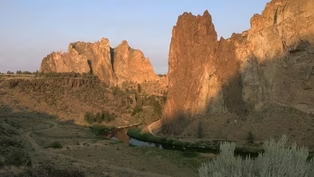
[ music playing ] If you ask me, Smith Rock is one of the most dramatic state parks in the entire country.
And if you needed a reminder why, Oregon Field Guide photographer Todd Sonflieth has your answer.
[ wind blowing ] [ birds chirping ] Good and strong, buddy!
Good and strong!
[ bird caws ] [ climbers chattering indistinctly ] [ wind blowing ] [ music playing ] You can now find many Oregon Field Guide stories and episodes online.
And to be part of the conversation about the outdoors and environment here in the Northwest, join us on Facebook.
[ birds cawing ] [ indistinct conversation ] Major support for Oregon Field Guide is provided by... Additional support provided by... And the following... and contributing members of OPB and viewers like you.
Video has Closed Captions
Clip: S35 Ep4 | 10m 12s | Oregon grapples with an invasion of green crabs. (10m 12s)
Video has Closed Captions
Clip: S35 Ep4 | 10m 6s | The Pig-N-Ford is a zany, century old Tillamook County competition. (10m 6s)
Video has Closed Captions
Clip: S35 Ep4 | 3m | A visual exploration of Smith Rock State Park. (3m)
Providing Support for PBS.org
Learn Moreabout PBS online sponsorship















Support for PBS provided by:
Oregon Field Guide is a local public television program presented by OPB