One-on-One
President Trump's Leadership Style and the January 6th Riots
Season 2021 Episode 2471 | 27m 8sVideo has Closed Captions
President Trump's Leadership Style and the January 6th Riots
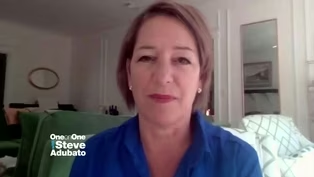
Steve Adubato is joined by Co-Authors of “I Alone Can Fix It: Donald J. Trump’s Catastrophic Final Year,” Carol Leonnig, National Investigative Reporter, Washington Post, and Philip Rucker, Senior Washington Correspondent, Washington Post, to discuss former President Trump’s leadership style, the long-term impact of the Jan. 6th Capitol riots, and the impact of the pandemic on the nation.
Problems playing video? | Closed Captioning Feedback
Problems playing video? | Closed Captioning Feedback
One-on-One is a local public television program presented by NJ PBS
One-on-One
President Trump's Leadership Style and the January 6th Riots
Season 2021 Episode 2471 | 27m 8sVideo has Closed Captions
Steve Adubato is joined by Co-Authors of “I Alone Can Fix It: Donald J. Trump’s Catastrophic Final Year,” Carol Leonnig, National Investigative Reporter, Washington Post, and Philip Rucker, Senior Washington Correspondent, Washington Post, to discuss former President Trump’s leadership style, the long-term impact of the Jan. 6th Capitol riots, and the impact of the pandemic on the nation.
Problems playing video? | Closed Captioning Feedback
How to Watch One-on-One
One-on-One is available to stream on pbs.org and the free PBS App, available on iPhone, Apple TV, Android TV, Android smartphones, Amazon Fire TV, Amazon Fire Tablet, Roku, Samsung Smart TV, and Vizio.
Providing Support for PBS.org
Learn Moreabout PBS online sponsorship- [Narrator] Funding for this edition of One-On-One with Steve Adubato has been provided by Hackensack Meridian Health.
Keep getting better.
New Jersey Institute of Technology.
NJIT makes industry ready professionals in all STEM fields.
Horizon Blue Cross Blue Shield of New Jersey.
Here when you need us most, now and always.
The New Jersey Education Association.
The New Jersey Economic Development Authority.
PSE&G, committed to providing safe, reliable energy now and in the future.
PNC, Grow Up Great.
Choose New Jersey.
And by Fedway Associates, Inc.
Promotional support provided by NJ.Com, keeping communities informed and connected.
And by New Jersey Monthly, the magazine of the Garden State.
Available at newsstands.
- This is One-On-One.
- I'm an equal American just like you are.
- The jobs of tomorrow are not the jobs of yesterday.
- Look at this.
You get this?
- Life without dance is boring.
- I don't care how good you are or how good you think you are, there is always something to learn.
- I did do the finale, and guess where my trailer was?
A block away from my apartment, it couldn't have been better!
- People call me 'cause they feel nobody's paying attention.
- (slowly) Start talking right now.
- That's a good question, high five.
(upbeat music) - Welcome, everyone.
An important program, an important discussion about a very important book.
The book is, "I Alone Can Fix It, "Donald J. Trump's Catastrophic," if you will, "Final Year."
The authors are with us today.
Carol Leonnig, who is National Investigative Reporter with The Washington Post, and Philip Rucker, Senior Washington Correspondent at The Washington Post.
Also, they co-wrote, as I said, "I Alone Can Fix It."
I wanna thank you for joining us.
It is our honor to have both of you.
Carol, let me ask you.
I've been reading this book, going back and forth, marking it up and saying to some friends how important this book is, and some, to play devil's advocate right out of the box, say, "Come on, Steve," quote, "let's get over it, "let's get past it, let's stop talking about January 6th."
Let's stop talking about the last year of Trump, if you will; let's, quote, "move on."
Why can't we just, quote, "move on," Carol?
And I ask Phil the same thing.
- As a reporter, I'm fascinated, and Phil is, too, by the patterns of our policy and our governing.
And we can't move past this because it's still happening.
You know, the things that President Trump, former President Trump, promulgated and promoted, the misleading information and the flat-out lies he continues to push, and now is seeking to syndicate that, if you will, with his own media platform, as of yesterday.
These are things he's promoting across the country in an effort to reshape election results in the future, and also build his own political support beyond what he already has.
So this promulgation of lies continues.
You can't ignore that because it's shaping our politics today, and it will have a huge impact on the midterms and ultimately, the next presidential election.
- Phil, we're obsessed here in Public Broadcasting about democracy and the preservation of our democracy.
It's beyond in danger, if you will.
The "Stop the Steal" movement that the President led and those around him, what does that have to do with, quote, "preserving our American democracy," Phil?
- Well, first of all, preserving democracy in this country is so important, and so it's nice to see your programming and your viewers caring so much about it.
And you know, it's been under threat for several years now and it's these slow sort of movements chipping away at our institutions, and frankly, at our democratic fabric here in this country.
The "Stop the Steal" movement from Trump and his supporters was nothing short of an attempt at a coup, an attempt to overturn the results of a free and fair election so that former President Trump could stay in power for a second term, despite having lost that election, according to the results.
But it continues.
It continues in a number of states like Texas and Georgia, and elsewhere, where Republican legislators and Republican governors have been passing new voting laws intended, designed, to restrict people's access to the polls.
And it continues, frankly, in the effort that we're seeing right now this year in former President Trump recruiting like-minded allies to become Secretaries of State in places like Arizona and other key presidential battleground states in order to install loyalists who, in the 2024 elections, might be more willing to overturn the election results, where they were not able to do it in 2020.
- Carol and Phil, I'm a student of leadership, you know.
Write about it, talk about it, make mistakes as a leader.
So one of the things I'm fascinated by is the people around the so-called leader, meaning the person at the highest level in an organization with the most responsibility, obviously in this case, the President.
So take us back, Carol, if you will, to election night in 2020.
A, what was the President doing?
But again, to my question about those around the leader, in this case, President Trump, what was he doing, what were they doing or not doing, and what was it like?
'Cause the book talks about it extensively.
- You know, I'm glad that you focus on leadership, Steve.
So many moments of the Trump presidency are lessons in bad leadership and also lessons in kind of scary profiles in weakness.
Around the President on election night, he was largely surrounded by people who were going to tell him the Emperor had beautiful clothes.
They were never going to tell him the real facts, the real truth of what was happening.
He had Rudy Giuliani set up on a, almost a card table in the White House at a big party, surrounded by his most loyal aides and supporters.
He and his family, of course, Donald Trump and his family, were in a separate room where the President was watching this mostly in the residence, along with some family members and friends.
But the party downstairs was full of people telling the President that he won the election.
As the returns came in from all sorts of places, Arizona being the most important at one point, Rudy Giuliani just said to the President's advisors, "Declare you won, declare victory, say we won."
And defiant of all- - Just say it.
- Just say it.
- I'm sorry but just say it.
- (laughs) That the brilliant strategy on election night.
Again, not exactly a Kennedy moment, not exactly a profile in courage.
It was an effort to do this from the start, though.
We have sourcing, Phil and I, from that time period in which Bill Barr apparently heard from a White House friend of his- - The Attorney General.
- The night, yes, heard from a friend of his the night before that the President always had this as a plan, that the day of the election, he was going to declare victory before the night ended, knowing that most of the pro-Trump states and precincts were going to come in early, and the votes essentially that were going to be counted from absentee ballots in other states couldn't be counted until later in the evening, and might be days away from being finalized.
So he was just going to declare victory.
And everyone around the President did the same.
In fact, his sons were berating other people on the campaign staff, "What do we pay you for?"
We're supposed to win.
How do we lose to, quote, unquote, "this guy," meaning Biden.
It was sort of a rejection of all fact.
And your leadership question illustrates that by this point in the presidency, the President is largely surrounded by sycophants or people who are not willing to be straight with him.
- So let me play devil's advocate here, Phil.
In spite of everything your colleague just said, or Carol just said, what about to those watching right now who say, you know, this Trump-bashing of his leadership style, the sycophants around him, what about if he is just the kind of, quote, "leader," particularly in this last year, this, as you say, this catastrophic last year, what about if he's just the kinda leader who doesn't take anyone's crap, who has people who are very loyal to him, who are loyal, yeah, to a fault.
But you know what?
That's what charismatic leaders do.
They attract that kind of loyalty.
What's wrong with that, Phil?
- Yeah, you know, I would say a couple of things to answer that, and that's an important point that you raised.
The first is, I would not characterize this as Trump-bashing, and I would tell somebody, look, it's not Trump-bashing; it's truth-telling.
This is what really happened behind the scenes.
These are the facts.
They might be ugly facts, they might make some people form a negative impression of Trump, but it's the truth of what was really going on in that Administration.
And it's not our opinion.
It's according to the more than 140 senior administration officials and Trump advisors that we interviewed for our book, "I Alone Can Fix It."
So I'd want to establish that first.
But the other point is really important that you raised, and it's that a lot of people in this country, tens of millions of them, like Trump's characteristics.
They like- - Love.
- His machismo.
- Love Trump.
- They love him, they adore him.
They think he's speaking for them.
They think he's fighting their fights.
They like that he's brash.
They like that he attacks people on Twitter.
They like that he makes fun of the German Chancellor and the British Prime Minister, and all of our sort of traditional Western allies.
And they like that he is taking a wrecking ball to the institutions in Washington for one simple reason.
And it's because for many, many, many years, these people have felt the institutions weren't working for them, and the leaders of this country were sticking up their nose at them, and finally, they have in Trump, somebody who's fighting for them.
That's the belief of Trump's supporters.
We should keep in mind that that is very much a minority in this country.
It's the reason why Trump lost the popular vote both in 2016 and in 2020.
It does not represent the majority thinking in the United States, but it certainly represents a very sizeable portion of the electorate.
- Carol, let me try this.
Again, the book is, "I Alone Can Fix It."
You've seen Carol and Phil on a whole range of national broadcasts.
We're honored that they've joined us here on Public Broadcasting.
We encourage you to get this book, read it and decide for yourself about a whole range of things.
But I do wanna talk a little bit about January 6th.
(sighs) So as we speak, and we don't know what Congress is going to do with these investigations, who's gonna show up, who's not.
And again, we're taping it, and we never try to hide when we're taping.
We're taping on the 21st of October; we'll be seen later.
But Carol, here's the question.
Why, from election night leading up to January 6th, and the book does such an extraordinary job, not just that period of time, but the entire last year, the final year, if you will, of the Trump presidency, leading up to that date, leading up to the insurrection of the Capitol, the invading of the Capitol, the "Kill Mike Pence," if you will, "Hang Mike Pence," whatever that expression was, there is a question here, trust me.
Was it, from your perspective, quite predictable that something like that horrific event was likely to happen, Carol?
- It's such a good question, and I have to tell you that I don't think, in my mind as a reporter, not as a person, but as a reporter, that it was quite predictable.
You don't imagine people taking up arms to wrest control of the government.
You just never imagine that.
However, I think all of us at The Washington Post, and Phil and I, were on pins and needles about the rhetoric and how it was ratcheting up from election night on, from the time that President Trump gave that, you know, slightly unhinged, middle-of-the-night press conference, where he said, frankly, we did win; honestly, we did win.
From that moment onward, the rhetoric was just amping up.
And when you heard one of the President's closest allies, Michael Flynn, say on a national platform, not television, but on a national platform, the President should just seize the election machines in swing states and rerun the election, declare martial law in order for that to happen, you knew something unpleasant was afoot.
Because, in fact, the day after, as our book reveals, the day after Michael Flynn uttered that, he was in a meeting in the Oval Office with the President that went on for more than three hours, discussing exactly that.
The conversations that the President and his supporters were having with the American public in those weeks leading up to January 6th, was out for everyone to say, "Come to Washington, "help me stop the steal, help me convince Mike Pence "because I'm not going to," to use the President's words, "like him very much "if he doesn't reject these certified elections, "if he doesn't reject these results."
- To your point, Phil, let me ask you.
Your colleague, Carol, mentions Mike Pence.
I've been thinking a lot about Mike Pence, not just from a leadership perspective, but frankly from a human perspective.
And the book does an extraordinary job, again, talking about the Mike Pence, those critical moments for him leading up to what he was supposed to do based on the United States Constitution, and certify that Joe Biden was our President.
How do you believe, or what do you believe history will say about Mike Pence not just in that moment, but leading up to that moment and frankly since?
- Well, a couple of thoughts on that.
First of all, I think history will look kindly on the way Pence handled the day of January 6th.
The fact that he went ahead and conducted his Constitutional duty of overseeing the certification of the electoral college results at that joint session of Congress, that he rebuffed and resisted President Trump's entreaties to try to rig the election somehow, because he knew it was wrong, because he knew it was unconstitutional.
And that's a good thing, that the Vice President would honor the Constitution in that way.
But I'm not sure that history overall is gonna look kindly on Mike Pence, largely because he was one of the biggest, if not the biggest, enablers of President Trump throughout all four years of that Administration.
Time and again, Trump would do something that was either considered immoral, that was legally dubious in some cases, lies again and again and again, and Pence was at his shoulder, at his side, smiling, nodding, going along with it, excusing President Trump's behavior, excusing the way he conducted himself in office.
Certainly, as we talked earlier, tens of millions of Americans like all of that and likes the way Trump conducted himself.
But I'm not sure history will look kindly on this presidency, and I think history is gonna remember that Mike Pence was the Vice President for all four of those years, and loyally, was number two at his side.
- I wanna be clear on something.
Carol and Phil were supposed to join us for a half a show.
We are pushing the envelope.
They have hard outs because they have planes to catch and work to do, so we have just a few more minutes I'm gonna do this.
The final year of the Trump presidency, Carol, and COVID, talk about it.
Because that's a huge, huge and very important part of this very important book.
Carol, please.
- You know, this is to me, really illustrative of a presidency when you don't have people around you who are willing to forcefully give you good advice, a strong Chief of Staff, a series of strong cabinet leaders who tell you what's what, and also illustrative of a president who was incredibly emboldened, believed his decision-making, his PR, his legal theorizing, his scientific knowledge was superior to all of those around him.
- Just take the bleach, just take the bleach under the skin, right, Dr. Birx?
- (laughs) Yeah.
- Listen, I am not editorializing.
It's not our job on Public Broadcasting, but you watched it, I watched it.
"Right, Dr.
Birx?"
You take the bleach, you put it on, and then the light, what is that illustrative of, if you will, I'm sorry.
- No, no, it's an excellent point, and it's one we try to bring to life.
Because many of the people watching that who advised the President were cringing inside.
Their stomachs were flipping.
They were really freaked out and disturbed, but they didn't stop him from telling millions of Americans that this was a possibility and a way to solve it.
- Could they have, Carol?
I'm so sorry for interrupting.
Do you believe- - No!
I think they could have.
I think they absolutely could have.
- You do?
- It's- - Tony Fauci, Dr. Fauci and Dr. Birx, quote, "could have stopped the President"?
- They could have spoken up in a different way; they would never stop the President.
He was emboldened like no other president I've seen, in 2020.
Remember, by then, Steve, he's beaten back an impeachment.
He's beaten back one of the leading federal prosecutors in the nation's history who's investigated and found that four times there was enough evidence to charge him with the crime of criminally obstructing an investigation.
- The Mueller investigation, I'm sorry, go ahead, right.
- Yes, he's beaten back both of these.
And he's come to 2020 feeling like, I got this; I know what to do.
So stopping him is a bridge too far.
But speaking up at that moment, saying something like, "No, Mr. President, that's not true," was a possibility.
I'm not a judge; I'm just saying that's a possibility.
One of the things that's also striking about this year as COVID begins, which Phil and I learned a lot more detail about, was how many tragic lost opportunities there were in the early days of this event.
You know, the most important, from my perspective, looking through and interviewing so many of these people as we did, who were involved in the science, the CDC would normally, in any situation like this, with a mysterious pneumonia in a foreign country, send in a landing team, a CDC pro-athlete team, essentially, of scientists, the NBA of scientists, and they would figure out what's this virus, what's it doing, what's its genetic code, genomic code, what are we facing.
That didn't happen here, because President Xi- - They were supposed to lead this, Carol.
I'm sorry, they were supposed, the scientists, the health experts, were supposed to lead it.
Who led it?
Was it Donald Trump?
- Ultimately, it was Donald Trump.
Because Donald Trump could have pressed President Xi in China to let that team in, but he didn't.
He was focused on a good PR relationship.
He was focused on bragging about a trade deal in the middle of January that they were about to ink together.
And the PR of that was so superior to President Trump in terms of importance than anything about learning about the virus.
And the tragic consequences, we were blind.
Those scientists who were the best in the nation, Dr. Fauci, Dr. Birx; Dr. Redfield, the head of the CDC, they did not know what they were dealing with for critical months and weeks, when if they had known, the spread of this would have been so much smaller.
- Okay, we got a couple of minutes left; real quick.
Phil, if the President had not mocked masks, if the President, and again, talked extensively about in "I Alone Can Fix It," this extraordinary book, if the President had, (sighs) had the scientists lead, as Carol just said, if the President had been supportive of efforts to promote the vaccine, not just, "Hey, I did this, "it happened on my watch," which is true.
Operation Warp Speed was that.
If the President had done those things, do you believe that it would have, and right now, be making a significant difference in the lives of so many millions and millions of Americans, many of whom are my friends who I have failed to convince the importance of this vaccine, do you believe, who are big Trump supporters, do you believe that many of those people would have a different perspective about how they should protect themselves, and frankly, more importantly, those around them regarding this virus?
It's a loaded question, I know; two minutes left.
- Absolutely, and it's not just what I believe and what Carol believes.
It's what scientific experts and medical experts around the country, who we've interviewed, believe.
The fact is science should not be a partisan issue.
There should not be a political divide over whether a mask is necessary to help protect yourself and protect your community from a virus like COVID-19.
There should not be a political divide about whether a vaccine is safe to take, and whether that helps protect you, and protect your family and others in your community from the vaccine.
And yet because of Trump's conduct in office while managing COVID, but also in these months since he's left office, in communicating to the public about COVID, there has become this great political divide.
And so that's why you're seeing, all year long, the surge in cases in so many red Republican states around the country, you're seeing so many more hospitals that are overwhelmed, healthcare workers who are taxed, and most importantly, people who have been dying in these communities.
It's not like had Trump advocated for masks and the vaccine, and followed the letter of the law when it comes to the science that COVID would have magically disappeared, but it could have had a demonstrable impact in the kind of devastation we've seen in this country.
And one of the reasons why America has been so slow to beat back the virus is because of the political discussion surrounding all of the best medical practices.
- And finally, both of you are objective reporters, journalists.
You interviewed countless people for this book, but I would be remiss if I did not ask this.
In writing this book, and covering Donald Trump for as long as you have, and it's not just Donald Trump; it's everything that he represents in this nation, which is significant, Carol, is it a fair question to ask what impact has writing this book and researching with your colleague, Phil Rucker, has had on you, not just as a journalist, but frankly, as an American?
- I'd like to talk primarily about how it's affected me as a journalist.
You know, Phil and I view ourselves as very serious non-partisan objective finders of fact, and it is fairly chilling as a journalist to find these facts, discover how close our democracy came to falling off the rails.
It's chilling as a journalist to see how science was beaten back, how facts were beaten back in favor of someone who was leading a movement to try to deny all of those things, only for one purpose, personal power.
And I also think another thing that was chilling about this reporting, never in my career, and I've been a journalist for, a national journalist for a quarter of a century, (laughs) which is hard to say out loud, never in my career have I come across so many people who worked for a president who were afraid of what he was going to do.
We did not realize in real time how many people, who were ardent supporters of the president, sitting at his shoulder, helping advise him, at his shoulder on national television, nodding and applauding him as he did certain things.
We did not realize how many of them were about to hit the panic button, were internally discussing their fear that he was putting his personal political gains ahead of American lives, ahead of the country's sort of stability.
- Yeah, Carol and Phil, I can't thank you enough.
This is the book.
It's been by my bedside for a long time, marking it up, trying to learn from it, asking questions because of it.
Cannot thank you enough because you, again, went way longer than we had originally agreed to.
I stole your time.
I am confident it made a difference with our Public Television audience.
Carol and Phil, I wish you all the best in your work, to you and your families.
Thank you so much.
- Thank you, Steve.
- Thank you.
- It was such a treat to talk to you, and thank you and your viewers for caring about the subject.
- Well, thank you for caring about and writing about it.
I'm Steve Adubato.
That's Phil and Carol; "I Alone Can Fix It" is the book.
Thanks for watching.
We'll see you next time.
- [Narrator] One-On-One with Steve Adubato has been a production of the Caucus Educational Corporation.
Funding has been provided by Hackensack Meridian Health.
New Jersey Institute of Technology.
Horizon Blue Cross Blue Shield of New Jersey.
The New Jersey Education Association.
The New Jersey Economic Development Authority.
PSE&G.
PNC, Grow Up Great.
Choose New Jersey.
And by Fedway Associates, Inc.
Promotional support provided by NJ.Com, And by New Jersey Monthly.
- I'm Tim Sullivan, CEO of the New Jersey Economic Development Authority.
Since joining the NJEDA, I've been struck by the incredible assets and resources that New Jersey has to offer.
The NJEDA is working every day to grow New Jersey's economy in a way that maximizes the values of those assets to benefit every single New Jersey resident.
This includes more support for small businesses and a focus on reclaiming New Jersey's position as a leader in the innovation economy.
Visit njeda.com to learn more about how NJEDA is building a stronger and fairer New Jersey economy.
President Trump's Leadership Style and the January 6th Riots
Video has Closed Captions
Clip: S2021 Ep2471 | 25m 35s | President Trump's Leadership Style and the January 6th Riots (25m 35s)
Providing Support for PBS.org
Learn Moreabout PBS online sponsorship
- News and Public Affairs

Top journalists deliver compelling original analysis of the hour's headlines.

- News and Public Affairs

FRONTLINE is investigative journalism that questions, explains and changes our world.












Support for PBS provided by:
One-on-One is a local public television program presented by NJ PBS