
Remembering 2020/University of Detroit Mercy
Season 49 Episode 2 | 26m 46sVideo has Closed Captions
Remembering 2020/University of Detroit Mercy | Episode 4902
Advice on what small businesses can do now to survive the pandemic. Plus, the president of University of Detroit Mercy is here to talk about how the campus is combating COVID-19. Episode 4902
Problems playing video? | Closed Captioning Feedback
Problems playing video? | Closed Captioning Feedback
American Black Journal is a local public television program presented by Detroit PBS
Remembering 2020/University of Detroit Mercy
Season 49 Episode 2 | 26m 46sVideo has Closed Captions
Advice on what small businesses can do now to survive the pandemic. Plus, the president of University of Detroit Mercy is here to talk about how the campus is combating COVID-19. Episode 4902
Problems playing video? | Closed Captioning Feedback
How to Watch American Black Journal
American Black Journal is available to stream on pbs.org and the free PBS App, available on iPhone, Apple TV, Android TV, Android smartphones, Amazon Fire TV, Amazon Fire Tablet, Roku, Samsung Smart TV, and Vizio.
Providing Support for PBS.org
Learn Moreabout PBS online sponsorshipJust ahead on "American Black Journal," we'll hear advice for small businesses for surviving the pandemic.
Plus, the President of the University of Detroit Mercy is here to talk about how the campus is combating COVID-19.
And we're gonna be treated to a special dance performance.
Stay right there, "American Black Journal" starts now.
Announcer 1: From Delta Faucets to Behr Paint, MASCO Corporation is proud to deliver products that enhance the way consumers all over the world experience and enjoy their living spaces.
MASCO, serving Michigan communities since 1929.
Announcer 2: Support also provided by the Cynthia & Edsel Ford Fund for Journalism at Detroit Public TV.
Announcer 1: The DTE Foundation proudly supports 50 years of "American Black Journal" in covering African American history, culture, and politics.
The DTE Foundation and "American Black Journal," partners in presenting African-American perspectives about our communities and in our world.
Announcer 2: Also brought to you by Nissan Foundation.
Ally.
UAW, solidarity forever.
Inpact at Home, and viewers like you.
Thank you.
(upbeat music) Welcome to "American Black Journal."
I'm Stephen Henderson.
Last year was certainly a big challenge for small businesses, and there's still uncertainty about where the economy is headed as we try to survive the pandemic.
Restaurants, retail stores, and other businesses continue to operate under COVID-19 restrictions, and some companies were able to pivot and survive 2020 while others were forced to close.
So, what can business owners do to make this year a better one?
I got some answers from Marketing Consultant, Mark Lee, of the Lee Group.
So let's start with just your assessment of businesses and how they're doing right now.
2020 was a rough year.
It was quite frankly, I'll leave at that, it was a very rough year.
And specifically, a lot of businesses struggled for as a direct result of the pandemic, We know that factually, over 100,000 businesses have shut down completely.
100,000 businesses over a six month period shut down completely.
In other words, will not open back up.
Number two is that 41% of all African American businesses in this country, nationally, also temporarily closed, or shut down completely.
So when you look at those data points and look at the fact that the GDP also declined for the first time in several years, it was a rough year for businesses.
And our hope is as we move into 2021, that things will slowly begin to turn around as well.
So, if you're a small business owner, what are the things that you should be doing to prepare for 2021?
Still a lot of unknowns, but hopefully some stability in places that you didn't have the year before.
What should they be doing?
Yeah, that's a great question.
There's several things that businesses and business owners should be doing right now.
Do not wait any longer.
One is you need to anticipate your revenue streams and your income levels.
You need to look at your business projections and say, okay, 2020 is behind us.
Right now, the, in 2021, the economy is projected to improve by mid-year as a result of the vaccinations and other things that are happening, maybe a new administration.
We'll see what happens.
But as a business owner, make sure you anticipate your revenue streams.
Where might you have those gaps?
If you have gaps, where are you gonna close those gaps?
Number two is begin to reassess your business model.
And when you reassess your business model, you need to take a good hard look at your staffing.
I was talking to someone in preparation for this discussion where they did that exact process, where they reassessed their staffing.
And as a direct result of that, they realized they had to lay off people, but they're gonna go back and offer those same individuals part-time opportunities.
A great strategy of going back and saying, okay, let's reassess, maybe offer part-time opportunities.
You know what?
Go back and review your marketing efforts.
And what I mean by that is you don't have to spend a ton of money.
Look at your grassroots programs, right?
Look at your social media.
Begin to communicate with people directly about what your intentions are for the year.
Number four is look at your informal network.
Begin to leverage that informal network right now in terms of potential business opportunities, asking them to go out and provide business for you if possible.
And lastly, make sure that you make fact-based decisions.
Right now, there's a lot of emotion, so let the numbers dictate what you should do.
What I mean specifically like that, if you have a family member that you've hired, can you afford to hire that person or maintain that expense on your books?
So therefore, make a fact-based decision as opposed to an emotional decision as well.
Hmm.
Is there more help for businesses that will be out there and particularly for minority-owned businesses, is there going to be help targeted at that community, which of course, took a much bigger hit, it always does, than other businesses did because of the pandemic.
Yes, there will be.
And I'm pleased to say that over the holidays, the President did sign into law another economic relief program passed by Congress.
I would encourage those of you viewing today to go out and do your research.
There are over $400 billion, I believe, in economic relief for small businesses.
And that's gonna be round two of the payment protection program which will be administered by the Small Business Administration.
There's a strong revenue stream there for you.
I would encourage you to establish that relationship with your financial advisor, with your banker.
One of the reasons is, one of the reasons that Black businesses struggle, Stephen, quite frankly, is that many of those businesses did not have their relationship with their banker.
They need to go in and establish that relationship now.
Number two is there is a hundred million dollar fund that will be focused on supporting small businesses in the city of Detroit and across Metro Detroit.
It's called the Grow Michigan Fund II.
And that's gonna be in conjunction with the First Independence bank here in Detroit.
And what it is is it's a funding program that will be focused on helping minorities access funding to basically finance their business in 2021, I should say in '21.
I'm used to saying 2020, but in 2021 and beyond.
So I would encourage people to go out and look at those funds, look at those programs, Google financial resources and get the information, and pursue it accordingly.
Hmm.
Are there things that minority businesses should be doing that other businesses don't have to worry about this year?
Are there things that because of the pandemic we had to be more focused on in our community?
We need to be more focused, quite frankly, on supporting Black businesses, right?
Now is the opportunity to shop local.
We've heard that phrase a million times over the holidays.
We really have to support not just with our mouths, but with our pocket books, with our purses and our wallets.
We need to be going out and supporting these businesses.
We need to help to spread the messaging for these businesses, 'cause if you don't, eventually, these businesses are going to shut down.
So now, it's the time to put your money where your mouth is.
I would encourage, again, everyone viewing this today to go out and support that small business owner.
It's critical.
Yeah, yeah.
So I was in downtown Detroit recently on a weekday afternoon.
And it felt to me as though it was 2007 again, so not the '90s when everything was going away, but the kind of beginning of the rebirth that we had over over the last 10 or 13 years.
And of course, look, we're in the middle of a pandemic that still, we don't have control of and people are being encouraged not to gather in public and things like that, but it did still really worry me.
And it worried me how many storefronts I saw that were dark.
That doesn't mean they're gone, but they're closed.
And I started to think about where we'll be when this is all over in our sort of just getting back on its feet downtown.
I mean, I really felt like right before this happened, we were hitting a new kind of stride in terms of growth, and re-attracting business, and welcoming minority-owned businesses to the picture in a way that it hadn't happened before.
How much of that have we lost?
A lot.
I think that the momentum will come back.
Is it gonna come back to where we were back in 2007 or even pre-pandemic?
It's gonna take a while.
And I'm being rather candid here.
It's gonna take a while for that momentum to come back because you're right.
We had a lot of resources, a lot of investment dollars were coming downtown, even pre-pandemic.
A lot of those investment dollars will coming downtown.
Now, let me kind of put people at ease a little bit here.
While we are in the midst of this pandemic, again, the economic forecasters are saying that we should see unemployment rates come back down later this year.
We should see the GDP grow again later this year, expecting full recovery by the middle part of 2022, assuming the pandemic is under control and that the vaccine is out there.
So as it relates to the city of Detroit, I would anticipate that we're gonna come back, but it's gonna take a while.
It's gonna take a lot of block building, and foundational building, and resource building to get that momentum back to where it was.
But it's gonna take a while to get there.
I'm anticipating most of this year, quite frankly, for us to build that momentum back.
Hmm.
So, you don't think an elongated timeframe for that or do you think we've gotta be patient?
We have to be patient.
You know, think about this.
We've been in a situation now for what, now it's our 10th month, I believe, where the first a case was reported back in February or March of last year.
So it's taken us 10 months to get to this point.
It's gonna take us at least a year to get out of this.
And so I think right now, the way we need to view this is that 2021 should be a foundational year that's focused on business recovery and sustainability.
And anticipate that in 2022, I know it's a long ways off or sounds like it's a long ways off, At that point, we should begin to reap the benefits again, assuming another pandemic doesn't come along and things like that.
But assuming that we get this new administration up and running, other things out there, I would anticipate that 2022 will be a much stronger year.
But we have to use this year to build the foundation and go back to basics.
Of course, COVID-19 has really disrupted education.
And that's true for higher ed as well.
Lots of schools going almost all virtual to keep their students, and their staff, and their teachers safe during the pandemic.
University of Detroit Mercy President Dr. Antoine Garibaldi wrote an op-ed in the Detroit news recently about how that McNichols campus is dealing with the pandemic.
Meanwhile, the university is moving ahead with a multi-million dollar renovation project.
First up is a complete reno of the student union.
And the goal is to create a more contemporary environment to attract and retain students.
I spoke with Dr. Garibaldi about all of the changes happening on his campus.
I want to start with how the university is coping with the pandemic.
I've talked to, I think, all of the university presidents in Southeast Michigan about how they're doing it.
And it's really interesting to see how for everyone, it presents some common challenges, but it also presents some very specific challenges depending on the campus.
So, tell me what the story has been like at U of D Mercy.
Well, we've been very, very fortunate in that on our three campuses, we've done things a little bit differently, but yet some things have been also very much the same.
One of the primary items I would say is because we are largely a commuter institution, we don't have nearly as many students on campus.
So we've had about 400 to 500 students who have actually been living on the campus.
And we have had classes in a hybrid flex mode.
So a lot of our classes are virtual, but at least 40% of our classes during the summertime as well as during the fall were classes that were in person.
So, students had those chances and opportunities to select the kind of classes that they would like to take.
In the case of the law school, all of those classes have been virtual and that's worked out just fine.
And our School of Dentistry has been a little different because the dental students obviously need to have more clinical experiences.
So the first and second year students are in more what we call didactic classes and not nearly as many of the laboratories.
So we've been able to work that out in smaller settings and smaller classes.
And then fortunately, our clinics were reopened again after having been out for about three years in the School of Dentistry so that the third and the fourth year students were actually able to bring back their patients and to be able to work very closely with them in an ordinary setting.
And as I said, social distancing, wearing a mask, all of those things, we've been able to take care of that.
But a lot of it has just really been focused on the safety, and health, and wellness of our students, and faculty, and staff.
So it's gone very, very well for us.
Are there things that the vaccine, which is now with us and being distributed, are there things that that changes about U of D Mercy?
And do you have a plan to try to be part of the distribution of the vaccine the way some other universities are?
Right.
Well, in our case, probably it won't be until the spring or the summertime that many of our students will have the opportunity to get the vaccine.
Certainly for many of our faculty and staff, we are going to encourage most of them to get it unless their physicians indicate that it might not be a wise thing for them to do.
But all of our plans have really been focused in on vaccine development.
So we've been working very closely with the state.
We've worked very, very closely with the city as well too.
And I think when we get to next fall, if a lot more Americans have taken the vaccine, we'll be able to do some things with social distancing and also wearing of masks.
But that will certainly be a very, very important precaution.
Our student athletes, for example, we have over 300 of them.
Obviously, they've been adhering to all of the different practices and the guidelines very, very closely.
And that's what's allowed us to have at least our basketball, men's and women's basketball teams to be able to play.
But I think that things will definitely continue to be different next fall.
And probably social distancing will be a part of that.
And our classrooms are all set up for those arrangements right now, anyway, so we'll be ready and everybody would like to have the opportunity to come back to campus and be able to do a lot more things together.
And I've very, very hopeful that by the fall, we'll be able to do some of those things.
You know, I've heard from a lot of people and from some folks in higher ed about things that had to change for the pandemic that maybe it doesn't make sense to change back once things get back to normal.
Are there things that you guys have had to innovate or accept that are just good ideas that may continue after this is over?
Yeah, well, I would say, first of all, the majority of our faculty knew how to teach virtually.
I would say that some of those instructional practices have been improved as a result of that.
We have what's called an instructional design studio and we're very fortunate that we received the grant very recently to have something that I've wanted here for quite a little while, a center for excellence in teaching and learning.
So we'll be able to do some things differently.
I've joked with some of the students and with the faculty and staff and said, well, you know, this may really just terminate what we knew as snow days because if the snow comes, then we just do things virtually.
But in all seriousness, I think that it is allowed faculty to be innovative and also to be creative about it.
And students who were first anxious about all of this switching and transitioning to virtual learning have come to accept it and realize that, yeah, they can get a great learning by also having this virtual interaction with their classmates as well as their faculty and staff.
But at the end of the day, everybody really does want to be together again.
And so I think that we'll be able to learn a lot from what we've experienced over the last 10 months.
So let's talk about some other things that are going on on your campus.
You have this renovation initiative going on and you're starting with the student union.
That's right.
We're starting with the student union.
You'll be interested to know that I had to get them to stop for a little while or otherwise, we might not be able to hear one another.
Yes, we have.
Our student union building was built in 1955 and we are putting an extension onto it and also building a sunken plaza in that building.
We're adding on about 10,000 square feet that will be my new office as well as most of my vice presidents office.
It'll bring the admissions office into the student union, financial aid, student services, and the like.
We're really making a $55 million investment here on the campus to really renovate and also upgrade much of what we have had here on the McNichols campus over these last 90 plus years.
And so it's gonna really be great for the students because they'll have a lot more places that they can come together.
And also, a lounge here.
We're also eliminating deferred maintenance from our portfolio.
And the building is like the one that I'm in right now, the Fisher Administration Center.
That building will eventually be demolished.
And also, we have a couple of other buildings.
Reno Hall, which was an office building for the faculty.
And fortunately, Stephen, those things were in the works before we had the pandemic.
And I think that as a result of the pandemic, we've probably gotten a little bit, you know, ahead of ourselves in terms of some of the work that's going on right now here on the campus.
So certainly by next December, we hope that we'll have that expansion all done.
And then our next plan will be to add additional housing on the campus so that we can increase the number of students from 800 to hopefully at least about 11 to 1,300 students living on campus.
So we're very excited about that here on the McNichols campus.
And it's another investment into the city of Detroit and particularly, in this neighborhood.
Yeah, yeah.
Let's talk about the relationship between the university and the neighborhood.
Of course, you sit right in the middle of several neighborhoods here in Detroit including Bagley and University District.
Over the years, there's been a lot of effort to enhance that relationship and talk about the fortunes of the university going along with the fortunes of the neighborhoods.
In other words, making it all kind of one together.
How is that going and how does this renovation, this real investment that you're making affect all of that?
Well, it all goes hand in hand.
And you know, this is my 10th year here at the university.
And you may recall when we first started talking, we talked about really doing more in the neighborhood.
And I'm very pleased at the Kresge Foundation along with the university founded Live6 Alliance, Livernois 6 Mile alliance.
And it's now been a little bit more than five years, about five and a half years now.
It's being led now by Dr. Geneva Williams who has provided some really dynamic leadership.
We have five staff members as well too.
So a lot of the renovations that we've recently had for example on McNichols between Livernois and Wyoming is just about completed.
During the pandemic, Live6 Alliance, which is now officially 501(c)(3).
I continue to be the chair of the board.
But we've really done a lot of things helping the local businesses along Livernois in particular with some of their lost revenues that they had when the pandemic came along and then also when the streets were being expanded and the sidewalks were being expanded.
So we've been fortunate that in addition to the Kresge Foundation, we've had some great contributions from most recently TCF, the Bauman Foundation, Kresge is very, very strongly in support of that.
A number of other major foundations, Hudson Webber.
And a number of these things, we've been able to do by working very, very closely with the neighborhood community.
And I would say that that support has really been galvanized, and at the same time, Kresge, which has put in a great deal of money into the refashioning of the Marygrove Campus, I serve as a member of the Marygrove Conservancy with several other individuals from there, that work is also providing some excellent bookends between the University of Detroit Mercy as well as Marygrove Conservancy so that we can really stay a very, very strong, vibrant, and very vital community.
That's gonna do it for us today.
Thanks for watching.
You can always get more information about our guests at AmericanBlackJournal.org and you can connect with us on Facebook and on Twitter.
We're gonna leave you with a performance by students from the Institute of Dance at Marygrove.
Enjoy and we'll see you next time.
(upbeat jazz music) ♪ I never met a girl who makes me feel the way that you do ♪ ♪ You're all right ♪ Whenever I'm asked who makes my dreams real ♪ ♪ I say that you do ♪ You're out of sight ♪ So, fee-fi-fo-fum ♪ Look out baby, 'cause here I come ♪ ♪ And I'm bringing you a love that's true ♪ ♪ So get ready, get ready ♪ I'm gonna try to make you love me too ♪ ♪ So get ready, get ready 'cause here I come ♪ ♪ Get ready 'cause here I come now ♪ ♪ I'm on my way ♪ Get ready 'cause here I come ♪ Get ready ♪ Get ready ♪ Get ready, ready, ready, ready ♪ ♪ 'Cause here we come (upbeat jazz music) ♪ Calling out around the world ♪ Are you ready for a brand new beat?
♪ ♪ Summer's here and the time is right ♪ ♪ For dancing in the street ♪ They're dancing in Chicago ♪ Dancing in the street ♪ Down in New Orleans ♪ Dancing in the street ♪ In New York City ♪ Dancing in the street ♪ All we need is music, sweet music ♪ ♪ There'll be music everywhere ♪ There'll be swinging and swaying and records playing ♪ ♪ Dancing in the street (clapping) ♪ It doesn't matter what you wear ♪ ♪ Just as long as you are there ♪ ♪ So come on, every guy, grab a girl ♪ ♪ Everywhere, around the world (upbeat jazz music) ♪ Oh ♪ It doesn't matter what you wear ♪ ♪ As long as you are there Announcer 1: From Delta faucets to Behr paint, MASCO Corporation is proud to deliver products that enhance the way consumers all over the world experience and enjoy their living spaces.
MASCO, serving Michigan communities since 1929.
Announcer 2: Support also provided by the Cynthia and Edsel Ford Fund for Journalism at Detroit Public TV.
Announcer 1: The DTE Foundation proudly supports 50 years of "American Black Journal" in covering African American history, culture, and politics.
The DTE Foundation and "American Black Journal," partners in presenting African American perspectives about our communities and in our world.
Announcer 2: Also brought to you by Nissan Foundation.
Ally.
UAW, solidarity forever.
Inpact at Home.
And viewers like you.
Thank you.
(heartfelt piano music)

Video has Closed Captions
Clip: S49 Ep2 | 2m 18s | Marygrove Dancers | Episode 4902/Segment 3 (2m 18s)
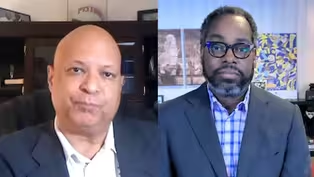
Video has Closed Captions
Clip: S49 Ep2 | 9m 22s | Remembering 2020 | Episode 4902/Segment 1 (9m 22s)
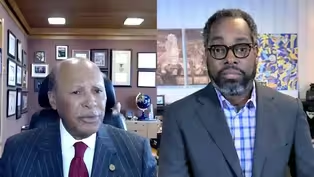
Video has Closed Captions
Clip: S49 Ep2 | 10m 36s | University of Detroit Mercy | Episode 4902/Segment 2 (10m 36s)
Providing Support for PBS.org
Learn Moreabout PBS online sponsorship
- News and Public Affairs

Top journalists deliver compelling original analysis of the hour's headlines.

- News and Public Affairs

FRONTLINE is investigative journalism that questions, explains and changes our world.












Support for PBS provided by:
American Black Journal is a local public television program presented by Detroit PBS