State of Affairs with Steve Adubato
Simmons; Wilson; Williams; Sanders
Season 5 Episode 30 | 28m 19sVideo has Closed Captions
Simmons; Wilson; Williams; Sanders
Maisha Simmons talks about how COVID exacerbated the racial disparities in healthcare; Catherine Wilson discusses the importance of supporting families from Afghanistan who are transitioning to life in the U.S; Diane Williams shares the impact of the pandemic on domestic violence; Dr. Elaine Sanders talks about the ways people can help to combat food insecurity across the state.
Problems playing video? | Closed Captioning Feedback
Problems playing video? | Closed Captioning Feedback
State of Affairs with Steve Adubato is a local public television program presented by NJ PBS
State of Affairs with Steve Adubato
Simmons; Wilson; Williams; Sanders
Season 5 Episode 30 | 28m 19sVideo has Closed Captions
Maisha Simmons talks about how COVID exacerbated the racial disparities in healthcare; Catherine Wilson discusses the importance of supporting families from Afghanistan who are transitioning to life in the U.S; Diane Williams shares the impact of the pandemic on domestic violence; Dr. Elaine Sanders talks about the ways people can help to combat food insecurity across the state.
Problems playing video? | Closed Captioning Feedback
How to Watch State of Affairs with Steve Adubato
State of Affairs with Steve Adubato is available to stream on pbs.org and the free PBS App, available on iPhone, Apple TV, Android TV, Android smartphones, Amazon Fire TV, Amazon Fire Tablet, Roku, Samsung Smart TV, and Vizio.
Providing Support for PBS.org
Learn Moreabout PBS online sponsorship- [Narrator] Funding for this edition of State of Affairs with Steve Adubato has been provided by RWJBarnabas Health.
The Healthcare Foundation of New Jersey.
Berkeley College.
Celebrating more than 90 years of preparing students for lifelong careers.
Bank of America.
The North Ward Center.
MD Advantage Insurance Company.
Fedway Associates, Inc.
The Adler Aphasia Center.
And by The Fidelco Group.
Promotional support provided by Insider NJ.
And by AM970 The Answer.
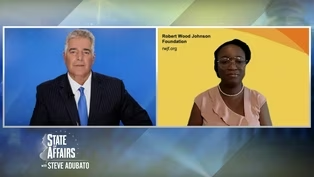
[INSPRATIONAL MUSIC] - Hi, I'm Steve Adubato a compelling, important conversation about our healthcare, the healthcare of those who are most vulnerable in our community, in our society, we have Maisha Simmons, who's Director of New Jersey grantmaking at the Robert Wood Johnson Foundation.
Thank you so much for joining us.
- Thank you so much for having me, Steve, and I'm so happy to share with you and your audience about what the Robert Wood Johnson Foundation is doing to achieve a future where all New Jersey residents can be the healthiest that they can be.
- Why is that so challenging for so many, particularly people of color, Miasha.
- You know, Steve, historically, we've seen that black and brown people in this country hadn't received adequate healthcare, and adequate access to other systems.
So at the Robert Wood Johnson Foundation, we have a commitment to building a culture of health, where everyone in America can live their healthiest life possible.
But in particular, our work in New Jersey is focused on a statewide approach to policy and systems change to ensure that practices and policies are put in place so that we can experience full healthy lives.
- Well, first of all, I wanna make it clear that the Robert Wood Johnson Foundation supports a whole range of New Jersey-based organizations.
They support our health care program, our public awareness program, and one of the areas I wanna talk about specifically, is the impact of COVID in terms of exacerbating the problems and the challenges you just described.
- You know, COVID is a pandemic that we're still dealing with, and with this global implications and national implications, there's a lot of systems that were stressed, but in particular, our public health system, the system that's designed to mitigate disease and inform the public about healthy choices that they can make, it was particularly stressed.
And the reason is that all across the country, and even in New Jersey, we've seen disinvestment from our public health system.
So now, we are actually thinking about what does it mean to have a robust and stable public health system that supports the needs of people in their context in their communities.
I'll give you an example and it's widely known, but it really stresses this fact, back when testing was available, testing sites popped up all across the state, but you had to have a car to get to those testing sites.
Later, we recognized that that misstep and we centered testing sites and community.
Well, what would have happened if we would have started with what the community needs were first, and really put those test sites in the context of the place where people who were experiencing the highest amounts of COVID and services that they needed early.
That's the types of shifts that we're thinking about we could have in a much more robust and stable public health infrastructure.
- Maisha, I'm gonna follow up on this point.
Vaccine hesitancy, resistance in the African-American and Latino community, but more on the African-American community, A, the reasons behind it, B, what do we need to do to get it to where it needs to be?
- You know, Steve, historically, there's been mistrust in African-Americans about our health systems and public health systems.
And that comes from years of structural racism and practices that did not favor our communities.
And so, this pandemic struck, there was a lot of misinformation, and our communities do not have the time to really think, and, you know, they really wanna understand what is relevant for them.
So vaccine hesitancy is really real, but there are ways that we can work in partnerships with our communities to mitigate that fact.
And I'll give you an example, right now, we have a grantee, a wonderful grantee, that's partnering with the department of health in New Jersey and community-based organizations.
Those community-based organizations are trusted, they're members of the communities, they're going out into the community, sharing relevant information, taking the time to have folks understand what these vaccines are about, how they can impact them and their families.
And also, with those conversations, they're also partnered with the department of health to actually administer the vaccines.
So it's just time, it doesn't mean that folks won't get vaccinated eventually, but we need to work in our communities diligently to make sure they have the right information to make the right choices for them in their family.
- You told our producer, "As a black mother, I'm disheartened to know that another mom like me in New Jersey is seven times more likely than a white mother to die from maternity-related complications.
Not to mention the situation for African-American babies, three more times likely than white babies to die before their first birthday."
Those numbers have remained constant, why are we not making more progress?
- You know, Steve it's not a silver bullet answer to this question, but I would say we're not making progress because we're not listening.
We need to listen to our mothers and what they need and require while they're in the stage of birthing.
When I was having my son, I was very excited, and very nervous, but I didn't have all the information I needed, and I trusted my doctor who could help me navigate the system.
And there were times where I even was having challenges, but my doctor could advocate for me.
Every mom doesn't have that as a resource.
So trusting folks like Doulas, and people to come in with them and be a part of the birthing process is important.
But we can't just think about what happens in a medical system, it's also the community context.
It's when you bring that baby home, and being able to have a home visit by a trusted practitioner who is culturally competent and understands the needs of you and your family.
It's about me having access to fresh foods, and nutritious foods, if you can't afford them through programs like supports through the WIC and SNAP program, where babies and moms can have the most nutritious foods are possible.
It's about transportation, Steve, being able to get to those first critical doctor's appointments.
So it's a series of wraparound services that we need to make sure that moms and new families have when they bring their babies home.
- Complex stuff, and people think there are simple answers just may not understand how challenging it is.
Maisha, I wanna thank you so much for joining us and also thank you and your colleagues at the Robert Wood Johnson Foundation for the work you're doing, thank you, Maisha.
- Thank you, Steve, it's been a pleasure to be with you today.
- Right back at you, Steve Adubato, we right back.
(grand music) - [Announcer] To watch more State of Affairs with Steve Adubato, find us online and follow us on social media.
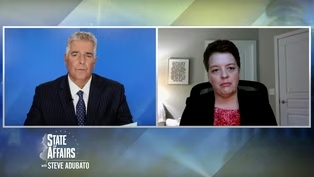
- We're now joined by Catherine Wilson, President and CEO United Way of Greater Newark.
Good to see a Katherine.
- Thank you, thanks for having me.
- Catherine, we're gonna put up the website for the United Way right now.
Tell us exactly what the commitment is of the United Way and the Greater Newark community.
- Our commitment Steve to the community is to disrupt the cycle of poverty.
And we do that by focusing on education, health, and financial stability for our residents in the Greater Newark area.
So that includes Newark along with 12 other surrounding municipalities.
- As you do this program in the fall of 2021, how much worse is it for those that you are serving because of COVID?
- I think it's way worse than it's ever been, I think that we have seen the impact of COVID on the economic stability, along with the health of our residents.
It's unprecedented, we've never seen this kind of need, we've never seen bread lines that long in our food pantries, people who've never utilized a food pantry are now consistently utilizing food pantries.
The impact of COVID of course, on people's health, you know.
- Physical and mental health.
- Their mental health, their physical health.
I actually have a friend who lives in Newark, from Newark.
She lost 30 people to COVID.
That is, you know, just a mind boggling number.
- 30 people in her life she lost?
- In her life to COVID, yes.
So I think it just illustrates the health disparities that we knew existed in cities like Newark.
It's just exacerbated by COVID.
And people are suffering from the mental health, the economic aspect, along with our kids of course, having spent at least a year out of school and trying to learn from home on computers, et cetera.
It's been a challenging time I think for everyone.
- Complicated, even more with Hurricane Ida.
Hurricane Ida's impact on the people you serve at the United Way of Greater Newark, what has it been, and what will it be moving forward?
- I think the impact of Ida again, exacerbated an existing need in the community.
If we start with our undocumented neighbors, typically that we find in the east, in the west and the north wards of Newark already reeling from the impacts of COVID, many of whom will not be eligible to receive FEMA assistance, many who lost apartments, the contents of their apartments, their clothing, their food, et cetera, displaced from their homes.
This is a huge issue and I think it's important to remember that again, many of the assistance programs that benefit others may not necessarily benefit our undocumented neighbors.
In addition, you know, our residents, again, lost cars, the ability to travel to and from work, right?
Again, being displaced with an already existing eviction crisis.
We keep hearing about the coming eviction crisis.
The eviction crisis is here.
- It's very real.
- And so it just exacerbated that issue as well with the lack of housing inventory.
- So let's talk exacerbating of-- the exacerbation of problems, families from Afghanistan who come to certain communities and Newark is one of them, the Greater Newark area is an area where many people from Afghanistan who were fortunate enough to get out are here, and they're coming here.
What will that mean in terms of the needs of people and the work of the United Way?
- I think for us, you know, we have a motto that we live by, that we fight for the education, the health and the financial stability of every person in every community.
And I think folding in the Afghan refugees is part of our work and serving those who may have greater needs right now they have not yet resettled in Newark, they are currently settled at Fort Dix.
They will be resettled of course, throughout the country.
And I think that you will see every United Way across the country try to support the new Afghan residents.
And I think what's important to remember is that they will be Americans just as we are Americans and they will need our support, just like our other residents need our support.
- Documented or not?
- I think documented or not they're here, right?
And so they still-- their children need to eat, they still need to be educated and so, you know, without taking a political side, we still recognize that they are human and they still have needs.
- By the way, when Catherine makes reference to Fort Dix, right?
And actually it was an interview with a Congressman down in that area, Andy Kim, that Briana Vannozzi did on Spotlight, NJ Spotlight News.
And what she talked about, I believe the number, Elvin, if you know this, who knows that show very well, it was 11,000 Afghan refugees are there and they will be spread around this state very soon.
So that's the point that Catherine is making.
Catherine final words, how hopeful are you about the people you are serving every day that their lives will get just a little bit better over the next several months?
- I'm hopeful as we see vaccine rates go up and we see COVID numbers go down, that we will begin to see.
- As we do this program September 28th, 2021, go ahead changing all the time.
- And to see those COVID numbers go down, I think what you'll see is a shift in economic recovery, you're starting to see a shift in philanthropy moving towards economic recovery.
And I think as the closer we get to that, the sooner we get to that, I think people can have hope that life will begin to not return to normal.
I don't think many people wanna go back to that normal I think we wanna create a better normal, a better future and I think that that's what we're looking forward to.
- And that's what the United Way does every day.
Catherine Wilson, President and CEO of United Way of Greater Newark.
Catherine, thank you so much and particularly to the work of the United Way, with you and your colleagues.
Thank you for the work you do.
- Thank you.
- I'm Steve Adubato stay with us we'll be right back.
(grand music) - [Announcer] To watch more State of Affairs with Steve Adubato, find us online and follow us on social media.
- We are honored to be joined by Diane Williams, President and CEO of JBWS.
Good to see you, Diane.
- Good to see you too, Steve.
So happy to be here.
It's really a privilege.
- Well, it's our honor and we're going to put up the website of JBWS so that people understand who you are, what you do and why it matters so much.
The hotline, the 24 hour hotline, the website, et cetera, JBWS, the acronym, there's something to it.
Please share.
- Absolutely.
So we're actually celebrating our 45th anniversary this year.
And for many years, we were known as Jersey Battered Women's Services.
And around 2017, it really dawned on us that as an organization we were not only cutting out an entire segment of the population by using the term women in our title, but also to, you know, the term battered.
So when people think about battered, they really only think about physical violence, and domestic violence is so much more than that.
It's emotional, it's financial, it's verbal.
And so when we wanted to ensure that our services were open and inviting to all genders, we decided to shorten it to JBWS and stick a tagline on there, that safety support and solutions for abuse for all.
- And doing incredibly important work.
And as the website is up there, the hotline is up there to those of you who are experiencing domestic violence, experiencing a situation that is unbearable.
That is an important resource, and we want to provide that information to people so they'd go to the website.
Diane, how much worse has the, as we do this program going into October of 2021, how much worse is the situation, particularly because of COVID?
- Wow.
You know, they really called domestic violence, the pandemic within the pandemic.
And it was so frightening, especially immediately when the pandemic became such a real thing for all of us.
Because all of the hotlines stopped ringing, the domestic violence hotlines across the nation stopped ringing, and we knew domestic violence didn't go away.
But what happened is people were under 24/7 surveillance.
They didn't have space, they didn't have the ability to have any privacy or confidentiality to reach out for help.
So for us, that was a really, really scary time, and we knew we had to quadruple our efforts to get out there and let people know that, you know, we were still open, our shelter and our 24/7 hotline were still available in taking in victims that needed safe shelter.
- So people were trapped even more so than when they were trapped pre-pandemic.
Gun sales have gone up.
Alcohol consumption has gone up.
I mean, what an incredibly, difficult is not the right word, harrowing experience for these men and some women, excuse me, women and some men.
When people call the hotline, what happens, so that people understand?
Because I don't want to make it sound like we're solving a problem that's longstanding and complex.
What happens when you call the hotline?
- So, so many things.
So we actually call it a helpline.
- Helpline, I apologize.
- No, no worries, you know, because not all people when they call our helpline are looking to leave the situation that they're in.
You know, they're looking for support, they're looking for information, or they're calling about someone that they care about, or concerned about.
And so really it's an opportunity for someone on the other side to listen and provide resources and support, so that at some point, if somebody wants to leave an unhealthy or unsafe relationship, they know the safest way to do so.
And, you know, what sort of resources there are in their community to be able to do that.
- I have a police question in my mind that I'll get to in a second in terms of whether police are more sensitive, aware, and helpful than in the past.
But the other question is about dating abuse.
One third of high school students in a recent study, one third of high school students, have been involved in a abusive dating relationship.
Talk about it.
- Yeah, that's scary.
You know, just as a parent myself of a 14 year old daughter, those statistics are incredibly scary.
And what happens is, you know, so many things out there in the media or on social media, really glamorized sometimes what dating abuse looks like.
You know, intense jealousy can sometimes feel flattering at first or, you know, somebody won't think twice when someone picks up your phone and goes through it and starts asking questions about who you're talking to, or, you know, sends you a hundred messages in an hour.
That really, it's so important in regards to, you know, getting to people when they're young to talk about what healthy dating relationships looks like, so that maybe we can stop the cycle of violence from continuing.
And that's actually, you know, one of the programs that we have at JBWS is teen dating abuse prevention.
And so we are in the universities, we're in the high schools, the middle schools, and we're going out more talking about what warning signs are in an unhealthy relationship and what you can do as either an upstander, bystander, or if you think that you might be in an unhealthy relationship, what can you do?
And so that's such an important part of the work that we do.
- And if someone goes on the website, they can find out as someone who sees it, observes it, thinks it's a real problem and wants to be helpful, but doesn't want to exacerbate the problem or someone who's in that situation, you have professionals to help them through this, correct?
- Absolutely.
You know, I think the times of just not getting involved in what's going on need to be over.
And domestic violence just grows in isolation because all of the shame and the stigma that is attached to being a victim and people don't understand that victims, they look like you and I, Steve, you know, it cuts across all socioeconomic lines, ethnicities, religions, races, and we just need to, if we see something, say something.
And be a support.
Don't be judgmental or labeling.
You know, be a good listener.
Know what the resources are in your community, so that if you have some concerns about someone that you care about, you'll be able to direct them to some professionals that can help.
- Diane Williams is President and CEO of JBWS.
Thank you so much for the work that you and your colleagues do everyday.
Use that helpline, please folks.
Hey Diane, thank you so much.
You honor us.
- Thanks so much, Steve, - I'm Steve Adubato, stay with us, we'll be right back.
(grand music) - [Announcer] To watch more State of Affairs with Steve Adubato, find us online and follow us on social media.
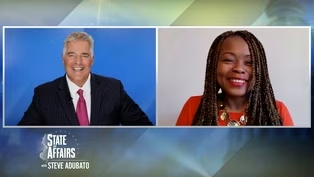
- We're now joined by Dr. Elaine Sanders, Director of Workforce Development at the Community FoodBank of New Jersey.
Dr. Sanders, great to see you.
- Thank you, great.
Thank you for having me.
- We're gonna have the website up for the Community FoodBank of New Jersey for people who wanna find out more and help more.
Doctor, put this in perspective.
I've been familiar with the Food Service Training Academy for years, but I want other folks to know what it is and why it is so important.
- Well, the Food Service Training Academy is a 14-week program, where we teach our students culinary, bulk production, baking, and essential skills.
The essential skills part of our program is a hybrid model, so we're teaching our students how to learn on platforms, such as Zoom, such as Google Meets, Google Classroom, Teams, so that they're ready for the real world once they finished with our training academy.
And as you know, they say, if you give a man a fish, you feed him for a day, but if you teach a man to fish, you feed them for a lifetime.
- Dr. Sanders, tell us exactly who these students are, which is very significant.
- Our students are New Jerseyans who are underserved, that are looking for opportunities to better their lives.
So whether that's a second career due to a job loss, maybe re-entry students.
So our students, we have a plethora of where our students come from.
- When you say re-entry, you're referring to people who were previously incarcerated?
- Absolutely.
- Okay, and tell folks why that matters so much.
- I got to say we root for the underdog.
Many times they feel like they're forgotten or they don't have the ability to have another chance.
So sometimes as we know, we've passed the second chance, but they have the ability to have another chance.
And we at the Community FoodBank believe in that, so we train our students that they are marketable to enter into the workplace.
- And when they graduate, doctor, they're actually in a position to gain college credits?
- Absolutely.
So with the ServSafe Certification, which is a nationally recognized credential, once our students complete the program, they can take that to the community college and use that as a two credit, depending on what the college sees is worth.
And they've started with college credits because of that ServSafe Certification.
- Everyone, our nonprofit, you're a nonprofit, affected, impacted, we've had to pivot all kinds of things, which is obviously why we're not in a studio together because of COVID.
How has the Food Service Training Academy been impacted because of COVID?
- Well, due to COVID, we ended up last year serving over 85 million meals, due to COVID.
So that to me is- - How?
How?
(Elaine laughs) - With dedicated staff and students, because a part of our bulk production, our students were a part of helping to prepare those meals for seniors, prepare those meals for children, youth, so our kids cafe.
So it's very vital.
So they also understand the give back portion of what we do with the Food Service Training Academy.
- How'd you get it out?
How did you get it distributed?
- Well, we had truckloads.
We had just volunteers coming in to help, to get it done.
- So I said at the beginning of this segment, Dr. Sanders, that we're gonna put up the website for the Community FoodBank of New Jersey.
We've been trying to promote public awareness around food insecurity, hunger issues for years.
What exactly could people do?
They go on the website, they want to be helpful.
Be specific, what does that mean?
- That means donate, which is very helpful.
$1 provides three meals, so we definitely would ask for people to donate to the community.
- $1, three meals.
- $1, Steve, will provide three meals.
- So they can donate, what else?
- They can volunteer, as we talked about, our volunteers were a big part of getting the food out to those that are in need during this time.
And we're still in the pandemic, so we're still producing meals.
- Yeah, one to 10, how rewarding is your work?
- A 12.
(Steve laughs) Because?
- I love what I do.
I love who I do it with, and I understand the purpose and the mission, which is neighbors need and network.
That's how we get it done.
- Yeah.
That is Dr. Elaine Sanders.
Everybody should be at 12 on a scale from one to 10 for job satisfaction.
Dr. Elaine Sanders is Director of Workforce Development at the Community FoodBank of New Jersey.
Check them out.
They're doing important work and they need help.
Thank you doctor so much.
- Thank you, Steve, for having me.
- You got it.
And thank you so much for watching and we'll see you next time.
- [Narrator] State of Affairs with Steve Adubato Is a production of the Caucus Educational Corporation.
Funding has been provided by RWJBarnabas Health.
The Healthcare Foundation of New Jersey.
Berkeley College.
Bank of America.
The North Ward Center.
MD Advantage Insurance Company.
Fedway Associates, Inc.
The Adler Aphasia Center.
And by The Fidelco Group.
Promotional support provided by Insider NJ.
And by AM970 The Answer.
- Hi, I'm Abbie.
You might see me as an ordinary person, but I've been living with a brain injury since 2018.
Opportunity Project gave me hope and I've gained confidence through job skill training and helping my family.
Despite my challenges with memory, I see a possibility to keep improving.
- [Narrator] If you have a brain injury, you don't have to face your road to recovery alone.
Learn more about Opportunity Project and its partnership with Children's Specialized Hospital.
Community FoodBank of NJ's Food Service Training Academy
Video has Closed Captions
Clip: S5 Ep30 | 6m 17s | Community FoodBank of NJ's Food Service Training Academy (6m 17s)
Helping Newark Families Impacted by COVID and Hurricane Ida
Video has Closed Captions
Clip: S5 Ep30 | 8m 5s | Helping Newark Families Impacted by COVID and Hurricane Ida (8m 5s)
How COVID Exacerbated Racial Disparities in Healthcare
Video has Closed Captions
Clip: S5 Ep30 | 7m 43s | How COVID Exacerbated Racial Disparities in Healthcare (7m 43s)
The Impact of the Pandemic on Domestic Violence
Video has Closed Captions
Clip: S5 Ep30 | 8m 22s | The Impact of the Pandemic on Domestic Violence (8m 22s)
Providing Support for PBS.org
Learn Moreabout PBS online sponsorship
- News and Public Affairs

Top journalists deliver compelling original analysis of the hour's headlines.

- News and Public Affairs

FRONTLINE is investigative journalism that questions, explains and changes our world.












Support for PBS provided by:
State of Affairs with Steve Adubato is a local public television program presented by NJ PBS