
The Port Authority of NY/NJ -Embracing Diversity & Inclusion
Season 3 Episode 310 | 26m 46sVideo has Closed Captions
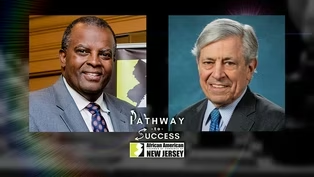
Rick Cotton talks about the Port Authority of NY/NJ and embracing Diversity & Inclusion.
John E. Harmon, Sr., Founder, Pres. & CEO of the African American Chamber of Commerce speaks with Rick Cotton, Exec. Director of the Port Authority of NY/NJ, about his career, socially conscious parents, working for a Supreme Court Justice and how the Port Authority is embracing Diversity & Inclusion. Produced by the AACCNJ, Pathway to Success highlights the African American business community.
Problems playing video? | Closed Captioning Feedback
Problems playing video? | Closed Captioning Feedback
Pathway to Success is a local public television program presented by NJ PBS
The Port Authority of NY/NJ -Embracing Diversity & Inclusion
Season 3 Episode 310 | 26m 46sVideo has Closed Captions
John E. Harmon, Sr., Founder, Pres. & CEO of the African American Chamber of Commerce speaks with Rick Cotton, Exec. Director of the Port Authority of NY/NJ, about his career, socially conscious parents, working for a Supreme Court Justice and how the Port Authority is embracing Diversity & Inclusion. Produced by the AACCNJ, Pathway to Success highlights the African American business community.
Problems playing video? | Closed Captioning Feedback
How to Watch Pathway to Success
Pathway to Success is available to stream on pbs.org and the free PBS App, available on iPhone, Apple TV, Android TV, Android smartphones, Amazon Fire TV, Amazon Fire Tablet, Roku, Samsung Smart TV, and Vizio.
Providing Support for PBS.org
Learn Moreabout PBS online sponsorshipannouncer: Support for this program was provided by Horizon Blue Cross Blue Shield of New Jersey.
PSE&G, proud sponsors of "Pathway to Success."
JCP&L and the African American Chamber of Commerce of New Jersey-- working together to build a stronger community for all.
Investors Bank, banking in your best interest.
Berkeley College-- education drives opportunity.
Be inspired.
NJM Insurance Group.
The New Jersey Economic Development Authority.
[upbeat jazz music] ♪ ♪ - Hello, this is John Harmon, founder, president, and CEO of the African American Chamber of Commerce of New Jersey.
And welcome to "Pathway to Success."
Today's guest is a longtime friend and a supporter of the African American Chamber of Commerce of New Jersey.
He oversees activities in both New York and New Jersey.
I speak no other than Rick Cotton, executive director Port Authority of New York and New Jersey.
Rick, welcome to "Pathway to Success."
- John, delighted to be here.
- You're a man in great demand, and I can't emphasize enough how honored we are to have you here today.
Just a little bit on your background.
Where are you from?
Big family?
Small family?
And then where did you go to school and why?
- Well, I'm from a small family.
I have one brother younger than me.
I grew up on the South Side of Chicago.
Attended Chicago public schools.
My high school was probably 3/4 African American.
I lived in the integrated neighborhood of Hyde Park-Kenwood on the South Side of Chicago.
I was a White Sox fan.
Although I've have to confess I've changed allegiances to the New York Mets.
But I grew up in a family that was very politically active, socially conscious.
My mother was a huge advocate on behalf of women's rights.
In fact, she founded an organization that was dedicated to creating high-quality childcare so that women could work.
And my education, I went-- I left Chicago after high school.
I attended Harvard College and then Yale Law School.
After that, clerked for two judges including Justice William Brennan on the Supreme Court.
- You know, there's some special people from Chicago.
Within our membership we have John Rogers and Mellody Hobson of Ariel Investments.
We have Millhouse Engineering, the largest Black engineering firm in the country.
Infrastructure engineering also out of Chicago.
Luke Capital headed up by Jim Reynolds, and he has a joint venture with Magic Johnson.
I understand they're doing some great work over at JFK.
But the people from Chicago, they get it.
They understand business.
They understand the significance of equity, diversity, inclusion, all that.
And so now, I guess, I appreciate you even more understanding your background.
Just a little bit, you reference clerking for Supreme Court justices.
What is that like?
Just so our viewers get a glimpse of what that might be like.
- Well, it's a very challenging and inspiring experience.
It obviously at the at the top of the judicial system of the United States.
The justices all have extraordinary backgrounds.
I was lucky enough to work for Justice William Brennan.
I revered him.
He was just an extraordinary individual both as a lawyer, as a judge.
I learned from him the importance of both attention to detail, total commitment to trying to find the right answer, but I would also say empathy, which is bringing to the table not dealing with legal issues in a vacuum, but understanding the individuals, the plaintiffs and the defendants but also putting the issue that's on the table in the context of the individuals involved and the social dynamics involved.
Was privileged to have an enormous amount of interchange with the justice as he analyzed cases and came to his conclusion as to how he was going to vote.
- You know, I tell you, there had to be some experience.
You reference empathy and, you know, not overly politicizing decisions.
And I think some of those qualities are innate in your position today.
Let's talk about the Port Authority of New York and New Jersey.
We could start with its mission, and maybe you could speak to globally kind of its capital budget, if you will.
- The Port Authority is a bi-state agency.
You see that in its name.
The Port Authority of New York and New Jersey.
It was created 100 years ago, 1921.
It was created as a self-sustaining agency.
What do I mean by that?
It means that the Port Authority receives no regular funding from the state of New Jersey, no regular funding from the state of New York, no regular funding from the federal government.
All of the Port Authority's revenues are generated from its facilities.
The important thing to remember about the Port Authority's generation of revenue is that we've been successful in getting 2/3 of that revenue from our business partners, from companies where we lease terminal facilities at the port.
We have marine terminal operators.
They're the ones who are responsible for operating the offloading and onloading of cargo on ships, but they pay rent to the Port Authority.
- So all of the burden does not fall on toll payers or fare payers.
What the Port Authority is responsible for is quite wide-ranging.
We operate the three major airports in the region, Newark Liberty Airport, JFK, LaGuardia.
We operate four bridges, including the busiest bridge in the world, the George Washington Bridge, but the three bridges also that run from Staten Island to New Jersey and the two tunnels.
We operate the PATH commuter train operation, and we operate-- we're the landlord at the World Trade Center.
And all of those facilities are what we bring to the table in terms of operating the transportation infrastructure for which we're responsible.
- How many employees do you have there today?
- Our head count is roughly 7,500 employees.
- And so with that number of people and your customers being commuters, folks who travel over the bridges and the tunnels, et cetera, how do you go about-- you and the 7,500 employees there, go about establishing the priorities in terms of which projects get green lighted, which projects should we be planning for, how do we engage the community?
- As we think about the agenda of the Port Authority, we've said it has really six priorities, which is how we think about it.
One is safety and security.
Has to be at the top of the list in terms of ensuring that people who use our facilities as well as our employees are secure and safe.
Secondly, our capital plan.
In over a ten-year period, the Port Authority is operating in terms of delivering $37 billion worth of construction in terms of either building new facilities, investing in new facilities, or making sure that our existing facilities are in a state of good repair.
Our third priority is customer experience.
You referenced our customers.
All the travelers.
We've tried to put in as much focus as we can in ensuring that the way we operate our facilities provides as good a customer experience as we possibly can.
Operational excellence.
We really do try to make sure that all of our facilities are operating as top quality as we possibly can.
Sustainability.
We are enormously aware of our responsibility in terms of climate change to try to reduce our carbon footprint and try to ensure that we are as good an environmental citizen as possible.
And finally, our sixth priority is employer of choice.
Comes back to the 7,500 employees.
We want them to have a positive work experience.
Because in turn workers that are having a positive work experience are productive workers and motivated to do as good a job as possible.
So broadly, that's how we think of our agenda.
And all of that is try to assure that we discharge our responsibility to operate these critical transportation facilities as well as we possibly can.
- How many representatives do you have on the board?
50/50?
How does that process play out in terms of priorities?
I'm just curious.
- Well, that's exactly right, John.
It is 50/50.
The board of commissioners of the Port Authority has 12 members.
Six are appointed by the governor of New Jersey.
Six are appointed by the governor of New York.
And the tradition is that the governor of New York designates the executive director, which is my position.
And the governor of New Jersey designates the chair of the board, who currently is Kevin O'Toole.
- No, I think that on paper, that sounds like a fair, fair process.
We'll take our break here on "Pathway to Success."
I'm really enjoying the chat with Rick Cotton today, and we'll be back in a moment.
- We encourage you to visit our website at www.accnj.com or call us at 609-571-1620.
We are your strategic partners for success.
- Welcome back to "Pathway to Success."
I'm joined here today by Rick Cotton, executive director of the Port Authority of New York and New Jersey.
And from the first time I met Rick several years ago, he confirmed today why he and I kind of got in alignment as it relates to the mission of the African American Chamber of Commerce in his upbringing in Chicago.
So I see now that there's a nexus there, but it's important that you have some understanding as it relates to diversity, equity, inclusion from life experience, if you will, from an empathetic perspective.
But moreover, this is not about charity.
This is about business.
This is about positioning men and women for opportunities for mutual benefit.
The state of New Jersey as a result of bringing those perspectives together can produce a more competitive, viable environment in our great state.
So, Rick, that said, can you speak to some of the current projects in New Jersey that the Port Authority has underway or plan to do in the coming years?
- Definitely can speak to that.
We have at Newark Liberty Airport, a multibillion-dollar ambition in terms of updating the entire airport-- right now, our primary construction project.
And it's a $2.7 billion investment.
It is the largest project that the Port Authority has done in New Jersey.
It is a brand new Terminal A.
So the new Terminal A at Newark will be extraordinary.
It will be 21st century.
It will be world class.
I can't wait until we're in a position to open it.
The other major project from the point of view of New Jersey bus commuters is the new Port Authority Bus Terminal.
Again, this is--while it's situated in Manhattan, it is a cornerstone of the New Jersey commuting public.
This facility is going to be a $7.5 billion to $10 billion challenge.
I would cite those as the two biggest investments, but obviously take the George Washington Bridge.
We are in the midst of a $2 billion-- 2 billion with a B.
A total restoration project for that bridge.
It is 90 years old, and we're committed to making it a bridge that will serve New Jersey and New York for another 90 to 100 years.
- Well, you mentioned just a couple projects between, say, 12 and $15 billion right there.
And there's a number of additional projects.
But as I think about the state of New Jersey, home of 1.2 million Blacks, over 80,000 Black businesses, and we have the highest poverty, the highest unemployment here in the state.
Our net worth is about $5,900 versus 315,000 for whites.
My question as it relates to establishing the agenda, as it relates to diversity, equity, and inclusion, you guys look at those numbers that I just mentioned.
How can we transform them in an impactful way?
What's the thought process related to that?
- Well, you have to start with the thought process of making diversity and inclusion a top focus at the agency.
I've discussed our priorities in terms of discharging the agency's responsibilities in terms of keeping the region moving and transportation assets.
But we also have a set of values and a set of standards.
And the first two of those, number one, integrity, and number two, diversity and inclusion.
So we have made diversity and inclusion right at the top of the agenda.
And that flows through in a number of different ways.
In terms of these major construction projects and our $37-billion capital plan, we are completely focused on creating opportunities for minority- and women-owned businesses.
We have set what is really as far as I'm aware, the highest goal in the nation in terms of having 30% of the contracting opportunities in those projects go to minority- and women-owned businesses.
And that takes a lot of focus in order to assure that happens.
First of all, when we contract with people to operate or to carry out our capital projects, we have to make clear to them that we expect the subcontracting process, which they run to have the same goal, which is the 30% of their subcontracts.
And I'll give you two figures quickly, John.
One is in terms of the Newark Airport project that I mentioned.
More than $500 million worth of contracting opportunities have gone to minority- and women-owned businesses.
And $400 million of contracting opportunities have gone to local, New-Jersey-based businesses.
And that's really-- hitting those numbers is only possible through this combination, trying to be sure that there's an outreach program, there's a support program, and there's an informational program to assure that we get minority- and women-owned businesses to engage and take up those opportunities.
- So now, that's very good information.
I'm thinking about a conversation I had recently with a few of our members that are part of a team that was awarded a restaurant opportunity in Terminal A.
They're very excited about that.
That speaks to, you know, the Chamber connecting its members with resources to bring forth a desired objective.
And so that's very encouraging.
Since you've been at the helm, can you speak to how you, through your leadership, have gotten the Port Authority in a better place with getting more minorities and women on these projects, notwithstanding some of the inherent obstacles?
- First of all, it's been very intentional.
One of the first things we did was to appoint the first chief diversity and inclusion officer in the Port Authority history.
But we've tried to build an entire part of the organization, which is focused on this agenda.
And what's come out of that have been many initiatives.
There's a mentor-mentee program.
There's what we call a Principals Academy, which brings in smaller businesses, which feel they would benefit from perhaps getting some insight in terms of how to build a finance organization that can deal with the requirements that the Port Authority as a public agency asks its contractors to carry out.
And across all of the challenges, we've tried to provide resources either through training.
We've brought in, for example, in terms of concessionaires at our airports, an actual couple of day-long training sessions where businesses, restaurants... other food and beverage retailers in the New Jersey, New York area who aspire to be in the airports, who aspire to be at the bus terminal, who aspire to be at the Journal Square PATH Station.
We try to assure that they have resources which if they feel they need them, again, to deal with these barriers that you've just mentioned, John.
- Well, I can tell you, I've been in a number of your workshops firsthand and the intentionality is there.
Just a few more questions, and we're bringing today's conversation home.
Your thoughts about the mission of the African American Chamber of Commerce of New Jersey.
- The Chamber of Commerce could give us feedback, feedback from your members, feedback that you personally have observed.
Obviously, you're very active in many different forums.
We're aware of that, but I think that's really what we're looking for, which is give us challenges.
How can we--how can we make the Port Authority easier for minority- and women-owned businesses to deal with?
How can outreach be better?
How can information flow be better?
- We really cherish the relationship, because it's so important to many of the businesses here in New Jersey.
So my last question as it relates to the Gateway Project.
Your thoughts about that.
And is there any involvement from the Port Authority in that particular project, if it should come to fruition?
- Well, the Gateway Project is probably the most important infrastructure project in the country.
What the Port Authority has done has been to commit $2.7 billion worth of payments over the next period of time to support the capital spending required by the local partners.
We've also tried to be supportive in terms of potential services that we might provide to Gateway.
But the fundamental responsibility for Gateway lies with the Gateway Development Commission.
And I'm certainly optimistic given the support that the Biden administration has indicated for that project that it will obtain the funding that it needs.
So big picture, double the capacity to carry the trains going up and down the Northeast corridor.
The Tunnel Project is that section.
It's probably the most complicated section of that construction ambition with respect to the Northeast corridor.
But what it represents is build two new tunnels, rehabilitate the other two tunnels, and have that portion of the Northeast corridor brought up to 21st century standards.
- A massive undertaking.
So, Rick, I just want to thank you for joining us today.
And for those of you who've tuned in until the next time on your pathway to success, this is John Harmon, founder, president, and CEO of the African American Chamber of Commerce of New Jersey.
Thank you.
[jazz music] Today's message is all about the pathway to success.
We're about to conclude our third season.
Very excited.
And the show is all about the challenges, the partnerships, the opportunities as it relates to Black people in New Jersey.
You've heard from businesses and the industries that they represent, all of which they've stepped up to the plate and knocked the cover off the ball.
You've heard of leaders of major agencies who put forth opportunities.
For us, it's about awareness, it's about relevance, it's about the value proposition.
And we say, if we can leverage those three individual situations, if you will, with intentionality to ensure that Black people who have the wherewithal to compete, have the wherewithal to provide excellence in their products in their service, New Jersey wins.
It's not about Black people versus white people.
It's about New Jersey.
It's about New Jersey being the best it can be.
Please continue to support the African American Chamber of Commerce in this effort, because by doing so, we all win.
Thank you.
♪ ♪ announcer: Support for this program was provided by Horizon Blue Cross Blue Shield of New Jersey, PSE&G, JCP&L, Investors Bank, Berkeley College, NJM Insurance Group, the New Jersey Economic Development Authority.
The Port Authority of NY/NJ -Embracing Diversity & Inclusion
Video has Closed Captions
Preview: S3 Ep310 | 30s | Rick Cotton talks about the Port Authority of NY/NJ and embracing Diversity & Inclusion. (30s)
Providing Support for PBS.org
Learn Moreabout PBS online sponsorship
- News and Public Affairs

Top journalists deliver compelling original analysis of the hour's headlines.

- News and Public Affairs

FRONTLINE is investigative journalism that questions, explains and changes our world.












Support for PBS provided by:
Pathway to Success is a local public television program presented by NJ PBS