Utah Insight
The State of Utah's COVID Vaccines
Season 2 Episode 2 | 26m 47sVideo has Closed Captions
Two months after Utah offered COVID-19 vaccines to all adults, how are we doing so far?
In late March, Utah became one of the first states to open up COVID-19 vaccinations to all adults 16 and older. Two months later, how are we doing on the path to herd immunity? And are we reaching the communities most impacted by the pandemic? Health experts discuss Utah’s path forward and evaluate the state’s response to the global pandemic.
Problems playing video? | Closed Captioning Feedback
Problems playing video? | Closed Captioning Feedback
Utah Insight is a local public television program presented by PBS Utah
Utah Insight
The State of Utah's COVID Vaccines
Season 2 Episode 2 | 26m 47sVideo has Closed Captions
In late March, Utah became one of the first states to open up COVID-19 vaccinations to all adults 16 and older. Two months later, how are we doing on the path to herd immunity? And are we reaching the communities most impacted by the pandemic? Health experts discuss Utah’s path forward and evaluate the state’s response to the global pandemic.
Problems playing video? | Closed Captioning Feedback
How to Watch Utah Insight
Utah Insight is available to stream on pbs.org and the free PBS App, available on iPhone, Apple TV, Android TV, Android smartphones, Amazon Fire TV, Amazon Fire Tablet, Roku, Samsung Smart TV, and Vizio.
All Episodes Now Streaming
Hosted by Jason Perry, each week’s guests feature Utah’s top journalists, lawmakers and policy experts.Providing Support for PBS.org
Learn Moreabout PBS online sponsorship(upbeat jingle) - [Announcer] Funding for Utah Insight, is made possible by viewers like you.
Thank you.
- [Raeann] Tonight on Utah Insight, the fight against the Corona virus.
Months after offering COVID-19 vaccines to all adults, are people choosing to get the shots?
- We're hoping we get more Pacific Islanders out there to please come out and vaccinate.
We just wanna be able to vaccinate our community.
- [Raeann] Plus, are we reaching the communities most impacted by the pandemic?
Health experts join us to talk about Utah's path forward.
(upbeat music) - Welcome to Utah Insight.
I'm Raeann Christensen.
Are enough people getting vaccinated to finally put this pandemic behind us?
According to WHO, the world health organization it's not yet known how much of the population must be vaccinated against COVID-19 to reach herd immunity.
WHO says, "It varies with each disease.
"And for example, herd immunity against measles "requires about 95% of the population to be vaccinated.
"For polio, the threshold is 80%."
In Utah, about 37% of people are fully vaccinated against Corona virus.
Again, what percentage we have to reach to get to herd immunity is not yet known.
Now joining us to talk about vaccinations and moving forward, Dr. Michelle Hofmann, the deputy director for the Utah Department of Health.
And joining us by Skype, Byron Clarke, the chief operations officer with the Utah Navajo Health System.
And Dr. Andrew Pavia an infectious disease specialist with the University of Utah.
Thank you all so much for joining us.
Now, I wanna start Dr. Pavia with the broad question, how are we doing?
- In terms of vaccination as a country, we're doing really well.
And if you compare us to what's happening in other nations we're really making great progress.
49% of Americans as of this morning are fully vaccinated.
If we drill down to Utah, we've got ways to go.
We're at about 39% of the population have fully vaccinated, but that doesn't tell the whole story.
And we're doing really well with teenagers.
And we're probably one of the best states in the country, in terms of how our rollout of vaccines to teenagers has gone.
And as Dr. Hofmann would probably wanna talk about, we've got pockets of the community where we're not really reaching people, people of color, some of the rural counties where our vaccine rates are still falling behind.
I've got confidence we're gonna get there though.
- Okay, we will get there actually.
Now, Dr. Hofmann, I wanna talk about children and the vaccine because their time is now for some that are in that 12 range, and then we've got some coming in the future.
How important is it that our children are getting vaccinated?
- Really important.
Every Utahn needs to get vaccinated.
And for children, I think there's some misconceptions out there that they aren't impacted by COVID-19.
And in fact, they are!
We have had nearly 78,000 Utah children, age zero to 18, who have had COVID-19 and almost 700 of them have been hospitalized.
The rates of hospitalization for COVID-19 are equivalent to what we might see over four influenza seasons for children.
And so it is important.
They do suffer the impacts of COVID-19.
And they're also vectors of the disease for others who are more vulnerable.
And, and as Dr Pavia said, we haven't reached levels of vaccination that are optimal to protect all Utahns and children are an important vehicle of protecting the more vulnerable that they're around, their loved ones.
Especially in our communities of color, where we've got intergenerational housing and lots of people living together in small confined spaces, vaccinations are a ticket out of this pandemic.
- Okay.
- It is.
Someone who sees the sickest children, their primary children, it drives me crazy when people say that kids can't get sick, because it's just wrong.
But I think it's really important for parents to realize that for children, the biggest benefit is the ability to return to a normal life.
So protecting them and this disease is really important, but also allowing them to get back to being kids and doing all the things they wanna do.
- Okay, and Byron, the Navajo Nation was hit really hard by COVID-19.
How are you guys doing with your vaccination rates?
Are you reaching out to youth now?
- Yeah, our facility's aspects of Utah side of Navajo Nation.
And right now our rates are looking really, really good for the adult population.
We're approaching the 70% vaccination rate and we hope to improve that slowly, doing more education, more health page to make sure getting above 75 is our goal.
So I think we've really seen a huge turnout for those willing to accept it.
And it's really made a big impact on the number of cases, the number of severe cases and the number of deaths, they've all gone way down.
So it's been really great for us.
- Okay, and we asked you, how has the COVID-19 rollout in Utah been?
What areas could the state improve on as we continue to vaccinate residents?
And Steve Williams on Facebook writes, "I received mine in Utah County.
"It was fast and no hassle, mine was at an old ShopCo.
"Everyone there was awesome.
"I was in and out in 35 minutes, "that's with 15 minutes wait "to see if I would have a reaction."
Dr. Hofmann, what do you want people to know about the availability of the vaccine here in the state?
- Widely available.
You pretty much can walk in anywhere.
You know, we've been through different phases of rolling out vaccinations.
And at a time when we had very limited supply, it was much harder to access, difficult to get the registration and get the appointments and all of that.
We're doing walk-ins everywhere.
It's in small clinic providers, we have over 180 clinic providers already receiving vaccine.
And that's gonna grow.
That's our focus, getting it into the hands of trusted providers, many pharmacies across the state.
The president set a goal that we would have vaccine within five miles of greater than 90% of the population of the U.S. And we exceeded that, we got to 95%.
Vaccine is widely available.
It is easily accessible.
We just need Utahns to go out and get it.
- And do you think that those that are not vaccinated yet are questioning the safety of the vaccines or are they just hesitant still?
- I think there's a combination of factors.
I think a lot of it is convenience.
Just not getting around to it and not feeling a sense of urgency.
That's a large number of people.
We still are seeing really good interest in wanting to become vaccinated.
And so focusing on convenience is a really important part of our strategy to get more vaccinated.
There are a subset who are hesitant, because they're concerned about the vaccine and how rapidly we were able to develop it.
We've vaccinated millions of people and these are safe and effective vaccines.
And sometimes it just takes that one-on-one conversation with a trusted provider.
We expect for children, especially that parents are gonna have questions.
And so we really are preparing to get vaccine into the hands of the people that they trust so that they can administer it right there in those moments where these critical conversations are happening.
- Okay, and Dr.Pavia, are those that are choosing to not get vaccinated, are they keeping us from reaching herd immunity?
- I'd like to sort of back us away from the concept of herd immunity.
It's a squishy concept where we don't know the exact number that we would have to reach.
It's probably pretty close to 90% of the population being vaccinated to really not allow any transmission.
And realistically, we may never get there.
But what we do wanna do is get really high levels of community immunity so that most people are protected, transmission is really limited.
And every single extra person that we vaccinate makes a difference in terms of reducing spread.
We can see that in the numbers already in the us, even though we're nowhere close to herd immunity transmission is dropping.
- Okay, and Byron, how are you guys doing?
Do you think you're getting close to herd immunity by people having it or getting vaccinated?
- Yeah, we get a daily report where we track the number of cases, the number of people who are shipped out.
I keep in close touch with the EMS department.
So, and every peak last year, when the numbers increased you would see a correlation to the number of flights out, life flights, ER, visits, things like that.
And since we've met a high percentage of people vaccinated all of those numbers have really improved.
Sometimes, in some sites, in some communities we don't have any cases for weeks on end.
And then it's no severe illnesses, very few deaths since the vaccine campaign started.
So it's made a huge impact.
Everybody locally, could really see that.
So for us, it's been really a blessing.
- That's really good, no cases for weeks.
Now, Governor Cox, at his news conference last week here on PBS, Utah said he's not worried about moving too quickly to get back to normal.
CDC guidelines changed abruptly and for some it's been confusing.
Here's what he had to say.
- Whether you trust the person next to you or not, I don't care and it doesn't matter if you've been fully vaccinated.
So if you haven't been fully vaccinated then I would be really nervous.
And, I would exercise caution.
If you are worried about you or you are worried about your family, then you absolutely should wear a mask, and no one should judge you for doing that.
- Dr. Pavia, why do you think those people should be, that are choosing not to get vaccinated, why should they be worried?
- Well, they're still at risk of getting sick.
They're still at risk of passing it on.
They're still at risk of dying.
In fact, if you look at the rates of infection among the portion of the population that's not vaccinated, they're not really going down yet.
So we really want everyone to get vaccinated to protect themselves, protect their family, protect their community.
I think what governor Cox was saying last week was a little bit simplistic because the vaccine doesn't work equally well for everybody.
And not only do we have everyone under 12, has no vaccine but there are people for whom there aren't immunosuppressive drugs, They're getting treated for cancer.
And they're not well-protected, even though they got vaccinated.
So, we really do need to look out for our neighbors in our behavior and in our choice to get vaccinated.
- Okay, And on that note, Dr. Hofmann, those that are vaccinated, those are not vaccinated, We've got the debate of to continue mask wearing or not.
Do you think that we should still continue mask wearing?
- Definitely.
We need to swap one for the other, right?
We have very... Masking was the most effective and the least invasive and cheapest public health intervention we could have had for this pandemic.
I did a little evaluation of the different interventions around masks through the pandemic and really, it was the people themselves seeing what was happening not the policies that we made.
The mask uptake went up, as the cases went up and they were seeing this devastation from this disease.
We had policy come at the very end and we got a little bit of a bump, I think enough to get us to start to come down in our cases.
But really, these are the choices we make.
We should be choosing to be vaccinated and until we are we should be choosing to wear a mask to protect both ourselves and our loved ones and the rest of our community.
- Okay, and Dr. Pavia, I know you said that some of the diseases are starting to uptick now, that you've been seeing.
- So we've just seen early data showing that there's an increase in RSV, a disease which we normally never see in the summer.
And it seems to be starting to increase.
There's also increased reports of absenteeism from regular colds.
And I think that's because masks have that added benefit of protecting us from all the other viral diseases.
That's not a terrible thing because most of those diseases are much milder, but it is a sign that people have stopped wearing their masks.
And it's not just the vaccinated people because that should only be 40% of our population.
And yet we're seeing very little mask wearing in some parts of the state.
- Yeah, Byron, how are they doing for mask wearing where you're located?
Are people still wearing masks there?
- Yeah, so we're on the Navajo Nation and for the Navajo nation president analysis has kept the mask mandate and they'll evaluate that.
But for now they view that as a good thing.
And so we'll continue to do that down here.
- Do you, Andrew you wanna add to that?
- Well, I think the Navajo Nation has provided us with a lot of good examples.
They really believe in public health.
The people themselves really believe in looking out for their neighbors.
And so there hasn't been the kind of pushback, I think Byron could probably speak to that, about individual liberty that we've had because there's a real sense of community that some of our communities have forgotten.
- Okay, and Byron, can you speak to that?
The mask wearing everyone's pretty supportive in your area?
- Yeah, for the most part.
I think it's a bit easier for us because the beginning we were hit really hard.
And so the deaths were happening, many in our community lost several family members.
Some of our employees lost one or two parents, or grandparents.
And so when it happens so close to so real there's less dispute about whether or not it's real.
And I think because of that there's more acceptance of the vaccines and more acceptance of evasive and safety precautions because we don't really need to debate it if we lived it.
So that's been in favor for us, so I really do appreciate the community banding together.
And for the most part, we're all united on keeping everybody safe, wearing masks and taking the vaccine.
So it's been a good experience.
- That's good news.
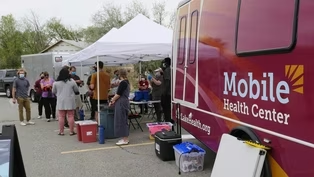
Several local groups launched COVID-19 vaccination clinics throughout Utah, with the goal of protecting minority populations from the virus.
people who are at high risk for COVID-19, but statistically have shown low turnout at vaccination clinics.
Liz Adeola, gives us a unique view of one of those outreach efforts.
- [Liz] Sometimes we're too close to something, it's hard to see the bigger picture.
- I've had family members that just caught it and just couldn't kick it.
I've lost two people from COVID this year, within a two month period.
It's tough and it's sad and crazy.
And hopefully the artwork can help make that hard situation brighter.
To kind of be the light in the dark.
I'll just have a couple yellows and greens just to kind of represent good energy, positive energy.
- [Liz] Because good, positive, and energetic are words most people use to describe the woman in this portrait that Bill Louis is painting, Margarita Satini.
- She gave lots of her time.
Her children knew that, her family members knew that, the community knew that.
And so it only made sense for her to be honored.
- [Liz] Here in the Og-woi Peoples Orchard and Garden, just a few blocks away from the neighborhood where she grew up.
- This is something that they'll never forget.
Not very often do you see Pacific Islanders on a mural?
And so that's special.
- [Liz] Representation was what Margarita stood for, as she used her voice to speak out about the inequities that hurt people of color and underrepresented communities.
- I mean, we talked to her every day, we'd have the conversation of the vaccination coming out and we were excited for it.
(chuckling) And when she had gotten COVID, I think in my mind I thought, "Oh, she's gonna pull out of this.
"She'll be fine."
And when she didn't... - [Liz] Lisia Satini was devastated, but didn't give up.
- I think these guys need to get vacc'ed.
She's on that side.
- [Liz] In fact, she doubled down on her sister-in-law's goal to protect their community from COVID-19.
- And then right here, we've got initial pair.
- Working as a coordinator with the Utah Pacific Islander Health Coalition to give out COVID care kits and host weekend vaccination clinics.
- I'll have you come up front or in the middle part and you can come and help them out.
In the Tongan language, we call it, who maloii, which means like, if you were to really translate it it's a protection shot.
The whole island would get vaccinated.
And it wasn't thoughts of should we, or should we not?
It was something that you just did.
- [Liz] But here, on the west side of Salt Lake City, it's been another story.
- I think it's a mixture of either, I'll get to it when I get to it.
Education is a big deal, there's a lot of misinformation out there.
Even our first clinic we had here, the last time was really low.
It was our smallest clinic.
You know, we always try to beat every weekend's goal, whatever it may be.
If it's a hundred, then next week we hope for 200.
Stat wise, there's so many people that still need to get vaccinated.
- When you're out there leading the vaccination clinics, does it ever feel like someone is missing beside you that should be there?
- You said that and I thought of Margarita.
We do a lot of this work in honor of her and it just brings a lot more meaning.
- [Liz] Meaning that now with a bit of time and distance, is starting to become clear.
- There's 40,000 plus of us here in Utah, our culture and our community were probably hit the hardest with it, as far as percentage.
- Our whole community knows that we didn't come to the land of opportunity for nothing.
We came for a reason and we're here to stay.
(upbeat music) - Quite emotional to watch that story and see how people are impacted.
Byron, you're in a similar community, how has the access for vaccines...
I know you were doing things out there to be able to get people that may not be able to drive or be able to get a vaccine, talk about what you guys are doing.
- Yeah, so the access to that from the beginning it's been really good.
I think we were very well supported by the Navajo Nation and the state of Utah.
So both those made sure that we had enough vaccine at any given point.
We then started doing the mass drives and then those tapered off.
And then we started doing home visits and offering free rides.
We have a fleet of vehicles, so we utilize those to bring people in who may not have had transportation.
And then we've now moved it to in-house walk-ins and by-appointment-visit vaccination visits.
So I'm trying to make it as convenient as possible for everyone.
And we continue to look for ways to make it more convenient and do education about that.
We share our statistics with interested parties that can public speak then with the health department.
We've done 11,000 doses so far and we try to share the outcomes, even if there's a mild reaction in some places we share that information just to educate and show people that, yeah, this is working, it's safe to take.
And yeah, come on in and get vaccinated.
- Okay, Dr. Hofmann, for those people that say, "I can't get time off.
"I can't afford to get sick from side effects."
What would you suggest for them?
- So there's a few things.
We are working in direct partnership with community-based organizations, community health workers and employers.
About four weeks ago, we launched a public facing centralized request system for mobile vaccinations.
And employers can bring the vaccine right to their work sites so that people can get vaccinated where they are.
After hours, early in the morning, on the weekends we've really created a flexible adaptable system to overcome very well understood access gaps.
Early in our response, we were focusing on speed and we left people behind as a result.
Not everyone has a car.
Not everyone can get off work to come to get a vaccine at an appointment.
Not everyone has a computer.
To date, we've had over 300 requests for these mobile vaccination events.
It's vastly in Salt Lake County, but really distributed throughout the state.
And we're doing vaccine events in churches, in ethnic grocery stores, in businesses where we have a large number of ethnic minority population working.
And we're not gonna stop until we're done.
We have the data, it shows the gaps.
We have gaps.
We're not gonna stop until we close the race and ethnicity gaps that we've had in vaccine access.
- Dr. Pavia, how important is it that we close those gaps?
- Well, it's critical.
As we talked about, as Byron talked about, it's communities of color.
It's the people who generally have poor access to medical care, who pawn the heaviest brunt.
And they're the same people who have difficulty taking time off, getting computer access, hearing the information they need to learn about their own language.
I think the state health department's doing a terrific job as are many of the counties, at really pivoting to this ground game.
This, you know, get people vaccinated one by one where they live in a way that they can do it without taking time off from work, without having to go to a place that they feel uncomfortable like a mass vaccination site.
But there's months of work ahead of us to get there.
- Okay, and turning to another social media comment, James Harper writes on Twitter, "The state seems to be ready to turn their back "on this effort.
"What are they going to do to encourage tourists "that they don't spread the variants this summer?"
Dr. Hofmann, what's your response to that?
Do we know yet how long we're gonna be vaccinated for if we do get the vaccination?
- So we don't know how long the benefits of vaccination are gonna last.
But we expect them to be long-lasting similar to other vaccines.
And so that's the part of COVID that's so challenging.
The one thing vaccination does do is it brings certainty.
We can't predict who's gonna get super sick and land in the hospital or possibly even die from COVID-19.
But we can predict that they're gonna have a very positive outcome after vaccination.
We are preventing hospitalizations and death.
And that's the reason to get it, even though we don't know how long that immunity is going to last.
We're seeing very good outcomes that it's long lasting.
And we'll know when we know, because we're studying it, we're evaluating it.
We want people to be protected and we're on the watch for variants.
We're gonna need boost doses that cover those, if our current vaccines don't manage those well.
So we need to be trusted that we're looking at the science, we're surveying what's happening and that we're responding appropriately to information as it comes.
- And we have a lot of good preliminary news.
Vaccines give better immunity than natural infection, that lasts longer, that provides better protection against a wide range variants.
The earliest people vaccinated are gonna be coming up roughly on a year at the end of this summer.
So far, we haven't seen any major waning of the immunity in most healthy people.
So, it won't last forever but it's a pretty effective vaccine and appears so far to be lasting pretty well.
- Okay, and I wanna get some final thoughts and as I bring this up, I wanna bring up the future.
Byron, are you guys more prepared for a future pandemic?
- Yeah, I think so.
I think we've learned a lot of lessons.
We've made a lot of connections through our outreach and we've never... Obviously no one's dealt with something like this before.
So there was a lot of things that we learned and we're gonna be cautious in the future.
And we'd wanna be prepared if something like this happens again.
So certainly we're gonna take a lot of things to heart and gotta keep improving our system to be prepared if this happens again.
- Okay, Dr. Hofmann, I know you have some thoughts about the future.
- I've tried to put it in some buckets that where we've done really well and where we may see some challenges.
We've had some very good strategy in our state and some really cool successes.
The test to play and test to stay allowed children to stay in school a lot longer than the rest of the country in person and learning.
We've had really good execution in many ways.
And we've had really good structure.
I mean, the amount of partnerships that are required to get this done together, collectively across local community organizations, subject matter experts, the department of health, our political leaders, it really... We have a structural setup that's gonna allow this to be easy to stand back up.
But the part that's the more challenging part that gives me pause are what I'm gonna call the Ps, the politics and the people.
And the people drive the politics.
Our politicians listened to their constituents.
And as I mentioned earlier, the masks that happened because of the people chose to do it.
And so we can be as prepared as we wanna be, but in the end, our citizens have to be a part of that response as much as anything that we put together to be prepared.
And so I really want all Utahns to think about that, that this will happen again and we will have the structure, the strategy, we'll be good executors but we can't do it without all of the people.
- Okay, and we're gonna end on that note.
Thank you so much for being here everyone.
And next week on Utah Insight, more women lost their jobs due to the COVID-19 pandemic than any other group.
We look at the factors influencing this and what's being done to reverse the trend.
And we wanna hear from you, share your thoughts using the methods you see on your screen, social media, email, or call-in.
Thank you so much for watching Utah Insight, I'm Raeann Christiansen and we'll see you back here next time week.
(upbeat music)
Video has Closed Captions
Clip: S2 Ep2 | 3m 48s | Several groups are working to get underserved populations vaccinated against COVID-19. (3m 48s)
The State of Utah's COVID Vaccines - Preview
Preview: S2 Ep2 | 30s | Is Utah on the path to herd immunity? Health experts weigh in, on the next Utah Insight. (30s)
Providing Support for PBS.org
Learn Moreabout PBS online sponsorship
- News and Public Affairs

Top journalists deliver compelling original analysis of the hour's headlines.

- News and Public Affairs

FRONTLINE is investigative journalism that questions, explains and changes our world.












Support for PBS provided by:
Utah Insight is a local public television program presented by PBS Utah