
Vaccine Hesitation and the Trust Gap/Motor Bella
Season 4 Episode 12 | 26m 46sVideo has Closed Captions
Vaccine Hesitation and the Trust Gap/Motor Bella | Episode 412
Will Glover talks to experts in social media research, right wing extremists groups. Christy talks with Dr. Debra Furr-Holden about helping local groups get their questions answered when it comes to COVID vaccine safety. News that the North American International Auto Show is on hold again this year is causing speculation that we’ll never see a big auto show here again. Episode 412
Problems playing video? | Closed Captioning Feedback
Problems playing video? | Closed Captioning Feedback
One Detroit is a local public television program presented by Detroit PBS
Vaccine Hesitation and the Trust Gap/Motor Bella
Season 4 Episode 12 | 26m 46sVideo has Closed Captions
Will Glover talks to experts in social media research, right wing extremists groups. Christy talks with Dr. Debra Furr-Holden about helping local groups get their questions answered when it comes to COVID vaccine safety. News that the North American International Auto Show is on hold again this year is causing speculation that we’ll never see a big auto show here again. Episode 412
Problems playing video? | Closed Captioning Feedback
How to Watch One Detroit
One Detroit is available to stream on pbs.org and the free PBS App, available on iPhone, Apple TV, Android TV, Android smartphones, Amazon Fire TV, Amazon Fire Tablet, Roku, Samsung Smart TV, and Vizio.
Providing Support for PBS.org
Learn Moreabout PBS online sponsorship- Hi, I'm Christie McDonald, and here's what's coming up this week on "One Detroit."
Addressing the hesitancy to get the COVID vaccine, and the trust gap with epidemiologist Dr. Debra Furr-Holden.
Plus President Trump's second impeachment and growing concern with extremism.
Then, will we ever see a big Detroit Auto Show again?
Doug North from NAIAS.
And remembering fame Detroit artist, Charles McGee and The Supremes' Mary Wilson.
It's all ahead, this week on "One Detroit."
- [Narrator] From Delta faucets to Behr paint, Masco Corporation is proud to deliver products that enhance the way consumers all over the world experience and enjoy their living spaces.
Masco, serving Michigan communities since 1929.
(upbeat music) - [Narrator] Support for this program provided by the Cynthia & Edsel Ford Fund for Journalism at Detroit Public TV, The Kresge Foundation, Community Foundation for SouthEast Michigan, AAA.
- [Narrator] The DTE Foundation is a proud sponsor of Detroit Public TV among the State's largest foundations committed to Michigan-focused giving.
We support organizations that are doing exceptional work in our State.
Visit DTEFoundation.com to learn more.
- [Narrator] Business Leaders for Michigan, dedicated to making Michigan a top 10 State for jobs, personal income and a healthy economy.
Nissan Foundation, Ally, and viewers like you.
(bright upbeat music) - Hi there, and welcome to "One Detroit."
I'm Christy McDonald.
So glad that you are with me.
We've a lot to get to this week, as COVID vaccine supply continues to grow, we'll take a look at the hesitancy to get the vaccine, how messaging and distribution could help bridge the trust gap.
Plus, will we ever see a big Detroit Auto Show again?
Nolan Finley talks with Doug North from NAIAS on the new Motor Bella event.
We also take a closer look at the role of Black churches in Detroit.
It's a special "American Black Journal series" launching this month.
Then we say goodbye to two influential artists this week, One, a Motown legend, Mary Wilson and artist Charles McGee.
But we're starting off with a second impeachment of former President Trump this week, and the increasing concern over extremist views, perpetuated lies of election fraud, and how that will shape our policies and politics in the years to come.
Will Glover has more.
- [Will] The images from just one month ago at the US Capitol hours after President Donald Trump, again, lied about the results of the 2020 election and incited the pro-Trump crowd to "Fight."
- We had an election that was stolen from us.
It was a landslide election.
- The mob stormed the Capitol, and attacked in a deadly riot.
Now the week of former President Trump's impeachment for inciting the violence, there's an effort to stem misinformation, analyze government mistrust and the threat of domestic terrorism.
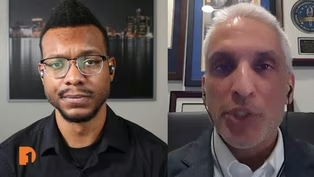
Dr. Amy Cooter, Senior Lecturer in Sociology at Vanderbilt University is an expert on Right-wing Patriot groups.
Do you think that his messaging and his, you know, words to his followers were a large part of why things have transpired or gotten to the point that they have?
- I think we absolutely have to consider that a large variable, again, not for every single actor in this morass that we've seen develop, but it was very clear from the online chatter that groups were paying attention to him taking that as a personal message.
Were it not for his repeated messaging on that very topic, we would have seen a smaller (indistinct) - [Will] A faction of Trump's supporters still believe the election was stolen, a belief spread and reinforced by social media.
Helen Lee Bouygues analyzes critical thinking effects on social media.
- Heavier use of social media demonstrated that those individuals actually had more susceptibility to not being able to identify disinformation.
- We gotta stop this steal from happening because if we don't, nobody's ever gonna vote again.
- It's very hard to differentiate between blogs, opinions, facts, and so people might have erroneous information because they might take an opinion as a fact.
But that's what I put the misinformation category.
Disinformation is deliberate, intentional interest groups or individuals who will put out outright lies that catch on fire in order for their own personal interest.
- If this election were overturned by mere allegations from the losing side, our democracy would enter a death spiral.
(crowd chanting) - [Will] It wasn't just MAGA supporters, malicious (crowd chattering) and Right-wing extremists were also at the Capitol willing and ready to commit violence for beliefs rooted in misogyny and White supremacy.
- We're talking about militias and even more extreme groups that we saw at the Capitol openly representing Nazi iconography, everything in between is that they all feel like America as it should be, their ideal version of America is gone.
- I had made the argument that the Far-right extremism problem in the United States is now the single biggest counterterrorism threat to the Homeland.
- [Will] Javid Ali is a former Senior Director for counterterrorism at the National Security Council.
- Oh, and what is that?
- This eclipsed the foreign terrorist threat that I spent the majority of my career in government from 2002 to 2018 trying to help combat.
Events even here in Michigan show that there is something happening in the country where people operating on all, some of these various beliefs, whether it's a frustration over COVID, whether it's a steepening political polarization, whether it's perceptions that the election is stolen or rigged or fraudulent, are not only radicalized and angry, but are willing to act out violently.
- We were normal, good, law abiding citizens, and you guys did this to us, we-- - They all feel like America as it should be, their ideal version of America is gone, that they need to do something to keep that slip from happening further or to to regain their ideal version of the country.
- What is that?
What does that look like?
How did they describe or I guess reminisce about that place?
- Oh, for militia members specifically, they usually reference notions that (indistinct) a lot with mainstream libertarianism, small government people being individualistic, being able to work hard, the American dream being basically no limits to your success except your own input.
And of course we've never really truly had that in this country, but that's the ideal vision, and for most militia members, they don't really overtly recognize ideas of race or gender or sex being part of that equation.
But it's kind of hard to ignore how many of them reference the '50s or the '60s as that more ideal moment, where in reality it was mostly White men who held power.
- [Will] The FBI continues its investigations into the attack.
There have been arrests around the country including here in Michigan.
- So we really all need to take a bit of a step back, maybe do some digital detox, and allow ourselves to breathe and think better.
- So there's so much more work that needs to be done, and at the same time, again, this threat is here, it's real, it's potentially only going to increase as we go forward.
So we are not out of the woods by any stretch.
- Turning now to COVID and the initial hesitancy in the Black community to get the vaccine.
On "American Black Journal" this past week, Stephen Henderson had a round table with a pointed conversation about the trust gap between Black and White communities when it comes to healthcare and what can be done to address that.
- If the shenanigans are out there and Black folks, we know that we live in a society where the healthcare system is not that fair as to us.
- Right.
- Then the concern I bet is gonna get pretty quickly to where we really fall on that list of getting the shot.
- To get some data behind the concerns, I spoke with Dr. Deborah Furr-Holden, she's an epidemiologist and Director of the Division of Public Health at Michigan State University.
She also works as the Director of the Flint Health Equity Solutions and is helping local groups get their questions answered when it comes to COVID vaccine safety.
- You've been leading a lot of community discussions about COVID as the Director of the Flint Center for Health Equity Solutions, and working on the after effects, really of public health with the Flint Water Crisis, and then COVID hits.
So what was your initial reaction in terms of a crisis in underserved communities and treatment really, and now with the vaccine for COVID?
- Well, it sort of felt like trauma on top of trauma, and we talked a lot about communities being resilient.
But you do sort of ask the question, how much can one community bear?
But the one thing I'll say about Flint is we learned a lot from the water crisis about how to respond to crisis and how to recover.
- What are the biggest concerns that people are coming to you and talking about when it comes to the vaccine now?
- So we talk a lot and emphasize a lot on vaccine hesitancy and resistance.
And what I'm actually finding in the community is the narrative that people are sharing is a little bit different from the one that's being put forward.
Most people are saying things like, "I'm not a no, I'm a no for now.
"I'm a, let's wait and see."
You know, people...
The naming even of this initiative, Operation Warp Speed, what a lot of people heard was corner cutting or skipping steps.
And so I think the hesitancy that we're seeing around the vaccine, you know, people just have more questions than they do answers.
And now we have a new problem, which is a lot of those people who were a no or a no for now have become a yes.
And we have a wait list in Genesee County of over 30,000 people, and the list grows by about 2000 people a day.
- Who are the voices that we need to enable with the information, and so they can help build that trust?
- I think it varies by community, it varies by age, but if we look broadly, I think we've underutilized churches.
Here in Genesee County our three community COVID testing sites are all located in churches, in different parts of the city.
Pastors have been a key resource and trusted messenger for people in the community.
Why?
Because they're already engaged.
They already are interacting, not just with people in their congregation, but typically with people in the communities where their churches are located.
Local health departments also play a critical role, and it's important that we not use one media or medium for getting information to people.
Some people need something that they can put in their hands and hold and read.
I think using social media, using the press, written media, newsletters for parents, we've gotta use multiple forms to get the word to people from trusted messengers.
- What are some of the biggest, I guess, maybe fallacies that you're hearing come up over and over again and when it comes to the COVID vaccine?
- I think one of the big myths is that vaccine hesitancy specifically in the African-American community predated COVID.
If you actually look at what the data tell us, African-American parents vaccinate their children at the exact same rates that White parents vaccinate their children.
There's a slight difference in adult vaccinations, and a big part of that is actually due to health insurance status and other social determinants of health.
I think specifically some of the hesitancy that we're seeing around the COVID vaccine in particular, is due to more modern day wrongdoings and mistreatment in the medical system, I think the way we language this effort, I think the fact that there are other important layers of protection, including government resources like payroll protection for small businesses where African-American businesses were disproportionately left out of have raised a red flag for people.
And they say "If my health is so important "as it relates to the vaccine, "why was our lot not allowed "to honor the shelter-in-place order "and provide a payroll protection for my small business?
"Why was I denied enhanced unemployment?"
You know, it just doesn't jive because so many other important resources that have been rolled out have not been equitably rolled out for women, for minorities and other disparate populations.
- We've had so many conversations about how COVID has really exacerbated that gap in society, and we know that the State has started the Racial Disparities Task Force around health and around COVID.
Do you think that's enough?
- Health disparities predated COVID, and we saw in the State of Michigan, we closed the African-American White gap and disparities in COVID cases and deaths within the first six months of the pandemic.
And those strides have been sustained.
So clearly we have the capacity, we can do it.
What we had to do, and what we have to continue to do is deal with the gaps and the cracks in our system.
You know, people don't have fair access and equitable access to a pharmacy, people don't have the same level of access to healthcare facilities to even get the vaccine.
And so I think the opportunity that we have is to repair those cracks in the system and start to deal with those inequities, because if we don't, what's gonna happen is, we'll come out of this pandemic and we'll still be dealing with the problems that we had that predated COVID.
- Dr. Furr-Holden talked a lot about church communities and pastors as trusted messengers when it comes to spreading vital information.
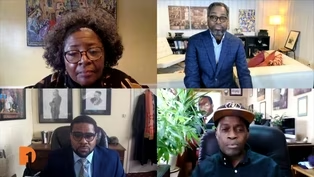
This month, "American Black Journal" is kicking off a year-long initiative highlighting the historic importance and continuing influence of Black churches in Detroit.
Stephen Henderson spoke with Pastor Barry Randolph of the church of the Messiah, Reverend Dr. Constance Simon of Fellowship Chapel, and the Reverend Charles Williams II of Historic King Solomon Church.
- I wanna start with you talking about that marriage between the church, the Black church in particular and activism that's focused on social and racial justice.
- Yeah, you know, look, the Black church birthed Black Lives Matter, birthed activism.
It has been the mantra that we have held since we organized the African Methodist Episcopal Church, further since we organized our resources in the First Baptist Church of Savannah Georgia, oldest institutions that Blacks have ever own, not only in the sense that we were protesting or picketing, but we, at that time, we were providing.
- Even if you don't go to church, when something happens you go back to Black church to find out "Well, how do we feel about this "and what things are happening with that?"
And the other thing is it's a personal level where they'll look at who needs what?
That's activism.
- COVID kinda brought a lot of things to light that were kinda undercover.
There were things that we found out as a community, as a city that we (indistinct) and truly, really were able to do.
One of the things that kinda surprised me was the fact that we coulda get everybody's water turns back up, that we could run the buses for free, we found out that children were getting one of their major meals in school.
So it brought a lot of things to life.
- You can see "American Black Journal" this Sunday morning at 9:30AM.
News that the North American International Auto Show is on hold again this year is causing some speculation that we'll never see a big Auto Show here again.
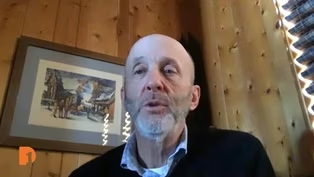
"Not so fast" says Doug North chair of the NAIAS, he talks with Nolan Finley about their new event in Pontiac called Motor Bella next fall.
- Why don't you tell us what Motor Bella is going to be this summer, and what you hope to accomplish here?
- Motor Bella was really intended originally the motor kind of speaking to British motoring.
So it was British and then Bella, which is of course beautiful or nice in Italian for the Italian products.
And we had hoped to have, you know some of the Supercars and vehicles from Britain and Italy that we wouldn't normally have on the show, but it has evolved, is how I would put it.
And as we considered moving the show from June then trying to move it to September, it kinda took on a little bit of a new light because when we did that, we couldn't do it downtown originally because we thought there would be baseball games that time of the year.
And so we planned on moving it out to M1 and then that gave us some additional capability, as you might imagine, having at 1.5-mile Trek out there.
- What elements of the Auto Show that we're accustomed to will move out to Pontiac for the Motor Bella event?
- We're hopeful that you'll see many brands represented with a variety of products, and then of course we'll have the opportunity to really see a lot of activations.
You may see autonomous vehicles, you may be able to ride in one, you might be able to ride with a pro driver doing a drifting run around the track, or even watching them do drifting and see how some of these vehicles perform under circumstances that we really couldn't replicate Downtown - Will the Auto Show return?
Will they come back Doug North?
- It is our intent and our hope that it comes back, it would be our goal and our hope to have it returned to Detroit in September of 2022.
- How much of the support network for the Auto Show, have you lost?
The infrastructure, all the companies all the people who used to come together to make the auto show happen, how much of that is still intact?
- You know, surprisingly, we have a great deal of support from many of our stakeholders and our partners.
Certainly the city and the mayor, the big three had had stated, you know, verbally their support for what we do in Detroit and not to mention many of the sponsors and the OEMs as well as many of their suppliers.
And it's really been remarkable how strong the support has been that they wanna continue, they would like to see it continue, and we've really been very pleasantly surprised given how long it's been since we've had a show, it was two years, you know, literally about now, since we've had a show.
- We know that COVID-19 has changed a lot of things, but people have continued to buy cars, buy trucks, shop, and a lot of that has moved online.
Do you think a live event, like an Auto Show is, will still be relevant in post-COVID times?
- It's true, many of the manufacturers are not only showing new product, but they're revealing product online for either specific media or specific groups.
But at the end of the day, you can't smell a new car online.
There's certainly an emotional draw to buying a car too.
And so, you know, we really strongly believe in what shows represent and what it allows the consumer to do, but we know that there's an evolution there and we're gonna continue to watch it and be prepared for it, and if we can, in some way assist or augment consumers looking at product both ways, we're certainly gonna do it.
- And finally, this week Detroit lost two iconic artists, Motown legend, Mary Wilson of the Supremes and artists, Charles McGee.
This is Mary back on "American Black Journal" In 1986, it was called "Detroit Black Journal" then.
She was a long reigning member of The Supremes, was inducted into the Rock & Roll Hall of Fame, wrote three books and fiercely loved Detroit.
Mary died at the age of 76 and you can see her interview @onedetroitpbs.org.
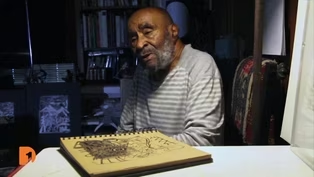
And you've seen Charles McGee's murals on buildings in Detroit and at the Charles H. Wright museum.
He passed away at the age of 96 last week.
But here's Charles in his own words in 2017 after the unveiling of his piece called Unity.
(gentle music) - The world is my canvas.
I'm just one little speck on the canvas who is trying to understand the order that holds the world together.
That's very important to me because I think that if we understand it, we respect it.
When we all work together, we understand more, we tolerate more, we live better lives because we are talking about being moved by togetherness.
We're able to live together harmoniously.
I think art tries to help to understand where we are and achieve order out of our existence.
(gentle music) It's important for me to try to understand what it is that nature gives us in existence, to make reason out of why we are who we are.
(gentle music) I live in the awe of the beautiful things that nature imparts on us.
I create pieces when it's not a physical involvement, it's a continual investigation with some kind of purpose and understanding of trying to make the world better.
(gentle music) And so the mural in my situation, the reason that I used the imagery that I did was to create a juxtaposition of opposites.
It balances out and it's telling you about the order in the world, because nature didn't want there to be just one of anything.
So that kind of dichotomy of opposites creates harmony, creates diversion.
To me its pointing toward peace through that kind of organization, and that's why I think I'm hungry to create, because I think that that was my call in nature, was to be able to make a mark, make another mark that balances that mural.
(gentle music) We live in a rapid changing world, and it's very important we learn to adjust ourselves to these changes.
We're all gonna make mistakes.
We're working toward a better world, each from their own direction according to their experiences, and how open our outlooks are.
(gentle music) It takes time, it takes experience and requires a lot of giving and understanding to get us through this maze of life in peace.
(gentle music) And so the basic thesis behind everything that I do has to do with trying to make it better.
It's very important to be able to understand the insights of how art is a system and why if we look at one color, close our eyes, we see the after image of that particular object in it's complimentary.
That's just one element of our understanding.
Everything is rapidly metamorphosizing.
There's a little more unity, I feel, there's a little more understanding, I look around and I'm really...
I feel greatly accelerated by the newness that's happening to Detroit, I thought I'd never live to see it.
I feel fortunate to be a part of that, being able to put a fingerprint on the building of a new Detroit.
- Our best to both Charles' and Mary's families at this time, and thank you to both of them for the art and the legacy that they leave.
And if you wanna see where Charles McGee's murals are in Detroit, we have an interactive map for that and more Detroit arts and culture news.
Just head to our website @onedetroitpbs.org.
That's gonna do it for me this week, have a good one, I will see you next time.
Take care and be well.
- [Narrator] You can find more @onedetroitpbs.org or subscribe to our social media channels and sign up for our One Detroit Newsletter.
(bright upbeat music) - [Narrator] From Delta faucets to Behr paint, Masco corporation is proud to deliver products that enhance the way consumers all over the world experience and enjoy their living spaces.
Masco, serving Michigan communities since 1929.
- [Narrator] Support for this program provided by the Cynthia & Edsel Ford Fund for Journalism at Detroit Public TV, The Kresge Foundation, Community Foundation for Southeast Michigan, AAA.
- [Narrator] The DTE Foundation is a proud sponsor of Detroit Public TV among the State's largest foundations, committed to Michigan-focused giving.
We support organizations that are doing exceptional work in our State.
Visit DTEFoundation.com to learn more.
- [Narrator] Business Leaders for Michigan, dedicated to making Michigan a top 10 State for jobs, personal income and a healthy economy.
Nissan Foundation, Ally and viewers like you.
(gentle music)
ABJ: The Role of Activism in the Black Church
Video has Closed Captions
Clip: S4 Ep12 | 1m 36s | ABJ kicks off its year-long initiative on the Black church's influence | E412/S3 (1m 36s)
Honoring Detroit Legend Charles McGee
Video has Closed Captions
Clip: S4 Ep12 | 4m 4s | One Detroit remembers Charles McGee, an iconic Detroit artist | Episode 412/Segment 5 (4m 4s)
Video has Closed Captions
Clip: S4 Ep12 | 5m 32s | Insurrection and Aftermath | Episode 412/Segment 1 (5m 32s)
Motor Bella and the Future of the Auto Show
Video has Closed Captions
Clip: S4 Ep12 | 3m 58s | Will we ever see a big Detroit auto show again? | Episode 412/Segment 4 (3m 58s)
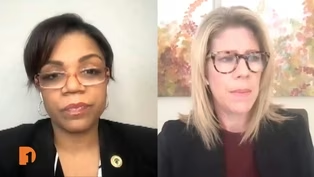
Vaccine Hesitation and the Trust Gap
Video has Closed Captions
Clip: S4 Ep12 | 5m 17s | Epidemiologist Dr. Debra Furr-Holden talks addressing concerns around COVID vaccine safety (5m 17s)
Providing Support for PBS.org
Learn Moreabout PBS online sponsorship
- News and Public Affairs

Top journalists deliver compelling original analysis of the hour's headlines.

- News and Public Affairs

FRONTLINE is investigative journalism that questions, explains and changes our world.












Support for PBS provided by:
One Detroit is a local public television program presented by Detroit PBS