
William Sproule; Dr. Ami Vaidya; Adam Philipson
9/4/2021 | 26m 35sVideo has Closed Captions
William Sproule; Dr. Ami Vaidya; Adam Philipson
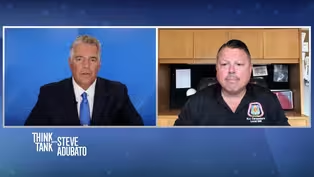
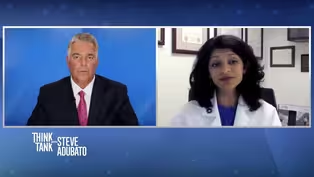
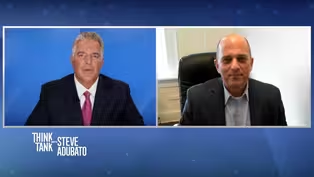
William Sproule talks about the importance of the Gateway Tunnel Project and the issues around misclassification of workers; Dr. Ami Vaidya shares the importance of the HPV vaccine for youth and the common misconceptions about the HPV vaccine; Adam Philipson discusses the challenges the arts community faced during COVID and William J. “Count” Basie’s impact on the music industry and New Jersey.
Problems playing video? | Closed Captioning Feedback
Problems playing video? | Closed Captioning Feedback
Think Tank with Steve Adubato is a local public television program presented by NJ PBS
William Sproule; Dr. Ami Vaidya; Adam Philipson
9/4/2021 | 26m 35sVideo has Closed Captions
William Sproule talks about the importance of the Gateway Tunnel Project and the issues around misclassification of workers; Dr. Ami Vaidya shares the importance of the HPV vaccine for youth and the common misconceptions about the HPV vaccine; Adam Philipson discusses the challenges the arts community faced during COVID and William J. “Count” Basie’s impact on the music industry and New Jersey.
Problems playing video? | Closed Captioning Feedback
How to Watch Think Tank with Steve Adubato
Think Tank with Steve Adubato is available to stream on pbs.org and the free PBS App, available on iPhone, Apple TV, Android TV, Android smartphones, Amazon Fire TV, Amazon Fire Tablet, Roku, Samsung Smart TV, and Vizio.
Providing Support for PBS.org
Learn Moreabout PBS online sponsorship- [Narrator] Funding for this edition of Think Tank with Steve Adubato has been provided by Bank of America.
PSE&G, committed to providing safe, reliable energy now and in the future.
Horizon Blue Cross Blue Shield of New Jersey.
Here when you need us most, now and always.
The New Jersey Economic Development Authority.
Choose New Jersey.
The New Jersey Board of Public Utilities, Clean Energy program.
The Fidelco Group.
Johnson & Johnson.
And by Caldwell University.
Promotional support provided by New Jersey Globe.
And by New Jersey Monthly, the magazine of the Garden State.
Available at newsstands.
[MOTIVATIONAL MUSIC] - Hi, Steve Adubato, and we welcome back, right out of the box, our good friend Bill Sproule, who's Executive Secretary Treasurer, Eastern Atlantic States Regional Council of Carpenters.
Good to see you, Bill.
- Good to see you, Steve.
- Hey, Bill, can we talk infrastructure?
We're taping on the 20th of July, lots of stuff going down in Washington that's confusing.
The definition of infrastructure, what is it?
What isn't it?
Define it and why is it so important, particularly in the region we live in?
- Okay, well, I gotta tell you, infrastructure is something that we've been hearing about, I guess, most of my adult life and my career in the carpenter's union.
And it's something that I think most Americans feel as though it's been neglected.
When you look at some of the other modernized countries around the world, some of the rail systems, the air traffic control systems, just everything that that is necessary to have a successful, thriving economy revolves around infrastructure.
President Biden recently visited our Pittsburgh training center to announce his American Jobs Plan.
- You were there that day, weren't you, Bill?
- Yes, sir.
Yes, sir.
- I remember.
- It was a great honor to have him, and actually, the Secret Service came in a couple of days earlier with very short notice, but it was great to have our team be able to host that event at our training center and hear such a significant announcement about a potential plan that can take our nation where it really needs to be in over the next 30, 50, 100 years, for future generations.
- Let's talk specifically about jobs.
What kind of jobs are we potentially talking about, Bill?
- Well, you're talking about bridges, highways, roads, airports, ports.
- Is the Gateway Tunnel in that?
- Yes, sir.
Yes, sir.
It's approximately $11 billion.
And as we know, that project kinda fell off the tracks, no pun intended, under former governor Christie's administration.
And we're just happy to see that it looks like we may even see shovels in the ground by next fall if we're lucky.
- I know you're not a betting man, but if I were to press you, the Gateway project is so critical, not just to the New York/New Jersey region, but to the entire country, particularly the Eastern seaboard.
A, do you believe it will happen?
B, when could you foresee it actually being built?
- I absolutely believe it's going to happen.
It's been too long.
The tubes that go under the Hudson right now are, I believe they're they're over a hundred years old, and God forbid something were to happen where one or all of them were shut down.
Imagine what that would do to the economy of New York City, Northern New Jersey, the whole Northeast, for that matter.
So, it's critical that this project is key and at the forefront of the infrastructure plan.
And I do believe that we are gonna see some activity as far as preliminary construction, perhaps by year's end, and the project's gonna happen.
- Hey, clean energy, we're involved in a clean energy initiative, promoting, I shouldn't say promoting, creating greater public awareness around clean energy.
What the heck does clean energy have to do with the carpenters?
By the way, the carpenters are, in fact, to fully disclose an underwriter of not just our energy programming, but overall public policy program.
Go ahead, Bill.
- Sure, Steve.
When you talk about clean energy, primarily what comes to mind is solar and wind, okay?
And both types of energy are produced without affecting the environment like other types of energy production.
So, I'll start with solar, land-based or roof based solar systems have a significant amount of installation required that, you know, the carpenters get involved with that work.
There's some other trades as well.
Obviously, the IBEW has a lot to do with that.
- International Brotherhood of Electrical Workers.
We know the 102 folks very well.
- With the electrical systems involved in that, and you know, there's a lot of solar happening right now, and it was extremely popular in New Jersey when there was a favorable SRECs program.
And I think, right now.
- Hold on, a lot of acronyms here.
The SREC program was the program having to do with reimbursing folks who are actually building solar panels, right?
- Yes, sir.
Solar renewable energy credits.
- Yeah, I had that on the tip of my tongue.
I'm joking, I didn't.
- I'll use another one, too, ORECs.
- Don't do, oh, you can't do ORECs if you just did S. No, what is ORECs.
- ORECs is, I believe it's.
- Look, Bill, don't get yourself in a box.
What is it?
- Offshore renewable energy credits.
- Why does it matter?
- It matters, and don't quote me on that second one, but that's, I'm taking a stab at it.
The offshore wind projects that you're going to see, okay?
There's been several thousands of megawatts already awarded, there's other areas that are gonna be leased, and there's companies that are scrambling to be a part of this.
And basically, what's gonna happen there, Steve, is there's going to be a crew of tradesmen that are going to work off shore, installing the foundations for these massive turbines, as well as erecting the towers, the blades, the cells, and that also involves our people, from the pile drivers and the millwrights, which are specialty trades within the United Brotherhood of Carpenters and Joiners.
So, we're extremely excited about that new technology.
Thus far, we've only built these on land.
So, there's a small project up in New England that our colleagues out there were involved in off of Block Island.
But you're really gonna see this industry take off, and what's significant about it is not only the offshore construction work that's going to occur, but there's a massive amount of interest in setting up manufacturing right here in New Jersey that is going to create thousands of construction jobs, as well as thousands of manufacturing jobs.
- Bill, sorry, I'm cutting you off.
By the way, developers like or Orstead and Atlantic Shores are working with the unions to find and train, find and train workers to fill these jobs.
Just, it's interesting.
By the way, check out NJ Spotlight News every night, 'cause they're doing a lot of work on clean energy.
Last question before you go, what the heck is this issue with the misclassification of workers and its impact on the state's economy?
Give me 30 seconds.
- Yes, sir.
Misclassification of workers comes in all shapes and sizes, but basically what goes on is there's an underground economy where construction workers are paid off the books, and it used to occur on small projects, but now we're seeing more and more larger projects where there's 100 or 200 workers.
It basically erodes the construction industry.
- Hold on, Bill, I want to be clear.
They don't hire them as employees.
They hire them as contractors, which has implications as to whether it's really under the books, under the table, on top of the table.
It affects state revenues.
And how does it affect the labor industry?
- Well, they hire them off the books.
Sometimes they classify them as independent contractors, but I don't ever see the 1099s actually go full circle, where taxes get paid.
So, you've got local, state, and federal taxes, as well as unemployment disability insurance payments.
- Well, the rest of us pay.
- We pay, and these contractors that utilize these unscrupulous techniques to manage their job sites and their subcontractors are basically stealing from the taxpayers, Steve, and this problem has to be solved.
Otherwise, the construction industry will go to hell in a hand basket.
- Hey, Bill, thank you for educating us every time you join us.
Best to you and your members at the council, Regional Council of Carpenters.
- All the best, Bill.
- Thank you, Steve.
Great talking to you today, sir.
- You got it.
I'm Steve Adubato.
Stay with us.
We'll be right back.
To watch more Think Tank with Steve Adubato, find us online and follow us on social media.
- We're now joined by Dr. Ami Vaidya, who is co-chief of the Division of Gynecologic Oncology and vice chair of the Department of Obstetrics and Gynecology at Hackensack Meridian health.
Good to see ya doctor.
- Hello, good to see you too.
- There's so much confusion, so much misinformation out there.
Before we do the HPV, the whole vaccine issue regarding that virus, could you help us understand something, as it relates to COVID vaccine and women and pregnancy, or the ability to be pregnant?
What's the connection, if any?
- There really is no connection.
There's been a whole slew of rumors floating around, and unfortunately these rumors have taken a life of their own.
And I think building on fear and natural apprehension for something that's new, people have really fed into some of this.
And there really is no scientific basis for some of these rumors that have started.
- We need more accurate information like that.
HPV stands for?
The reason I'm saying it is because, I'm not gonna incorrectly pronounce this, go ahead.
- Human papillomavirus.
- How common?
- Extremely common.
Up to 80% of individuals at some point or other, have been exposed?
I'm talking men and women to this particular virus.
- What do you mean men and women?
Talk about misconceptions.
I thought it was an issue that was disproportionately impacting women.
- No, it actually isn't.
HPV has been shown to be linked as a causative agent in a number of different cancers.
And we know the most about HPV with regards to cervical cancer, where more than 90% of cervical cancers are driven by changes that are happening from HPV, this virus, on cells of the cervix.
But we also know that over 60% of vulvar cancers, 75% of vaginal cancers, all also driven by HPV.
Yes, those are organs that women have that men don't, but 90% of anal cancers, over 60% of penile cancers.
And if we start looking at the head and neck, tonsillar cancers, cancers of the base of the tongue, cancers involving the oral cavity, overall.
These all have been shown to be linked and associated The vaccine, the HPV vaccine, who should get it and why?
- So in 2006, the FDA approved the first HPV vaccine, which it targeted toward adolescent and young women.
And so in 2006, Merck put out a vaccine that covered four different strains of HPV virus.
Shortly thereafter, in 2009, the FDA approved that male adolescents and all young adults along with female adolescents as well, of course, should be receiving this vaccine.
By 2014, Gardasil came out with what's called a NanoValent vaccine, which included the original first four strains put out by Merck, but five additional HPV high risk strains.
So that where we are right now, is we are recommending this vaccination.
Our target range is for young adolescents, boys and girls, ideally 10, 11, 12 years of age.
The vaccine is approved from ages nine up through age 45.
- So hold on one second, we have a daughter turning 11.
- Yes, she should be vaccinated.
- She's a candidate?
- Excellent candidate.
So, to parents right now, watching, who are either hesitant or resistant regarding their children.
You say what to them?
- Well, the simple answer is, this is an incredibly powerful vaccine.
One of a kind in a way, that is able to prevent a large number of cancers that can affect both men and women.
Get your kids vaccinated.
We can spend some time and talk about some of the misconceptions.
- To start off, many people think that the HPV, the vaccine has not been officially shown to prevent cervical cancer.
And that misconception came about because some of the early, early studies on the vaccine, looked at preventing pre-cancer.
But since the vaccine has been approved now for over 15 years, we have a tremendous amount of data that shows us that cervical cancer rates in vaccinated individuals have decreased.
So for example, in the United States, nearly 30% reduction in cervical cancers identified in women under the age of 24.
There's been about a 13% reduction in cervical cancers identified in women ages 25 to 34.
And recently just this past year in the New England Journal of Medicine, a really interesting study coming out of Sweden, where they've got long-term followup, showed an 88% reduction in cervical cancer in those individuals, those girls that were vaccinated under the age of 17.
So we've got great information that counters this idea that the vaccine doesn't really prevent cervical cancer.
It does.
Another misconception.
Well, some people have said, why don't we just get pap smears?
Pap smears are enough to prevent cervical cancer, aren't they?
No, no, they're not.
So pap smears, extremely wonderful screening tool, some limitations, but has really helped in our fight against cervical cancer.
But pap smears identify cervical cancer.
They don't prevent it.
HPV vaccine tries to prevent it.
In addition, pap smears don't identify any of the other anal genital cancers that we know are HPV driven, nor do they identify any of the oropharyngeal or some of the head and neck cancers that we're seeing driven by HPV.
So really pap smears alone are not doing the trick.
- One more, 'cause there's a time issue.
I want to be real quick on this.
Let me ask you this.
It's a bigger, it's not a bigger question.
It's a different question.
HMH actually has a physician leadership academy that you well know, I teach in.
And one of the biggest areas we focus on is on the need for physician leaders to communicate more effectively.
How important has effective communication become for you and your colleagues as physicians beyond simply clinical expertise, which is not a simple thing in itself?
- Well, I've always thought that at least 50% of what we do as physicians involves communication education, right?
We're partnering with our patients.
We want to try to help prevent disease.
And the only way we can do that is if we can take the time and educate those patients that are coming to see us, whether it's parents, whether it's children, about the benefits of, you know, we're having a whole conversation about HPV vaccine, but there are tremendous benefits to receiving good quality healthcare, in ways that have made a difference for people's quality of life.
- Next time you join us, let's talk about social determinants of health and a whole variety of other topics.
Dr. Vaidya, I want to thank you so much for joining us.
- Thank you so much for having me.
- Stay with us.
We'll be right back.
To watch more Think Tank with Steve Adubato, find us online and follow us on social media.
♪ Man, he's high ♪ ♪ I said that cat is high ♪ ♪ Yes, he's high ♪ ♪ Man, he's higher than a kite ♪ ♪ I've been treated like a freak ♪ ♪ That's the story of my life, yes sir ♪ ♪ That's the story of my life, oi vey ♪ (violin playing) - You've just seen video from the Count Basie Center for the Arts and we are joined by their president and CEO, Adam Philipson.
How you doing Adam?
- I'm doing great as great, as great can be.
We're hanging in there, just like everybody.
- You're hanging in, listen, what we just saw is just a piece of what's going on down at Count Basie Center for the Arts.
An iconic institution struggling, thriving, what?
- Kind of all, actually.
I mean, you know, did a lot of thriving from the struggle.
I mean, like everyone in the arts, we were the first to close and we'll be the last open, but, you know, despite that there's just been, you know, the proverbial pivot, but also growth, building, preparing, partnering.
There's just been so much that we've been doing in this downtime to get ready to live up to the reopen.
- You know, I'm obsessed by the whole idea of innovation for leaders of nonprofits, organizations like yours, like ours, but a drive-in?
Did you create a drive-in?
What did you do, build one?
- Yeah, you know, we did.
We partnered in the racetrack for actually what was the largest in the country.
You know, we didn't want to do something small.
We didn't want to just, like, make something happen for a hundred people.
We figured if we're going to do something, let's go big, so that was a 900 cars in a parking lot.
I mean, it was, it was a big, big happening.
We did a bunch of those and I mean, it was one of the beginning of the pivot that we did.
- Let me ask you, COVID-19 has made what you're doing more difficult and more challenging, but there's also, many people believe, and I'd like you to elaborate on this, Adam, that it's also made it clear how important the arts really are in our lives.
- Listen, I mean, 100%.
I mean, first of all, there wasn't a commercial that you saw during COVID, you know, during the quarantine era where somebody wasn't reaching for a musical instrument, singing on a balcony, dancing with family.
You know, there was definitely, I think, a reconnection to the arts and the need to be expressing ourselves.
So that's the good piece, you know, I think the problem was this perception that by being somewhere publicly consuming the arts, it was going to be the problem.
That's where it was all going to break down.
And that's why I think we were the slowest to open, but we have been, I think, more committed to our mission and the need for the arts to be part of the healing as we come out of this, because we're not out of it yet.
- Right.
You know, let's do this.
By the way, Mom, I know you're watching.
My mother, who, I'm never gonna say her age.
She made me promise.
She's just taken up playing the piano.
And you just proved the point by saying that.
She was telling me literally two days ago.
I said, "Ma, is it a good time?"
She goes, "It's the best time."
So there it is.
- Totally, and we've seen that, I think, because of virtual, that's one thing.
It did make it easier, you know?
You didn't have to drive.
I would make a pretty hefty wager that your mom is taking a class online.
Am I right?
- If she can turn the computer on, yes.
I'm sorry.
I'm sorry, Ma.
Don't edit that out.
No.
Yeah, go ahead.
But are you saying people are learning how to play instruments, learning how to do things online as well as in person?
- Absolutely, I think the virtual world has definitely shown that it's easier, you know, it's easier for parents, it's easier for kids, you know, you don't have to drive an hour for a lesson.
Listen, I'm not saying that there's not an incredible value to be in a room, right?
I mean, there's only so much longer we can handle the Zoom.
You need to have that human connection, but it absolutely works.
Parents that have their kids doing a lot are actually, you know, very grateful to be able to be home and have their kids Zooming in for a guitar lesson or a violin lesson.
So yeah, we've seen lessons go up.
- Adam, do this for us.
We're doing a series called New Jersey Leaders Who Matter and Count Basie, Red Bank, his connection, he matters.
And he mattered and matters greatly.
Why is he a leader who matters?
- You know, he was, first of all, he's from Red Bank, but I mean, you know, he was a maverick in his time.
He's self-taught, you know, he used to go to a movie theater that's no longer here, but down in Red Bank and would watch the silent films and watch the person who was doing the piano and sort of taught himself, then had some lessons.
Apparently the story goes, the person who was the accompanist of the silent movies was sick and he jumped in and he never stopped playing.
And I just think, you know, that's why he's so important.
He's so important to our community and one of the reasons Red Bank is a popular place.
And so when we had the opportunity to put his name on this venue, I think it just drove in the importance of the arts, the importance of jazz, the importance of what music means to this community.
- Let me ask you something.
For those of us who lead non-profits, there's often some connection, some personal connection, the passion that we feel, whoever we are, whatever we do.
What's your connection to the arts?
- So, yeah, I had an arts background.
I mean, listen, I'll be an artist forever, but I was a theater actor, was on Broadway, a bunch of national tours, movies, TV, just did a lot of the work as a working actor.
But at some point, you know, wanted to step away from being in the front and kind of be behind and I think what's just fantastic, for me, and the connection that I've been able to make is that I know what it means to be sitting with an audience of 2000 people and how you have to take someone from Point A to Point B through a story and take them on that journey.
And even though I'm not on the stage, you know, I bring that from behind the stage and that's what we try to create here, you know?
You're taking someone on a journey.
From the second they see that the show is on sale to the minute they leave, you're taking them on a journey.
- Hey, speaking of journeys, real quick, we got about 30 seconds left.
Philanthropic support of what you do is critically important.
Corporate foundation support, right?
- Absolutely.
- 'Cause no money, no mission.
- No, no doubt.
I mean, we have been so blessed by not only our board of trustees, but this community who rallied when we closed our doors and said, you are not closing and kept us open.
If you ever see that kind of support.
I mean, yes, we had unbelievable support to build a $27 million campus.
But the support that we saw before we were about to close our doors, like everyone during COVID, is something that recommitted us all to our mission forever.
- By the way, I want to thank the folks at the Bank of America who actually encouraged us and talked to us about the work going on at the Count Basie Center for the Arts.
Adam, we thank you.
We wish you and the family at Count Basie all the best in beautiful Red Bank, down at the Jersey shore.
Hey Adam, all the best.
Thank you.
- Thank you.
Thanks for having us, take care.
- I'm Steve Adubato.
Thank you so much for watching and we'll see you next time.
- [Narrator] Think Tank with Steve Adubato has been a production of the Caucus Educational Corporation.
Funding has been provided by Bank of America.
PSE&G, Horizon Blue Cross Blue Shield of New Jersey.
The New Jersey Economic Development Authority.
Choose New Jersey.
The New Jersey Board of Public Utilities, Clean Energy program.
The Fidelco Group.
Johnson & Johnson.
And by Caldwell University.
Promotional support provided by New Jersey Globe.
And by New Jersey Monthly.
- Hi, I'm Abbie.
You might see me as an ordinary person, but I've been living with a brain injury since 2018.
Opportunity Project gave me hope and I've gained confidence through job skill training and helping my family.
Despite my challenges with memory, I see a possibility to keep improving.
- [Narrator] If you have a brain injury, you don't have to face your road to recovery alone.
Learn more about Opportunity Project and its partnership with Children's Specialized Hospital.
How Misclassification of Workers Impacts NJ's Economy
Video has Closed Captions
Clip: 9/4/2021 | 9m 51s | How Misclassification of Workers Impacts NJ's Economy (9m 51s)
The Importance of the HPV Vaccine for Youth
Video has Closed Captions
Clip: 9/4/2021 | 8m 18s | The Importance of the HPV Vaccine for Youth (8m 18s)
Reconnecting with the Arts During the COVID Crisis
Video has Closed Captions
Clip: 9/4/2021 | 9m 21s | Reconnecting with the Arts During the COVID Crisis (9m 21s)
Providing Support for PBS.org
Learn Moreabout PBS online sponsorship
- News and Public Affairs

Top journalists deliver compelling original analysis of the hour's headlines.
- News and Public Affairs

FRONTLINE is investigative journalism that questions, explains and changes our world.


Support for PBS provided by:
Think Tank with Steve Adubato is a local public television program presented by NJ PBS