Two Days After 9/11, FRONTLINE Aired This Documentary on Osama bin Laden’s Terror Network
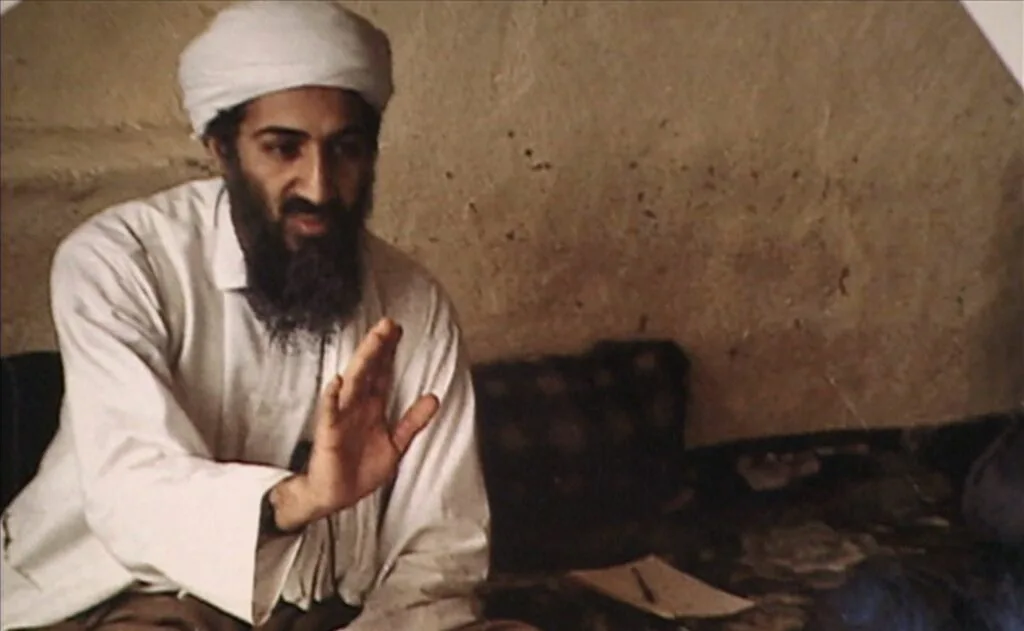
In the hours after the attacks, the CIA and FBI briefed political leaders in Washington that their search for the terrorists responsible was focused on one name above all others. FRONTLINE aired ‘Hunting bin Laden’ just two days later.
September 9, 2026
Share
On the afternoon of Sept. 11, 2001, the CIA and FBI briefed political leaders in Washington that their search for the terrorists responsible for the attacks was focused on one person above all others.
That suspect’s name was Osama bin Laden. And as the country reeled and searched for answers, a team at FRONTLINE mobilized to bring the public vital context on his origins, his Al Qaeda terrorist network, and past U.S. efforts to track him down.
The resulting documentary, a powerful first draft of history, aired just two days after 9/11. It was called Hunting bin Laden. And as the nation prepares to mark the 25th anniversary of the attacks, it’s now available on YouTube for the first time.
With opening and closing commentary from legendary journalist Bill Moyers, the Sept. 13, 2001, documentary is a time capsule of the shock, grief and horror that gripped the U.S. when the twin towers fell — and of the emergence of one central question: Why did U.S. intelligence agencies fail so tragically to “connect the dots” and uncover this enormous operation in time?
Drawing on an investigation into bin Laden and his militant Islamist network that FRONTLINE had aired two years earlier, and featuring new interviews conducted in the hours after 9/11, Hunting bin Laden was a collaboration with The New York Times. Director and producer Martin Smith and correspondent Lowell Bergman pieced together how bin Laden, a wealthy Saudi exile then believed to be hiding in Afghanistan, had eluded the U.S. while building a terror network and calling for the killing of Americans.
A pivotal moment in bin Laden’s journey, the film reported, was when he volunteered in the Afghan war, which began in 1979 and lasted a decade. In that conflict, “a small Islamic nation of 15 million people stood up to the Soviet Union, with assistance from others, and forced that entity called the Soviet Red Army to withdraw,” former CIA officer Milt Bearden told FRONTLINE.
The victory against the Soviets carried a powerful lesson for many, Ahmed Sattar told FRONTLINE: “If I can defeat the ‘evil empire,’ I can defeat anybody else.” Sattar, a close associate of Sheikh Omar Abdel Rahman who was convicted of conspiring to blow up landmarks in New York, would later be convicted on related charges himself.
The documentary traced how the U.S. responded when bin Laden’s ideology emerged in connection with several major acts of Islamist terrorism against Americans in the ‘90s — from the 1993 attack on the World Trade Center, to the bombings of U.S. military installations in Saudi Arabia, to the 1998 bombings of U.S. embassies in Kenya and Tanzania.
Following those embassy bombings, the U.S. carried out retaliatory missile strikes in Sudan, a country where bin Laden had once been based. Hunting bin Laden raised tough questions about the evidence used to justify those strikes, and how the strikes contributed to a growing perception in some Muslim countries of America as an aggressor nation — a perception that bin Laden would tap into as he called on his followers to fight.
Less than a year before 9/11 came Al Qaeda’s bombing of the USS Cole in Yemen. Then, on a sunny Tuesday morning in September 2001, four hijacked commercial planes crashed into the World Trade Center in Manhattan, the Pentagon and a Pennsylvania field — and officials said soon after that the suspects were followers of bin Laden.
At the time Hunting bin Laden aired, the search for survivors of the 9/11 attacks was ongoing. As Moyers noted, a connection between bin Laden and the attacks had yet to be confirmed. It would be, soon. In the years to come, as the resulting U.S.-led “war on terror” expanded and debates over U.S. strategies for combatting militant Islamist ideologies ground on, the words with which Moyers closed the documentary would prove prescient.
“How do we bring the guilty to justice without making martyrs of them? And can we distinguish between those who commit the crimes and the innocent who share their culture but not their cause?” Moyers asked. “Not only our security as a nation is at stake, but our values as a people.”
Watch the Full Documentary | Hunting bin Laden
Plus: Our Extensive Reporting on 9/11’s Long Tail
The legacy of the 9/11 attacks and the U.S.’s ensuing “war on terror” has been complex and far-reaching, from bloody conflicts in Afghanistan, Iraq and beyond, to hate crimes against Muslims and a rise in division and distrust at home. Our archive of documentaries probes the 9/11 attacks, investigates the cascade of decisions that followed, and traces the lasting impact on America and the world — including the toll of the wars in Afghanistan and Iraq on civilians there, as well as on U.S. troops; the CIA’s use of “enhanced interrogation techniques” widely criticized as torture; the deployment of a secret surveillance apparatus within the U.S.; the 2011 killing of bin Laden; the rise of ISIS; and an erosion of the American public’s trust in the U.S. government and democratic institutions.
Senior Digital Writer, FRONTLINE
Support provided by:
Learn More
Related Documentaries

Latest Documentaries


Explore
Policies
Teacher Center

Jon and Jo Ann Hagler on behalf of the Jon L. Hagler Foundation
Corey David Sauer
Koo and Patricia Yuen
FRONTLINE is a registered trademark of WGBH Educational Foundation. Web Site Copyright ©1995-2025 WGBH Educational Foundation. PBS is a 501(c)(3) not-for-profit organization.
Funding for FRONTLINE is provided through the support of PBS viewers and by the Corporation for Public Broadcasting, with major support from Ford Foundation, and Fialkow Family Foundation. Additional funding is provided the Abrams Foundation, Park Foundation, John D. and Catherine T. MacArthur Foundation, Heising-Simons Foundation, and the FRONTLINE Trust, with major support from Jon and Jo Ann Hagler on behalf of the Jon L. Hagler Foundation, and Corey David Sauer, and additional support from Koo and Patricia Yuen. FRONTLINE is a registered trademark of WGBH Educational Foundation. Web Site Copyright ©1995-2026 WGBH Educational Foundation. PBS is a 501(c)(3) not-for-profit organization.