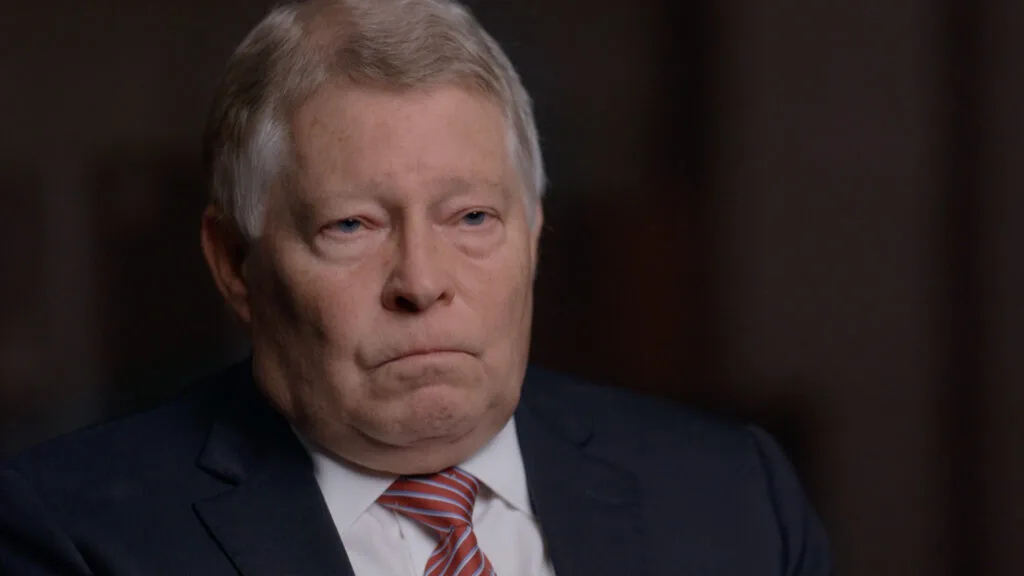
Dan Balz is chief correspondent covering politics at TheWashington Post and is the author of several books, including Collision 2012: The Future of Election Politics in a Divided America.
Following is the transcript of an interview with FRONTLINE’s Michael Kirk conducted on July 10, 2019. It has been edited for clarity and length.
It’s the inaugurals of the two men.… What is the difference between these two men as they assume the presidency?
I think the difference—the biggest difference is the overall thrust of the message.For Obama, he came in at a moment of great peril for the country because of the recession.But his presidency, or his election, was a moment of great hope for the country.First African American elected.Many people who did not even vote for him felt good about that.And there was something—a sense of uplift on that very cold Inauguration Day when he was inaugurated.
When President Trump came into office, this country was far more divided than when President Obama was inaugurated, but also there was great fear about what was coming as a result of the Trump presidency, and his message reinforced that.The “American carnage” message was one in which he took aim at the elected leadership sitting behind him, at the elites that he identified in whatever way he wanted to, and spoke in a way—a harsher way, and certainly a less optimistic way than is the tradition of Inauguration Day.So I think that—that gulf between the two of them really defines the difference between the beginnings of their presidencies.
One a uniter and one a divider in some ways.
Yes.And obviously Obama turned out to be a divider for many people.But Trump has never sought to be a uniter, and I think that’s one of the major differences.
The Promise of Obama
So when you think about Obama running, and even go back to ’04 for a minute, if you want to, what is the promise of Obama?What do we witness happening as he aspires to the presidency?
I think the promise of that candidacy was a desire to move to a different place in the country.We were in the middle of tumults over the Iraq War.There was great dissatisfaction with President George W. Bush at that point.And Obama was—he was obviously a different kind of candidate.He looked different; he sounded different.He had an aspirational message, and I think at that moment in the country, people were looking for that.When he gave that speech at the convention in Boston, when John Kerry was nominated, “We’re not a red America or blue America; we’re the United States of America,” that captured people’s imagination, and it carried through into his candidacy.
I think also what happened was that because he was not well known and had a very slender record, people were able to project onto him their own hopes and dreams, no matter what side of the spectrum they were coming from.And so as a result of that—I mean, his was an aspirational candidacy, and that was an aspirational election.
Sarah Palin and the “Forgotten”
Of course, Sarah Palin rises during that same 2008 election.She seems to identify with, or a group of people identify with her who many of us hadn’t paid attention to really before.The people that would eventually become the Trump “forgotten” are in some ways that group of people.
In a way, Palin identifies that group of people.That group of people would become the Tea Party.… Do you think Obama knew about that America when he was running, when he was aspiring, when he was thinking about uniting America?
You know, I’d say a couple of things about that.One is certainly he knew about that America.You know, we all remember that comment he made at a fundraiser when he talked about, “Americans cling to their guns and religion,” kind of a xenophobia.And he was talking about literally the very parts of the country that supported Trump heavily in 2016.So he was aware of it.
But I think that what was overlooked at that time, there was a great deal of focus on Sarah Palin and who she was or who she wasn’t, and what she was.But I think there was much less focus on who she really represented or spoke to.And I think one of the things that, I know I overlooked or underappreciated, was the degree to which the country was already polarizing around Barack Obama as a candidate in that election, as opposed to things that then happened during his presidency.
It’s clear that Palin represented that piece of it and that hostility to what Obama ran into when he became president.
Hostility about the race?Hostility about his race?Hostility about the coastal elites?What hostility?She said a lot of things about elites and negative things about Washington and the West and East Coasts, but personalizing to Obama?
Well, I think some of it clearly was race.You know, race is the great stain on American history and the issue that we never can quite get past and that continues to rule our politics today.So certainly there was some element of race.But I also think there was a feeling that Obama looked down on that part of America; that there was a sense that he was condescending toward that America, and it was something that Palin certainly wasn’t.I mean, she spoke in the vernacular of people from different parts of the country who felt alienated from the elites on the coasts, and that gravitated eventually to the benefit of Donald Trump.
Conservative and Social Media
Let’s keep ourselves to one other side road for a second.Technology now is so much of politics messaging, all that Twitter, the right-wing radio, the right-wing websites, everything.But then it was maybe the last moment where it wasn’t so important.Am I right about that?
Talk radio was a force in America, I mean, dating back to the [Speaker of the House Newt] Gingrich era.If you think of Rush Limbaugh’s impact on American politics, it goes way back.But we’ve moved into a different period, and because of social media, it’s both the pervasiveness of it and the velocity of it, and the ability for something to strike, for a match to be lit and for the fire to just burn very, very brightly and very, very hot in an amazingly short amount of time.And that’s—that’s something that we’ve witnessed from when President Obama got elected.Cycle by cycle, that’s become much, much more intense, and politicians have learned, or had to try to learn, how to deal with it.And obviously, President Trump has become the most skillful at using and manipulating those tools.
Obama and the Economic Crisis
Now moving down our chronology just a little bit.We’re at the moment where Obama has faced the decision; the bankers have come to the White House; the bonuses were now in the newspapers a couple of days before.Everybody’s anxious about what’s going to happen inside the White House when Obama meets them.He’s being advised that this is the moment for Old Testament justice, but he seems to be on the fence about whether to do that or not.It feels like a lot of people are watching very closely what side he’s on, what he’s going to do with that TARP [Troubled Asset Relief Program] money, what he’s going to do with the banks.Take me there.Help us understand what the stakes are at that moment for Barack Obama and America.
Well, I think the stakes are the definition of the Obama presidency, and the degree to which a new administration responds to a level of anxiety over the economy that we hadn’t seen since the Great Depression, and this sense that in one way or another, Wall Street had gotten away with something, that there was unbelievable pain and suffering all around the country: people being foreclosed on their houses; people whose savings accounts had been cut in half and their 401(k)’s or whatever they had.And how do you respond to that?Not only how do you respond to it in terms of getting the economy moving again, but how do you respond to it in holding people accountable for what happened?
And that was a definitional moment.And I think that there was a perception on the part of a lot of people, particularly people in the progressive wing of the Democratic Party, that President Obama flinched at that point; that in one way or another, he was not prepared to go there, to go after CEOs or to take people to court and to charge them with things.And I think it took some of the energy out of the movement that had helped elect the president, particularly on the left.And I think that became, in some ways, kind of a lasting feeling on the part of a lot of progressives in the party who loved the president in almost every other way, but who felt that on that and some other things, he was not as bold as they wanted.
… Obama announces to his staff that he wants to address national health care; he wants to go open up what eventually will be called Obamacare.Take me to what that’s about.He says I don’t want to just be known for what I saved; I want to be known for what we did, and we don’t have very long to do that.Let’s move forward with this.How important is that moment to what Obama’s aspirations are for the country?
Saving the economy was something he was forced to do.It was never part of the campaign until the very last month or six weeks of the campaign when the economy was collapsing.So that landed in his lap as he was making the transition from candidate to president-elect to president of the United States.
It was the most important thing he had to deal with, and in some ways the most thankless.I mean, it was something he had to address.They had to stop the bleeding.Unemployment was rising at astronomical rates in that period; jobs were being lost.He had to deal with that.But that was not where his heart was as a candidate.He wanted to be somebody who did big and bold things on his own, and on his own initiative.And health care was the biggest of those on the domestic front, and he wanted to turn to that.
I think he also knew that for any new president, you have a very limited amount of time to get big things done, and if you don’t move in your first year, the chances of getting those things done diminish dramatically year by year by year.And he was well aware of that, and he was well aware that they were losing time.
The other thing he had to deal with, in addition to the American Recovery Act and the bailout of the auto industry, was to do something about the banking system, with the Dodd-Frank Bill.That was his way of addressing the issue, as opposed to trying to put CEOs in jail, to change the regulatory system to prevent this from happening again.But again, that was something that fell in his lap more than his initiative as a candidate.If you think of what he talked about as a candidate, it was to do something big like health care.
And the problem, of course, with the bailout of the auto industry, the Dodd-Frank Bill and all the rest of it, it’s not exactly big, publicity-driven—or you’re not receiving a lot of applause from the future Bernie Sanderses and Bob Reichs of the world.
Right.You’re dealing with a problem.Presidents have to solve problems.They don’t always get to do exactly what they want.Issues come at them, particularly foreign policy issues, but often on the domestic front.Something like banking regulation is as arcane as a policy issue as you can imagine.I mean, I suppose milk-marketing orders might be more arcane.But when you think about the detail of the financial system and regulating that, the average person has no grasp of that, no particular desire to get into that.So if you say, “I’ve fixed that,” people say: “Well, OK, but do I feel it?I don’t know that I feel it.”
The auto industry is something different.I mean, I think that was something that people have a better grasp of, because they could see the American auto industry for many years eroding because of foreign competition and other things, and they recognize the power of that industry as an engine of American growth for so many years.So saving that had both symbolic and practical implications and practical value.
But dealing with the health care system, I mean, you are touching every American at a very core level.Everybody has a view about their own health care, their own coverage of health insurance, and what’s wrong with it and what ought to be done with it.And so to try to fix that, to try to assure that everybody’s got affordable care, is a huge potential winner if you can do it right.
The Rise of the Tea Party
… That summer, what a lot of people call the Tea Party summer, that August, as everybody goes back to their districts, in town meeting after town meeting, this eruption of the Tea Party growing I think first out of Rick Santelli’s CNBC—
His rant on CNBC.
“What we need is a Tea Party!”
“Mr. President, are you listening?”
So this group is out there.That’s the Palin group I suppose; that’s the future Trump group.And there they are shouting, holding forth about what becomes known as Obamacare.Why?
I think what happened was that during the campaign, President Obama never had to sort of square the circle on kind of the aspirational rhetoric that he was talking about to move the country to a different place and what the policies would be to do that.So people could draw their own conclusions about what kind of approach he was going to take.
Once in office, if you do the Recovery Act, and that’s $800 billion, if you save the automobile industry, if you’re redoing the banks, which means significant intervention and intrusion by the government in terms of regulations, and then you say, “We’re going to remake the health care system, and we’re going to change the nature of this system,” even if you say, “We’re not getting rid of private insurance,” you’re changing that.To a lot of people, particularly on the right, that says big government is on the march, and therefore my freedom is at risk; the freedom to come and go as I want, the freedom to make my own decisions, is at risk.And there has always been a populist wave in this country, and in this case it was a conservative populist wave, that rises up against that.
Obama was able to do what he needed to do in the first months of his administration, but once he turned to health care, it was kind of—that was the switch that got flipped and activated this opposition.
We talked to… people who were in the White House at the time, and they all say he didn’t really understand that there was another thing in play as well, those posters of him as a gorilla or a Zulu warrior.And they said it shocked him, that this might be about him, too.Some of this opposition might be about him personally.What say you about that?
Well, I think that was what was the overlooked or misunderstood piece from the campaign; that because so many people seemed to adore Barack Obama, not just in the Democratic Party but other people, at least early on as a candidate, that this part of the country that was resentful or resistant or nervous or fearful or to some extent racist suddenly saw in him something that alarmed them.And this began to take root fairly quickly.
And therefore, then there were the questions of was he really born in America?Was he really Kenyan?Was he really an American citizen?All of this began to boil.You know, it was a little bit below the surface.I mean, it wasn’t as though this was the central part of the debate, but there was enough of it there.And again, because we’re in the—we’re in the internet age, you know, we’re rich in the internet age, that kind of stuff floats around, and then it pops up.
And so I think for President Obama to see that is, you know, it’s both shocking and unnerving to realize the degree to which that’s a piece of the resistance that he’s running into and that he’s going to have to deal with as president.When he ran for president, he did everything he could to avoid talking explicitly about race unless he was forced to, when Rev. [Jeremiah] Wright’s tapes came out and he had to give that speech during the primaries, that sort of thing.But other than that, he did not want to campaign as a civil rights advocate or anything like that.And yet he’s confronted relatively early in his administration with the fact that this is still part of what he’s got to deal with.
… How important was that decision to go forward on that vote, despite the fact that I think he knew he wasn’t going to get any Republican support?
Well, I think that, too, was a defining moment for his presidency.I mean, there were people around him who advised caution, who advised him to take, you know, if not half a loaf, three-quarters of a loaf, but don’t go for the whole thing, because this is going to be a tough fight, and you might not win it.But even if you do, you’re going to have to win it with no Republican votes.
But as I recall, he said to the people around him: “You know, if we don’t do this now, we’re never going to do it.And if we don’t do it—if we don’t do it whole, it’s in a sense partly a waste of time.”And he was prepared to take that risk, to go ahead and do the whole thing at once and pay the consequences.And I think there are several consequences.One is historic enactment of a major change in our domestic policy, biggest domestic policy change since Medicare, Medicaid, to the Great Society.But it also is a defining moment as saying OK, the country is now split badly over your presidency, and in one way or another, you’re going to have to figure out how to solve that, or you’re going to live with the consequences.
Speaking of living with the consequences, here we are still talking about it, still repealing and replacing it, still having arguments.As a result of that decision, you’re right about the division.… Somebody told us it became the issue for Republicans: Here it is; this is what we can run on now.
Well, it was a galvanizing issue for Republicans at a time when Republicans had their own divisions.You know, we used to talk about a Republican Party that was held together by anti-communism and muscular defense and some kind of small-government economics.But some of those things fractured over a long period of time, and so you had a Republican Party that was also searching kind of for its own identity.And it had lost the 2006 election; it lost its majority in the House; the Democrats took over.Lost the 2008 election.And so the Republicans were back on their heels, and they needed something to bring their party together and energize their own base in order to go after Obama.And their hope at the time was to deny him reelection in 2012.
They found health care as the issue that across the board galvanized Republicans and led them into 2010 and the success they had in that election.
Certainly fueled the Tea Party rise as well.It was easy for them to then go out and find, and make the pact with the devil, and find a handful of these angry Tea Partyers and bring them into the Congress.
Well, when parties are out of power and looking to come back into power, they make bargains that they then are forced to live with.They’re not always the easiest.And for the Republicans it was—I would say to seed the Tea Party movement, to encourage it whenever they could, in order to win a majority in the 2010 election.And then they had to deal with a new group of Republican House members who came to Washington with a much different view of what they were there to do than many of the old guard.
Trump and Birtherism
… The birther movement.It’s really for us, by the way we see it, the first time you really see Trump emerge in a different form—not just the reality TV star, but something else.Talk to me about the implications of the rise of the birther movement and his role in it.
Well, the birther movement had what I would call kind of a grassroots connection among some parts of the Republican Party, and people who were not necessarily Republicans, there was a sense there of something.And polling at the time showed a substantial number of Republicans who bought into the idea that he was Muslim or that he was not born in America, some version of that, that story.
And what Trump did was to give it oxygen, in part because Trump became I would say the most prominent person because of his celebrity status, the most prominent person to really push it, and to push it in a very concerted way.
Now, I think as we look back, he pushed it for some particular reasons.He was thinking of running for president in 2012.That was a way to begin to kind of put himself forward.It was a way for him to create a bond with a part of an electorate that if he ever did run for president would be useful for him to try to win the nomination and in a sense to kind of change the nature of the Republican Party.So in the spring of 2011 he went and pushed that very hard, talked about sending investigators to Hawaii to check on things and that they were finding out amazing things, whatever that quote was, but talking about it in a way that was designed to give it more credibility than it had ever had.
Sowing division.
Well, the division was there.I think it was to bring that division much more to the surface.
Obama’s response?
Well, Obama’s response was severalfold.One was he always wanted to be just completely dismissive of this.He never wanted to respond in a way that suggested he took it at all seriously, that this was—this was frivolous.This was totally a fringe element of American society and not to be taken at all seriously.That’s his initial reaction to it, you know, with some—you can understand why.
But then when Trump keeps pushing it, and it seems to be gathering some force, he takes a different tack, and he says all right, we’re going out to Hawaii, and we’re going to get the real birth certificate; we’re going to get the full birth certificate.And they do a surreptitious mission out there with somebody, and they come back with it.And on the morning that Donald Trump is preparing to go to New Hampshire to, you know, perhaps launch a candidacy or to propel himself forward again, Obama unveils this and takes—totally takes the wind out of Donald Trump’s arrival in New Hampshire and out of that movement at the moment.
And then, you know, to rub it in, the president uses the White House Correspondents’ Dinner that year with Donald Trump in the room to completely ridicule Donald Trump in front of this audience that—journalists and lobbyists and government officials and people who at that time Trump wanted to have the respect of.And Trump was sitting at a table, very uncomfortable, and the rest of the room is roaring uproariously at his expense.
The impact?I would assume people who liked Obama loved it, and I would guess there were probably people out there who thought, wait a minute; who is this guy mocking Donald Trump?
That’s true.And I think in the narrowness of the worlds in which we all live now that it was the people who loved what Obama did who got the most attention, who commanded the airwaves or who were the talking heads who talked about what a moment this was, whereas elsewhere out there in America, there were people who resented what Obama was doing and still were partial to the narrative that Trump had been pushing.
Immigration and the Republican Party
Let’s talk for just a moment about the rise of immigration as an issue.After [Mitt] Romney loses, there’s the “autopsy,” the autopsy basically saying we’ve got to broaden our base.Meanwhile,… [Jeff] Sessions, [Stephen] Miller and [Steve] Bannon… have a different plan.They’ll use Breitbart to bring immigration to the fore; they’ll stop the Gang of Eight bill that’s landed in Congress if they can; and they’ll take on [House Majority Leader] Eric Cantor with a candidate in Virginia named David Brat, and using Laura Ingraham and Mark Levin and right-wing media.
I would back this to an earlier point in American political moments, to the 2000s period.In both the 2000 and the 2004 campaign, you could see this issue beginning to boil up.It hadn’t reached the point where it later became, but you could feel that there was a resistance building up to the idea that there were millions upon millions of people here without documentation, who had come in illegally, and nothing was being done about it.
In 2007 we saw John McCain’s primary campaign come apart over the issue of immigration.President Bush was pushing a comprehensive immigration bill that would have included some path to legal status or citizenship for the undocumented.McCain was part of the effort to try to do that.He got tremendous resistance to his presidential candidacy as a result of that.Cost him a tremendous amount of money, and he almost had to—he almost got driven out of the race.
So we could see in the Republican Party in 2007 and 2008 how divisive this issue was.You then fast-forward to a later period, and the Republicans lose in 2012, in part because—not solely because, but in part because they get wiped out in the Hispanic community.And the autopsy put forward at the impetus of Reince Priebus, then the chairman [of the Republican National Committee], says: “There’s no future for a Republican Party that is dependent almost entirely on white votes.If we are to become a majority party again, we have to diversify.We have to reach a broader audience, and that starts with the Hispanic community.And we have to do something about that.”
But the group that came in in 2010, after the 2010 election, represented that view of the—within the Republican Party that had sunk comprehensive immigration reform back in the Bush administration.And so what you had was, on the one hand, the establishment Republican Party saying, “Here is the course we have to take if we are to survive,” and you have a resistance operation, populist, angry, out there in the country that the Freedom Caucus, that the Tea Party movement typifies in many ways saying, “No, no, no, we are not going to go there.”So when the bill from the Senate goes to the House, that’s where it gets bottled up, and that’s where that division deepens, widens and becomes more inflamed.
How significant is it that the primary issue, they say, that Brat used against Cantor was immigration as a demonstration project if nothing else to the Republican establishment who may still be hanging around thinking, well, maybe we’ll vote for this bill?
You know, I think that the Cantor loss, if you think about kind of the initial reaction to it and analysis to it, was that here was a classic case of a Republican who rose up in the leadership and forgot the people back home; that it was not specifically that he was in a particular place on immigration but that more generally he had lost touch with the people who elected him.That may have been in part because of immigration, but I think—you know, it’s again, these things were—things bubble through the political system, and it’s only at a later point that you realize, oh, my gosh, that was there; we just didn’t appreciate where it was heading or how it was going to have its full impact.
So I think at the moment that Cantor lost, yes, immigration was part of it, but I think people tended to move beyond that and look for other reasons.And then, you know, immigration comes roaring back.
Obama and Rising Division
We’re now in ’14.By now, when Obama is issuing these sort of angry statements with his signature on them, what has happened to the unifier at this moment?
I think the unifier left the stage sometime in the fall of 2011, after the debt ceiling fight and the collapse of any effort to resolve that or to reach a big grand bargain with John Boehner, the Republican speaker of the House.I think at that point President Obama decided the inside game is of no value; we’re not going to get anywhere with it.We’re going to have an argument in 2012.We’re going to win that argument if we can.And if we win it, we are then going to do what we want to do or push in the directions we want to push.
And if you think about his 2013 inaugural address compared to his 2009 inaugural address, it’s a different President Obama.It’s a much more explicitly liberal President Obama.It is a more confident, in-your-face President Obama about here is where we are going.In a sense, we have the coalition of the rising America, and we’re going to speak to that coalition.And so you are at a point when you get into that later period in which the president is saying: “I’m going to do what I’m able to do with the tools available to me.I’m never going to get from a Republican Congress much progress on the things I think are very important, whether it’s immigration or climate or you name it.And so as I said, I’ve got the pen and the phone, and I’m going to use them.”And he used them to advance his initiatives, and I think in part not only to push the ball forward on those issues, but also as a way of defining what the Democratic Party was and would be in the future as a prelude to 2016.
And the state of division in America at this moment?Where do we stand?
At that point, this country is terribly divided.We have been on a path toward greater and greater division dating back to the era of Bill Clinton and Newt Gingrich.You know, we can all argue about the very moment at which it turned in that direction, but this is a continuum.This is like an assembly-line operation.And year by year, presidency by presidency, this country has become more divided.
George W. Bush’s presidency was more divisive and divided than Bill Clinton’s, which was more divided and divisive than George H. Bush’s.Barack Obama’s was more divided, and he was a more divisive, polarizing figure than George W. Bush.And Donald Trump is more polarizing than any of his predecessors.So it’s just gotten worse and worse and worse.
As we sit here, you and I, trying to parse out where and when and how bad the earthquakes are, why is it getting worse and worse and worse?What’s actually happening?And what’s actually representative at that moment, at the end of ’14, heading into what will become the election of Donald Trump?
Well, the country’s in a great transformation.I mean, this is becoming a different United States of America.Technological change, economic changes, demographic changes all in one way or another are contributing to the remaking of an America from what it had been 30 years ago, 40 years ago, 50 years ago.
When you go through that kind of upheaval—and it’s not the first time we’ve done it—but when you go through that, there are beneficiaries, and there are people who come out on the losing end of it.And the people on the losing end of it feel that pain immensely, and often feel as though nothing is being done to address their situation.And I think that there is also, during that period, a cultural separation—I use that term broadly—a cultural separation in the country over certain values and certain issues.
Abortion has obviously always been a divisive issue, but same-sex marriage and gay rights in this period is another.And so that’s another thing that’s pulling the country apart.And those are, you know—race obviously being another one.Those are issues that are very hard to talk about.Those divisions are very hard to bridge.And often it’s to the benefit of politicians, in one way or another, to exacerbate those in the short term in order to gain something politically.
The Trump Candidacy
When Trump comes down the escalator in that understated announcement for the presidency, you wrote that it was immigration in this case, using the escalator moment as a jumping-off point, as a proxy for what’s going on in America.Talk to me a little bit about what you meant by that.
Well, I mean, immigration, particularly in a way that candidate Trump defined it and seized on it, was a broader statement about America’s identity and people’s identity in America.And to talk about what’s happening in terms of people coming across the border, and the way he described them, “rapists” and things like that, and “Mexico is sending us the worst,” and everything—all the ways in which he put that into context, it was a way to say, “America’s under siege, and many of you are at risk of losing power, status, stature, income, whatever, as a result of these changes in America.”
There are different stories about whether he accidentally hit that issue or whether he knew exactly what he was doing.Whatever the real answer is, he tapped into something in a very profound way that began to redefine the debate in the political year of 2016, and continues to redefine the politics of the country today.
What did he hit?What’s out there?Is it fear?What’s going on among that group he calls the “forgotten” that immigration is such a hot button?
Well, I don’t think there’s any one thing that necessarily is “it.”I mean, I think there are a number of “its.”Some of it is economic anxiety.Some of it is a fear of the other, of people who don’t look like us, or look—some of it is a resentment toward the political class, which in one way or another has not dealt with this or many other issues of concern to people, that—you know, that they are enriching themselves, or they are aggrandizing their own power, they’re letting Wall Street CEOs get off, whatever you want to say, and they’ve lost touch with the people who put them there.
So Trump is tapping broadly into that.But I think very much at heart you’ve got the immigration issue tied to the question of terrorism, because you’re dealing with the rise of ISIS in that period, the threat of migration from the Middle East, all of that.So there’s a combination of actual fear about security and fear about the reshaping of America.And so, you know, no matter what your concern was, the way Trump went at it—[claps hands]—found a voice, found a home.
As Obama watches Trump run, sees what’s catching on… what’s that probably like for him?What does it say about the country that he wanted to unify as he watches this man climb the ladder?
I can’t get inside his head, obviously.I would think that initially his reaction is the reaction that the Clinton campaign had or many of the Democrats had, or a lot of people had, which is Donald Trump is a—you know, is a comet, and he’ll flame out fairly quickly; that you can’t run a successful campaign based on this much divisiveness and negativity and with clear racial overtones.And so I think there was a tendency to want to dismiss it; that this is ultimately going to be a sideshow and the Republicans will come to their senses, if you will, and end up nominating someone far more traditional than a reality TV star and a billionaire businessperson who’s never had any involvement in government or in politics.
I think as you get farther into the fall, and then with—even in the late stages of the campaign, when it’s clear that Donald Trump has a real following, I think in those last weeks of the campaign, because of Access Hollywood and that controversy, there’s still a belief on the part of the Obamas in the world that the public will judge Donald Trump ultimately as unfit to be president, and therefore, he might get close, but he won’t get all the way.
So that’s why election night 2016 is just such an incredible shock.I mean, it’s a shock obviously to the Clinton campaign, but it’s a shock to the Obama White House as well.They have to had sat there that night and wondered, where did we go wrong?What could we have done that we did not do that made it possible for this outcome to happen?
Or how could we have so miscalculated who Americans are, what America is in lots of ways?
Well, I think that everybody knew America was divided, but, you know, you can make the parallel to the Brexit vote a few months earlier in Great Britain.People knew that that vote was likely to be close, that people had very strong passions on both sides, but that in the end, the establishment was quite confident they would prevail.And when they did not prevail, they were in a state of shock in the same way that I think that Obama and others in the political establishment were in a state of shock that in the end Donald Trump was able to tip the balance narrowly in his direction.He lost the popular vote, but he won three states barely—Wisconsin, Michigan and Pennsylvania—and that gave him an Electoral College majority.
So it wasn’t that we didn’t know the country’s divided.I mean, we’ve been having elections for a very long time that are—that are dramatic elections: 2006, 2008, 2010; not so much 2012, 2014 and 2016.You know, we’ve been having close, dramatic, change-oriented elections for the—you know, for a decade or more.So you always think, yeah, it’s closely divided, but we can prevail.
Bernie Sanders and the Democratic Party
Let me ask you about the rise of Bernie Sanders and the Sanders—I don’t know what you’d call it—progressive wing, liberal wing of the Democratic Party rising up certainly in the summer and the late spring and throughout the democratic primary. …
Well, I think there are two reasons that Sanders caught fire.One had to do with Secretary Clinton and her candidacy; that she looked like she was the, you know, the heir apparent; that there was going to be in some ways or another a coronation.And no political party, particularly the Democrats, likes coronations.They like a battle.And so inevitably there was going to be a battle.I think what was the surprise was that it was Bernie Sanders who got out front of that and was able to capture that energy.
So part of it is energy of a group of people who don’t want the nomination to be a cakewalk for Hillary Clinton, who want her to have to fight for the nomination and who have some reservations about her as a candidate.But there’s another side of that that’s very important.And that is the feeling that, for whatever reason, Barack Obama has not lived up to the liberal promise that his candidacy and his presidency seemed to promise, that he turned out to have pulled some punches, and that—that though he prevented the economy from going into a terrible depression, that he had not resolved or solved or even addressed seriously enough the issues of inequality that still remained, the income and wealth gap in America, the rising pay of CEOs, I mean, the role of Wall Street.
We saw during the 2012 election the Occupy Wall Street movement that rose up.The Obama team took note of that.I mean, they recognized that there was something there, and they kind of weathered through it.But they were able to do that by making Mitt Romney become kind of the symbol or the emblem of, you know, the anger rather than turning it on Obama.
By the time you get to 2015 and ’16 and you’re in the Democratic primaries, Bernie Sanders has a very well-articulated critique not personally of Obama, but a critique of the system; that the health care reforms, however good they may have been, were not enough; that the economic fixes fell well short of what needed to be.And what we saw was the beginning of the making of a different Democratic Party, one in which the progressive left had a much louder voice than they had had before.
Russia and the 2016 Election
The next place we’ll go is the impact of the Russian incursion… and the way they used our divisions, our very public divisions and the internet to get in the middle of our election.
One of the fascinating things about the role the internet, broadly defined, plays in our politics is in the positive and negative aspects.The positive aspects are all obvious.I mean, it’s democratized things; it allows people to communicate in ways they never were able to do before; it binds people together, etc.The other side of that is it can be used in all kinds of nefarious ways because there are so many corners of the internet that most of us don’t understand.And the Russians, like everybody else, could see that this was a divided America, and what they did was they probed for soft spots, and one of the soft spots they found was race; that race was obviously a divisive issue, but an issue that you could easily inflame people over.And they began to push and probe on things like that.
And in doing that, it amplified what was already there.So they were able to take advantage of things that, you know, that we were trying to sort out ourselves, but they were able to do it in a way that sowed greater discord than if we were left to deal with these on our own.
… The divisions are so obvious to people who want to use them to create chaos and disruption that it was almost easy for them to do it during this time.
Well, it’s relatively easy for them to do it.And what’s interesting about the internet, or Twitter in particular, is it’s so easy to kind of put something into play and to get people to start arguing about it and hating over it.I think that’s a new element to everybody over a relatively recent number of years, that the power of that piece of it—or, similarly, Facebook, because you have these communities that exist without anybody quite knowing that they’re there, and if you can find them and inflame them, people will talk among themselves and come up with conspiracy theories or distortions of reality, whatever.And those take root, and people believe it because there’s no—in a sense, they’re not hearing a real contrary argument.They’re not seeing evidence that’s powerful enough to knock it down.And it kind of plays to their own feelings or attitudes or prejudices or whatever.
What a wonderful opportunity for fake news to begin.I guess that’s when I heard the word—the words “fake news” a lot was right around that time with things—Hillary’s sick, Hillary’s dying, whatever.The most insidious thing was that you didn’t know what you could trust in the public comments.
Part of the problem is knowing what to do if you’re a political candidate when things like that pop up.Do you respond?Do you respond to every conspiracy theory?You know, the instinct of most people who work in politics is, well, not initially.But then there’s the other instinct, which is any negative attack that goes unanswered can stick.So where’s the point at which you jump in?And how do you jump in?And how do you ever win an argument against ghosts and smoke and things like that?That’s the challenge for traditional politics in a way it had been practiced up until recent years.
The Trump Inauguration and Transition
… We’re amused and interested in what happens that first weekend when Sean Spicer has to come out and estimate the crowd size for everybody.… And Kellyanne [Conway] utters those words.
“Alternative facts.”
Take me there, to what we learn from this from the very beginning of this administration in that realm.
I think what we learned in those first days of the Trump presidency was the degree to which Donald Trump was going to insist on trying to write the history of his presidency the way he wanted to, and that no matter what the objective facts, no matter what the pictures, no matter what other people said, he was going to define it as most favorable to himself, and he was not going to let anybody who spoke for him do anything other than that; that if you spoke for Donald Trump, you had a constituency of one, and that was Donald Trump, and that if you did not tell the story the way he wanted to tell it, he was going to let you know he was very unhappy about it.
And so that was the beginning of it.You know, there were elements of that during the campaign, of candidate Trump wanting to defy other evidence to make his own case on things.But that was—that was such a bald effort with the size of the crowd at the [inauguration] that everybody who looked at it objectively knew that what Sean Spicer was trying to say was simply not real, and yet Kellyanne Conway had to come out the next day and defend it and suggest that there are facts and alternative facts, and the president is making clear to his staff, this is the way we’re going to operate.
Trump and the Media
It’s clear from the very beginning that the declaration that the press—the Post, the Times, CNN—“enemies of the people,” that value, that norm, that somehow there’s an argument that it’s all OK, it’s what we’re supposed to do, and it’s what he’s supposed to do, but it’s not personal … signals what?
I think everybody in the world of journalism and the media was terribly concerned about that kind of rhetoric from the president.I mean, presidents and press corps have sparred as long as they have been presidents and press corps.No president likes the coverage that he gets.No president is happy with everything they get.And even when they’re critical, they’re critical within bounds.There is a recognition of the role of a free press.There is an acknowledgement that we have a Constitution that guarantees freedom of speech and freedom of religion and freedom of assembly and freedom of the press, and that when you take a part of that and you define it in contradiction to the well-being of the country, you’ve crossed a line that other presidents have not done.And I think that was alarming.I mean, I think for everybody in the press and other citizens who are strong supporters of the Constitution, their view was the press does what the press does, and the press should continue to do what it does, and this is not a—this is not a personal fight with President Trump; this is us doing our job of covering an administration and holding whoever is in power accountable.But he saw things differently, and he used it as a way, again, to divide the country, to energize his supporters, and to cast himself as somebody who is under siege by an establishment or an elite whose interests are counter to the people who elected Donald Trump.And frankly, very effectively done.
One of the things we will watch in our film happen during the Obama years is the rise of vitriol and right-wing media.Fox grows immensely; Limbaugh soldiers on.And they are a force.They are a strong force in the division of the society, if not impacting the president and the government itself.By the time we get to Trump, who has his own device, the Twitter device he’s mastered, it’s almost like another group starts to push back against him.It’s the best of late-night comedians.It’s a whole different zeitgeist of the culture finding a way to push back.It’s Melissa McCarthy making fun of Sean Spicer.It’s all of that.Talk a little bit about the arc of the cultural response to each of these presidents.
I think it goes back to the point I made earlier about this country becoming more and more polarized and that with each moment of inflammation, something else happens—you know, action/reaction.
And so by the time Donald Trump is a candidate or is elected president, the country’s divided, and the media is divided, and people’s sources of information are separated.You know, somebody who watches Fox probably is not watching something that somebody who is a Hillary supporter is watching.People are getting their own information in different places.
But with Trump, because of the way he handled things, and because of his skill with Twitter or the bully pulpit of the presidency, you ignite another part of resistance to him.You ignite it with the Women’s March that happened the day after the election.I mean, we know that from everything we’ve seen, from the moment he got elected on, that women had a particular reaction to his election, particularly younger women or college-educated women.And culturally you saw parts of the media who had feasted on politicians of various stripes for a long time, turn very, very hostile to President Trump, and not just for laughs, but to, in a sense, try to make the political argument against him.
And so that then creates even more reaction on the part of the right, whether it’s talk radio or Fox or whoever.So this just becomes a louder and louder battle, and one that, you know, that you can’t—you can’t find any kind of middle ground on.I mean, people are just dug in and dug in more than they’d ever been.
Trump and the Republican Party
… So there’s been this ongoing, as we said earlier, battle to repeal and replace Obamacare.… Talk a little bit about finally the Tea Party people and the Republicans.They have the Senate and the House.They can, with his pen, do something about the repeal and replace of Obamacare.They fail dramatically.He uses that to try to seize the reins from them, to threaten them, to primary them, whatever it is.Talk a little bit about that time period and what it tells us about the division.
What’s interesting about that is it’s the beginning of the evolution of Trump literally taking over the Republican Party.And so when he comes into office, Paul Ryan’s the speaker.He’s not a Trump person.Mitch McConnell is the Senate leader.He’s not particularly a Trump person.He’s been more artful about the way he’s handled that than Ryan, who’s gotten into a number of spats.
But on health care, the Republicans had had seven years to rail against the Affordable Care Act and to say, “We’re going to repeal it and replace it.”Alright, the moment arrives when they’ve got the power to do that, and they don’t have a plan.So you go through a period of months in which they are floundering.They can’t get their act together.There’s division.They can’t find, you know, uniformity enough in their own party to get it done.Eventually the House does get it done.They kind of bullet through, and the president hails it.
But ultimately it fails.It fails because John McCain, who had had a longstanding argument with Donald Trump and vice versa, signals thumbs down, and he votes against it.This is a crushing blow to Trump personally, but it’s also a blow to the Republican Party, because it takes this issue away from them.They have nowhere to go on it.And in that period, and as a result of that debate, Trump’s badgering of the Republican leadership and of the Republican Congress finds a voice outside of Washington among rank-and-file Republicans.And the congressional Republicans recognize that Donald Trump now is, in fact, in charge of the Republican Party, and they had to pay attention to that.
That’s right.And when that amazing moment of the announcement of the tax bill, they’re all out on the back lawn of the steps of the White House,… Ryan is there; McConnell is there.They’re saying things like, “He’s the greatest president of all time.”
Yeah, maybe greater than Reagan.
One of the things about the Trump presidency is, he will never back down in a fight, and he will always take it to his adversaries.And he’s relentless about that.If he’s blocked, he will keep at it.If he is unhappy with somebody, he makes that known.And ultimately he has—he has worn people down, particularly in the Republican Party.If you’re an elected Republican, Donald Trump has made it clear that if you go against him, he’s going to go against you, and you will pay a price for that.And we saw it in any number of individual cases.And it doesn’t take very many of those.I mean, all it takes are two or three of those cases for people to get the message that there is enormous risk if you go against the president.
And, you know, often presidents are a little tentative about getting into those kinds of battles within their own party.I mean, they want to try to stay above some of those divisional fights and those factional fights.Donald Trump is not at all, because for Donald Trump, everything’s about Donald Trump.You’re either for Donald Trump, or you are against Donald Trump, and he wants to encourage everybody to see it his way.So he steps into all of these and makes his voice heard and makes his muscle felt.
We saw it so vividly in the Roy Moore case.… It’s at that same time he’s taking on the National Football League, certainly the African American athletes that walk away from the national anthem.He’s doubling down on everything that he does, even in the face of the failure of the Affordable Care Act, a lot of other things that are happening to him, and heading into the tax bill in the fall.What’s with this?
What’s with this?Trump knows how to pick his fights and to pick his enemies.His fight with Colin Kaepernick, he turned that from the issue of policing in black communities to an issue of the flag and patriotism.He was able to take an issue and turn it to the advantage of him, and to energize his own base with it.
With somebody like Roy Moore and the Alabama election, this is a way for him to say to a part of his base, “I’m with you.”He knew that Roy Moore had tremendous support in the evangelical community, and he has played to the evangelical community constantly in his administration.That was a way to do that.
And the other thing about Donald Trump is, when he gets involved in a fight like that, if his side loses, he walks away.Roy Moore lost that election, but Donald Trump’s still in the White House.Donald Trump moves onto something else, and his base is happy with him.The Republican establishment is not going to go against him as a result of it.So he comes out and says, “I stuck with—I stuck with our team, and we lost this round, but there are many more to go.”
It’s him playing to his own base independent of what happens with the Roy Moore election.He’s sending a signal to lots of people that I’m still who I said I was.
Well, he does that with a variety of things.I mean, that’s part of the way he’s operated as president, is he is very mindful of how he got to the White House and what are the issues and the people who elected him.And so for, you know, for a part of that base, it’s issues of immigration and race and American identity.For others, it’s the issue of the Supreme Court and judges.Or for others, it’s the issue of cutting tax rates.He has done enough in enough places to reinforce all aspects of the electorate that got him elected.What he hasn’t done, obviously, is reach beyond that.What we’re going to see in 2020 is whether that’s enough to win reelection in a divided country.
This is the first president that I’ve ever seen who didn’t try, at least in some ways, to reach out and broaden his base from the White House.He planned it, I won; now it’s time to open it up and not just live with my base.It seems like stoking the base is his job one.
It’s his job one and his job 100 and job 1,000.It’s kind of the basic building block of his political movement: Keep that base energized.
Now, in 2018 it did not particularly work in House races.It had some effect on Senate races, but those were generally in very red states.He tried to energize based on the immigration issue, caravans coming from Mexico.It did not have any real effect in those swing districts that flipped from Republican to Democrat.So I think that the issue for 2020 is, how will that approach play in these places that were crucial to him winning?Can he get the size of turnout among people who turned out for him in 2016?And he may need even more of that because you’ll have presumably a more energized Democratic Party in 2020.How do those numbers all add up?You know, the Trump campaign, I think, is quite mindful of that.
One of the things that I think we see—and this is probably not necessarily for where you guys are going, but one of the things that you can see is that in addition to doing everything to energize the base, he’s doing little things to try to ameliorate the anger among suburban women or among, you know, among other groups, not to win them over in a significant way but to peel a couple of percentage points away from the Democrats with small things. …
A Divided Nation and the 2020 Election
… So the state of the division as we head into 2020, what’s in play?
This country goes into 2020 as divided as it’s ever been.It will go through 2020 with one of the most divisive campaigns we’ve probably ever seen, and it is likely to come out at the end of 2020 still divided.And whether the next president, whether it’s Donald Trump for a second term or whoever is the Democratic nominee, whether they can move us past that, I think, is the biggest single question for the next presidency.And so I think based on everything we’ve seen, not just over the last few years, but over the last decade or more, tells us how enormously difficult that’s going to be.
But inside the Democratic Party, now just talking about the frame of that group, there are strong arguments that say: “Let’s keep that division going.We’ve got the demographics; we’ve got the energy; we’ve got something to be angry about.Let’s go,” from the younger, more progressive groups, and then there’s the [Speaker of the house Nancy] Pelosi forces and others who are saying, “No, no, no, no.” …Whither the Democrats at this moment?
Here’s what I would say: that what the Democrats are going through is a version of what the Republicans were heading into in 2015 and 2016, which is what is the right path?What is the right formula?What is the right equation to win back the White House?And what is the constituency that maximizes our opportunity for that?
And so there are different and competing theories about that.One obviously is a resurgent progressive wing of the party, and a party increasingly of younger people, of people of color who believe that the path is big, bold ideas to energize as much as possible this new Democratic Party.And there are others who say, no, no, no, this election is still going to be won in part by the persuadable handful at the middle.We can’t do anything to so alienate them that we can’t bring them over in the fall of 2020.That’s the argument within the Democratic Party.How that gets resolved, we don’t know yet.I mean, the primaries are about to unfold, and this is going to be quite an interesting question.
I think the other question is, is the energy simply to defeat Donald Trump so strong within the Democratic Party that no matter how that question of which is the right path gets resolved, no matter who the nominee is, that energy will be there for that nominee, even if some people are disappointed?I mean, I think that’s the challenge for the Democratic nominee, to make sure that they can pull that party together and energize it in a way that Hillary Clinton was not able to do in 2016.
The Mueller Report
When the Mueller report lands in Washington, the reaction of Republicans and Democrats—we’ve been talking with people about the different ways of viewing it—what happens in that moment, and what does it reveal about the country’s divisions?
… Trump was very effective at polarizing reactions to the Mueller investigation long before Mueller was able to report.His kind of constant attacks on Mueller, on the motivations of the Mueller team, on the origins of the investigation, all of that played to saying to his side of the electorate, “This is something that you can’t trust.”
So when it lands, and there is no finding of conspiracy, of collusion, lots of contacts between Trump people and Russians, but no finding of conspiracy between the campaign and the Russians, and no conclusion on the issue of obstruction—and then Attorney General [William] Barr jumps in and says, “Therefore, no obstruction,” Trump is able to seize on that and try to turn it very quickly as to “Alright, we’ve had this investigation; it’s time to move on.”
There are a lot of Democrats who resist that, for all of the reasons that are outlined in the Mueller report, particularly on the obstruction question.But the Democrats are torn as to what’s the right way to deal with that.Do you launch hearings?Do you subpoena people?Do you go to impeachment?Do you step toward impeachment, and then go to impeachment?And Nancy Pelosi, the speaker, is mindful of the potential fallout of an impeachment proceeding that ultimately doesn’t get anywhere and that further inflames and divides the country.And so she is constantly putting her foot on the brake in a very obvious way.
So the Democrats are left in a kind of a no-win situation.The Trump White House is resisting any effort to cooperate with the various committees that want information.They want documents; they want people to testify.They’re stonewalling on that, throwing it into the courts, which means it’s going to be an endless or near-endless fight. …
… Just following up on the Mueller thing.I think you wrote that the document also was proof of the fact that the Trump presidency is, quote/unquote, “normalizing extraordinary behavior.”Just describe that for us.What would that be?
What the Mueller report laid out in the second section on the obstruction was behavior by a president to, in one way or another, interfere with an ongoing investigation.Whether it’s obstruction or not is an issue that’s yet to be adjudicated perhaps.But there’s no question that he was doing things that other presidents had not done, and he was quite open about it.I mean, that was part of the issue.I mean, this was, depending on your viewpoint, this was obstruction in plain view, or it was a president under siege who was fighting back.I mean, you can take whatever side of that argument you want.
But it was one of a number of things that the president has done.I mean, we’ve seen him do things that presidents generally have not done.We’ve seen him hector the chairman of the Federal Reserve to get involved in monetary policy and lower interest rates.The Federal Reserve is supposed to be independent from politics.The president has made an issue of that.We’ve seen him get involved with the Brits over Brexit and how they should be negotiating their exit from the European Union.This is not Donald Trump’s responsibility, and yet he goes there and wants to be part of that debate, and he bends people to his will.
And so those are the kinds of things that you step back and you say, “This is a president who operates in ways we’ve not seen past presidents.”