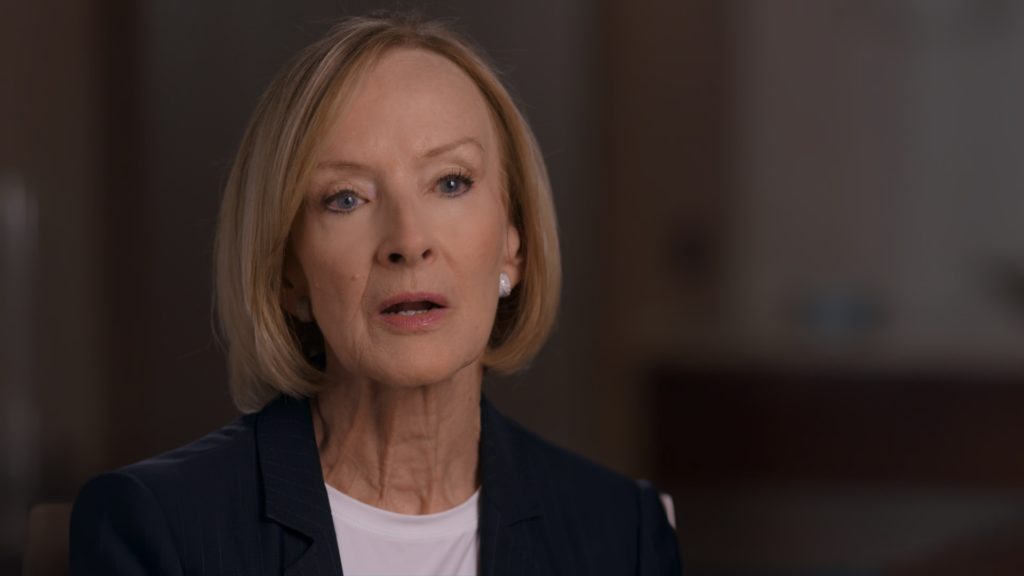
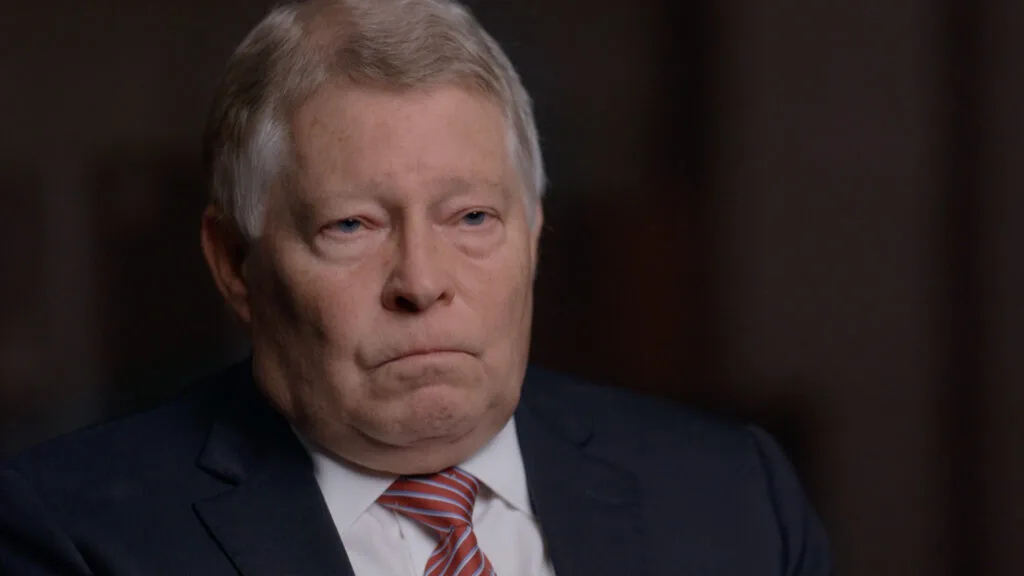
Judy Woodruff is the anchor and managing editor of the PBS Newshour. Prior to that, she covered politics for both CNN and NBC.
Following is the transcript of an interview conducted by FRONTLINE’s Gabrielle Schonder on September 17, 2019. It has been edited for clarity and length.
So we open the film with the comparison of the tone and tenor of the two inaugurations and really the two inaugural addresses.I assume that you’re covering both, of course.
Yeah.
Can you help set that up, the Obama inauguration, the message of hope and change, the Trump inauguration, the “American carnage” speech?
Yes.When Barack Obama was elected, it did seem like the country had turned a corner.It was supposed to be about hope and change.That’s what we heard during the campaign.It’s what we heard at the inauguration.We saw even Americans who had been skeptical of Barack Obama were giving him a look, listening to what he was saying.I think there was just an enormous amount of goodwill toward him and toward the possibility of what might be under this first African American president.
But clearly, along the way, President Obama tried to do things that didn’t sit well with a chunk of the American electorate.We saw the rise of the Tea Party.They were angry about government spending.They were angry about the vibes coming out of Washington.There were also the personal accusations against the president, that he wasn’t born in the United States.You had the birther movement.It all became angry.It became this sort of angry stew of—that dissolved into disagreement and—and worse, division.
And then, somehow along the way, it created an opening for that aggrieved piece of America to come back and say: “We’ve had it up to here.We don’t like the way you’re spending money.We don’t like government money.It’s our money.We don’t like some of the changes you’re making.We don’t like these social changes that you like to talk about, how we’re becoming more open as a country—make us feel uncomfortable.And we don’t see anybody on the horizon who speaks for us.”
And that was the opening for Donald Trump.He looked at that.He figured out a way to become the voice, the unlikely voice.Here was a New York television celebrity, businessperson, real estate guy, who became the voice of the blue-collar Middle American, who felt they weren’t listened to, who rejected so much of what New York stands for—the coast, the elite coast.But he became their voice.And that was the message he brought at his inauguration, when he spoke about “American carnage,” when he spoke about—when he spent most of the inaugural address talking about what was wrong with the country, what was wrong with Washington.Essentially, all the people sitting behind him he indicted for being responsible for the mess that he was describing.It was—it was quite a change from what we had seen eight years earlier.
Sarah Palin as a Precursor to Donald Trump
A precursor to that moment, which is another candidate, Sarah Palin. She’s this folksy, kind of unknown political figure. But she taps into a base you just referenced. … So Palin and this kind of—this brewing rebellion that is maybe happening under her candidacy and under her sort of announcement as John McCain’s running mate.
I think in many ways, Sarah Palin was a precursor to Donald Trump, because she spoke to that—that chunk of America who felt unheard, unappreciated, disrespected, who increasingly was feeling there was this elite, this super-educated, above-it-all group of people in Washington and New York on the coasts, who knew more, claimed to know more than anybody else and claimed to have, you know, a lock on what was best for the country.
And there were a lot of Americans who felt they weren’t part of that, that they were looked down on.And I think of, you know, how Palin was portrayed in the campaign.You know, some of the media coverage of her, you know, not being as well-educated, not—you know, not understanding some pieces of American history, American culture, that everybody was supposed to know about.So that added, I think, to the sense of us versus them and, in a way, did open the door to what would become the Trump candidacy.
Obama and the Financial Crisis
Obama wins that election and inherits the financial crisis.One of the first major decisions he’s tasked with is the bailout.Can you help us understand what’s at stake there and what challenge he’s now facing?
… Everything was at stake.The—yes, the U.S. financial system was at serious risk, but that meant the world financial system was at risk.So on President Obama’s shoulders, he was inheriting what President Bush and his Federal Reserve and his Treasury secretary had just pulled together, a package to bail the banks, but really the country, out of this crisis.But President Obama was tasked with figuring it out.You know, how do we make this work?How do we get the government to—to take this huge amount of money, billions—hundreds of billions of dollars and spend it on our financial system, which had, frankly, made big mistakes?
Right.
And while on the one hand, it was—it had to happen—God only knows what might have taken place if the government hadn’t come up with some plan to bail out the banks—on the other hand, it looked unfair to people who saw huge amounts of money being transferred to these already wealthy institutions.It looked like, you know, a big chunk of America was—was getting the short end of the stick, and people rose up.We saw the Tea Party movement grow out of that, and it was aimed at President Obama, and some of it, frankly, at President Bush, because so much of this had originated under him.But President Obama was the man in the hot seat.He was in the White House.He was the one who bore the brunt of this.
The Rise of the Tea Party
Let me ask you about the group of folks who see the wealthy getting rescued and are economically dislocated by the financial crisis themselves.They don’t feel rescued.They feel resentment about the bailout and about this massive spending bill.Conservative talk radio hosts sort of covered that animosity.And, as you mentioned, the Tea Party grows out of that.Sarah Palin is even involved in that movement.Can you help describe their perspective on the bailout?
On the part of the Tea Party/Sarah Palin?I think they just felt that they were not listened to, they were not respected, and they were getting the short end of the stick.They felt the country was, and the government—the Obama administration—was so worried and so focused on helping Wall Street get back on its feet that it was forgetting ordinary Americans.There was an effort to get the banks to instill new rules and regulations that would prevent this kind of thing from happening again.Some of that filtered down to community banks, which, for their part, felt they didn’t have anything to do with creating this mess, and they felt they were being unnecessarily and unfairly squeezed.
So you had people at both ends of the spectrum, of the political and the financial spectrum, feeling, you know, they—they just were not appreciated; they were not listened to; and they were going to—and they were going to be hurt by administration decisions. …
So the next thing I was going to ask you about was about the Tea Party specifically.In those rallies, there appears to be this calling out of Obama specifically, that this is the single figure responsible for this.There’s a racial animus about it as well in some of the rallies.
There becomes a racial element.
Can you help sort of describe what’s happening there?
It—my sense of it is that it started as a—as a reaction to the bailouts; that it was the little people, you know, real America, reacting to the fact that hundreds of billions of dollars were being spent to bail out these huge financial institutions that had made terrible mistakes and had put their own interests ahead of ordinary—the interests of ordinary Americans.And there was an understandable reaction to that, and a focus on President Obama, because he was the guy in the White House.He was in the hot seat.He was the one who was having to figure it all out, even though so much—this had all happened before he was elected president.He was the one tasked with figuring out how to make it work.
But because he was Barack Obama, the first African American president, because there was also this residue of suspicion toward him, some of it race-based, and—and that, I think, explains the rise of the birther movement, people on the right who weren’t just talking about President Obama’s policies; they were talking about whether he was legitimately elected, and, you know, saying even though he was born in Hawaii, there was no—there was no reason to doubt that—but they came in and said: “Oh, no.We haven’t seen his birth certificate.He was born in Kenya.”His father was born in Kenya.He was born in the United States.
And it—and it all got wrapped together in this angry moment that then carried on.It became something that would pop—it would pop up every once in a while on—on talk radio, on cable news, and it never really went away during the Obama presidency, even though, you know, they went and they produced the actual birth certificate.President Obama authorized the release of that.It didn’t make any difference.You still had the resentment toward him.And it all got wrapped together with a sense that he was elite but illegitimate; that the people around him didn’t care about the middle of America.And race got to be a part of that in a way that wasn’t there in the very beginning of his administration.But—but it became an element, no question, that would last for the eight years he was in the White House.
The Affordable Care Act
… Right after this time period, he decides to double down on Obamacare, right?So right on the heels of the bailout and TARP [Troubled Asset Relief Program], these are huge government programs, and I wonder if you can help us understand some of the lasting effects of that decision to do health care next.Certainly it will dominate the next decade.But also, to move without Republicans, because that was sort of the reality of doing a deal like that, was that it was really either going to be a bipartisan deal or no deal, and he chose to do this deal.I’m curious what you—
For Democrats, health care had been a priority for a very long time.Bill Clinton and Hillary Clinton had tried to do something about it back in the ’90s.They hadn’t been able to.They hadn’t been able to get a consensus together.President Obama was determined to do it again.But what was he up against?He was up against a Senate Republican leadership who was determined not to work with him.
… So that opposition was there, and it was real from day one.And yet, there was a huge push on the part of Democrats, because it’s something they believed in, to try to make sure that—that as many Americans had access to good health care as possible.So they worked on this, came up with this plan, the Affordable Care Act.There were a lot of tweaks, a lot of changes.The plan that they ultimately presented in Congress was a modified version of what they originally wanted.They couldn’t get agreement.They had to weaken it and weaken it, lighten it up and lighten it up, in order to get approval.
They did try to work with Republicans.They had—they were holding out for one or two.When that ultimately didn’t happen in the Senate, the Obama White House made the decision to go forward, regardless, and do it with Democratic votes.And the Republican—what that did was it gave Republicans the ability to say: “You rammed this through over our objection.You—you—this was a completely partisan effort.”And although I do not believe that was President—I know it wasn’t President Obama’s intention in the first place.They tried hard to make it bipartisan, but that’s not how it turned out.And Republicans were determined to—to hang that on President Obama and say: “You did this against our will, and we are now going to do all we can to undermine it, to weaken it, and eventually to repeal it.We’re going to do what we can.”
Obama and the Republicans
… Let me jump to 2010, the midterms, the Tea Party Congress.That anger that group that we discussed earlier has now—it’s a driving force.And, in fact, they’re coming into Washington.It reminds me a little bit of [Speaker of the House] Newt [Gingrich] and the Contract with America.Can you help describe sort of that energy as they’re coming in early in the first term of the Obama administration?
With President Obama and the work that he was doing on the financial bailout, the trying to straighten out Wall Street and at the same time seeing the blowback from working-class Americans who felt too much money was going to the big guys on Wall Street, so President Obama had that set of controversy.He was trying to reform health care in America, and Republicans were looking at the health care issue and calling it a government takeover.They were talking about death panels.They were doing everything they could to stop it from happening.
They made that the rallying cry.And so in 2010, it became an election very much about President Obama and about how his administration was one that was—that was much more liberal than what the country wanted or had voted for.It was as if, you know, “We’ve been betrayed.This is a president who’s going to take us off in a crazy, dangerous direction, and we can’t let that happen.”And it became very personal.It became very bitter.And Republicans were organizing around it all over the country.It gave them—it gave them the rallying cry they needed to—to—in those midterm elections in 2010.
And we’re a long way already from the promises of Obama in 2008, really the promises of Obama in 2004.But he’s up against this Republican apparatus, which you described so well, and also this decision of the “party of no” at this point.
Right.
Let me ask you about the 2012 election.There seems to be at least a belief that Obama has during this time period of change can still happen; that there is a way to move forward.How realistic was that, looking back?
I think it was—you know, I think you could almost say it was wishful thinking, because Republicans were determined that President Obama was not going to be reelected.They were doing everything they could.You know, they obviously had a big fight among themselves over who their nominee was going to be in 2012, but they settled on Mitt Romney.And they—and they pretty much, you know, were not—they were not going to go along with any Obama initiative.It was just not in the cards.
And at the same time, I think what you saw with President Obama was an effort—he was figuring out what his legacy was going to be and how much he wanted his legacy, yes, to be around health care and around the economy, but also, as the first African American president, to be around bringing the country together.He still had a—had a held-out hope that he could bring people together, that the country was going to be more diverse.We were moving into a—into a time when America was changing.
And he, I think understandably, wanted to be on the front end of that.He wanted to reach into his own community of African Americans, a diverse community.And some of the steps that he took to speak to, I think, some of the efforts he took to speak to people of color, to make them feel more welcome, to know that their voices were heard, those—those gestures were heard by other Americans as—as unfriendly, as hostile, as going in a direction that was not good for the country, as moving too fast, as not respecting white Americans.And for all this to be happening at a moment of division that already existed over the economy and over health care and everything else, it didn’t sit well.And it—I think it exacerbated what was already there.
It’s a real fine line that he’s walking to not wade into some of the Trayvon Martin, Michael Brown controversies—
Exactly.
—until late.
He waited.He was figuring out—I mean, as I read it, he was trying to figure out what his role was as president.And—and so he was criticized in the African American community for not stepping into some of these controversies soon enough.On the other hand, when he did finally speak up, when he found his voice, if you will, in talking about the African American experience in America, the way young African American men see, you know, how American society, he was criticized by others, other Americans, many of them white Americans, for being, you know, racist and anti-white.
And those were, you know, that—that became a division that was much, much harder, I think, for him to negotiate, even, than—than the policy differences over health care and the economy.
Obama’s Executive Orders
… We’ll go to 2014 midterms, which is now Congress moving to Republican control and this new reality for Obama, which is that he’s going to be governing by executive order.There’s a decision.There’s a change in him that happens post-midterms.Can you help us understand sort of the Obama of 2008—it’s really Obama even of 2012, who’s willing to work and willing to push for bipartisan support, and then sort of this—an Obama that’s changing, the Obama that’s learning about Washington’s ways?
It was—I mean, the—the political reality had come into place even before this.But by 2014, when the midterm elections were happening in his second term, President Obama was heading into a place where he was going to be opposed by Congress, by the Republican majorities in Congress, over virtually everything he tried to do.… If you don’t have some folks who are going to work with you and give you, you know, some legislative footing, you are working uphill.
And at this point, President Obama is—is—he’s already struggled on any—trying to do anything about guns.He’s beginning to deal with a crisis in immigration.He’s dealing with a number of—you know, record numbers of migrants coming across the border from Mexico, from Central America and—and not really having a solution for that.So yes, you do see him starting to resort to executive actions, executive orders, taking steps that presidents do have the ability to do, they have the legal authority to do.But at a moment of—of utter partisan division, this was seen by Republicans as, you know, “Oh, OK, we are—we’re going to challenge everything you say and everything you do.”And he just found himself uphill, working up—climbing uphill every single day with everything he tried to do.And Republicans would turn around and say: “You’re—you’re usurping the powers of the presidency.You’re taking over.This is not your—this is not your role.You don’t have the power to do this.”They were, you know, they were going to court.It was just the nasty division that had been there before became even more exacerbated at that time.And I think the handwriting was on the wall that his presidency was going to come to an end with a really bitter split between the two political parties, like nothing we had ever seen.
The Trump Campaign
… The Trump campaign announcement.Let’s jump to that.When that happens in Trump Tower, do you remember watching and taking it seriously?Or how did you view it when he goes into that speech, Mexicans and rapists and murders?
… We knew Donald Trump was about to announce, so we watched him come down the escalator at Trump Tower and launch into his announcement.But people were not taking him seriously as a candidate.Nobody at that point I knew thought he had a real chance at winning the nomination.But it was curious.He was a TV star.And people—I mean, we had heard him express himself on a few things, but it was—it was such a statement of—of animus toward immigrants, toward—I mean, in many ways, people felt animus toward people of color.
There were—there were statements that he made that were—that led—I think led a lot of us to wonder what kind of campaign he was going to run.Is he going to continue to talk about Mexicans as rapists and murderers?Is that going to be the theme, or is this just something to get our attention today, and we’re going to see something different from him?I mean, we knew that he had been a Democrat only a few years earlier.Hillary Clinton had gone to his wedding.It was not as if, you know, he was a known Republican.People weren’t even sure how much of a Republican he was.But that—it was a jarring speech.It got our attention.And I think everybody was waiting to see if that was the—going to be the theme of the campaign.
Let me ask you about his biography.What is it about him and his own story that makes him be perfect presidential—or the political figure for 2016?
I have to think about that.2016 was a year when you had a lot of Republicans announce they wanted to run for president, and they were Republicans of stature: former governors, you know, Jeb Bush of Florida; Marco Rubio of Florida.These were respected figures in the Republican Party.Donald Trump came from a very different place.He’d never held any public office, had never been involved in politics.He had had an active Twitter account and spoke up from time to time.But people didn’t see him as a—as a political player.
So he was really coming out of—out of a different background from everybody else.The rest—the rest of the field had, in one way or another, had some involvement in—in politics and public life, but Donald Trump had been a TV star, successful show, The Apprentice.He was known in New York City as somebody who had been in the—in the—in the tabloids.He’d been married three times.He’d been somebody involved in real estate.There were questions about his business background.I mean, I didn’t know that much about him other than, you know, what I had read and heard.I had never covered him.
But he—he entered the field as somebody from a different place, and so when he started running and started making headlines with remarkable statements about immigrants, about what was wrong with President Obama and about his opponents—I mean, right off the bat, in the debates, he was—he had a nickname and a—and a—and an ugly epithet for every one of his Republican opponents, or almost every one.
And it was—it was a spectacle.It became a spectacle.In the beginning, everybody thought, this is somebody who is—is not going to win the nomination, but he sure is livening things up.And cable news was so fascinated with Donald Trump that they were putting him on the air almost every day.Every one of his rallies made great television.… Colorful speaker, took no prisoners in the way he talked.He—he made it—he made great TV.And—and the news media jumped on that and gave him a lot of airtime—as it turned out, more airtime than they gave just about anybody else.
And that anger that we spoke about earlier, he sees that.He recognizes it out there, and he’s drawn to it.I mean, he seems to not only speak to it, but—but is fueled by it.
He figured out what it was that was making many Americans angry, resentful, not listened to, not respected, and he identified with them.I mean, it was an unlikely coming together, because here you have people, you know, many of them working-class Americans, people who live in the middle of the country, what is sometimes—you know, I hate the term “flyover country,” but, you know, they’re from—they’re from Tennessee, Michigan, the Deep South.They—they look at the news every day, and they feel they’re not being listened to, that they’re not respected.And Donald Trump adopted that perspective and talked about how Washington was disrespecting them, and used very, you know, tough language to describe it.
He inhabited their anger and expressed it in the way he spoke to crowds.And people started showing up.And they were—and they felt that he was, you know, truly a beacon for them.I remember covering a rally toward the end of the campaign in 2016 in Los Angeles, where, you know, I went down the line of people who were waiting, and I mean, a really long line, to get into a casino, into one of the Trump rallies.And one after the other, they—you know, they were wearing Trump paraphernalia, T-shirts, pins, hats.You could see that this is somebody who they felt spoke for them, that they related to.There was a real emotional connection with him that I didn’t see with any other candidate that year.
Obama and Race
… Can I ask you about the shooting in Charleston during the Obama—end of the Obama administration?
…When he travels down to South Carolina and sings “Amazing Grace” at that memorial service, what do you think he’s recognizing about the country in that moment, at the end of his presidency?
I think President Obama saw what happened in Charleston as not just another horrible moment in our modern history of mass shootings in this country, but because it was an African American church, because the victims were all African American, because of the way it was done, I mean, I looked at that as a moment when he felt he had to and wanted to identify with his African American roots, with that community, with his community, and to speak for them in a way that he probably hadn’t done in his presidency.
He had defended the minister [Rev. Jeremiah Wright] who he had been close to.That had been an issue going back to the campaign in 2008.But during much of his presidency, I think President Obama wrestled with what his role would be.First African American president, but, as he said himself, “I’m also president of all Americans.”And so how much should he be, could he be the person to speak for the African American community?
But I think the shooting in Charleston was a moment for him to speak up, a moment for him to be as—to show the fullness of his feelings, of his emotions, and his identification with—with his community.And so I think that’s why that was such a—such a powerful moment.We watched him speak, and we watched him sing “Amazing Grace.”It was one of the—I think one of the moments we remember most about the Obama presidency.
I think there’s also a recognition by him of some of the hate that’s out there, some of the animosity that still exists towards him and towards people that look like him.
… My read of it was that President Obama was not eager to jump into the divisions in America and to label the other side.He was always trying to bring people together, going back to the hope and change that he talked about in the very beginning of his campaign, of his presidency.So it was not a—it was not a wonderful place for him to be, to be talking about this terrible incident, where African Americans had been the victim.But he—he did finally speak to it.
The 2016 Presidential Race
Let me ask you about the 2016 campaign, which is now in full swing and is taking off.You know, we’ve talked about the anger on the right, but there is anger on the left, and there is a rise in [Sen.] Bernie Sanders’ campaign.When he takes New Hampshire—and I wonder if you could help me understand what’s happening here, if this is a response, obviously, to disappointment in the Obama years, on the left side of the aisle.Or what it is about Bernie that seems to be resonating with voters?
I think American—there were Americans on the progressive side of the—of the aisle who felt that President Obama, while he had—yes, he was a Democrat; yes, he had progressive liberal ideas—that he had been very careful about some issues that they felt deserved full-throated action and—and—and a voice that would, even—even if—even if it was arguing for something that was not going to pass Congress, become law, that somebody needed to be out there making the case forcefully for the most progressive change.And they didn’t think Hillary Clinton was doing that.And they thought, you know, they saw Hillary Clinton as the descendant—political descendant of her husband’s presidency, which, you know, they remembered for triangulation and crossing the aisle to work with Republicans too much.
So while you had Republicans and conservatives accusing President Obama of being too far to the left, you had liberals, progressives unhappy with what President Obama had done, and certainly unhappy with what Secretary Clinton, Hillary Clinton was—was willing to do.
You know, on issue after issue, they felt that she was not forward enough.She was not giving full-throated support to the issues that mattered the most to them: taking the fight to Wall Street; raising taxes on the wealthy; being more aggressive about health care; supporting the unions; and just, you know, speaking to the poor in America.They viewed her as too careful and too cautious.And they wanted somebody who they thought would fight to the death for what they believed in.
Let me ask you about when Trump secures the nomination.You’re at the convention.Can you give us a sense of what that moment is like?There is now this strategy of doubling down.It’s either—it’s about sort of amplifying that division.It’s either you’re red or you’re blue; you’re Hillary or you’re not.And that’s the decision.And that in turn sort of brings Republicans back home to this campaign that they were sort of cautious about.But I wonder if you could sort of help me understand what is so significant about what Trump is doing during the time of the RNC [Republican National Convention]?
… By the time of the convention, there were still some Republican holdouts who thought that maybe there was a way to stop him from winning the nomination.But they were few.It was pretty clear he was moving in that direction, and everything …possible was being done to shut down any voices of dissent in the Republican Party.It was—it was a—it was a, you know, heavily orchestrated convention, as all political conventions are.The voices you heard were many voices, angry voices, that came on stage.
… Whereas on the one hand you had people angry at the police for going after young—shooting young black men for no good reason, President Trump had there on stage the families, the widows of policemen who had been shot by African Americans and others, stirring up that division and—and bringing out that other voice.When it comes to the argument over immigration, Democrats were saying, you know, “This is a president who was anti-immigrant, anti—anybody who isn’t a Caucasian.”And at President Trump’s convention, there are the victims of immigrant violence, those immigrants who came to the United States and committed a crime.There were people on stage that they promoted, who talked about what immigrants had done to them.
So President Trump was doubling down on division.He was doubling down on the idea that immigrants are bad, that the police are good; they’re within their rights; that if they are—sometimes a mistake is made on the part of the police, it’s—it’s just a mistake; that people ask for, you know, some of these shootings that happen.And it—it became, just frankly, a parade—in many ways, a parade of aggrievement at the Republican convention.
I remember talking to some Republicans who felt they couldn’t get another—there was no other Republican voice that was welcome at the Republican convention, that President Trump wanted it to be an answer to his opponents, and they orchestrated it to be exactly that. …
But this was just a moment of, this isn’t how it normally goes.This is a very different strategy.This is a different message.This is a different moment in—in our recent political history.
Yeah.I remember we interviewed [Gen.] Michael Flynn in the NewsHour booth there at the Republican convention, and I remember, he was loaded for bear.He came in with tough language against Iran, saying that the Obama administration sold out the United States when it came to the nuclear treaty with Iran, but just essentially saying that President Trump was going to do everything he could to make America safe again.We were going to go after America’s enemies; that everything the Democrats stood for was weakness and surrender.
But it was a very combative, argumentative approach and message.And that was what you heard.That was the—that was the message at President Trump’s convention.
Yeah.And that we’re also a country in peril.
That’s right.
The Trump Inauguration
Let me ask you about the inauguration, which we talked about a little bit already.But, you know, the message that’s being sent by the election to the elites, by that Trump base that we—that we mentioned, is it a rebuke of the Obama legacy?Is it a rejection of some of these big policies we’ve discussed?
I think it’s a complete rejection of the Obama legacy and everything he stood for.President Trump, in his short inaugural address, was indicting everything the Obama administration tried to do with regard to any—any—the economy, with regard to health care.It was as if, you know, we’ve—we’ve destroyed America over these last eight years, and I’m now going to turn things around.I have your back.He said in so many words, “I’m going to—I’m here as your—as your voice; I’m going to be the voice of the common man,” in so many words, in this country.
And it set up and underlined the divisions that were there.But he set up a very clear contrast between what President Obama had stood for and what he wanted to do, and was perfectly comfortable insulting the people who were behind him on that stage.
There’s also this visual contrast in the day, which is, you have the Women’s March happening.
The next day.
The next day.You have the disagreement about crowd size and the defending of crowd size and manipulation of the photos of the crowds.The press is coming down pretty hard on him, and he’s forced—
Digging in.
Yeah.He’s forcefully sort of going back at them.Is this a preview of what’s to come?What is happening in those two days?
Yeah.We didn’t know it at the time, but it was—it was a preview of what was to come.The day after the inauguration, there were more people who showed up on the National Mall in Washington for the Women’s March than there had been the day before, when a new president was inaugurated.And the press wrote about that, commented on that.And President Trump was very upset and pushed back immediately, said that his crowd was not only bigger than the Women’s March crowd, but that it was the biggest crowd in history, and showed pictures, and challenged the pictures of the National Park Service.
It became—it really did become emblematic of what the Trump presidency was to be in that nothing was accepted at face value.I mean, even—even these official photographs from the National Park Service, which is a neutral agency of the federal government, which doesn’t take sides, isn’t partisan, the president challenged that and said that those pictures weren’t accurate.And that was what—that was what to come.It was—it was the beginning of a presidency that would challenge the norm, challenge everything about what was expected, what was—had been the way of doing things.It was kind of a warning sign that—not to take your eye off this ball, because it’s going to be different from now on.And it has been.
What was so different about it at that point?
That a president was going to—that you had a sitting American president who was going to personally engage, up and down the line, with the smallest of issues to the biggest of issues, from whether we are engaged in conflict with North Korea or Iran to health care to the economy, all the way to what was the crowd size at the inauguration, and later issues like whether football players were going to kneel, take a knee during the national anthem, professional football players.There was almost as if there was no issue too big or too small for President Trump to weigh in on.
And—and—and all day long, and to do it on Twitter, not to wait for a news conference, not to wait for an interview, but to speak up essentially around the clock with this unique microphone/megaphone of his own that he could reach—he reached, what is it, 20, 50, 80 millions of Americans, hundreds of millions of Americans, 100 million Americans and millions of people around the world like that.He had that megaphone, and he was going to use it.
Trump and Congress
… One of the early legislative goals is health care.[Speaker of the House] Paul Ryan has convinced him that this is unified government; you know, we can work together on this.And very quickly, it—it hits snags.What I’m curious about is what you think he learned from that experience, because he really does seem to sort of go out on his own after this point.
I think President Trump came into office—my interpretation was that he was used to working on his own.He was a business leader.He had been a—worked in the entertainment industry.He was a solo figure.He was persuaded by some of the Republicans in Congress that it was smart for him—that he had to work with Congress, that presidents can’t pass laws; they have to work with the Congress.And he had a lot of cooperation from many members of the Senate and the House, who felt that it was in their interest to work with him.
Having said that, it’s not a—it’s not a slam-dunk.You have to work the policy machinery.You’ve got to work the political machinery.It’s a painstaking process.How a bill becomes a law is not something that you snap your fingers and it happens.And President Trump learned that the hard way.I mean, he tried to work with Congress.He didn’t get what he wanted.It was a very frustrating experience for him.And I think while he did get his tax cut passed by and large the way he wanted it, he found just about everything else he was trying to do was running into roadblocks, because he wasn’t—there wasn’t a desire on the part of Democrats to work with some of his ideas, and there wasn’t a desire on the part of Republicans to work with Democrats.It was coming from both sides.
And the—the chemistry was just not there.And so President Trump, I think, realized he was going to have to do things on his own.And so you saw executive orders.You saw the travel ban very early in his administration, controversial effort to deny entry to the United States from people from a number of majority-Muslim countries.The White House insisted it wasn’t anti-Muslim, but it looked that way to many who saw what the effect of it was going to be.
But I think that was a time of a learning experience for the president, and I think he took away from it, eventually, that he was going to have to do things on his own.And—and he found that his base, his voter base, they liked what he was trying to do.Even when he failed, they liked the fact that he was trying.
Yeah, he was going down fighting for them.
Yeah.
Charlottesville and the NFL
If they even viewed it as going down.Let me ask you about Charlottesville for a moment.… Can you help me understand what he does, what the Washington establishment response is to his comments about Charlottesville?
When President Trump, in response to the death of that young woman in Charlottesville, after the white supremacist rally, when he said after that that there were good people on both sides, it—it really did set off a firestorm of reaction.There’s no question that President Trump was trying to speak to his base with that statement.He was trying to say that he wasn’t ready to condemn what the white supremacist group was doing.And he tried, I think, in a number of ways, and over a period of days, to smooth it over, but it was a ragged process, and I think it animated his opponents, who took that statement as just incredible and unacceptable.But at the same time, it probably did send a signal.In fact, I don’t think there’s any doubt it sent a signal to some of the most conservative and—and most intolerant elements in the country, in our country, American citizens who are racist.I think it sent a signal to them, even though he didn’t say it in so many words, that he was listening to them, that he respected that point of view, that he wasn’t going to walk away from them.And that’s—that’s been a lasting message that’s been out there.
The NFL controversy is something we just sort of briefly touched on, but there is an example of the president moving from the political to the cultural and inserting himself into a conversation that seems very surprising for a president to wade into.What is he doing in that controversy?What is the message he’s sending? ...
I think President Trump, as I—as I look at how he’s responded to incidents like the NFL players taking a knee, some of them taking a knee at the national anthem, he sees this as a way to speak to his base, as a way to speak to the divisions that exist in the United States over—over race, over ethnicity, over what I guess you could say, writ large, is a—is a discomfort with a changing America, an America that is becoming more diverse, an America that is—that is not going to be majority white at some point in the coming century.
And he’s looking to those Americans who are uncomfortable with that, who don’t want any more immigrants here unless they, you know, are contributing at a high-level job. And he’s—he’s saying to those folks: “I hear you.I am here for you.I’m going to speak up for you.And if I’m—if that means I’m going to call out these players, or I’m going to call out somebody who does something or says something that—that I think plays to these instincts, I’m going to speak up about it.”And it puts him in a position where he’s speaking up about things that we don’t traditionally see our presidents engaging [in], and—and engaging in a very raw way.But that’s who President Trump is.He doesn’t have the kind of guardrails when it comes to entering these—these cultural debates.He views them—it looks to me as if he views them as an opportunity to express his values and express the values of the people he’s appealing to.
All right, and not something to avoid.
Yeah.
Trump and Immigration
The crisis at the border is brewing throughout this time period that we’ve been discussing.… Can you help me understand a little bit about this president and the issue of immigration?
I think immigration is one of the great issues of our time in this country in that it—it speaks to the changing America.We are in a country that is growing increasingly diverse.We’ve been the melting pot.Many Americans have been very comfortable with that.But at a time of some economic insecurity, in pockets of this country, the idea that we are letting in millions of people from south of the border who are taking jobs, Americans see, from other Americans—even though that’s not necessarily the case, it is what many Americans see.
And I think for President Trump, immigration becomes another way of saying, “We don’t need to let people in who don’t look like us.”And even as he denies that it’s racist or that he’s anti-Mexico, or anti-Central America, it has the effect of being a statement about tolerance, acceptance in this country, and—and—and it has a—in essence, it’s saying to his base: “I’m with you.If you’re worried about America changing, if you’re worried about America becoming a diverse place, where you’re not sure of your—how you fit in anymore, I’m here to tell you, I have some of those same worries, and I’m going to speak up, you know, for you.I’m going to be here.I’m going to fight this.”And he’s—he’s used that as a—as a—as an issue, as a rallying cry, since the first day he entered this campaign, the campaign, and certainly his presidency.
Yes.And going back to the Tea Party and the energy, and the people that maybe are the “forgotten” in their first incarnation, it’s incredible to see that consistency in who he’s—who he’s speaking to.There’s not this—this desire to go to the other side and bring others over to his side.
No.It’s a fascinating—it’s a question mark of his presidency in that he’s chosen, up until this point, to reach out almost entirely to the base, to the people who are fearful of immigration, to the people who don’t want their guns taken away, to the people who believe religion has been shoved to the back seat in American life, to the people who think we’ve spent too much on foreign aid, people who think we’re too engaged with the rest of the world.He’s giving them—he’s trying to give them a voice.That’s the animating feature of his presidency.And—and not reaching out, trying to enlarge that base, is a—is a curiosity.We’ll see whether it works or not.
Divisions in the Democratic Party
Can I ask you about the rise of what’s happening on the left, which is AOC [Rep.Alexandria Ocasio-Cortez] during the midterms?What does that represent, that sort of the fight appears to be more polarizing, more aggressive?There’s obviously something going on within the Democratic Party itself.Help me understand AOC in 2018.
I think in the wake of Hillary Clinton’s defeat, [there was] a lot of frustration among Democrats over: “Where’s our voice?You know, who is going to speak up for the values we believe in?”And there’s no clear leader out there.There’s no clear nominee to be—it’s—it’s not absolutely clear that Joe Biden is going to run, or any other Democrat early on.And so you have, in parts of the country that are very blue, you’ve got some voices rising up, some figures rising up, who are young, who are aggressive in their—in their willingness to speak out about what they think is wrong, in their anger, in their frustration with President Trump for standing for things that—that they believe are completely wrong-headed.
And so you have—you not only have the Alexandria Ocasio-Cortez, and the AOC, the—the—the, you know, the—the new guard, if you will, of the Democratic Party.You have Democrats speaking up in the middle of the country who are not happy.And they’re coming together, and they are giving a voice, giving life to this rising frustration and anger at President Trump.So while President Trump is over here speaking for the—for the base, who he believes is his—his ticket to reelection, you’ve got Democrats and liberals on the other hand who are furious at what he stands for, don’t agree with his set of values, who want, you know, who believe they’ve got to have an angry voice speaking for them, and a voice that will be full-throated and won’t hold back.They are frustrated that they—they don’t think Hillary Clinton did that enough for the Democrats.And that sentiment is still there today, heading into a new cycle.We’re watching what’s happening.And those Democrats still feel that they are not heard.
Yeah, but the volume is being turned up on both sides.
For sure.
The Mueller Report
…When the Mueller report is released, after two years of the administration governing under the cloud of the special counsel investigation, there’s incredible buildup and anticipation on both sides about the report.What will it say?What will it mean?Will the president be indicted?Jeff Sessions has been fired at this point; William Barr is now the attorney general.The way that news is delivered, and the way that that day happens, where Barr, you know, gives comments and doesn’t release the report initially, help me understand and help us understand what’s going on.And certainly the energy and the expectations that everyone has on the release of this report.
Well, there was so—there was so much buildup to learning what was going to be in the Mueller report.It extended over a couple of years.It was month after month of extensive media coverage.What are they finding out?What do we know about the Russians?What do we know about Trump involvement?His administration, or his business, what—you know, who did what?And people were—some people were indicted.People were being called out.You know, people were lining up behind the barricades on either side of this.
And as we get closer to the conclusion of the Mueller investigation, it—what happens is the administration decides it’s going to take over how this is released, how it’s released to the public.And they—they do a very skillful job of framing what is in the report, only releasing a very small little sliver of it to the American people.At the same time, they characterize it as exonerating the president in so many words—not exactly, but that’s how the president felt he was free to describe it.
And then, after that, the information from what was in the Mueller investigation, the Mueller report, was so carefully sort of handed out, and to the extent that, by the time the public got to see more, and the press got to see more of what was there, the conclusion was really already set in stone that the president was—was let off the hook.They didn’t find any wrongdoing in the way—in the form of a conspiracy on the part of the president, or collusion with the Russians.
And the question of obstruction of justice had not been proven, according to Robert Mueller.But all that had been—had been pretty much preordained by the way the release had been orchestrated.It was a very skillful handling by the Trump administration.Of course, they were in charge.It’s their White House.It’s their Justice Department.It’s their investigation, if you will.I mean, this is a special counsel.It was not an independent counsel; it’s a special counsel under the attorney general in the Justice Department; and so it was under that set of circumstances that this report was released.
A Divided Nation
… But now, as we look towards 2020, how divided are we?How divided are we in September of 2019?But how divided are we as we see this election cycle kick off?
I think we are as divided as we have ever been in this country.I’ve watched Washington over a few decades, and I’ve never seen it like it is.And it’s not just a division here in Washington between the politicians, where we see it raw and visceral day after day, where people not only disagree with each other; they insult and undermine and demean the other side.It’s—it’s been blown even further out of proportion by the news media.
We gravitate to division, to argument, all of us in the media.I’d like to say the PBS NewsHour doesn’t engage in that.But the media, writ large, has bought into this.And we’ve—we’ve dramatized the—the differences, and we’ve dramatized the divisions, and we—we make a lot out of argument.And that’s what—that’s what makes great TV.That’s what makes—sells tweets.That’s what gets eyeballs focused on—on whatever argumentative Facebook posting or Twitter post is out there.
And hand in hand with that, the American people are divided like they’ve never been.I remember—I’ve been in Washington long enough where I would travel around, talk to voters, and people would be willing to hear the other side.It’s not that they were all ready to hold hands, “Kumbaya,” we’re all going to come together, but they would at least listen to the other side and understand there was a difference.Today there’s just a lack of respect and a willingness to ascribe the worst motives, to assume the other side is not just the opponent, political opponent, but the enemy, the guy who needs to be not just vanquished but eliminated, not just defeated in the election but crushed under our heels.
It’s—it’s a much more visceral, bloody, gladiator-like contest than anything I’ve seen in my time covering American politics.